Articles | Volume 19, issue 4
https://doi.org/10.5194/amt-19-1551-2026
© Author(s) 2026. This work is distributed under
the Creative Commons Attribution 4.0 License.
https://doi.org/10.5194/amt-19-1551-2026
© Author(s) 2026. This work is distributed under
the Creative Commons Attribution 4.0 License.
Evaluate the impact of power-law scattering amplitude fitting on dual-polarization radar data assimilation – summertime cases study
Department of Atmospheric Sciences, National Central University, Taoyuan City, Taiwan
Chin-Chuan Chang
Department of Atmospheric Sciences, National Central University, Taoyuan City, Taiwan
Bing-Xue Zhuang
Department of Atmospheric and Oceanic Sciences, McGill University, Montreal, Quebec, Canada
Chih-Chien Tsai
National Science and Technology Center for Disaster Reduction, New Taipei City, Taiwan
Chen-Hau Lan
Department of Atmospheric Sciences, National Central University, Taoyuan City, Taiwan
National Center for Atmospheric Research, Colorado, CO, USA
Wei-Yu Chang
Department of Atmospheric Sciences, National Central University, Taoyuan City, Taiwan
Related authors
Kai-I Lin, Kao-Shen Chung, Sheng-Hsiang Wang, Li-Hsin Chen, Yu-Chieng Liou, Pay-Liam Lin, Wei-Yu Chang, Hsien-Jung Chiu, and Yi-Hui Chang
Atmos. Chem. Phys., 23, 10423–10438, https://doi.org/10.5194/acp-23-10423-2023, https://doi.org/10.5194/acp-23-10423-2023, 2023
Short summary
Short summary
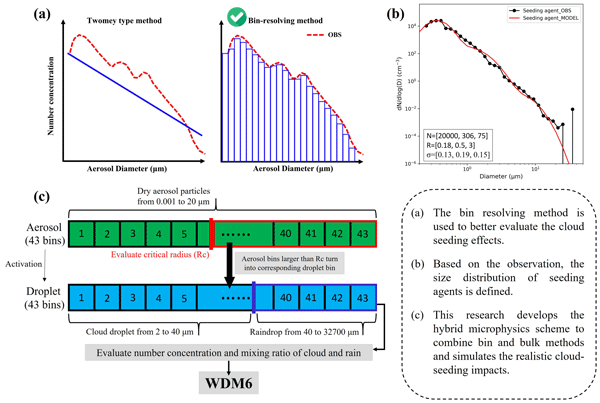
This study develops a hybrid microphysics scheme to enable the complex model simulation of cloud seeding based on observational cloud condensation nuclei size distribution. Our results show that more precipitation can be developed in the scenarios seeding in the in-cloud region, and seeding over an area of tens km2 is the most efficient strategy due to the strengthening of the accretion process. Moreover, particles bigger than 0.4 μm are the main factor contributing to cloud-seeding effects.
Ki-Hong Min, Kao-Shen Chung, Ji-Won Lee, Cheng-Rong You, and Gyuwon Lee
Geosci. Model Dev. Discuss., https://doi.org/10.5194/gmd-2022-18, https://doi.org/10.5194/gmd-2022-18, 2022
Revised manuscript not accepted
Short summary
Short summary
LETKF underestimated the water vapor mixing ratio and temperature compared to 3DVAR due to a lack of a water vapor mixing ratio and temperature observation operator. Snowfall in GWD was less simulated in LETKF. The results signify that water vapor assimilation is important in radar DA and significantly impacts precipitation forecasts, regardless of the DA method used. Therefore, it is necessary to apply observation operators for water vapor mixing ratio and temperature in radar DA.
Ying-Chieh Chen, Sheng-Hsiang Wang, Qilong Min, Sarah Lu, Pay-Liam Lin, Neng-Huei Lin, Kao-Shan Chung, and Everette Joseph
Atmos. Chem. Phys., 21, 4487–4502, https://doi.org/10.5194/acp-21-4487-2021, https://doi.org/10.5194/acp-21-4487-2021, 2021
Short summary
Short summary
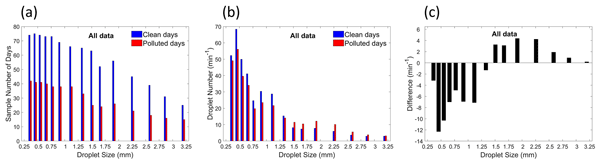
In this study, we integrate satellite and surface observations to statistically quantify aerosol impacts on low-level warm-cloud microphysics and drizzle over northern Taiwan. Our result provides observational evidence for aerosol indirect effects. The frequency of drizzle is reduced under polluted conditions. For light-precipitation events (≤ 1 mm h-1), however, higher aerosol concentrations drive raindrops toward smaller sizes and thus increase the appearance of the drizzle drops.
Kai-I Lin, Kao-Shen Chung, Sheng-Hsiang Wang, Li-Hsin Chen, Yu-Chieng Liou, Pay-Liam Lin, Wei-Yu Chang, Hsien-Jung Chiu, and Yi-Hui Chang
Atmos. Chem. Phys., 23, 10423–10438, https://doi.org/10.5194/acp-23-10423-2023, https://doi.org/10.5194/acp-23-10423-2023, 2023
Short summary
Short summary
This study develops a hybrid microphysics scheme to enable the complex model simulation of cloud seeding based on observational cloud condensation nuclei size distribution. Our results show that more precipitation can be developed in the scenarios seeding in the in-cloud region, and seeding over an area of tens km2 is the most efficient strategy due to the strengthening of the accretion process. Moreover, particles bigger than 0.4 μm are the main factor contributing to cloud-seeding effects.
Ki-Hong Min, Kao-Shen Chung, Ji-Won Lee, Cheng-Rong You, and Gyuwon Lee
Geosci. Model Dev. Discuss., https://doi.org/10.5194/gmd-2022-18, https://doi.org/10.5194/gmd-2022-18, 2022
Revised manuscript not accepted
Short summary
Short summary
LETKF underestimated the water vapor mixing ratio and temperature compared to 3DVAR due to a lack of a water vapor mixing ratio and temperature observation operator. Snowfall in GWD was less simulated in LETKF. The results signify that water vapor assimilation is important in radar DA and significantly impacts precipitation forecasts, regardless of the DA method used. Therefore, it is necessary to apply observation operators for water vapor mixing ratio and temperature in radar DA.
Ying-Chieh Chen, Sheng-Hsiang Wang, Qilong Min, Sarah Lu, Pay-Liam Lin, Neng-Huei Lin, Kao-Shan Chung, and Everette Joseph
Atmos. Chem. Phys., 21, 4487–4502, https://doi.org/10.5194/acp-21-4487-2021, https://doi.org/10.5194/acp-21-4487-2021, 2021
Short summary
Short summary
In this study, we integrate satellite and surface observations to statistically quantify aerosol impacts on low-level warm-cloud microphysics and drizzle over northern Taiwan. Our result provides observational evidence for aerosol indirect effects. The frequency of drizzle is reduced under polluted conditions. For light-precipitation events (≤ 1 mm h-1), however, higher aerosol concentrations drive raindrops toward smaller sizes and thus increase the appearance of the drizzle drops.
Cited articles
Anderson, J. L.: An ensemble adjustment Kalman filter for data assimilation, Mon. Weather Rev., 129, 2884–2903, https://doi.org/10.1175/1520-0493(2001)129<2884:AEAKFF>2.0.CO;2, 2001.
Augros, C., Caumont, O., Ducrocq, V., Gaussiat, N., and Tabary, P.: Comparisons between S-, C- and X-band polarimetric radar observations and convective-scale simulations of the HyMeX first special observing period, Q. J. Roy. Meteor. Soc., 142, 347–362, https://doi.org/10.1002/qj.2572, 2016.
Augros C., Caumont, O., Ducrocq, V., and Gaussiat, N.: Assimilation of radar dual-polarization observations in the AROME model, Q. J. Roy. Meteor. Soc., 144, 1352–1368, https://doi.org/10.1002/qj.3269, 2018.
Brandes, E. A., Zhang, G., and Vivekanandan, J.: Experiments in Rainfall Estimation with a Polarimetric Radar in a Subtropical Environment, J. Appl. Meteorol., 41, 674–685, https://doi.org/10.1175/1520-0450(2002)041<0674:EIREWA>2.0.CO;2, 2002.
Cao, Q., Zhang, G., Brandes, E., Schuur, T., Ryzhkov, A., and Ikeda, K.: Analysis of video disdrometer and polarimetric radar data to characterize rain microphysics in Oklahoma, J. Appl. Meteorol. Clim., 47, 2238–2255, https://doi.org/10.1175/2008JAMC1732.1, 2008.
Chang, S.-F., Liou, Y.-C., Sun, J., and Tai, S.-L.: The Implementation of the Ice-Phase Microphysical Process into a Four-Dimensional Variational Doppler Radar Analysis System (VDRAS) and Its Impact on Parameter Retrieval and Quantitative Precipitation Nowcasting, J. Atmos. Sci., 73, 1015–1038, https://doi.org/10.1175/jas-d-15-0184.1, 2016.
Chang, W., Chung, K.-S., Fillion, L., and Baek, S.-J.: Radar Data Assimilation in the Canadian High-Resolution Ensemble Kalman Filter System: Performance and Verification with Real Summer Cases, Mon. Weather Rev., 142, 2118–2138, https://doi.org/10.1175/MWR-D-13-00291.1, 2014.
Chung, K.-S., Zawadzki, I., Yau, M. K., and Fillion, L.: Short-Term Forecasting of a Midlatitude Convective Storm by the Assimilation of Single–Doppler Radar Observations, Mon. Weather Rev., 137, 4115–4135, https://doi.org/10.1175/2009mwr2731.1, 2009.
Dawson, D. T., Mansell, E. R., Jung, Y., Wicker, L. J., Kumjian, M. R., and Xue, M.: Low-Level ZDR Signatures in Supercell Forward Flanks: The Role of Size Sorting and Melting of Hail, J. Atmos. Sci., 71, 276–299, https://doi.org/10.1175/jas-d-13-0118.1, 2014.
Dudhia, J.: Numerical Study of Convection Observed during the Winter Monsoon Experiment Using a Mesoscale Two-Dimensional Model, J. Atmos. Sci., 46, 3077–3107, https://doi.org/10.1175/1520-0469(1989)046<3077:NSOCOD>2.0.CO;2, 1989.
Gastaldo, T., Poli, V., Marsigli, C., Cesari, D., Alberoni, P. P., and Paccagnella, T.: Assimilation of radar reflectivity volumes in a pre-operational framework, Q. J. Roy. Meteor. Soc., 147, 1031–1054, https://doi.org/10.1002/qj.3957, 2021.
Grell, G. A. and Dévényi, D.: A generalized approach to parameterizing convection combining ensemble and data assimilation techniques, Geophys, Res. Lett., 29, https://doi.org/10.1029/2002GL015311, 2002.
Hamrud, M., Bonavita, M., and Isaksen, L.: EnKF and hybrid gain ensemble data assimilation. Part I: EnKF implementation, Mon. Weather Rev., 143, 4847–4864, https://doi.org/10.1175/MWR-D-14-00333.1, 2015.
Herzegh, P. H. and Jameson, A. R.: Observing Precipitation through Dual-Polarization Radar Measurements, B. Am. Meteorol. Soc., 73, 1365–1374, https://doi.org/10.1175/1520-0477(1992)073<1365:OPTDPR>2.0.CO;2, 1992.
Hong, S.-Y., Noh, Y., and Dudhia, J.: A New Vertical Diffusion Package with an Explicit Treatment of Entrainment Processes, Mon. Weather Rev., 134, 2318–2341, https://doi.org/10.1175/MWR3199.1, 2006.
Hunt, B. R., Kostelich, E. J., and Szunyogh, I.: Efficient data assimilation for spatiotemporal chaos: A local ensemble transform Kalman filter, Physica D, 230, 112–126, https://doi.org/10.1016/j.physd.2006.11.008, 2007.
Jung, Y., Zhang, G., and Xue, M.: Assimilation of Simulated Polarimetric Radar Data for a Convective Storm Using the Ensemble Kalman Filter. Part I: Observation Operators for Reflectivity and Polarimetric Variables, Mon. Weather Rev., 136, 2228–2245, https://doi.org/10.1175/2007MWR2083.1, 2008a.
Jung, Y., Xue, M., Zhang, G., and Straka, J. M.: Assimilation of Simulated Polarimetric Radar Data for a Convective Storm Using the Ensemble Kalman Filter. Part II: Impact of Polarimetric Data on Storm Analysis, Mon. Weather Rev., 136, 2246–2260, https://doi.org/10.1175/2007MWR2288.1, 2008b.
Jung, Y., Xue, M., and Zhang, G.: Simulations of Polarimetric Radar Signatures of a Supercell Storm Using a Two-Moment Bulk Microphysics Scheme, J. Appl. Meteorol. Clim., 49, 146–163, https://doi.org/10.1175/2009JAMC2178.1, 2010.
Kawabata, T., Schwitalla, T., Adachi, A., Bauer, H.-S., Wulfmeyer, V., Nagumo, N., and Yamauchi, H.: Observational operators for dual polarimetric radars in variational data assimilation systems (PolRad VAR v1.0), Geosci. Model Dev., 11, 2493–2501, https://doi.org/10.5194/gmd-11-2493-2018, 2018.
Kumjian, M. R. and Ryzhkov, A. V.: Polarimetric Signatures in Supercell Thunderstorms, J. Appl. Meteorol. Clim., 47, 1940–1961, https://doi.org/10.1175/2007jamc1874.1, 2008.
Lee, M.-T., Lin, P.-L., Chang, W.-Y., Seela, B. K., and Janapati, J.: Microphysical characteristics and types of precipitation for different seasons over north Taiwan, J. Meteorol. Soc. Jpn., 97, 841–865, https://doi.org/10.2151/jmsj.2019-048, 2019.
Lee, J.-W., Min, K.-H., and Lee, G.-W.: Improvement of a dual-polarization radar operator for ice-phase microphysical terms, Adv. Atmos. Sci., 43, 550–564, https://doi.org/10.1007/s00376-025-4451-4, 2026.
Lim, K. S. S. and Hong, S.-Y.: Development of an Effective Double-Moment Cloud Microphysics Scheme with Prognostic Cloud Condensation Nuclei (CCN) for Weather and Climate Models, Mon. Weather Rev., 138, 1587–1612, https://doi.org/10.1175/2009MWR2968.1, 2010.
Loh, J. L., Chang, W.-Y., Hsu, H.-W., Lin, P.-F., Chang, P.-L., Teng, Y.-L., and Liou, Y.-C.: Long-term assessment of the reflectivity biases and wet-radome effect using collocated operational S- and C-band dual-polarization radars, IEEE T. Geosci. Remote, 60, 1–17, https://doi.org/10.1109/TGRS.2022.3170609, 2022.
Lupo, K. M., Torn, R. D., and Yang, S.: Evaluation of Stochastic Perturbed Parameterization Tendencies on Convective-Permitting Ensemble Forecasts of Heavy Rainfall Events in New York and Taiwan, Weather Forecast., 35, 5–24, https://doi.org/10.1175/WAF-D-19-0064.1, 2020.
Mahale, V. N., Zhang, G., Xue, M., Gao, J., and Reeves, H. D.: Variational retrieval of rain microphysics and related parameters from polarimetric radar data with a parameterized operator. J. Atmos. Ocean. Tech., 36, 2483–2500, https://doi.org/10.1175/JTECH-D-18-0212.1, 2019.
Miyoshi, T., Sato, Y., and Kadowaki, T.: Ensemble Kalman filter and 4D-Var intercomparison with the Japanese operational global analysis and prediction system, Mon. Weather Rev., 138, 2846–2866, https://doi.org/10.1175/2010MWR3209.1, 2010.
Mlawer, E. J., Taubman, S. J., Btown, P. D., Iacono, M. J., and Clough, S. A.: Radiative Transfer for Inhomogeneous Atmospheres: RRTM, a Validated Correlated-k Model for the Longwave, J. Geophys. Res., 102, 16663, https://doi.org/10.1029/97JD00237, 1997.
National Centers for Environmental Prediction, National Weather Service, NOAA, and U.S. Department of Commerce: NCEP GDAS/FNL 0.25 Degree Global Tropospheric Analyses and Forecast Grids, NSF National Center for Atmospheric Research [data set], Boulder, CO, https://doi.org/10.5065/D65Q4T4Z, 2015.
Ott, E., Hunt, B. R., Szunyogh, I., Zimin, A. V., Kostelich, E. J., Corazza, M., Kalnay, E., Patil, D. J., and Yorke, J. A.: A local ensemble Kalman filter for atmospheric data assimilation, Tellus A, 56, 415–428, https://doi.org/10.3402/tellusa.v56i5.14462, 2004.
Oue, M., Tatarevic, A., Kollias, P., Wang, D., Yu, K., and Vogelmann, A. M.: The Cloud-resolving model Radar SIMulator (CR-SIM) Version 3.3: description and applications of a virtual observatory, Geosci. Model Dev., 13, 1975–1998, https://doi.org/10.5194/gmd-13-1975-2020, 2020.
Pfeifer, M., Craig, G. C., Hagen, M., and Keil, C.: A polarimetric radar forward operator for model evaluation, J. Appl. Meteorol. Clim., 47, 3202–3220, https://doi.org/10.1175/2008JAMC1793.1, 2008.
Putnam, B., Xue, M., Jung, Y., Snook, N., and Zhang, G.: Ensemble Kalman Filter Assimilation of Polarimetric Radar Observations for the 20 May 2013 Oklahoma Tornadic Supercell Case, Mon. Weather Rev., 147, 2511–2533, https://doi.org/10.1175/MWR-D-18-0251.1, 2019.
Putnam, B. J., Jung, Y., Yussouf, N., Stratman, D., Supinie, T. A., Xue, M., Kuster, C., and Labriola, J.: The Impact of Assimilating ZDR Observations on Storm-Scale Ensemble Forecasts of the 31 May 2013 Oklahoma Storm Event, Mon. Weather Rev., 149, 1919–1942, https://doi.org/10.1175/MWR-D-20-0261.1, 2021.
Reimann, L., Simmer, C., and Trömel, S.: Assimilation of 3D polarimetric microphysical retrievals in a convective-scale NWP system, Atmos. Chem. Phys., 23, 14219–14237, https://doi.org/10.5194/acp-23-14219-2023, 2023.
Ryzhkov, A., Pinsky, M., Pokrovsky, A., and Khain, A.: Polarimetric Radar Observation Operator for a Cloud Model with Spectral Microphysics, J. Appl. Meteorol. Clim., 50, 873–894, https://doi.org/10.1175/2010JAMC2363.1, 2011.
Shrestha, P., Mendrok, J., Pejcic, V., Trömel, S., Blahak, U., and Carlin, J. T.: Evaluation of the COSMO model (v5.1) in polarimetric radar space – impact of uncertainties in model microphysics, retrievals and forward operators, Geosci. Model Dev., 15, 291–313, https://doi.org/10.5194/gmd-15-291-2022, 2022a.
Shrestha, P., Trömel, S., Evaristo, R., and Simmer, C.: Evaluation of modelled summertime convective storms using polarimetric radar observations, Atmos. Chem. Phys., 22, 7593–7618, https://doi.org/10.5194/acp-22-7593-2022, 2022b.
Snyder, C. and Zhang, F.: Assimilation of Simulated Doppler Radar Observations with an Ensemble Kalman Filter, Mon. Weather Rev., 131, 1663–1677, https://doi.org/10.1175//2555.1, 2003.
Sun, J. and Crook, N. A.: Dynamical and Microphysical Retrieval from Doppler Radar Observations Using a Cloud Model and Its Adjoint. Part I: Model Development and Simulated Data Experiments, J. Atmos. Sci., 54, 1642–1661, https://doi.org/10.1175/1520-0469(1997)054<1642:Damrfd>2.0.Co;2, 1997.
Tippett, M. K., Anderson, J. L., Bishop, C. H., Hamill, T. M., and Whitaker, J. S.: Ensemble Square Root Filters, Mon. Weather Rev., 131, 1485–1490, https://doi.org/10.1175/1520-0493(2003)131<1485:ESRF>2.0.CO;2, 2003.
Tsai, C.-C. and Chung, K.-S.: Sensitivities of Quantitative Precipitation Forecasts for Typhoon Soudelor (2015) near Landfall to Polarimetric Radar Data Assimilation, Remote Sensing, 12, 3711, https://doi.org/10.3390/rs12223711, 2020.
Tsai, C.-C., Yang, S.-C., and Liou, Y.-C.: Improving quantitative precipitation nowcasting with a local ensemble transform Kalman filter radar data assimilation system: observing system simulation experiments, Tellus A, 66, 21804, https://doi.org/10.3402/tellusa.v66.21804, 2014.
Ulbrich, C. W.: Natural Variations in the Analytical Form of the Raindrop Size Distribution, J. Appl. Meteorol. Clim., 22, 1764–1775, https://doi.org/10.1175/1520-0450(1983)022<1764:NVITAF>2.0.CO;2, 1983.
Vivekanandan, J., Adams, W. M., and Bringi, V. N.: Rigorous Approach to Polarimetric Radar Modeling of Hydrometeor Orientation Distributions, J. Appl. Meteorol. Clim., 30, 1053–1063, https://doi.org/10.1175/1520-0450(1991)030<1053:RATPRM>2.0.CO;2, 1991.
Whitaker, J. S. and Hamill, T. M.: Ensemble data assimilation without perturbed observations, Mon. Weather Rev., 130, 1913–1924, https://doi.org/10.1175/1520-0493(2002)130<1913:EDAWPO>2.0.CO;2, 2002.
Xiao, Q., Kuo, Y.-H., Sun, J., Lee, W.-C., Lim, E., Guo, Y.-R., and Barker D. M.: Assimilation of Doppler Radar Observations with a Regional 3DVAR System: Impact of Doppler Velocities on Forecasts of a Heavy Rainfall Case, J. Appl. Meteorol. Clim., 44, 768–788, https://doi.org/10.1175/jam2248.1, 2005.
You, C.-R., Chung, K.-S., and Tsai, C.-C.: Evaluating the Performance of a Convection-Permitting Model by Using Dual-Polarimetric Radar Parameters: Case Study of SoWMEX IOP8, Remote Sensing, 12, 3004, https://doi.org/10.3390/rs12183004, 2020.
Zeng, Y., Blahak, U., and Jerger, D.: An efficient modular volume-scanning radar forward operator for NWP models: description and coupling to the COSMO model, Q. J. Roy. Meteor. Soc., 142, 32343256, https://doi.org/10.1002/qj.2904, 2016.
Zhang, F., Snyder, C., and Sun, J.: Impacts of Initial Estimate and Observation Availability on Convective-Scale Data Assimilation with an Ensemble Kalman Filter, Mon. Weather Rev., 132, 1238–1253, https://doi.org/10.1175/1520-0493(2004)132<1238:IOIEAO>2.0.CO;2, 2004.
Zhang, G., Gao, J., and Du, M.: Parameterized forward operators for simulation and assimilation of polarimetric radar data with numerical weather predictions, Adv. Atmos. Sci., 38, 737–754, https://doi.org/10.1007/s00376-021-0289-6, 2021.
Zrnic, D. S. and Ryzhkov, A. V.: Polarimetry for Weather Surveillance Radars, B. Am. Meteorol. Soc., 80, 389–406, https://doi.org/10.1175/1520-0477(1999)080<0389:Pfwsr>2.0.Co;2, 1999.
Short summary
This study compares two configurations of the dual-polarization observation operator for radar data assimilation. The power-law method efficiently simulates reflectivity but may introduce a bias in differential reflectivity. The direct integration approach yields more accurate and realistic simulations of both variables, with lower residuals, making it the more proper operator for dual-pol radar data assimilation.
This study compares two configurations of the dual-polarization observation operator for radar...