Articles | Volume 19, issue 5
https://doi.org/10.5194/amt-19-1711-2026
© Author(s) 2026. This work is distributed under
the Creative Commons Attribution 4.0 License.
https://doi.org/10.5194/amt-19-1711-2026
© Author(s) 2026. This work is distributed under
the Creative Commons Attribution 4.0 License.
Monitoring and quantifying wind turbine clutter in DWD weather radar measurements

Deutscher Wetterdienst, Observatorium Hohenpeißenberg, Albin-Schwaiger-Weg 10, 82383 Hohenpeißenberg, Germany
Annette M. Boehm
Deutscher Wetterdienst, Observatorium Hohenpeißenberg, Albin-Schwaiger-Weg 10, 82383 Hohenpeißenberg, Germany
Patrick Tracksdorf
Deutscher Wetterdienst, Research and Development, Frankfurter Straße 135, 63067 Offenbach, Germany
Related authors
Paul Ockenfuß, Michael Frech, Mathias Gergely, and Stefan Kneifel
EGUsphere, https://doi.org/10.5194/egusphere-2025-4679, https://doi.org/10.5194/egusphere-2025-4679, 2025
Short summary
Short summary
The 17 operational German weather radars regularly look vertical for calibration. We proof that this data also contains valuable scientific information. To demonstrate this, we use it to detect the melting level in clouds and strong snowflake riming. Riming is the collision of a snowflake with liquid droplets, which can create precipitation. We analyze the frequency and temperature dependence of riming for all German weather radar sites and relate it to the local precipitation climatology.
Alexander Myagkov, Tatiana Nomokonova, and Michael Frech
Atmos. Meas. Tech., 18, 1621–1640, https://doi.org/10.5194/amt-18-1621-2025, https://doi.org/10.5194/amt-18-1621-2025, 2025
Short summary
Short summary
The study examines the use of the spheroidal shape approximation for calculating cloud radar observables in rain and identifies some limitations. To address these, it introduces the empirical scattering model (ESM) based on high-quality Doppler spectra from a 94 GHz radar. The ESM offers improved accuracy and directly incorporates natural rain's microphysical effects. This new model can enhance retrieval and calibration methods, benefiting cloud radar polarimetry experts and scattering modelers.
Cornelius Hald, Maximilian Schaper, Annette Böhm, Michael Frech, Jan Petersen, Bertram Lange, and Benjamin Rohrdantz
Atmos. Meas. Tech., 17, 4695–4707, https://doi.org/10.5194/amt-17-4695-2024, https://doi.org/10.5194/amt-17-4695-2024, 2024
Short summary
Short summary
Weather radars should use lightning protection to be safe from damage, but the rods can reduce the quality of the radar measurements. This study presents three new solutions for lightning protection for weather radars and evaluates their influence on data quality. The results are compared to the current system. All tested ones have very little effect on data, and a new lightning protection system with four rods is recommended for the German Meteorological Service.
Michael Frech, Cornelius Hald, Maximilian Schaper, Bertram Lange, and Benjamin Rohrdantz
Atmos. Meas. Tech., 16, 295–309, https://doi.org/10.5194/amt-16-295-2023, https://doi.org/10.5194/amt-16-295-2023, 2023
Short summary
Short summary
Weather radar data are the backbone of a lot of meteorological products. In order to obtain a better low-level coverage with radar data, additional systems have to be included. The frequency range in which radars are allowed to operate is limited. A potential radar-to-radar interference has to be avoided. The paper derives guidelines on how additional radars can be included into a C-band weather radar network and how interferences can be avoided.
Mathias Gergely, Maximilian Schaper, Matthias Toussaint, and Michael Frech
Atmos. Meas. Tech., 15, 7315–7335, https://doi.org/10.5194/amt-15-7315-2022, https://doi.org/10.5194/amt-15-7315-2022, 2022
Short summary
Short summary
This study presents the new vertically pointing birdbath scan of the German C-band radar network, which provides high-resolution profiles of precipitating clouds above all DWD weather radars since the spring of 2021. Our AI-based postprocessing method for filtering and analyzing the recorded radar data offers a unique quantitative view into a wide range of precipitation events from snowfall over stratiform rain to intense frontal showers and will be used to complement DWD's operational services.
Maximilian Schaper, Michael Frech, David Michaelis, Cornelius Hald, and Benjamin Rohrdantz
Atmos. Meas. Tech., 15, 6625–6642, https://doi.org/10.5194/amt-15-6625-2022, https://doi.org/10.5194/amt-15-6625-2022, 2022
Short summary
Short summary
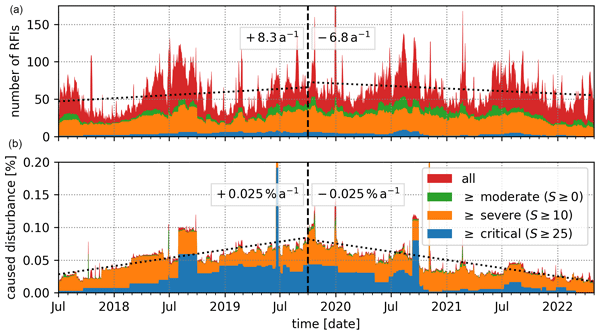
C-band weather radar data are commonly compromised by radio frequency interference (RFI) from external sources. It is not possible to separate a superimposed interference signal from the radar data. Therefore, the best course of action is to shut down RFI sources as quickly as possible. An automated RFI detection algorithm has been developed. Since its implementation, persistent RFI sources are eliminated much more quickly, while the number of short-lived RFI sources keeps steadily increasing.
Silke Trömel, Clemens Simmer, Ulrich Blahak, Armin Blanke, Sabine Doktorowski, Florian Ewald, Michael Frech, Mathias Gergely, Martin Hagen, Tijana Janjic, Heike Kalesse-Los, Stefan Kneifel, Christoph Knote, Jana Mendrok, Manuel Moser, Gregor Köcher, Kai Mühlbauer, Alexander Myagkov, Velibor Pejcic, Patric Seifert, Prabhakar Shrestha, Audrey Teisseire, Leonie von Terzi, Eleni Tetoni, Teresa Vogl, Christiane Voigt, Yuefei Zeng, Tobias Zinner, and Johannes Quaas
Atmos. Chem. Phys., 21, 17291–17314, https://doi.org/10.5194/acp-21-17291-2021, https://doi.org/10.5194/acp-21-17291-2021, 2021
Short summary
Short summary
The article introduces the ACP readership to ongoing research in Germany on cloud- and precipitation-related process information inherent in polarimetric radar measurements, outlines pathways to inform atmospheric models with radar-based information, and points to remaining challenges towards an improved fusion of radar polarimetry and atmospheric modelling.
Paul Ockenfuß, Michael Frech, Mathias Gergely, and Stefan Kneifel
EGUsphere, https://doi.org/10.5194/egusphere-2025-4679, https://doi.org/10.5194/egusphere-2025-4679, 2025
Short summary
Short summary
The 17 operational German weather radars regularly look vertical for calibration. We proof that this data also contains valuable scientific information. To demonstrate this, we use it to detect the melting level in clouds and strong snowflake riming. Riming is the collision of a snowflake with liquid droplets, which can create precipitation. We analyze the frequency and temperature dependence of riming for all German weather radar sites and relate it to the local precipitation climatology.
Alexander Myagkov, Tatiana Nomokonova, and Michael Frech
Atmos. Meas. Tech., 18, 1621–1640, https://doi.org/10.5194/amt-18-1621-2025, https://doi.org/10.5194/amt-18-1621-2025, 2025
Short summary
Short summary
The study examines the use of the spheroidal shape approximation for calculating cloud radar observables in rain and identifies some limitations. To address these, it introduces the empirical scattering model (ESM) based on high-quality Doppler spectra from a 94 GHz radar. The ESM offers improved accuracy and directly incorporates natural rain's microphysical effects. This new model can enhance retrieval and calibration methods, benefiting cloud radar polarimetry experts and scattering modelers.
Cornelius Hald, Maximilian Schaper, Annette Böhm, Michael Frech, Jan Petersen, Bertram Lange, and Benjamin Rohrdantz
Atmos. Meas. Tech., 17, 4695–4707, https://doi.org/10.5194/amt-17-4695-2024, https://doi.org/10.5194/amt-17-4695-2024, 2024
Short summary
Short summary
Weather radars should use lightning protection to be safe from damage, but the rods can reduce the quality of the radar measurements. This study presents three new solutions for lightning protection for weather radars and evaluates their influence on data quality. The results are compared to the current system. All tested ones have very little effect on data, and a new lightning protection system with four rods is recommended for the German Meteorological Service.
Michael Frech, Cornelius Hald, Maximilian Schaper, Bertram Lange, and Benjamin Rohrdantz
Atmos. Meas. Tech., 16, 295–309, https://doi.org/10.5194/amt-16-295-2023, https://doi.org/10.5194/amt-16-295-2023, 2023
Short summary
Short summary
Weather radar data are the backbone of a lot of meteorological products. In order to obtain a better low-level coverage with radar data, additional systems have to be included. The frequency range in which radars are allowed to operate is limited. A potential radar-to-radar interference has to be avoided. The paper derives guidelines on how additional radars can be included into a C-band weather radar network and how interferences can be avoided.
Mathias Gergely, Maximilian Schaper, Matthias Toussaint, and Michael Frech
Atmos. Meas. Tech., 15, 7315–7335, https://doi.org/10.5194/amt-15-7315-2022, https://doi.org/10.5194/amt-15-7315-2022, 2022
Short summary
Short summary
This study presents the new vertically pointing birdbath scan of the German C-band radar network, which provides high-resolution profiles of precipitating clouds above all DWD weather radars since the spring of 2021. Our AI-based postprocessing method for filtering and analyzing the recorded radar data offers a unique quantitative view into a wide range of precipitation events from snowfall over stratiform rain to intense frontal showers and will be used to complement DWD's operational services.
Maximilian Schaper, Michael Frech, David Michaelis, Cornelius Hald, and Benjamin Rohrdantz
Atmos. Meas. Tech., 15, 6625–6642, https://doi.org/10.5194/amt-15-6625-2022, https://doi.org/10.5194/amt-15-6625-2022, 2022
Short summary
Short summary
C-band weather radar data are commonly compromised by radio frequency interference (RFI) from external sources. It is not possible to separate a superimposed interference signal from the radar data. Therefore, the best course of action is to shut down RFI sources as quickly as possible. An automated RFI detection algorithm has been developed. Since its implementation, persistent RFI sources are eliminated much more quickly, while the number of short-lived RFI sources keeps steadily increasing.
Silke Trömel, Clemens Simmer, Ulrich Blahak, Armin Blanke, Sabine Doktorowski, Florian Ewald, Michael Frech, Mathias Gergely, Martin Hagen, Tijana Janjic, Heike Kalesse-Los, Stefan Kneifel, Christoph Knote, Jana Mendrok, Manuel Moser, Gregor Köcher, Kai Mühlbauer, Alexander Myagkov, Velibor Pejcic, Patric Seifert, Prabhakar Shrestha, Audrey Teisseire, Leonie von Terzi, Eleni Tetoni, Teresa Vogl, Christiane Voigt, Yuefei Zeng, Tobias Zinner, and Johannes Quaas
Atmos. Chem. Phys., 21, 17291–17314, https://doi.org/10.5194/acp-21-17291-2021, https://doi.org/10.5194/acp-21-17291-2021, 2021
Short summary
Short summary
The article introduces the ACP readership to ongoing research in Germany on cloud- and precipitation-related process information inherent in polarimetric radar measurements, outlines pathways to inform atmospheric models with radar-based information, and points to remaining challenges towards an improved fusion of radar polarimetry and atmospheric modelling.
Cited articles
Angulo, I., Grande, O., Jenn, D., Guerra, D., and de la Vega, D.: Estimating reflectivity values from wind turbines for analyzing the potential impact on weather radar services, Atmos. Meas. Tech., 8, 2183–2193, https://doi.org/10.5194/amt-8-2183-2015, 2015. a
Argemí, O., Pineda, N., Rigo, T., Bech, J., Fabregas, X., and Belmonte, A.: Wind turbine impact evolution and beam blockage analysis on the Weather Radar Network of the Meteorological Service of Catalonia, in: Proceedings of the 7th European Conference on Radar in Meteorology and Hydrology (ERAD 2012), Toulouse, France, 1–7, http://www.meteo.fr/cic/meetings/2012/ERAD/extended_abs/NET_013_ext_abs.pdf (last access: 23 February 2026), 2012. a
Bredemeyer, J., Schubert, K., Werner, J., Schrader, T., and Mihalachi, M.: Comparison of principles for measuring the reflectivity values from wind turbines, in: 2019 20th International Radar Symposium (IRS), Ulm, Germany, 1–10, https://doi.org/10.23919/IRS.2019.8768171, 2019. a
Bundesamt für Kartographie und Geodäsie (BKG): Digitale Geodaten TopPlusOpen, https://www.bkg.bund.de (last access: 23 February 2026), 2020. a
Fabry, F.: Radar Meteorology: Principles and Practice, Cambridge University Press, ISBN 9781108460392, https://doi.org/10.1017/CBO9781107707405, 2015. a
Frech, M., and Seltmann, J.: Assessment Wind Turbine Repowering on Radar Data Quality, 38th Conference on Radar Meteorology, AMS, https://ams.confex.com/ams/38RADAR/mediafile/Manuscript/Paper320487/ams_radar2017_frech_seltmann_WEA_4.pdf (last access: 23 February 2026), 2017. a
Frech, M., Hagen, M., and Mammen, T.: Monitoring the Absolute Calibration of a Polarimetric Weather Radar, J. Atmos. Ocean. Tech., 34, 599–615, https://doi.org/10.1175/JTECH-D-16-0076.1, 2017. a, b, c
Friedrich, K., Germann, U., and Tabary, P.: Influence of Ground Clutter Contamination on Polarimetric Radar Parameters, J. Atmos. Ocean. Tech., 26, 251–269, https://doi.org/10.1175/2008JTECHA1092.1, 2009. a
Gabella, M., Lainer, M., Wolfensberger, D., and Grazioli, J.: On the polarimetric backscatter by a still or quasi-still wind turbine, Atmos. Meas. Tech., 16, 4409–4422, https://doi.org/10.5194/amt-16-4409-2023, 2023. a
Gerhards, S. and Tracksdorf, P.: Wind Turbine Clutter detection in real-time Weather Radar Signals, developments for the DWD C-Band Weather Radar Network, in: 3rd Weather Radar Calibration and Monitoring Workshop, http://www.meteo.fr/cic/meetings/2021/wxrcalmon/ (last access: 23 February 2026), 2021. a, b
Helmus, J. and Collis, S.: pyart-1.6.0.zip, figshare [code], https://doi.org/10.6084/m9.figshare.2202553.v1, 2016a. a
Helmus, J. J. and Collis, S. M.: The Python ARM Radar Toolkit (Py-ART), a Library for Working with Weather Radar Data in the Python Programming Language, Journal of Open Research Software, 4, e25, https://doi.org/10.5334/jors.119, 2016b. a
Isom, B. M., Palmer, R. D., Secrest, G. S., Rhoton, R. D., Saxion, D., Allmon, T. L., Reed, J., Crum, T., and Vogt, R.: Detailed Observations of Wind Turbine Clutter with Scanning Weather Radars, J. Atmos. Ocean. Tech., 26, 894–910, https://doi.org/10.1175/2008JTECHA1136.1, 2009. a
Kilambi, A., Fabry, F., and Meunier, V.: A Simple and Effective Method for Separating Meteorological from Nonmeteorological Targets Using Dual-Polarization Data, J. Atmos. Ocean. Tech., 35, 1415–1424, https://doi.org/10.1175/JTECH-D-17-0175.1, 2018. a, b
Lainer, M., Figueras i Ventura, J., Schauwecker, Z., Gabella, M., F.-Bolaños, M., Pauli, R., and Grazioli, J.: Insights into wind turbine reflectivity and radar cross-section (RCS) and their variability using X-band weather radar observations, Atmos. Meas. Tech., 14, 3541–3560, https://doi.org/10.5194/amt-14-3541-2021, 2021. a
Melnikov, V. and Matrosov, S. Y.: Estimations of aspect ratios of ice cloud particles with the WSR-88D radar, in: 36rd AMS Conf. on Radar Meteorology, Breckenridge, CO, AMS, https://ams.confex.com/ams/36Radar/webprogram/Paper228291.html (last access: 23 February 2026), 2013. a
Michelson, D., Hansen, B., Jacques, D., Lemay, F., and Rodriguez, P.: Monitoring the impacts of weather radar data quality control for quantitative application at the continental scale, Meteorological Applications, 27, e1929, https://doi.org/10.1002/met.1929, 2020. a, b
Norin, L.: A quantitative analysis of the impact of wind turbines on operational Doppler weather radar data, Atmos. Meas. Tech., 8, 593–609, https://doi.org/10.5194/amt-8-593-2015, 2015. a
Norin, L.: Wind turbine impact on operational weather radar I/Q data: characterisation and filtering, Atmos. Meas. Tech., 10, 1739–1753, https://doi.org/10.5194/amt-10-1739-2017, 2017. a, b
Ośródka, K. and Szturc, J.: Improvement in algorithms for quality control of weather radar data (RADVOL-QC system), Atmos. Meas. Tech., 15, 261–277, https://doi.org/10.5194/amt-15-261-2022, 2022. a, b
Ryzhkov, A., Matrosov, S. Y., Melnikov, V., Zrnic, D., Zhang, P., Cao, Q., Knight, M., Simmer, C., and Troemel, S.: Estimation of Depolarization Ratio Using Weather Radars with Simultaneous Transmission/Reception, Journal of Applied Meteorology and Climatology, 56, 1797–1816, https://doi.org/10.1175/JAMC-D-16-0098.1, 2017. a
Seltmann, J. and Böhme, T.: Wind Turbine Issues in Germany, in: 38th Conference on Radar Meteorology, AMS, https://ams.confex.com/ams/38RADAR/mediafile/Manuscript/Paper320410/2017_AMS_38Radar_Chicago_Seltmann-Boehme.pdf (last access: 23 February 2026), 2017. a
Seltmann, J. E., Hohmann, T., Frech, M., and Tracksdorf, P.: DWD's new operational scan strategy, in: 36rd AMS Conf. on Radar Meteorology, Breckenridge, CO, https://ams.confex.com/ams/36Radar/webprogram/Paper229003.html (last access: 23 February 2026), 2013. a
Tang, L., Zhang, J., Simpson, M., Arthur, A., Grams, H., Wang, Y., and Langston, C.: Updates on the Radar Data Quality Control in the MRMS Quantitative Precipitation Estimation System, J. Atmos. Ocean. Tech., 37, 1521–1537, https://doi.org/10.1175/JTECH-D-19-0165.1, 2020. a, b
Wehner, C., Albert, J., Siegismund, J., Zschache, J., Röhl, S., and Gärtner, P.: Remote sensing derived onshore wind turbine locations for Germany, Zenodo [data set], https://doi.org/10.5281/zenodo.15835057, 2025. a
Werner, M. and Steinert, J.: New quality assurance algorithms for the DWD polarimetric C-band weather radar network, in: 7th Europ. Conf. On Radar in Meteor. and Hydrol., NET403, http://www.meteo.fr/cic/meetings/2012/ERAD/extended_abs/NET_403_ext_abs.pdf (last access: 23 February 2026), 2012a. a
Werner, M. and Steinert, J.: New quality assurance algorithms for the DWD polarimetric C-band weather radar network, in: 7th Europ. Conf. On Radar in Meteor. and Hydrol., NET403, http://www.meteo.fr/cic/meetings/2012/ERAD/extended_abs/NET_403_ext_abs.pdf (last access: 23 February 2026), 2012b. a
Wildmann, N., Hagen, M., and Gerz, T.: Enhanced resource assessment and atmospheric monitoring of the research wind farm WiValdi, Journal of Physics: Conference Series, 2265, 022029, https://doi.org/10.1088/1742-6596/2265/2/022029, 2022. a
Wilfong, T. L., Lau, E. M., Weber, B. L., Merritt, D. A., and McLaughlin, S. A.: Median filter effects on radar wind profiler spectral noise statistics, J. Atmos. Ocean. Tech., 31, 2088–2093, 2014. a
Short summary
Wind turbine clutter (WTC) reduces the accuracy of weather radar measurements, as turbines may now be built closer to radar sites. A dynamic algorithm reliably detects WTC when wind turbine rotor speeds exceed 5 rpm. Beamblockage due to WT in the 5 km range is significant. A wind turbine-free 5 km radius is recommended.
Wind turbine clutter (WTC) reduces the accuracy of weather radar measurements, as turbines may...