Articles | Volume 19, issue 5
https://doi.org/10.5194/amt-19-1825-2026
© Author(s) 2026. This work is distributed under
the Creative Commons Attribution 4.0 License.
https://doi.org/10.5194/amt-19-1825-2026
© Author(s) 2026. This work is distributed under
the Creative Commons Attribution 4.0 License.
Ground-based HF to VHF radar calibration by scattering off a stratospheric balloon

Leibniz-Institute of Atmospheric Physics at the Rostock University, Schloss-Str. 6, 18225 Kühlungsborn, Germany
Faculty of Engineering, Hochschule Wismar, University of Applied Sciences: Technology, Business and Design, 23966 Wismar, Germany
Matthias Clahsen
Leibniz-Institute of Atmospheric Physics at the Rostock University, Schloss-Str. 6, 18225 Kühlungsborn, Germany
Ralph Latteck
Leibniz-Institute of Atmospheric Physics at the Rostock University, Schloss-Str. 6, 18225 Kühlungsborn, Germany
Related authors
Yadu Krishnan Krishnakumar, Toralf Renkwitz, and Andreas Ahrens
EGUsphere, https://doi.org/10.5194/egusphere-2026-1030, https://doi.org/10.5194/egusphere-2026-1030, 2026
This preprint is open for discussion and under review for Atmospheric Chemistry and Physics (ACP).
Short summary
Short summary
We report on the observations of radar echoes at the lower HF range from the lower part of the ionosphere, near 60 km altitude. The observed echoes are actually seen below and isolated to the generally accepted lowermost ionospheric D region. For the detection of these echoes we employed machine learning techniques for the inspection of 4 years of radar raw data. We derived statistical parameters of their occurrence and hypothesize a connection for galactic cosmic rays as an ionization source
J. Federico Conte, Jorge L. Chau, Toralf Renkwitz, Ralph Latteck, Masaki Tsutsumi, Christoph Jacobi, Njål Gulbrandsen, and Satonori Nozawa
Ann. Geophys., 43, 603–619, https://doi.org/10.5194/angeo-43-603-2025, https://doi.org/10.5194/angeo-43-603-2025, 2025
Short summary
Short summary
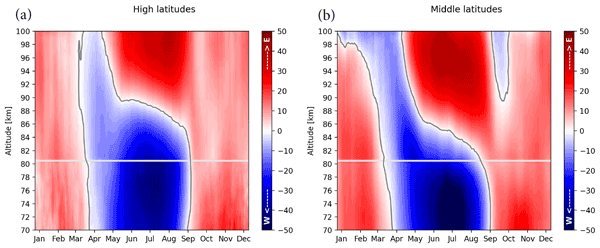
Analysis of 10 years of continuous measurements provided MMARIA/SIMONe Norway and MMARIA/SIMONe Germany reveals that the divergent and vortical motions in the mesosphere and lower thermosphere exchange the dominant role depending on the height and the time of the year. At summer mesopause altitudes over middle latitudes, the horizontal divergence and the relative vorticity contribute approximately the same, indicating an energetic balance between mesoscale divergent and vortical motions.
Devin Huyghebaert, Juha Vierinen, Björn Gustavsson, Ralph Latteck, Toralf Renkwitz, Marius Zecha, Claudia C. Stephan, J. Federico Conte, Daniel Kastinen, Johan Kero, and Jorge L. Chau
EGUsphere, https://doi.org/10.5194/egusphere-2025-2323, https://doi.org/10.5194/egusphere-2025-2323, 2025
Short summary
Short summary
The phenomena of meteors occurs at altitudes of 60–120 km and can be used to measure the neutral atmosphere. We use a large high power radar system in Norway (MAARSY) to determine changes to the atmospheric density between the years of 2016–2023 at altitudes of 85–115 km. The same day-of-year is compared, minimizing changes to the measurements due to factors other than the atmosphere. This presents a novel method by which to obtain atmospheric neutral density variations.
Christoph Jacobi, Khalil Karami, Ales Kuchar, Manfred Ern, Toralf Renkwitz, Ralph Latteck, and Jorge L. Chau
Adv. Radio Sci., 23, 21–31, https://doi.org/10.5194/ars-23-21-2025, https://doi.org/10.5194/ars-23-21-2025, 2025
Short summary
Short summary
Half-hourly mean winds have been obtained using ground-based low-frequency and very high frequency radio observations of the mesopause region at Collm, Germany, since 1984. Long-term changes of wind variances, which are proxies for short-period atmospheric gravity waves, have been analysed. Gravity wave amplitudes increase with time in winter, but mainly decrease in summer. The trends are consistent with mean wind changes according to wave theory.
Jennifer Hartisch, Jorge L. Chau, Ralph Latteck, Toralf Renkwitz, and Marius Zecha
Ann. Geophys., 42, 29–43, https://doi.org/10.5194/angeo-42-29-2024, https://doi.org/10.5194/angeo-42-29-2024, 2024
Short summary
Short summary
Scientists are studying the mesosphere and lower thermosphere using radar in northern Norway. They found peculiar events with strong upward and downward air movements, happening frequently (up to 2.5 % per month) from 2015 to 2021. Over 700 such events were noted, lasting around 20 min and expanding the studied layer. A total of 17 % of these events had extreme vertical speeds, showing their unique nature.
Christoph Jacobi, Ales Kuchar, Toralf Renkwitz, and Juliana Jaen
Adv. Radio Sci., 21, 111–121, https://doi.org/10.5194/ars-21-111-2023, https://doi.org/10.5194/ars-21-111-2023, 2023
Short summary
Short summary
Middle atmosphere long-term changes show the signature of climate change. We analyse 43 years of mesopause region horizontal winds obtained at two sites in Germany. We observe mainly positive trends of the zonal prevailing wind throughout the year, while the meridional winds tend to decrease in magnitude in both summer and winter. Furthermore, there is a change in long-term trends around the late 1990s, which is most clearly visible in summer winds.
Juliana Jaen, Toralf Renkwitz, Huixin Liu, Christoph Jacobi, Robin Wing, Aleš Kuchař, Masaki Tsutsumi, Njål Gulbrandsen, and Jorge L. Chau
Atmos. Chem. Phys., 23, 14871–14887, https://doi.org/10.5194/acp-23-14871-2023, https://doi.org/10.5194/acp-23-14871-2023, 2023
Short summary
Short summary
Investigation of winds is important to understand atmospheric dynamics. In the summer mesosphere and lower thermosphere, there are three main wind flows: the mesospheric westward, the mesopause southward (equatorward), and the lower-thermospheric eastward wind. Combining almost 2 decades of measurements from different radars, we study the trend, their interannual oscillations, and the effects of the geomagnetic activity over these wind maxima.
Toralf Renkwitz, Mani Sivakandan, Juliana Jaen, and Werner Singer
Atmos. Chem. Phys., 23, 10823–10834, https://doi.org/10.5194/acp-23-10823-2023, https://doi.org/10.5194/acp-23-10823-2023, 2023
Short summary
Short summary
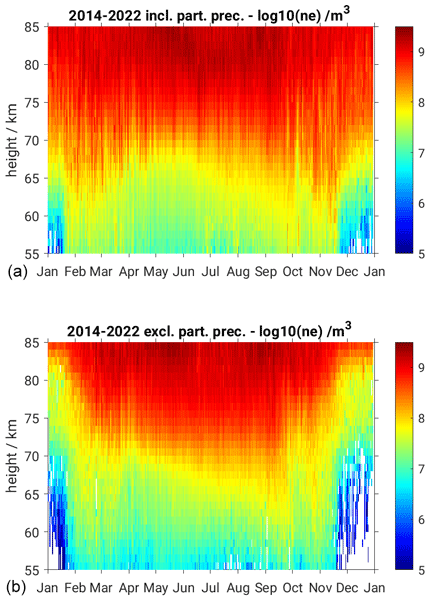
The paper focuses on remote sensing of the lowermost part of the ionosphere (D region) between ca. 50 and 90 km altitude, which overlaps widely with the mesosphere. We present a climatology of electron density over northern Norway, covering solar-maximum and solar-minimum conditions (2014–2022). Excluding detected energetic particle precipitation events, we derived a quiet-profile climatology. We also found a spring–fall asymmetry, while a symmetric solar zenith angle dependence was expected.
Juliana Jaen, Toralf Renkwitz, Jorge L. Chau, Maosheng He, Peter Hoffmann, Yosuke Yamazaki, Christoph Jacobi, Masaki Tsutsumi, Vivien Matthias, and Chris Hall
Ann. Geophys., 40, 23–35, https://doi.org/10.5194/angeo-40-23-2022, https://doi.org/10.5194/angeo-40-23-2022, 2022
Short summary
Short summary
To study long-term trends in the mesosphere and lower thermosphere (70–100 km), we established two summer length definitions and analyzed the variability over the years (2004–2020). After the analysis, we found significant trends in the summer beginning of one definition. Furthermore, we were able to extend one of the time series up to 31 years and obtained evidence of non-uniform trends and periodicities similar to those known for the quasi-biennial oscillation and El Niño–Southern Oscillation.
Yadu Krishnan Krishnakumar, Toralf Renkwitz, and Andreas Ahrens
EGUsphere, https://doi.org/10.5194/egusphere-2026-1030, https://doi.org/10.5194/egusphere-2026-1030, 2026
This preprint is open for discussion and under review for Atmospheric Chemistry and Physics (ACP).
Short summary
Short summary
We report on the observations of radar echoes at the lower HF range from the lower part of the ionosphere, near 60 km altitude. The observed echoes are actually seen below and isolated to the generally accepted lowermost ionospheric D region. For the detection of these echoes we employed machine learning techniques for the inspection of 4 years of radar raw data. We derived statistical parameters of their occurrence and hypothesize a connection for galactic cosmic rays as an ionization source
J. Federico Conte, Jorge L. Chau, Toralf Renkwitz, Ralph Latteck, Masaki Tsutsumi, Christoph Jacobi, Njål Gulbrandsen, and Satonori Nozawa
Ann. Geophys., 43, 603–619, https://doi.org/10.5194/angeo-43-603-2025, https://doi.org/10.5194/angeo-43-603-2025, 2025
Short summary
Short summary
Analysis of 10 years of continuous measurements provided MMARIA/SIMONe Norway and MMARIA/SIMONe Germany reveals that the divergent and vortical motions in the mesosphere and lower thermosphere exchange the dominant role depending on the height and the time of the year. At summer mesopause altitudes over middle latitudes, the horizontal divergence and the relative vorticity contribute approximately the same, indicating an energetic balance between mesoscale divergent and vortical motions.
Devin Huyghebaert, Juha Vierinen, Björn Gustavsson, Ralph Latteck, Toralf Renkwitz, Marius Zecha, Claudia C. Stephan, J. Federico Conte, Daniel Kastinen, Johan Kero, and Jorge L. Chau
EGUsphere, https://doi.org/10.5194/egusphere-2025-2323, https://doi.org/10.5194/egusphere-2025-2323, 2025
Short summary
Short summary
The phenomena of meteors occurs at altitudes of 60–120 km and can be used to measure the neutral atmosphere. We use a large high power radar system in Norway (MAARSY) to determine changes to the atmospheric density between the years of 2016–2023 at altitudes of 85–115 km. The same day-of-year is compared, minimizing changes to the measurements due to factors other than the atmosphere. This presents a novel method by which to obtain atmospheric neutral density variations.
Christoph Jacobi, Khalil Karami, Ales Kuchar, Manfred Ern, Toralf Renkwitz, Ralph Latteck, and Jorge L. Chau
Adv. Radio Sci., 23, 21–31, https://doi.org/10.5194/ars-23-21-2025, https://doi.org/10.5194/ars-23-21-2025, 2025
Short summary
Short summary
Half-hourly mean winds have been obtained using ground-based low-frequency and very high frequency radio observations of the mesopause region at Collm, Germany, since 1984. Long-term changes of wind variances, which are proxies for short-period atmospheric gravity waves, have been analysed. Gravity wave amplitudes increase with time in winter, but mainly decrease in summer. The trends are consistent with mean wind changes according to wave theory.
Ralph Latteck and Damian J. Murphy
Ann. Geophys., 42, 55–68, https://doi.org/10.5194/angeo-42-55-2024, https://doi.org/10.5194/angeo-42-55-2024, 2024
Short summary
Short summary
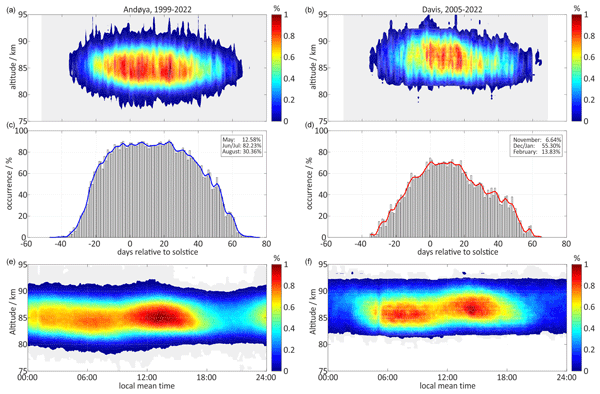
This paper gives an overview of continuous measurements of polar mesophere summer echoes (PMSE) by VHF radars at Andøya (69° N) and Davis (69° S). PMSE signal strengths are of the same order of magnitude; significantly fewer PMSE were observed in the Southern than the Northern Hemisphere. Compared to Andøya, the PMSE season over Davis starts ~7 d later and ends 9 d earlier; PMSE occur less frequently but with greater seasonal/diurnal occurrence variability, reaching higher peak altitudes.
Jennifer Hartisch, Jorge L. Chau, Ralph Latteck, Toralf Renkwitz, and Marius Zecha
Ann. Geophys., 42, 29–43, https://doi.org/10.5194/angeo-42-29-2024, https://doi.org/10.5194/angeo-42-29-2024, 2024
Short summary
Short summary
Scientists are studying the mesosphere and lower thermosphere using radar in northern Norway. They found peculiar events with strong upward and downward air movements, happening frequently (up to 2.5 % per month) from 2015 to 2021. Over 700 such events were noted, lasting around 20 min and expanding the studied layer. A total of 17 % of these events had extreme vertical speeds, showing their unique nature.
Christoph Jacobi, Ales Kuchar, Toralf Renkwitz, and Juliana Jaen
Adv. Radio Sci., 21, 111–121, https://doi.org/10.5194/ars-21-111-2023, https://doi.org/10.5194/ars-21-111-2023, 2023
Short summary
Short summary
Middle atmosphere long-term changes show the signature of climate change. We analyse 43 years of mesopause region horizontal winds obtained at two sites in Germany. We observe mainly positive trends of the zonal prevailing wind throughout the year, while the meridional winds tend to decrease in magnitude in both summer and winter. Furthermore, there is a change in long-term trends around the late 1990s, which is most clearly visible in summer winds.
Juliana Jaen, Toralf Renkwitz, Huixin Liu, Christoph Jacobi, Robin Wing, Aleš Kuchař, Masaki Tsutsumi, Njål Gulbrandsen, and Jorge L. Chau
Atmos. Chem. Phys., 23, 14871–14887, https://doi.org/10.5194/acp-23-14871-2023, https://doi.org/10.5194/acp-23-14871-2023, 2023
Short summary
Short summary
Investigation of winds is important to understand atmospheric dynamics. In the summer mesosphere and lower thermosphere, there are three main wind flows: the mesospheric westward, the mesopause southward (equatorward), and the lower-thermospheric eastward wind. Combining almost 2 decades of measurements from different radars, we study the trend, their interannual oscillations, and the effects of the geomagnetic activity over these wind maxima.
Toralf Renkwitz, Mani Sivakandan, Juliana Jaen, and Werner Singer
Atmos. Chem. Phys., 23, 10823–10834, https://doi.org/10.5194/acp-23-10823-2023, https://doi.org/10.5194/acp-23-10823-2023, 2023
Short summary
Short summary
The paper focuses on remote sensing of the lowermost part of the ionosphere (D region) between ca. 50 and 90 km altitude, which overlaps widely with the mesosphere. We present a climatology of electron density over northern Norway, covering solar-maximum and solar-minimum conditions (2014–2022). Excluding detected energetic particle precipitation events, we derived a quiet-profile climatology. We also found a spring–fall asymmetry, while a symmetric solar zenith angle dependence was expected.
Juliana Jaen, Toralf Renkwitz, Jorge L. Chau, Maosheng He, Peter Hoffmann, Yosuke Yamazaki, Christoph Jacobi, Masaki Tsutsumi, Vivien Matthias, and Chris Hall
Ann. Geophys., 40, 23–35, https://doi.org/10.5194/angeo-40-23-2022, https://doi.org/10.5194/angeo-40-23-2022, 2022
Short summary
Short summary
To study long-term trends in the mesosphere and lower thermosphere (70–100 km), we established two summer length definitions and analyzed the variability over the years (2004–2020). After the analysis, we found significant trends in the summer beginning of one definition. Furthermore, we were able to extend one of the time series up to 31 years and obtained evidence of non-uniform trends and periodicities similar to those known for the quasi-biennial oscillation and El Niño–Southern Oscillation.
Ryan Volz, Jorge L. Chau, Philip J. Erickson, Juha P. Vierinen, J. Miguel Urco, and Matthias Clahsen
Atmos. Meas. Tech., 14, 7199–7219, https://doi.org/10.5194/amt-14-7199-2021, https://doi.org/10.5194/amt-14-7199-2021, 2021
Short summary
Short summary
We introduce a new way of estimating winds in the upper atmosphere (about 80 to 100 km in altitude) from the observed Doppler shift of meteor trails using a statistical method called Gaussian process regression. Wind estimates and, critically, the uncertainty of those estimates can be evaluated smoothly (i.e., not gridded) in space and time. The effective resolution is set by provided parameters, which are limited in practice by the number density of the observed meteors.
Cited articles
Bernhardt, P. A., Siefring, C. L., Thomason, J. F., Rodriquez, S. P., Nicholas, A. C., Koss, S. M., Nurnberger, M., Hoberman, C., Davis, M., Hysell, D. L., and Kelley, M. C.: Design and applications of a versatile HF radar calibration target in low Earth orbit, Radio Sci., 43, 1–23, https://doi.org/10.1029/2007RS003692, 2008. a, b
Chau, J. L. and Clahsen, M.: Empirical Phase Calibration for Multistatic Specular Meteor Radars Using a Beamforming Approach, Radio Sci., 54, 60–71, https://doi.org/10.1029/2018RS006741, 2019. a, b
Chau, J. L., Hysell, D. L., Kuyeng, K. M., and Galindo, F. R.: Phase calibration approaches for radar interferometry and imaging configurations: equatorial spread F results, Ann. Geophys., 26, 2333–2343, https://doi.org/10.5194/angeo-26-2333-2008, 2008. a
Chau, J. L., Renkwitz, T., Stober, G., and Latteck, R.: MAARSY multiple receiver phase calibration using radio sources, J. Atmos. Sol.-Terr. Phy. 118, 55–63, https://doi.org/10.1016/j.jastp.2013.04.004, 2014. a, b
From, W. R. and Whitehead, J. D.: The calibration of an HF Radar used for ionospheric research, Radio Sci., 19, 423–428, https://doi.org/10.1029/RS019i001p00423, 1984. a
Gao, B. and Mathews, J. D.: Phase and pattern calibration of the Jicamarca Radio Observatory radar using satellites, Mon. Not. R. Astron. Soc., 446, 3416–3426, https://doi.org/10.1093/mnras/stu2177, 2014. a
Ghosh, P., Renkwitz, T., Holt, L., Tsutsumi, M., Latteck, R., and Chau, J. L.: Intermittency of Waves in the Polar Upper Troposphere and Lower Stratosphere Over Northern Norway Using MAARSY, J. Geophys. Res.-Atmos., 129, https://doi.org/10.1029/2024JD040938, 2024. a
HELIX Collaboration, Coutu, S., Allison, P. S., Baiocchi, M., Beatty, J. J., Beaufore, L., Calderon, D. H., Castano, A. G., Chen, Y., Green, N., Hanna, D., Jeon, H. B., Klein, S. B., Kunkler, B., Lang, M., Mbarek, R., McBride, K., Mognet, S. I., Musser, J., Nutter, S., OBrien, S., Park, N., Powledge, K. M., Sakai, K., Tabata, M., Tarle, G., Tuttle, J. M., Visser, G., Wakely, S. P., and Yu, M.: The High Energy Light Isotope eXperiment program of direct cosmic-ray studies, arXiv [preprint], https://doi.org/10.48550/arXiv.2312.06796, 2023. a
Holdsworth, D. A., Tsutsumi, M., Reid, I. M., Nakamura, T., and Tsuda, T.: Interferometric meteor radar phase calibration using meteor echoes, Radio Sci., 39, https://doi.org/10.1029/2003RS003026, 2004. a
Huyghebaert, D., Clahsen, M., Chau, J. L., Renkwitz, T., Latteck, R., Johnsen, M. G., and Vierinen, J.: Multiple E-Region Radar Propagation Modes Measured by the VHF SIMONe Norway System During Active Ionospheric Conditions, Frontiers in Astronomy and Space Sciences, 9, 2022, https://doi.org/10.3389/fspas.2022.886037, 2022. a
Huyghebaert, D., Vierinen, J., Kero, J., Mann, I., Latteck, R., Kastinen, D., Våden, S., and Chau, J. L.: Examining the altitude dependence of meteor head echo plasma distributions with EISCAT and MAARSY, Adv. Space Res., 76, 2280–2294, https://doi.org/10.1016/j.asr.2025.06.056, 2025. a
Latteck, R., Singer, W., Morris, R. J., Hocking, W. K., Murphy, D. J., Holdsworth, D. A., and Swarnalingam, N.: Similarities and differences in polar mesosphere summer echoes observed in the Arctic and Antarctica, Ann. Geophys., 26, 2795–2806, https://doi.org/10.5194/angeo-26-2795-2008, 2008. a
Latteck, R., Singer, W., Rapp, M., Vandepeer, B., Renkwitz, T., Zecha, M., and Stober, G.: MAARSY – The new MST radar on Andøya: System description and first results, Radio Sci., 47, RS1006, https://doi.org/10.1029/2011RS004775, 2012. a
Latteck, R., Renkwitz, T., and Chau, J. L.: Two decades of long-term observations of polar mesospheric echoes at 69° N, J. Atmos. Sol.-Terr. Ph., 105576, https://doi.org/10.1016/j.jastp.2021.105576, 2021. a, b
Mathews, J. D., Breakall, J. K., and Sulzer, M. P.: The Moon as a calibration target of convenience for VHF-UHF radar systems, Radio Sci., 23, 1–12, https://doi.org/10.1029/RS023i001p00001, 1988. a
Palmer, R. D., Vangal, S., Larsen, M. F., Fukao, S., Nakamura, T., and Yamamoto, M.: Phase calibration of VHF spatial interferometry radars using stellar sources, Radio Sci., 31, 147–156, https://doi.org/10.1029/95RS02319, 1996. a
Ponomarenko, P., St.-Maurice, J.-P., and McWilliams, K. A.: Calibrating HF Radar Elevation Angle Measurements Using E Layer Backscatter Echoes, Radio Sci., 53, 1438–1449, https://doi.org/10.1029/2018RS006638, 2018. a
Renkwitz, T.: RenkwitzAMT2026, Leibniz Institute of Atmospheric Physics at the University of Rostock [data set], https://doi.org/10.22000/ksbh1xe0bg3rn15k, 2026. a
Renkwitz, T., Singer, W., Latteck, R., Stober, G., and Rapp, M.: Validation of the radiation pattern of the Middle Atmosphere Alomar Radar System (MAARSY), Adv. Radio Sci., 10, 245–253, https://doi.org/10.5194/ars-10-245-2012, 2012. a
Renkwitz, T., Stober, G., Latteck, R., Singer, W., and Rapp, M.: New experiments to validate the radiation pattern of the Middle Atmosphere Alomar Radar System (MAARSY), Adv. Radio Sci., 11, 283–289, https://doi.org/10.5194/ars-11-283-2013, 2013. a
Renkwitz, T., Schult, C., Latteck, R., and Stober, G.: Validation of the radiation pattern of the VHF MST radar MAARSY by scattering off a sounding rocket's payload, Adv. Radio Sci., 13, 41–48, https://doi.org/10.5194/ars-13-41-2015, 2015. a
Renkwitz, T., Schult, C., and Latteck, R.: VHF antenna pattern characterization by the observation of meteor head echoes, Atmos. Meas. Tech., 10, 527–535, https://doi.org/10.5194/amt-10-527-2017, 2017. a
Renkwitz, T., Tsutsumi, M., Laskar, F. I., Chau, J. L., and Latteck, R.: On the role of anisotropic MF/HF scattering in mesospheric wind estimation, Earth Planets Space, 70, 158, https://doi.org/10.1186/s40623-018-0927-0, 2018. a, b
Renkwitz, T., Sivakandan, M., Jaen, J., and Singer, W.: Ground-based noontime D-region electron density climatology over northern Norway, Atmos. Chem. Phys., 23, 10823–10834, https://doi.org/10.5194/acp-23-10823-2023, 2023. a
Schmidt, R. O.: Multiple Emitter Location and Signal Parameter Estimation, IEEE T. Antenn. Propag., 34, 276–280, 1986. a
Schult, C., Kero, J., Stober, G., and Brown, P.: Dual frequency measurements of meteor head echoes simultaneously detected with the MAARSY and EISCAT radar systems, Icarus, 355, 114137, https://doi.org/10.1016/j.icarus.2020.114137, 2021. a
Singer, W., Latteck, R., and Holdsworth, D. A.: A new narrow beam Doppler radar at 3 MHz for studies of the high-latitude middle atmosphere, Adv. Space Res., 41, 1488–1494, https://doi.org/10.1016/j.asr.2007.10.006, 2008. a
Spargo, A. J.: Radar Measurements of Gravitiy Wave Characteristics in the MLT, Master of philosophy, The University of Adelaide, South Australia, https://doi.org/10.4225/55/59015b841b883, 2016. a
StratoCat: Balloon launches – HELIX, https://stratocat.com.ar/fichas-e/2024/KRN-20240528.htm (last access: 2 March 2026), 2023. a
Tsutsumi, M., Holdsworth, D., Nakamura, T., and Reid, I.: Meteor observations with an MF radar, Earth Planets Space, 51, 691–699, https://doi.org/10.1186/BF03353227, 1999. a
Urco, J. M., Chau, J. L., Weber, T., and Latteck, R.: Enhancing the spatiotemporal features of polar mesosphere summer echoes using coherent MIMO and radar imaging at MAARSY, Atmos. Meas. Tech., 12, 955–969, https://doi.org/10.5194/amt-12-955-2019, 2019. a
Wan, B., Wu, X., Yue, X., Zhang, L., and Wang, L.: Calibration of Phased-Array High-Frequency Radar on an Anchored Floating Platform, Remote Sens., 14, https://doi.org/10.3390/rs14092174, 2022. a
Short summary
We describe the use of a nearby drifting stratospheric balloon to calibrate three different radar systems. While for radars in the VHF range different calibration options exist, it is much more complicate to do this in the lower HF range. The main complication is the required distance and size of the target, which is especially challenging for vertical pointing radars. We also present the validation of proper phase calibration and the general radiation pattern.
We describe the use of a nearby drifting stratospheric balloon to calibrate three different...