
Articles | Volume 19, issue 6
https://doi.org/10.5194/amt-19-2149-2026
© Author(s) 2026. This work is distributed under
the Creative Commons Attribution 4.0 License.
the Creative Commons Attribution 4.0 License.
https://doi.org/10.5194/amt-19-2149-2026
© Author(s) 2026. This work is distributed under
the Creative Commons Attribution 4.0 License.
the Creative Commons Attribution 4.0 License.
Research article
| 
30 Mar 2026
Research article |
| 30 Mar 2026
| 30 Mar 2026
Lidar measurement of aircraft engine particulate emissions

ONERA, Université de Toulouse, Toulouse, France
Andrés Bedoya-Velásquez
ONERA, Université de Toulouse, Toulouse, France
Gerald Lemineur
ONERA, Université de Toulouse, Toulouse, France
Pierrick Loyers
Airbus Operations SAS, Toulouse, France
Charles Renard
Airbus Operations SAS, Toulouse, France
Katharina Seeliger
Airbus Operations SAS, Toulouse, France
Louise Ganeau
ONERA, Paris-Saclay University, 91123 Palaiseau, France
Alaric Vandestoc
ONERA, Paris-Saclay University, 91123 Palaiseau, France
Ismael Ortega
ONERA, Paris-Saclay University, 91123 Palaiseau, France
Mark Johnson
Rolls-Royce plc, Derby, United Kingdom
David Delhaye
DGAC French Civil Aviation Authority, Paris, France
Related authors
Andrés Esteban Bedoya-Velásquez, Claire Sarrat, Céline Parzani, and Romain Ceolato
EGUsphere, https://doi.org/10.5194/egusphere-2026-3056, https://doi.org/10.5194/egusphere-2026-3056, 2026
Short summary
Short summary
Aircraft condensation trails can evolve into thin ice clouds that affect how heat is trapped and reflected in the atmosphere, but their properties are difficult to measure accurately. In this study, we developed an automated method combining ground-based laser observations, and atmospheric measurements to detect these clouds and estimate their radiative properties. The method successfully characterizes thin cloud layers and supports future studies of aviation impacts on climate.
África Barreto, Francisco Quirós, Omaira E. García, Jorge Pereda-de-Pablo, Daniel González-Fernández, Andrés Bedoya-Velásquez, Michael Sicard, Carmen Córdoba-Jabonero, Marco Iarlori, Vincenzo Rizi, Nickolay Krotkov, Simon Carn, Reijo Roininen, Antonio J. Molina-Arias, A. Fernando Almansa, Óscar Álvarez-Losada, Carla Aramo, Juan José Bustos, Romain Ceolato, Adolfo Comerón, Alicia Felpeto, Rosa D. García, Pablo González-Sicilia, Yenny González, Pascal Hedelt, Miguel Hernández, María-Ángeles López-Cayuela, Diego Loyola, Stavros Meletlidis, Constantino Muñoz-Porcar, Ermanno Pietropaolo, Ramón Ramos, Alejandro Rodríguez-Gómez, Roberto Román, Pedro M. Romero-Campos, Martin Stuefer, Carlos Toledano, and Ellsworth J. Welton
Atmos. Meas. Tech., 19, 1385–1406, https://doi.org/10.5194/amt-19-1385-2026, https://doi.org/10.5194/amt-19-1385-2026, 2026
Short summary
Short summary
This manuscript describes the instrumental coverage deployed during the Tajogaite eruption (19 September–25 December 2021) by the Instituto Geográfico Nacional (IGN), the Spanish State Meteorological Agency (AEMET), and other Spanish members of ACTRIS (Aerosol, Clouds and Trace Gases Research Infrastructure) to monitor its atmospheric impact. Two complementary methods provide consistent plume height data for future operational surveillance.
Margaux Vals, Nicolas Bonne, Katharina Seeliger, Charles Renard, Raphael Märkl, Rebecca Dischl, Christiane Voigt, Ismael Ortega, Etienne Terrenoire, Daniel Sauer, Stefan Kaufmann, Andreas Marsing, Anke Roiger, and Amandine Roche
EGUsphere, https://doi.org/10.5194/egusphere-2026-4583, https://doi.org/10.5194/egusphere-2026-4583, 2026
This preprint is open for discussion and under review for Atmospheric Chemistry and Physics (ACP).
Short summary
Short summary
Contrails contribute significantly to the climate impact of aviation. Their formation depends on fuel composition, engine type and combustion regime, as well as on meteorological conditions. A microphysics code is used and confronted to recent aerosols and contrails measurements. In particular, the first comparison of data of total number of particles measured in the near-field are compared to model simulations. The model results are also compared to far-field measurement data of ice crystals.
Simon Braun, Magdalena Pühl, Andreas Marsing, Daniel Sauer, Gregor Neumann, Elena de la Torre Castro, Valerian Hahn, Michael Lichtenstern, Paul Stock, Christopher Heckl, Dennis Hillenbrand, Anke Roiger, Christiane Voigt, Simon Unterstraßer, Arne Vasenden, Roberta Vasenden, Jean Cammas, Florian Thorey, Catherine Mackay, Charles Renard, and Tina Jurkat-Witschas
EGUsphere, https://doi.org/10.5194/egusphere-2026-2887, https://doi.org/10.5194/egusphere-2026-2887, 2026
Short summary
Short summary
In this work, we share the results of first in-flight emission and contrail measurements behind a fuel cell exhaust emulator, with the goal of quantifying the contrail properties for this new aviation propulsion concept. An artificial dilution tracer system was used to assess plume dilution and derive emission indices. At ambient temperatures close to the homogeneous freezing threshold, a strong temperature-dependence of the number of contrail ice crystals, due to droplet freezing, was observed.
Andrés Esteban Bedoya-Velásquez, Claire Sarrat, Céline Parzani, and Romain Ceolato
EGUsphere, https://doi.org/10.5194/egusphere-2026-3056, https://doi.org/10.5194/egusphere-2026-3056, 2026
Short summary
Short summary
Aircraft condensation trails can evolve into thin ice clouds that affect how heat is trapped and reflected in the atmosphere, but their properties are difficult to measure accurately. In this study, we developed an automated method combining ground-based laser observations, and atmospheric measurements to detect these clouds and estimate their radiative properties. The method successfully characterizes thin cloud layers and supports future studies of aviation impacts on climate.
África Barreto, Francisco Quirós, Omaira E. García, Jorge Pereda-de-Pablo, Daniel González-Fernández, Andrés Bedoya-Velásquez, Michael Sicard, Carmen Córdoba-Jabonero, Marco Iarlori, Vincenzo Rizi, Nickolay Krotkov, Simon Carn, Reijo Roininen, Antonio J. Molina-Arias, A. Fernando Almansa, Óscar Álvarez-Losada, Carla Aramo, Juan José Bustos, Romain Ceolato, Adolfo Comerón, Alicia Felpeto, Rosa D. García, Pablo González-Sicilia, Yenny González, Pascal Hedelt, Miguel Hernández, María-Ángeles López-Cayuela, Diego Loyola, Stavros Meletlidis, Constantino Muñoz-Porcar, Ermanno Pietropaolo, Ramón Ramos, Alejandro Rodríguez-Gómez, Roberto Román, Pedro M. Romero-Campos, Martin Stuefer, Carlos Toledano, and Ellsworth J. Welton
Atmos. Meas. Tech., 19, 1385–1406, https://doi.org/10.5194/amt-19-1385-2026, https://doi.org/10.5194/amt-19-1385-2026, 2026
Short summary
Short summary
This manuscript describes the instrumental coverage deployed during the Tajogaite eruption (19 September–25 December 2021) by the Instituto Geográfico Nacional (IGN), the Spanish State Meteorological Agency (AEMET), and other Spanish members of ACTRIS (Aerosol, Clouds and Trace Gases Research Infrastructure) to monitor its atmospheric impact. Two complementary methods provide consistent plume height data for future operational surveillance.
Gregor Neumann, Andreas Marsing, Theresa Harlass, Daniel Sauer, Simon Braun, Magdalena Pühl, Christopher Heckl, Paul Stock, Elena De La Torre Castro, Valerian Hahn, Anke Roiger, Christiane Voigt, Simon Unterstraßer, Jean Cammas, Charles Renard, Roberta Vasenden, Arnold Vasenden, and Tina Jurkat-Witschas
Atmos. Meas. Tech., 18, 6795–6816, https://doi.org/10.5194/amt-18-6795-2025, https://doi.org/10.5194/amt-18-6795-2025, 2025
Short summary
Short summary
This study presents the first successful in-flight emission characterization of a turboprop engine using a fully autonomous airborne measurement platform, offering new insights into the atmospheric impacts of regional aviation. By equipping the high-altitude Grob G 520 Egrett with a suite of custom and modified commercial instruments, we demonstrate precise, high-resolution measurements of aerosol particles, trace gases, and contrail ice in the engine exhaust plume at cruise altitudes.
Theresa Harlass, Rebecca Dischl, Stefan Kaufmann, Raphael Märkl, Daniel Sauer, Monika Scheibe, Paul Stock, Tiziana Bräuer, Andreas Dörnbrack, Anke Roiger, Hans Schlager, Ulrich Schumann, Magdalena Pühl, Tobias Schripp, Tobias Grein, Linda Bondorf, Charles Renard, Maxime Gauthier, Mark Johnson, Darren Luff, Paul Madden, Peter Swann, Denise Ahrens, Reetu Sallinen, and Christiane Voigt
Atmos. Chem. Phys., 24, 11807–11822, https://doi.org/10.5194/acp-24-11807-2024, https://doi.org/10.5194/acp-24-11807-2024, 2024
Short summary
Short summary
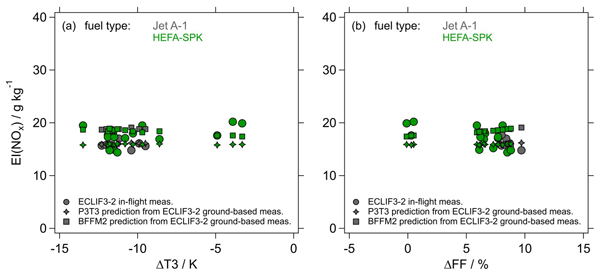
Emissions from aircraft have a direct impact on our climate. Here, we present airborne and ground-based measurement data of nitrogen oxides that were collected in the exhaust of an Airbus aircraft. We study the impact of burning fossil and sustainable aviation fuel on nitrogen oxide emissions at different engine settings related to combustor temperature, pressure and fuel flow. Further, we compare observations with engine emission models.
Rebecca Dischl, Daniel Sauer, Christiane Voigt, Theresa Harlaß, Felicitas Sakellariou, Raphael Märkl, Ulrich Schumann, Monika Scheibe, Stefan Kaufmann, Anke Roiger, Andreas Dörnbrack, Charles Renard, Maxime Gauthier, Peter Swann, Paul Madden, Darren Luff, Mark Johnson, Denise Ahrens, Reetu Sallinen, Tobias Schripp, Georg Eckel, Uwe Bauder, and Patrick Le Clercq
Atmos. Chem. Phys., 24, 11255–11273, https://doi.org/10.5194/acp-24-11255-2024, https://doi.org/10.5194/acp-24-11255-2024, 2024
Short summary
Short summary
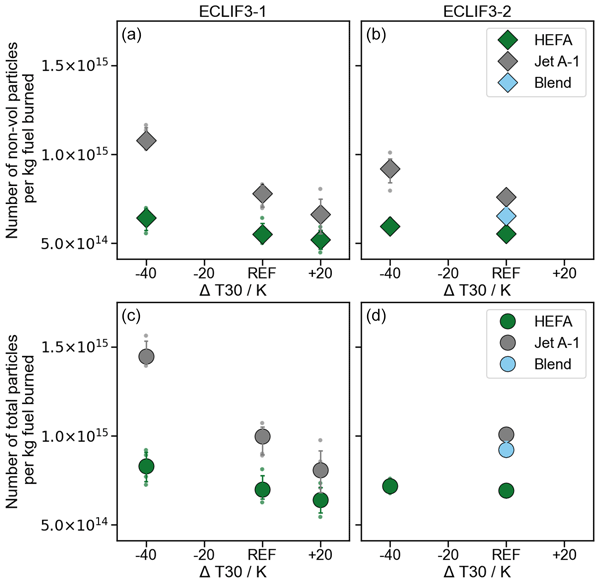
In-flight measurements of aircraft emissions burning 100 % sustainable aviation fuel (SAF) show reduced particle number concentrations up to 41 % compared to conventional jet fuel. Particle emissions are dependent on engine power setting, flight altitude, and fuel composition. Engine models show a good correlation with measurement results. Future increased prevalence of SAF can positively influence the climate impact of aviation.
Timothy A. Sipkens, Joel C. Corbin, Brett Smith, Stéphanie Gagné, Prem Lobo, Benjamin T. Brem, Mark P. Johnson, and Gregory J. Smallwood
Atmos. Meas. Tech., 17, 4291–4302, https://doi.org/10.5194/amt-17-4291-2024, https://doi.org/10.5194/amt-17-4291-2024, 2024
Short summary
Short summary
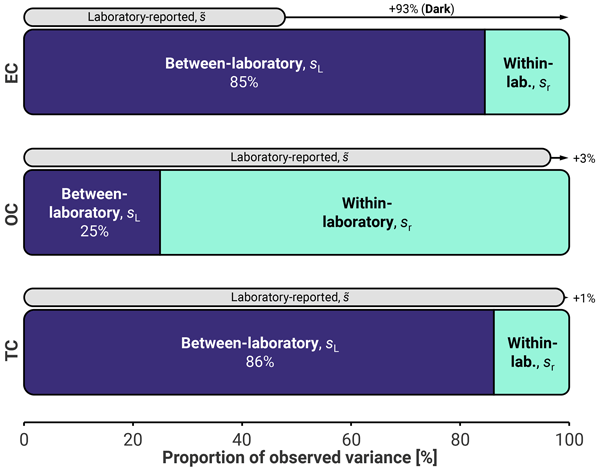
Carbonaceous particles, such as soot, contribute to climate forcing, air pollution, and human health impacts. Thermal–optical analysis is a calibration standard used to measure these particles, but significant differences have been observed in the measurements across identical instruments. We report on the reproducibility of these measurements for aircraft emissions, which range from 8.0 % of the nominal value for organic carbon to 17 % for elemental carbon.
Raphael Satoru Märkl, Christiane Voigt, Daniel Sauer, Rebecca Katharina Dischl, Stefan Kaufmann, Theresa Harlaß, Valerian Hahn, Anke Roiger, Cornelius Weiß-Rehm, Ulrike Burkhardt, Ulrich Schumann, Andreas Marsing, Monika Scheibe, Andreas Dörnbrack, Charles Renard, Maxime Gauthier, Peter Swann, Paul Madden, Darren Luff, Reetu Sallinen, Tobias Schripp, and Patrick Le Clercq
Atmos. Chem. Phys., 24, 3813–3837, https://doi.org/10.5194/acp-24-3813-2024, https://doi.org/10.5194/acp-24-3813-2024, 2024
Short summary
Short summary
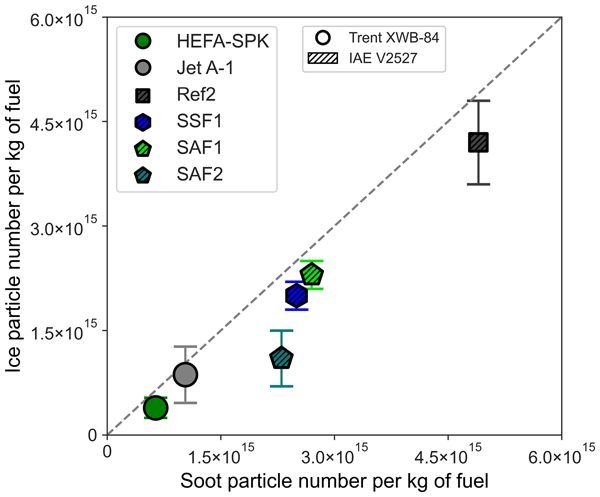
In situ measurements of contrails from a large passenger aircraft burning 100 % sustainable aviation fuel (SAF) show a 56 % reduction in contrail ice crystal numbers compared to conventional Jet A-1. Results from a climate model initialized with the observations suggest a significant decrease in radiative forcing from contrails. Our study confirms that future increased use of low aromatic SAF can reduce the climate impact from aviation.

Ruoyang Yuan, Prem Lobo, Greg J. Smallwood, Mark P. Johnson, Matthew C. Parker, Daniel Butcher, and Adrian Spencer
Atmos. Meas. Tech., 15, 241–259, https://doi.org/10.5194/amt-15-241-2022, https://doi.org/10.5194/amt-15-241-2022, 2022
Short summary
Short summary
The relationship between the non-volatile particulate matter (nvPM) mass emissions produced by different engine sources and the response of the LII 300 instrument, used for regulatory measurements of nvPM mass emissions in aircraft engine certification tests, was investigated for different sources and operating conditions. Laser fluence optimisation was required for real-time nvPM mass concentration measurements. These results will inform the development of updated calibration protocols.
Cited articles
Aamaas, B., Lund, M. T., Fuglestvedt, J. S., Totterdill, A., Owen, B., Skowron, A., and Lee, D. S.: Continued global warming from aviation even under high-ambition mitigation scenarios, One Earth, 8, 101451, https://doi.org/10.1016/j.oneear.2025.101451, 2025. a
Bedoya-Velásquez, A. E., Ceolato, R., Titos, G., Bravo-Aranda, J. A., Casans, A., Patrón, D., Fernández-Carvelo, S., Guerrero-Rascado, J. L., and Alados-Arboledas, L.: Synergy between Short-Range Lidar and In Situ Instruments for Determining the Atmospheric Boundary Layer Lidar Ratio, Remote Sensing, 16, https://doi.org/10.3390/rs16091583, 2024. a
Biavati, G., Di Donfrancesco, G., Cairo, F., and Feist, D. G.: Correction scheme for close-range lidar returns, Appl. Optics, 50, 5872–5882, https://doi.org/10.1364/AO.50.005872, 2011. a
Ceolato, R. and Berg, M. J.: Aerosol light extinction and backscattering: A review with a lidar perspective, J. Quant. Spectrosc. Ra., 262, 107492, https://doi.org/10.1016/j.jqsrt.2020.107492, 2021. a, b
Ceolato, R., Bedoya-Velásquez, A. E., and Mouysset, V.: Short-Range Elastic Backscatter Micro-Lidar for Quantitative Aerosol Profiling with High Range and Temporal Resolution, Remote Sensing, 12, https://doi.org/10.3390/rs12203286, 2020. a, b
Ceolato, R., Bedoya-Velasquez, A., Fossard, F., Mouysset, V., Paulien, L., Lefebvre, S., Mazzoleni, C., Sorensen, C., Berg, M., and Yon, J.: Black carbon aerosol number and mass concentration measurements by picosecond short-range elastic backscatter lidar, Scientific Reports, 12, 8443, https://doi.org/10.1038/s41598-022-11954-7, 2022. a, b
Ceolato, R., Yon, J., and Berg, M. J.: Lidar backscattering model for soot aerosols, J. Quant. Spectrosc. Ra., 345, 109532, https://doi.org/10.1016/j.jqsrt.2025.109532, 2025. a
Delhaye, D., Ouf, F.-X., Ferry, D., Ortega, I. K., Penanhoat, O., Peillon, S., Salm, F., Vancassel, X., Focsa, C., Irimiea, C., Harivel, N., Perez, B., Quinton, E., Yon, J., and Gaffie, D.: The MERMOSE project: Characterization of particulate matter emissions of a commercial aircraft engine, J. Aerosol Sci., 105, 48–63, https://doi.org/10.1016/j.jaerosci.2016.11.018, 2017. a
Dho, S. W., Park, Y. J., and Kong, H. J.: Experimental determination of a geometric form factor in a lidar equation for an inhomogeneous atmosphere, Appl. Optics, 36, https://doi.org/10.1364/ao.36.006009, 1997. a
Digby, R. A. R., von Salzen, K., Monahan, A. H., Gillett, N. P., and Li, J.: The impact of uncertainty in black carbon's refractive index on simulated optical depth and radiative forcing, Atmos. Chem. Phys., 25, 3109–3130, https://doi.org/10.5194/acp-25-3109-2025, 2025. a
Dobbins, R. A. and Megaridis, C. M.: Absorption and scattering of light by polydisperse aggregates, Appl. Optics., 30, 4747–4754, https://doi.org/10.1364/AO.30.004747, 1991. a
Durand, E., Durdina, L., Smallwood, G., Johnson, M., Spirig, C., Edebeli, J., Roth, M., Brem, B., Sevcenco, Y., and Crayford, A.: Correction for particle loss in a regulatory aviation nvPM emissions system using measured particle size, J. Aerosol Sci., 169, 106140, https://doi.org/10.1016/j.jaerosci.2023.106140, 2023. a
Durdina, L., Brem, B., Abegglen, M., Lobo, P., Rindlisbacher, T., Thomson, K., Smallwood, G., Hagen, D., Sierau, B., and Wang, J.: Determination of PM mass emissions from an aircraft turbine engine using particle effective density, Atmos. Environ., 99, 500–507, https://doi.org/10.1016/j.atmosenv.2014.10.018, 2014. a, b
Durdina, L., Brem, B. T., Elser, M., Schönenberger, D., Siegerist, F., and Anet, J. G.: Reduction of Nonvolatile Particulate Matter Emissions of a Commercial Turbofan Engine at the Ground Level from the Use of a Sustainable Aviation Fuel Blend, Environ. Sci. Technol., 55, 14576–14585, https://doi.org/10.1021/acs.est.1c04744, 2021. a
Fushimi, A., Saitoh, K., Fujitani, Y., and Takegawa, N.: Identification of jet lubrication oil as a major component of aircraft exhaust nanoparticles, Atmos. Chem. Phys., 19, 6389–6399, https://doi.org/10.5194/acp-19-6389-2019, 2019. a
Guerrero-Rascado, J. L., Costa, M. J., Bortoli, D., Silva, A. M., Lyamani, H., and Alados-Arboledas, L.: Infrared lidar overlap function: an experimental determination, Opt. Express, 18, 20350–20369, https://doi.org/10.1364/OE.18.020350, 2010. a
Halldórsson, T. and Langerholc, J.: Geometrical form factors for the lidar function, Appl. Optics, 17, https://doi.org/10.1364/ao.17.000240, 1978. a
Harms, J.: Lidar return signals for coaxial and noncoaxial systems with central obstruction, Appl. Optics, 18, 1559–66, https://doi.org/10.1364/AO.18.001559, 1979. a
International Civil Aviation Organization: ICAO Aircraft Engine Emissions Databank, https://www.easa.europa.eu/en/domains/environment/icao-aircraft-engine-emissions-databank (last access: 1 February 2025), 2025. a
Ishimoto, H., Kudo, R., and Adachi, K.: A shape model of internally mixed soot particles derived from artificial surface tension, Atmos. Meas. Tech., 12, 107–118, https://doi.org/10.5194/amt-12-107-2019, 2019. a
Jones, S. H. and Miake-Lye, R. C.: Parameterization of H2SO4 and organic contributions to volatile PM in aircraft plumes at ground idle, J. Air Waste Manage., 74, 490–510, https://doi.org/10.1080/10962247.2024.2354820, 2024. a
Kanngiesser, F. and Kahnert, M.: Coating material-dependent differences in modelled lidar-measurable quantities for heavily coated soot particles, Opt. Express, 27, 36368–36387, https://doi.org/10.1364/OE.27.036368, 2019. a
Klöwer, M., Allen, M. R., Lee, D. S., Proud, S. R., Gallagher, L., and Skowron, A.: Quantifying aviation’s contribution to global warming, Environ. Res. Lett., 16, 104027, https://doi.org/10.1088/1748-9326/ac286e, 2021. a
Kumal, R. R., Liu, J., Gharpure, A., Vander Wal, R. L., Kinsey, J. S., Giannelli, B., Stevens, J., Leggett, C., Howard, R., Forde, M., Zelenyuk, A., Suski, K., Payne, G., Manin, J., Bachalo, W., Frazee, R., Onasch, T. B., Freedman, A., Kittelson, D. B., and Swanson, J. J.: Impact of Biofuel Blends on Black Carbon Emissions from a Gas Turbine Engine, Energ. Fuel., 34, 4958–4966, https://doi.org/10.1021/acs.energyfuels.0c00094, 2020. a
Lee, D. S., Allen, M. R., Cumpsty, N., Owen, B., Shine, K. P., and Skowron, A.: Uncertainties in mitigating aviation non-CO2 emissions for climate and air quality using hydrocarbon fuels, Environ. Sci.: Atmos., 3, 1693–1740, https://doi.org/10.1039/D3EA00091E, 2023. a
Li, J., Li, C., Zhao, Y., Li, J., and Chu, Y.: Geometrical constraint experimental determination of Raman lidar overlap profile, Appl. Optics, 55, 4924–4928, https://doi.org/10.1364/AO.55.004924, 2016. a
Liu, F., Yon, J., Fuentes, A., Lobo, P., Smallwood, G. J., and Corbin, J. C.: Review of recent literature on the light absorption properties of black carbon: Refractive index, mass absorption cross section, and absorption function, Aerosol Sci. Tech., 54, 33–51, https://doi.org/10.1080/02786826.2019.1676878, 2020. a
Liu, L. and Mishchenko, M. I.: Spectrally dependent linear depolarization and lidar ratios for nonspherical smoke aerosols, J. Quant. Spectrosc. Ra., 248, 106953, https://doi.org/10.1016/j.jqsrt.2020.106953, 2020. a
Marhaba, I., Ferry, D., Laffon, C., Regier, T. Z., Ouf, F.-X., and Parent, P.: Aircraft and MiniCAST soot at the nanoscale, Combust. Flame, 204, 278–289, https://doi.org/10.1016/j.combustflame.2019.03.018, 2019. a, b
Measures, R. M.: Laser remote sensing: Fundamentals and applications, New York, Wiley-Interscience, 1984. a
Mishchenko, M. I., Travis, L. D., and Lacis, A. A.: Scattering, absorption, and emission of light by small particles, Cambridge University Press, 2002. a
Moteki, N., Ohata, S., Yoshida, A., and Adachi, K.: Constraining the complex refractive index of black carbon particles using the complex forward-scattering amplitude, Aerosol Sci. Tech., 57, 678–699, https://doi.org/10.1080/02786826.2023.2202243, 2023. a
Qin, Z., Wang, H., He, A., Sun, Y., Li, J., Zhang, Y., and Zhang, Q.: Backscattering Linear Depolarization Ratio of Smoke Aerosols From Biomass Burning, J. Geophys. Res.-Atmos., 129, e2024JD041276, https://doi.org/10.1029/2024JD041276, 2024. a
SAE International: Procedure for the Continuous Sampling and Measurement of Non-Volatile Particulate Matter Emissions from Aircraft Turbine Engines, Aerospace Recommended Practice ARP6320, SAE International, https://doi.org/10.4271/ARP6320, 2018. a
SAE International: Procedure for the Calculation of Non-Volatile Particulate Matter Sampling and Measurement System Losses and System Loss Correction Factors, Aerospace Recommended Practice ARP6481, SAE International, https://doi.org/10.4271/ARP6481, 2019. a
Sasano, Y., Shimizu, H., Takeuchi, N., and Okuda, M.: Geometrical form factor in the laser radar equation: an experimental determination, Appl. Optics, 18, 3908–10, https://doi.org/10.1364/AO.18.003908, 1979. a
Smith, A. J. A., Peters, D. M., McPheat, R., Lukanihins, S., and Grainger, R. G.: Measuring black carbon spectral extinction in the visible and infrared, J. Geophys. Res.-Atmos., 120, 9670–9683, https://doi.org/10.1002/2015JD023564, 2015. a
Sorensen, C. M.: Light Scattering by Fractal Aggregates: A Review, Aerosol Sci. Tech., 35, 648–687, https://doi.org/10.1080/02786820117868, 2001. a, b
Teoh, R., Stettler, M. E., Majumdar, A., Schumann, U., Graves, B., and Boies, A. M.: A methodology to relate black carbon particle number and mass emissions, J. Aerosol Sci., 132, 44–59, https://doi.org/10.1016/j.jaerosci.2019.03.006, 2019. a
Trivanovic, U., Kelesidis, G. A., and Pratsinis, S. E.: High-throughput generation of aircraft-like soot, Aerosol Sci. Tech., 56, 732–743, https://doi.org/10.1080/02786826.2022.2070055, 2022. a
Ungeheuer, F., van Pinxteren, D., and Vogel, A. L.: Identification and source attribution of organic compounds in ultrafine particles near Frankfurt International Airport, Atmos. Chem. Phys., 21, 3763–3775, https://doi.org/10.5194/acp-21-3763-2021, 2021. a
Vande Hey, J., Coupland, J., Foo, M. H., Richards, J., and Sandford, A.: Determination of overlap in lidar systems, Appl. Optics, 50, 5791–5797, https://doi.org/10.1364/AO.50.005791, 2011. a
Wandinger, U. and Ansmann, A.: Experimental determination of the lidar overlap profile with Raman lidar, Appl. Optics, 41, 511–514, https://doi.org/10.1364/ao.41.000511, 2002. a
Yu, F., Kärcher, B., and Anderson, B. E.: Revisiting Contrail Ice Formation: Impact of Primary Soot Particle Sizes and Contribution of Volatile Particles, Environ. Sci. Technol., 58, 17650–17660, https://doi.org/10.1021/acs.est.4c04340, 2024. a, b
Yu, Z., Herndon, S. C., Ziemba, L. D., Timko, M. T., Liscinsky, D. S., Anderson, B. E., and Miake-Lye, R. C.: Identification of Lubrication Oil in the Particulate Matter Emissions from Engine Exhaust of In-Service Commercial Aircraft, Environ. Sci. Technol., 46, 9630–9637, https://doi.org/10.1021/es301692t, 2012. a
Short summary
We developed a new way to measure ultrafine particles released by aircraft engines using an aerosol lidar sensor. This method allows us to quickly check emissions from a distance, without needing to collect samples directly from the engines. Our results show that this approach works well and could help airports and regulators better monitor air quality and reduce the environmental impact of aviation.
We developed a new way to measure ultrafine particles released by aircraft engines using an...


