Articles | Volume 19, issue 10
https://doi.org/10.5194/amt-19-3557-2026
© Author(s) 2026. This work is distributed under
the Creative Commons Attribution 4.0 License.
https://doi.org/10.5194/amt-19-3557-2026
© Author(s) 2026. This work is distributed under
the Creative Commons Attribution 4.0 License.
Correction and calibration protocol for isotope data via CRDS: a study case for N2O and other isotope systems

Julius C. Havsteen
CORRESPONDING AUTHOR
Empa, Laboratory for Air Pollution/Environmental Technology, Dübendorf, Switzerland
Mehr Fatima
VTT Technical Research Centre of Finland Ltd, Espoo, Finland
Simone Brunamonti
Empa, Laboratory for Air Pollution/Environmental Technology, Dübendorf, Switzerland
Andrea Pogány
Physikalisch-Technische Bundesanstalt, Braunschweig, Germany
Thomas Hausmaninger
VTT Technical Research Centre of Finland Ltd, Espoo, Finland
Benjamin Wolf
Karlsruhe Institute of Technology (KIT), Institute of Meteorology and Climate Research, Atmospheric Environmental Research (IMK-IFU), Garmisch-Partenkirchen, Germany
Reinhard Well
Thünen Institute of Climate-Smart Agriculture, Braunschweig, Germany
Empa, Laboratory for Air Pollution/Environmental Technology, Dübendorf, Switzerland
Related authors
No articles found.
Noémy Chénier, Paul M. Magyar, Jakob Zopfi, Claudia Frey, Thomas Kuhn, Moritz F. Lehmann, and Joachim Mohn
EGUsphere, https://doi.org/10.5194/egusphere-2026-1824, https://doi.org/10.5194/egusphere-2026-1824, 2026
This preprint is open for discussion and under review for Biogeosciences (BG).
Short summary
Short summary
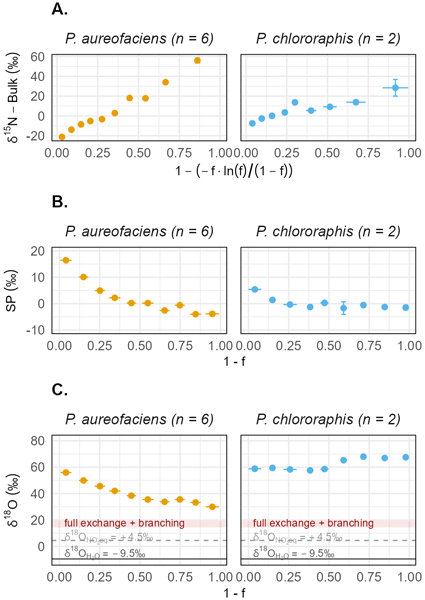
N₂O is a greenhouse gas produced by microbes during nitrogen cycling. We studied two bacterial species and found that the isotope signatures of the N₂O they produced changed strongly depending on growth conditions and cell activity. Early during growth, the distribution of N isotopes within the N₂O molecule also changed unexpectedly. These results show that N₂O isotope signatures are more variable than previously assumed and depend strongly on physiology.
Paul M. Magyar, Nico Kueter, Simone Brunamonti, Naizhong Zhang, Ivan Prokhorov, Noémy Chénier, Lukas Emmenegger, Béla Tuzson, and Joachim Mohn
EGUsphere, https://doi.org/10.5194/egusphere-2026-874, https://doi.org/10.5194/egusphere-2026-874, 2026
This preprint is open for discussion and under review for Atmospheric Measurement Techniques (AMT).
Short summary
Short summary
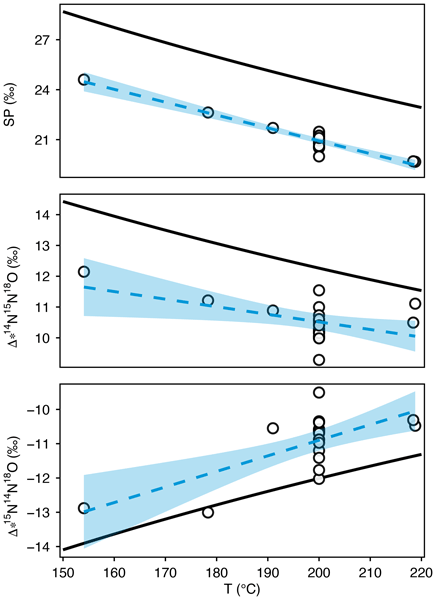
Human activity drives increases in atmospheric nitrous oxide. Stable isotopes help trace the pathways involved. We developed a reliable way to calibrate measurements of rare isotopic variants of nitrous oxide so results from different labs can be compared. By heating nitrous oxide with a catalyst, the molecules reach well-defined equilibrium patterns suitable as a reference. To measure these isotopic variants quickly and precisely, we improved a laser-based measurement approach.
Hannes Keck, Laurence Strubbe, Paul M. Magyar, Adriano Joss, Andreas Froemelt, André Kupferschmid, Klaus-Holger Knorr, and Joachim Mohn
EGUsphere, https://doi.org/10.5194/egusphere-2026-857, https://doi.org/10.5194/egusphere-2026-857, 2026
This preprint is open for discussion and under review for Atmospheric Measurement Techniques (AMT).
Short summary
Short summary
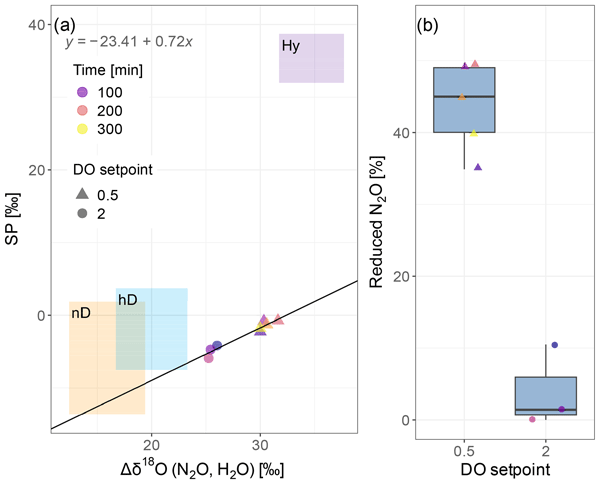
We monitored nitrous oxide in a pilot wastewater treatment plant in real time to understand how microbes produce and remove this greenhouse gas. We designed and tested a laser-based analytical setup, with which we were able to show that denitrification is the main source of nitrous oxide emissions and that low oxygen concentrations enhances nitrous oxide removal. Our approach offers a new way to monitor the wastewater treatment processes and to cut climate-relevant nitrous oxide emissions.
Samin Payrosangari, Kathrin Fuchs, Benjamin Wolf, Ralf Kiese, and Clemens Scheer
EGUsphere, https://doi.org/10.5194/egusphere-2025-5155, https://doi.org/10.5194/egusphere-2025-5155, 2025
Short summary
Short summary
In our manuscript, we implement a machine learning based model to improve the simulation of daily N2O emissions at regional scale across several pre-alpine grasslands in Central Europe. The study focuses on evaluating the model’s general applicability to other grasslands in the region. This work contributes to the development of generic N₂O emission models, thereby reducing the effort required to estimate emissions from sites lacking direct measurements.
Simone Brunamonti, Harald Saathoff, Albert Hertzog, Glenn Diskin, Masatomo Fujiwara, Karen Rosenlof, Ottmar Möhler, Béla Tuzson, Lukas Emmenegger, Nadir Amarouche, Georges Durry, Fabien Frérot, Jean-Christophe Samake, Claire Cenac, Julio Lopez, Paul Monnier, and Mélanie Ghysels
Atmos. Meas. Tech., 18, 5321–5348, https://doi.org/10.5194/amt-18-5321-2025, https://doi.org/10.5194/amt-18-5321-2025, 2025
Short summary
Short summary
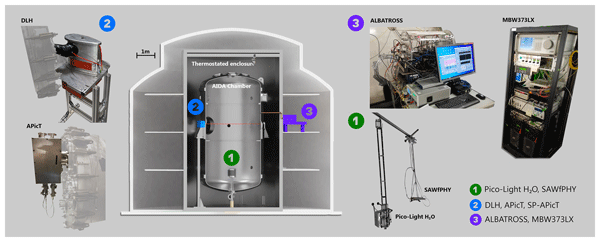
Water vapor is a strong greenhouse gas, and accurate measurements of its concentration in the upper atmosphere (~8–25 km altitude) are crucial for reliable climate predictions. We investigated the performance of four airborne hygrometers, deployed on aircraft or stratospheric balloon platforms and based on different techniques, in a climate simulation chamber. The results demonstrate the high accuracy and reliability of the involved sensors for atmospheric monitoring and research applications.
Sushmita Deb, Mikk Espenberg, Reinhard Well, Michał Bucha, Marta Jakubiak, Ülo Mander, Mariusz-Orion Jędrysek, and Dominika Lewicka-Szczebak
Biogeosciences, 22, 5535–5556, https://doi.org/10.5194/bg-22-5535-2025, https://doi.org/10.5194/bg-22-5535-2025, 2025
Short summary
Short summary
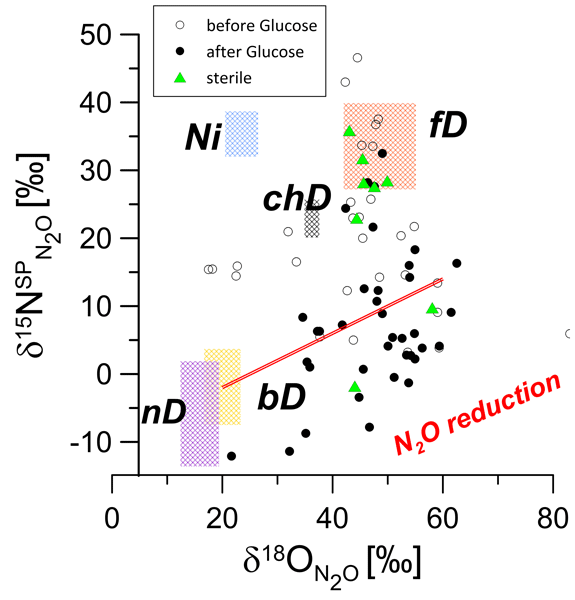
This study investigates nitrogen cycling in groundwater from an agricultural area using organic fertilizer. The research combines isotope and microbial studies to track transformations. High-nitrate samples were incubated with a low addition of 15N tracer. Results showed a shift from archaeal nitrification to bacterial denitrification under low oxygen with glucose, confirmed by isotope and microbial analyses. The findings offer insights for improving water quality and pollution management.
Fawad Khan, Samuel Franco Luesma, Frederik Hartmann, Michael Dannenmann, Rainer Gasche, Clemens Scheer, Andreas Gattinger, Wiebke Niether, Elizabeth Gachibu Wangari, Ricky Mwangada Mwanake, Ralf Kiese, and Benjamin Wolf
Biogeosciences, 22, 5081–5102, https://doi.org/10.5194/bg-22-5081-2025, https://doi.org/10.5194/bg-22-5081-2025, 2025
Short summary
Short summary
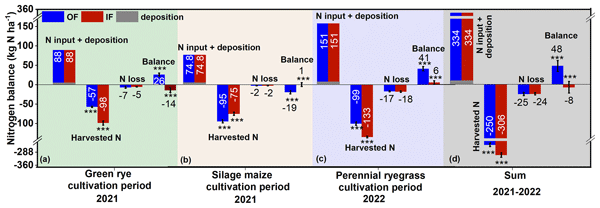
Crop rotations with legumes and use of organic and mineral fertilizers show potential to reduce agricultural N losses. This study examined N losses, including direct N2 flux, on two adjacent sites with different management histories: organic farming (OF) with legume cultivation and integrated farming (IF) using synthetic and organic N inputs. IF increased soil organic carbon and nitrogen content and 15N recovery and showed a balanced N budget (i.e. more efficient N cycling compared to OF).
Samuel Franco-Luesma, María Alonso-Ayuso, Benjamin Wolf, Borja Latorre, and Jorge Álvaro-Fuentes
SOIL, 11, 523–533, https://doi.org/10.5194/soil-11-523-2025, https://doi.org/10.5194/soil-11-523-2025, 2025
Short summary
Short summary
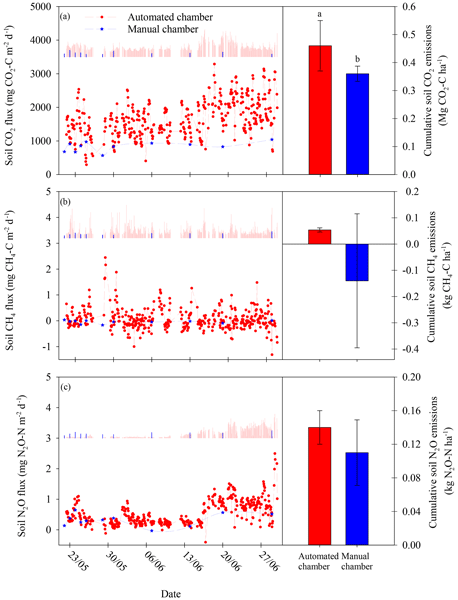
Agriculture may play a significant role in climate change mitigation. For this reason, it is necessary to have good estimations of the greenhouse gas (GHG) emissions from agricultural activities. In this work, two different chamber systems to determine GHGs were compared. Our results highlighted that automated chamber systems, compared to manual chamber systems, are a powerful tool for quantifying GHG fluxes, allowing us to capture the large temporal variability that characterizes them.
Roxanne Daelman, Marijn Bauters, Matti Barthel, Emmanuel Bulonza, Lodewijk Lefevre, José Mbifo, Johan Six, Klaus Butterbach-Bahl, Benjamin Wolf, Ralf Kiese, and Pascal Boeckx
Biogeosciences, 22, 1529–1542, https://doi.org/10.5194/bg-22-1529-2025, https://doi.org/10.5194/bg-22-1529-2025, 2025
Short summary
Short summary
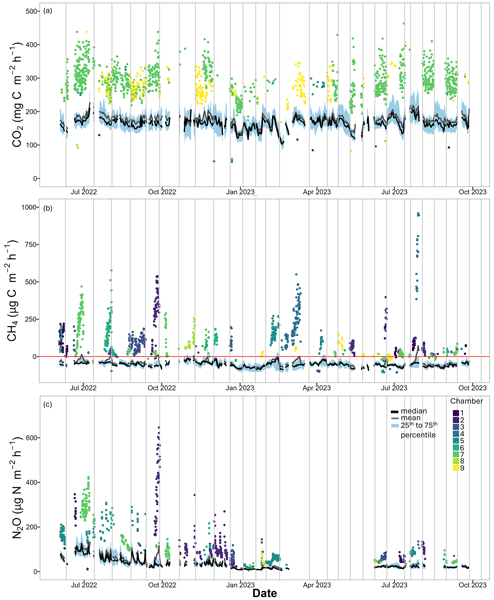
The increase in atmospheric concentrations of several greenhouse gases (GHGs) since 1750 is attributed to human activity. However, natural ecosystems, such as tropical forests, also contribute to GHG budgets. The Congo Basin hosts the second largest tropical forest and is understudied. In this study, measurements of soil GHG exchange were carried out during 16 months in a tropical forest in the Congo Basin. Overall, the soil acted as a major source of CO2 and N2O and a minor sink of CH4.
Simone Brunamonti, Manuel Graf, Tobias Bühlmann, Céline Pascale, Ivan Ilak, Lukas Emmenegger, and Béla Tuzson
Atmos. Meas. Tech., 16, 4391–4407, https://doi.org/10.5194/amt-16-4391-2023, https://doi.org/10.5194/amt-16-4391-2023, 2023
Short summary
Short summary
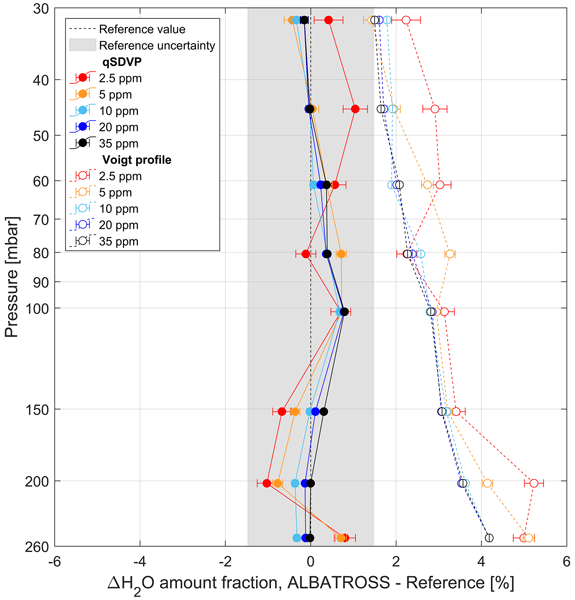
The abundance of water vapor (H2O) in the upper atmosphere has a significant impact on the rate of global warming. We developed a new lightweight spectrometer (ALBATROSS) for H2O measurements aboard meteorological balloons. Here, we assess the accuracy and precision of ALBATROSS using metrology-grade reference gases. The results demonstrate the exceptional potential of mid-infrared laser absorption spectroscopy as a new reference method for in situ measurements of H2O in the upper atmosphere.
Marsailidh M. Twigg, Augustinus J. C. Berkhout, Nicholas Cowan, Sabine Crunaire, Enrico Dammers, Volker Ebert, Vincent Gaudion, Marty Haaima, Christoph Häni, Lewis John, Matthew R. Jones, Bjorn Kamps, John Kentisbeer, Thomas Kupper, Sarah R. Leeson, Daiana Leuenberger, Nils O. B. Lüttschwager, Ulla Makkonen, Nicholas A. Martin, David Missler, Duncan Mounsor, Albrecht Neftel, Chad Nelson, Eiko Nemitz, Rutger Oudwater, Celine Pascale, Jean-Eudes Petit, Andrea Pogany, Nathalie Redon, Jörg Sintermann, Amy Stephens, Mark A. Sutton, Yuk S. Tang, Rens Zijlmans, Christine F. Braban, and Bernhard Niederhauser
Atmos. Meas. Tech., 15, 6755–6787, https://doi.org/10.5194/amt-15-6755-2022, https://doi.org/10.5194/amt-15-6755-2022, 2022
Short summary
Short summary
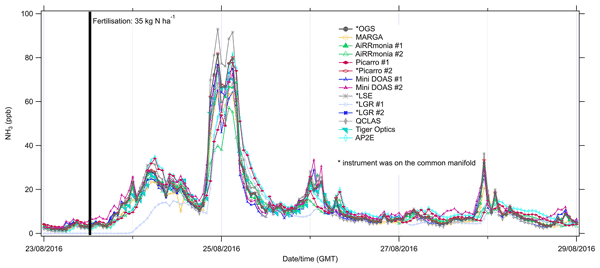
Ammonia (NH3) gas in the atmosphere impacts the environment, human health, and, indirectly, climate. Historic NH3 monitoring was labour intensive, and the instruments were complicated. Over the last decade, there has been a rapid technology development, including “plug-and-play” instruments. This study is an extensive field comparison of the currently available technologies and provides evidence that for routine monitoring, standard operating protocols are required for datasets to be comparable.
Clare E. Singer, Benjamin W. Clouser, Sergey M. Khaykin, Martina Krämer, Francesco Cairo, Thomas Peter, Alexey Lykov, Christian Rolf, Nicole Spelten, Armin Afchine, Simone Brunamonti, and Elisabeth J. Moyer
Atmos. Meas. Tech., 15, 4767–4783, https://doi.org/10.5194/amt-15-4767-2022, https://doi.org/10.5194/amt-15-4767-2022, 2022
Short summary
Short summary
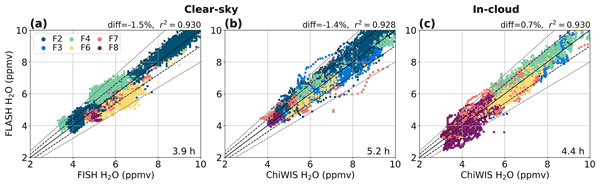
In situ measurements of water vapor in the upper troposphere are necessary to study cloud formation and hydration of the stratosphere but challenging due to cold–dry conditions. We compare measurements from three water vapor instruments from the StratoClim campaign in 2017. In clear sky (clouds), point-by-point differences were <1.5±8 % (<1±8 %). This excellent agreement allows detection of fine-scale structures required to understand the impact of convection on stratospheric water vapor.
Balázs Grosz, Reinhard Well, Rene Dechow, Jan Reent Köster, Mohammad Ibrahim Khalil, Simone Merl, Andreas Rode, Bianca Ziehmer, Amanda Matson, and Hongxing He
Biogeosciences, 18, 5681–5697, https://doi.org/10.5194/bg-18-5681-2021, https://doi.org/10.5194/bg-18-5681-2021, 2021
Short summary
Short summary
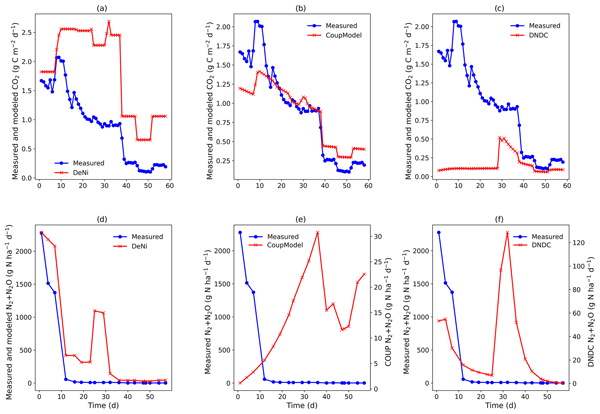
To assure quality predictions biogeochemical models must be current. We use data measured using novel incubation methods to test the denitrification sub-modules of three models. We aim to identify limitations in the denitrification modeling to inform next steps for development. Several areas are identified, most urgently improved denitrification control parameters and further testing with high-temporal-resolution datasets. Addressing these would significantly improve denitrification modeling.
Lena Rohe, Traute-Heidi Anderson, Heinz Flessa, Anette Goeske, Dominika Lewicka-Szczebak, Nicole Wrage-Mönnig, and Reinhard Well
Biogeosciences, 18, 4629–4650, https://doi.org/10.5194/bg-18-4629-2021, https://doi.org/10.5194/bg-18-4629-2021, 2021
Short summary
Short summary
This is the first experimental setup combining a complex set of methods (microbial inhibitors and isotopic approaches) to differentiate between N2O produced by fungi or bacteria during denitrification in three soils. Quantifying the fungal fraction with inhibitors was not successful due to large amounts of uninhibited N2O production. All successful methods suggested a small or missing fungal contribution. Artefacts occurring with microbial inhibition to determine N2O fluxes are discussed.
Ruth E. Hill-Pearce, Aimee Hillier, Eric Mussell Webber, Kanokrat Charoenpornpukdee, Simon O'Doherty, Joachim Mohn, Christoph Zellweger, David R. Worton, and Paul J. Brewer
Atmos. Meas. Tech., 14, 5447–5458, https://doi.org/10.5194/amt-14-5447-2021, https://doi.org/10.5194/amt-14-5447-2021, 2021
Short summary
Short summary
There is currently a need for gas reference materials with well-characterised delta values for monitoring N2O amount fractions. We present work towards the preparation of gas reference materials for calibration of in-field monitoring equipment, which target the WMO-GAW data quality objectives for comparability of amount fraction and demonstrate the stability of δ15Nα, δ15Nβ and δ18O values with pressure and effects of cylinder passivation.
Cited articles
Barnes, J. and Allan, D.: Statistics of atomic frequency standards, P. IEEE, 54, 221–230, https://doi.org/10.1109/PROC.1966.4634, 1966.
Braden-Behrens, J., Emad, A., Ebert, V., Durbiano, F., Li, G., Moossen, H., Nwaboh, J., Pavarelli, S., Rolle, F., Sega, M., and Steur, P. M.: Good practice guide for specification and application of OIRS for atmospheric measurements, including sample handling protocol, optimised analytical procedures, traceability to the international standards and target uncertainties (0.05 ‰ for δ13C-CO2 and δ18O-CO2), Physikalisch-Technische Bundesanstalt, Braunschweig, Germany, https://empir.npl.co.uk/stellarproject/documents/ (last access: 20 May 2026), 2023.
Denk, T. R., Kraus, D., Kiese, R., Butterbach-Bahl, K., and Wolf, B.: Constraining N cycling in the ecosystem model LandscapeDNDC with the stable isotope model SIMONE, Ecology, 100, e02675, https://doi.org/10.1002/ecy.2675, 2019.
Forster, P., Ramaswamy, V., Artaxo, P., Berntsen, T., Betts, R., Fahey, D. W., Haywood, J., Lean, J., Lowe, D. C., Myhre, G., Nganga, J., Prinn, R., Raga, G., Schulz, M., and Van Dorland, R.: Changes in atmospheric constituents and in radiative forcing, in: Climate Change 2007: The Physical Science Basis, edited by: Solomon, S., Qin, D., Manning, M., Chen, Z., Marquis, M., Averyt, K. B., Tignor, M., and Miller, H. L., Cambridge University Press, Cambridge, United Kingdom, New York, NY, USA, 129–234, ISBN: 978-0-521-88009-1, 2007.
Gordon, I. E., Rothman, L. S., Hargreaves, R. J., Hashemi, R., Karlovets, E. V., Skinner, F. M., Conway, E. K., Hill, C., Kochanov, R. V., and Tan, Y.: The HITRAN2020 molecular spectroscopic database, J. Quant. Spectrosc. Ra., 277, 107949, https://doi.org/10.1016/j.jqsrt.2021.107949, 2022.
Gruber, W., Magyar, P. M., Mitrovic, I., Zeyer, K., Vogel, M., von Känel, L., Biolley, L., Werner, R. A., Morgenroth, E., and Lehmann, M. F.: Tracing N2O formation in full-scale wastewater treatment with natural abundance isotopes indicates control by organic substrate and process settings, Water Res. X, 15, 100130, https://doi.org/10.1016/j.wroa.2022.100130, 2022.
Harris, S. J., Liisberg, J., Xia, L., Wei, J., Zeyer, K., Yu, L., Barthel, M., Wolf, B., Kelly, B. F. J., Cendón, D. I., Blunier, T., Six, J., and Mohn, J.: N2O isotopocule measurements using laser spectroscopy: analyzer characterization and intercomparison, Atmos. Meas. Tech., 13, 2797–2831, https://doi.org/10.5194/amt-13-2797-2020, 2020.
Havsteen, J., Mehr, F., Brunamonti, S., Pogány, A., Hausmaninger, T., Wolf, B., Well, R., and Mohn, J.: Raw spectral and experimental data: Correction and Calibration Protocol for Isotope Data via CRDS A Study Case for N2O and Other Isotope Systems, Zenodo [data set], https://doi.org/10.5281/zenodo.19885376, 2026.
JCGM: Evaluation of measurement data – Guide to the expression of uncertainty in measurement, Joint Committee for Guides in Metrology (JCGM), Sèvres, France, JCGM 100:2008, https://doi.org/10.59161/JCGM100-2008E, 2008.
Lan, X., Thoning, K. W., and Dlugokencky, E. J.: Trends in globally-averaged CH4, N2O, and SF6 determined from NOAA Global Monitoring Laboratory measurements, Version 2024-11, https://doi.org/10.15138/P8XG-AA10, 2024.
Mohn, J., Biasi, C., Bodé, S., Boeckx, P., Brewer, P. J., Eggleston, S., Geilmann, H., Guillevic, M., Kaiser, J., and Kantnerová, K.: Isotopically characterised N2O reference materials for use as community standards, Rapid Commun. Mass Sp., 36, e9296, https://doi.org/10.1002/rcm.9296, 2022.
Ostrom, N. E., Gandhi, H., Coplen, T. B., Toyoda, S., Böhlke, J. K., Brand, W. A., Casciotti, K. L., Dyckmans, J., Giesemann, A., and Mohn, J.: Preliminary assessment of stable nitrogen and oxygen isotopic composition of USGS51 and USGS52 nitrous oxide reference gases and perspectives on calibration needs, Rapid Commun. Mass Sp., 32, 1207–1214, https://doi.org/10.1002/rcm.8157, 2018.
Pogány, A., Lüttschwager, N. O. B., Banik, G. D., Persijn, S., de Boed, E. J. J., Sutour, C., Macé, T., Nwaboh, J. A., Werhahn, O., and Ebert, V.: Towards an optical gas standard for ammonia measurements in air at ambient levels, J. Quant. Spectrosc. Ra., 347, 109643, https://doi.org/10.1016/j.jqsrt.2025.109643, 2025.
Schrade, S., Zeyer, K., Mohn, J., and Zähner, M.: Effect of diets with different crude protein levels on ammonia and greenhouse gas emissions from a naturally ventilated dairy housing, Sci. Total Environ., 896, 165027, https://doi.org/10.1016/j.scitotenv.2023.165027, 2023.
Sperlich, P., Camin, F., Deufrains, K., Eglund Michel, S., Hoheisel, A., Mohn, J., Schmidt, M., and Tarasova, O.: Measurement of the Stable Carbon Isotope Ratio in Atmospheric CH4 Using Laser Spectroscopy for CH4 Source Characterization, International Atomic Energy Agency (IAEA), Vienna, IAEA-TECDOC-2066, https://doi.org/10.61092/iaea.logm-wiux, 2024.
Toyoda, S. and Yoshida, N.: Determination of nitrogen isotopomers of nitrous oxide on a modified isotope ratio mass spectrometer, Anal. Chem., 71, 4711–4718, https://doi.org/10.1021/ac9904563, 1999.
Toyoda, S., Yoshida, N., and Koba, K.: Isotopocule analysis of biologically produced nitrous oxide in various environments, Mass Spectrom. Rev., 36, 135–160, https://doi.org/10.1002/mas.21459, 2017.
Werle, P., Mücke, R., and Slemr, F.: The limits of signal averaging in atmospheric trace-gas monitoring by tunable diode-laser absorption spectroscopy (TDLAS), Appl. Phys. B, 57, 131–139, 1993.
Werner, R. A. and Brand, W. A.: Referencing strategies and techniques in stable isotope ratio analysis, Rapid Commun. Mass Sp., 15, 501–519, https://doi.org/10.1002/rcm.258, 2001.
Wojdyr, M.: Fityk: a general-purpose peak fitting program, J. Appl. Crystallogr., 43, 1126–1128, https://doi.org/10.1107/S0021889810030499, 2010.
Wu, W., Zhang, L., Zhu, D., Shi, Z., and Jin, B.: Spectroscopic techniques to analyze stable carbon isotopic compositions of carbon dioxide, methane and volatile organic compounds, J. Anal. Atom. Spectrom., 39, 1444–1453, https://doi.org/10.1039/D3JA00330B, 2024.
Yu, L., Harris, E., Lewicka-Szczebak, D., Barthel, M., Blomberg, M. R. A., Harris, S. J., Johnson, M. S., Lehmann, M. F., Liisberg, J., Muller, C., Ostrom, N. E., Six, J., Toyoda, S., Yoshida, N., and Mohn, J.: What can we learn from N2O isotope data? – Analytics, processes and modelling, Rapid Commun. Mass Sp., 34, e8858, https://doi.org/10.1002/rcm.8858, 2020.
Short summary
We present a new correction and calibration protocol to improve the accuracy of nitrous oxide isotope measurements obtained using laser spectroscopy. Through laboratory experiments, spectral simulations, and an automated MATLAB (Matrix Laboratory) reduction scheme, we identify and correct biases caused by matrix gas composition, spectral interferences and instrument variability. This protocol enables researchers to produce more reliable isotope data and supports standardised isotope analyses across laboratories.
We present a new correction and calibration protocol to improve the accuracy of nitrous oxide...