Articles | Volume 19, issue 20
https://doi.org/10.5194/amt-19-6699-2026
© Author(s) 2026. This work is distributed under
the Creative Commons Attribution 4.0 License.
https://doi.org/10.5194/amt-19-6699-2026
© Author(s) 2026. This work is distributed under
the Creative Commons Attribution 4.0 License.
Survival-analysis methods for droplet-freezing data: Kaplan–Meier confidence intervals and non-parametric curve comparison

Institute for Climate and Atmospheric Science, University of Leeds, Leeds, LS2 9JT, UK
Trystan Surawy-Stepney
Institute for Climate and Atmospheric Science, University of Leeds, Leeds, LS2 9JT, UK
Sarah L. Barr
Institute for Climate and Atmospheric Science, University of Leeds, Leeds, LS2 9JT, UK
National Centre for Atmospheric Science, Leeds, LS2 9PH, UK
Related authors
Nina L. H. Kinney, Charles A. Hepburn, Matthew I. Gibson, Daniel Ballesteros, and Thomas F. Whale
Biogeosciences, 21, 3201–3214, https://doi.org/10.5194/bg-21-3201-2024, https://doi.org/10.5194/bg-21-3201-2024, 2024
Short summary
Short summary
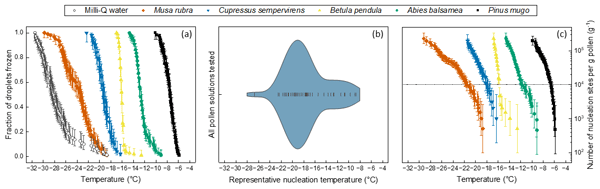
Molecules released from plant pollen induce the formation of ice from supercooled water at temperatures warm enough to suggest an underlying function for this activity. In this study we show that ice nucleators are ubiquitous in pollen. We suggest the molecules responsible fulfil some unrelated biological function and nucleate ice incidentally. The ubiquity of ice-nucleating molecules in pollen and particularly active examples reveal a greater potential for pollen to impact weather and climate.
Martin I. Daily, Mark D. Tarn, Thomas F. Whale, and Benjamin J. Murray
Atmos. Meas. Tech., 15, 2635–2665, https://doi.org/10.5194/amt-15-2635-2022, https://doi.org/10.5194/amt-15-2635-2022, 2022
Short summary
Short summary
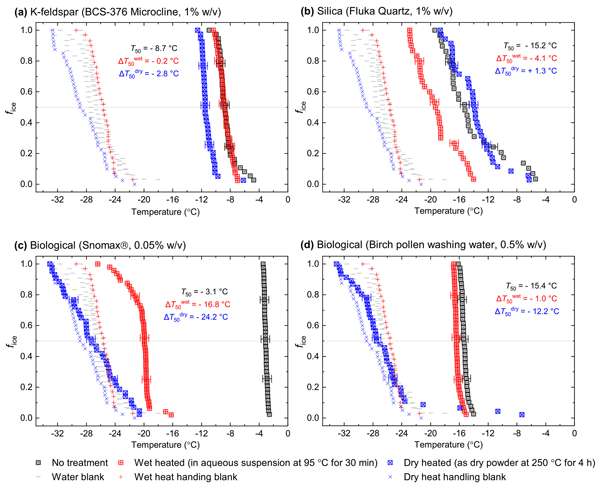
Mineral dust and particles of biological origin are important types of ice-nucleating particles (INPs) that can trigger ice formation of supercooled cloud droplets. Heat treatments are used to detect the presence of biological INPs in samples collected from the environment as the activity of mineral INPs is assumed unchanged, although not fully assessed. We show that the ice-nucleating ability of some minerals can change after heating and discuss how INP heat tests should be interpreted.
Mae E. Evans, Anna E. Hogg, Trystan Surawy-Stepney, Benjamin J. Wallis, Ross A. W. Slater, and Richard Rigby
EGUsphere, https://doi.org/10.5194/egusphere-2026-5527, https://doi.org/10.5194/egusphere-2026-5527, 2026
This preprint is open for discussion and under review for The Cryosphere (TC).
Short summary
Short summary
We studied how 66 glaciers in central and southeast Greenland changed speed over the last decade using satellite observations. Most glaciers sped up between 2016 and 2020, with some more than doubling their speed, before slowing down after 2020. The timing coincided with unusually warm ocean water and reduced sea ice. We show that glacier speed changes in this region were larger and more widespread than previously reported, highlighting how sensitive this region is to environmental change.
Ross J. Herbert, Larissa Lacher, Alexander Böhmländer, Mark D. Tarn, Antoine Canzi, Aidan Pantoya, Evelyn Freney, Kristina Höhler, Pia Bogert, Céline Planche, Ping Tian, Michael Adams, Sarah Barr, David Brus, Nicole Büttner, Martin Daily, Konstantinos Doulgeris, Konstantinos Eleftheriadis, Grant Forster, Romy Fösig, Dimitrios G. Georgakopoulos, Maria I. Gini, A. Gannet Hallar, Radovan Krejci, Elke Ludewig, Mauro Mazzola, Ian B. McCubbin, Athanasios Nenes, Tuukka Petäjä, Joseph Robinson, Franziska Vogel, Paul Zieger, Stephen Arnold, Kenneth S. Carslaw, Naruki Hiranuma, Ottmar Möhler, and Benjamin J. Murray
Earth Syst. Sci. Data, 18, 6465–6483, https://doi.org/10.5194/essd-18-6465-2026, https://doi.org/10.5194/essd-18-6465-2026, 2026
Short summary
Short summary
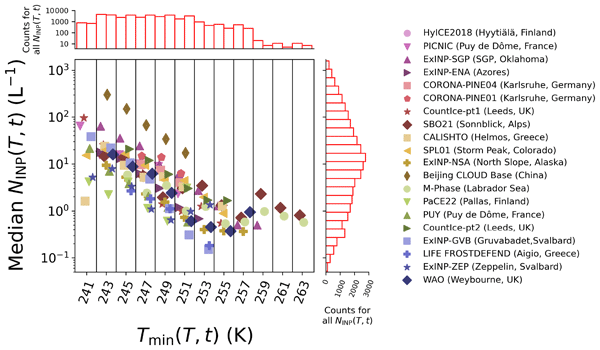
Ice formation in sub-zero clouds is influenced by airborne particles called ice-nucleating particles (INPs), whose concentrations vary substantially over short time and spatial scales. To assess the role of INPs in our climate, a comprehensive and consistent global dataset is essential. Our GloPINE model-ready dataset is a major step in this direction, comprising 36,000 measurements made using a single instrument design (PINE) over 70,000 hours of operation at 20 Northern Hemisphere sites.
Trystan Surawy-Stepney, Stephen L. Cornford, and Anna E. Hogg
The Cryosphere, 19, 5531–5545, https://doi.org/10.5194/tc-19-5531-2025, https://doi.org/10.5194/tc-19-5531-2025, 2025
Short summary
Short summary
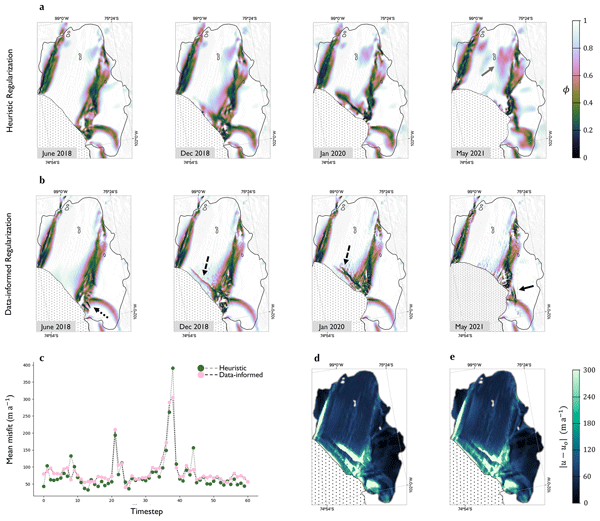
The speed at which Antarctic ice flows is dependent on its viscosity and the slipperiness of the ice/bedrock interface. Often, these unknown variables are inferred from observations of ice speed. This article presents an attempt to make this difficult procedure easier by making use of additional information in the form of observations of crevasses, which make ice appear less viscous to numerical models. We find in some circumstances that this leads to more appealing solutions to this problem.
Nina L. H. Kinney, Charles A. Hepburn, Matthew I. Gibson, Daniel Ballesteros, and Thomas F. Whale
Biogeosciences, 21, 3201–3214, https://doi.org/10.5194/bg-21-3201-2024, https://doi.org/10.5194/bg-21-3201-2024, 2024
Short summary
Short summary
Molecules released from plant pollen induce the formation of ice from supercooled water at temperatures warm enough to suggest an underlying function for this activity. In this study we show that ice nucleators are ubiquitous in pollen. We suggest the molecules responsible fulfil some unrelated biological function and nucleate ice incidentally. The ubiquity of ice-nucleating molecules in pollen and particularly active examples reveal a greater potential for pollen to impact weather and climate.
Martin I. Daily, Mark D. Tarn, Thomas F. Whale, and Benjamin J. Murray
Atmos. Meas. Tech., 15, 2635–2665, https://doi.org/10.5194/amt-15-2635-2022, https://doi.org/10.5194/amt-15-2635-2022, 2022
Short summary
Short summary
Mineral dust and particles of biological origin are important types of ice-nucleating particles (INPs) that can trigger ice formation of supercooled cloud droplets. Heat treatments are used to detect the presence of biological INPs in samples collected from the environment as the activity of mineral INPs is assumed unchanged, although not fully assessed. We show that the ice-nucleating ability of some minerals can change after heating and discuss how INP heat tests should be interpreted.
Cited articles
Agresti, A. and Coull, B. A.: Approximate is Better than “Exact” for Interval Estimation of Binomial Proportions, Am. Stat., 52, 119–126, https://doi.org/10.1080/00031305.1998.10480550, 1998.
Anderson, T. W.: On the Distribution of the Two-Sample Cramér–von Mises Criterion, Ann. Math. Stat., 33, 1148–1159, 1962.
Bigg, E. K.: The supercooling of water, P. Phys. Soc. B, 66, 688, https://doi.org/10.1088/0370-1301/66/8/309, 1953.
Budke, C. and Koop, T.: BINARY: an optical freezing array for assessing temperature and time dependence of heterogeneous ice nucleation, Atmos. Meas. Tech., 8, 689–703, https://doi.org/10.5194/amt-8-689-2015, 2015.
Conover, W. J.: Practical nonparametric statistics, John Wiley & Sons, ISBN 978-0-471-16068-7, 1999.
Cumming, G.: Inference by eye: Reading the overlap of independent confidence intervals, Stat. Med., 28, 205–220, https://doi.org/10.1002/sim.3471, 2009.
Daily, M. I., Tarn, M. D., Whale, T. F., and Murray, B. J.: An evaluation of the heat test for the ice-nucleating ability of minerals and biological material, Atmos. Meas. Tech., 15, 2635–2665, https://doi.org/10.5194/amt-15-2635-2022, 2022.
Dormuth, I., Liu, T., Xu, J., Yu, M., Pauly, M., and Ditzhaus, M.: Which test for crossing survival curves? A user's guideline, BMC Med. Res. Methodol., 22, 34, https://doi.org/10.1186/s12874-022-01520-0, 2022.
Fahy, W. D., Shalizi, C. R., and Sullivan, R. C.: A universally applicable method of calculating confidence bands for ice nucleation spectra derived from droplet freezing experiments, Atmos. Meas. Tech., 15, 6819–6836, https://doi.org/10.5194/amt-15-6819-2022, 2022.
Fleming, T. R. and Harrington, D. P.: Counting processes and survival analysis, John Wiley & Sons, ISBN-13 978-0471769880, 2013.
Harrison, A. D., Whale, T. F., Carpenter, M. A., Holden, M. A., Neve, L., O'Sullivan, D., Vergara Temprado, J., and Murray, B. J.: Not all feldspars are equal: a survey of ice nucleating properties across the feldspar group of minerals, Atmos. Chem. Phys., 16, 10927–10940, https://doi.org/10.5194/acp-16-10927-2016, 2016.
Herbert, R. J., Sanchez-Marroquin, A., Grosvenor, D. P., Pringle, K. J., Arnold, S. R., Murray, B. J., and Carslaw, K. S.: Gaps in our understanding of ice-nucleating particle sources exposed by global simulation of the UK Earth System Model, Atmos. Chem. Phys., 25, 291–325, https://doi.org/10.5194/acp-25-291-2025, 2025.
Kalbfleisch, J. D. and Prentice, R. L.: The statistical analysis of failure time data, econd edn., Wiley series in probablility and statistics, 2nd Edn., Wiley Series in Probability and Statistics, Wiley, New York, https://doi.org/10.1002/9781118032985, 2002.
Kaplan, E. L. and Meier, P.: Nonparametric Estimation from Incomplete Observations, J. Am. Stat. Assoc., 53, 457–481, https://doi.org/10.1080/01621459.1958.10501452, 1958.
Kinney, N. L. H., Hepburn, C. A., Gibson, M. I., Ballesteros, D., and Whale, T. F.: High interspecific variability in ice nucleation activity suggests pollen ice nucleators are incidental, Biogeosciences, 21, 3201–3214, https://doi.org/10.5194/bg-21-3201-2024, 2024.
Knopf, D. A. and Alpert, P. A.: Atmospheric ice nucleation, Nature Reviews Physics, 5, 203–217, https://doi.org/10.1038/s42254-023-00570-7, 2023.
Kobayashi, A., Golash, H. N., and Kirschvink, J. L.: A first test of the hypothesis of biogenic magnetite-based heterogeneous ice-crystal nucleation in cryopreservation, Cryobiology, 72, 216–224, https://doi.org/10.1016/j.cryobiol.2016.04.003, 2016.
Koop, T., Luo, B. P., Biermann, U. M., Crutzen, P. J., and Peter, T.: Freezing of HNO3/H2SO4/H2O solutions at stratospheric temperatures: Nucleation statistics and experiments, J. Phys. Chem., 101, 1117–1133, https://doi.org/10.1021/jp9626531, 1997.
Kuhns, I. E.: The supercooling and nucleation of water, University of London, 1966.
Kunert, A. T., Lamneck, M., Helleis, F., Pöschl, U., Pöhlker, M. L., and Fröhlich-Nowoisky, J.: Twin-plate Ice Nucleation Assay (TINA) with infrared detection for high-throughput droplet freezing experiments with biological ice nuclei in laboratory and field samples, Atmos. Meas. Tech., 11, 6327–6337, https://doi.org/10.5194/amt-11-6327-2018, 2018.
Miller, A. J., Brennan, K. P., Mignani, C., Wieder, J., David, R. O., and Borduas-Dedekind, N.: Development of the drop Freezing Ice Nuclei Counter (FINC), intercomparison of droplet freezing techniques, and use of soluble lignin as an atmospheric ice nucleation standard, Atmos. Meas. Tech., 14, 3131–3151, https://doi.org/10.5194/amt-14-3131-2021, 2021.
Phipson, B. and Smyth, G. K.: Permutation P-values should never be zero: calculating exact P-values when permutations are randomly drawn, Stat. Appl. Genet. Mol. Biol., 9, 39, https://doi.org/10.2202/1544-6115.1585, 2010.
Polen, M., Brubaker, T., Somers, J., and Sullivan, R. C.: Cleaning up our water: reducing interferences from nonhomogeneous freezing of “pure” water in droplet freezing assays of ice-nucleating particles, Atmos. Meas. Tech., 11, 5315–5334, https://doi.org/10.5194/amt-11-5315-2018, 2018.
Sachs, M. C., Brand, A., and Gabriel, E. E.: Confidence bands in survival analysis, Brit. J. Cancer, 127, 1636–1641, https://doi.org/10.1038/s41416-022-01920-5, 2022.
Scholz, F. W. and Stephens, M. A.: K-Sample Anderson–Darling Tests, J. Am. Stat. Assoc., 82, 918–924, https://doi.org/10.1080/01621459.1987.10478517, 1987.
Stan, C. A., Schneider, G. F., Shevkoplyas, S. S., Hashimoto, M., Ibanescu, M., Wiley, B. J., and Whitesides, G. M.: A microfluidic apparatus for the study of ice nucleation in supercooled water drops, Lab Chip, 9, 2293–2305, https://doi.org/10.1039/b906198c, 2009.
Tarn, M. D., Shaw, K. J., Foster, P. B., West, J. S., Johnston, I. D., McCluskey, D. K., Peyman, S. A., and Murray, B. J.: Microfluidics for the biological analysis of atmospheric ice-nucleating particles: Perspectives and challenges, Biomicrofluidics, 19, https://doi.org/10.1063/5.0236911, 2025.
Vali, G.: Quantitative Evaluation of Experimental Results on the Heterogeneous Freezing Nucleation of Supercooled Liquids, J. Atmos. Sci., 28, 402–409, https://doi.org/10.1175/1520-0469(1971)028<0402:qeoera>2.0.co;2, 1971.
Vali, G.: Revisiting the differential freezing nucleus spectra derived from drop-freezing experiments: methods of calculation, applications, and confidence limits, Atmos. Meas. Tech., 12, 1219–1231, https://doi.org/10.5194/amt-12-1219-2019, 2019.
Vali, G.: Comment on “A universally applicable method of calculating confidence bands for ice nucleation spectra derived from droplet freezing experiments” by Fahy et al. (2022), Atmos. Meas. Tech., 16, 4303–4306, https://doi.org/10.5194/amt-16-4303-2023, 2023.
Vali, G., DeMott, P. J., Möhler, O., and Whale, T. F.: Technical Note: A proposal for ice nucleation terminology, Atmos. Chem. Phys., 15, 10263–10270, https://doi.org/10.5194/acp-15-10263-2015, 2015.
Whale, T. F.: Quantification of the Ice Nucleation Activity of Ice-Binding Proteins Using a Microliter Droplet Freezing Experiment, Methods Mol Biol, 2730, 121–134, https://doi.org/10.1007/978-1-0716-3503-2_9, 2024.
Whale, T. F., Murray, B. J., O'Sullivan, D., Wilson, T. W., Umo, N. S., Baustian, K. J., Atkinson, J. D., Workneh, D. A., and Morris, G. J.: A technique for quantifying heterogeneous ice nucleation in microlitre supercooled water droplets, Atmos. Meas. Tech., 8, 2437–2447, https://doi.org/10.5194/amt-8-2437-2015, 2015.
Short summary
Droplet-freezing experiments help us study substances that trigger ice formation in the atmosphere, but existing ways to show uncertainty or compare results are lacking. We adapt confidence intervals used in medical
time-to-evenstudies, then test them using realistic simulations. They work well across most of the freezing range, though less well at its limits. We also compare tests for differences between curves and show that the best choice depends on how the curves differ.
Droplet-freezing experiments help us study substances that trigger ice formation in the...