
Articles | Volume 19, issue 21
https://doi.org/10.5194/amt-19-7403-2026
© Author(s) 2026. This work is distributed under
the Creative Commons Attribution 4.0 License.
the Creative Commons Attribution 4.0 License.
https://doi.org/10.5194/amt-19-7403-2026
© Author(s) 2026. This work is distributed under
the Creative Commons Attribution 4.0 License.
the Creative Commons Attribution 4.0 License.
Research article
| 
13 Nov 2026
Research article |
| 13 Nov 2026
| 13 Nov 2026
Simultaneous temperature and wind profiling in the troposphere and lower stratosphere using a Rayleigh Doppler lidar with a Fizeau-interferometer-based high-spectral-resolution receiver
Liangyu Pu
School of Earth and Space Sciences, University of Science and Technology of China, Hefei, China
Hefei National Laboratory, Hefei, China
Tingdi Chen
CORRESPONDING AUTHOR

School of Earth and Space Sciences, University of Science and Technology of China, Hefei, China
Hefei National Laboratory, Hefei, China
Anhui Mengcheng Geophysics National Observation and Research Station, University of Science and Technology of China, Hefei, China
Yuli Han
School of Earth and Space Sciences, University of Science and Technology of China, Hefei, China
Hefei National Laboratory, Hefei, China
Anhui Mengcheng Geophysics National Observation and Research Station, University of Science and Technology of China, Hefei, China
Zhaowang Su
School of Earth and Space Sciences, University of Science and Technology of China, Hefei, China
Hefei National Laboratory, Hefei, China
Yiming Song
School of Earth and Space Sciences, University of Science and Technology of China, Hefei, China
Zhu Meng
School of Earth and Space Sciences, University of Science and Technology of China, Hefei, China
Hefei National Laboratory, Hefei, China
Yuxin Wen
School of Earth and Space Sciences, University of Science and Technology of China, Hefei, China
Chong Chen
Hefei National Laboratory, Hefei, China
Dongsong Sun
School of Earth and Space Sciences, University of Science and Technology of China, Hefei, China
Hefei National Laboratory, Hefei, China
Xianghui Xue
School of Earth and Space Sciences, University of Science and Technology of China, Hefei, China
Hefei National Laboratory, Hefei, China
Anhui Mengcheng Geophysics National Observation and Research Station, University of Science and Technology of China, Hefei, China
Xiankang Dou
School of Earth and Space Sciences, University of Science and Technology of China, Hefei, China
Hefei National Laboratory, Hefei, China
Related authors
No articles found.
Jianyuan Wang, Wen Yi, Xianghui Xue, Maosheng He, Jianfei Wu, Hailun Ye, Tingdi Chen, Jian Li, Jie Zeng, Zonghua Ding, Na Li, Jian Wang, Robert A. Vincent, Iain M. Reid, Paulo P. Batista, Ricardo A. Buriti, Toshitaka Tsuda, Nicholas J. Mitchell, and Xiankang Dou
EGUsphere, https://doi.org/10.5194/egusphere-2026-6900, https://doi.org/10.5194/egusphere-2026-6900, 2026
This preprint is open for discussion and under review for Atmospheric Chemistry and Physics (ACP).
Short summary
Short summary
Horizontal winds from six meteor radars in the low-latitude region are used to derive nonmigrating tides in the MLT. To our knowledge, it is the first time to decompose nonmigrating tides from sparse meteor radar observations. The climatology of DE3, DE2, and DW2 is consistent with CTMT. During the 2006 SSW, these tides show significant response. This study develops a method for decomposing nonmigrating tidal winds and provides a chance for investigating middle atmosphere–ionosphere coupling.
Chuan Huang, Zhaofeng Wang, Chaomei Wu, Jinru Cheng, Tangsheng Cheng, Zhenwei Liu, Chen Liang, Tingdi Chen, Weilong Luo, Chong Wang, Ruocan Zhao, and Xianghui Xue
EGUsphere, https://doi.org/10.5194/egusphere-2026-6508, https://doi.org/10.5194/egusphere-2026-6508, 2026
This preprint is open for discussion and under review for Atmospheric Measurement Techniques (AMT).
Short summary
Short summary
Earth's upper atmosphere is difficult to observe over large areas. We simulated a satellite laser instrument that detects light from excited helium atoms. Under the conditions tested, it could measure the density of these atoms up to 1000 kilometres above Earth and estimate temperature and wind along the laser beam between 500 and 700 kilometres. This approach could extend observations beyond ground stations and help reveal how the upper atmosphere changes.
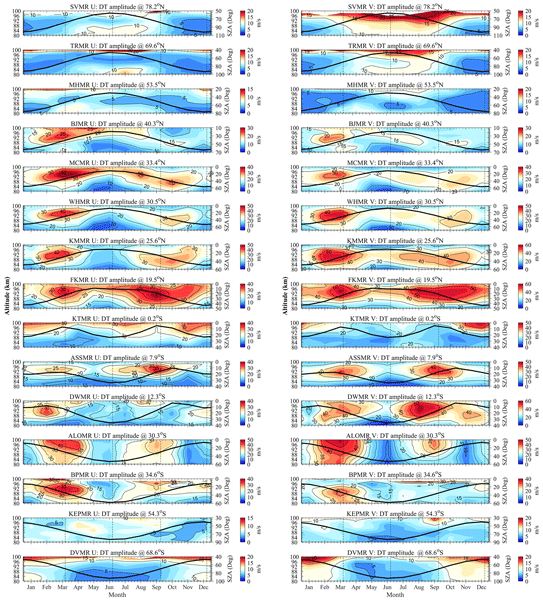
Wen Yi, Jianyuan Wang, Xianghui Xue, Chengyun Yang, Iain M. Reid, Robert A. Vincent, Andrew MacKinnon, Damian J. Murphy, Njål Gulbrandsen, Masaki Tsutsumi, Baiqi Ning, Guozhu Li, Nicholas J. Mitchell, Tracy Moffat-Griffin, Toshitaka Tsuda, Haiying Li, Paulo P. Batista, Jianfei Wu, Tingdi Chen, and Xiankang Dou
Atmos. Chem. Phys., 26, 13441–13462, https://doi.org/10.5194/acp-26-13441-2026, https://doi.org/10.5194/acp-26-13441-2026, 2026
Short summary
Short summary
This study provides observational evidence that the solar zenith angle (SZA) influences the vertical structure of diurnal tides in the mesosphere and lower thermosphere (MLT) region. Diurnal tides are strongest at low and mid-latitudes (10–50° N/S) and weaker near the Equator and at polar latitudes. The results further suggest that background zonal winds influence tidal propagation and structure through filtering and momentum drag.
Kexin Ming, Chong Wang, Wei Kong, Xianghui Xue, Genghua Huang, Ruikai Xue, Wenhao Li, Yudie Li, Chen Liang, Ruocan Zhao, Mingjiao Jia, and Xiang Shang
EGUsphere, https://doi.org/10.5194/egusphere-2026-4536, https://doi.org/10.5194/egusphere-2026-4536, 2026
Short summary
Short summary
Boundary layer height is important for weather forecasting and climate studies, but consistent global observations remain difficult. We designed a spaceborne lidar and validated its performance through theoretical simulations and experiments with a scaled airborne prototype. Nighttime results in Yulin agreed closely with ground-based observations, while daytime tests in Hainan showed detection potential under strong background illumination, supporting future global monitoring from space.
Yiran Pan, Jialin Zhang, Chengyun Yang, Tao Li, Xin Fang, Xinyue Wang, Xianghui Xue, and Xiankang Dou
EGUsphere, https://doi.org/10.5194/egusphere-2026-3774, https://doi.org/10.5194/egusphere-2026-3774, 2026
Short summary
Short summary
In 2024, the upper atmosphere above Antarctica experienced two sudden warming events and then repeated warming and recovery instead of returning steadily to normal. Large-scale atmospheric waves disturbed the circling polar winds, and the altered winds then shaped how later waves moved upward, allowing the disturbance to persist. This helps explain how rare Antarctic events can last longer and affect links between the upper and lower atmosphere.
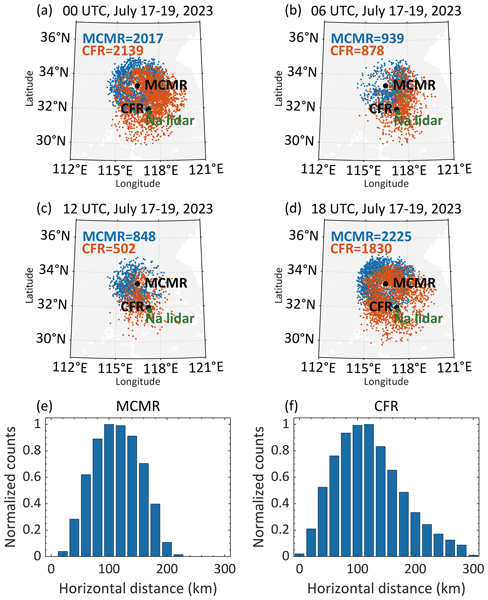
Chao Ban, Xin Fang, Wen Yi, Jie Zeng, Gunter Stober, Weilin Pan, Tao Li, and Xianghui Xue
Atmos. Meas. Tech., 19, 1697–1709, https://doi.org/10.5194/amt-19-1697-2026, https://doi.org/10.5194/amt-19-1697-2026, 2026
Short summary
Short summary
This paper presents an intercomparison of zonal winds observed by a sodium fluorescence lidar and three types of meteor radars – a multistatic meteor radar, a conventional monostatic radar, and a forward remote receiver – located near Hefei, China. The multistatic meteor radar shows the best agreement with the lidar measurements, confirming the reliability of its wind retrievals in the mesosphere and lower thermosphere and highlighting its potential for future atmospheric dynamics studies.

Xingjin Wang, Xin Fang, Wenhao Gao, Xianhang Chen, Tai Liu, Chengyun Yang, Tingdi Chen, Tao Li, and Xianghui Xue
Atmos. Meas. Tech., 19, 1629–1641, https://doi.org/10.5194/amt-19-1629-2026, https://doi.org/10.5194/amt-19-1629-2026, 2026
Short summary
Short summary
This paper reports the deployment of the first narrowband sodium lidar in the low-latitude region of China. The lidar observations are compared with satellite measurements and atmospheric models, confirming the scientific credibility of these results. Calculations of vertical gravity wave heat and sodium fluxes are used to investigate the influence of the space environment. This lidar system will provide a new ground-based detection device for studying atmospheric environment above the area.
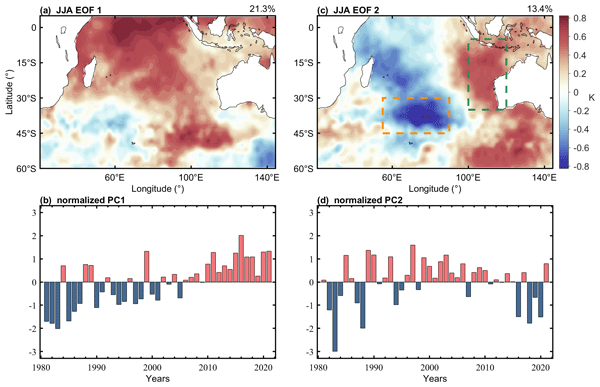
Chengyun Yang, Xiang Guo, Tao Li, Xinyue Wang, Jun Zhang, Xin Fang, and Xianghui Xue
Atmos. Chem. Phys., 26, 1021–1039, https://doi.org/10.5194/acp-26-1021-2026, https://doi.org/10.5194/acp-26-1021-2026, 2026
Short summary
Short summary
The Indian Ocean strongly influences weather and climate far beyond its region. We found that unusual sea surface warming patterns in the midlatitude Indian Ocean can disrupt winds and temperatures in the middle atmosphere, including the stratosphere and mesosphere, of the Southern Hemisphere. These disturbances alter ozone and air movement and may affect polar climate. Our results highlight the need to include Indian Ocean variability in climate models for better predictions.
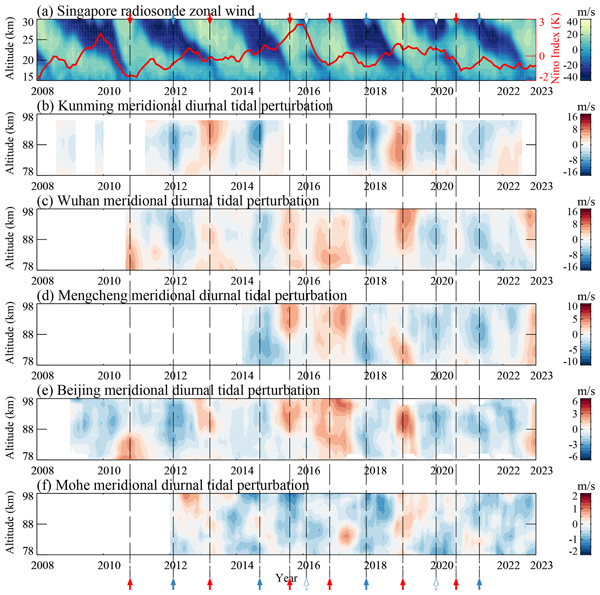
Jianyuan Wang, Na Li, Wen Yi, Xianghui Xue, Iain M. Reid, Jianfei Wu, Hailun Ye, Jian Li, Zonghua Ding, Jinsong Chen, Guozhu Li, Yaoyu Tian, Boyuan Chang, Jiajing Wu, and Lei Zhao
Atmos. Chem. Phys., 24, 13299–13315, https://doi.org/10.5194/acp-24-13299-2024, https://doi.org/10.5194/acp-24-13299-2024, 2024
Short summary
Short summary
We present the impact of quasi-biennial oscillation (QBO) disruption events on diurnal tides over the low- and mid-latitude MLT region observed by a meteor radar chain. By using a global atmospheric model and reanalysis data, it is found that the stratospheric QBO winds can affect the mesospheric diurnal tides by modulating the subtropical ozone variability in the upper stratosphere and the interaction between tides and gravity waves in the mesosphere.
Jianfei Wu, Wuhu Feng, Xianghui Xue, Daniel Robert Marsh, and John Maurice Campbell Plane
Atmos. Chem. Phys., 24, 12133–12141, https://doi.org/10.5194/acp-24-12133-2024, https://doi.org/10.5194/acp-24-12133-2024, 2024
Short summary
Short summary
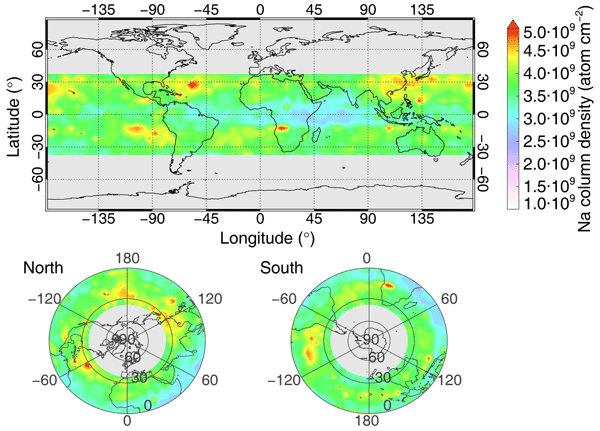
Metal layers occur in the mesosphere and lower thermosphere region 80–120 km from the ablation of cosmic dust. Nonmigrating diurnal tides are persistent global oscillations. We investigate nonmigrating diurnal tidal variations in metal layers using satellite observations and global climate model simulations; these have not been studied previously due to the limitations of measurements. The nonmigrating diurnal tides in temperature are strongly linked to the corresponding change in metal layers.
Penghao Tian, Bingkun Yu, Hailun Ye, Xianghui Xue, Jianfei Wu, and Tingdi Chen
Atmos. Chem. Phys., 23, 13413–13431, https://doi.org/10.5194/acp-23-13413-2023, https://doi.org/10.5194/acp-23-13413-2023, 2023
Short summary
Short summary
Modeling and prediction of ionospheric irregularities is an important topic in upper-atmospheric and upper-ionospheric physics. We proposed an artificial intelligence model to reconstruct the E-region ionospheric irregularities and first developed an open-source application for the community. The model reveals complex relationships between ionospheric irregularities and external driving factors. The findings suggest that spatiotemporal information plays an important role in the reconstruction.
Wen Yi, Jie Zeng, Xianghui Xue, Iain Reid, Wei Zhong, Jianfei Wu, Tingdi Chen, and Xiankang Dou
Atmos. Meas. Tech. Discuss., https://doi.org/10.5194/amt-2022-254, https://doi.org/10.5194/amt-2022-254, 2022
Revised manuscript not accepted
Short summary
Short summary
In recent years, the concept of multistatic meteor radar systems has attracted the attention of the atmospheric radar community, focusing on the MLT region. In this study, we apply a multistatic meteor radar system consisting of a monostatic meteor radar in Mengcheng (33.36° N, 116.49° E) and a remote receiver in Changfeng (31.98° N, 117.22° E) to estimate the two-dimensional horizontal wind field, and the horizontal divergence and relative vorticity of the wind field.
Bingkun Yu, Xianghui Xue, Christopher J. Scott, Mingjiao Jia, Wuhu Feng, John M. C. Plane, Daniel R. Marsh, Jonas Hedin, Jörg Gumbel, and Xiankang Dou
Atmos. Chem. Phys., 22, 11485–11504, https://doi.org/10.5194/acp-22-11485-2022, https://doi.org/10.5194/acp-22-11485-2022, 2022
Short summary
Short summary
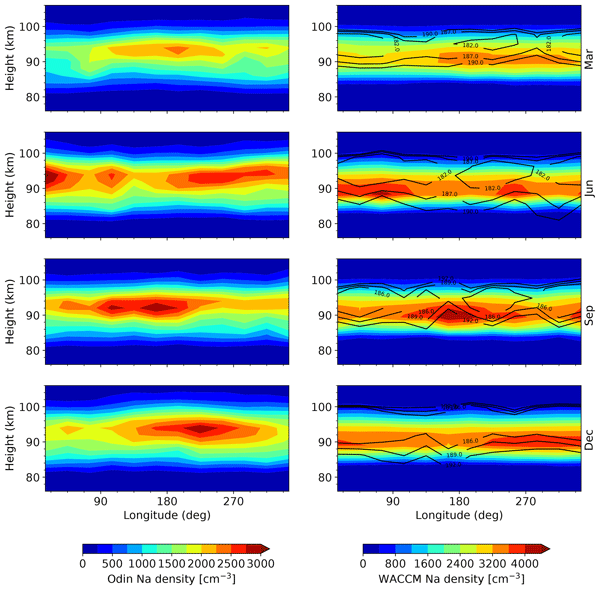
We present a study on the climatology of the metal sodium layer in the upper atmosphere from the ground-based measurements obtained from a lidar network, the Odin satellite measurements, and a global model of meteoric sodium in the atmosphere. Comprehensively, comparisons show good agreement and some discrepancies between ground-based observations, satellite measurements, and global model simulations.
Shican Qiu, Mengzhen Yuan, Willie Soon, Victor Manuel Velasco Herrera, Zhanming Zhang, and Xiankang Dou
Ann. Geophys. Discuss., https://doi.org/10.5194/angeo-2022-22, https://doi.org/10.5194/angeo-2022-22, 2022
Revised manuscript not accepted
Short summary
Short summary
In this paper, the solar radiation index Y10 acts as an indicator of the solar activity, and the vertical column of ice water content (IWC) characterizes the nature of the polar mesosphere cloud (PMC). Superposed epoch analysis is used to determine the time lag days of temperature and IWC anomalies in responding to Y10 for the PMC seasons from 2007–2015. The results show that the IWC can respond quickly to temperature within time lag of one day.
Yetao Cen, Chengyun Yang, Tao Li, James M. Russell III, and Xiankang Dou
Atmos. Chem. Phys., 22, 7861–7874, https://doi.org/10.5194/acp-22-7861-2022, https://doi.org/10.5194/acp-22-7861-2022, 2022
Short summary
Short summary
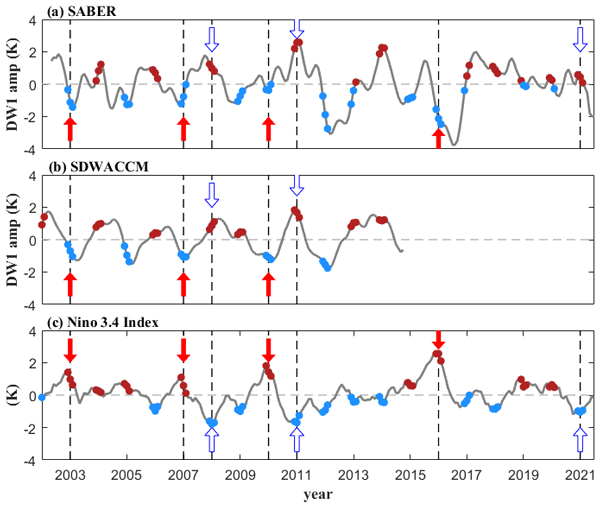
The MLT DW1 amplitude is suppressed during El Niño winters in both satellite observation and SD-WACCM simulations. The suppressed Hough mode (1, 1) in the tropopause region propagates vertically to the MLT region, leading to decreased DW1 amplitude. The latitudinal zonal wind shear anomalies during El Niño winters would narrow the waveguide and prevent the vertical propagation of DW1. The gravity wave drag excited by ENSO-induced anomalous convection could also modulate the MLT DW1 amplitude.

Dawei Tang, Tianwen Wei, Jinlong Yuan, Haiyun Xia, and Xiankang Dou
Atmos. Meas. Tech., 15, 2819–2838, https://doi.org/10.5194/amt-15-2819-2022, https://doi.org/10.5194/amt-15-2819-2022, 2022
Short summary
Short summary
During 11–20 March 2020, three aerosol transport events were investigated by a lidar system and an online bioaerosol detection system in Hefei, China.
Observation results reveal that the events not only contributed to high particulate matter pollution but also to the transport of external bioaerosols, resulting in changes in the fraction of fluorescent biological aerosol particles.
This detection method improved the time resolution and provided more parameters for aerosol detection.
Shican Qiu, Mengxi Shi, Willie Soon, Mingjiao Jia, Xianghui Xue, Tao Li, Peng Ju, and Xiankang Dou
Atmos. Chem. Phys. Discuss., https://doi.org/10.5194/acp-2021-1085, https://doi.org/10.5194/acp-2021-1085, 2022
Revised manuscript not accepted
Short summary
Short summary
The solitary wave theory is applied for the first time to study the sporadic sodium layers (NaS). We perform soliton fitting processes on the observed data from the Andes Lidar Observatory, and find out that 24/27 NaS events exhibit similar features to a soliton. Time series of the net anomaly reveal the same variation process to the solution of a five-order KdV equation. Our results suggest the NaS phenomenon would be an appropriate tracer for nonlinear wave studies in the atmosphere.
Liang Tang, Sheng-Yang Gu, and Xian-Kang Dou
Atmos. Chem. Phys., 21, 17495–17512, https://doi.org/10.5194/acp-21-17495-2021, https://doi.org/10.5194/acp-21-17495-2021, 2021
Short summary
Short summary
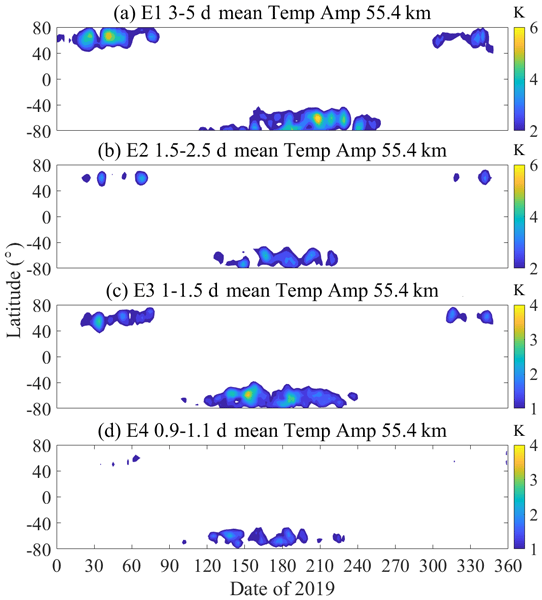
Our study explores the variation in the occurrence date, peak amplitude and wave period for eastward waves and the role of instability, background wind structure and the critical layer in eastward wave propagation and amplification.
Cited articles
Alpers, M., Eixmann, R., Fricke-Begemann, C., Gerding, M., and Höffner, J.: Temperature lidar measurements from 1 to 105 km altitude using resonance, Rayleigh, and Rotational Raman scattering, Atmos. Chem. Phys., 4, 793–800, https://doi.org/10.5194/acp-4-793-2004, 2004.
Behrendt, A. and Reichardt, J.: Atmospheric temperature profiling in the presence of clouds with a pure rotational Raman lidar by use of an interference-filter-based polychromator, Appl. Optics, 39, 1372–1378, https://doi.org/10.1364/AO.39.001372, 2000.
Behrendt, A., Nakamura, T., Onishi, M., Baumgart, R., and Tsuda, T.: Combined Raman lidar for the measurement of atmospheric temperature, water vapor, particle extinction coefficient, and particle backscatter coefficient, Appl. Optics, 41, 7657–7666, https://doi.org/10.1364/AO.41.007657, 2002.
Bu, L. B., Liu, J. Q., Zhou, J., Yu, T., and Chen, W. B.: Development of a direct-detection wind lidar based on Fizeau interferometer, Lidar Technologies, Techniques, And Measurements For Atmospheric Remote Sensing II, WOS:000243895800026, https://doi.org/10.1117/12.689296, 2006.
Dou, X., Han, Y., Sun, D., Xia, H., Shu, Z., Zhao, R., Shangguan, M., and Guo, J.: Mobile Rayleigh Doppler lidar for wind and temperature measurements in the stratosphere and lower mesosphere, Opt. Express, 22, A1203–A1221, https://doi.org/10.1364/OE.22.0A1203, 2014.
Garnier, A. and Chanin, M. L.: Description of a Doppler Rayleigh lidar for measuring winds in the middle atmosphere, Appl. Phys. B, 55, 35–40, https://doi.org/10.1007/BF00348610, 1992.
Hagen, N., Kupinski, M., and Dereniak, E. L.: Gaussian profile estimation in one dimension, Appl. Optics, 46, 5374–5383, https://doi.org/10.1364/AO.46.005374, 2007.
Hair, J. W., Caldwell, L. M., Krueger, D. A., and She, C.-Y.: High-Spectral-Resolution Lidar with Iodine-Vapor Filters: Measurement of Atmospheric-State and Aerosol Profiles, Appl. Optics, 40, 5280–5294, https://doi.org/10.1364/AO.40.005280, 2001.
Hauchecorne, A. and Chanin, M. L.: Density And Temperature Profiles Obtained By Lidar Between 35-km and 70-km, Geophys. Res. Lett., 7, 565–568, https://doi.org/10.1029/GL007i008p00565, 1980.
Hua, D. X. and Kobayashi, T.: Ultraviolet Rayleigh-Mie lidar by use of a multicavity Fabry-Perot filter for accurate temperature profiling of the troposphere, Appl. Optics, 44, 6474–6478, https://doi.org/10.1364/AO.44.006474, 2005.
Kaifler, B. and Kaifler, N.: A Compact Rayleigh Autonomous Lidar (CORAL) for the middle atmosphere, Atmos. Meas. Tech., 14, 1715–1732, https://doi.org/10.5194/amt-14-1715-2021, 2021.
Liu, H., Liu, J., Wu, S., Zhang, S., Li, J., Chen, C., Sun, D., and Han, Y.: Wind Profiling from Boundary Layer to Stratosphere Using a Scanning Rayleigh Doppler Lidar and a Coherent Lidar, Photonics, 13, 533, https://doi.org/10.3390/photonics13060533, 2026.
Liu, Y.-W., Sun, X.-J., Zhang, C.-L., Li, S.-H., Zhou, Y.-B., and Li, Y.-L.: Research on Lidar Temperature Measurement Method Based on Fizeau Interferometer, Spectrosc. Spect. Anal., 39, 3302–3307, https://www.researching.cn/ArticlePdf/m00026/2019/39/10/2019-10-3302.pdf (last access: 10 November 2026), 2019.
Liu, Z. S., Wu, D., Liu, J. T., Zhang, K. L., Chen, W. B., Song, X. Q., Hair, J. W., and She, C. Y.: Low-altitude atmospheric wind measurement from the combined Mie and Rayleigh backscattering by Doppler lidar with an iodine filter, Appl. Optics, 41, 7079–7086, https://doi.org/10.1364/AO.41.007079, 2002.
McKay, J. A.: Assessment of a multibeam Fizeau wedge interferometer for Doppler wind lidar, Appl. Optics, 41, 1760–1767, https://doi.org/10.1364/AO.41.001760, 2002.
Pu, L.: LiangyuPuu/Fizeau-HSRL-Forward-Model: Fizeau-HSRL Forward Model v1.0.0 (Version v1.0.0), Zenodo [code], https://doi.org/10.5281/zenodo.22196460, 2026.
Pu, L., Chen, T., Han, Y., Su, Z., Meng, Z., Song, Y., Wen, Y., Chen, C., Sun, D., Xue, X., and Dou, X.: Observation data of a High-Spectral-Resolution Lidar (HSRL) [DS/OL], V1, Science Data Bank, [data set], https://doi.org/10.57760/sciencedb.00zrn, 2026.
Radlach, M., Behrendt, A., and Wulfmeyer, V.: Scanning rotational Raman lidar at 355 nm for the measurement of tropospheric temperature fields, Atmos. Chem. Phys., 8, 159–169, https://doi.org/10.5194/acp-8-159-2008, 2008.
Vaughan, M., Ridley, K., Witschas, B., Lux, O., Nikolaus, I., and Reitebuch, O.: Spectral performance analysis of the Fizeau interferometer on board ESA's Aeolus wind lidar satellite, Atmos. Meas. Tech., 18, 2149–2181, https://doi.org/10.5194/amt-18-2149-2025, 2025.
Wang, X., Fang, X., Gao, W., Chen, X., Liu, T., Yang, C., Chen, T., Li, T., and Xue, X.: Vertical distribution of heat and sodium fluxes in the mesopause region measured by sodium lidar over Hainan, China (109° E, 19° N), Atmos. Meas. Tech., 19, 1629–1641, https://doi.org/10.5194/amt-19-1629-2026, 2026.
Witschas, B.: Analytical model for Rayleigh–Brillouin line shapes in air, Appl. Optics, 50, 267–270, https://doi.org/10.1364/AO.50.000267, 2011a.
Witschas, B.: Analytical model for Rayleigh–Brillouin line shapes in air: errata, Appl. Optics, 50, 5758–5758, https://doi.org/10.1364/AO.50.005758, 2011b.
Witschas, B., Vieitez, M. O., van Duijn, E.-J., Reitebuch, O., van de Water, W., and Ubachs, W.: Spontaneous Rayleigh–Brillouin scattering of ultraviolet light in nitrogen, dry air, and moist air, Appl. Optics, 49, 4217–4227, https://doi.org/10.1364/AO.49.004217, 2010.
Witschas, B., Gu, Z., and Ubachs, W.: Temperature retrieval from Rayleigh-Brillouin scattering profiles measured in air, Opt. Express, 22, 29655–29667, https://doi.org/10.1364/OE.22.029655, 2014a.
Witschas, B., Lemmerz, C., and Reitebuch, O.: Daytime measurements of atmospheric temperature profiles (2–15 km) by lidar utilizing Rayleigh-Brillouin scattering, Opt. Lett., 39, 1972–1975, https://doi.org/10.1364/OL.39.001972, 2014b.
Witschas, B., Reitebuch, O., Lemmerz, C., Kableka, P. G., Kondratyev, S., Gu, Z., and Ubachs, W.: The Measurement Of Tropospheric Temperature Profiles Using Rayleigh-Brillouin Scattering: Results From Laboratory And Atmospheric Studies, 27th International Laser Radar Conference (ILRC 27), 2016, WOS:000386726600266, https://doi.org/10.1051/epjconf/201611927004, 2016.
Witschas, B., Lemmerz, C., Lux, O., Marksteiner, U., Reitebuch, O., and Schafler, A.: Airborne temperature profiling in the troposphere during daytime by lidar utilizing Rayleigh-Brillouin scattering, Opt. Lett., 46, 4132–4135, https://doi.org/10.1364/OL.431350, 2021.
Witschas, B., Lemmerz, C., Geiß, A., Lux, O., Marksteiner, U., Rahm, S., Reitebuch, O., Schäfler, A., and Weiler, F.: Validation of the Aeolus L2B wind product with airborne wind lidar measurements in the polar North Atlantic region and in the tropics, Atmos. Meas. Tech., 15, 7049–7070, https://doi.org/10.5194/amt-15-7049-2022, 2022a.
Witschas, B., Lemmerz, C., Lux, O., Marksteiner, U., Reitebuch, O., Weiler, F., Fabre, F., Dabas, A., Flament, T., Huber, D., and Vaughan, M.: Spectral performance analysis of the Aeolus Fabry–Pérot and Fizeau interferometers during the first years of operation, Atmos. Meas. Tech., 15, 1465–1489, https://doi.org/10.5194/amt-15-1465-2022, 2022b.
Xu, J. Q., Witschas, B., Liang, K., Wang, Y. Q., and Ubachs, W.: Characterization Of A Novel Temperature Lidar Receiver By Means Of Laboratory Rayleigh-Brillouin Scattering Measurements, 29th International Laser Radar Conference (ILRC 29), WOS:000591371500122, https://doi.org/10.1051/epjconf/202023707004, 2020.
Xu, J. Q., Witschas, B., Kabelka, P. G., and Liang, K.: High-spectral-resolution lidar for measuring tropospheric temperature profiles by means of Rayleigh-Brillouin scattering, Opt. Lett., 46, 3320–3323, https://doi.org/10.1364/OL.424526, 2021.
Short summary
Atmospheric wind and temperature are essential for understanding weather and atmospheric dynamics. We developed a new lidar receiver that measures both quantities from the same atmospheric backscatter signal without frequency scanning. Field experiments demonstrated wind measurements from 2 to 20 km and simultaneous wind and temperature measurements from 5.3 to 20 km, with good agreement with radiosondes.
Atmospheric wind and temperature are essential for understanding weather and atmospheric...


Altmetrics
Final-revised paper
Preprint