
the Creative Commons Attribution 4.0 License.
the Creative Commons Attribution 4.0 License.
 | 24 Nov 2026
Development of an offline Aerosol Mass Spectrometry method for organic aerosol characterization in a globally distributed Surface Particulate Matter Network
Yuxuan Ren

Jhao-Hong Chen
Christopher R. Oxford
Brent J. Williams
Rodney J. Weber
Global measurements of organic aerosol (OA) concentrations and chemical composition remain limited and unevenly distributed. While fine particulate matter monitoring networks, including the globally distributed Surface Particulate Matter Network (SPARTAN), provide an established framework for measurements, their current methodologies do not fully support comprehensive OA characterization. Aerosol Mass Spectrometry (AMS) is widely used for real-time OA composition measurements, but its cost, complexity, and logistical requirements limit consistent, long-term online deployment across multiple countries, particularly at the global scale. Here we develop and evaluate an offline AMS methodology to characterize OA in particulate matter collected on Teflon filters routinely used by monitoring networks. Using a commercial ultrasonic nebulizer coupled with a syringe pump, this offline method is highly reproducible, requires small extract volumes (2 mL), offers low detection limits (1.7 µg OA and 0.43 µg sulfate per entire filter), and achieves higher nebulization efficiency than previous methods. We evaluate this offline AMS method against co-located online AMS observations. We find that oxygenated OA is effectively recovered (66 ± 27 %), while the recovery is lower for hydrocarbon-like OA, consistent with its limited water solubility. This approach offers a new capability for SPARTAN and is readily adaptable to other monitoring networks. Its application across networks will broaden the spatiotemporal coverage of AMS-based OA measurements and improve methodological and instrumental consistency to support ongoing efforts to build a long-term, globally consistent OA dataset.
- Article
(2859 KB) - Full-text XML
-
Supplement
(3311 KB) - BibTeX
- EndNote


Organic aerosol (OA) constitutes a substantial fraction of atmospheric fine particulate matter (PM2.5) (Kanakidou et al., 2005; Zhang et al., 2007). OA influences climate through direct aerosol-radiation interactions (Chung et al., 2012) and cloud formation (Sareen et al., 2013), and affects human health due to its high potential to inflict oxidative stress and inflammation by generating reactive oxygenated and nitrogen species (Bates et al., 2019; Tuet et al., 2016). OA originates from both primary and secondary processes. Primary OA (POA) is directly emitted into the atmosphere from sources such as vehicle exhaust, biomass burning, and cooking. Secondary OA (SOA) is formed through gas-phase oxidation of anthropogenic and biogenic volatile organic compounds (VOCs) and subsequent condensation or nucleation (Jimenez et al., 2009; Kroll and Seinfeld, 2008). The large number of molecular species and reaction pathways involved leads to extreme chemical complexity, complicating the characterization of OA loadings, spatiotemporal variability, and atmospheric oxidation processes (Kroll et al., 2011; Williams et al., 2007).
Despite advances in instruments capable of detailed chemical speciation, global OA concentrations and chemical composition remain poorly constrained (Sun et al., 2025). Measurements are largely derived from independent field campaigns that vary in instrumentation, sampling objectives, and methodologies, and are typically confined to limited time periods. In addition, these measurements are mostly conducted in developed regions in the northern midlatitudes, with relatively sparse representation from the Global South (Jeon et al., 2023; Tsimpidi et al., 2025). Therefore, global OA datasets compiled from collections of unique field campaigns face challenges such as limited comparability and incomplete spatiotemporal coverage, which further inhibit accurate evaluation of global OA simulations in chemical transport and climate models (Pai et al., 2020; Shrivastava et al., 2017). This highlights the need to routinely and consistently measure OA concentrations and composition across long-term monitoring networks, particularly at the global scale.
The Surface Particulate Matter Network (SPARTAN, https://www.spartan-network.org/, last access: 18 November 2026) collects PM2.5 on Teflon filters from globally distributed sites that prioritize undersampled, densely populated regions. This network provides long-term, ground-based PM2.5 composition measurements, including black carbon (BC), trace elements, water-soluble ions, and organic carbon (OC), to support the development and evaluation of satellite-derived PM2.5 estimates (Liu et al., 2024; McNeill et al., 2020; Oxford et al., 2026; Ren et al., 2025; Singh et al., 2026; Snider et al., 2015, 2016; Weagle et al., 2018). Its consistency across globally distributed sites offers the possibility of constructing a comprehensive global OA dataset. Leveraging this potential, however, requires targeted methodological development to enable comprehensive OA characterization within the network.
The Aerodyne High-Resolution Time-of-Flight Aerosol Mass Spectrometer (HR-ToF-AMS) has been extensively used for real-time measurement of OA with high time resolution and sensitivity in field campaigns (DeCarlo et al., 2006). By coupling thermal vaporization with 70 eV electron ionization (EI), AMS provides quantitative mass spectra of non-refractory aerosol components, including OA, sulfate, nitrate, ammonium, and chloride (Canagaratna et al., 2007). However, its high cost, operational complexity, and logistical requirements limit its feasibility for long-term, simultaneous deployment across many developing countries. This limitation has stimulated the development of offline AMS methodology, where atmospheric particulate matter samples are collected in the field and subsequently atomized for AMS analysis in the laboratory.
Previous studies have demonstrated the promise of offline AMS for quantitative OA characterization. Sun et al. (2011) analyzed water extracts of PM2.5 in the southeastern US to determine water-soluble organic matter to organic carbon (OM OC) ratios using AMS, complemented by total organic carbon (TOC) measurements of water-soluble OC. Mihara and Mochida (2011) investigated extraction with multiple solvents (water, methanol, and ethyl acetate) for PM collected in urban Nagoya, Japan. Daellenbach et al. (2016) systematically assessed water-extract offline AMS and quantified source-related OA recoveries through comparison with co-located online measurements in Paris and Zurich. To extend applicability to lower mass loadings, O'Brien et al. (2019) introduced a small-volume nebulizer for microgram-level analysis using calibration based on an internal standard (IS), while Niedek et al. (2023) developed another micronebulization technique with improved detection limits for PM collected from uncrewed platforms. To further improve OA recoveries, Vasilakopoulou et al. (2023) proposed excluding filtration during water extraction to retain partially soluble and insoluble OA fractions, and Khare et al. (2025) demonstrated improved OC recovery using organic solvents, with high similarity between online and offline mass spectra. Beyond methodological development and evaluation, offline AMS has been directly applied to characterize long-term OA concentrations and infer source properties across sites in Europe (Bozzetti et al., 2016, 2017a, b; Casotto et al., 2022, 2023; Daellenbach et al., 2017; Moschos et al., 2022; Srivastava et al., 2021; Vlachou et al., 2018, 2019), the US (Niedek et al., 2025), China (Cui et al., 2024; Ge et al., 2017; Huang et al., 2014; Li et al., 2021; Qiu et al., 2019; Xu et al., 2015a; Ye et al., 2017a, b), and India (Bhowmik et al., 2024; Cash et al., 2023).
Despite these developments, offline AMS has not been integrated as a routine measurement within globally distributed monitoring networks. For application within large-scale networks, the offline method is expected to meet several criteria: it should efficiently generate particles from small-volume extracts given limited filter mass loadings, the setup should be reproducible and easy to maintain for rapid analysis, and the procedures should be compatible with existing protocols within monitoring frameworks. However, current offline AMS approaches present practical limitations for routine implementation within large-scale monitoring networks. For example, the use of customized nebulizers can limit reproducibility, and some configurations require relatively large extract volumes (typically 5–15 mL) or additional operational steps and time to ensure cleaning and stability. In addition, quantification based on an internal standard requires rigorous calibration, and the use of externally spiked internal standards (e.g., isotopically labeled ammonium nitrate or ammonium sulfate) may introduce potential interference while increasing sample preparation complexity. These considerations motivate the development of an offline AMS method that is reproducible, operationally streamlined, and compatible with existing SPARTAN protocols for high-throughput routine measurements across globally distributed sites.
In this study, we develop an offline AMS methodology well-suited for additionally characterizing water-soluble OA in SPARTAN Teflon filters while sustaining existing measurements of PM2.5 chemical composition, with broader applicability to other monitoring networks that use similar filter-based sampling. We use a commercial ultrasonic nebulizer for high reproducibility and select sulfate as an internal standard given its routine measurement in monitoring networks. We further evaluate this offline AMS method against co-located online AMS measurements. This development of the offline AMS methodology establishes a basis for a comprehensive OA dataset with consistent instrumentation and methodology across globally distributed sites in densely populated regions.
2.1 Chemicals
Ammonium sulfate (AS, American Chemical Society (ACS) grade) and nitric acid (ACS grade) are from Fisher Scientific. Methanol (high-performance liquid chromatography (HPLC) grade), glucose (≥ 99.5 %, gas chromatography (GC) grade), DL-4-Hydroxy-3-methoxymandelic acid (HMMA, ≥ 98 % HPLC grade), and poly(ethylene glycol) (PEG-400) are from MilliporeSigma. All solutions are prepared using ultrapure water (Milli-Q water, 18.2 M Ωcm). Prior to use, all glassware is soaked in 1 % nitric acid for 24 h, rinsed sequentially with methanol and then three times with ultrapure water, and baked at 500 °C for 5 h.
2.2 SPARTAN sampling and chemical analyses
SPARTAN is a long-term global network that measures ground-based PM composition at sites distributed across densely populated regions. SPARTAN and its measurements have been described in detail in the literature (Liu et al., 2024; McNeill et al., 2020; Oxford et al., 2026; Ren et al., 2025; Singh et al., 2026; Snider et al., 2015, 2016; Weagle et al., 2018). PM samples are collected on 25 mm Teflon filters (PT25DMCAN-PF03A, Measurement Technology Laboratories, Bloomington, Minnesota, US) assembled in cartridges for use in sampling stations (SS5, AirPhoton, Baltimore, Maryland, US) coupled with a sharp-cut cyclone (SCC1.829, Mesa Laboratories, Lakewood, Colorado, US) typically operated at a target flow rate of 5 L min−1 for a PM2.5 size cut. Each cartridge consists of seven sample filters and one field blank. Sampling duration is site-specific, ranging from 12 to 48 h per filter to deposit approximately 100–200 µg of collected aerosol mass.
This network routinely provides measurements of PM mass and chemical composition. Filters are equilibrated and weighed before and after sampling under controlled conditions of 21.5 °C and 35 % relative humidity (Oxford et al., 2026). Chemical analysis begins with non-destructive optical techniques, including Hybrid integrating plate/sphere (HIPS) for BC (White et al., 2016), Fourier transform infrared spectroscopy (FT-IR) for OC (Debus et al., 2022; Dillner and Takahama, 2015), and X-ray fluorescence (XRF) for elements (Liu et al., 2024). Elements, including sulfur, are quantified using an energy dispersive XRF (Epsilon 4, Malvern PANalytical, Worcestershire, UK). Calibration is performed annually, with monthly checks to confirm instrument stability (Liu et al., 2024). Following these non-destructive analyses, filters undergo a destructive extraction in which collected particles are dissolved into solution. The entire 25 mm Teflon filter (3.53 cm2 collection area) is placed aerosol-side up in a 20 mL scintillation vial and covered with 0.2 mL of HPLC-grade methanol followed by 5.8 mL of ultrapure water. The vial is sealed with aluminum foil and a plastic cap and sonicated for 30 min at room temperature. Sonication facilitates the release of collected aerosol from the filter into the extraction solvent, where soluble components dissolve and insoluble material may remain suspended. The extract is then filtered through a 0.2 µm polypropylene syringe filter. A 4 mL aliquot of the filtered extract is refrigerated for Ion chromatography (IC) analysis to quantify water-soluble ions. Cations, including ammonium, sodium, potassium, calcium, and magnesium, and anions, including sulfate, nitrate, and chloride, are measured using two IC systems (Dionex Integrion, Thermo Scientific, Waltham, Massachusetts, US). The cation system uses a methanesulfonic acid eluent generation system with a Dionex CS12A column and a CG12A guard column, while the anion system uses a potassium hydroxide eluent generation system with a Dionex AS18 column and an AG18 guard column. Calibrations for both systems are performed at the beginning of each measurement sequence using standards prepared biweekly. The remaining 2 mL aliquot of the filtered extract is transferred to a glass vial, tightly capped, sealed around the cap-vial interface with Teflon tape, placed in a sealed Ziploc bag, and frozen for subsequent AMS analysis to characterize OA, which is the focus of this study.
2.3 Offline AMS methodology
Our offline AMS methodology consists of a syringe pump (780100I, Thermo Fisher Scientific Inc., Waltham, Massachusetts, US), a commercial ultrasonic nebulizer (U-5000AT+, Cetac Technologies Inc., Omaha, Nebraska, US), a diffusion dryer, a Scanning Mobility Particle Sizer (SMPS, Model 3938, TSI Inc., Shoreview, Minnesota, US), and an HR-ToF-AMS (Aerodyne Research Inc., Billerica, Massachusetts, US). A simplified schematic of the experimental setup is shown in Fig. S1 in the Supplement.
Filter extracts are delivered by the syringe pump to the ultrasonic nebulizer, where aerosol is generated through oscillation of a piezoelectric transducer operating at 1.4 MHz (Ohata et al., 2011). Dry, zero air is introduced near the transducer to generate airflow. The downstream tube heater is turned off to minimize potential volatilization loss of organics, and water vapor is subsequently condensed in a tube maintained at 3 °C. The generated particles are then dried using a silica gel diffusion dryer and analyzed by the HR-ToF-AMS and SMPS for chemical composition and size distribution measurements. Figure S2 illustrates the measurement sequence for a SPARTAN cartridge using representative raw AMS data. Field blank filters are analyzed using the same procedure as the sample filters. Each cartridge measurement also includes a laboratory blank with no filter present, with signals used for blank subtraction within the corresponding cartridge. In addition, ultrapure water is nebulized between samples to rinse the system, with residual particles monitored using the SMPS before proceeding to the next sample. A 10 mg L−1 AS solution is analyzed at the beginning and end of each experimental day to verify instrument stability. For future routine analysis of SPARTAN samples spanning a wider range of loadings, additional AS standard runs can be included periodically and after high loading samples to provide a more stringent check for organic carryover in the AMS.
The choice of the nebulization system is critical for offline AMS methods. Commonly used commercial nebulizers, such as the TSI nebulizer (Model 3076, TSI Inc., Shoreview, Minnesota, US) (Li et al., 2021; Sun et al., 2011) and the Apex Q nebulizer (Elemental Scientific Inc., Omaha, Nebraska, US) (Khare et al., 2025; Vlachou et al., 2018), typically require relatively large extract volumes, which can be challenging for filters with limited collected mass. Custom nebulization systems (Cash et al., 2023; Niedek et al., 2023; O'Brien et al., 2019) have expanded the capabilities of offline AMS through specialized designs. However, these configurations are not commercially available and may be less accessible for routine implementation. The ultrasonic nebulizer used in this study has been applied in previous studies (Chen et al., 2019; Fang et al., 2015; Xu et al., 2017) and can efficiently nebulize small extract volumes while generating relatively large particles aligned with the AMS transmission efficiency. The system is stable and easy to clean and maintain, with carryover removed by nebulizing ultrapure water between samples for a few minutes (Fig. S2). Under routine operation, approximately 14–21 filter samples can be analyzed per day, supporting routine analysis of large-scale monitoring networks.
The HR-ToF-AMS operating principles, calibration procedures, and analysis protocols have been described extensively elsewhere (Canagaratna et al., 2007; DeCarlo et al., 2006). AMS provides quantitative mass spectra of non-refractory submicron PM (PM1) components, including OA, sulfate, nitrate, ammonium, and chloride. In this study, the HR-ToF-AMS is operated in V mode (DeCarlo et al., 2006) over an range of 12–210, providing a mass resolution of approximately 2000–3000 m Δm−1 and a temporal resolution of 1 min. AMS data are processed using the standard AMS data analysis toolkits Squirrel v1.67A (SeQUential Igor data RetRiEvaL) and Pika v1.27A (Peak Integration by Key Analysis) in the IGOR Pro software package (Wavemetrics Inc., Portland, Oregon, US). Values for the AMS nitrate ionization efficiency (IE) and relative ionization efficiencies (RIEs) for sulfate and ammonium are determined through calibration following standard procedures. A default RIE value of 1.4 is assumed for OA (Xu et al., 2018). The composition-dependent collection efficiency (CDCE) is applied following Middlebrook et al. (2012).
We perform positive matrix factorization (PMF) analysis for OA factor apportionment. The principles of PMF have been described in detail elsewhere (Paatero and Tapper, 1994; Ulbrich et al., 2009a). Briefly, PMF is a bilinear unmixing receptor model that quantitatively resolves organic mass spectra into a linear combination of static factor profiles and their time-dependent contributions, with each factor attributed to characteristic sources and atmospheric processes. PMF analyses are performed using the PMF Evaluation Toolkit (PET) v3.08E or the multilinear engine (ME-2) (Paatero, 1999) implemented through the Source Finder (SoFi Pro 6.4; Datalystica Ltd., Villigen, Switzerland) (Canonaco et al., 2013). Details of the PMF analysis are provided in the Supplement.

Figure 1Particle size distributions generated from ammonium sulfate (AS) solutions and measured with a Scanning Mobility Particle Sizer (SMPS) to optimize nebulization system parameters. Panels show the effects of (a) carrier gas flow rate, (b) liquid feed rate, and (c) solution concentration. Colored lines represent the mean of three runs, with shaded areas indicating the standard error. The diameter (Dp) here is the electrical mobility diameter (Dm).
3.1 Optimization and characterization of nebulization system
We optimize key parameters of the nebulization system, including carrier gas flow rate and liquid feed rate, to generate particles with high transmission efficiency in the AMS and high mass concentrations (Fig. 1). Increasing the carrier gas flow rate enhances aerosol transport and reduces upstream losses, leading to higher particle mass concentrations. However, at sufficiently high flow rates, dilution by the carrier gas becomes dominant and reduces particle mass concentrations. Varying the carrier gas flow rate (0.5, 1.0, 1.3, and 1.5 L min−1) shows a clear increase followed by a decrease in particle mass concentration, with 1.3 L min−1 identified as optimal. For the liquid feed rate, higher feed rates increase particle mass concentrations due to increased solute delivery. However, increasing the feed rate also reduces the number of AMS runs per sample of a finite extract volume. We vary the liquid feed rate at 0.10, 0.12, 0.15, and 0.20 mL min−1, and select 0.20 mL min−1 to maximize particle mass concentration while maintaining an adequate AMS sampling period, providing approximately 10 min of measurement time from a 2 mL extract.
Under these optimized conditions, we characterize particle size distributions generated from AS solutions at concentrations of 2, 5, 10, and 20 mg L−1. These concentrations are selected to represent the range of inorganic ion loadings observed in SPARTAN samples, with 2 and 20 mg L−1 corresponding approximately to the 5th and 95th percentiles. Across this range, the regenerated aerosol exhibits a mode electrical mobility diameter (Dm) of approximately 120 to 180 nm (Fig. 1c), which aligns well with the AMS transmission efficiency that is nearly 100 % for particles with vacuum aerodynamic diameters (Dva) between 70 and 500 nm (Jimenez et al., 2003; Liu et al., 2007).
3.2 Quantification using internal standard
Nebulization efficiency (NE), defined as the ratio of mass measured by the AMS to the mass of solute nebulized, is a key indicator of offline AMS sensitivity (O'Brien et al., 2019). To quantify NE, 2 mL of binary solutions containing varying proportions of sulfate and organic species are nebulized at a fixed total solute concentration of 40 mg L−1. The organic species examined include glucose, HMMA, and PEG-400. The analyte concentrations for each solution are listed in Table S1 in the Supplement. For glucose, NE ranges from 0.70 % to 1.2 %, while the corresponding sulfate NE ranges from 0.31 % to 0.91 %, with NE varying with solution composition (Sect. S1 in the Supplement; Fig. S3). The NE determined using this offline method is higher than that reported by O'Brien et al. (2019) and comparable to values reported by Niedek et al. (2023) (Table 1). We note that Fang et al. (2015) reported substantially higher efficiencies (47 %–60 %) using the same nebulizer for XRF analysis of water-soluble elements. This difference arises primarily because the AMS samples only a small fraction of the nebulized air (6.2 % in this study), while Fang et al. (2015) quantified the full nebulized output.
Table 1Summary of offline AMS methods for OA characterization and comparison with this study.

Notes: a Xu et al. (2017) use a Particle-into-Liquid Sampler (PILS) to convert ambient PM directly into aqueous extracts, rather than collecting particles on filters followed by solvent extraction as in most offline studies; n/a indicates not reported or not applicable. b Particle size comparisons across studies should be interpreted with caution due to differences in solvent composition, concentration, and measurement techniques, including AMS, Scanning Mobility Particle Sizer (SMPS), hygroscopicity tandem differential mobility analyzer (HTDMA), and Zetasizer. c Electrical mobility diameter. d Vacuum aerodynamic diameter. e Hydrodynamic diameter. f The unit is reported as mLsolution m in the original study, representing the volume of extract solution (mL) consumed per cubic meter of carrier air entering the AMS. g Results are reported for OA unless explicitly stated; detection limits are expressed as mass per filter based on blank measurements unless otherwise noted. h Detection limits are expressed as mass in solution, estimated using a standard binary solution containing sucrose and sulfate, each at a concentration of 0.06 mg L−1. i Results reported for OC.
Variability in NE and the nonlinearity between nebulized and measured mass necessitate the use of an internal standard (IS) to quantify organic concentrations. In offline AMS studies, the IS should be non-refractory, soluble, chemically unreactive, distinguishable from other sample components, internally mixed with organics, and experience consistent and quantifiable nebulization processes (O'Brien et al., 2019). The organic-to-IS ratio determined from AMS signals can then be used to correct for any variations in NE and AMS sensitivity. Ambient OA concentration is subsequently obtained by multiplying this AMS-derived organic-to-IS ratio by an independently quantified IS concentration. The IS can be either an inorganic ion originally present in the extract that can be independently quantified, or a species externally spiked into the solution prior to nebulization at a known concentration. Internal standards used in previous studies include sulfate (Daellenbach et al., 2016; Li et al., 2021), nitrate (Srivastava et al., 2021), externally added isotopically labeled ammonium sulfate or ammonium nitrate (Casotto et al., 2022; Cui et al., 2024; Khare et al., 2025), and externally added phthalic acid (Mihara and Mochida, 2011). In this study, we select sulfate as the internal standard because it is consistently present in samples, predominantly water-soluble and non-refractory for major atmospheric sulfate species, nonvolatile, and routinely quantified by IC and XRF (through sulfur) within SPARTAN. Potential limitations of this approach are discussed below.
Figure 2 shows calibration curves for glucose, HMMA, and PEG-400 using sulfate as the internal standard. To cover organic-to-sulfate ratios characteristic of urban background PM, we vary the ratios in solution from 0.18 to 14. We observe strong linearity (r2>0.996) for organic-to-sulfate ratios between 0.28 and 2.8 in solution, while nonlinearity appears at higher ratios. This likely reflects increased AMS collection efficiency as organic-coated particles are more likely to adhere upon impact with the vaporizer (Matthew et al., 2008; Xu et al., 2018). Compared with previous offline AMS studies, this work explicitly considers nonlinearity in the calibration relationship. Given the diverse properties of PM across globally distributed SPARTAN sites, extending the organic-to-IS ratio range and accounting for nonlinearity are therefore important for robust OA quantification.

Figure 2The organic-to-sulfate ratio in known solutions compared to that determined by AMS for three binary solutions (glucose, DL-4-Hydroxy-3-methoxymandelic acid (HMMA), and poly(ethylene glycol) (PEG-400)) across nine sulfate-organic combinations at a total solute concentration of 40 mg L−1. The main panel (a) shows quadratic fits to all data, with fitted equations annotated for each compound. The inset (b) shows the corresponding linear relationships for six ratios within the solution range of 0.28–2.8. Data are shown as mean and standard error from 8–12 replicate runs. Standard errors plotted as vertical error bars are on the order of 10−2 and imperceptible at the scale of the figure.
Within the linear range (Fig. 2b), we find slopes of 1.6, 0.89, and 2.2 for glucose, HMMA, and PEG-400, respectively. These slopes reflect the ratio of the AMS RIE of each organic compound to the RIE of sulfate. For complex organic mixtures, the most accurate calibration would ideally use standards representative of the average chemical composition of ambient OA. However, such representation is challenging given the chemical diversity and spatiotemporal variability of atmospheric OA. For urban background aerosol, an RIE of 1.4 is commonly applied for OA (Canagaratna et al., 2007; Xu et al., 2018), and an RIE of 0.97 for sulfate was determined from the experiment-specific calibration in this study, corresponding to an organic-to-sulfate RIE ratio of approximately 1.4. Given that the glucose-derived slope is consistent with this ratio, we select glucose-based calibration to approximate bulk OA in our samples. Accordingly, we apply the nonlinear calibration function derived from glucose in subsequent OA calculations for this offline method, with the associated uncertainty propagated as described in Sect. S2.
Using sulfate as an internal standard, the quantification procedure for the offline AMS method is summarized as follows. Each filter extract (2 mL) generates 8–12 AMS runs (1 min time resolution) using the optimized nebulization system. For each run k, the blank-corrected AMS concentration for species i is calculated as:
where Ii,k is the measured AMS concentration (µg m−3) and is the measured mean laboratory blank concentration for the corresponding cartridge (µg m−3).
For each filter extract, the organic-to-sulfate ratio measured by AMS is calculated as the mean of the ratios across N runs:
where ϕk is the organic-to-sulfate ratio for each run k and ϕAMS is the organic-to-sulfate ratio for each filter extract in AMS. Laboratory blank signals for both OA and sulfate are subtracted prior to calculating the organic-to-sulfate ratio to remove analytical background contributions before normalization.
Assuming an internal mixture with consistent behavior of sulfate and OA during nebulization, ϕAMS is converted to the organic-to-sulfate ratio in the extract, ϕextract, using the inverse nonlinear calibration function f(ϕAMS) in Fig. 2. The offline OA concentration (COA,offline, µg m−3) is then calculated as:
where Csulfate,extract is the sulfate concentration in the extract determined by IC (µg mL−1), Vextract is the extract volume (mL), and Vair is the sampled air volume (m3). Note that the offline OA concentrations discussed throughout this study refer to OA concentrations calculated through Eq. (5), rather than raw OA signals directly reported by the offline AMS. Uncertainties in these parameters are propagated to estimate the overall uncertainty in the offline OA concentration (Sect. S2).
The detection limit is defined as three times the standard deviation of blank measurements. For offline AMS, which includes ultrapure water blanks, field blanks, and laboratory blanks (Sect. 2.3), we calculate detection limits for each blank type and adopt the largest value as a conservative estimate (Table S2). The resulting detection limits are 1.7 µg (0.28 µg mL−1 extract) for OA and 0.43 µg (0.072 µg mL−1 extract) for sulfate, expressed as mass per entire filter and reflecting the background variability of the analytical method. Approximately 99.8 % of filters collected in SPARTAN exceed the sulfate detection limit, indicating the suitability of this offline method for SPARTAN and its potential for application in other monitoring networks.
3.3 Evaluation with online AMS and other measurements
3.3.1 Online-offline sample collection
To evaluate the offline methodology, we conducted a pilot study by comparing OA concentrations determined by the offline method with co-located online AMS measurements. PM samples were collected from September to November 2025 on the Danforth Campus (38.65° N, 90.31° W) of Washington University in St. Louis, Missouri, US. Sampling was conducted by drawing air through a stainless-steel sampling line from a third-floor rooftop located away from primary aerosol sources to represent an urban background environment. Use of a single sampling line ensures consistent air sampling for both the offline and online configurations in a controlled laboratory environment. Filter sampling was performed using SPARTAN stations following the standard SPARTAN protocol, with each filter sampled for 24 h. We varied the flow rate among filters from 6 to 11 L min−1 to change the cyclone particle size cut. For the cyclone used here, 5 L min−1 corresponds to PM2.5 and 11 L min−1 to PM1, with intermediate flow rates yielding intermediate size cuts. This design allowed direct comparison of PM1 filter samples with online AMS measurements while evaluating the influence of particle size cut for routine SPARTAN PM2.5 sampling. In total, six paired cartridges were sampled, yielding a collection of 42 paired filter samples, along with six paired field blank filters collected without air being drawn through them. Collected filters were analyzed using the HR-ToF-AMS following the offline methodology described in Sect. 2.3, and 30 paired filter samples exceeded offline detection limits and were retained for further analysis. Concurrently, the same AMS with a standard PM1 aerodynamic lens was operated alongside filter sampling from the same sampling line to provide continuous online measurements of non-refractory PM1. Background measurements for the online AMS were obtained by periodically inserting a high-efficiency particulate air (HEPA) filter upstream of the cyclone during the campaign. Average online OA concentrations over the duration of each filter sampling period were compared with the corresponding offline filter measurements. Together, this setup enables a direct comparison between offline filter-based measurements and co-located online AMS measurements. Previous online-offline comparisons often have mismatches in instrument configurations (offline AMS and online aerosol chemical speciation monitor (ACSM)), particle size cuts (PM10 (aerodynamic diameter <10 µm), PM2.5, and PM1), and sampling time or location, which can introduce additional uncertainty. In contrast, this study uses the same sampling line and the same AMS instrument for both measurements, minimizing potential interferences and providing a robust basis for comparison.
3.3.2 Online-offline comparison
Figure 3 compares bulk OA concentrations derived from the offline AMS method with those measured by the co-located online AMS. Most samples show lower concentrations in the offline AMS, with two exceptions that may reflect measurement uncertainty. The OA recovery is 53 ± 25 % (mean ± standard deviation), with a median recovery of 48 % (38 % and 61 % for the first and third quartiles, respectively). For complex mixtures such as ambient OA, recovery depends on the water solubility of its numerous compounds, with additional losses potentially arising from volatilization during filter collection and handling (Daellenbach et al., 2016; Srivastava et al., 2021). Previous offline studies using water extraction have reported a wide range of bulk OA recoveries, from 29 % in the polluted city of Handan and 47 % in Beijing during wintertime in Northern China (Li et al., 2021; Qiu et al., 2019) to 64 %–76 % for PM collected in Paris and Zurich (Daellenbach et al., 2016). Thus, the observed recovery reflects the combined effects of potential losses during filter sampling and handling, extraction efficiency, and intrinsic OA properties that vary with composition and sources.

Figure 3Comparison of online OA mass concentrations directly measured by the AMS with offline OA concentrations derived from filter samples analyzed using the offline method for samples collected in St. Louis. Online OA represents the time-averaged concentration over each corresponding filter sampling interval, with horizontal bars indicating the estimated AMS measurement uncertainty following Bahreini et al. (2009). Offline OA concentrations are calculated using sulfate as the internal standard and the nonlinear glucose calibration function, with vertical bars indicating the propagated uncertainty of offline OA concentrations. Each point represents the mean across 8 to 12 runs. Points are colored by the fraction of oxygenated OA (OOA) in OA, determined from positive matrix factorization (PMF) of the online measurements. Annotations indicate the ordinary least-squares fit (y), coefficient of determination (r2), number of comparison points (N), normalized mean bias (NMB), and normalized root mean square deviation (NRMSD). Dashed lines indicate reference lines with slopes of 0.5, 1, and 2.
To evaluate how well the offline AMS analysis preserves ambient OA composition, we compare average mass spectra from online and offline measurements (Fig. 4). The spectra show strong agreement, with an r2 of 0.85. Similarly, Niedek et al. (2023) found an r2 of 0.70 for mass spectra collected in north-central Oklahoma, US, and Daellenbach et al. (2016) found an r2>0.97 for mass spectra from Zurich, both comparing offline AMS with online ACSM measurements. Despite the overall agreement, differences are observed in the relative contributions of individual ions, suggesting that certain species may be preferentially recovered during filter collection, extraction, and nebulization. To better understand compositional differences, OA recovery is further examined by grouping high-resolution AMS fragment ions into representative chemical families (Daellenbach et al., 2016). Fragments are grouped into major ion families, including hydrocarbon ions (CH), oxygen-containing ions with one O atom (CHO1), and oxygen-containing ions with more than one O atom (CHOgt1). Recovery varies substantially across these ion families (Fig. S4), with the highest recovery (mean ± standard deviation) observed for the CHOgt1 family (80 ± 35 %), followed by the CHO1 family (48 ± 21 %), while the CH family shows the lowest recovery (32 ± 18 %). N-containing ion families (CHN, CHO1N, and CHOgt1N) contribute only a small fraction of total OA and are therefore not explicitly examined.

Figure 4Comparison of average OA mass spectral fractions from online measurements (bottom panel, light green) obtained directly by the AMS and offline measurements (top panel, dark green) analyzed using the offline method for samples collected in St. Louis. Fragments () commonly considered as source-specific markers are explicitly labeled with their formula.
In addition to individual ions, we evaluate the recovery of OA factors. First, we perform PMF analysis on online measurements and resolve two OA factors: oxygenated OA (OOA) and hydrocarbon-like OA (HOA) (Fig. S5). The resulting factor profiles are consistent with established spectral characteristics, with OOA dominated by oxygenated fragments at 44 (CO) and 43 (mostly C2H3O+) and HOA characterized by alkyl fragments (CnH and CnH) (Cubison et al., 2011; Ng et al., 2010; Zhang et al., 2011). OOA and HOA are the two most prevalent OA factors resolved in a wide range of environments. Although they can be further resolved into subtypes such as less-oxidized OOA, more-oxidized OOA, and isoprene-derived OA, the occurrence and relative contributions of these subtypes vary across locations, making them difficult to resolve consistently across the globally distributed SPARTAN sites. Therefore, we select this two-factor solution to support the objective of deriving representative OA factor profiles for evaluating the offline AMS methodology and facilitating its future application throughout SPARTAN. We further evaluate the selected solution using PMF diagnostics, factor interpretability, and comparisons of temporal variations in factor contributions with characteristic tracer ions and secondary inorganic species (Sect. S3; Figs. S6–S8).
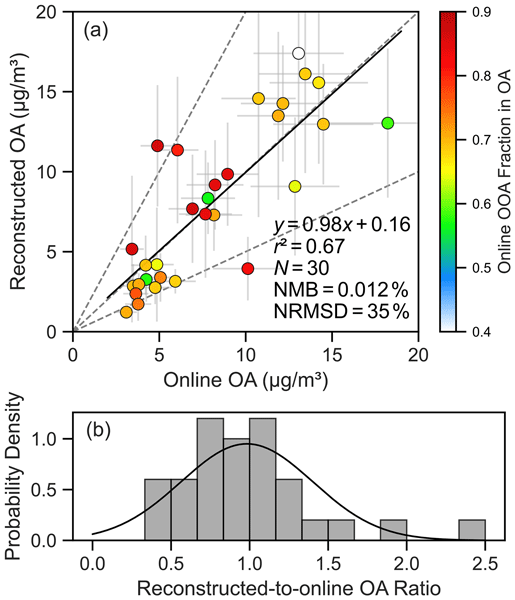
We also perform PMF analysis on offline measurements, with the online-derived factor profiles used as a priori constraints in selected configurations. We evaluate four approaches, representing different assumptions about how OOA and HOA factor profiles vary between the online and offline measurements: (1) unconstrained PMF, assuming both factors are resolved directly from the offline OA mass spectra; (2) OOA-only constrained PMF, assuming the online OOA profile is preserved during offline analysis while the HOA profile is allowed to vary; (3) HOA-only constrained PMF, assuming the HOA profile is preserved while the OOA profile is allowed to vary; and (4) simultaneously constrained OOA and HOA PMF, assuming both factor profiles are preserved during offline analysis. The detailed implementation and corresponding results for each approach are described in Sect. S4. Among the evaluated configurations, the HOA-only constrained configuration with an a-value of 0.1 is selected as the primary offline factor analysis approach. The resulting solution resolves physically interpretable OOA and HOA factors (Fig. S9b), exhibits satisfactory PMF diagnostics (Fig. S10), and yields the lowest normalized mean bias (NMB) among the tested configurations while following conventional constrained source-apportionment practice (Bozzetti et al., 2016, 2017a; Canonaco et al., 2021; Vlachou et al., 2018). As complementary analyses, offline factor concentrations are also quantified using weighted non-negative least-squares (NNLS) regression against fixed factor profiles, providing a simple alternative to constrained PMF (Sect. S5). We further perform sensitivity tests using a three-factor solution from the online PMF that additionally resolves a biomass burning OA (BBOA)-influenced component (Sect. S6) and alternative OOA and HOA factor profiles from the literature (Sect. 3.4) to evaluate the robustness of the offline factor analysis.

Figure 5Comparison of online and offline factor concentrations for (a) oxygenated OA (OOA) and (b) hydrocarbon-like OA (HOA) for samples collected in St. Louis. Online factor concentrations are calculated from positive matrix factorization (PMF) factor contributions and time-averaged bulk concentrations over each corresponding filter sampling interval, with horizontal bars indicating the estimated AMS measurement uncertainty. Offline factor concentrations are calculated by multiplying factor contributions derived from constrained PMF, with the HOA profile partially constrained to the online PMF HOA factor profile (a-value =0.1), by offline bulk OA concentrations determined using the offline method. Vertical bars indicate the propagated uncertainty in the offline OA concentrations. Each point represents the mean across 8 to 12 runs. Points are colored by the fraction of OOA in OA, determined from the online PMF. Annotations indicate the ordinary least-squares fit (y), coefficient of determination (r2), number of comparison points (N), normalized mean bias (NMB), and normalized root mean square deviation (NRMSD). Dashed lines indicate reference lines with slopes of (a) 0.5, 1, and 2 and (b) 0.125, 0.25, and 0.5.
Figure 5 compares online and offline concentrations for OOA and HOA. OOA exhibits relatively high recovery (mean ± standard deviation) of 66 ± 27 % and a median of 64 % (50 % and 77 % for the first and third quartiles, respectively). In contrast, HOA recovery is substantially lower, with a mean and standard deviation of 17 ± 9.4 % and a median of 16 % (11 % and 20 % for the first and third quartiles, respectively). Sensitivity tests using additional constrained offline PMF configurations and weighted NNLS regression yield generally consistent results, with mean OOA recovery ranging from 58 % to 67 % and mean HOA recovery ranging from 9.9 % to 24 % (Fig. S11). These results are consistent with the range reported in the literature (Fig. 6), with OOA exhibiting relatively high and consistent recovery, while other factors show lower and more variable recovery. For example, Daellenbach et al. (2016) found recoveries of 89 % for OOA and 11 % for HOA for PM collected in Paris and Zurich. Xu et al. (2017) reported that 77 %, 96 %, and 68 % of isoprene-derived OA, more-oxidized OOA, and less-oxidized OOA, respectively, are water-soluble in Atlanta, while HOA is largely water-insoluble. Li et al. (2021) found recoveries of 49 % for OOA, 37 % for BBOA, and 17 % for coal combustion OA in Handan, northern China. Together, these observations align with the established understanding of chemical characteristics of different OA components, with water solubility decreasing from highly oxygenated species to more hydrocarbon-like species (Kondo et al., 2007; Saxena and Hildemann, 1996).

Figure 6Comparison of OA recovery reported in the literature and in this study across bulk OA and major OA factors, including oxygenated OA (OOA), isoprene-derived OA (isoprene-OA), more-oxidized OOA (MO-OOA), less-oxidized OOA (LO-OOA), biomass burning OA (BBOA), hydrocarbon-like OA (HOA), cooking OA (COA), and solid fuel combustion OA (SFCOA). Symbols indicate different studies. Original values from each study are shown, so direct comparison should be interpreted with caution due to differences in statistical measures across studies. This study is reported as mean ± standard deviation, Daellenbach et al. (2016) as median with first and third quartiles, Qiu et al. (2019) as mean ± standard deviation, Li et al. (2021) as median with the 10th and 90th percentiles, Cui et al. (2024) as mean values, and Xu et al. (2017) as mode. For studies reporting ranges only, the central value is taken as the midpoint of the reported range.
Building on the factor-resolved recovery, we reconstruct OA by dividing each offline-derived factor by its mean recovery and compare it with online OA measurements (Fig. 7). This approach aligns with the objectives of this offline method and monitoring networks such as SPARTAN for long-term ambient OA characterization. This comparison shows an r2 of 0.67, a slope of 0.98, and an NMB of 0.012 %. Sensitivity tests using additional constrained offline PMF configurations and weighted NNLS regression yield broadly consistent results (Fig. S12). We further examine samples with large deviations between reconstructed and online OA concentrations to identify potential drivers of reconstruction uncertainty (Fig. S13). Samples with OOA recoveries higher (or lower) than the mean recovery used in the reconstruction generally correspond to overestimation (or underestimation) of reconstructed OA, respectively. In contrast, HOA recovery shows a weaker association with reconstructed OA due to its relatively small contribution to total OA in these samples. The uncertainty associated with temporal and spatial variability in factor recovery is further discussed in Sect. 3.4. When evaluated over longer timescales such as at the cartridge level of one week, agreement improves further, with r2 increasing to 0.79 (Fig. S14). These results highlight that offline measurements can provide reliable estimates of ambient OA concentrations, especially over longer periods.

Figure 7(a) Comparison of reconstructed and online OA concentrations for samples collected in St. Louis. Reconstructed OA concentrations are calculated by dividing each offline-derived factor by its mean recovery. Offline factor contributions are obtained using constrained positive matrix factorization (PMF), with the hydrocarbon-like OA (HOA) factor profile partially constrained to the online PMF HOA factor profile (a-value =0.1). Online OA represents the time-averaged concentration over each corresponding filter sampling interval. Horizontal bars indicate the estimated AMS measurement uncertainty of online OA concentrations, while vertical bars indicate the propagated uncertainty of offline OA concentrations. Each point represents the mean across 8 to 12 runs. Points are colored by the fraction of oxygenated OA (OOA) in OA, determined from PMF of the online measurements. Annotations indicate the ordinary least-squares fit (y), coefficient of determination (r2), number of comparison points (N), normalized mean bias (NMB), and normalized root mean square deviation (NRMSD). Dashed lines indicate reference lines with slopes of 0.5, 1, and 2. (b) Histogram of the ratio of reconstructed to online OA for the same samples. The fitted curve represents a smoothed probability density function of this ratio.
As an additional evaluation, sulfate, ammonium, and nitrate concentrations derived from the offline AMS are compared with co-located online AMS and complementary offline IC and XRF measurements. We find strong agreement among online AMS measurements of sulfate in ambient aerosol, IC measurements of sulfate in water extracts, and XRF measurements of sulfur in aerosol collected on filter samples, with r2 of 0.80 and 0.95 for the respective comparisons (Fig. S15a and b). The observed agreement suggests a minor contribution from organosulfur compounds or refractory sulfate salts in the collected samples and supports the use of sulfate as the internal standard, as further discussed in Sect. 3.4. Offline AMS-derived ammonium and nitrate are quantified using sulfate as the internal standard, following the same approach as for OA but assuming a unity calibration slope between ammonium-to-sulfate and nitrate-to-sulfate ratios in the extract and in the AMS. We find strong agreement in ammonium concentrations between offline AMS and IC, with a slope of 1.1 and r2 of 0.93 (Fig. S15d), supporting the reliability of the offline quantification. Additional comparisons with other measurements are provided in Sect. S7.
3.4 Uncertainty in the application to SPARTAN
To support the goal of characterizing ambient OA across SPARTAN using reconstructed OA, we evaluate additional sources of uncertainty beyond those quantified for offline OA in the St. Louis online-offline comparison samples. Specifically, we assess the applicability of sulfate as an internal standard across SPARTAN sites and the variability in OOA and HOA factor profiles and recoveries.
We use sulfate as the internal standard to leverage routine sulfate measurements by IC and complementary sulfur measurements by XRF within SPARTAN. Two potential concerns should be noted. First, sulfate concentrations have declined in many regions over time, which may influence its suitability as a reference species (Tsimpidi et al., 2025). This concern is mitigated by the low sulfate detection limits of both IC and AMS, by retaining only samples with sulfate concentrations above the detection limits, and by increasing sulfate concentrations in many regions targeted by SPARTAN. Second, differences in sulfate speciation and salt association may affect the comparability of IC and offline AMS sulfate measurements. IC quantifies water-soluble inorganic sulfate in the extract, whereas offline AMS measures non-refractory sulfate in particles regenerated from an aliquot of the same extract. Complementary XRF measurements of total particulate sulfur can help identify samples where organosulfur compounds or poorly water-soluble sulfate species may introduce uncertainty. Salt association may also change during nebulization, as alkali and alkaline earth cations (e.g., Na+, K+, Ca2+, and Mg2+) extracted into solution may form refractory sulfate salts during aerosol regeneration, potentially altering the AMS sulfate response. IC measurements of these cations can help identify samples where this effect may be important, particularly those influenced by sea salt or mineral dust. Nitrate has also been used as an internal standard in previous offline AMS studies (Srivastava et al., 2021) but presents several challenges for SPARTAN applications, including potentially substantial contributions of organonitrates to total nitrate (Xu et al., 2015b) and more variable and generally lower nitrate concentrations across SPARTAN sites. Therefore, sulfate remains a practical internal standard for SPARTAN applications, while other internal standards may be appropriate in other settings depending on aerosol composition and available measurements.
In the reconstruction workflow described above (Fig. 7), we use reference factor profiles derived from co-located online AMS measurements as prior information in the offline factor analysis. However, such site-specific, highly accurate factor profiles may not be available at many SPARTAN locations with limited online AMS observations. For future applications, representative OOA and HOA factor profiles from the literature can instead be used as a priori constraints in the offline factor analysis. To evaluate this approach, we use the AMS Spectral Database to identify four additional pairs of deconvoluted OOA and HOA factor profiles (Ulbrich et al., 2009a, b, c). These profiles are derived from studies conducted in the US (Zhang et al., 2005), Zurich (Lanz et al., 2008), China (Elser et al., 2016), and an average across five sites (Ng et al., 2011), representing variability in OOA and HOA spectral characteristics. Each pair of OOA and HOA profiles is applied to the St. Louis offline OA measurements using weighted NNLS regression. Weighted NNLS is used for this sensitivity analysis because it provides a simple framework for evaluating multiple sets of fixed factor profiles while remaining conceptually consistent with the fully constrained PMF approach. The resulting four sets of offline OOA and HOA, together with the original set based on co-located measurements, are then extrapolated using recoveries to reconstruct ambient OA.
Factor recovery varies with time and location, indicating that recovery estimates derived at one site and during a given period may not be directly applicable to other sites or time periods (Li et al., 2021; Vasilakopoulou et al., 2023). We consider this variability in two ways. First, previous studies suggest that OOA recovery is relatively consistent across sites (Fig. 6). Second, we define conservative recovery ranges by synthesizing results from this and previous offline AMS studies, yielding 0.36–0.92 for OOA and 0.028–0.17 for HOA. A sensitivity analysis is performed by bootstrapping OOA and HOA recoveries 100 times from these ranges for five sets of factor profiles across 30 samples for reconstruction. Despite variability in factor profiles and the use of broad recovery ranges, the distribution of reconstructed-to-online OA ratios exhibits a mode between 0.8 and 1.2 (Fig. S16), supporting the feasibility of future extrapolation of offline OA measurements to characterize ambient OA across SPARTAN sites. However, greater uncertainty is expected in rapidly changing environments and at sites with high HOA contributions, where factor recoveries may be more variable. High temporal resolution measurements such as online AMS remain particularly valuable for resolving rapid changes in OA composition, while the offline approach provides complementary capability for consistent, longer-term characterization across globally distributed sites. Future applications across SPARTAN will evaluate the offline AMS method across a broader range of atmospheric conditions and compare the results with independent OA measurements from complementary techniques such as FT-IR.
This study presents a comprehensive development and evaluation of an offline AMS methodology and demonstrates its potential applicability to filter-based measurement networks. The commercial nebulization system enables continuous aerosol generation from small sample volumes of 2 mL and is straightforward and reproducible to operate, representing a substantial improvement for large-scale sample processing. Use of sulfate as an internal standard leverages routine sulfate measurements in monitoring networks. Offline AMS results are directly evaluated against co-located online measurements using the same sampling line and instrument. The online-offline comparison shows varying recovery across OA factors, with the highest recovery observed for OOA, likely due to its higher water solubility. Therefore, this offline method provides a robust estimate of oxygenated species, although correction is required when estimating hydrocarbon-like species associated with more primary emissions. Despite source-dependent recovery biases, the offline method provides useful estimates of ambient OA concentrations for long-term characterization, supporting its application in monitoring networks and enabling the development of a consistent OA dataset across globally distributed sites. Future work will apply this method to the Surface Particulate Matter Network to examine globally distributed variation in OA.
Data related to this article are available at https://doi.org/10.5281/zenodo.23573567 (Ren, 2026). SPARTAN data are publicly available at https://www.spartan-network.org/ (last access: 18 November 2026).
The supplement related to this article is available online at https://doi.org/10.5194/amt-19-7711-2026-supplement.
YR designed the study, conducted the experiments, analyzed the data, and drafted the manuscript. RVM secured funding, co-designed the study, edited the manuscript, and provided guidance throughout the analysis. JHC contributed to AMS instrument maintenance and nebulizer optimization. CRO assisted with SPARTAN operations. BJW contributed to AMS instrument maintenance. RJW assisted with the ultrasonic nebulizer. LX contributed to AMS measurements, co-designed the study, edited the manuscript, and provided guidance throughout the analysis. All authors reviewed and approved the final manuscript.
The contact author has declared that none of the authors has any competing interests.
Publisher's note: Copernicus Publications remains neutral with regard to jurisdictional claims made in the text, published maps, institutional affiliations, or any other geographical representation in this paper. The authors bear the ultimate responsibility for providing appropriate place names. Views expressed in the text are those of the authors and do not necessarily reflect the views of the publisher.
The authors thank William A. Brooks (Aerodyne Research, Inc.) for technical support and assistance with the AMS.
This work was supported by the Clean Air Fund (grant nos. 001591 and 001859) and the National Science Foundation (grant no. 2020673).
This paper was edited by Albert Presto and reviewed by four anonymous referees.
Bahreini, R., Ervens, B., Middlebrook, A. M., Warneke, C., de Gouw, J. A., DeCarlo, P. F., Jimenez, J. L., Brock, C. A., Neuman, J. A., Ryerson, T. B., Stark, H., Atlas, E., Brioude, J., Fried, A., Holloway, J. S., Peischl, J., Richter, D., Walega, J., Weibring, P., Wollny, A. G., and Fehsenfeld, F. C.: Organic aerosol formation in urban and industrial plumes near Houston and Dallas, Texas, J. Geophys. Res.-Atmos., 114, D00F16, https://doi.org/10.1029/2008JD011493, 2009.
Bates, J. T., Fang, T., Verma, V., Zeng, L. H., Weber, R. J., Tolbert, P. E., Abrams, J. Y., Sarnat, S. E., Klein, M., Mulholland, J. A., and Russell, A. G.: Review of acellular assays of ambient particulate matter oxidative potential: Methods and relationships with composition, sources, and health effects, Environ. Sci. Technol., 53, 4003–4019, https://doi.org/10.1021/acs.est.8b03430, 2019.
Bhowmik, H. S., Tripathi, S. N., Shukla, A. K., Lalchandani, V., Murari, V., Devaprasad, M., Shivam, A., Bhushan, R., Prevot, A. S. H., and Rastogi, N.: Contribution of fossil and biomass-derived secondary organic carbon to winter water-soluble organic aerosols in Delhi, India, Sci. Total Environ., 912, 168655, https://doi.org/10.1016/j.scitotenv.2023.168655, 2024.
Bozzetti, C., Daellenbach, K. R., Hueglin, C., Fermo, P., Sciare, J., Kasper-Giebl, A., Mazar, Y., Abbaszade, G., El Kazzi, M., Gonzalez, R., Shuster-Meiseles, T., Flasch, M., Wolf, R., Krepelova, A., Canonaco, F., Schnelle-Kreis, J., Slowik, J. G., Zimmermann, R., Rudich, Y., Baltensperger, U., El Haddad, I., and Prevot, A. S. H.: Size-resolved identification, characterization, and quantification of primary biological organic aerosol at a European rural site, Environ. Sci. Technol., 50, 3425–3434, https://doi.org/10.1021/acs.est.5b05960, 2016.
Bozzetti, C., Sosedova, Y., Xiao, M., Daellenbach, K. R., Ulevicius, V., Dudoitis, V., Mordas, G., Byčenkienė, S., Plauškaitė, K., Vlachou, A., Golly, B., Chazeau, B., Besombes, J.-L., Baltensperger, U., Jaffrezo, J.-L., Slowik, J. G., El Haddad, I., and Prévôt, A. S. H.: Argon offline-AMS source apportionment of organic aerosol over yearly cycles for an urban, rural, and marine site in northern Europe, Atmos. Chem. Phys., 17, 117–141, https://doi.org/10.5194/acp-17-117-2017, 2017a.
Bozzetti, C., El Haddad, I., Salameh, D., Daellenbach, K. R., Fermo, P., Gonzalez, R., Minguillón, M. C., Iinuma, Y., Poulain, L., Elser, M., Müller, E., Slowik, J. G., Jaffrezo, J.-L., Baltensperger, U., Marchand, N., and Prévôt, A. S. H.: Organic aerosol source apportionment by offline-AMS over a full year in Marseille, Atmos. Chem. Phys., 17, 8247–8268, https://doi.org/10.5194/acp-17-8247-2017, 2017b.
Canagaratna, M. R., Jayne, J. T., Jimenez, J. L., Allan, J. D., Alfarra, M. R., Zhang, Q., Onasch, T. B., Drewnick, F., Coe, H., Middlebrook, A., Delia, A., Williams, L. R., Trimborn, A. M., Northway, M. J., DeCarlo, P. F., Kolb, C. E., Davidovits, P., and Worsnop, D. R.: Chemical and microphysical characterization of ambient aerosols with the aerodyne aerosol mass spectrometer, Mass Spectrom. Rev., 26, 185–222, https://doi.org/10.1002/mas.20115, 2007.
Canonaco, F., Crippa, M., Slowik, J. G., Baltensperger, U., and Prévôt, A. S. H.: SoFi, an IGOR-based interface for the efficient use of the generalized multilinear engine (ME-2) for the source apportionment: ME-2 application to aerosol mass spectrometer data, Atmos. Meas. Tech., 6, 3649–3661, https://doi.org/10.5194/amt-6-3649-2013, 2013.
Canonaco, F., Tobler, A., Chen, G., Sosedova, Y., Slowik, J. G., Bozzetti, C., Daellenbach, K. R., El Haddad, I., Crippa, M., Huang, R.-J., Furger, M., Baltensperger, U., and Prévôt, A. S. H.: A new method for long-term source apportionment with time-dependent factor profiles and uncertainty assessment using SoFi Pro: application to 1 year of organic aerosol data, Atmos. Meas. Tech., 14, 923–943, https://doi.org/10.5194/amt-14-923-2021, 2021.
Cash, J. M., Di Marco, C., Langford, B., Heal, M. R., Mandal, T. K., Sharma, S. K., Gurjar, B. R., and Nemitz, E.: Response of organic aerosol to Delhi's pollution control measures over the period 2011–2018, Atmos. Environ., 315, 120123, https://doi.org/10.1016/j.atmosenv.2023.120123, 2023.
Casotto, R., Kusan, A. C., Bhattu, D., Cui, T., Manousakas, M. I., Frka, S., Kroflic, A., Grgic, I., Ciglenecki, I., Baltensperger, U., Slowik, J. G., Daellenbach, K. R., and Prevot, A. S. H.: Chemical composition and sources of organic aerosol on the Adriatic coast in Croatia, Atmos. Environ. X, 13, 100159, https://doi.org/10.1016/j.aeaoa.2022.100159, 2022.
Casotto, R., Skiba, A., Rauber, M., Strahl, J., Tobler, A., Bhattu, D., Lamkaddam, H., Manousakas, M., Salazar, G., Cui, T. Q., Canonaco, F., Samek, L., Rys, A., El Haddad, I., Kasper-Giebl, A., Baltensperger, U., Necki, J., Szidat, S., Styszko, K., Slowik, J. G., Prevot, A. S. H., and Daellenbach, K. R.: Organic aerosol sources in Krakow, Poland, before implementation of a solid fuel residential heating ban, Sci. Total Environ., 855, 158655, https://doi.org/10.1016/j.scitotenv.2022.158655, 2023.
Chen, Y., Xu, L., Humphry, T., Hettiyadura, A. P. S., Ovadnevaite, J., Huang, S., Poulain, L., Schroder, J. C., Campuzano-Jost, P., Jimenez, J. L., Herrmann, H., O'Dowd, C., Stone, E. A., and Ng, N. L.: Response of the aerodyne aerosol mass spectrometer to inorganic sulfates and organosulfur compounds: Applications in field and laboratory measurements, Environ. Sci. Technol., 53, 5176–5186, https://doi.org/10.1021/acs.est.9b00884, 2019.
Chung, C. E., Ramanathan, V., and Decremer, D.: Observationally constrained estimates of carbonaceous aerosol radiative forcing, P. Natl. Acad. Sci. USA, 109, 11624–11629, https://doi.org/10.1073/pnas.1203707109, 2012.
Cubison, M. J., Ortega, A. M., Hayes, P. L., Farmer, D. K., Day, D., Lechner, M. J., Brune, W. H., Apel, E., Diskin, G. S., Fisher, J. A., Fuelberg, H. E., Hecobian, A., Knapp, D. J., Mikoviny, T., Riemer, D., Sachse, G. W., Sessions, W., Weber, R. J., Weinheimer, A. J., Wisthaler, A., and Jimenez, J. L.: Effects of aging on organic aerosol from open biomass burning smoke in aircraft and laboratory studies, Atmos. Chem. Phys., 11, 12049–12064, https://doi.org/10.5194/acp-11-12049-2011, 2011.
Cui, T., Manousakas, M. I., Wang, Q., Uzu, G., Hao, Y., Khare, P., Qi, L., Chen, Y., Han, Y., Slowik, J. G., Jaffrezo, J.-L., Cao, J., Prevot, A. S. H., and Daellenbach, K. R.: Composition and sources of organic aerosol in two megacities in western China using complementary mass spectrometric and statistical techniques, Environ. Sci. Technol. Air, 1, 1053–1065, https://doi.org/10.1021/acsestair.4c00051, 2024.
Daellenbach, K. R., Bozzetti, C., Křepelová, A., Canonaco, F., Wolf, R., Zotter, P., Fermo, P., Crippa, M., Slowik, J. G., Sosedova, Y., Zhang, Y., Huang, R.-J., Poulain, L., Szidat, S., Baltensperger, U., El Haddad, I., and Prévôt, A. S. H.: Characterization and source apportionment of organic aerosol using offline aerosol mass spectrometry, Atmos. Meas. Tech., 9, 23–39, https://doi.org/10.5194/amt-9-23-2016, 2016.
Daellenbach, K. R., Stefenelli, G., Bozzetti, C., Vlachou, A., Fermo, P., Gonzalez, R., Piazzalunga, A., Colombi, C., Canonaco, F., Hueglin, C., Kasper-Giebl, A., Jaffrezo, J.-L., Bianchi, F., Slowik, J. G., Baltensperger, U., El-Haddad, I., and Prévôt, A. S. H.: Long-term chemical analysis and organic aerosol source apportionment at nine sites in central Europe: source identification and uncertainty assessment, Atmos. Chem. Phys., 17, 13265–13282, https://doi.org/10.5194/acp-17-13265-2017, 2017.
Debus, B., Weakley, A. T., Takahama, S., George, K. M., Amiri-Farahani, A., Schichtel, B., Copeland, S., Wexler, A. S., and Dillner, A. M.: Quantification of major particulate matter species from a single filter type using infrared spectroscopy – application to a large-scale monitoring network, Atmos. Meas. Tech., 15, 2685–2702, https://doi.org/10.5194/amt-15-2685-2022, 2022.
DeCarlo, P. F., Kimmel, J. R., Trimborn, A., Northway, M. J., Jayne, J. T., Aiken, A. C., Gonin, M., Fuhrer, K., Horvath, T., Docherty, K. S., Worsnop, D. R., and Jimenez, J. L.: Field-deployable, high-resolution, time-of-flight aerosol mass spectrometer, Anal. Chem., 78, 8281–8289, https://doi.org/10.1021/ac061249n, 2006.
Dillner, A. M. and Takahama, S.: Predicting ambient aerosol thermal–optical reflectance (TOR) measurements from infrared spectra: organic carbon, Atmos. Meas. Tech., 8, 1097–1109, https://doi.org/10.5194/amt-8-1097-2015, 2015.
Elser, M., Huang, R.-J., Wolf, R., Slowik, J. G., Wang, Q., Canonaco, F., Li, G., Bozzetti, C., Daellenbach, K. R., Huang, Y., Zhang, R., Li, Z., Cao, J., Baltensperger, U., El-Haddad, I., and Prévôt, A. S. H.: New insights into PM2.5 chemical composition and sources in two major cities in China during extreme haze events using aerosol mass spectrometry, Atmos. Chem. Phys., 16, 3207–3225, https://doi.org/10.5194/acp-16-3207-2016, 2016.
Fang, T., Guo, H., Verma, V., Peltier, R. E., and Weber, R. J.: PM2.5 water-soluble elements in the southeastern United States: automated analytical method development, spatiotemporal distributions, source apportionment, and implications for heath studies, Atmos. Chem. Phys., 15, 11667–11682, https://doi.org/10.5194/acp-15-11667-2015, 2015.
Ge, X., Li, L., Chen, Y., Chen, H., Wu, D., Wang, J., Xie, X., Ge, S., Ye, Z., Xu, J., and Chen, M.: Aerosol characteristics and sources in Yangzhou, China resolved by offline aerosol mass spectrometry and other techniques, Environ. Pollut., 225, 74–85, https://doi.org/10.1016/j.envpol.2017.03.044, 2017.
Huang, R. J., Zhang, Y., Bozzetti, C., Ho, K. F., Cao, J. J., Han, Y., Daellenbach, K. R., Slowik, J. G., Platt, S. M., Canonaco, F., Zotter, P., Wolf, R., Pieber, S. M., Bruns, E. A., Crippa, M., Ciarelli, G., Piazzalunga, A., Schwikowski, M., Abbaszade, G., Schnelle-Kreis, J., Zimmermann, R., An, Z., Szidat, S., Baltensperger, U., El Haddad, I., and Prevot, A. S. H.: High secondary aerosol contribution to particulate pollution during haze events in China, Nature, 514, 218–222, https://doi.org/10.1038/nature13774, 2014.
Jeon, S., Walker, M. J., Sueper, D. T., Day, D. A., Handschy, A. V., Jimenez, J. L., and Williams, B. J.: A searchable database and mass spectral comparison tool for the Aerosol Mass Spectrometer (AMS) and the Aerosol Chemical Speciation Monitor (ACSM), Atmos. Meas. Tech., 16, 6075–6095, https://doi.org/10.5194/amt-16-6075-2023, 2023.
Jimenez, J. L., Jayne, J. T., Shi, Q., Kolb, C. E., Worsnop, D. R., Yourshaw, I., Seinfeld, J. H., Flagan, R. C., Zhang, X. F., Smith, K. A., Morris, J. W., and Davidovits, P.: Ambient aerosol sampling using the aerodyne aerosol mass spectrometer, J. Geophys. Res.-Atmos., 108, 8425, https://doi.org/10.1029/2001JD001213, 2003.
Jimenez, J. L., Canagaratna, M. R., Donahue, N. M., Prevot, A. S. H., Zhang, Q., Kroll, J. H., DeCarlo, P. F., Allan, J. D., Coe, H., Ng, N. L., Aiken, A. C., Docherty, K. S., Ulbrich, I. M., Grieshop, A. P., Robinson, A. L., Duplissy, J., Smith, J. D., Wilson, K. R., Lanz, V. A., Hueglin, C., Sun, Y. L., Tian, J., Laaksonen, A., Raatikainen, T., Rautiainen, J., Vaattovaara, P., Ehn, M., Kulmala, M., Tomlinson, J. M., Collins, D. R., Cubison, M. J., Dunlea, E. J., Huffman, J. A., Onasch, T. B., Alfarra, M. R., Williams, P. I., Bower, K., Kondo, Y., Schneider, J., Drewnick, F., Borrmann, S., Weimer, S., Demerjian, K., Salcedo, D., Cottrell, L., Griffin, R., Takami, A., Miyoshi, T., Hatakeyama, S., Shimono, A., Sun, J. Y., Zhang, Y. M., Dzepina, K., Kimmel, J. R., Sueper, D., Jayne, J. T., Herndon, S. C., Trimborn, A. M., Williams, L. R., Wood, E. C., Middlebrook, A. M., Kolb, C. E., Baltensperger, U., and Worsnop, D. R.: Evolution of organic aerosols in the atmosphere, Science, 326, 1525–1529, https://doi.org/10.1126/science.1180353, 2009.
Kanakidou, M., Seinfeld, J. H., Pandis, S. N., Barnes, I., Dentener, F. J., Facchini, M. C., Van Dingenen, R., Ervens, B., Nenes, A., Nielsen, C. J., Swietlicki, E., Putaud, J. P., Balkanski, Y., Fuzzi, S., Horth, J., Moortgat, G. K., Winterhalter, R., Myhre, C. E. L., Tsigaridis, K., Vignati, E., Stephanou, E. G., and Wilson, J.: Organic aerosol and global climate modelling: a review, Atmos. Chem. Phys., 5, 1053–1123, https://doi.org/10.5194/acp-5-1053-2005, 2005.
Khare, P., Kurdieh, A. A., Hao, Y. F., Manousakas, M. I., Dada, L., Tobler, A., Schneider-Beltran, K., Diapouli, E., Skiba, A., Styszko, K., Slowik, J. G., Prevot, A. S. H., and Daellenbach, K. R.: Organic solvents-based offline aerosol mass spectrometry (SOff-AMS) for comprehensive chemical characterization of ambient organic aerosol, Environ. Sci. Technol., 59, 18236–18248, https://doi.org/10.1021/acs.est.5c08949, 2025.
Kondo, Y., Miyazaki, Y., Takegawa, N., Miyakawa, T., Weber, R. J., Jimenez, J. L., Zhang, Q., and Worsnop, D. R.: Oxygenated and water-soluble organic aerosols in Tokyo, J. Geophys. Res.-Atmos., 112, D01203, https://doi.org/10.1029/2006JD007056, 2007.
Kroll, J. H. and Seinfeld, J. H.: Chemistry of secondary organic aerosol: Formation and evolution of low-volatility organics in the atmosphere, Atmos. Environ., 42, 3593–3624, https://doi.org/10.1016/j.atmosenv.2008.01.003, 2008.
Kroll, J. H., Donahue, N. M., Jimenez, J. L., Kessler, S. H., Canagaratna, M. R., Wilson, K. R., Altieri, K. E., Mazzoleni, L. R., Wozniak, A. S., Bluhm, H., Mysak, E. R., Smith, J. D., Kolb, C. E., and Worsnop, D. R.: Carbon oxidation state as a metric for describing the chemistry of atmospheric organic aerosol, Nat. Chem., 3, 133–139, https://doi.org/10.1038/nchem.948, 2011.
Lanz, V. A., Alfarra, M. R., Baltensperger, U., Buchmann, B., Hueglin, C., Szidat, S., Wehrli, M. N., Wacker, L., Weimer, S., Caseiro, A., Puxbaum, H., and Prevot, A. S. H.: Source attribution of submicron organic aerosols during wintertime inversions by advanced factor analysis of aerosol mass spectra, Environ. Sci. Technol., 42, 214–220, https://doi.org/10.1021/es0707207, 2008.
Li, H., Zhang, Q., Jiang, W., Collier, S., Sun, Y., Zhang, Q., and He, K.: Characteristics and sources of water-soluble organic aerosol in a heavily polluted environment in Northern China, Sci. Total Environ., 758, 143970, https://doi.org/10.1016/j.scitotenv.2020.143970, 2021.
Liu, P. S. K., Deng, R., Smith, K. A., Williams, L. R., Jayne, J. T., Canagaratna, M. R., Moore, K., Onasch, T. B., Worsnop, D. R., and Deshler, T.: Transmission efficiency of an aerodynamic focusing lens system: Comparison of model calculations and laboratory measurements for the aerodyne aerosol mass spectrometer, Aerosol Sci. Technol., 41, 721–733, https://doi.org/10.1080/02786820701422278, 2007.
Liu, X., Turner, J. R., Oxford, C. R., McNeill, J., Walsh, B., Le Roy, E., Weagle, C. L., Stone, E., Zhu, H., Liu, W., Wei, Z., Hyslop, N. P., Giacomo, J., Dillner, A. M., Salam, A., Hossen, A.-A., Islam, Z., Abboud, I., Akoshile, C., Amador-Munoz, O., Anh, N. X., Asfaw, A., Balasubramanian, R., Chang, R. Y. W., Coburn, C., Dey, S., Diner, D. J., Dong, J., Farrah, T., Gahungu, P., Garland, R. M., Grutter de la Mora, M., Hasheminassab, S., John, J., Kim, J., Kim, J. S., Langerman, K., Lee, P. C., Lestari, P., Liu, Y., Mamo, T., Martins, M., Mayol-Bracero, O. L., Naidoo, M., Park, S. S., Schechner, Y., Schofield, R., Tripathi, S. N., Windwer, E., Wu, M. T., Zhang, Q., Brauer, M., Rudich, Y., and Martin, R. V.: Elemental characterization of ambient particulate matter for a globally distributed monitoring network: Methodology and implications, Environ. Sci. Technol. Air, 1, 283–293, https://doi.org/10.1021/acsestair.3c00069, 2024.
Matthew, B. M., Middlebrook, A. M., and Onasch, T. B.: Collection efficiencies in an aerodyne aerosol mass spectrometer as a function of particle phase for laboratory generated aerosols, Aerosol Sci. Technol., 42, 884–898, https://doi.org/10.1080/02786820802356797, 2008.
McNeill, J., Snider, G., Weagle, C. L., Walsh, B., Bissonnette, P., Stone, E., Abboud, I., Akoshile, C., Anh, N. X., Balasubramanian, R., Brook, J. R., Coburn, C., Cohen, A., Dong, J. L., Gagnon, G., Garland, R. M., He, K. B., Holben, B. N., Kahn, R., Kim, J. S., Lagrosas, N., Lestari, P., Liu, Y., Jeba, F., Joy, K. S., Martins, J. V., Misra, A., Norford, L. K., Quel, E. J., Salam, A., Schichtel, B., Tripathi, S. N., Wang, C., Zhang, Q., Brauer, M., Gibson, M. D., Rudich, Y., and Martin, R. V.: Large global variations in measured airborne metal concentrations driven by anthropogenic sources, Sci. Rep., 10, 21817, https://doi.org/10.1038/s41598-020-78789-y, 2020.
Middlebrook, A. M., Bahreini, R., Jimenez, J. L., and Canagaratna, M. R.: Evaluation of composition-dependent collection efficiencies for the aerodyne aerosol mass spectrometer using field data, Aerosol Sci. Technol., 46, 258–271, https://doi.org/10.1080/02786826.2011.620041, 2012.
Mihara, T. and Mochida, M.: Characterization of solvent-extractable organics in urban aerosols based on mass spectrum analysis and hygroscopic growth measurement, Environ. Sci. Technol., 45, 9168–9174, https://doi.org/10.1021/es201271w, 2011.
Moschos, V., Dzepina, K., Bhattu, D., Lamkaddam, H., Casotto, R., Daellenbach, K. R., Canonaco, F., Rai, P., Aas, W., Becagli, S., Calzolai, G., Eleftheriadis, K., Moffett, C. E., Schnelle-Kreis, J., Severi, M., Sharma, S., Skov, H., Vestenius, M., Zhang, W., Hakola, H., Hellen, H., Huang, L., Jaffrezo, J.-L., Massling, A., Nojgaard, J. K., Petaja, T., Popovicheva, O., Sheesley, R. J., Traversi, R., Yttri, K. E., Schmale, J., Prevot, A. S. H., Baltensperger, U., and El Haddad, I.: Equal abundance of summertime natural and wintertime anthropogenic Arctic organic aerosols, Nat. Geosci., 15, 196–202, https://doi.org/10.1038/s41561-021-00891-1, 2022.
Ng, N. L., Canagaratna, M. R., Zhang, Q., Jimenez, J. L., Tian, J., Ulbrich, I. M., Kroll, J. H., Docherty, K. S., Chhabra, P. S., Bahreini, R., Murphy, S. M., Seinfeld, J. H., Hildebrandt, L., Donahue, N. M., DeCarlo, P. F., Lanz, V. A., Prévôt, A. S. H., Dinar, E., Rudich, Y., and Worsnop, D. R.: Organic aerosol components observed in Northern Hemispheric datasets from Aerosol Mass Spectrometry, Atmos. Chem. Phys., 10, 4625–4641, https://doi.org/10.5194/acp-10-4625-2010, 2010.
Ng, N. L., Canagaratna, M. R., Jimenez, J. L., Zhang, Q., Ulbrich, I. M., and Worsnop, D. R.: Real-time methods for estimating organic component mass concentrations from Aerosol Mass Spectrometer data, Environ. Sci. Technol., 45, 910–916, https://doi.org/10.1021/es102951k, 2011.
Niedek, C. R., Mei, F., Zawadowicz, M. A., Zhu, Z., Schmid, B., and Zhang, Q.: Quantitative chemical assay of nanogram-level particulate matter using aerosol mass spectrometry: characterization of particles collected from uncrewed atmospheric measurement platforms, Atmos. Meas. Tech., 16, 955–968, https://doi.org/10.5194/amt-16-955-2023, 2023.
Niedek, C. R., Mei, F., Jiang, W., Trousdell, J., Zawadowicz, M. A., Schmid, B., and Zhang, Q.: Advancing aerosol chemical characterization and vertical profiling over the Southern Great Plains using uncrewed aerial sampling and offline Aerosol Mass Spectrometry, Environ. Sci. Technol. Air, 2, 2131–2146, https://doi.org/10.1021/acsestair.5c00128, 2025.
O'Brien, R. E., Ridley, K. J., Canagaratna, M. R., Jayne, J. T., Croteau, P. L., Worsnop, D. R., Budisulistiorini, S. H., Surratt, J. D., Follett, C. L., Repeta, D. J., and Kroll, J. H.: Ultrasonic nebulization for the elemental analysis of microgram-level samples with offline aerosol mass spectrometry, Atmos. Meas. Tech., 12, 1659–1671, https://doi.org/10.5194/amt-12-1659-2019, 2019.
Ohata, S., Moteki, N., and Kondo, Y.: Evaluation of a method for measurement of the concentration and size distribution of black carbon particles suspended in rainwater, Aerosol Sci. Technol., 45, 1326–1336, https://doi.org/10.1080/02786826.2011.593590, 2011.
Oxford, C. R., Zhu, H., Mehrotra, M., Liu, X., Ren, Y., Arnott, M., Adimula, I. A., Ajibolataiye, T. B., Akoshile, C., Amador-Munoz, O., Asfaw, A., Chang, R. Y.-W., Dey, S., Dillner, A. M., Diner, D. J., Flynn, C. J., Francis, D., Gahungu, P., Garland, R. M., Grutter, M., Hasheminassab, S., Imam, F., Kim, J., Langerman, K., Lee, P.-C., Lestari, P., Lin, P.-H., Loria-Salazar, S. M., Mamo, T., Mayol-Bracero, O. L., Naidoo, M., Nelli, N., Park, S. S., Salam, A., Sarangi, B., Saud, T., Schofield, R., Schechner, Y., Tripathi, S. N., West, E. K., Windwer, E., Wu, M.-T., Zhang, Q., Brauer, M., Rudich, Y., Turner, J. R., and Martin, R. V.: Gravimetrically measured water content of filter sampled fine particulate matter at low relative humidity: Insight from the Surface Particulate Matter Network (SPARTAN), EGUsphere [preprint], https://doi.org/10.5194/egusphere-2026-3224, 2026.
Paatero, P.: The multilinear engine – a table-driven, least squares program for solving multilinear problems, including the n-way parallel factor analysis model, J. Comput. Graph. Stat., 8, 854–888, https://doi.org/10.1080/10618600.1999.10474853, 1999.
Paatero, P. and Tapper, U.: Positive matrix factorization – a nonnegative factor model with optimal utilization of error-estimates of data values, Environmetrics, 5, 111–126, https://doi.org/10.1002/env.3170050203, 1994.
Pai, S. J., Heald, C. L., Pierce, J. R., Farina, S. C., Marais, E. A., Jimenez, J. L., Campuzano-Jost, P., Nault, B. A., Middlebrook, A. M., Coe, H., Shilling, J. E., Bahreini, R., Dingle, J. H., and Vu, K.: An evaluation of global organic aerosol schemes using airborne observations, Atmos. Chem. Phys., 20, 2637–2665, https://doi.org/10.5194/acp-20-2637-2020, 2020.
Qiu, Y., Xie, Q., Wang, J., Xu, W., Li, L., Wang, Q., Zhao, J., Chen, Y., Chen, Y., Wu, Y., Du, W., Zhou, W., Lee, J., Zhao, C., Ge, X., Fu, P., Wang, Z., Worsnop, D. R., and Sun, Y.: Vertical characterization and source apportionment of water-soluble organic aerosol with high-resolution aerosol mass spectrometry in Beijing, China, ACS Earth Space Chem., 3, 273–284, https://doi.org/10.1021/acsearthspacechem.8b00155, 2019.
Ren, Y.: Data for “Development of an offline Aerosol Mass Spectrometry method for organic aerosol characterization in a globally distributed Surface Particulate Matter Network”, Zenodo [data set], https://doi.org/10.5281/zenodo.23573567, 2026.
Ren, Y., Oxford, C. R., Zhang, D., Liu, X., Zhu, H., Dillner, A. M., White, W. H., Chakrabarty, R. K., Hasheminassab, S., Diner, D. J., Le Roy, E. J., Kumar, J., Viteri, V., Song, K., Akoshile, C., Amador-Munoz, O., Asfaw, A., Chang, R. Y. W., Francis, D., Gahungu, P., Garland, R. M., Grutter, M., Kim, J., Langerman, K., Lee, P. C., Lestari, P., Mayol-Bracero, O. L., Naidoo, M., Nelli, N., O'Neill, N., Park, S. S., Salam, A., Sarangi, B., Schechner, Y., Schofield, R., Tripathi, S. N., Windwer, E., Wu, M. T., Zhang, Q., Rudich, Y., Brauer, M., and Martin, R. V.: Black carbon emissions generally underestimated in the global south as revealed by globally distributed measurements, Nat. Commun., 16, 7010, https://doi.org/10.1038/s41467-025-62468-5, 2025.
Sareen, N., Schwier, A. N., Lathem, T. L., Nenes, A., and McNeill, V. F.: Surfactants from the gas phase may promote cloud droplet formation, P. Natl. Acad. Sci. USA, 110, 2723–2728, https://doi.org/10.1073/pnas.1204838110, 2013.
Saxena, P. and Hildemann, L. M.: Water-soluble organics in atmospheric particles: A critical review of the literature and application of thermodynamics to identify candidate compounds, J. Atmos. Chem., 24, 57–109, https://doi.org/10.1007/BF00053823, 1996.
Shrivastava, M., Cappa, C. D., Fan, J., Goldstein, A. H., Guenther, A. B., Jimenez, J. L., Kuang, C., Laskin, A., Martin, S. T., Ng, N. L., Petaja, T., Pierce, J. R., Rasch, P. J., Roldin, P., Seinfeld, J. H., Shilling, J., Smith, J. N., Thornton, J. A., Volkamer, R., Wang, J., Worsnop, D. R., Zaveri, R. A., Zelenyuk, A., and Zhang, Q.: Recent advances in understanding secondary organic aerosol: Implications for global climate forcing, Rev. Geophys., 55, 509–559, https://doi.org/10.1002/2016RG000540, 2017.
Singh, A., Kumar, J., Kapoor, T. S., Tripathy, S. S., Viteri, V., Zhang, L., Song, K., Gudi, R., and Chakrabarty, R. K.: Aerosol absorption coefficients across global sites: Impacts of chemical composition, emissions, and meteorology, Atmos. Environ., 387, 122391, https://doi.org/10.1016/j.atmosenv.2026.122391, 2026.
Snider, G., Weagle, C. L., Martin, R. V., van Donkelaar, A., Conrad, K., Cunningham, D., Gordon, C., Zwicker, M., Akoshile, C., Artaxo, P., Anh, N. X., Brook, J., Dong, J., Garland, R. M., Greenwald, R., Griffith, D., He, K., Holben, B. N., Kahn, R., Koren, I., Lagrosas, N., Lestari, P., Ma, Z., Vanderlei Martins, J., Quel, E. J., Rudich, Y., Salam, A., Tripathi, S. N., Yu, C., Zhang, Q., Zhang, Y., Brauer, M., Cohen, A., Gibson, M. D., and Liu, Y.: SPARTAN: a global network to evaluate and enhance satellite-based estimates of ground-level particulate matter for global health applications, Atmos. Meas. Tech., 8, 505–521, https://doi.org/10.5194/amt-8-505-2015, 2015.
Snider, G., Weagle, C. L., Murdymootoo, K. K., Ring, A., Ritchie, Y., Stone, E., Walsh, A., Akoshile, C., Anh, N. X., Balasubramanian, R., Brook, J., Qonitan, F. D., Dong, J., Griffith, D., He, K., Holben, B. N., Kahn, R., Lagrosas, N., Lestari, P., Ma, Z., Misra, A., Norford, L. K., Quel, E. J., Salam, A., Schichtel, B., Segev, L., Tripathi, S., Wang, C., Yu, C., Zhang, Q., Zhang, Y., Brauer, M., Cohen, A., Gibson, M. D., Liu, Y., Martins, J. V., Rudich, Y., and Martin, R. V.: Variation in global chemical composition of PM2.5: emerging results from SPARTAN, Atmos. Chem. Phys., 16, 9629–9653, https://doi.org/10.5194/acp-16-9629-2016, 2016.
Srivastava, D., Daellenbach, K. R., Zhang, Y., Bonnaire, N., Chazeau, B., Perraudin, E., Gros, V., Lucarelli, F., Villenave, E., Prevot, A. S. H., El Haddad, I., Favez, O., and Albinet, A.: Comparison of five methodologies to apportion organic aerosol sources during a PM pollution event, Sci. Total Environ., 757, 143168, https://doi.org/10.1016/j.scitotenv.2020.143168, 2021.
Sun, Y., Zhang, Q., Zheng, M., Ding, X., Edgerton, E. S., and Wang, X.: Characterization and source apportionment of water-soluble organic matter in atmospheric fine particles (PM2.5) with High-Resolution Aerosol Mass Spectrometry and GC-MS, Environ. Sci. Technol., 45, 4854–4861, https://doi.org/10.1021/es200162h, 2011.
Sun, Y., Luo, H., Li, Y., Zhou, W., Xu, W., Fu, P., and Zhao, D.: Atmospheric organic aerosols: Online molecular characterization and environmental impacts, npj Clim. Atmos. Sci., 8, 305, https://doi.org/10.1038/s41612-025-01199-2, 2025.
Tsimpidi, A. P., Scholz, S. M. C., Milousis, A., Mihalopoulos, N., and Karydis, V. A.: Aerosol composition trends during 2000–2020: in-depth insights from model predictions and multiple worldwide near-surface observation datasets, Atmos. Chem. Phys., 25, 10183–10213, https://doi.org/10.5194/acp-25-10183-2025, 2025.
Tuet, W. Y., Fok, S., Verma, V., Rodriguez, M. S. T., Grosberg, A., Champion, J. A., and Ng, N. L.: Dose-dependent intracellular reactive oxygen and nitrogen species (ROS/RNS) production from particulate matter exposure: Comparison to oxidative potential and chemical composition, Atmos. Environ., 144, 335–344, https://doi.org/10.1016/j.atmosenv.2016.09.005, 2016.
Ulbrich, I. M., Canagaratna, M. R., Zhang, Q., Worsnop, D. R., and Jimenez, J. L.: Interpretation of organic components from Positive Matrix Factorization of aerosol mass spectrometric data, Atmos. Chem. Phys., 9, 2891–2918, https://doi.org/10.5194/acp-9-2891-2009, 2009a.
Ulbrich, I. M., Handschy, A., Lechner, M., and Jimenez, J. L.: High-Resolution AMS Spectral Database, http://cires.colorado.edu/jimenez-group/HRAMSsd/ (last access: 14 November 2026), 2009b.
Ulbrich, I. M., Handschy, A., Lechner, M., and Jimenez, J. L.: AMS Spectral Database, http://cires.colorado.edu/jimenez-group/AMSsd/ (last access: 14 November 2026), 2009c.
Vasilakopoulou, C. N., Florou, K., Kaltsonoudis, C., Stavroulas, I., Mihalopoulos, N., and Pandis, S. N.: Development and evaluation of an improved offline aerosol mass spectrometry technique, Atmos. Meas. Tech., 16, 2837–2850, https://doi.org/10.5194/amt-16-2837-2023, 2023.
Vlachou, A., Daellenbach, K. R., Bozzetti, C., Chazeau, B., Salazar, G. A., Szidat, S., Jaffrezo, J.-L., Hueglin, C., Baltensperger, U., El Haddad, I., and Prévôt, A. S. H.: Advanced source apportionment of carbonaceous aerosols by coupling offline AMS and radiocarbon size-segregated measurements over a nearly 2-year period, Atmos. Chem. Phys., 18, 6187–6206, https://doi.org/10.5194/acp-18-6187-2018, 2018.
Vlachou, A., Tobler, A., Lamkaddam, H., Canonaco, F., Daellenbach, K. R., Jaffrezo, J.-L., Minguillón, M. C., Maasikmets, M., Teinemaa, E., Baltensperger, U., El Haddad, I., and Prévôt, A. S. H.: Development of a versatile source apportionment analysis based on positive matrix factorization: a case study of the seasonal variation of organic aerosol sources in Estonia, Atmos. Chem. Phys., 19, 7279–7295, https://doi.org/10.5194/acp-19-7279-2019, 2019.
Weagle, C. L., Snider, G., Li, C., van Donkelaar, A., Philip, S., Bissonnette, P., Burke, J., Jackson, J., Latimer, R., Stone, E., Abboud, I., Akoshile, C., Anh, N. X., Brook, J. R., Cohen, A., Dong, J., Gibson, M. D., Griffith, D., He, K., Holben, B. N., Kahn, R., Keller, C. A., Kim, J. S., Lagrosas, N., Lestari, P., Khian, Y. L., Liu, Y., Marais, E. A., Martins, J. V., Misra, A., Muliane, U., Pratiwi, R., Quel, E. J., Salam, A., Segev, L., Tripathi, S. N., Wang, C., Zhang, Q., Brauer, M., Rudich, Y., and Martin, R. V.: Global sources of fine particulate matter: Interpretation of PM2.5 chemical composition observed by SPARTAN using a global chemical transport model, Environ. Sci. Technol., 52, 11670–11681, https://doi.org/10.1021/acs.est.8b01658, 2018.
White, W. H., Trzepla, K., Hyslop, N. P., and Schichtel, B. A.: A critical review of filter transmittance measurements for aerosol light absorption, and calibration for a decade of monitoring on PTFE membranes, Aerosol Sci. Technol., 50, 984–1002, https://doi.org/10.1080/02786826.2016.1211615, 2016.
Williams, B. J., Goldstein, A. H., Millet, D. B., Holzinger, R., Kreisberg, N. M., Hering, S. V., White, A. B., Worsnop, D. R., Allan, J. D., and Jimenez, J. L.: Chemical speciation of organic aerosol during the International Consortium for Atmospheric Research on Transport and Transformation 2004: Results from in situ measurements, J. Geophys. Res.-Atmos., 112, D10S26, https://doi.org/10.1029/2006JD007601, 2007.
Xu, J. Z., Zhang, Q., Wang, Z. B., Yu, G. M., Ge, X. L., and Qin, X.: Chemical composition and size distribution of summertime PM2.5 at a high altitude remote location in the northeast of the Qinghai–Xizang (Tibet) Plateau: insights into aerosol sources and processing in free troposphere, Atmos. Chem. Phys., 15, 5069–5081, https://doi.org/10.5194/acp-15-5069-2015, 2015a.
Xu, L., Suresh, S., Guo, H., Weber, R. J., and Ng, N. L.: Aerosol characterization over the southeastern United States using high-resolution aerosol mass spectrometry: spatial and seasonal variation of aerosol composition and sources with a focus on organic nitrates, Atmos. Chem. Phys., 15, 7307–7336, https://doi.org/10.5194/acp-15-7307-2015, 2015b.
Xu, L., Guo, H., Weber, R. J., and Ng, N. L.: Chemical characterization of water-soluble organic aerosol in contrasting rural and urban environments in the Southeastern United States, Environ. Sci. Technol., 51, 78–88, https://doi.org/10.1021/acs.est.6b05002, 2017.
Xu, W., Lambe, A., Silva, P., Hu, W., Onasch, T., Williams, L., Croteau, P., Zhang, X., Renbaum-Wolff, L., Fortner, E., Jimenez, J. L., Jayne, J., Worsnop, D., and Canagaratna, M.: Laboratory evaluation of species-dependent relative ionization efficiencies in the aerodyne aerosol mass spectrometer, Aerosol Sci. Technol., 52, 626–641, https://doi.org/10.1080/02786826.2018.1439570, 2018.
Ye, Z., Liu, J., Gu, A., Feng, F., Liu, Y., Bi, C., Xu, J., Li, L., Chen, H., Chen, Y., Dai, L., Zhou, Q., and Ge, X.: Chemical characterization of fine particulate matter in Changzhou, China, and source apportionment with offline aerosol mass spectrometry, Atmos. Chem. Phys., 17, 2573–2592, https://doi.org/10.5194/acp-17-2573-2017, 2017a.
Ye, Z., Li, Q., Liu, J., Luo, S., Zhou, Q., Bi, C., Ma, S., Chen, Y., Chen, H., Li, L., and Ge, X.: Investigation of submicron aerosol characteristics in Changzhou, China: Composition, source, and comparison with co-collected PM2.5, Chemosphere, 183, 176–185, https://doi.org/10.1016/j.chemosphere.2017.05.094, 2017b.
Zhang, Q., Alfarra, M. R., Worsnop, D. R., Allan, J. D., Coe, H., Canagaratna, M. R., and Jimenez, J. L.: Deconvolution and quantification of hydrocarbon-like and oxygenated organic aerosols based on aerosol mass spectrometry, Environ. Sci. Technol., 39, 4938–4952, https://doi.org/10.1021/es048568l, 2005.
Zhang, Q., Jimenez, J. L., Canagaratna, M. R., Allan, J. D., Coe, H., Ulbrich, I., Alfarra, M. R., Takami, A., Middlebrook, A. M., Sun, Y. L., Dzepina, K., Dunlea, E., Docherty, K., DeCarlo, P. F., Salcedo, D., Onasch, T., Jayne, J. T., Miyoshi, T., Shimono, A., Hatakeyama, S., Takegawa, N., Kondo, Y., Schneider, J., Drewnick, F., Borrmann, S., Weimer, S., Demerjian, K., Williams, P., Bower, K., Bahreini, R., Cottrell, L., Griffin, R. J., Rautiainen, J., Sun, J. Y., Zhang, Y. M., and Worsnop, D. R.: Ubiquity and dominance of oxygenated species in organic aerosols in anthropogenically-influenced Northern Hemisphere midlatitudes, Geophys. Res. Lett., 34, L13801, https://doi.org/10.1029/2007GL029979, 2007.
Zhang, Q., Jimenez, J. L., Canagaratna, M. R., Ulbrich, I. M., Ng, N. L., Worsnop, D. R., and Sun, Y. L.: Understanding atmospheric organic aerosols via factor analysis of aerosol mass spectrometry: A review, Anal. Bioanal. Chem., 401, 3045–3067, https://doi.org/10.1007/s00216-011-5355-y, 2011.