
Articles | Volume 19, issue 3
https://doi.org/10.5194/amt-19-949-2026
© Author(s) 2026. This work is distributed under
the Creative Commons Attribution 4.0 License.
the Creative Commons Attribution 4.0 License.
https://doi.org/10.5194/amt-19-949-2026
© Author(s) 2026. This work is distributed under
the Creative Commons Attribution 4.0 License.
the Creative Commons Attribution 4.0 License.
Research article
| 
10 Feb 2026
Research article |
| 10 Feb 2026
| 10 Feb 2026
GLOFI – A methodology and toolbox for scale-separation of satellite observations for analysis of gravity waves

School of Earth, Environmental and Sustainability Sciences, Indian Institute of Science Education and Research, Thiruvananthapuram (IISER-TVM), India
Institute of Climate and Energy Systems (ICE-4), Forschungszentrum Jülich, Jülich, Germany
Manfred Ern
Institute of Climate and Energy Systems (ICE-4), Forschungszentrum Jülich, Jülich, Germany
Maniyatt Pramitha
School of Earth, Environmental and Sustainability Sciences, Indian Institute of Science Education and Research, Thiruvananthapuram (IISER-TVM), India
Peter Preusse
Institute of Climate and Energy Systems (ICE-4), Forschungszentrum Jülich, Jülich, Germany
Related authors
No articles found.
Florian Voet, Felix Ploeger, Johannes C. Laube, Laura N. Saunders, Patrick E. Sheese, Attahir Mainika, Peter Preusse, Jens-Uwe Grooß, Kaley A. Walker, Susann Tegtmeier, and Michaela Imelda Hegglin
EGUsphere, https://doi.org/10.5194/egusphere-2026-4647, https://doi.org/10.5194/egusphere-2026-4647, 2026
This preprint is open for discussion and under review for Atmospheric Chemistry and Physics (ACP).
Short summary
Short summary
We developed a better way to estimate how long air remains in the upper atmosphere, because satellite estimates can be too noisy to show long-term changes. Using measurements of several gases from a satellite, we found that combining them cuts uncertainty by about half and gives estimates with about 0.3 years of average uncertainty. Results for 2004–2021 show older air in the Northern Hemisphere and younger air in the tropics and Southern Hemisphere, suggesting slower circulation in the north.
Wolfgang Woiwode, Bärbel Vogel, Valentin Lauther, Jens-Uwe Grooß, Jeremy Harrison, Sören Johansson, Jörn Ungermann, Peter Braesicke, Markus Dick, Andreas Engel, Felix Friedl-Vallon, Norbert Glatthor, Thomas Gulde, Michael Höpfner, Markus Jesswein, Jan Kaumanns, Timo Keber, Anne Kleinert, Erik Kretschmer, Guido Maucher, Tom Neubert, Hans Nordmeyer, Christof Piesch, Felix Plöger, Peter Preusse, Markus Retzlaff, Sebastian Rhode, Heinz Rongen, Georg Schardt, Tanja Schuck, Björn-Martin Sinnhuber, Johannes Strobel, Franziska Trinkl, Ronja Van Luijt, Stefan Versick, C. Michael Volk, Gerald Wetzel, Peter Hoor, and Martin Riese
EGUsphere, https://doi.org/10.5194/egusphere-2026-3271, https://doi.org/10.5194/egusphere-2026-3271, 2026
This preprint is open for discussion and under review for Atmospheric Chemistry and Physics (ACP).
Short summary
Short summary
Filaments of CH2Cl2-rich air are revealed by airborne infrared limb-imaging observations in late summer 2023 above the North Pacific, Canada and Alaska and traced back to the Asian Summer Monsoon region. Involving new spectroscopic data, high CH2Cl2 levels were retrieved in the troposphere and moderate enhancements also in air masses with characteristics of the lowermost stratosphere. Mesoscale filaments are shown to transport substantial amounts of CH2Cl2 across the North Pacific.
Jan Kaumanns, Florian Voet, Felix Ploeger, Peter Preuße, Jörn Ungermann, and Michaela Imelda Hegglin
EGUsphere, https://doi.org/10.5194/egusphere-2026-4183, https://doi.org/10.5194/egusphere-2026-4183, 2026
Short summary
Short summary
Age-of-Air (AoA) denotes the time an air parcel has spent inside the stratosphere and is an important diagnostic quantity for the Brewer Dobson Circulation (BDC). We present a novel approach using neural networks to accurately and robustly derive AoA from inert chemical species with considerable measurement noise even far beyond the training domain. We also present an alternative view of AoA by using autoencoders to derive a model-independent proxy quantity for it and validate its robustness.
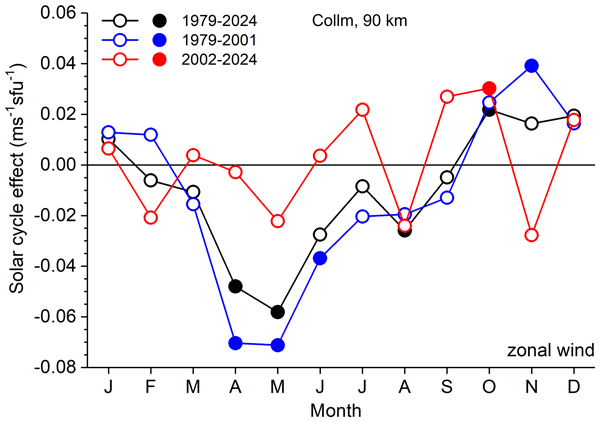
Christoph Jacobi, Ales Kuchar, Manfred Ern, Toralf Renkwitz, Ralph Latteck, and Jorge L. Chau
Adv. Radio Sci., 24, 15–28, https://doi.org/10.5194/ars-24-15-2026, https://doi.org/10.5194/ars-24-15-2026, 2026
Short summary
Short summary
Analyses of more than four decades (1979–2024) of mean horizontal winds in the mesopause region at about 90 km altitude show long-term trends and an influence of the 11-year solar cycle. After the 1990s, both linear trends and the solar cycle effect change and strongly weaken, indicating a change in dynamics or solar forcing. Gravity wave proxies also show a solar cycle effect, which decreases after the 1990s.
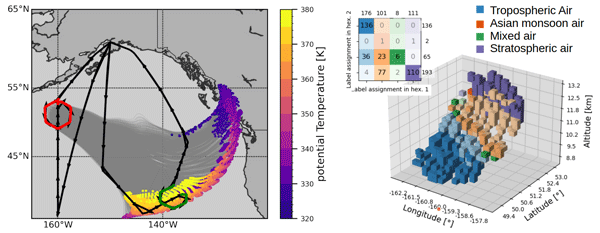
Jan Kaumanns, Jörn Ungermann, Bärbel Vogel, Sören Johansson, Erik Kretschmer, Felix Plöger, Peter Preuße, Wolfgang Woiwode, and Martin Riese
Atmos. Chem. Phys., 26, 9083–9111, https://doi.org/10.5194/acp-26-9083-2026, https://doi.org/10.5194/acp-26-9083-2026, 2026
Short summary
Short summary
During the PHILEAS aircraft campaign a self-matching experiment was conducted to study the mixing of Asian Summer monsoon air into the upper troposphere – lower stratosphere. We present the first 3-D tomographic observations of this mixing for multiple trace gas species. We use advanced clustering to identify the types of air and their transport pathways, particularly into the stratosphere. Simulations of surface-origin tracers link several of these air types to different source regions.
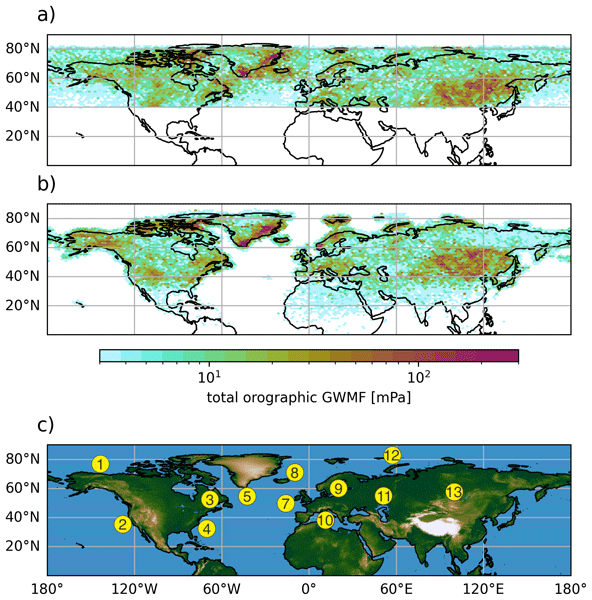
Sebastian Rhode, Peter Preusse, and Jörn Ungermann
Atmos. Chem. Phys., 26, 8145–8158, https://doi.org/10.5194/acp-26-8145-2026, https://doi.org/10.5194/acp-26-8145-2026, 2026
Short summary
Short summary
Mountain waves are excited when wind flows over elevated terrain. These waves travel through the atmosphere and alter the winds locally when they break, thereby impacting global-scale dynamic phenomena. Understanding mountain waves and their interactions, they need to be identified in measurement data or model simulations. This study provides a method for disentangling the mountain waves from atmospheric fluctuations of other origin in three-dimensional temperature data.
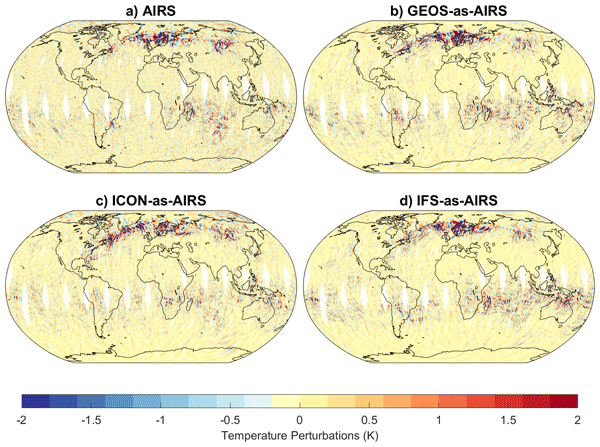
Phoebe Noble, Haruka Okui, Joan Alexander, Manfred Ern, Neil P. Hindley, Lars Hoffmann, Laura Holt, Annelize van Niekerk, Riwal Plougonven, Inna Polichtchouk, Claudia C. Stephan, Martina Bramberger, Milena Corcos, William Putnam, Christopher Kruse, and Corwin J. Wright
Atmos. Chem. Phys., 26, 7607–7630, https://doi.org/10.5194/acp-26-7607-2026, https://doi.org/10.5194/acp-26-7607-2026, 2026
Short summary
Short summary
Gravity waves are small-scale processes that drive the circulation in the middle and upper atmosphere. In this work, we assess 3 new high-resolution (3-5km horizontal resolution) models against satellite data. Generally, models capture the spatial patterns and represent stratospheric northern hemisphere mountain generated waves well. However, they still underestimate amplitudes globally and struggle with the representation of southern hemispheric convective waves.
Gerald Wetzel, Anne Kleinert, Sören Johansson, Felix Friedl-Vallon, Michael Höpfner, Jörn Ungermann, Tom Neubert, Valéry Catoire, Cyril Crevoisier, Andreas Engel, Thomas Gulde, Patrick Jacquet, Oliver Kirner, Erik Kretschmer, Thomas Kulessa, Johannes C. Laube, Guido Maucher, Hans Nordmeyer, Christof Piesch, Peter Preusse, Markus Retzlaff, Georg Schardt, Johan Schillings, Herbert Schneider, Axel Schönfeld, Tanja Schuck, Wolfgang Woiwode, Martin Riese, and Peter Braesicke
Atmos. Meas. Tech., 18, 5873–5894, https://doi.org/10.5194/amt-18-5873-2025, https://doi.org/10.5194/amt-18-5873-2025, 2025
Short summary
Short summary
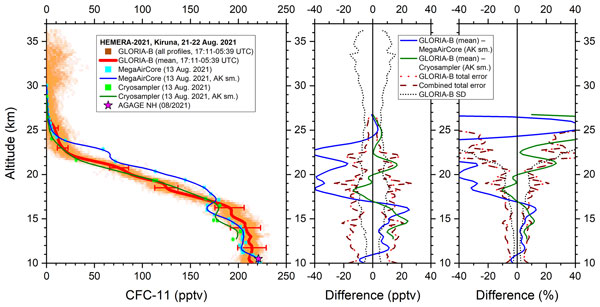
We present vertical trace gas profiles from the first balloon flight of the newly developed GLORIA-B limb-imaging Fourier-Transform spectrometer. Longer-lived gases are compared to external measurements to assess the quality of the GLORIA-B observations. Diurnal changes of photochemically active species are compared to model simulations. GLORIA-B demonstrates the capability of balloon-borne limb imaging to provide high-resolution vertical profiles of trace gases up to the middle stratosphere.
Rasul Baikhadzhaev, Felix Ploeger, Peter Preusse, Manfred Ern, and Thomas Birner
Atmos. Chem. Phys., 25, 12753–12777, https://doi.org/10.5194/acp-25-12753-2025, https://doi.org/10.5194/acp-25-12753-2025, 2025
Short summary
Short summary
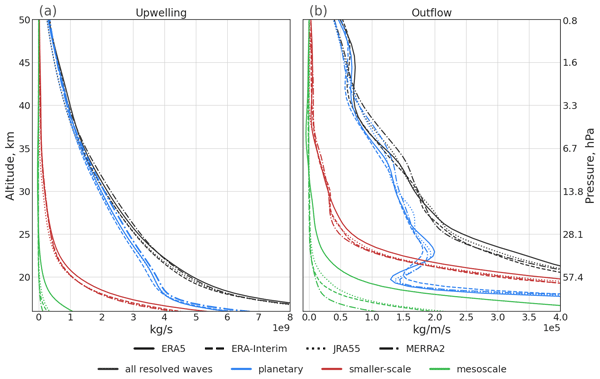
Across four reanalyses, the shallow branch of the stratospheric overturning circulation was found to be driven by planetary waves 1 to 3, and the deep branch of the circulation was found to be driven by smaller-scale waves (wave 4 and higher). However, the height of the level separating the branches is dependent on the reanalysis considered. Thus, using the appropriate separation levels in model inter-comparisons could reduce the spread between models regarding climatology and trends in the circulation.
Ales Kuchar, Gunter Stober, Dimitry Pokhotelov, Huixin Liu, Han-Li Liu, Manfred Ern, Damian Murphy, Diego Janches, Tracy Moffat-Griffin, Nicholas Mitchell, and Christoph Jacobi
EGUsphere, https://doi.org/10.5194/egusphere-2025-2827, https://doi.org/10.5194/egusphere-2025-2827, 2025
Short summary
Short summary
We studied how the healing of the Antarctic ozone layer is affecting winds high above the South Pole. Using ground-based radar, satellite data, and computer models, we found that winds in the upper atmosphere have become stronger over the past two decades. These changes appear to be linked to shifts in the lower atmosphere caused by ozone recovery. Our results show that human efforts to repair the ozone layer are also influencing climate patterns far above Earth’s surface.
Christoph Jacobi, Khalil Karami, Ales Kuchar, Manfred Ern, Toralf Renkwitz, Ralph Latteck, and Jorge L. Chau
Adv. Radio Sci., 23, 21–31, https://doi.org/10.5194/ars-23-21-2025, https://doi.org/10.5194/ars-23-21-2025, 2025
Short summary
Short summary
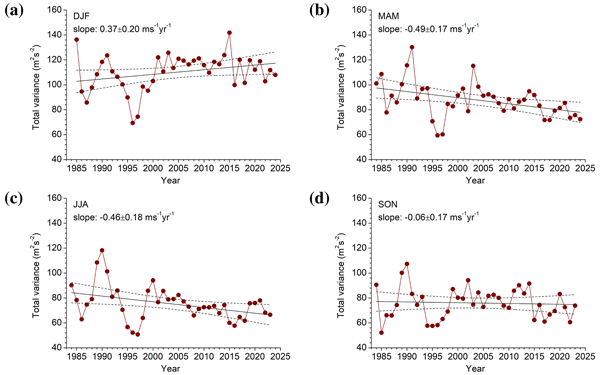
Half-hourly mean winds have been obtained using ground-based low-frequency and very high frequency radio observations of the mesopause region at Collm, Germany, since 1984. Long-term changes of wind variances, which are proxies for short-period atmospheric gravity waves, have been analysed. Gravity wave amplitudes increase with time in winter, but mainly decrease in summer. The trends are consistent with mean wind changes according to wave theory.
Florian Voet, Felix Ploeger, Johannes Laube, Peter Preusse, Paul Konopka, Jens-Uwe Grooß, Jörn Ungermann, Björn-Martin Sinnhuber, Michael Höpfner, Bernd Funke, Gerald Wetzel, Sören Johansson, Gabriele Stiller, Eric Ray, and Michaela I. Hegglin
Atmos. Chem. Phys., 25, 3541–3565, https://doi.org/10.5194/acp-25-3541-2025, https://doi.org/10.5194/acp-25-3541-2025, 2025
Short summary
Short summary
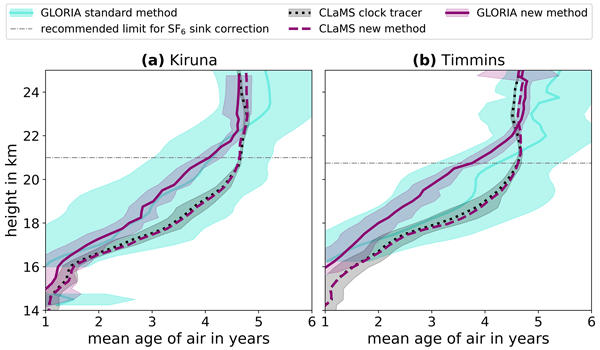
This study refines estimates of the stratospheric “age of air”, a measure of how long air circulates in the stratosphere. By analyzing correlations between trace gases measurable by satellites, the research introduces a method that reduces uncertainties and detects small-scale atmospheric features. This improved understanding of stratospheric circulation is crucial for better climate models and predictions, enhancing our ability to assess the impacts of climate change on the atmosphere.
Sebastian Rhode, Peter Preusse, Jörn Ungermann, Inna Polichtchouk, Kaoru Sato, Shingo Watanabe, Manfred Ern, Karlheinz Nogai, Björn-Martin Sinnhuber, and Martin Riese
Atmos. Meas. Tech., 17, 5785–5819, https://doi.org/10.5194/amt-17-5785-2024, https://doi.org/10.5194/amt-17-5785-2024, 2024
Short summary
Short summary
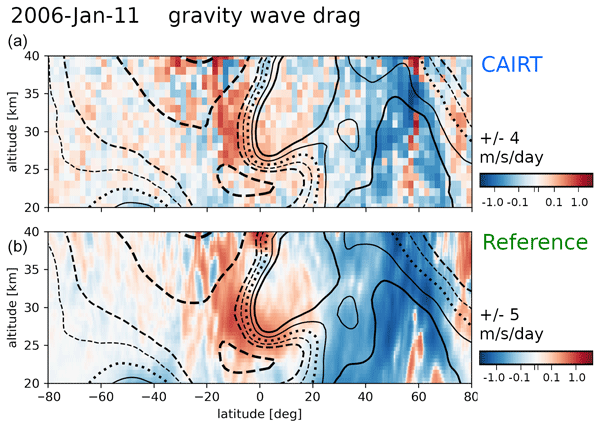
We investigate the capabilities of a proposed satellite mission, CAIRT, for observing gravity waves throughout the middle atmosphere and present the necessary methodology for in-depth wave analysis. Our findings suggest that such a satellite mission is highly capable of resolving individual wave parameters and could give new insights into the role of gravity waves in general atmospheric circulation and atmospheric processes.
Sören Johansson, Michael Höpfner, Felix Friedl-Vallon, Norbert Glatthor, Thomas Gulde, Vincent Huijnen, Anne Kleinert, Erik Kretschmer, Guido Maucher, Tom Neubert, Hans Nordmeyer, Christof Piesch, Peter Preusse, Martin Riese, Björn-Martin Sinnhuber, Jörn Ungermann, Gerald Wetzel, and Wolfgang Woiwode
Atmos. Chem. Phys., 24, 8125–8138, https://doi.org/10.5194/acp-24-8125-2024, https://doi.org/10.5194/acp-24-8125-2024, 2024
Short summary
Short summary
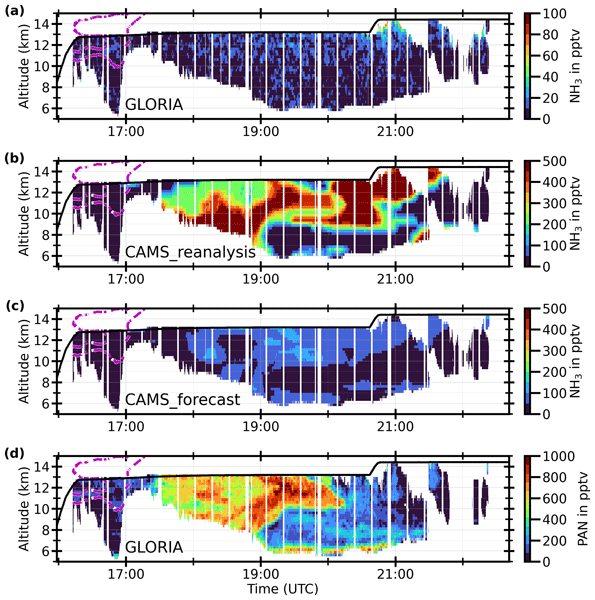
We present airborne infrared limb sounding GLORIA measurements of ammonia (NH3) in the upper troposphere of air masses within the Asian monsoon and of those connected with biomass burning. Comparing CAMS (Copernicus Atmosphere Monitoring Service) model data, we find that the model reproduces the measured enhanced NH3 within the Asian monsoon well but not that within biomass burning plumes, where no enhanced NH3 is measured in the upper troposphere but considerable amounts are simulated by CAMS.
Björn Linder, Peter Preusse, Qiuyu Chen, Ole Martin Christensen, Lukas Krasauskas, Linda Megner, Manfred Ern, and Jörg Gumbel
Atmos. Meas. Tech., 17, 3829–3841, https://doi.org/10.5194/amt-17-3829-2024, https://doi.org/10.5194/amt-17-3829-2024, 2024
Short summary
Short summary
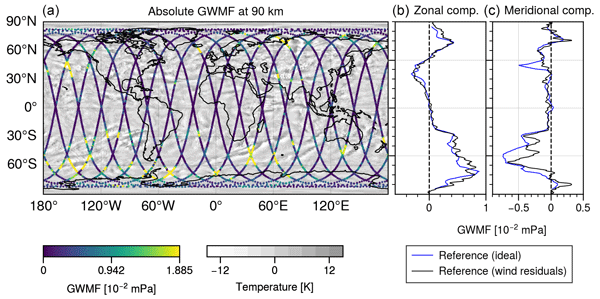
The Swedish research satellite MATS (Mesospheric Airglow/Aerosol Tomography and Spectroscopy) is designed to study atmospheric waves in the mesosphere and lower thermosphere. These waves perturb the temperature field, and thus, by observing three-dimensional temperature fluctuations, their properties can be quantified. This pre-study uses synthetic MATS data generated from a general circulation model to investigate how well wave properties can be retrieved.
Roland Eichinger, Sebastian Rhode, Hella Garny, Peter Preusse, Petr Pisoft, Aleš Kuchař, Patrick Jöckel, Astrid Kerkweg, and Bastian Kern
Geosci. Model Dev., 16, 5561–5583, https://doi.org/10.5194/gmd-16-5561-2023, https://doi.org/10.5194/gmd-16-5561-2023, 2023
Short summary
Short summary
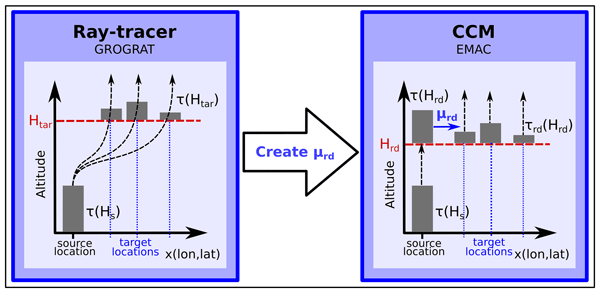
The columnar approach of gravity wave (GW) schemes results in dynamical model biases, but parallel decomposition makes horizontal GW propagation computationally unfeasible. In the global model EMAC, we approximate it by GW redistribution at one altitude using tailor-made redistribution maps generated with a ray tracer. More spread-out GW drag helps reconcile the model with observations and close the 60°S GW gap. Polar vortex dynamics are improved, enhancing climate model credibility.
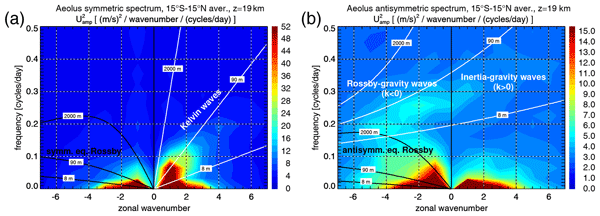
Manfred Ern, Mohamadou A. Diallo, Dina Khordakova, Isabell Krisch, Peter Preusse, Oliver Reitebuch, Jörn Ungermann, and Martin Riese
Atmos. Chem. Phys., 23, 9549–9583, https://doi.org/10.5194/acp-23-9549-2023, https://doi.org/10.5194/acp-23-9549-2023, 2023
Short summary
Short summary
Quasi-biennial oscillation (QBO) of the stratospheric tropical winds is an important mode of climate variability but is not well reproduced in free-running climate models. We use the novel global wind observations by the Aeolus satellite and radiosondes to show that the QBO is captured well in three modern reanalyses (ERA-5, JRA-55, and MERRA-2). Good agreement is also found also between Aeolus and reanalyses for large-scale tropical wave modes in the upper troposphere and lower stratosphere.
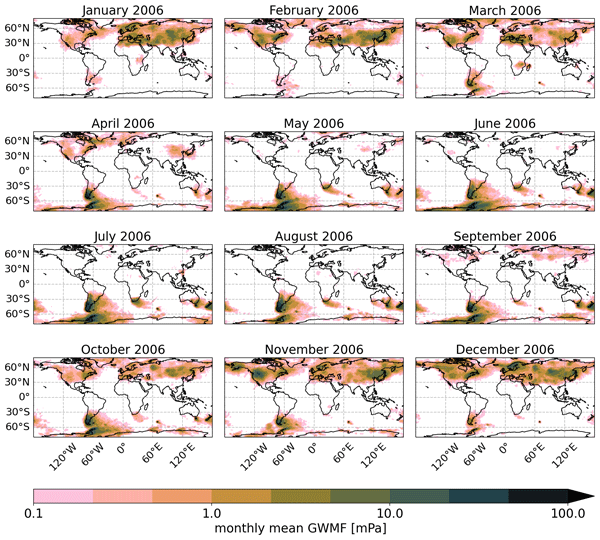
Sebastian Rhode, Peter Preusse, Manfred Ern, Jörn Ungermann, Lukas Krasauskas, Julio Bacmeister, and Martin Riese
Atmos. Chem. Phys., 23, 7901–7934, https://doi.org/10.5194/acp-23-7901-2023, https://doi.org/10.5194/acp-23-7901-2023, 2023
Short summary
Short summary
Gravity waves (GWs) transport energy vertically and horizontally within the atmosphere and thereby affect wind speeds far from their sources. Here, we present a model that identifies orographic GW sources and predicts the pathways of the excited GWs through the atmosphere for a better understanding of horizontal GW propagation. We use this model to explain physical patterns in satellite observations (e.g., low GW activity above the Himalaya) and predict seasonal patterns of GW propagation.
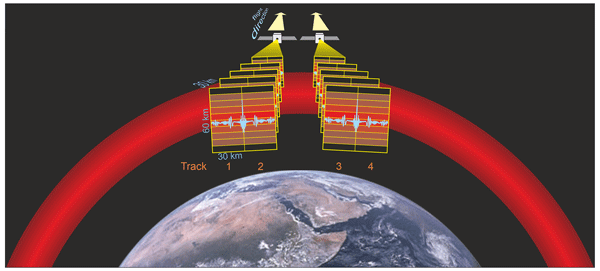
Qiuyu Chen, Konstantin Ntokas, Björn Linder, Lukas Krasauskas, Manfred Ern, Peter Preusse, Jörn Ungermann, Erich Becker, Martin Kaufmann, and Martin Riese
Atmos. Meas. Tech., 15, 7071–7103, https://doi.org/10.5194/amt-15-7071-2022, https://doi.org/10.5194/amt-15-7071-2022, 2022
Short summary
Short summary
Observations of phase speed and direction spectra as well as zonal mean net gravity wave momentum flux are required to understand how gravity waves reach the mesosphere–lower thermosphere and how they there interact with background flow. To this end we propose flying two CubeSats, each deploying a spatial heterodyne spectrometer for limb observation of the airglow. End-to-end simulations demonstrate that individual gravity waves are retrieved faithfully for the expected instrument performance.
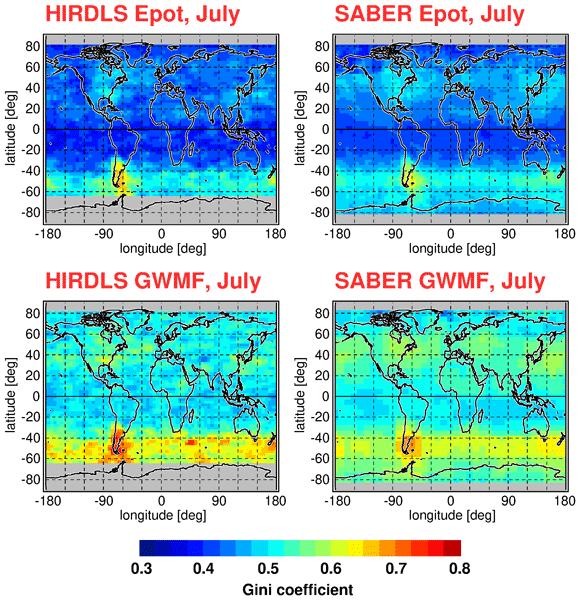
Manfred Ern, Peter Preusse, and Martin Riese
Atmos. Chem. Phys., 22, 15093–15133, https://doi.org/10.5194/acp-22-15093-2022, https://doi.org/10.5194/acp-22-15093-2022, 2022
Short summary
Short summary
Based on data from the HIRDLS and SABER infrared limb sounding satellite instruments, we investigate the intermittency of global distributions of gravity wave (GW) potential energies and GW momentum fluxes in the stratosphere and mesosphere using probability distribution functions (PDFs) and Gini coefficients. We compare GW intermittency in different regions, seasons, and altitudes. These results can help to improve GW parameterizations and the distributions of GWs resolved in models.
Mohamadou A. Diallo, Felix Ploeger, Michaela I. Hegglin, Manfred Ern, Jens-Uwe Grooß, Sergey Khaykin, and Martin Riese
Atmos. Chem. Phys., 22, 14303–14321, https://doi.org/10.5194/acp-22-14303-2022, https://doi.org/10.5194/acp-22-14303-2022, 2022
Short summary
Short summary
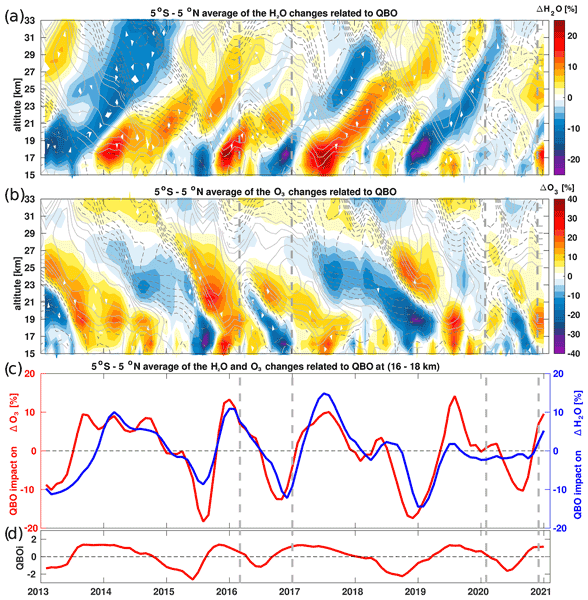
The quasi-biennial oacillation disruption events in both 2016 and 2020 decreased lower-stratospheric water vapour and ozone. Differences in the strength and depth of the anomalous lower-stratospheric circulation and ozone are due to differences in tropical upwelling and cold-point temperature induced by lower-stratospheric planetary and gravity wave breaking. The differences in water vapour are due to higher cold-point temperature in 2020 induced by Australian wildfire.
Cornelia Strube, Peter Preusse, Manfred Ern, and Martin Riese
Atmos. Chem. Phys., 21, 18641–18668, https://doi.org/10.5194/acp-21-18641-2021, https://doi.org/10.5194/acp-21-18641-2021, 2021
Short summary
Short summary
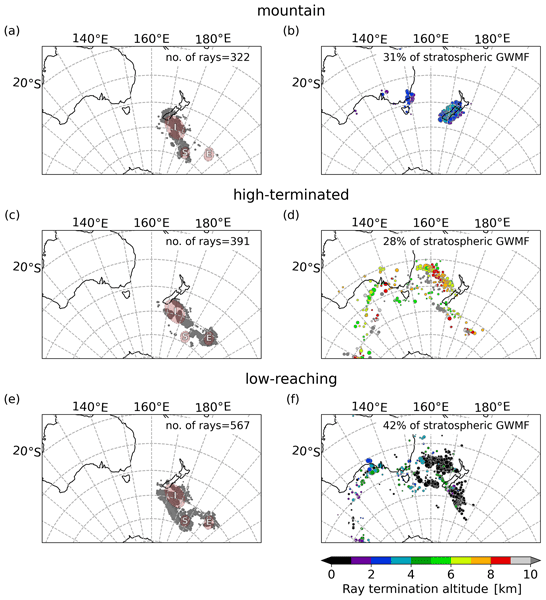
High gravity wave (GW) momentum fluxes in the lower stratospheric southern polar vortex around 60° S are still poorly understood. Few GW sources are found at these latitudes. We present a ray tracing case study on waves resolved in high-resolution global model temperatures southeast of New Zealand. We show that lateral propagation of more than 1000 km takes place below 20 km altitude, and a variety of orographic and non-orographic sources located north of 50° S generate the wave field.
Cited articles
Alexander, M. J., Gille, J., Cavanaugh, C., Coffey, M., Craig, C., Dean, V., Eden, T., Francis, G., Halvorson, C., Hannigan, J., Khosravi, R., Kinnison, D., Lee, H., Massie, S., and Nardi, B.: Global estimates of gravity wave momentum flux from High Resolution Dynamics Limb Sounder (HIRDLS) observations, J. Geophys. Res., 113, https://doi.org/10.1029/2007JD008807, 2008. a, b
Alexander, M. J., Geller, M., McLandress, C., Polavarapu, S., Preusse, P., Sassi, F., Sato, K., Eckermann, S., Ern, M., Hertzog, A., Kawatani, Y., Pulido, M., Shaw, T. A., Sigmond, M., Vincent, R., and Watanabe, S.: Recent developments in gravity-wave effects in climate models and the global distribution of gravity-wave momentum flux from observations and models, Quart. J. Roy. Meteorol. Soc., 136, 1103–1124, https://doi.org/10.1002/qj.637, 2010. a, b, c
Alexander, P., Schmidt, T., and de la Torre, A.: A method to determine gravity wave net momentum flux, propagation direction, and “real” wavelengths: A GPS radio occultations soundings case study, Earth and Space Science, 5, 222–230, https://doi.org/10.1002/2017EA000342, 2018. a
Allen, S. J. and Vincent, R. A.: Gravity wave activity in the lower atmosphere: Seasonal and latitudinal variations, J. Geophys. Res., 100, 1327–1350, 1995. a
Becker, E., Vadas, S. L., Bossert, K., Harvey, V. L., Zülicke, C., and Hoffmann, L.: A High-Resolution Whole-Atmosphere Model With Resolved Gravity Waves and Specified Large-Scale Dynamics in the Troposphere and Stratosphere, J. Geophys. Res. Atmos., 127, e2021JD035018, https://doi.org/10.1029/2021JD035018, 2022. a
Charney, J. G. and Drazin, P. G.: Propagation of planetary-scale disturbances from the lower into the upper atmosphere, J. Geophys. Res., 66, 83–109, https://doi.org/10.1029/JZ066i001p00083, 1961. a
De la Torre, A., Tsuda, T., Hajj, G., and Wickert, J.: A global distribution of the stratospheric gravity wave activity from GPS occultation profiles with SAC-C and CHAMP, J. Met. Soc. Japan Ser. II, 82, 407–417, https://doi.org/10.2151/jmsj.2004.407, 2004. a
Eckermann, S. D., Hirota, I., and Hocking, W. K.: Gravity wave and equatorial wave morphology of the stratosphere derived from long-term rocket soundings, Quart. J. Roy. Meteorol. Soc., 121, 149–186, 1995. a
Ehard, B., Kaifler, B., Kaifler, N., and Rapp, M.: Evaluation of methods for gravity wave extraction from middle-atmospheric lidar temperature measurements, Atmos. Meas. Tech., 8, 4645–4655, https://doi.org/10.5194/amt-8-4645-2015, 2015. a
Ern, M. and Preusse, P.: Wave fluxes of equatorial Kelvin waves and QBO zonal wind forcing derived from SABER and ECMWF temperature space-time spectra, Atmos. Chem. Phys., 9, 3957–3986, https://doi.org/10.5194/acp-9-3957-2009, 2009. a
Ern, M., Preusse, P., and Warner, C. D.: Some experimental constraints for spectral parameters used in the Warner and McIntyre gravity wave parameterization scheme, Atmos. Chem. Phys., 6, 4361–4381, https://doi.org/10.5194/acp-6-4361-2006, 2006. a
Ern, M., Preusse, P., Gille, J. C., Hepplewhite, C. L., Mlynczak, M. G., Russell III, J. M., and Riese, M.: Implications for atmospheric dynamics derived from global observations of gravity wave momentum flux in stratosphere and mesosphere, J. Geophys. Res., 116, https://doi.org/10.1029/2011JD015821, 2011. a, b
Ern, M., Preusse, P., Kalisch, S., Kaufmann, M., and Riese, M.: Role of gravity waves in the forcing of quasi two-day waves in the mesosphere: An observational study, J. Geophys. Res. Atmos., 118, 3467–3485, https://doi.org/10.1029/2012JD018208, 2013. a
Ern, M., Trinh, Q. T., Preusse, P., Gille, J. C., Mlynczak, M. G., Russell III, J. M., and Riese, M.: GRACILE: a comprehensive climatology of atmospheric gravity wave parameters based on satellite limb soundings, Earth Syst. Sci. Data, 10, 857–892, https://doi.org/10.5194/essd-10-857-2018, 2018. a, b
Ern, M., Diallo, M. A., Khordakova, D., Krisch, I., Preusse, P., Reitebuch, O., Ungermann, J., and Riese, M.: The quasi-biennial oscillation (QBO) and global-scale tropical waves in Aeolus wind observations, radiosonde data, and reanalyses, Atmos. Chem. Phys., 23, 9549–9583, https://doi.org/10.5194/acp-23-9549-2023, 2023. a
Fetzer, E. J. and Gille, J. C.: Gravity wave variance in LIMS temperatures. Part I: Variability and comparison with background winds, J. Atmos. Sci., 51, 2461–2483, https://doi.org/10.1175/1520-0469(1994)051<2461:GWVILT>2.0.CO;2, 1994. a
Fetzer, J. E. and Gille, J. C.: Gravity wave variance in LIMS temperatures. Part II: Comparison with the zonal-mean momentum balance, J. Atmos. Sci., 53, 398–410, 1996. a
Fritts, D. and Alexander, M.: Gravity wave dynamics and effects in the middle atmosphere, Rev. Geophys., 41, https://doi.org/10.1029/2001RG000106, 2003. a
Fujiwara, M., Suzuki, J., Gettelman, A., Hegglin, M. I., Akiyoshi, H., and Shibata, K.: Wave activity in the tropical tropopause layer in seven reanalysis and four chemistry climate model data sets, J. Geophys. Res. Atmos., 117, https://doi.org/10.1029/2011JD016808, 2012. a
Geller, M. A., Alexander, M. J., Love, P. T., Bacmeister, J., Ern, M., Hertzog, A., Manzini, E., Preusse, P., Sato, K., Scaife, A. A., and Zhou, T.: A comparison between gravity wave momentum fluxes in observations and climate models, J. Clim., 26, 6383–6405, https://doi.org/10.1175/JCLI-D-12-00545.1, 2013. a
Guest, F., Reeder, M., Marks, C., and Karoly, D.: Inertia-gravity waves observed in the lower stratosphere over Macquarie Island, J. Atmos. Sci., 57, 737–752, 2000. a
Hersbach, H., Bell, B., Berrisford, P., Hirahara, S., Horanyi, A., Munoz-Sabater, J., Nicolas, J., Peubey, C., Radu, R., Schepers, D., Simmons, A., Soci, C., Abdalla, S., Abellan, X., Balsamo, G., Bechtold, P., Biavati, G., Bidlot, J., Bonavita, M., De Chiara, G., Dahlgren, P., Dee, D., Diamantakis, M., Dragani, R., Flemming, J., Forbes, R., Fuentes, M., Geer, A., Haimberger, L., Healy, S., Hogan, R. J., Holm, E., Janiskova, M., Keeley, S., Laloyaux, P., Lopez, P., Lupu, C., Radnoti, G., de Rosnay, P., Rozum, I., Vamborg, F., Villaume, S., and Thepaut, J.-N.: The ERA5 global reanalysis, Quart. J. Roy. Meteorol. Soc., 146, 1999–2049, https://doi.org/10.1002/qj.3803, 2020. a
Hirota, I.: Climatology of gravity waves in the middle atmosphere, J. Atm. Terr. Phys., 46, 767–773, 1984. a
Hirota, I. and Niki, T.: A statistical study of inertia-gravity waves in the middle atmosphere, J. Met. Soc. Japan Ser. II, 63, 1055–1066, 1985. a
Hoffmann, L. and Alexander, M. J.: Occurrence frequency of convective gravity waves during the North American thunderstorm season, J. Geophys. Res., 115, https://doi.org/10.1029/2010JD014401, 2010. a
Kim, Y.-H. and Chun, H.-Y.: Contributions of equatorial wave modes and parameterized gravity waves to the tropical QBO in HadGEM2, J. Geophys. Res. Atmos., 120, 1065–1090, https://doi.org/10.1002/2014JD022174, 2015. a
Kim, Y.-J., Eckermann, S. D., and Chun, H.-Y.: An overview of the past, present and future of gravity-wave drag parameterization for numerical climate and weather prediction models, Atmosphere-Ocean, 41, 65–98, 2003. a
Krebsbach, M. and Preusse, P.: Spectral analysis of gravity wave activity in SABER temperature data, Geophys. Res. Lett., 34, https://doi.org/10.1029/2006GL028040, 2007. a
Lomb, N. R.: Least-squares frequency analysis of unequally spaced data, Astrophys. & Space Sci., 39, 447–462, https://doi.org/10.1007/BF00648343, 1976. a
Oberheide, J., Hagan, M., Ward, W., Riese, M., and Offermann, D.: Modeling the diurnal tide for the Cryogenic Infrared Spectrometers and Telescopes for the Atmosphere (CRISTA) 1 time period, J. Geophys. Res., 105, 24917–24929, https://doi.org/10.1029/2000JA000047, 2000. a
Pahlavan, H. A., Wallace, J. M., Fu, Q., and Kiladis, G. N.: Revisiting the quasi-biennial oscillation as seen in ERA5. Part II: evaluation of waves and wave forcing, J. Atmos. Sci., 78, 693–707, https://doi.org/10.1175/JAS-D-20-0249.1, 2021. a
Plougonven, R., de la Camara, A., Hertzog, A., and Lott, F.: How does knowledge of atmospheric gravity waves guide their parameterizations?, Quart. J. Roy. Meteorol. Soc., 146, 1529–1543, https://doi.org/10.1002/qj.3732, 2020. a
Pramitha, M., Ratnam, M. V., Leena, P. P., Murthy, B. V. K., and Rao, S. V. B.: Identification of inertia gravity wave sources observed in the troposphere and the lower stratosphere over a tropical station Gadanki, Atmos. Res., 176, 202–211, https://doi.org/10.1016/j.atmosres.2016.03.001, 2016. a
Preusse, P., Dörnbrack, A., Eckermann, S. D., Riese, M., Schaeler, B., Bacmeister, J. T., Broutman, D., and Grossmann, K. U.: Space-based measurements of stratospheric mountain waves by CRISTA, 1. Sensitivity, analysis method, and a case study, J. Geophys. Res., 107, https://doi.org/10.1029/2001JD000699, 2002. a
Preusse, P., Eckermann, S. D., and Ern, M.: Transparency of the atmosphere to short horizontal wavelength gravity waves, J. Geophys. Res., 113, https://doi.org/10.1029/2007JD009682, 2008. a
Rapp, M., Dörnbrack, A., and Preusse, P.: Large Midlatitude Stratospheric Temperature Variability Caused by Inertial Instability: A Potential Source of Bias for Gravity Wave Climatologies, Geophys. Res. Lett., 45, 10682–10690, 2018. a
Rhode, S.: CAIRT Synthetic Temperature Data 2018-12–2019-03, Zenodo [data set], https://doi.org/10.5281/zenodo.17251039, 2025. a
Rhode, S., Preusse, P., Ungermann, J., Polichtchouk, I., Sato, K., Watanabe, S., Ern, M., Nogai, K., Sinnhuber, B.-M., and Riese, M.: Global-scale gravity wave analysis methodology for the ESA Earth Explorer 11 candidate CAIRT, Atmos. Meas. Tech., 17, 5785–5819, https://doi.org/10.5194/amt-17-5785-2024, 2024. a, b
Rhode, S., Mathew, A. J., Ern, M., Pramitha, M., and Preusse, P.: OpenGLOFI – Global Wave Fit for Atmospheric Background Removal, Zenodo [code], https://doi.org/10.5281/zenodo.17090223, 2025. a, b
Sakib, M. N. and Yigit, E.: A brief overview of gravity wave retrieval techniques from observations, Front. Astron. Space Sci., 9, https://doi.org/10.3389/fspas.2022.824875, 2022. a
Salby, M.: Survey of planetary-scale traveling waves – the state of theory and observations, Rev. Geophys., 22, 209–236, https://doi.org/10.1029/RG022i002p00209, 1984. a
Salby, M. L.: Sampling theory for asynoptic satellite observatioons. Part I: Space-time spectra, resolution, and aliasing, J. Atmos. Sci., 39, 2577–2600, https://doi.org/10.1175/1520-0469(1982)039<2577:STFASO>2.0.CO;2, 1982. a
Savitzky, A. and Golay, M. J. E.: Smoothing and Differentiation of Data by Simplified Least Squares Procedures, Analytical Chemistry, 36, 1627–1639, https://doi.org/10.1021/ac60214a047, 1964. a
Scargle, J. D.: Studies in astronomical time series analysis. II-Statistical aspects of spectral analysis of unevenly spaced data, Astrophys. J., Part 1, 263, 835–853, https://doi.org/10.1086/160554, 1982. a
Schmidt, T., Alexander, P., and de la Torre, A.: Stratospheric gravity wave momentum flux from radio occultations, J. Geophys. Res. Atmos., 121, 4443–4467, https://doi.org/10.1002/2015JD024135, 2016. a
Strube, C., Ern, M., Preusse, P., and Riese, M.: Removing spurious inertial instability signals from gravity wave temperature perturbations using spectral filtering methods, Atmos. Meas. Tech., 13, 4927–4945, https://doi.org/10.5194/amt-13-4927-2020, 2020. a, b
Tsuda, T., Nishida, M., Rocken, C., and Ware, R. H.: A global morphology of gravity wave activity in the stratosphere revealed by the GPS occultation data (GPS/MET), J. Geophys. Res., 105, 7257–7274, 2000. a
Vincent, R. and Alexander, M.: Gravity waves in the tropical lower stratosphere: An observational study of seasonal and interannual variability, J. Geophys. Res. Atmos., 105, 17971–17982, https://doi.org/10.1029/2000JD900196, 2000. a
Wang, L. and Geller, M. A.: Morphology of gravity-wave energy as observed from 4 years (1998–2001) of high vertical resolution U. S. radiosonde data, J. Geophys. Res., 108, https://doi.org/10.1029/2002JD002786, 2003. a
Warner, D. C. and McIntyre, M. E.: An ultra-simple spectral parameterization for non-orographic gravity waves, J. Atmos. Sci., 58, 1837–1857, 2001. a
Wright, C. J., Osprey, S. M., Barnett, J. J., Gray, L. J., and Gille, J. C.: High Resolution Dynamics Limb Sounder measurements of gravity wave activity in the 2006 Arctic stratosphere, J. Geophys. Res. Atmos., 115, https://doi.org/10.1029/2009JD011858, 2010. a, b
Yan, X., Arnold, N., and Remedios, J.: Global observations of gravity waves from High Resolution Dynamics Limb Sounder temperature measurements: A yearlong record of temperature amplitude and vertical wavelength, J. Geophys. Res. Atmos., 115, D10113, https://doi.org/10.1029/2008JD011511, 2010. a
Zhang, S. D. and Yi, F.: A statistical study of gravity waves from radiosonde observations at Wuhan (30° N, 114° E) China, Ann. Geophys., 23, 665–673, https://doi.org/10.5194/angeo-23-665-2005, 2005. a
Zhang, S. D. and Yi, F.: Latitudinal and seasonal variations of inertial gravity wave activity in the lower atmosphere over central China, J. Geophys. Res. Atmos., 112, https://doi.org/10.1029/2006JD007487, 2007. a
Zhang, S. D., Yi, F., Huang, C. M., and Zhou, Q.: Latitudinal and seasonal variations of lower atmospheric inertial gravity wave energy revealed by US radiosonde data, Ann. Geophys., 28, 1065–1074, https://doi.org/10.5194/angeo-28-1065-2010, 2010. a
Zink, F. and Vincent, R. A.: Wavelet analysis of stratospheric gravity wave packets over Macquarie Island, 1. Wave parameters, J. Geophys. Res., 106, 275–288, 2001. a
Short summary
The atmosphere hosts a multitude of waves, among which Atmospheric Gravity wave separation from satellite measurements requires removal of global scale waves and tides. The present study describes the open access software GLOFI (GLObal wave FIt) which uses the 2D spectral decomposition to perform this removal. It is validated on simulated temperature observations synthesised for ESA (European Space Agency) Earth Explorer 11 candidate CAIRT (Changing-Atmosphere Infra-Red Tomography Explorer).
The atmosphere hosts a multitude of waves, among which Atmospheric Gravity wave separation from...


