
Articles | Volume 14, issue 5
https://doi.org/10.5194/amt-14-3333-2021
© Author(s) 2021. This work is distributed under
the Creative Commons Attribution 4.0 License.
the Creative Commons Attribution 4.0 License.
https://doi.org/10.5194/amt-14-3333-2021
© Author(s) 2021. This work is distributed under
the Creative Commons Attribution 4.0 License.
the Creative Commons Attribution 4.0 License.
Research article
| Highlight paper
| 
06 May 2021
Research article | Highlight paper |
| 06 May 2021
| 06 May 2021
Assimilation of DAWN Doppler wind lidar data during the 2017 Convective Processes Experiment (CPEX): impact on precipitation and flow structure
Svetla Hristova-Veleva
Jet Propulsion Laboratory, California Institute of Technology,
Pasadena, CA 91107, USA
Sara Q. Zhang
National Aeronautics and Space Administration, Goddard Space Flight
Center, Greenbelt, MD 20771, USA
Science Applications International Corporation, McLean, VA 22101, USA
Jet Propulsion Laboratory, California Institute of Technology,
Pasadena, CA 91107, USA
Ziad S. Haddad
Jet Propulsion Laboratory, California Institute of Technology,
Pasadena, CA 91107, USA
Randy C. Sawaya
Department of Physics and Astronomy, University of California, Irvine, Irvine, CA 92697, USA
Related authors
Hai Nguyen, Derek Posselt, Igor Yanovsky, Longtao Wu, and Svetla Hristova-Veleva
Atmos. Meas. Tech., 17, 3103–3119, https://doi.org/10.5194/amt-17-3103-2024, https://doi.org/10.5194/amt-17-3103-2024, 2024
Short summary
Short summary
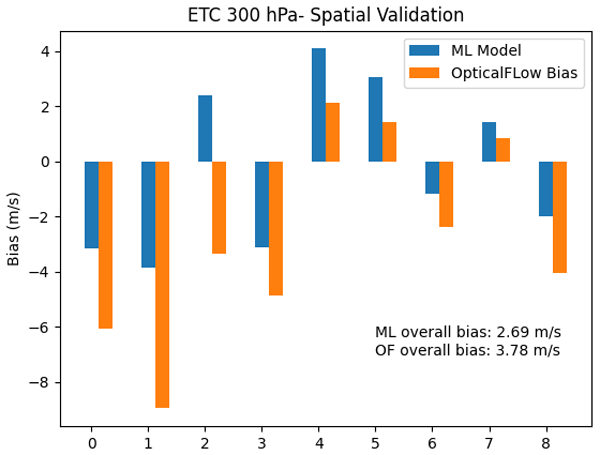
Accurate global wind estimation is crucial for weather prediction and environmental modeling. Our study investigates a method to refine atmospheric motion vectors (AMVs) by comparing them with high-precision active-sensor winds. Leveraging supervised learning, we discovered that using high-precision active-sensor data can significantly reduce biases in passive-sensor winds in addition to providing estimates of the wind errors, thereby improving their reliability.
Shunsuke Aoki, Takuji Kubota, and F. Joseph Turk
Atmos. Meas. Tech., 19, 79–100, https://doi.org/10.5194/amt-19-79-2026, https://doi.org/10.5194/amt-19-79-2026, 2026
Short summary
Short summary
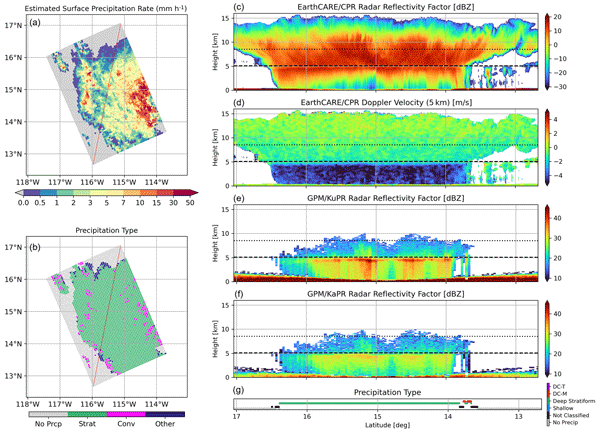
Using coincident observations from the EarthCARE Cloud Profiling Radar with Doppler velocity measurement capability and the Dual-Frequency Precipitation Radar on the Global Precipitation Measurement, vertical motions in stratiform and convective precipitation systems are examined, providing insights into the dynamical and microphysical processes inside deep clouds. This enables a more comprehensive understanding of hydrometeor fall speeds and vertical air motions in precipitation systems.
Shu-Ya Chen, Ying-Hwa Kuo, Hsiu-Wen Li, Ramon Padullés, Estel Cardellach, and Francis Joseph Turk
Atmos. Meas. Tech., 18, 5265–5280, https://doi.org/10.5194/amt-18-5265-2025, https://doi.org/10.5194/amt-18-5265-2025, 2025
Short summary
Short summary
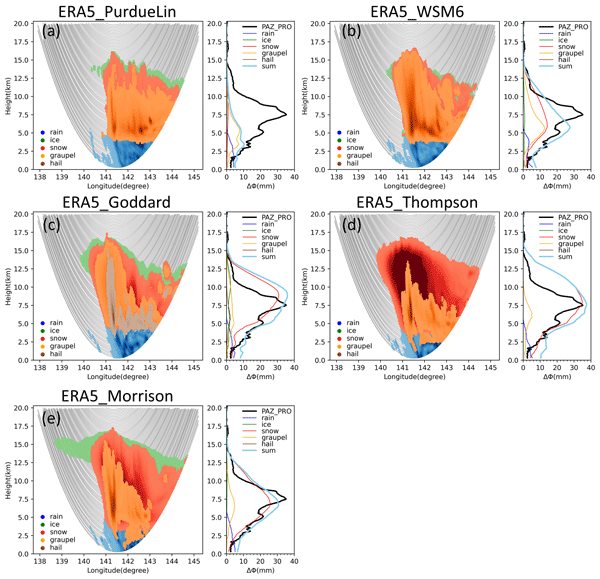
This study used Polarimetric radio occultation (PRO) observations to evaluate simulations of cloud hydrometeors with five microphysics schemes for three typhoons from 2019 and 2021. The simulated cloud hydrometeors distributions varied significantly depending on model initial conditions, typhoon structures, and microphysics schemes. Results in this study demonstrate the potential for using PRO observation to evaluate the performance of different microphysics schemes in numerical models.
Jonas E. Katona, Manuel de la Torre Juárez, Terence L. Kubar, F. Joseph Turk, Kuo-Nung Wang, and Ramon Padullés
Atmos. Meas. Tech., 18, 953–970, https://doi.org/10.5194/amt-18-953-2025, https://doi.org/10.5194/amt-18-953-2025, 2025
Short summary
Short summary
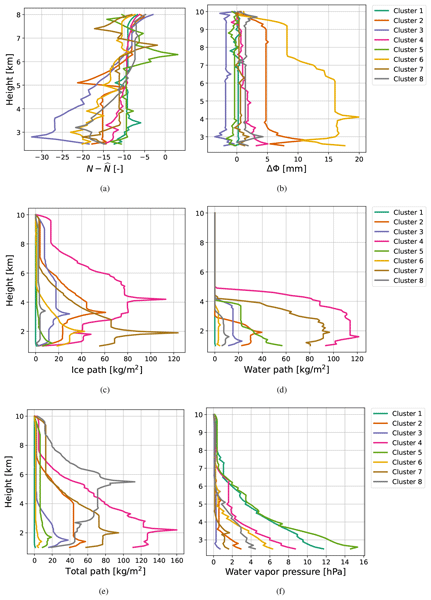
Polarimetric radio occultations (PROs) use polarized radio signals from satellites to detect moisture and precipitation in Earth's atmosphere. By applying nonlinear regression and k-means cluster analysis to over 2 years of PRO and non-PRO data, this study shows how deviations from a refractivity model relate to vertical profiles of water vapor pressure (moisture) and that differences between components of PRO signals correlate directly with vertical profiles of water path (precipitation).
Terence L. Kubar, Manuel de la Torre Juarez, Jonas Katona, and F. Joseph Turk
EGUsphere, https://doi.org/10.5194/egusphere-2024-3898, https://doi.org/10.5194/egusphere-2024-3898, 2025
Short summary
Short summary
We analyze space-borne observations of simultaneous vertical profiles of precipitation, cloud layers, and temperatures, and find that about 80–90 % of cloud tops globally reach or are below the level of least stability. Since water vapor is limited at these low temperatures, this height may be a more important constraint on cloud top heights than the tropopause height below the level of maximum stability. Only the heaviest precipitating clouds vertically extend above this most unstable level.
Ramon Padullés, Estel Cardellach, Antía Paz, Santi Oliveras, Douglas C. Hunt, Sergey Sokolovskiy, Jan-Peter Weiss, Kuo-Nung Wang, F. Joe Turk, Chi O. Ao, and Manuel de la Torre Juárez
Earth Syst. Sci. Data, 16, 5643–5663, https://doi.org/10.5194/essd-16-5643-2024, https://doi.org/10.5194/essd-16-5643-2024, 2024
Short summary
Short summary
This dataset provides, for the first time, combined observations of clouds and precipitation with coincident retrievals of atmospheric thermodynamics obtained from the same space-based instrument. Furthermore, it provides the locations of the ray trajectories of the observations along various precipitation-related products interpolated into them with the aim of fostering the use of such dataset in scientific and operational applications.
Hai Nguyen, Derek Posselt, Igor Yanovsky, Longtao Wu, and Svetla Hristova-Veleva
Atmos. Meas. Tech., 17, 3103–3119, https://doi.org/10.5194/amt-17-3103-2024, https://doi.org/10.5194/amt-17-3103-2024, 2024
Short summary
Short summary
Accurate global wind estimation is crucial for weather prediction and environmental modeling. Our study investigates a method to refine atmospheric motion vectors (AMVs) by comparing them with high-precision active-sensor winds. Leveraging supervised learning, we discovered that using high-precision active-sensor data can significantly reduce biases in passive-sensor winds in addition to providing estimates of the wind errors, thereby improving their reliability.
Kuo-Nung Wang, Chi O. Ao, Mary G. Morris, George A. Hajj, Marcin J. Kurowski, Francis J. Turk, and Angelyn W. Moore
Atmos. Meas. Tech., 17, 583–599, https://doi.org/10.5194/amt-17-583-2024, https://doi.org/10.5194/amt-17-583-2024, 2024
Short summary
Short summary
In this article, we described a joint retrieval approach combining two techniques, RO and MWR, to obtain high vertical resolution and solve for temperature and moisture independently. The results show that the complicated structure in the lower troposphere can be better resolved with much smaller biases, and the RO+MWR combination is the most stable scenario in our sensitivity analysis. This approach is also applied to real data (COSMIC-2/Suomi-NPP) to show the promise of joint RO+MWR retrieval.
Ramon Padullés, Estel Cardellach, and F. Joseph Turk
Atmos. Chem. Phys., 23, 2199–2214, https://doi.org/10.5194/acp-23-2199-2023, https://doi.org/10.5194/acp-23-2199-2023, 2023
Short summary
Short summary
The results of comparing the polarimetric radio occultation observables and the ice water content retrieved from the CloudSat radar in a global and statistical way show a strong correlation between the geographical patterns of both quantities for a wide range of heights. This implies that horizontally oriented hydrometeors are systematically present through the whole globe and through all vertical levels, which could provide insights on the physical processes leading to precipitation.
Miguel Ricardo A. Hilario, Ewan Crosbie, Michael Shook, Jeffrey S. Reid, Maria Obiminda L. Cambaliza, James Bernard B. Simpas, Luke Ziemba, Joshua P. DiGangi, Glenn S. Diskin, Phu Nguyen, F. Joseph Turk, Edward Winstead, Claire E. Robinson, Jian Wang, Jiaoshi Zhang, Yang Wang, Subin Yoon, James Flynn, Sergio L. Alvarez, Ali Behrangi, and Armin Sorooshian
Atmos. Chem. Phys., 21, 3777–3802, https://doi.org/10.5194/acp-21-3777-2021, https://doi.org/10.5194/acp-21-3777-2021, 2021
Short summary
Short summary
This study characterizes long-range transport from major Asian pollution sources into the tropical northwest Pacific and the impact of scavenging on these air masses. We combined aircraft observations, HYSPLIT trajectories, reanalysis, and satellite retrievals to reveal distinct composition and size distribution profiles associated with specific emission sources and wet scavenging. The results of this work have implications for international policymaking related to climate and health.
Cited articles
Baker, W. E., Atlas, R., Cardinali, C., Clement, A., Emmitt, G. D., Gentry,
B. M., Hardesty, R. M., Källén, E., Kavaya, M. J., Langland, R., Ma,
Z., Masutani, M., McCarty, W., Pierce, R. B., Pu, Z., Riishojgaard, L. P.,
Ryan, J., Tucker, S., Weissmann, M., and Yoe, J. G.: Lidar-Measured Wind
Profiles: The Missing Link in the Global Observing
System, B. Am. Meteorol. Soc., 95, 543–564,
https://doi.org/10.1175/BAMS-D-12-00164.1, 2014.
Bedka, K. M., Nehrir, A. R., Kavaya, M., Barton-Grimley, R., Beaubien, M., Carroll, B., Collins, J., Cooney, J., Emmitt, G. D., Greco, S., Kooi, S., Lee, T., Liu, Z., Rodier, S., and Skofronick-Jackson, G.: Airborne Lidar Observations of Wind, Water Vapor, and Aerosol Profiles During The NASA Aeolus Cal/Val Test Flight Campaign, Atmos. Meas. Tech. Discuss. [preprint], https://doi.org/10.5194/amt-2020-475, in press, 2021.
Chen, S. S., Kerns, B. W., Guy, N., Jorgensen, D. P., Delanoë, J., Viltard, N., Zappa, C. J., Judt, F., Lee, C.-Y., and Savarin, A.: Aircraft
Observations of Dry Air, the ITCZ, Convective Cloud Systems, and Cold Pools
in MJO during DYNAMO, B. Am. Meteorol. Soc., 97, 405–423, https://doi.org/10.1175/BAMS-D-13-00196.1, 2015.
Cui, Z., Pu, Z., Emmitt, G. D., and Greco, S.: The Impact of Airborne Doppler
Aerosol Wind (DAWN) Lidar Wind Profiles on Numerical Simulations of Tropical
Convective Systems during the NASA Convective Processes Experiment
(CPEX), J. Atmos. Ocean. Tech., 37, 705–722, https://doi.org/10.1175/JTECH-D-19-0123.1, 2020.
Drager, A. J. and van den Heever, S. C.: Characterizing convective cold pools, J. Adv. Model. Earth Sy., 9, 1091–1115, https://doi.org/10.1002/2016MS000788, 2017.
Durden, S. L., Tanelli, S., and Im, E.: Recent observations of clouds and precipitation by the airborne precipitation radar 2nd generation in support of the GPM and ACE missions, in: Proc. SPIE Asia-Pacific Remote Sensing, Remote Sensing of the Atmosphere, Clouds, and Precipitation IV, Kyoto, Japan, 8 November 2012, 85230M, https://doi.org/10.1117/12.977574, 2012.
Grant, L. D. and van den Heever, S. C.: Cold pool
dissipation, J. Geophys. Res.-Atmos., 121, 1138–1155, https://doi.org/10.1002/2015JD023813, 2016.
Greco, S., Emmitt, G. D., Garstang, M., and Kavaya, M.: Doppler Aerosol WiNd
(DAWN) Lidar during CPEX 2017: Instrument Performance and Data
Utility, Remote Sens.-Basel, 12, 2951, https://doi.org/10.3390/rs12182951, 2020.
Grecu, M., Olson, W. S., Munchak, S. J., Ringerud, S., Liao, L., Haddad, Z. S., Kelley, B. L., and McLaughlin, S. F.: The GPM combined
algorithm, J. Atmos. Ocean. Tech., 33, 2225–2245, https://doi.org/10.1175/JTECH-D-16-0019.1, 2016.
Horányi, A., Cardinali, C., Rennie, M., and Isaksen, L.: The assimilation
of horizontal line-of-sight wind information into the ECMWF data
assimilation and forecasting system, Part I: The assessment of wind
impact, Q. J. Roy. Meteor. Soc., 141, 1223–1232, https://doi.org/10.1002/qj.2430, 2015.
Houze, R. A.: 100 Years of Research on Mesoscale Convective
Systems, Meteor. Mon., 59, 171–175, https://doi.org/10.1175/AMSMONOGRAPHS-D-18-0001.1, 2018.
Hristova-Veleva, S., Li, P. P., Knosp, B., Vu, Q., Turk, F. J., Poulsen, W. L.,
Haddad, Z., Lambrigtsen, B., Stiles, B. W., Shen, T.-P., Niamsuwan, N.,
Tanelli, S., Sy, O., Seo, E.-K., Su, H., Vane, D. G., Chao, Y., Callahan,
P. S., Dunbar, R. S., Montgomery, M., Boothe, M., Tallapragada, V., Trahan,
S., Wimmers, A. J., Holz, R., Reid, J. S., Marks, F., Vukicevic, T.,
Bhalachandran, S., Leighton, H., Gopalakrishnan, S., Navarro, A., and
Tapiador, F. J.: An Eye on the Storm: Integrating a Wealth of Data for Quickly Advancing the Physical Understanding and Forecasting of Tropical
Cyclones, B. Am. Meteorol. Soc., 101, 1718–1742, https://doi.org/10.1175/BAMS-D-19-0020.1, 2020.
Hristova-Veleva, S., Haddad, Z., Chau, A., Stiles, B. W., Turk, F. J., Li ,
P. P., Knosp, B., Vu, Q., Shen, T. P., Lambrigtsen, B., Seo, E.-K., and Su, H.: Impact of microphysical parameterizations on simulated hurricanes: Using
multiparameter satellite data to determine the Particle Size Distributions
that produce most realistic storms, Atmosphere, 12, 154, https://doi.org/10.3390/atmos12020154, 2021.
Jet Propulsion Laboratory: CPEX data, APR-2 Data Archive for CPEX, available at: https://tcis.jpl.nasa.gov/data/cpex/apr3/data/, last access: 30 April 2021.
Kavaya, M. J., Beyon, J. Y., Koch, G. J., Petros, M., Petzar, P. J., Singh,
U. N., Trieu, B. C., and Yu, J.: The Doppler aerosol wind (DAWN) airborne,
wind-profiling coherent-detection Lidar system: overview and preliminary
flight results, J. Atmos. Ocean. Tech., 31, 826–842,
https://doi.org/10.1175/JTECH-D-12-00274.1, 2014.
Liu, S., Grassotti, C., Liu, Q., Lee, Y.-K., Honeyager, R., Zhou, Y., and Fang, M.: The NOAA Microwave Integrated Retrieval System (MiRS): Validation
of Precipitation From Multiple Polar-Orbiting Satellites, IEEE J. Sel. Top. Appl., 13, 3019–3031, https://doi.org/10.1109/JSTARS.2020.3000348, 2020.
Lux, O., Lemmerz, C., Weiler, F., Marksteiner, U., Witschas, B., Rahm, S., Geiß, A., and Reitebuch, O.: Intercomparison of wind observations from the European Space Agency's Aeolus satellite mission and the ALADIN Airborne Demonstrator, Atmos. Meas. Tech., 13, 2075–2097, https://doi.org/10.5194/amt-13-2075-2020, 2020.
Matsui, T., Santanello, J., Shi, J. J., Tao, W.-K., Wu, D., Peters-Lidard,
C., Kemp, E., Chin, M., Starr, D., Sekiguchi, M., and Aires, F.: Introducing
multisensor satellite radiance-based evaluation for regional Earth System
modeling, J. Geophys. Res.-Atmos., 119, 8450–8475, https://doi.org/10.1002/2013JD021424, 2014.
Morrison, H.: On the robustness of aerosol effects on an idealized supercell storm simulated with a cloud system-resolving model, Atmos. Chem. Phys., 12, 7689–7705, https://doi.org/10.5194/acp-12-7689-2012, 2012.
NASA Langley Research Center: CPEX data, Atmospheric Science Data Center (ASDC) for CPEX, available at: https://asdc.larc.nasa.gov/project/CPEX, last access: 30 April 2021.
Okamoto, K., Ishibashi, T., Ishii, S., Baron, P., Gamo, K., Tanaka, T. Y.,
Yamashita, K., and Kubota, T.: Feasibility Study for Future Space-Borne
Coherent Doppler Wind Lidar, Part 3: Impact Assessment Using Sensitivity
Observing System Simulation Experiments, J. Meteorol. Soc. Jpn., 96, 179–199, https://doi.org/10.2151/jmsj.2018-024, 2018.
Peters, K., Hohenegger, C., and Klocke, D.: Different Representation of
Mesoscale Convective Systems in Convection-Permitting and
Convection-Parameterizing NWP Models and Its Implications for Large-Scale
Forecast Evolution, Atmosphere, 10, 503, https://doi.org/10.3390/atmos10090503, 2019.
Prein, A. F., Langhans, W., Fosser, G., Ferrone, A., Ban, N., Goergen, K.,
Keller, M., Tölle, M., Gutjahr, O., Feser, F., Brisson, E., Kollet, S.,
Schmidli, J., Van Lipzig, N. P., and Leung, R.: A review on regional
convection-permitting climate modeling: Demonstrations, prospects, and
challenges, Rev. Geophys., 53, 323–361, https://doi.org/10.1002/2014RG000475, 2015.
Raymond, D., Fuchs, Ž., Gjorgjievska, S., and Sessions, S.: Balanced
dynamics and convection in the tropical
troposphere, J. Adv. Model. Earth Sy., 7, 1093–1116,
https://doi.org/10.1002/2015MS000467, 2015.
Rowe, A. K., Rutledge, S. A., and Lang, T. J.: Investigation of Microphysical
Processes Occurring in Organized Convection during
NAME, Mon. Weather Rev., 140, 2168–2187, https://doi.org/10.1175/MWR-D-11-00124.1, 2012.
Šavli, M., Žagar, N., and Anderson, J. L.: Assimilation of horizontal
line-of-sight winds with a mesoscale EnKF data assimilation system, Q. J. Roy. Meteor. Soc., 144, 2133–2155, https://doi.org/10.1002/qj.3323, 2018.
Schiro, K. A. and Neelin, J. D.: Deep Convective Organization, Moisture
Vertical Structure, and Convective Transition Using Deep-Inflow Mixing, J. Atmos. Sci., 76, 965–987, https://doi.org/10.1175/JAS-D-18-0122.1, 2019.
Schiro, K. A., Sullivan, S. C., Kuo, Y.-H., Su, H., Gentine, P., Elsaesser,
G. S., Jiang, J. H., and Neelin, J. D.: Environmental controls on tropical mesoscale convective system precipitation intensity, J. Atmos. Sci., 77, 4233–4249, https://doi.org/10.1175/JAS-D-20-0111.1, 2020.
Schlemmer, L. and Hohenegger, C.: The Formation of Wider and Deeper Clouds
as a Result of Cold-Pool Dynamics, J. Atmos. Sci., 71, 2842–2858, https://doi.org/10.1175/JAS-D-13-0170.1, 2014.
Schumacher, R. S. and Rasmussen, K. L.: The formation, character and changing
nature of mesoscale convective
systems, Nature Reviews Earth & Environment, 1, 300–314, https://doi.org/10.1038/s43017-020-0057-7, 2020.
Stoffelen, A., Pailleux, J., Källén, E., Vaughan, J. M., Isaksen, L.,
Flamant, P., Wergen, W., Andersson, E., Schyberg, H., Culoma, A., Meynart,
R., Endemann, M., and Ingmann, P.: The atmospheric dynamics mission for global wind field measurement, B. Am. Meteorol. Soc., 86, 73–88, https://doi.org/10.1175/BAMS-86-1-73, 2005.
Tan, J., Huffman, G. J., Bolvin, D. T., and Nelkin, E. J.: IMERG V06: Changes to
the Morphing Algorithm, J. Atmos. Ocean. Tech., 36, 2471–2482, https://doi.org/10.1175/JTECH-D-19-0114.1, 2019.
Turk, F. J., Hristova-Veleva, S., Durden, S. L., Tanelli, S., Sy, O., Emmitt, G. D., Greco, S., and Zhang, S. Q.: Joint analysis of convective structure from the APR-2 precipitation radar and the DAWN Doppler wind lidar during the 2017 Convective Processes Experiment (CPEX), Atmos. Meas. Tech., 13, 4521–4537, https://doi.org/10.5194/amt-13-4521-2020, 2020.
Zhang, S. Q., Zupanski, M., Hou, A. Y., Lin, X., and Cheung, S. H.: Assimilation
of precipitation-affected radiances in a cloud-resolving WRF ensemble data
assimilation system, Mon. Weather Rev., 141, 754–772, https://doi.org/10.1175/MWR-D-12-00055.1, 2013.
Zhang, S. Q., Matsui, T., Cheung, S., Zupanski, M., and Peters-Lidard, C.:
Impact of Assimilated Precipitation-Sensitive Radiances on the NU-WRF
Simulation of the West African Monsoon, Mon. Weather Rev., 145, 3881–3900,
https://doi.org/10.1175/MWR-D-16-0389.1, 2017.
Zipser, E. J. and Rajagopal, M.: June 10 case: Observations, satellite, DAWN,
dropsondes, in: 1st CPEX Science Team Meeting, University of Utah, Salt Lake City, Utah, USA, 7–8 June 2018, available at: https://cpex.jpl.nasa.gov/cpex2017/scienceteammeeting/2018/index.php (last access: 11 December 2020), 2018.
Zipser, E. J., Twohy, C. H., Tsay, S.-C., Thornhill, K. L., Tanelli, S., Ross, R., Krishnamurti, T. N., Ji, Q., Jenkins, G., Ismail, S., Hsu, N. C., Hood, R., Heymsfield, G. M., Heymsfield, A., Halverson, J., Goodman, H. M., Ferrare, R., Dunion, J. P., Douglas, M., Cifelli, R., Chen, G., Browell, E. V., and Anderson, B.: The Saharan Air Layer and the Fate of African Easterly
Waves – NASA's AMMA Field Study of Tropical Cyclogenesis, B. Am. Meteorol. Soc., 90, 1137–1156, https://doi.org/10.1175/2009BAMS2728.1, 2009.
Zuidema, P., Torri, G., Muller, C., and Chandra, A.: A Survey of
Precipitation-Induced Atmospheric Cold Pools over Oceans and Their
Interactions with the Larger-Scale Environment, Surv. Geophys., 38,
1283–1305, https://doi.org/10.1007/s10712-017-9447-x, 2017.
Short summary
The assimilation of airborne-based three-dimensional winds into a mesoscale weather forecast model resulted in better agreement with airborne radar-derived precipitation 3-D structure at later model time steps. More importantly, there was also a discernible impact on the resultant wind and moisture structure, in accord with independent analysis of the wind structure and external satellite observations.
The assimilation of airborne-based three-dimensional winds into a mesoscale weather forecast...


