
Articles | Volume 17, issue 23
https://doi.org/10.5194/amt-17-6791-2024
© Author(s) 2024. This work is distributed under
the Creative Commons Attribution 4.0 License.
the Creative Commons Attribution 4.0 License.
https://doi.org/10.5194/amt-17-6791-2024
© Author(s) 2024. This work is distributed under
the Creative Commons Attribution 4.0 License.
the Creative Commons Attribution 4.0 License.
Research article
| 
03 Dec 2024
Research article |
| 03 Dec 2024
| 03 Dec 2024
Performance evaluation of an online monitor based on X-ray fluorescence for detecting elemental concentrations in ambient particulate matter

Agro-environmental Systems Group, Environmental Sensing and Modelling (ENVISION), Luxembourg Institute of Science and Technology (LIST), 41, rue du Brill, 4422 Belvaux, Luxembourg
Céline Lett
Agro-environmental Systems Group, Environmental Sensing and Modelling (ENVISION), Luxembourg Institute of Science and Technology (LIST), 41, rue du Brill, 4422 Belvaux, Luxembourg
Andreas Krein
Faculty VI Spatial and Environmental Sciences, University of Trier, Behringstraße 21, 54296 Trier, Germany
Erika Matsumoto Kawaguchi
Aerosol Analysis Team, Gas & Fluid Analysis R&D Dept., R&D Division, HORIBA, Ltd., 1-15-1, Noka, Otsu-shi, Shiga 520-0102, Japan
Jürgen Junk
Agro-environmental Systems Group, Environmental Sensing and Modelling (ENVISION), Luxembourg Institute of Science and Technology (LIST), 41, rue du Brill, 4422 Belvaux, Luxembourg
Related authors
Ivonne Trebs, Philippe Pinheiro, Andreas Krein, and Jürgen Junk
EGUsphere, https://doi.org/10.5194/egusphere-2026-5341, https://doi.org/10.5194/egusphere-2026-5341, 2026
This preprint is open for discussion and under review for Atmospheric Chemistry and Physics (ACP).
Short summary
Short summary
Ground-level ozone is a harmful air pollutant that affects human health, crops and ecosystems. We analysed 25 years of air quality measurements from cities, rural areas and forests in the Greater Region. Despite a major decline in nitrogen dioxide, ozone concentrations continued to rise. Our results show that future air quality policies must address both pollutant emissions and climate change to reduce ozone effectively.
Ivonne Trebs, Philippe Pinheiro, Andreas Krein, and Jürgen Junk
EGUsphere, https://doi.org/10.5194/egusphere-2026-5341, https://doi.org/10.5194/egusphere-2026-5341, 2026
This preprint is open for discussion and under review for Atmospheric Chemistry and Physics (ACP).
Short summary
Short summary
Ground-level ozone is a harmful air pollutant that affects human health, crops and ecosystems. We analysed 25 years of air quality measurements from cities, rural areas and forests in the Greater Region. Despite a major decline in nitrogen dioxide, ozone concentrations continued to rise. Our results show that future air quality policies must address both pollutant emissions and climate change to reduce ozone effectively.
Takuma Miyakawa, Akinori Ito, Chunmao Zhu, Atsushi Shimizu, Erika Matsumoto, Yusuke Mizuno, and Yugo Kanaya
Atmos. Chem. Phys., 23, 14609–14626, https://doi.org/10.5194/acp-23-14609-2023, https://doi.org/10.5194/acp-23-14609-2023, 2023
Short summary
Short summary
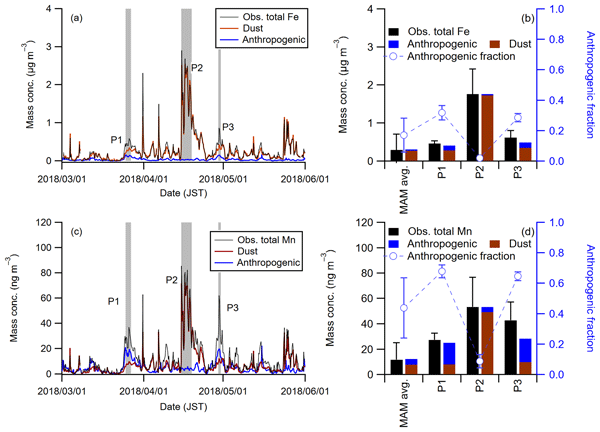
This study conducted semi-continuous measurements of PM2.5 aerosols and their elemental composition in western Japan, during spring 2018. It analyzed the emissions, transport, and wet removal of elements such as Pb, Cu, Fe, and Mn. It also assessed the accuracy of modeled concentrations and found overestimations of BC and underestimations of Cu and anthropogenic Fe in East Asia. Insights into emissions, removals, and source apportionment of trace metals in the East Asian outflow were provided.
Cited articles
Achakulwisut, P., Anenberg, S. C., Neumann, J. E., Penn, S. L., Weiss, N., Crimmins, A., Fann, N., Martinich, J., Roman, H., and Mickley, L. J.: Effects of Increasing Aridity on Ambient Dust and Public Health in the U.S. Southwest Under Climate Change, GeoHealth, 3, 127–144, https://doi.org/10.1029/2019GH000187, 2019.
Al Mamun, A., Cheng, I., Zhang, L. M., Dabek-Zlotorzynska, E., and Charland, J. P.: Overview of size distribution, concentration, and dry deposition of airborne particulate elements measured worldwide, Environ. Rev., 28, 77–88, https://doi.org/10.1139/er-2019-0035, 2020.
Asano, H., Aoyama, T., Mizuno, Y., and Shiraishi, Y.: Highly Time-Resolved Atmospheric Observations Using a Continuous Fine Particulate Matter and Element Monitor, Acs Earth Space Chem., 1, 580–590, https://doi.org/10.1021/acsearthspacechem.7b00090, 2017.
Baensch-Baltruschat, B., Kocher, B., Stock, F., and Reifferscheid, G.: Tyre and road wear particles (TRWP) – A review of generation, properties, emissions, human health risk, ecotoxicity, and fate in the environment, Sci. Total Environ., 733, 137823, https://doi.org/10.1016/j.scitotenv.2020.137823, 2020.
Beddows, D. C. S. and Harrison, R. M.: PM10 and PM2.5 emission factors for non-exhaust particles from road vehicles: Dependence upon vehicle mass and implications for battery electric vehicles, Atmos. Environ., 244, 117886, https://doi.org/10.1016/j.atmosenv.2020.117886, 2021.
Bilo, F., Cirelli, P., and Borgese, L.: Elemental analysis of particulate matter by X-ray fluorescence methods: A green approach to air quality monitoring, TrAC-Trend. Anal. Chem., 170, 117427, https://doi.org/10.1016/j.trac.2023.117427, 2024.
Briffa, J., Sinagra, E., and Blundell, R.: Heavy metal pollution in the environment and their toxicological effects on humans, Heliyon, 6, e04691, https://doi.org/10.1016/j.heliyon.2020.e04691, 2020.
Brown, R. J. C., Jarvis, K. E., Disch, B. A., Goddard, S. L., Adriaenssens, E., and Claeys, N.: Comparison of ED-XRF and LA-ICP-MS with the European reference method of acid digestion-ICP-MS for the measurement of metals in ambient particulate matter, Accredit. Qual. Assur., 15, 493–502, https://doi.org/10.1007/s00769-010-0668-7, 2010.
Büntgen, U., Urban, O., Krusic, P. J., Rybníček, M., Kolář, T., Kyncl, T., Ač, A., Koňasová, E., Čáslavský, J., Esper, J., Wagner, S., Saurer, M., Tegel, W., Dobrovolný, P., Cherubini, P., Reinig, F., and Trnka, M.: Recent European drought extremes beyond Common Era background variability, Nat. Geosci., 14, 190–196, https://doi.org/10.1038/s41561-021-00698-0, 2021.
Celo, V., Dabek-Zlotorzynska, E., Mathieu, D., and Okonskaia, I.: Validation of a simple microwave-assisted acid digestion method using microvessels for analysis of trace elements in atmospheric PM2.5 in monitoring and fingerprinting studies, The Open Chem. Biomed. Method. J., 3, 143–152, 2010.
Charrier, J. G. and Anastasio, C.: On dithiothreitol (DTT) as a measure of oxidative potential for ambient particles: evidence for the importance of soluble transition metals, Atmos. Chem. Phys., 12, 9321–9333, https://doi.org/10.5194/acp-12-9321-2012, 2012.
Chen, L. W. A., Lowenthal, D. H., Watson, J. G., Koracin, D., Kumar, N., Knipping, E. M., Wheeler, N., Craig, K., and Reid, S.: Toward Effective Source Apportionment Using Positive Matrix Factorization: Experiments with Simulated PM2.5 Data, J. Air Waste Manage. Assoc., 60, 43–54, https://doi.org/10.3155/1047-3289.60.1.43, 2010.
Christensen, W. F. and Schauer, J. J.: Impact of species uncertainty perturbation on the solution stability of positive matrix factorization of atmospheric particulate matter data, Environ. Sci. Technol., 42, 6015–6021, https://doi.org/10.1021/es800085t, 2008.
Creamean, J. M., Neiman, P. J., Coleman, T., Senff, C. J., Kirgis, G., Alvarez, R. J., and Yamamoto, A.: Colorado air quality impacted by long-range-transported aerosol: a set of case studies during the 2015 Pacific Northwest fires, Atmos. Chem. Phys., 16, 12329–12345, https://doi.org/10.5194/acp-16-12329-2016, 2016.
Daellenbach, K. R., Uzu, G., Jiang, J. H., Cassagnes, L. E., Leni, Z., Vlachou, A., Stefenelli, G., Canonaco, F., Weber, S., Segers, A., Kuenen, J. J. P., Schaap, M., Favez, O., Albinet, A., Aksoyoglu, S., Dommen, J., Baltensperger, U., Geiser, M., El Haddad, I., Jaffrezo, J. L., and Prévôt, A. S. H.: Sources of particulate-matter air pollution and its oxidative potential in Europe, Nature, 587, 414–419, https://doi.org/10.1038/s41586-020-2902-8, 2020.
Fang, T., Guo, H. Y., Zeng, L. H., Verma, V., Nenes, A., and Weber, R. J.: Highly Acidic Ambient Particles, Soluble Metals, and Oxidative Potential: A Link between Sulfate and Aerosol Toxicity, Environ. Sci. Technol., 51, 2611–2620, https://doi.org/10.1021/acs.est.6b06151, 2017.
Fomba, K. W., van Pinxteren, D., Müller, K., Spindler, G., and Herrmann, H.: Assessment of trace metal levels in size-resolved particulate matter in the area of Leipzig, Atmos. Environ., 176, 60–70, https://doi.org/10.1016/j.atmosenv.2017.12.024, 2018.
Fröhlich-Nowoisky, J., Kampf, C. J., Weber, B., Huffman, J. A., Pöhlker, C., Andreae, M. O., Lang-Yona, N., Burrows, S. M., Gunthe, S. S., Elbert, W., Su, H., Hoor, P., Thines, E., Hoffmann, T., Després, V. R., and Pöschl, U.: Bioaerosols in the Earth system: Climate, health, and ecosystem interactions, Atmos. Res., 182, 346–376, https://doi.org/10.1016/j.atmosres.2016.07.018, 2016.
Furger, M., Minguillón, M. C., Yadav, V., Slowik, J. G., Hüglin, C., Fröhlich, R., Petterson, K., Baltensperger, U., and Prévôt, A. S. H.: Elemental composition of ambient aerosols measured with high temporal resolution using an online XRF spectrometer, Atmos. Meas. Tech., 10, 2061–2076, https://doi.org/10.5194/amt-10-2061-2017, 2017.
GUM: Joint Committee for Guides in Metrology Evaluation of measurement data, Guide to the expression of uncertainty in measurement (GUM), JCGM, 100, http://www.bipm.org/utils/common/documents/jcgm/JCGM_100_2008_E.pdf (last access: 6 February 2024), 2008.
Guo, H., Otjes, R., Schlag, P., Kiendler-Scharr, A., Nenes, A., and Weber, R. J.: Effectiveness of ammonia reduction on control of fine particle nitrate, Atmos. Chem. Phys., 18, 12241–12256, https://doi.org/10.5194/acp-18-12241-2018, 2018.
Heikkilä, P., Rostedt, A., Toivonen, J., and Keskinen, J.: Analysis and classification of individual ambient aerosol particles with field-deployable laser-induced breakdown spectroscopy platform, Aerosol Sci. Technol., 58, 1063–1078, https://doi.org/10.1080/02786826.2024.2350022, 2024.
Hopke, P. K., Dai, Q., Li, L., and Feng, Y.: Global review of recent source apportionments for airborne particulate matter, Sci. Total Environ., 740, 140091, https://doi.org/10.1016/j.scitotenv.2020.140091, 2020.
Hyslop, N. P., Liu, Y. F., Yatkin, S., and Trzepla, K.: Application of the US EPA procedure for determining method detection limits to EDXRF measurement of filter-based aerosol samples, J. Air Waste Manage. Assoc., 72, 905–913, https://doi.org/10.1080/10962247.2022.2064005, 2022.
Hyslop, N. P., Trzepla, K., Yatkin, S., White, W. H., Ancelet, T., Davy, P., Butler, O., Gerboles, M., Kohl, S., McWilliams, A., Saucedo, L., Van Der Haar, M., and Jonkers, A.: An inter-laboratory evaluation of new multi-element reference materials for atmospheric particulate matter measurements, Aerosol Sci. Technol., 53, 771–782, https://doi.org/10.1080/02786826.2019.1606413, 2019.
IUPAC: Compendium of Chemical Terminology, 2nd ed. (the “Gold Book”), Blackwell Scientific Publications, Oxford, 6414 pp., https://doi.org/10.1351/goldbook, 1997.
Ji, X., Qin, R., Shi, C., Yang, L., Yao, L., Deng, S., Qu, G., Yin, Y., Hu, L., Shi, J., and Jiang, G.: Dynamic landscape of multi-elements in PM2.5 revealed by real-time analysis, Environ. Int., 170, 107607, https://doi.org/10.1016/j.envint.2022.107607, 2022.
Kellner, R., Mermet, J.-M., Otto, M., Valcarcel, M., and Widmer, H. M.: Analytical Chemistry: A Modern Approach to Analytical Science, 2nd Edition, WILEY-VCH Verlag GmbH & Co. KgaA, Weinheim, Germany, 1209 pp., 2004.
Lee, S.-H. and Allen, H. C.: Analytical Measurements of Atmospheric Urban Aerosol, Anal. Chem., 84, 1196–1201, https://doi.org/10.1021/ac201338x, 2012.
Li, Y. Y., Chang, M. A., Ding, S. S., Wang, S. W., Ni, D., and Hu, H. T.: Monitoring and source apportionment of trace elements in PM2.5: Implications for local air quality management, J. Environ. Manage., 196, 16–25, https://doi.org/10.1016/j.jenvman.2017.02.059, 2017.
Liu, X., Zhang, X., Wang, T., Jin, B., Wu, L., Lara, R., Monge, M., Reche, C., Jaffrezo, J.-L., Uzu, G., Dominutti, P., Darfeuil, S., Favez, O., Conil, S., Marchand, N., Castillo, S., de la Rosa, J. D., Stuart, G., Eleftheriadis, K., Diapouli, E., Gini, M. I., Nava, S., Alves, C., Wang, X., Xu, Y., Green, D. C., Beddows, D. C. S., Harrison, R. M., Alastuey, A., and Querol, X.: PM10-bound trace elements in pan-European urban atmosphere, Environ. Res., 260, 119630, https://doi.org/10.1016/j.envres.2024.119630, 2024.
Lu, D., Tan, J., Yang, X., Sun, X., Liu, Q., and Jiang, G.: Unraveling the role of silicon in atmospheric aerosol secondary formation: a new conservative tracer for aerosol chemistry, Atmos. Chem. Phys., 19, 2861–2870, https://doi.org/10.5194/acp-19-2861-2019, 2019.
Mach, T., Rogula-Kozlowska, W., Bralewska, K., Majewski, G., Rogula-Kopiec, P., and Rybak, J.: Impact of Municipal, Road Traffic, and Natural Sources on PM10: The Hourly Variability at a Rural Site in Poland, Energies, 14, 2654, https://doi.org/10.3390/en14092654, 2021.
Maenhaut, W., Raes, N., Chi, X. G., Cafmeyer, J., Wang, W., and Salma, I.: Chemical composition and mass closure for fine and coarse aerosols at a kerbside in Budapest, Hungary, in spring 2002, X-Ray Spectrom., 34, 290–296, https://doi.org/10.1002/xrs.820, 2005.
Margui, E., Queralt, I., and de Almeida, E.: X-ray fluorescence spectrometry for environmental analysis: Basic principles, instrumentation, applications and recent trends, Chemosphere, 303, 135006, https://doi.org/10.1016/j.chemosphere.2022.135006, 2022.
Molina, C., Manzano, C. A., Leiva, M. A. G., and Toro, R. A.: The oxidative potential of airborne particulate matter in two urban areas of Chile: More than meets the eye, Environ. Int., 173, 107866, https://doi.org/10.1016/j.envint.2023.107866, 2023.
Pai, S. J., Carter, T. S., Heald, C. L., and Kroll, J. H.: Updated World Health Organization Air Quality Guidelines Highlight the Importance of Non-anthropogenic PM2.5, Environ. Sci. Technol. Lett., 9, 501–506, https://doi.org/10.1021/acs.estlett.2c00203, 2022.
Pant, P., Baker, S. J., Shukla, A., Maikawa, C., Pollitt, K. J. G., and Harrison, R. M.: The PM10 fraction of road dust in the UK and India: Characterization, source profiles and oxidative potential, Sci. Total Environ., 530, 445–452, https://doi.org/10.1016/j.scitotenv.2015.05.084, 2015.
Park, S. S., Cho, S. Y., Jo, M. R., Gong, B. J., Park, J. S., and Lee, S. J.: Field evaluation of a near–real time elemental monitor and identification of element sources observed at an air monitoring supersite in Korea, Atmos. Pollut. Res., 5, 119–128, https://doi.org/10.5094/APR.2014.015, 2014.
Petit, J. E., Favez, O., Albinet, A., and Canonaco, F.: A user-friendly tool for comprehensive evaluation of the geographical origins of atmospheric pollution: Wind and trajectory analyses, Environ. Modell. Softw., 88, 183–187, https://doi.org/10.1016/j.envsoft.2016.11.022, 2017.
Schwarz, J., Cusack, M., Karban, J., Chalupnícková, E., Havránek, V., Smolík, J., and Zdímal, V.: PM2.5 chemical composition at a rural background site in Central Europe, including correlation and air mass back trajectory analysis, Atmos. Res., 176, 108–120, https://doi.org/10.1016/j.atmosres.2016.02.017, 2016.
Tang, Y. S., Flechard, C. R., Dämmgen, U., Vidic, S., Djuricic, V., Mitosinkova, M., Uggerud, H. T., Sanz, M. J., Simmons, I., Dragosits, U., Nemitz, E., Twigg, M., van Dijk, N., Fauvel, Y., Sanz, F., Ferm, M., Perrino, C., Catrambone, M., Leaver, D., Braban, C. F., Cape, J. N., Heal, M. R., and Sutton, M. A.: Pan-European rural monitoring network shows dominance of NH3 gas and NH4NO3 aerosol in inorganic atmospheric pollution load, Atmos. Chem. Phys., 21, 875–914, https://doi.org/10.5194/acp-21-875-2021, 2021.
Tasdemir, Y., Kural, C., Cindoruk, S. S., and Vardar, N.: Assessment of trace element concentrations and their estimated dry deposition fluxes in an urban atmosphere, Atmos. Res., 81, 17–35, https://doi.org/10.1016/j.atmosres.2005.10.003, 2006.
Trebs, I., Lett, C., Krein, A., and Junk, J.: Air quality impacts of aviation activities at a mid-sized airport in central Europe, Atmos. Pollut. Res., 14, 101696, https://doi.org/10.1016/j.apr.2023.101696, 2023.
Tremper, A. H., Font, A., Priestman, M., Hamad, S. H., Chung, T.-C., Pribadi, A., Brown, R. J. C., Goddard, S. L., Grassineau, N., Petterson, K., Kelly, F. J., and Green, D. C.: Field and laboratory evaluation of a high time resolution x-ray fluorescence instrument for determining the elemental composition of ambient aerosols, Atmos. Meas. Tech., 11, 3541–3557, https://doi.org/10.5194/amt-11-3541-2018, 2018.
Yang, K. X., Swami, K., and Husain, L.: Determination of trace metals in atmospheric aerosols with a heavy matrix of cellulose by microwave digestion-inductively coupled plasma mass spectroscopy, Spectrochim. Acta B, 57, 73–84, https://doi.org/10.1016/S0584-8547(01)00354-8, 2002.
Yang, X. Z., Lu, D. W., Tan, J. H., Sun, X., Zhang, Q. H., Zhang, L. Y., Li, Y., Wang, W. C., Liu, Q., and Jiang, G. B.: Two-Dimensional Silicon Fingerprints Reveal Dramatic Variations in the Sources of Particulate Matter in Beijing during 2013–2017, Environ. Sci. Technol., 54, 7126–7135, https://doi.org/10.1021/acs.est.0c00984, 2020.
Yatkin, S., Trzepla, K., White, W. H., and Hyslop, N. P.: Generation of multi-element reference materials on PTFE filters mimicking ambient aerosol characteristics, Atmos. Environ., 189, 41–49, https://doi.org/10.1016/j.atmosenv.2018.06.034, 2018.
Short summary
This study explores the effectiveness of the Horiba PX-375 monitor for analysing the elemental composition of airborne particulate matter (PM). Understanding this composition of PM is important for identifying its sources, assessing potential health risks, and developing strategies to reduce air pollution. The PX-375 monitor proved to be a valuable tool for ongoing air quality monitoring studies and could be particularly useful as pollution levels and sources change in the future.
This study explores the effectiveness of the Horiba PX-375 monitor for analysing the elemental...


