
Articles | Volume 18, issue 11
https://doi.org/10.5194/amt-18-2311-2025
© Author(s) 2025. This work is distributed under
the Creative Commons Attribution 4.0 License.
the Creative Commons Attribution 4.0 License.
https://doi.org/10.5194/amt-18-2311-2025
© Author(s) 2025. This work is distributed under
the Creative Commons Attribution 4.0 License.
the Creative Commons Attribution 4.0 License.
Research article
| 
03 Jun 2025
Research article |
| 03 Jun 2025
| 03 Jun 2025
Convolutional neural networks for specific and merged data sets of optical array probe images: compatibility of retrieved morphology-dependent size distributions
Louis Jaffeux
CORRESPONDING AUTHOR

Laboratoire de Météorologie Physique (UMR6016)/UCA/CNRS, Aubière, France
Jan Breiner
Laboratoire de Météorologie Physique (UMR6016)/UCA/CNRS, Aubière, France
Pierre Coutris
Laboratoire de Météorologie Physique (UMR6016)/UCA/CNRS, Aubière, France
Alfons Schwarzenböck
Laboratoire de Météorologie Physique (UMR6016)/UCA/CNRS, Aubière, France
Related authors
Louis Jaffeux, Marie Lothon, Fleur Couvreux, Dominique Bouniol, Grégoire Cayez, Lilian Joly, Jérémie Burgalat, Cyrille De Saint Leger, Hubert Bellec, Olivier Henry, Dyaa Chbib, Tetyana Jiang, and Sandrine Bony
Earth Syst. Sci. Data Discuss., https://doi.org/10.5194/essd-2025-586, https://doi.org/10.5194/essd-2025-586, 2025
Revised manuscript accepted for ESSD
Short summary
Short summary
A new dataset from the MAESTRO airborne campaign over the tropical Atlantic near Cabo Verde offers detailed turbulence measurements of temperature, moisture, and wind. The data was processed exploiting exceptional instrumental redundancy to provide best quality turbulence statistics and ensure their reliability. This resource can benefit weather and climate models by providing a clearer picture of how turbulence below clouds influences their formation and organization.
Anne-Claire Billault-Roux, Paraskevi Georgakaki, Josué Gehring, Louis Jaffeux, Alfons Schwarzenboeck, Pierre Coutris, Athanasios Nenes, and Alexis Berne
Atmos. Chem. Phys., 23, 10207–10234, https://doi.org/10.5194/acp-23-10207-2023, https://doi.org/10.5194/acp-23-10207-2023, 2023
Short summary
Short summary
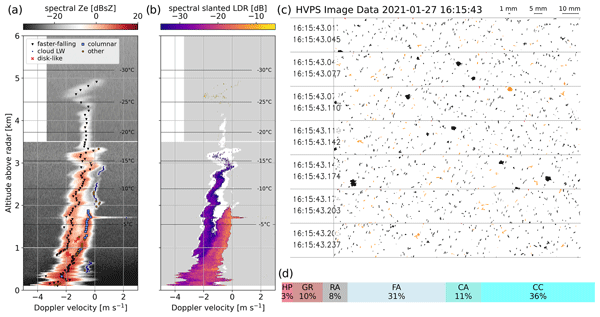
Secondary ice production plays a key role in clouds and precipitation. In this study, we analyze radar measurements from a snowfall event in the Jura Mountains. Complex signatures are observed, which reveal that ice crystals were formed through various processes. An analysis of multi-sensor data suggests that distinct ice multiplication processes were taking place. Both the methods used and the insights gained through this case study contribute to a better understanding of snowfall microphysics.
Anne-Claire Billault-Roux, Gionata Ghiggi, Louis Jaffeux, Audrey Martini, Nicolas Viltard, and Alexis Berne
Atmos. Meas. Tech., 16, 911–940, https://doi.org/10.5194/amt-16-911-2023, https://doi.org/10.5194/amt-16-911-2023, 2023
Short summary
Short summary
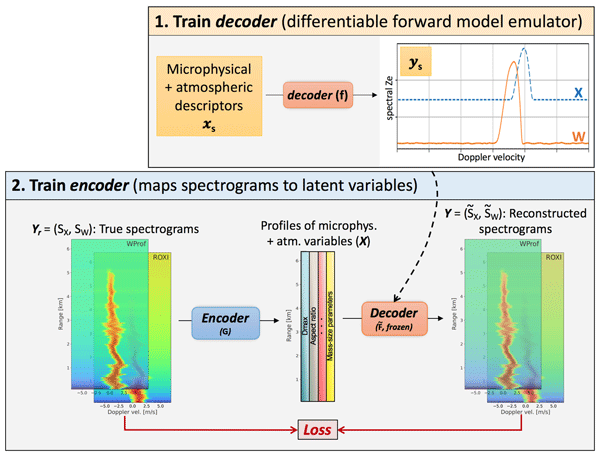
Better understanding and modeling snowfall properties and processes is relevant to many fields, ranging from weather forecasting to aircraft safety. Meteorological radars can be used to gain insights into the microphysics of snowfall. In this work, we propose a new method to retrieve snowfall properties from measurements of radars with different frequencies. It relies on an original deep-learning framework, which incorporates knowledge of the underlying physics, i.e., electromagnetic scattering.
Louis Jaffeux, Alfons Schwarzenböck, Pierre Coutris, and Christophe Duroure
Atmos. Meas. Tech., 15, 5141–5157, https://doi.org/10.5194/amt-15-5141-2022, https://doi.org/10.5194/amt-15-5141-2022, 2022
Short summary
Short summary
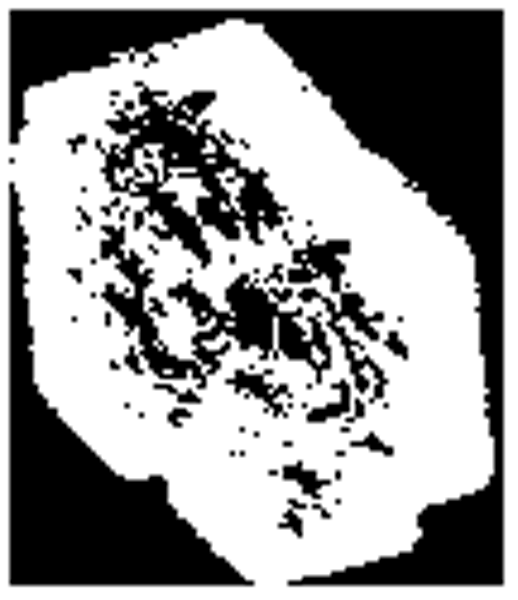
Optical array probes are instruments used aboard research aircraft to capture 2D images of ice or water particles in clouds. This study presents a new tool using innovative machine learning, called convolutional neural networks, designed to identify the shape of imaged ice particles for two of these imagers, namely 2DS and PIP. Such a tool will be a very strong asset for understanding cloud microphysics. Beyond traditional evaluation metrics, human inspections were performed of unknown data.
Aymeric Dziduch, Antoine Baudoux, Guillaume Mioche, Antoine Canzi, Benjamin Doiteau, Manuel Moser, Emma Järvinen, Étienne Vignon, Jean-Christophe Raut, Régis Dupuy, Christophe Gourbeyre, Jean-Luc Baray, Marie Monier, Frédéric Szczap, Guillaume Penide, Julien Delanoë, Odran Sourdeval, Alfons Schwarzenboeck, Stephan Mertes, Franz Martin Schnaiter, Christiane Voigt, Mario Mech, Susanne Crewell, Andreas Herber, Christof Lüpkes, André Ehrlich, Manfred Wendisch, and Olivier Jourdan
EGUsphere, https://doi.org/10.5194/egusphere-2026-3265, https://doi.org/10.5194/egusphere-2026-3265, 2026
This preprint is open for discussion and under review for Atmospheric Chemistry and Physics (ACP).
Short summary
Short summary
This study examines the microphysical properties and ice crystal habits of low-level Arctic mixed-phase clouds around Svalbard. Using airborne in situ observations from four campaigns, we show that cloud microphysical structure and ice crystal habits are influenced by weather conditions and surface type. These results provide quantitative observations to better understand low-level Arctic clouds, their ice formation processes, and their influence on the Arctic atmosphere and climate system.
Nina Elisabeth Larsgård, Tim Carlsen, Robert Oscar David, Filip Severin von der Lippe, Alfons Schwarzenboek, Harald Sodemann, and Trude Storelvmo
EGUsphere, https://doi.org/10.5194/egusphere-2026-1650, https://doi.org/10.5194/egusphere-2026-1650, 2026
Short summary
Short summary
In-situ data from multiple research flights are combined to investigate the cloud evolution of Arctic marine cold air outbreaks during the ISLAS2022 campaign. We observe a cloud development similar to what other studies have shown: More liquid at cloud top close to the sea ice, and increased glaciation as clouds mature and deepen. This composite approach can be used by the community to further understand mCAO cloud evolution with increased confidence compared to single-flight analysis.
Louis Jaffeux, Marie Lothon, Fleur Couvreux, Dominique Bouniol, Grégoire Cayez, Lilian Joly, Jérémie Burgalat, Cyrille De Saint Leger, Hubert Bellec, Olivier Henry, Dyaa Chbib, Tetyana Jiang, and Sandrine Bony
Earth Syst. Sci. Data Discuss., https://doi.org/10.5194/essd-2025-586, https://doi.org/10.5194/essd-2025-586, 2025
Revised manuscript accepted for ESSD
Short summary
Short summary
A new dataset from the MAESTRO airborne campaign over the tropical Atlantic near Cabo Verde offers detailed turbulence measurements of temperature, moisture, and wind. The data was processed exploiting exceptional instrumental redundancy to provide best quality turbulence statistics and ensure their reliability. This resource can benefit weather and climate models by providing a clearer picture of how turbulence below clouds influences their formation and organization.
Guillaume Feger, Jean-Pierre Chaboureau, Thibaut Dauhut, Julien Delanoë, and Pierre Coutris
Atmos. Chem. Phys., 25, 7447–7465, https://doi.org/10.5194/acp-25-7447-2025, https://doi.org/10.5194/acp-25-7447-2025, 2025
Short summary
Short summary
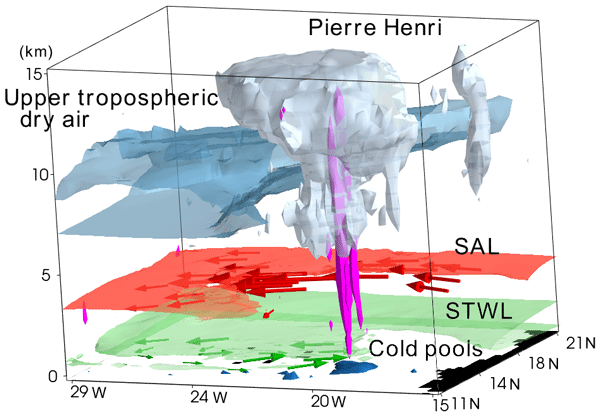
Saharan air at the trade wind layer, cold pools, and dry upper troposphere has these three main factors inhibiting the cyclogenesis of the Pierre Henri mesoscale convective system. The findings were obtained through observations made during two flights of the Clouds-Atmospheric Dynamics-Dust Interactions in West Africa (CADDIWA) campaign and a convection-permitting simulation run with the Meso-NH model. They provide new insights into the complex dynamics of cyclogenesis in the Cabo Verde region and challenge the existing model of the Saharan Air Layer (SAL).
Leonie Villiger, Marina Dütsch, Sandrine Bony, Marie Lothon, Stephan Pfahl, Heini Wernli, Pierre-Etienne Brilouet, Patrick Chazette, Pierre Coutris, Julien Delanoë, Cyrille Flamant, Alfons Schwarzenboeck, Martin Werner, and Franziska Aemisegger
Atmos. Chem. Phys., 23, 14643–14672, https://doi.org/10.5194/acp-23-14643-2023, https://doi.org/10.5194/acp-23-14643-2023, 2023
Short summary
Short summary
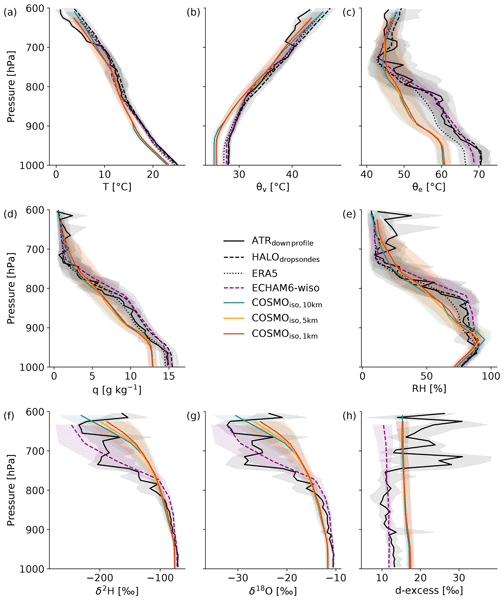
This study evaluates three numerical simulations performed with an isotope-enabled weather forecast model and investigates the coupling between shallow trade-wind cumulus clouds and atmospheric circulations on different scales. We show that the simulations reproduce key characteristics of shallow trade-wind clouds as observed during the field experiment EUREC4A and that the spatial distribution of stable-water-vapour isotopes is shaped by the overturning circulation associated with these clouds.
Anne-Claire Billault-Roux, Paraskevi Georgakaki, Josué Gehring, Louis Jaffeux, Alfons Schwarzenboeck, Pierre Coutris, Athanasios Nenes, and Alexis Berne
Atmos. Chem. Phys., 23, 10207–10234, https://doi.org/10.5194/acp-23-10207-2023, https://doi.org/10.5194/acp-23-10207-2023, 2023
Short summary
Short summary
Secondary ice production plays a key role in clouds and precipitation. In this study, we analyze radar measurements from a snowfall event in the Jura Mountains. Complex signatures are observed, which reveal that ice crystals were formed through various processes. An analysis of multi-sensor data suggests that distinct ice multiplication processes were taking place. Both the methods used and the insights gained through this case study contribute to a better understanding of snowfall microphysics.
Valerian Hahn, Ralf Meerkötter, Christiane Voigt, Sonja Gisinger, Daniel Sauer, Valéry Catoire, Volker Dreiling, Hugh Coe, Cyrille Flamant, Stefan Kaufmann, Jonas Kleine, Peter Knippertz, Manuel Moser, Philip Rosenberg, Hans Schlager, Alfons Schwarzenboeck, and Jonathan Taylor
Atmos. Chem. Phys., 23, 8515–8530, https://doi.org/10.5194/acp-23-8515-2023, https://doi.org/10.5194/acp-23-8515-2023, 2023
Short summary
Short summary
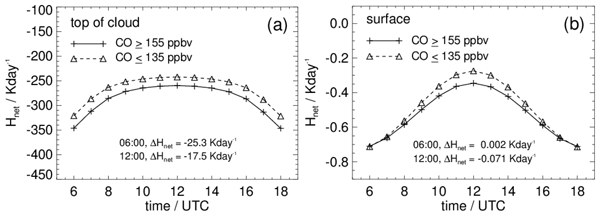
During the DACCIWA campaign in West Africa, we found a 35 % increase in the cloud droplet concentration that formed in a polluted compared with a less polluted environment and a decrease of 17 % in effective droplet diameter. Radiative transfer simulations, based on the measured cloud properties, reveal that these low-level polluted clouds radiate only 2.6 % more energy back to space, compared with a less polluted cloud. The corresponding additional decrease in temperature is rather small.
Manuel Moser, Christiane Voigt, Tina Jurkat-Witschas, Valerian Hahn, Guillaume Mioche, Olivier Jourdan, Régis Dupuy, Christophe Gourbeyre, Alfons Schwarzenboeck, Johannes Lucke, Yvonne Boose, Mario Mech, Stephan Borrmann, André Ehrlich, Andreas Herber, Christof Lüpkes, and Manfred Wendisch
Atmos. Chem. Phys., 23, 7257–7280, https://doi.org/10.5194/acp-23-7257-2023, https://doi.org/10.5194/acp-23-7257-2023, 2023
Short summary
Short summary
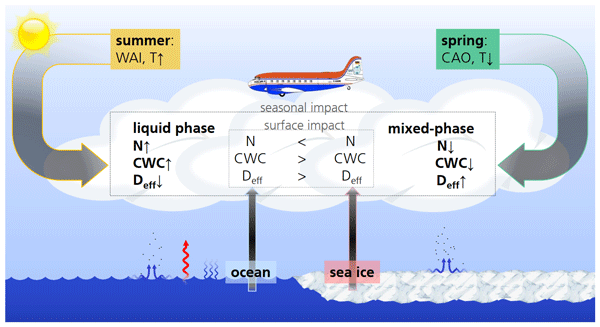
This study provides a comprehensive microphysical and thermodynamic phase analysis of low-level clouds in the northern Fram Strait, above the sea ice and the open ocean, during spring and summer. Using airborne in situ cloud data, we show that the properties of Arctic low-level clouds vary significantly with seasonal meteorological situations and surface conditions. The observations presented in this study can help one to assess the role of clouds in the Arctic climate system.
Anne-Claire Billault-Roux, Gionata Ghiggi, Louis Jaffeux, Audrey Martini, Nicolas Viltard, and Alexis Berne
Atmos. Meas. Tech., 16, 911–940, https://doi.org/10.5194/amt-16-911-2023, https://doi.org/10.5194/amt-16-911-2023, 2023
Short summary
Short summary
Better understanding and modeling snowfall properties and processes is relevant to many fields, ranging from weather forecasting to aircraft safety. Meteorological radars can be used to gain insights into the microphysics of snowfall. In this work, we propose a new method to retrieve snowfall properties from measurements of radars with different frequencies. It relies on an original deep-learning framework, which incorporates knowledge of the underlying physics, i.e., electromagnetic scattering.
Louis Jaffeux, Alfons Schwarzenböck, Pierre Coutris, and Christophe Duroure
Atmos. Meas. Tech., 15, 5141–5157, https://doi.org/10.5194/amt-15-5141-2022, https://doi.org/10.5194/amt-15-5141-2022, 2022
Short summary
Short summary
Optical array probes are instruments used aboard research aircraft to capture 2D images of ice or water particles in clouds. This study presents a new tool using innovative machine learning, called convolutional neural networks, designed to identify the shape of imaged ice particles for two of these imagers, namely 2DS and PIP. Such a tool will be a very strong asset for understanding cloud microphysics. Beyond traditional evaluation metrics, human inspections were performed of unknown data.
Sandrine Bony, Marie Lothon, Julien Delanoë, Pierre Coutris, Jean-Claude Etienne, Franziska Aemisegger, Anna Lea Albright, Thierry André, Hubert Bellec, Alexandre Baron, Jean-François Bourdinot, Pierre-Etienne Brilouet, Aurélien Bourdon, Jean-Christophe Canonici, Christophe Caudoux, Patrick Chazette, Michel Cluzeau, Céline Cornet, Jean-Philippe Desbios, Dominique Duchanoy, Cyrille Flamant, Benjamin Fildier, Christophe Gourbeyre, Laurent Guiraud, Tetyana Jiang, Claude Lainard, Christophe Le Gac, Christian Lendroit, Julien Lernould, Thierry Perrin, Frédéric Pouvesle, Pascal Richard, Nicolas Rochetin, Kevin Salaün, Alfons Schwarzenboeck, Guillaume Seurat, Bjorn Stevens, Julien Totems, Ludovic Touzé-Peiffer, Gilles Vergez, Jessica Vial, Leonie Villiger, and Raphaela Vogel
Earth Syst. Sci. Data, 14, 2021–2064, https://doi.org/10.5194/essd-14-2021-2022, https://doi.org/10.5194/essd-14-2021-2022, 2022
Short summary
Short summary
The French ATR42 research aircraft participated in the EUREC4A international field campaign that took place in 2020 over the tropical Atlantic, east of Barbados. We present the extensive instrumentation of the aircraft, the research flights and the different measurements. We show that the ATR measurements of humidity, wind, aerosols and cloudiness in the lower atmosphere are robust and consistent with each other. They will make it possible to advance understanding of cloud–climate interactions.
Adrien Deroubaix, Laurent Menut, Cyrille Flamant, Peter Knippertz, Andreas H. Fink, Anneke Batenburg, Joel Brito, Cyrielle Denjean, Cheikh Dione, Régis Dupuy, Valerian Hahn, Norbert Kalthoff, Fabienne Lohou, Alfons Schwarzenboeck, Guillaume Siour, Paolo Tuccella, and Christiane Voigt
Atmos. Chem. Phys., 22, 3251–3273, https://doi.org/10.5194/acp-22-3251-2022, https://doi.org/10.5194/acp-22-3251-2022, 2022
Short summary
Short summary
During the summer monsoon in West Africa, pollutants emitted in urbanized areas modify cloud cover and precipitation patterns. We analyze these patterns with the WRF-CHIMERE model, integrating the effects of aerosols on meteorology, based on the numerous observations provided by the Dynamics-Aerosol-Climate-Interactions campaign. This study adds evidence to recent findings that increased pollution levels in West Africa delay the breakup time of low-level clouds and reduce precipitation.
Cited articles
Baker, B. and Lawson, R. P.: Improvement in Determination of Ice Water Content from Two-Dimensional Particle Imagery. Part I: Image-to-Mass Relationships, J. Appl. Meteorol. Clim., 45, 1282–1290, https://doi.org/10.1175/JAM2398.1, 2006. a
Billault-Roux, A. C., Grazioli, J., Delanoë, J., Jorquera, S., Pauwels, N., Viltard, N., Martini, A., Mariage, V., Le Gac, C., Caudoux, C., Aubry, C., Bertrand, F., Schwarzenboeck, A., Jaffeux, L., Coutris, P., Febvre, G., Pichon, J. M., Dezitter, F., Gehring, J., Untersee, A., Calas, C., Figueras i Ventura, J., Vie, B., Peyrat, A., Curat, V., Rebouissoux, S., and Berne, A.: ICE GENESIS: Synergetic aircraft and ground-based remote sensing and in situ measurements of snowfall microphysical properties, B. Am. Meteor. Soc., 104, E367–E388, 2023. a
Duroure, C.: Une nouvelle méthode de traitement des images d'hydrométéores données par les sondes bidimensionnelles, Journal de recherches atmosphériques, https://hal.uca.fr/hal-01950254 (last access: 24 May 2025), 1982. a
Emersic, C. and Saunders, C.: Further laboratory investigations into the relative diffusional growth rate theory of thunderstorm electrification, Atmos. Res., 98, 327–340, 2010. a
Field, P., Heymsfield, A., and Bansemer, A.: Shattering and particle interarrival times measured by optical array probes in ice clouds, J. Atmos. Ocean. Tech., 23, 1357–1371, 2006. a
Fukuta, N. and Takahashi, T.: The Growth of Atmospheric Ice Crystals: A Summary of Findings in Vertical Supercooled Cloud Tunnel Studies, J. Atmos. Sci., 56, 1963–1979, https://doi.org/10.1175/1520-0469(1999)056<1963:TGOAIC>2.0.CO;2, 1999. a, b
Jaffeux, L., Coutris, P., Schwarzenboeck, A., and Dezitter, F.: Snow Particle Characterization. Part B: Morphology Dependent Study of Snow Crystal 3D Properties Using a Convolutional Neural Network (CNN), SAE Technical Paper, SAE International, https://doi.org/10.4271/2023-01-1486, 2023a. a
Jaffeux, L., Schwarzenboeck, A., Coutris, P., Febvre, G., Dezitter, F., Aguilar, B., Billault-Roux, A. C., Grazioli, J., Berne, A., Köbschall, K., Jorquera, S., and Delanoe, J.: Snow Particle Characterization. Part A: Statistics of Microphysical Properties of Snow Crystal Populations from Recent Observations Performed during the ICE GENESIS Project, SAE Technical Paper, SAE International, https://doi.org/10.4271/2023-01-1492, 2023b. a
Jensen, A. A. and Harrington, J. Y.: Modeling Ice Crystal Aspect Ratio Evolution during Riming: A Single-Particle Growth Model, J. Atmos. Sci., 72, 2569–2590, https://doi.org/10.1175/JAS-D-14-0297.1, 2015. a
Knight, C. A.: Observations of the morphology of melting snow, J. Atmos. Sci., 36, 1123–1130, 1979. a
Knollenberg, R. G.: The Optical Array: An Alternative to Scattering or Extinction for Airborne Particle Size Determination, J. Appl. Meteorol., 9, 86–103, https://doi.org/10.1175/1520-0450(1970)009<0086:TOAAAT>2.0.CO;2, 1970. a
Knorr, W., Dentener, F., Lamarque, J.-F., Jiang, L., and Arneth, A.: Wildfire air pollution hazard during the 21st century, Atmos. Chem. Phys., 17, 9223–9236, https://doi.org/10.5194/acp-17-9223-2017, 2017. a
Korolev, A. and Isaac, G. A.: Shattering during sampling by OAPs and HVPS. Part I: Snow particles, J. Atmos. Ocean. Tech., 22, 528–542, 2005. a
Leroy, D., Fontaine, E., Schwarzenboeck, A., and Strapp, J. W.: Ice Crystal Sizes in High Ice Water Content Clouds. Part I: On the Computation of Median Mass Diameter from In Situ Measurements, J. Atmos. Ocean. Tech., 33, 2461–2476, https://doi.org/10.1175/JTECH-D-15-0151.1, 2016. a
Locatelli, J. D. and Hobbs, P. V.: Fall speeds and masses of solid precipitation particles, J. Geophys. Res., 79, 2185–2197, 1974. a
Matsuo, T. and Sasyo, Y.: Melting of snowflakes below freezing level in the atmosphere, J. Meteorol. Soc. Jpn. Ser. II, 59, 10–25, 1981. a
McFarquhar, G. M., Timlin, M. S., Rauber, R. M., Jewett, B. F., Grim, J. A., and Jorgensen, D. P.: Vertical variability of cloud hydrometeors in the stratiform region of mesoscale convective systems and bow echoes, Mon. Weather Rev., 135, 3405–3428, 2007. a
Pasquier, J. T., Henneberger, J., Korolev, A., Ramelli, F., Wieder, J., Lauber, A., Li, G., David, R. O., Carlsen, T., Gierens, R., Maturilli, M., and Lohmann, U.: Understanding the history of two complex ice crystal habits deduced from a holographic imager, Geophys. Res. Lett., 50, e2022GL100247, https://doi.org/10.1029/2022GL100247, 2023. a
Praz, C., Roulet, Y.-A., and Berne, A.: Solid hydrometeor classification and riming degree estimation from pictures collected with a Multi-Angle Snowflake Camera, Atmos. Meas. Tech., 10, 1335–1357, https://doi.org/10.5194/amt-10-1335-2017, 2017. a
Pruppacher, H. and Klett, J.: Microphysics of Clouds and Precipitation, Taylor & Francis, vol. 18, 116–119, https://doi.org/10.1007/978-0-306-48100-0, 2010. a
Przybylo, V., Sulia, K. J., Lebo, Z. J., and Schmitt, C.: Automated Classification of Cloud Particle Imagery through the Use of Convolutional Neural Networks, in: 101st American Meteorological Society Annual Meeting, AMS, online, 10–15 January 2021, https://ui.adsabs.harvard.edu/abs/2021AMS...10177736P/abstract (last access: 24 May 2025), 2021. a
Rahman, M. M., Quincy, E. A., Jacquot, R. G., and Magee, M. J.: Feature Extraction and Selection for Pattern Recognition of Two-Dimensional Hydrometeor Images, J. Appl. Meteorol., 20, 521–535, https://doi.org/10.1175/1520-0450(1981)020<0521:FEASFP>2.0.CO;2, 1981. a
Schmitt, C. G., Järvinen, E., Schnaiter, M., Vas, D., Hartl, L., Wong, T., and Stuefer, M.: Classification of ice particle shapes using machine learning on forward light scattering images, Artificial Intelligence for the Earth Systems, 3, 230091, https://doi.org/10.1175/AIES-D-23-0091.1, 2024. a, b
Srivastava, N., Hinton, G., Krizhevsky, A., Sutskever, I., and Salakhutdinov, R.: Dropout: A Simple Way to Prevent Neural Networks from Overfitting, J. Mach. Learn. Res., 15, 1929–1958, http://jmlr.org/papers/v15/srivastava14a.html (last access: 20 May 2025), 2014. a
Vaillant de Guélis, T., Schwarzenböck, A., Shcherbakov, V., Gourbeyre, C., Laurent, B., Dupuy, R., Coutris, P., and Duroure, C.: Study of the diffraction pattern of cloud particles and the respective responses of optical array probes, Atmos. Meas. Tech., 12, 2513–2529, https://doi.org/10.5194/amt-12-2513-2019, 2019. a
Vázquez-Martín, S., Kuhn, T., and Eliasson, S.: Shape dependence of snow crystal fall speed, Atmos. Chem. Phys., 21, 7545–7565, https://doi.org/10.5194/acp-21-7545-2021, 2021. a
Westbrook, C. D., Hogan, R. J., and Illingworth, A. J.: The capacitance of pristine ice crystals and aggregate snowflakes, J. Atmos. Sci., 65, 206–219, 2008. a
Wu, Z., Liu, S., Zhao, D., Yang, L., Xu, Z., Yang, Z., Zhou, W., He, H., Huang, M., Liu, D., Li, R., and Ding, D.: Neural network classification of ice-crystal images observed by an airborne cloud imaging probe, Atmos.-Ocean, 58, 303–315, 2020. a
Wyser, K.: Ice crystal habits and solar radiation, Tellus A, 51, 937–950, 1999. a
Zhu, S., Guo, X., Lu, G., and Guo, L.: Ice crystal habits and growth processes in stratiform clouds with embedded convection examined through aircraft observation in northern China, J. Atmos. Sci., 72, 2011–2032, 2015. a
Short summary
Airborne cloud observation relies on high-frequency black-and-white-image information. The study presents automatic shape recognition tools developed with machine learning techniques and adapted for this type of image. Applied on a recent field campaign, these tools produce morphology-specific size distributions that can be compared across four instruments covering different size ranges. The analysis show that the tools are performing well and are consistent across the different instruments.
Airborne cloud observation relies on high-frequency black-and-white-image information. The study...


