Articles | Volume 18, issue 14
https://doi.org/10.5194/amt-18-3305-2025
© Author(s) 2025. This work is distributed under
the Creative Commons Attribution 4.0 License.
https://doi.org/10.5194/amt-18-3305-2025
© Author(s) 2025. This work is distributed under
the Creative Commons Attribution 4.0 License.
Evolution of wind field in the atmospheric boundary layer using multiple-source observations during the passage of Super Typhoon Doksuri (2305)
Xiaoye Wang
Qingdao Institute of Marine Meteorology, Chinese Academy of Meteorological Sciences, Qingdao, 266061, China
Qingdao Meteorological Observatory, Qingdao Meteorological Bureau, Qingdao, 266003, China
Jing Xu
CORRESPONDING AUTHOR
Qingdao Institute of Marine Meteorology, Chinese Academy of Meteorological Sciences, Qingdao, 266061, China
Qingdao Meteorological Observatory, Qingdao Meteorological Bureau, Qingdao, 266003, China
Songhua Wu
CORRESPONDING AUTHOR
College of Marine Technology, Faculty of Information Science and Engineering, Ocean University of China, Qingdao, 266100, China
Laoshan Laboratory, Qingdao, 266237, China
Institute for Advanced Ocean Study, Ocean University of China, Qingdao, 266100, China
Qichao Wang
Qingdao Leice Transient Technology Co., Ltd., Qingdao, 266100, China
Guangyao Dai
College of Marine Technology, Faculty of Information Science and Engineering, Ocean University of China, Qingdao, 266100, China
Laoshan Laboratory, Qingdao, 266237, China
Peizhi Zhu
College of Marine Technology, Faculty of Information Science and Engineering, Ocean University of China, Qingdao, 266100, China
Zhizhong Su
Xiamen Key Laboratory of Straits Meteorology, Xiamen Meteorological Bureau, Xiamen, 361012, China
Sai Chen
Xiamen Meteorological Bureau, Xiamen, 361012, China
Xiaomeng Shi
Qingdao Meteorological Observatory, Qingdao Meteorological Bureau, Qingdao, 266003, China
Mengqi Fan
Qingdao Leice Transient Technology Co., Ltd., Qingdao, 266100, China
Related authors
No articles found.
Xianrui Zhu, Zikuan Lin, Shaoqing Zhang, Zebin Lu, Songhua Wu, Xiangyun Hou, Zhisheng Xiao, Zhicheng Ren, Jiangyu Li, Jing Xu, Yang Gao, Rixu Hao, Xiaolin Yu, and Mingkui Li
EGUsphere, https://doi.org/10.5194/egusphere-2025-6479, https://doi.org/10.5194/egusphere-2025-6479, 2026
This preprint is open for discussion and under review for Geoscientific Model Development (GMD).
Short summary
Short summary
Deep integration of Artificial intelligence (AI) algorithms and traditional scientific models is crucial for progress, but Fortran-based scientific codes and Python-based AI are difficult to combine. We develop a Python–Fortran hybrid procedure that enables mutual invocation of AI and scientific modules. Applied to climate and weather models, it supports strongly coupled data assimilation and high-precision prediction, promoting future advances in both AI and scientific modeling.
Kangwen Sun, Guangyao Dai, Dimitri Trapon, Holger Baars, Albert Ansmann, Ulla Wandinger, and Songhua Wu
EGUsphere, https://doi.org/10.5194/egusphere-2026-596, https://doi.org/10.5194/egusphere-2026-596, 2026
This preprint is open for discussion and under review for Atmospheric Chemistry and Physics (ACP).
Short summary
Short summary
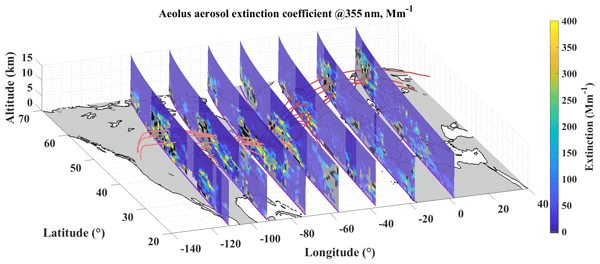
Targeting a large-scale smoke transport from the western US to Europe in September 2020 a smoke dataset was constructed based on Aeolus observations, in synergy with multi-platform data. The selected cross-sections show the vertical structure of the smoke layers at different transport phases. Statistical analyses of the complete dataset reveal the evolution of the smoke plume throughout its transatlantic transport.
Fanqian Meng, Junwu Tang, Guangyao Dai, Wenrui Long, Kangwen Sun, Zhiyu Zhang, Xiaoquan Song, Jiqiao Liu, Weibiao Chen, and Songhua Wu
Atmos. Meas. Tech., 18, 2021–2039, https://doi.org/10.5194/amt-18-2021-2025, https://doi.org/10.5194/amt-18-2021-2025, 2025
Short summary
Short summary
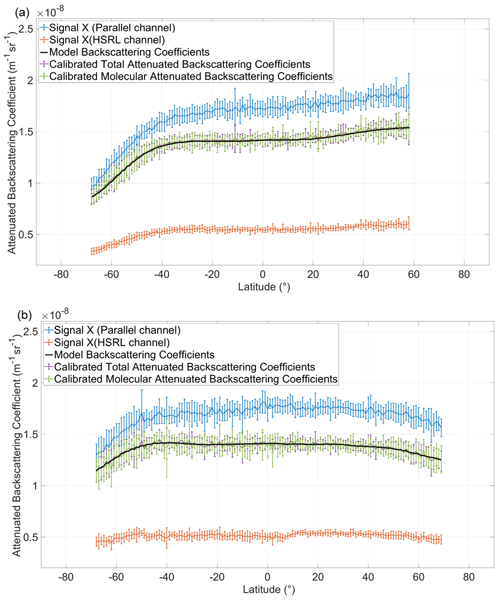
This paper presents a comprehensive calibration procedure for the first spaceborne high-spectral-resolution lidar with an iodine vapor absorption filter Aerosol and Carbon Detection Lidar (ACDL) on board DQ-1 by utilizing nighttime 532 nm multi-channel data. We analyzed the error sources of the multi-channel calibration coefficients and assessed the results. The results indicate that the uncertainty of the clear-air scattering ratio was within the anticipated range of 7.9 %.
Kangwen Sun, Guangyao Dai, Songhua Wu, Oliver Reitebuch, Holger Baars, Jiqiao Liu, and Suping Zhang
Atmos. Chem. Phys., 24, 4389–4409, https://doi.org/10.5194/acp-24-4389-2024, https://doi.org/10.5194/acp-24-4389-2024, 2024
Short summary
Short summary
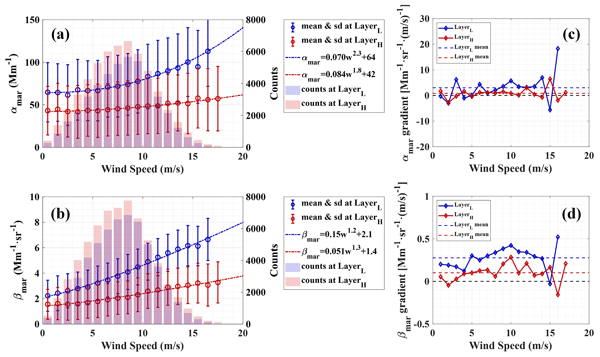
This paper investigates the correlation between marine aerosol optical properties and wind speeds over remote oceans using the spaceborne lidars ALADIN and CALIOP. Three remote ocean areas are selected. Pure marine aerosol optical properties at 355 nm are derived from ALADIN. The relationships between marine aerosol optical properties and wind speeds are analyzed within and above the marine atmospheric boundary layer, revealing the effect of wind speed on marine aerosols over remote oceans.
Guangyao Dai, Songhua Wu, Wenrui Long, Jiqiao Liu, Yuan Xie, Kangwen Sun, Fanqian Meng, Xiaoquan Song, Zhongwei Huang, and Weibiao Chen
Atmos. Meas. Tech., 17, 1879–1890, https://doi.org/10.5194/amt-17-1879-2024, https://doi.org/10.5194/amt-17-1879-2024, 2024
Short summary
Short summary
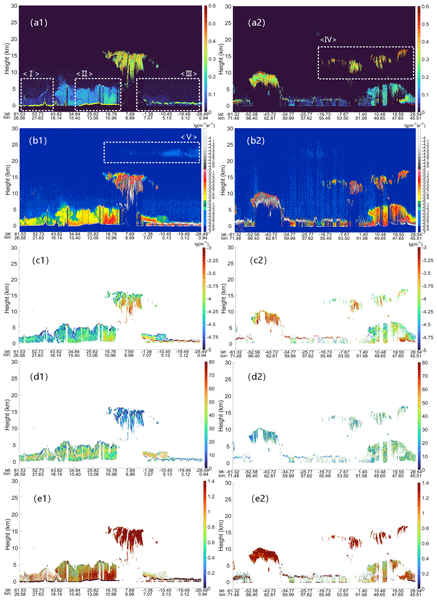
An overview is given of the main algorithms applied to derive the aerosol and cloud optical property product of the Aerosol and Carbon Detection Lidar (ACDL), which is capable of globally profiling aerosol and cloud optical properties with high accuracy. The paper demonstrates the observational capabilities of ACDL for aerosol and cloud vertical structure and global distribution through two optical property product measurement cases and global aerosol optical depth profile observations.
Qiantao Liu, Zhongwei Huang, Jiqiao Liu, Weibiao Chen, Qingqing Dong, Songhua Wu, Guangyao Dai, Meishi Li, Wuren Li, Ze Li, Xiaodong Song, and Yuan Xie
Atmos. Meas. Tech., 17, 1403–1417, https://doi.org/10.5194/amt-17-1403-2024, https://doi.org/10.5194/amt-17-1403-2024, 2024
Short summary
Short summary
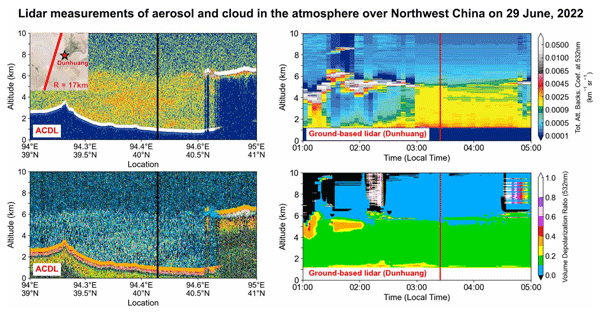
The achieved results revealed that the ACDL observations were in good agreement with the ground-based lidar measurements during dust events. The heights of cloud top and bottom from these two measurements were well matched and comparable. This study proves that the ACDL provides reliable observations of aerosol and cloud in the presence of various climatic conditions, which helps to further evaluate the impacts of aerosol on climate and the environment, as well as on the ecosystem in the future.
Fanqian Meng, Junwu Tang, Guangyao Dai, Wenrui Long, Kangwen Sun, Zhiyu Zhang, Xiaoquan Song, Jiqiao Liu, Weibiao Chen, and Songhua Wu
EGUsphere, https://doi.org/10.5194/egusphere-2024-588, https://doi.org/10.5194/egusphere-2024-588, 2024
Preprint archived
Short summary
Short summary
This paper presents a comprehensive calibration procedure for the first spaceborne high-spectral-resolution lidar with an iodine vapor absorption filter ACDL on board DQ-1 by utilizing nighttime 532 nm multi-channel data. And analyzed the error sources of the multi-channel calibration coefficients and assessed the results. The results shows that the ACDL polarization channel calibration is reliable and operates within the expected error range of approximately 5 %.
Guangyao Dai, Kangwen Sun, Xiaoye Wang, Songhua Wu, Xiangying E, Qi Liu, and Bingyi Liu
Atmos. Chem. Phys., 22, 7975–7993, https://doi.org/10.5194/acp-22-7975-2022, https://doi.org/10.5194/acp-22-7975-2022, 2022
Short summary
Short summary
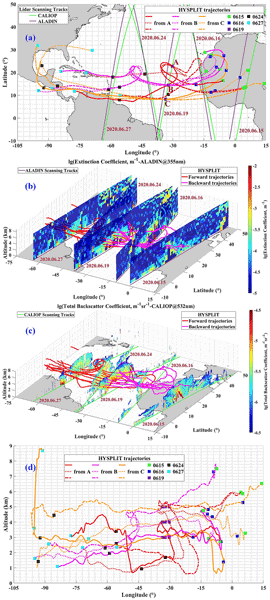
In this paper, a Sahara dust event is tracked with the spaceborne lidars ALADIN and CALIOP and the models ECMWF and HYSPLIT. The performance of ALADIN and CALIOP on tracking the dust event and on the observations of dust optical properties and wind fields during the dust transport is evaluated. The dust mass advection is defined, which is calculated with the combination of data from ALADIN and CALIOP coupled with the products from models to describe the dust transport quantitatively.
Songhua Wu, Kangwen Sun, Guangyao Dai, Xiaoye Wang, Xiaoying Liu, Bingyi Liu, Xiaoquan Song, Oliver Reitebuch, Rongzhong Li, Jiaping Yin, and Xitao Wang
Atmos. Meas. Tech., 15, 131–148, https://doi.org/10.5194/amt-15-131-2022, https://doi.org/10.5194/amt-15-131-2022, 2022
Short summary
Short summary
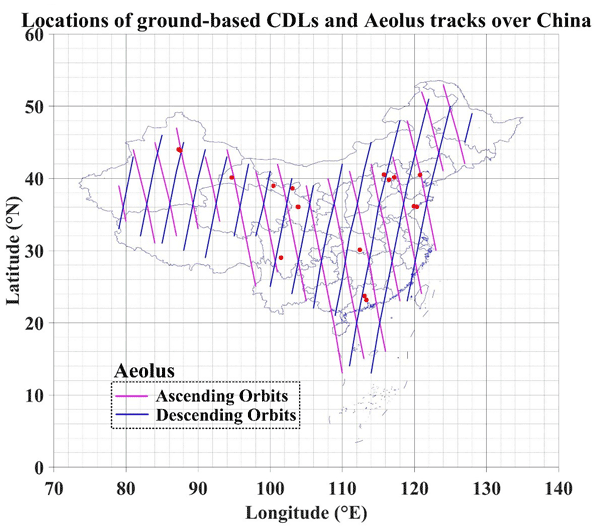
During the VAL-OUC campaign, we established a coherent Doppler lidar (CDL) network over China to verify the Level 2B (L2B) products from Aeolus. By the simultaneous wind measurements with CDLs at 17 stations, the L2B products from Aeolus are compared with those from CDLs. To our knowledge, the VAL-OUC campaign is the most extensive so far between CDLs and Aeolus in the lower troposphere for different atmospheric scenes. The vertical velocity impact on the HLOS retrieval from Aeolus is evaluated.
Guangyao Dai, Kangwen Sun, Xiaoye Wang, Songhua Wu, Xiangying E, Qi Liu, and Bingyi Liu
Atmos. Chem. Phys. Discuss., https://doi.org/10.5194/acp-2021-219, https://doi.org/10.5194/acp-2021-219, 2021
Revised manuscript not accepted
Short summary
Short summary
In this paper, a Sahara dust event is tracked with the spaceborne lidars ALADIN and CALIOP and the models ECMWF and HYSPLIT. The capability in calculating the dust horizontal fluxes with the joint measurements from ALADIN and CALIOP coupled with the data from ECMWF and HYSPLIT is demonstrated. The complement of Aeolus data products will improve the accuracy of dust horizontal flux estimations and contribute to the research on the dust fertilization impacts on the primary productivity of oceans.
Cited articles
Aoki, M., Iwai, H., Nakagawa, K., Ishii, S., and Mizutani, K.: Measurements of rainfall velocity and raindrop size distribution using coherent Doppler lidar, J. Atmos. Ocean. Tech., 33, 1949–1966, https://doi.org/10.1175/JTECH-D-15-0111.1, 2016.
Blackadar, A. K. and Tennekes, H.: Asymptotic similarity in neutral barotropic planetary boundary layers, J. Atmos. Sci., 25, 1015–1020, https://doi.org/10.1175/1520-0469(1968)025<1015:ASINBP>2.0.CO;2, 1968.
Chen, T., Fu, J., Chan, P., He, Y., Liu, A., and Zhou, W.: Wind characteristics in typhoon boundary layer at coastal areas observed via a Lidar profiler, J. Wind Eng. Ind. Aerod., 232, 105253, https://doi.org/10.1016/j.jweia.2022.105253, 2023.
Deaves, D. and Harris, R.: A mathematical model of the structure of strong winds, CIRIA Report 76, Const. Ind. Research and Inf. Assoc., Mendeley, https://www.mendeley.com/catalogue/7eb2d35b-868a-3a78-8693-a81655228a84/ (last access: 18 July 2025), 1978.
Duan, Z., Yao, X., Li, Y., Lei, X., Fang, P., and Zhao, B.: Investigation of turbulent momentum flux in the typhoon boundary layer, J. Geophys. Res.-Oceans, 122, 2259–2268, https://doi.org/10.1002/2016JC012169, 2017.
Fang, Q., Chu, K., Zhou, B., Chen, X., Peng, Z., Zhang, C., Luo, M., and Zhao, C.: Observed turbulent dissipation rate in a landfalling tropical cyclone boundary layer, J. Atmos. Sci., 80, 1739–1754, https://doi.org/10.1175/JAS-D-22-0265.1, 2023.
Gryning, S.-E., Batchvarova, E., Brümmer, B., Jørgensen, H., and Larsen, S.: On the extension of the wind profile over homogeneous terrain beyond the surface boundary layer, Bound.-Lay. Meteorol., 124, 251–268, https://doi.org/10.1007/s10546-007-9166-9, 2007.
Guo, X., Guo, J., Zhang, D. L., and Yun, Y.: Vertical divergence profiles as detected by two wind-profiler mesonets over East China: Implications for nowcasting convective storms, Q. J. Roy. Meteor. Soc., 149, 1629–1649, https://doi.org/10.1002/qj.4474, 2023.
Harris, R.: The structure of strong winds, Proc. CIRIA Conf. on Wind engineering in the eighties, 12–13 November 1980, Manchester, UK, Construction Industry Research and Information Association, London, UK, ISBN 9780860171706, 1981.
He, J., He, Y., Li, Q., Chan, P., Zhang, L., Yang, H., and Li, L.: Observational study of wind characteristics, wind speed and turbulence profiles during Super Typhoon Mangkhut, J. Wind Eng. Ind. Aerod., 206, 104362, https://doi.org/10.1016/j.jweia.2020.104362, 2020.
He, J., Chan, P., Li, Q., Li, L., Zhang, L., and Yang, H.: Observations of wind and turbulence structures of Super Typhoons Hato and Mangkhut over land from a 356 m high meteorological tower, Atmos. Res., 265, 105910, https://doi.org/10.1016/j.atmosres.2021.105910, 2022.
He, J., Chan, P. W., Chan, Y. W., and Cheung, P.: Super Typhoon Saola (2023) over the Northern Part of the South China Sea – Aircraft Data Analysis, Atmosphere-Basel, 14, 1595, https://doi.org/10.3390/atmos14111595, 2023a.
He, J., Li, Q., Chan, P.-W., Choy, C.-W., Mak, B., Lam, C.-C., and Luo, H.-Y.: An observational study of Typhoon Talim over the northern part of the South China Sea in July 2023, Atmosphere-Basel, 14, 1340, https://doi.org/10.3390/atmos14091340, 2023b.
He, Y., Chan, P., and Li, Q.: Observational study on thermodynamic and kinematic structures of Typhoon Vicente (2012) at landfall, J. Wind Eng. Ind. Aerod., 172, 280–297, https://doi.org/10.1016/j.jweia.2017.11.008, 2018.
Jin, X., Song, X., Yang, Y., Wang, M., Shao, S., and Zheng, H.: Estimation of turbulence parameters in the atmospheric boundary layer of the Bohai Sea, China, by coherent Doppler lidar and mesoscale model, Opt. Express, 30, 13263–13277, https://doi.org/10.1364/OE.455079, 2022.
Lan, C., Xie, J., Li, L., Wang, B., Yang, H., and Lu, J.: Downward momentum flux: An important mechanism of typhoon maintaining ground destructive force, J. Geophys. Res.-Atmos., 128, e2022JD037470, https://doi.org/10.1029/2022JD037470, 2023.
Li, L., Kareem, A., Hunt, J., Xing, F., Chan, P., Xiao, Y., and Li, C.: Observed sub-hectometer-scale low level jets in surface-layer velocity profiles of landfalling typhoons, J. Wind Eng. Ind. Aerod., 190, 151–165, https://doi.org/10.1016/j.jweia.2019.04.016, 2019.
Li, Q., Cheng, X., Zeng, X., Zhou, G., Huang, J., Wu, L., and Zeng, Q.: Study of the Air-Sea Momentum Flux of the Coastal Marine Boundary Layer During Typhoons, J. Geophys. Res.-Atmos., 127, e2022JD036839, https://doi.org/10.1029/2022JD036839, 2022.
Liu, B., Ma, Y., Guo, J., Gong, W., Zhang, Y., Mao, F., Li, J., Guo, X., and Shi, Y.: Boundary layer heights as derived from ground-based Radar wind profiler in Beijing, IEEE T. Geosci. Remote, 57, 8095–8104, https://doi.org/10.1109/TGRS.2019.2918301, 2019.
Liu, B., Guo, J., Gong, W., Shi, L., Zhang, Y., and Ma, Y.: Characteristics and performance of wind profiles as observed by the radar wind profiler network of China, Atmos. Meas. Tech., 13, 4589–4600, https://doi.org/10.5194/amt-13-4589-2020, 2020.
Lu, X., Yu, H., Ying, M., Zhao, B., Zhang, S., Lin, L., Bai, L., and Wan, R.: Western North Pacific tropical cyclone database created by the China Meteorological Administration, Adv. Atmos. Sci., 38, 690–699, https://doi.org/10.1007/s00376-020-0211-7, 2021.
Luo, Y., Fu, J., Li, Q., Chan, P., and He, Y.: Observation of Typhoon Hato based on the 356 m high meteorological gradient tower at Shenzhen, J. Wind Eng. Ind. Aerod., 207, 104408, https://doi.org/10.1016/j.jweia.2020.104408, 2020.
Lussier III, L. L., Montgomery, M. T., and Bell, M. M.: The genesis of Typhoon Nuri as observed during the Tropical Cyclone Structure 2008 (TCS-08) field experiment – Part 3: Dynamics of low-level spin-up during the genesis, Atmos. Chem. Phys., 14, 8795–8812, https://doi.org/10.5194/acp-14-8795-2014, 2014.
Ming, J., Zhang, J. A., Rogers, R. F., Marks, F. D., Wang, Y., and Cai, N.: Multiplatform observations of boundary layer structure in the outer rainbands of landfalling typhoons, J. Geophys. Res.-Atmos., 119, 7799–7814, https://doi.org/10.1002/2014JD021637, 2014.
Ming, J., Zhang, J. A., and Rogers, R. F.: Typhoon kinematic and thermodynamic boundary layer structure from dropsonde composites, J. Geophys. Res.-Atmos., 120, 3158–3172, https://doi.org/10.1002/2014JD022640, 2015.
Ming, J., Zhang, J. A., Li, X., Pu, Z., and Momen, M.: Observational estimates of turbulence parameters in the atmospheric surface layer of landfalling tropical cyclones, J. Geophys. Res.-Atmos., 128, e2022JD037768, https://doi.org/10.1029/2022JD037768, 2023.
Shi, W., Tang, J., Chen, Y., Chen, N., Liu, Q., and Liu, T.: Study of the boundary layer structure of a landfalling typhoon based on the observation from multiple ground-based Doppler wind lidars, Remote Sens.-Basel, 13, 4810, https://doi.org/10.3390/rs13234810, 2021.
Shu, Z., Li, Q., He, Y., and Chan, P.: Vertical wind profiles for typhoon, monsoon and thunderstorm winds, J. Wind Eng. Ind. Aerod., 168, 190–199, https://doi.org/10.1016/j.jweia.2017.06.004, 2017.
Song, L., Chen, W., Wang, B., Zhi, S., and Liu, A.: Characteristics of wind profiles in the landfalling typhoon boundary layer, J. Wind Eng. Ind. Aerod., 149, 77–88, https://doi.org/10.1016/j.jweia.2015.11.008, 2016.
Sparks, N., Hon, K., Chan, P., Wang, S., Chan, J., Lee, T., and Toumi, R.: Aircraft observations of tropical cyclone boundary layer turbulence over the South China Sea, J. Atmos. Sci., 76, 3773–3783, https://doi.org/10.1175/JAS-D-19-0128.1, 2019.
Tang, J., Zhang, J. A., Aberson, S. D., Marks, F. D., and Lei, X.: Multilevel tower observations of vertical eddy diffusivity and mixing length in the tropical cyclone boundary layer during landfalls, J. Atmos. Sci., 75, 3159–3168, https://doi.org/10.1175/JAS-D-17-0353.1, 2018.
Tang, J., Zhang, J. A., Chan, P., Hon, K., Lei, X., and Wang, Y.: A direct aircraft observation of helical rolls in the tropical cyclone boundary layer, Sci. Rep.-UK, 11, 18771, https://doi.org/10.1038/s41598-021-97766-7, 2021.
Tsai, Y.-S., Miau, J.-J., Yu, C.-M., and Chang, W.-T.: Lidar observations of the typhoon boundary layer within the outer rainbands, Bound.-Lay. Meteorol., 171, 237–255, https://doi.org/10.1007/s10546-019-00427-6, 2019.
Tse, K. T., Li, S. W., Chan, P., Mok, H., and Weerasuriya, A. U.: Wind profile observations in tropical cyclone events using wind-profilers and doppler SODARs, J. Wind Eng. Ind. Aerod., 115, 93–103, https://doi.org/10.1016/j.jweia.2013.01.003, 2013.
Wang, X., Huang, C., Huang, P., and Yu, X.: Study on wind characteristics of a strong typhoon in near-ground boundary layer, Struct. Des. Tall Spec., 26, e1338, https://doi.org/10.1002/tal.1338, 2017.
Wang, X., Dai, G., Wu, S., Zhu, P., Li, Z., Song, X., Zhang, S., Xu, J., Yin, J., and Qin, S.: Classification of Turbulent Mixing Driven Sources in Marine Atmospheric Boundary Layer with use of Shipborne Coherent Doppler Lidar observations, J. Geophys. Res.-Atmos., 128, e2023JD038918, https://doi.org/10.1029/2023JD038918, 2023.
Wu, S., Liu, B., Liu, J., Zhai, X., Feng, C., Wang, G., Zhang, H., Yin, J., Wang, X., and Li, R.: Wind turbine wake visualization and characteristics analysis by Doppler lidar, Opt. Express, 24, A762–A780, https://doi.org/10.1364/OE.24.00A762, 2016.
Wu, S., Sun, K., Dai, G., Wang, X., Liu, X., Liu, B., Song, X., Reitebuch, O., Li, R., Yin, J., and Wang, X.: Inter-comparison of wind measurements in the atmospheric boundary layer and the lower troposphere with Aeolus and a ground-based coherent Doppler lidar network over China, Atmos. Meas. Tech., 15, 131–148, https://doi.org/10.5194/amt-15-131-2022, 2022.
Xia, D., Dai, L., Lin, L., Wang, H., and Hu, H.: A field measurement based wind characteristics analysis of a typhoon in near-ground boundary layer, Atmosphere-Basel, 12, 873, https://doi.org/10.3390/atmos12070873, 2021.
Ying, M., Zhang, W., Yu, H., Lu, X., Feng, J., Fan, Y., Zhu, Y., and Chen, D.: An overview of the China Meteorological Administration tropical cyclone database, J. Atmos. Ocean. Tech., 31, 287–301, https://doi.org/10.1175/JTECH-D-12-00119.1, 2014.
Zhang, J. A., Marks, F. D., Montgomery, M. T., and Lorsolo, S.: An estimation of turbulent characteristics in the low-level region of intense Hurricanes Allen (1980) and Hugo (1989), Mon. Weather Rev., 139, 1447–1462, https://doi.org/10.1175/2010MWR3435.1, 2010.
Zhang, J. A., Rogers, R. F., Nolan, D. S., and Marks, F. D.: On the characteristic height scales of the hurricane boundary layer, Mon. Weather Rev., 139, 2523–2535, https://doi.org/10.1175/MWR-D-10-05017.1, 2011.
Zhang, J. A., Atlas, R., Emmitt, G. D., Bucci, L., and Ryan, K.: Airborne Doppler wind lidar observations of the tropical cyclone boundary layer, Remote Sens.-Basel, 10, 825, https://doi.org/10.3390/rs10060825, 2018.
Zhao, Z., Chan, P., Wu, N., Zhang, J. A., and Hon, K.: Aircraft observations of turbulence characteristics in the tropical cyclone boundary layer, Bound.-Lay. Meteorol., 174, 493–511, https://doi.org/10.1007/s10546-019-00487-8, 2020.
Zhao, Z., Gao, R., Zhang, J. A., Zhu, Y., Liu, C., Chan, P., and Wan, Q.: Observations of boundary layer wind and turbulence of a landfalling tropical cyclone, Sci. Rep.-UK, 12, 11056, https://doi.org/10.1038/s41598-022-14929-w, 2022.
Zhou, Q. J., Li, L., Chan, P. W., Cheng, X. L., Yang, H. L., Lan, C. X., and Su, J. C.: Vertical coupling of gusts in the lower boundary layer during super typhoons and squall lines, J. Geophys. Res.-Atmos., 128, e2022JD038058, https://doi.org/10.1029/2022JD038058, 2023.

Short summary
In this paper, we propose a data fusion method to obtain the no-blind-zone wind speed profiles covering the whole atmospheric boundary layer based on the joint measurements of coherent Doppler lidar (CDL), radar wind profiler (RWP) and automatic weather station (AWS). Since the above instruments are widely deployed in China, we believe this method has broad application prospects for the improvement of the boundary layer parameterization scheme in numerical forecast models.
In this paper, we propose a data fusion method to obtain the no-blind-zone wind speed profiles...