Articles | Volume 18, issue 23
https://doi.org/10.5194/amt-18-7421-2025
© Author(s) 2025. This work is distributed under
the Creative Commons Attribution 4.0 License.
https://doi.org/10.5194/amt-18-7421-2025
© Author(s) 2025. This work is distributed under
the Creative Commons Attribution 4.0 License.
New quantitative measurements and spectroscopic line parameters of ammonia in the 685–1250 cm−1 spectral region for atmospheric remote sensing

School of Physics and Astronomy, Space Park Leicester, University of Leicester, Leicester, LE4 5SP, UK
National Centre for Earth Observation, Space Park Leicester, Leicester, LE4 5SP, UK
Jeremy J. Harrison
CORRESPONDING AUTHOR
School of Physics and Astronomy, Space Park Leicester, University of Leicester, Leicester, LE4 5SP, UK
National Centre for Earth Observation, Space Park Leicester, Leicester, LE4 5SP, UK
D. Chris Benner
Department of Physics, The College of William and Mary, Williamsburg, 23187-8795, USA
V. Malathy Devi
Department of Physics, The College of William and Mary, Williamsburg, 23187-8795, USA
Related authors
No articles found.
Michael P. Cartwright, Jeremy J. Harrison, David P. Moore, Richard J. Pope, Martyn P. Chipperfield, Chris Wilson, and Wuhu Feng
Atmos. Chem. Phys., 25, 15913–15934, https://doi.org/10.5194/acp-25-15913-2025, https://doi.org/10.5194/acp-25-15913-2025, 2025
Short summary
Short summary
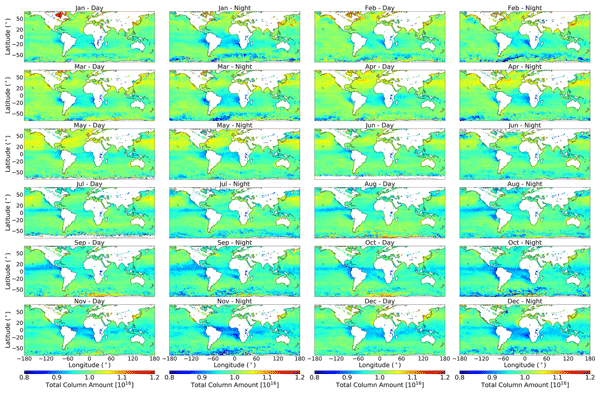
We use satellite measurements to estimate quantities of a gas called carbonyl sulfide (OCS) in the atmosphere. OCS is consumed during photosynthesis, much like carbon dioxide (CO2). Our data is focused mostly over the global oceans for the year 2018, and we find it compares well with past satellite observations, ground-based measurements and modelled OCS. We hope to extend this measurement record and use it in data-driven tools in the future to better understand the carbon cycle globally.
Antonio G. Bruno, David P. Moore, Jeremy J. Harrison, Ailish Graham, and Martyn P. Chipperfield
EGUsphere, https://doi.org/10.5194/egusphere-2025-5109, https://doi.org/10.5194/egusphere-2025-5109, 2025
This preprint is open for discussion and under review for Atmospheric Chemistry and Physics (ACP).
Short summary
Short summary
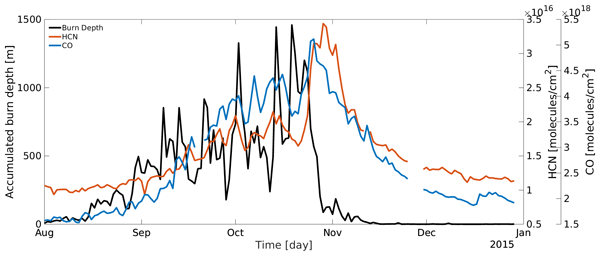
Indonesian peatlands store vast carbon reserves, but can release large quantities of greenhouse gases and other species with significant environmental impacts, including HCN, when fires occur. Analyzing three major El Niño years with satellites and models, we found that emissions depend on local hydrological conditions, not just El Niño strength. Including soil moisture and burn depth can improve emission estimates and climate strategies.
Michael P. Cartwright, Richard J. Pope, Jeremy J. Harrison, Martyn P. Chipperfield, Chris Wilson, Wuhu Feng, David P. Moore, and Parvadha Suntharalingam
Atmos. Chem. Phys., 23, 10035–10056, https://doi.org/10.5194/acp-23-10035-2023, https://doi.org/10.5194/acp-23-10035-2023, 2023
Short summary
Short summary
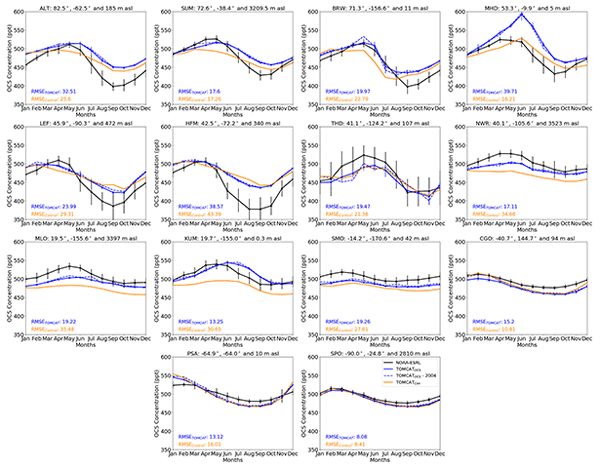
A 3-D chemical transport model, TOMCAT, is used to simulate global atmospheric carbonyl sulfide (OCS) distribution. Modelled OCS compares well with satellite observations of OCS from limb-sounding satellite observations. Model simulations also compare adequately with surface and atmospheric observations and suitably capture the seasonality of OCS and background concentrations.
Antonio G. Bruno, Jeremy J. Harrison, Martyn P. Chipperfield, David P. Moore, Richard J. Pope, Christopher Wilson, Emmanuel Mahieu, and Justus Notholt
Atmos. Chem. Phys., 23, 4849–4861, https://doi.org/10.5194/acp-23-4849-2023, https://doi.org/10.5194/acp-23-4849-2023, 2023
Short summary
Short summary
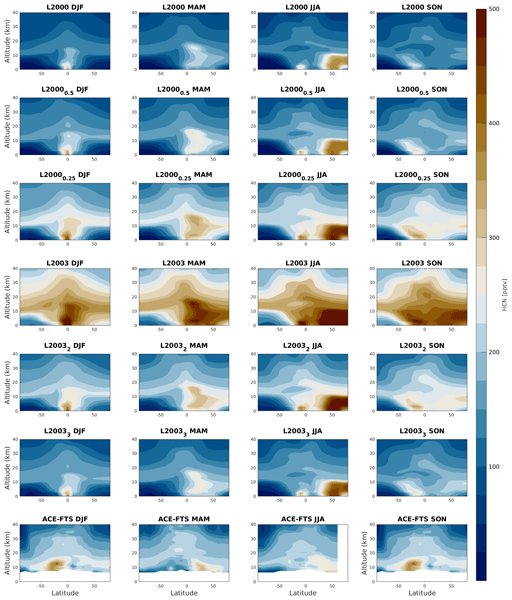
A 3-D chemical transport model, TOMCAT; satellite data; and ground-based observations have been used to investigate hydrogen cyanide (HCN) variability. We found that the oxidation by O(1D) drives the HCN loss in the middle stratosphere and the currently JPL-recommended OH reaction rate overestimates HCN atmospheric loss. We also evaluated two different ocean uptake schemes. We found them to be unrealistic, and we need to scale these schemes to obtain good agreement with HCN observations.
Richard J. Pope, Rebecca Kelly, Eloise A. Marais, Ailish M. Graham, Chris Wilson, Jeremy J. Harrison, Savio J. A. Moniz, Mohamed Ghalaieny, Steve R. Arnold, and Martyn P. Chipperfield
Atmos. Chem. Phys., 22, 4323–4338, https://doi.org/10.5194/acp-22-4323-2022, https://doi.org/10.5194/acp-22-4323-2022, 2022
Short summary
Short summary
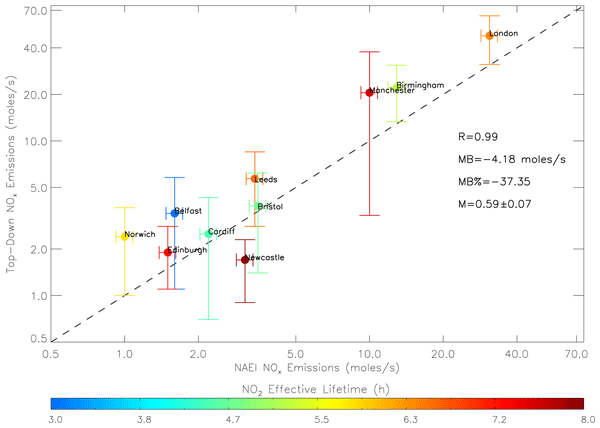
Nitrogen oxides (NOx) are potent air pollutants which directly impact on human health. In this study, we use satellite nitrogen dioxide (NO2) data to evaluate the spatial distribution and temporal evolution of the UK official NOx emissions inventory, with reasonable agreement. We also derived satellite-based NOx emissions for several UK cities. In the case of London and Birmingham, the NAEI NOx emissions are potentially too low by >50%.
Cited articles
Apte, J. S., Brauer, M., Cohen, A. J., Ezzati, M., and Arden Pope III, C.: Ambient PM2.5 Reduces Global and Regional Life Expectancy, Environ. Sci. Technol. Lett., 5, 546–551, https://doi.org/10.1021/acs.estlett.8b00360, 2018.
Aroui, H., Laribi, H., Orphal, J., and Chelin, P.: Self-broadening, self-shift and self-mixing in the ν2, 2ν2 and ν4 bands of NH3, J. Quant. Spectrosc. Radiat. Transf., 110, 2037–2059, https://doi.org/10.1016/j.jqsrt.2009.05.002, 2009.
Bauer, S. E., Tsigaridis, K., and Miller, R.: Significant atmospheric aerosol pollution caused by world food cultivation, Geophys. Res. Lett., 43, 5394–5400, https://doi.org/10.1002/2016GL068354, 2016.
Behera, S. N. and Sharma, M.: Investigating the potential role of ammonia in ion chemistry of fine particulate matter formation for an urban environment, Sci. Total Environ., 408, 3569–3575, https://doi.org/10.1016/j.scitotenv.2010.04.017, 2010.
Behera, S. N., Sharma, M., Aneja, V. P., and Balasubramanian, R.: Ammonia in the atmosphere: a review on emission sources, atmospheric chemistry and deposition on terrestrial bodies, Environ. Sci. Pollut. Control Ser., 20, 8092–8131, https://doi.org/10.1007/s11356-013-2051-9, 2013.
Benner, D. C., Rinsland, C. P., Devi, V. M., Smith, M. H., and Atkins, D.: A multispectrum nonlinear least squares fitting technique, J. Quant. Spectrosc. Radiat. Transf., 6, 705–721, https://doi.org/10.1016/0022-4073(95)00015-D, 1995.
Benner, D. C., Devi, V. M., Sung, K., Brown, L. R., Miller, C. E., Payne, V. H., Drouin, B. J., Yu, S., Crawford, T. J., Mantz, A. W., Smith, M. H., and Gamache, R. R.: Line parameters including temperature dependences of air- and self-broadened line shapes of 12C16O2: 2.06-µm region, J. Mol. Spectrosc., 326, 21–47, https://doi.org/10.1016/j.jms.2016.02.012, 2016.
Brunekreef, B., Harrison, R. M., Künzli, N., Querol, X., Sutton, M. A., Heederik, D. J. J., and Sigsgaard, T.: Reducing the health effect of particles from agriculture, Lancet Respir. Med., 3, 831–832, https://doi.org/10.1016/S2213-2600(15)00413-0, 2015.
Canè, E., Di Lonardo, G., Fusina, L., Tamassia, F., and Predoi-Cross, A.: The v2 = 1, 2 and v4 = 1 bending states of 15NH3 and their analysis at experimental accuracy, J. Chem. Phys., 150, 194301, https://doi.org/10.1063/1.5088751, 2019.
Canè, E., Di Lonardo, G., Fusina, L., Tamassia, F., and Predoi-Cross, A.: Spectroscopic characterization of the v2 = 3 and v2 = v4 = 1 states for 15NH3 from high resolution infrared spectra, J. Quant. Spectrosc. Radiat. Transf., 250, 106987, https://doi.org/10.1016/j.jqsrt.2020.106987, 2020.
Ciurylo, R.: Shapes of pressure- and Doppler-broadened spectral lines in the core and near wings, Phys. Rev. A, 58, 1029, https://doi.org/10.1103/PhysRevA.58.1029, 1998.
Clar, H.-J., Schieder, R., Winnewisser, G., and Yamada, K. M. T.: Pressure broadening and lineshifts in the ν2 band of NH3, J. Mol. Struct., 190, 447–456, https://doi.org/10.1016/0022-2860(88)80303-X, 1988.
Clarisse, L., Clerbaux, C., Dentener, F., Hurtmans, D., and Coheur, P.-F.: Global ammonia distribution derived from infrared satellite observations, Nat. Geosci., 2, 479–483, https://doi.org/10.1038/ngeo551, 2009.
Clarisse, L., Van Damme, M., Gardner, W., Coheur, P.-F., Clerbaux, C., Whitburn, S., Hadji-Lazaro, J., and Hurtmans, D.: Atmospheric ammonia (NH3) emanations from Lake Natron's saline mudflats, Sci. Rep., 9, 4441, https://doi.org/10.1038/s41598-019-39935-3, 2019.
Devi, V. M., Benner, D. C., Smith, M. A. H., Brown, L. R., and Dulick, M.: Absolute intensity measurements of the laser bands near 10 µm, J. Quant. Spectrosc. Radiat. Transf., 76, 393–410, https://doi.org/10.1016/S0022-4073(02)00067-5, 2003.
Down, M. J., Hill, C., Yurchenko, S. N., Tennyson, J., Brown, L. R., and Kleiner, I.: Re-analysis of ammonia spectra: Updating the HITRAN 14NH3 database, J. Quant. Spectrosc. Radiat. Transf., 130, 260–272, https://doi.org/10.1016/j.jqsrt.2013.05.027, 2013
Erisman, J. W. and Schaap, M.: The need for ammonia abatement with respect to secondary PM reductions in Europe, Environ. Pollut., 129, 159–163, https://doi.org/10.1016/j.envpol.2003.08.042, 2004.
García-Gómez, H., Garrido, J. L., Vivanco, M. G., Lassaletta, L., Rábago, I., Àvila, A., Tsyro, S., Sánchez, G., González Ortiz, A., González-Fernández, I., and Alonso, R.: Nitrogen deposition in Spain: modeled patterns and threatened habitats within the Natura 2000 network, Sci. Total Environ., 485–486, 450–460, https://doi.org/10.1016/j.scitotenv.2014.03.112, 2014.
Gordon, I. E., Rothman, L. S., Hargreaves, R. J., Hashemi, R., Karlovets, E. V., Skinner, F. M., Conway, E. K., Hill, C., Kochanov, R. V., Tan, Y., Wcislo, P., Finenko, A. A., Nelson, K., Bernath, P. F., Birk, M., Boudon, V., Campargue, A., Chance, K. V., Coustenis, A., Drouin, B. J., Flaud, J.-M., Gamache, R. R., Hodges, J. T., Mlawer, E. J., Nikitin, A. V., Perevalov, V. I., Rotger, M., Tennyson, J., Toon, G. C., Tran, H., Tyuterev, V. G., Adkins, E. M., Baker, A., Barbe, A., Cane, E., Csaszar, A. G., Dudaryonok, A., Egorov, O., Fleisher, A. J., Fleurbaey, H., Foltynowicz, A., Furtenbacher, T., Harrison, J. J., Hartmann, J.-M., Horneman, V.-M., Huang, X., Karman, T., Karns, J., Kassi, S., Kleiner, I., Kofman, V., Kwabia-Tchana, F., Lavrentieva, N. N., Lee, T. J., Long, D. A., Lukashevskaya, A. A., Lyulin, O. M., Makhnev, V. Yu., Matt, W., Massie, S. T., Melosso, M., Mikhailenko, S. N., Mondelain, D., Muller, H. S. P., Naumenko, O. V., Perrin, A., Polyansky, O. L., Raddaoui, E., Raston, P. L., Reed, Z. D., Rey, M., Richard, C., Tobias, R., Sadiek, I., Schwenke, D. W., Starikova, E., Sung, K., Tamassia, F., Tashkun, S. A., Vander Auwera, J., Vasilenko, I. A., Vigasin, A. A., Villanueva, G. L., Vispoel, B., Wagner, G., Yachmenev, A., and Yurchenko, S. N.: The HITRAN2020 molecular spectroscopic database, J. Quant. Spectrosc. Radiat. Transf., 277, 107949, https://doi.org/10.1016/j.jqsrt.2021.107949, 2021.
Guinet, M., Jeseck, P., Mondelain, D., Pepin, I., Janssen, C., Camy-Peyret, C., and Mandin, J. Y.: Absolute measurements of intensities, positions and self-broadening coefficients of R branch transitions in the ν2 band of ammonia, J. Quant. Spectrosc. Radiat. Transf., 112, 1950–1960, https://doi.org/10.1016/j.jqsrt.2011.03.015, 2011.
Han, X., Zhu, L., Liu, M., Song, Y., and Zhang, M.: Numerical analysis of agricultural emissions impacts on PM2.5 in China using a high-resolution ammonia emission inventory, Atmos. Chem. Phys., 20, 9979–9996, https://doi.org/10.5194/acp-20-9979-2020, 2020.
Ho, P. T. P. and Townes, C. H.: Interstellar Ammonia, Ann. Rev. Astron. Astrophys., 21, 239–270, https://doi.org/10.1146/annurev.aa.21.090183.001323, 1983.
Ibrahimi, M., Babay, A., Lemoine, B., and Rohart, F.: Pressure-Induced Frequency Lineshifts in the ν2 Band of Ammonia: An Experimental Test of the Rydberg–Ritz Principle, J. Mol. Spectrosc., 193, 277–284, https://doi.org/10.1006/jmsp.1998.7749, 1999.
Irwin, P. G. J., Hill, S. M., Fletcher, L. N., Alexander, C., and Rogers, J. H.: Clouds and Ammonia in the Atmospheres of Jupiter and Saturn Determined From a Band-Depth Analysis of VLT/MUSE Observations, J. Geophys. Res. Planets, 130, e2024JE008622, https://doi.org/10.1029/2024JE008622, 2025.
Jacquinet-Husson, N., Armante, R., Scott, N. A., Chédin, A., Crépeau, L., Boutammine, C., Bouhdaoui, A., Crevoisier, C., Capelle, V., Boonne, C., Poulet-Crovisier, N., Barbe, A., Benner, D. C., Boudon, V., Brown, L. R., Buldyreva, J., Campargue, A., Coudert, L. H., Devi, V. M., Down, M. J., Drouin, B. J., Fayt, A., Fittschen, C., Flaud, J.-M., Gamache, R. R., Harrison, J. J., Hill, C., Hodnebrog, Ø., Hu, S.-M., Jacquemart, D., Jolly, A., Jiménez, E., Lavrentieva, N. N., Liu, A.-W., Lodi, L., Lyulin, O. M., Massie, S. T., Mikhailenko, S., Müller, H. S. P., Naumenko, O. V., Nikitin, A., Nielsen, C. J., Orphal, J., Perevalov, V. I., Perrin, A., Polovtseva, E., Predoi-Cross, A., Rotger, M., Ruth, A. A., Yu, S. S., Sung, K., Tashkun, S. A., Tennyson, J., Tyuterev, Vl. G., Vander Auwera, J., Voronin, B. A., and Makie, A.: The 2015 edition of the GEISA spectroscopic database, J. Mol. Spectrosc., 327, 31–72, https://doi.org/10.1016/j.jms.2016.06.007, 2016.
Joint Committee for Guides in Metrology (JCGM): 100:2008 Evaluation of measurement data – Guide to the expression of uncertainty in measurement, https://doi.org/10.59161/JCGM100-2008E, 2008.
Lelieveld, J., Evans, J. S., Fnais, M., Giannadaki, D., and Pozzer, A.: The contribution of outdoor air pollution sources to premature mortality on a global scale, Nature, 525, 367–371, https://doi.org/10.1038/nature15371, 2015.
Letchworth, K. L. and Benner, D. C.: Rapid and accurate calculation of the Voigt function, J. Quant. Spectrosc. Radiat. Transf., 107, 173–192, https://doi.org/10.1016/j.jqsrt.2007.01.052, 2007.
Maki, A. G. and Wells, J. S.: Wavenumber calibration tables from heterodyne frequency measurements. NIST Special Publication 821, National Institute of Standard and Technology, Gaithersburg, https://doi.org/10.6028/NIST.SP.821, 1991.
Mâlin, M. Boccaletti, A., Perrot, C., Baudoz, P., Rouan, D., Lagage, P.-O., Waters, R., Güdel, M., Henning, T., Vandenbussche, B., Absil, O., Barrado, D., Charnay, B., Choquet, E., Cossou, C., Danielski, C., Decin, L., Glauser, A.M., Pye, J., Olofsson, G., Glasse, A., Patapis, P., Royer, P., Scheithauer, S., Serabyn, E., Tremblin, P., Whiteford, N., van Dishoeck, E. F., Ostlin, G., Ray, T. P., and Wright, G.: First unambiguous detection of ammonia in the atmosphere of a planetary mass companion with JWST/MIRI coronagraphs, Astron. Astrophys., 693, A315, https://doi.org/10.1051/0004-6361/202452695, 2025.
Megaritis, A. G., Fountoukis, C., Charalampidis, P. E., Pilinis, C., and Pandis, S. N.: Response of fine particulate matter concentrations to changes of emissions and temperature in Europe, Atmos. Chem. Phys., 13, 3423–3443, https://doi.org/10.5194/acp-13-3423-2013, 2013.
Nemtchinov, V., Sung, K., and Varanasi, P.: Measurements of line intensities and half-widths in the 10-µm bands of 14NH3, J. Quant. Spectrosc. Radiat. Transf., 83, 243–265, https://doi.org/10.1016/S0022-4073(02)00354-0, 2004.
Rosenkranz, P. W.: Interference coefficients for overlapping oxygen lines in air, J. Quant. Spectrosc. Radiat. Transf., 39, 287–297, https://doi.org/10.1016/0022-4073(88)90004-0, 1988.
Rothman, L. S., Gordon, I. E., Babikov, Y., Barbe, A., Benner, D. C., Bernath, P. F., Birk, M., Bizzocchi, L., Boudon, V., Brown, L. R., Campargue, A., Chance, K., Cohen, E. A., Coudert, L. H., Devi, V. M., Drouin, B. J., Fayt, A., Flaud, J. M., Gamache, R. R., Harrison, J. J., Hartmann, J. M., Hill, C., Hodges, J. T., Jacquemart, D., Jolly, A., Lamouroux, J., Le Roy, R. J., Li, G., Long, D. A., Lyulin, O. M., Mackie, C. J., Massie, S. T., Mikhailenko, S. N., Muller, H. S. P., Naumenko, O. V., Nikitin, A. V., Orphal, J., Perevalov, V. I., Perrin, A., Polovtseva, E. R., Richard, C., Smith, M. A. H., Starikova, E., Sung, K., Tashkun, S. A., Tennyson, J., Toon, G. C., Tyuterev, V. G., and Wagner, G.: The HITRAN2012 molecular spectroscopic database, J. Quant. Spectrosc. Radiat. Transf., 130, 4–50, https://doi.org/10.1016/j.jqsrt.2013.07.002, 2013.
Shephard, M. W. and Cady-Pereira, K. E.: Cross-track Infrared Sounder (CrIS) satellite observations of tropospheric ammonia, Atmos. Meas. Tech., 8, 1323–1336, https://doi.org/10.5194/amt-8-1323-2015, 2015.
Shephard, M. W., Cady-Pereira, K. E., Luo, M., Henze, D. K., Pinder, R. W., Walker, J. T., Rinsland, C. P., Bash, J. O., Zhu, L., Payne, V. H., and Clarisse, L.: TES ammonia retrieval strategy and global observations of the spatial and seasonal variability of ammonia, Atmos. Chem. Phys., 11, 10743–10763, https://doi.org/10.5194/acp-11-10743-2011, 2011.
Sutton, M. A., Erisman, J. W., Dentener, F., and Möller, D.: Ammonia in the environment: from ancient times to the present, Environ. Pollut., 156, 583–604, https://doi.org/10.1016/j.envpol.2008.03.013, 2008.
Sutton, M. A., Reis, S., and Baker, S. M. H.: Atmospheric Ammonia: Detecting Emission Changes and Environmental Impacts, Springer Netherlands, https://doi.org/10.1007/978-1-4020-9121-6, 2009.
Thakrar, S. K., Balasubramanian, S., Adams, P. J., Azevedo, I. M. L., Muller, N. Z., Pandis, S. N., Polasky, S., Arden Pope III, C., Robinson, A. L., Apte, J. S., Tessum, C. W., Marshall, J. D., and Hill, J. D.: Reducing Mortality from Air Pollution in the United States by Targeting Specific Emission Sources, Environ. Sci. Technol. Lett., 7, 639–645, https://doi.org/10.1021/acs.estlett.0c00424, 2020.
Ting, Y. C., Young, L. H., Lin, T. H., Tsay, S. C., Chang, K. E., and Hsiao, T. C.: Quantifying the impacts of PM2.5 constituents and relative humidity on visibility impairment in a suburban area of eastern Asia using long-term in-situ measurements, Sci. Total Environ., 818, 151759, https://doi.org/10.1016/j.scitotenv.2021.151759, 2022.
Twigg, M. M., Berkhout, A. J. C., Cowan, N., Crunaire, S., Dammers, E., Ebert, V., Gaudion, V., Haaima, M., Häni, C., John, L., Jones, M. R., Kamps, B., Kentisbeer, J., Kupper, T., Leeson, S. R., Leuenberger, D., Lüttschwager, N. O. B., Makkonen, U., Martin, N. A., Missler, D., Mounsor, D., Neftel, A., Nelson, C., Nemitz, E., Oudwater, R., Pascale, C., Petit, J.-E., Pogany, A., Redon, N., Sintermann, J., Stephens, A., Sutton, M. A., Tang, Y. S., Zijlmans, R., Braban, C. F., and Niederhauser, B.: Intercomparison of in situ measurements of ambient NH3: instrument performance and application under field conditions, Atmos. Meas. Tech., 15, 6755–6787, https://doi.org/10.5194/amt-15-6755-2022, 2022.
Van Damme, M., Clarisse, L., Heald, C. L., Hurtmans, D., Ngadi, Y., Clerbaux, C., Dolman, A. J., Erisman, J. W., and Coheur, P. F.: Global distributions, time series and error characterization of atmospheric ammonia (NH3) from IASI satellite observations, Atmos. Chem. Phys., 14, 2905–2922, https://doi.org/10.5194/acp-14-2905-2014, 2014.
Van Damme, M., Clarisse, L., Whitburn, S., Hadji-Lazaro, J., Hurtmans, D., Clerbaux, C., and Coheur, P.-F.: Industrial and agricultural ammonia point sources exposed, Nature, 564, 99–103, https://doi.org/10.1038/s41586-018-0747-1, 2018.
Van Damme, M., Clarisse, L., Franco, B., Sutton, M. A., Erisman, J. W., Kruit, R. W., van Zanten, M., Whitburn, S., Hadji-Lazaro, J., Hurtmans, D., Clerbaux, C., and Coheur, P.-F.: Global, regional and national trends of atmospheric ammonia derived from a decadal (2008–2018) satellite record, Environ. Res. Lett., 16, 055017, https://doi.org/10.1088/1748-9326/abd5e0, 2021.
Warner, J. X., Wei, Z., Strow, L. L., Dickerson, R. R., and Nowak, J. B.: The global tropospheric ammonia distribution as seen in the 13-year AIRS measurement record, Atmos. Chem. Phys., 16, 5467–5479, https://doi.org/10.5194/acp-16-5467-2016, 2016.
Warner, J. X., Dickerson, R. R., Wei, Z., Strow, L. L., Wang, Y., and Liang, Q.: Increased atmospheric ammonia over the world's major agricultural areas detected from space, Geophys. Res. Lett., 44, 2875–2884, https://doi.org/10.1002/2016GL072305, 2017.
Werwein, V., Brunzendorf, J., Li, G., Serdyukov, A., Werhahn, O., and Ebert, V.: High-resolution Fourier transform measurements of line strengths in the 0002-0000 main isotopologue band of nitrous oxide, Appl. Opt., 56, E99–E105, https://doi.org/10.1364/AO.56.000E99, 2017
Wyer, K. E., Kelleghan, D. B., Blanes-Vidal, V., Schauberger, G., and Curran, T. P.: Ammonia emissions from agriculture and their contribution to fine particulate matter: A review of implications for human health, J. Environ. Manage., 323, 116285, https://doi.org/10.1016/j.jenvman.2022.116285, 2022.
Yang, Y., Zhang, Z., Yang, Y., Wang, Z., Chen, Y., and He, H.: Impact of high PM2.5 nitrate on visibility in a medium size city of Pearl River Delta, Atmos Pollut. Res., 13, 101592, https://doi.org/10.1016/j.apr.2022.101592, 2022.
Yu, O., Sheppard, L., Lumley, T., Koenig, J. Q., and Shapiro, G. G.: Effects of ambient air pollution on symptoms of asthma in Seattle-area children enrolled in the CAMP study, Environ. Health Perspect., 108, 1209–1214, https://doi.org/10.1289/ehp.001081209, 2000.
Yurchenko, S. N.: A theoretical room-temperature line list for 15NH3, J. Quant. Spectrosc. Radiat. Transf., 152, 28–36, https://doi.org/10.1016/j.jqsrt.2014.10.023, 2015.
Short summary
Ammonia, a toxic gas produced largely through agricultural emissions, is one of the key pollutants that can be monitored by satellite instruments orbiting the Earth. Satellites rely on accurate spectral line parameters to interpret their data, which are obtained through fitting data from lab-based measurements. This work performs such experiments on the ammonia ν2 band, determining new line parameters which will provide a more accurate basis for modelling satellite measurements of ammonia.
Ammonia, a toxic gas produced largely through agricultural emissions, is one of the key...