Articles | Volume 19, issue 3
https://doi.org/10.5194/amt-19-1023-2026
© Author(s) 2026. This work is distributed under
the Creative Commons Attribution 4.0 License.
https://doi.org/10.5194/amt-19-1023-2026
© Author(s) 2026. This work is distributed under
the Creative Commons Attribution 4.0 License.
Accurate humidity probe for persistent aviation-contrail conditions

Christoph Dyroff
CORRESPONDING AUTHOR
Aerodyne Research, 45 Manning Road, Billerica MA 01821, USA
Michael D. Moore
Aerodyne Research, 45 Manning Road, Billerica MA 01821, USA
Bruce C. Daube
Aerodyne Research, 45 Manning Road, Billerica MA 01821, USA
Scott C. Herndon
Aerodyne Research, 45 Manning Road, Billerica MA 01821, USA
Related authors
John W. Halfacre, Lewis Marden, Marvin D. Shaw, Lucy J. Carpenter, Emily Matthews, Thomas J. Bannan, Hugh Coe, Scott C. Herndon, Joseph R. Roscioli, Christoph Dyroff, Tara I. Yacovitch, Patrick R. Veres, Michael A. Robinson, Steven S. Brown, and Pete M. Edwards
Atmos. Meas. Tech., 18, 3799–3818, https://doi.org/10.5194/amt-18-3799-2025, https://doi.org/10.5194/amt-18-3799-2025, 2025
Short summary
Short summary
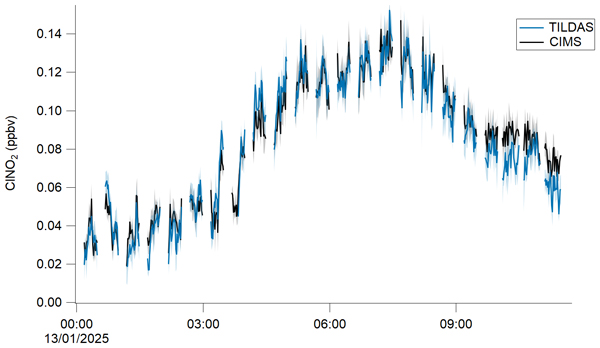
Nitryl chloride (ClNO2) is a reservoir of chlorine atoms and nitrogen oxides, both of which play important roles in atmospheric chemistry. However, all ambient ClNO2 observations so far have been made by a single technique, mass spectrometry, which needs complex calibrations. Here, we present a laser-based method that detects ClNO2 (TD-TILDAS – thermal dissociation–tunable infrared laser direct absorption spectrometry) without the need for complicated calibrations. The results show excellent agreement between these two methods from both laboratory and ambient samples.
Tara I. Yacovitch, Christoph Dyroff, Joseph R. Roscioli, Conner Daube, J. Barry McManus, and Scott C. Herndon
Atmos. Meas. Tech., 16, 1915–1921, https://doi.org/10.5194/amt-16-1915-2023, https://doi.org/10.5194/amt-16-1915-2023, 2023
Short summary
Short summary
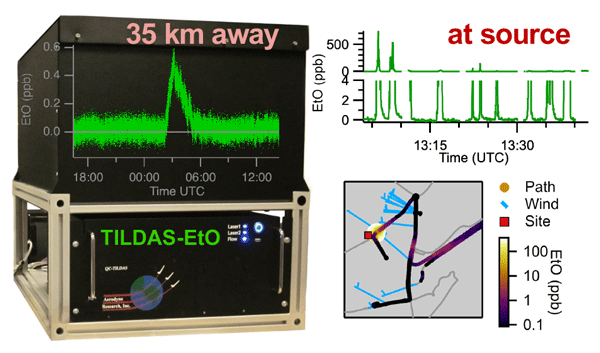
Ethylene oxide is a toxic, carcinogenic compound used in the medical and bulk sterilization industry. Here we describe a precise and fast laser-based ethylene oxide monitor. We report months-long concentrations at a Massachusetts site, and we show how they suggest a potential emission source 35 km away. This source, and another, is confirmed by driving the instrument downwind of the sites, where concentrations were tens to tens of thousands of times greater than background levels.
John W. Halfacre, Jordan Stewart, Scott C. Herndon, Joseph R. Roscioli, Christoph Dyroff, Tara I. Yacovitch, Michael Flynn, Stephen J. Andrews, Steven S. Brown, Patrick R. Veres, and Pete M. Edwards
Atmos. Meas. Tech., 16, 1407–1429, https://doi.org/10.5194/amt-16-1407-2023, https://doi.org/10.5194/amt-16-1407-2023, 2023
Short summary
Short summary
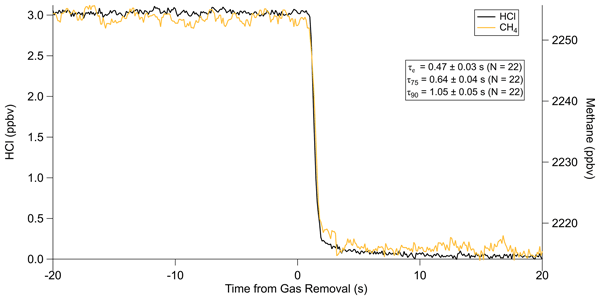
This study details a new sampling method for the optical detection of hydrogen chloride (HCl). HCl is an important atmospheric reservoir for chlorine atoms, which can affect nitrogen oxide cycling and the lifetimes of volatile organic compounds and ozone. However, HCl has a high affinity for interacting with surfaces, thereby preventing fast, quantitative measurements. The sampling technique in this study minimizes these surface interactions and provides a high-quality measurement of HCl.
Andrew J. Lindsay, Daniel C. Anderson, Rebecca A. Wernis, Yutong Liang, Allen H. Goldstein, Scott C. Herndon, Joseph R. Roscioli, Christoph Dyroff, Ed C. Fortner, Philip L. Croteau, Francesca Majluf, Jordan E. Krechmer, Tara I. Yacovitch, Walter B. Knighton, and Ezra C. Wood
Atmos. Chem. Phys., 22, 4909–4928, https://doi.org/10.5194/acp-22-4909-2022, https://doi.org/10.5194/acp-22-4909-2022, 2022
Short summary
Short summary
Wildfire smoke dramatically impacts air quality and often has elevated concentrations of ozone. We present measurements of ozone and its precursors at a rural site periodically impacted by wildfire smoke. Measurements of total peroxy radicals, key ozone precursors that have been studied little within wildfires, compare well with chemical box model predictions. Our results indicate no serious issues with using current chemistry mechanisms to model chemistry in aged wildfire plumes.
John W. Halfacre, Lewis Marden, Marvin D. Shaw, Lucy J. Carpenter, Emily Matthews, Thomas J. Bannan, Hugh Coe, Scott C. Herndon, Joseph R. Roscioli, Christoph Dyroff, Tara I. Yacovitch, Patrick R. Veres, Michael A. Robinson, Steven S. Brown, and Pete M. Edwards
Atmos. Meas. Tech., 18, 3799–3818, https://doi.org/10.5194/amt-18-3799-2025, https://doi.org/10.5194/amt-18-3799-2025, 2025
Short summary
Short summary
Nitryl chloride (ClNO2) is a reservoir of chlorine atoms and nitrogen oxides, both of which play important roles in atmospheric chemistry. However, all ambient ClNO2 observations so far have been made by a single technique, mass spectrometry, which needs complex calibrations. Here, we present a laser-based method that detects ClNO2 (TD-TILDAS – thermal dissociation–tunable infrared laser direct absorption spectrometry) without the need for complicated calibrations. The results show excellent agreement between these two methods from both laboratory and ambient samples.
Yutong Liang, Rebecca A. Wernis, Kasper Kristensen, Nathan M. Kreisberg, Philip L. Croteau, Scott C. Herndon, Arthur W. H. Chan, Nga L. Ng, and Allen H. Goldstein
Atmos. Chem. Phys., 23, 12441–12454, https://doi.org/10.5194/acp-23-12441-2023, https://doi.org/10.5194/acp-23-12441-2023, 2023
Short summary
Short summary
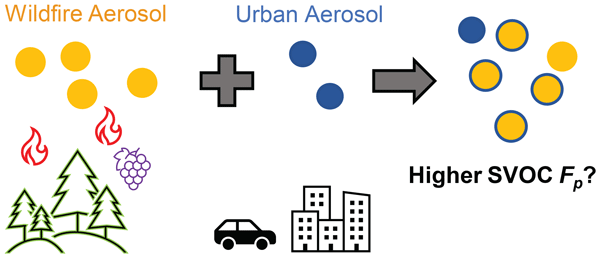
We measured the gas–particle partitioning behaviors of biomass burning markers and examined the effect of wildfire organic aerosol on the partitioning of semivolatile organic compounds. Most compounds measured are less volatile than model predictions. Wildfire aerosol enhanced the condensation of polar compounds and caused some nonpolar (e.g., polycyclic aromatic hydrocarbons) compounds to partition into the gas phase, thus affecting their lifetimes in the atmosphere and the mode of exposure.
Tara I. Yacovitch, Christoph Dyroff, Joseph R. Roscioli, Conner Daube, J. Barry McManus, and Scott C. Herndon
Atmos. Meas. Tech., 16, 1915–1921, https://doi.org/10.5194/amt-16-1915-2023, https://doi.org/10.5194/amt-16-1915-2023, 2023
Short summary
Short summary
Ethylene oxide is a toxic, carcinogenic compound used in the medical and bulk sterilization industry. Here we describe a precise and fast laser-based ethylene oxide monitor. We report months-long concentrations at a Massachusetts site, and we show how they suggest a potential emission source 35 km away. This source, and another, is confirmed by driving the instrument downwind of the sites, where concentrations were tens to tens of thousands of times greater than background levels.
John W. Halfacre, Jordan Stewart, Scott C. Herndon, Joseph R. Roscioli, Christoph Dyroff, Tara I. Yacovitch, Michael Flynn, Stephen J. Andrews, Steven S. Brown, Patrick R. Veres, and Pete M. Edwards
Atmos. Meas. Tech., 16, 1407–1429, https://doi.org/10.5194/amt-16-1407-2023, https://doi.org/10.5194/amt-16-1407-2023, 2023
Short summary
Short summary
This study details a new sampling method for the optical detection of hydrogen chloride (HCl). HCl is an important atmospheric reservoir for chlorine atoms, which can affect nitrogen oxide cycling and the lifetimes of volatile organic compounds and ozone. However, HCl has a high affinity for interacting with surfaces, thereby preventing fast, quantitative measurements. The sampling technique in this study minimizes these surface interactions and provides a high-quality measurement of HCl.
Yutong Liang, Christos Stamatis, Edward C. Fortner, Rebecca A. Wernis, Paul Van Rooy, Francesca Majluf, Tara I. Yacovitch, Conner Daube, Scott C. Herndon, Nathan M. Kreisberg, Kelley C. Barsanti, and Allen H. Goldstein
Atmos. Chem. Phys., 22, 9877–9893, https://doi.org/10.5194/acp-22-9877-2022, https://doi.org/10.5194/acp-22-9877-2022, 2022
Short summary
Short summary
This article reports the measurements of organic compounds emitted from western US wildfires. We identified and quantified 240 particle-phase compounds and 72 gas-phase compounds emitted in wildfire and related the emissions to the modified combustion efficiency. Higher emissions of diterpenoids and monoterpenes were observed, likely due to distillation from unburned heated vegetation. Our results can benefit future source apportionment and modeling studies as well as exposure assessments.
Andrew J. Lindsay, Daniel C. Anderson, Rebecca A. Wernis, Yutong Liang, Allen H. Goldstein, Scott C. Herndon, Joseph R. Roscioli, Christoph Dyroff, Ed C. Fortner, Philip L. Croteau, Francesca Majluf, Jordan E. Krechmer, Tara I. Yacovitch, Walter B. Knighton, and Ezra C. Wood
Atmos. Chem. Phys., 22, 4909–4928, https://doi.org/10.5194/acp-22-4909-2022, https://doi.org/10.5194/acp-22-4909-2022, 2022
Short summary
Short summary
Wildfire smoke dramatically impacts air quality and often has elevated concentrations of ozone. We present measurements of ozone and its precursors at a rural site periodically impacted by wildfire smoke. Measurements of total peroxy radicals, key ozone precursors that have been studied little within wildfires, compare well with chemical box model predictions. Our results indicate no serious issues with using current chemistry mechanisms to model chemistry in aged wildfire plumes.
Benjamin Sumlin, Edward Fortner, Andrew Lambe, Nishit J. Shetty, Conner Daube, Pai Liu, Francesca Majluf, Scott Herndon, and Rajan K. Chakrabarty
Atmos. Chem. Phys., 21, 11843–11856, https://doi.org/10.5194/acp-21-11843-2021, https://doi.org/10.5194/acp-21-11843-2021, 2021
Short summary
Short summary
We present a comparison of the changes to light absorption behavior and chemical composition of wildfire smoke particles from day- and nighttime oxidation processes and discuss the results within the context of previous laboratory findings.
Dianne Sanchez, Roger Seco, Dasa Gu, Alex Guenther, John Mak, Youngjae Lee, Danbi Kim, Joonyoung Ahn, Don Blake, Scott Herndon, Daun Jeong, John T. Sullivan, Thomas Mcgee, Rokjin Park, and Saewung Kim
Atmos. Chem. Phys., 21, 6331–6345, https://doi.org/10.5194/acp-21-6331-2021, https://doi.org/10.5194/acp-21-6331-2021, 2021
Short summary
Short summary
We present observations of total reactive gases in a suburban forest observatory in the Seoul metropolitan area. The quantitative comparison with speciated trace gas observations illustrated significant underestimation in atmospheric reactivity from the speciated trace gas observational dataset. We present scientific discussion about potential causes.
Cited articles
Appleman, H.: The formation of exhaust condensation trails by jet aircraft, Bull. Amer. Meteor. Soc., 34, 14–20, https://doi.org/10.1175/1520-0477-34.1.14, 1953.
Bock, L. and Burkhardt, U.: The temporal evolution of a long-lived contrail cirrus cluster: Simulations with a global climate model, J. Geophys. Res.-Atmos., 121, 3548–3565, https://doi.org/10.1002/2015JD024475, 2016.
Brenninkmeijer, C. A. M., Crutzen, P., Boumard, F., Dauer, T., Dix, B., Ebinghaus, R., Filippi, D., Fischer, H., Franke, H., Frieβ, U., Heintzenberg, J., Helleis, F., Hermann, M., Kock, H. H., Koeppel, C., Lelieveld, J., Leuenberger, M., Martinsson, B. G., Miemczyk, S., Moret, H. P., Nguyen, H. N., Nyfeler, P., Oram, D., O'Sullivan, D., Penkett, S., Platt, U., Pupek, M., Ramonet, M., Randa, B., Reichelt, M., Rhee, T. S., Rohwer, J., Rosenfeld, K., Scharffe, D., Schlager, H., Schumann, U., Slemr, F., Sprung, D., Stock, P., Thaler, R., Valentino, F., van Velthoven, P., Waibel, A., Wandel, A., Waschitschek, K., Wiedensohler, A., Xueref-Remy, I., Zahn, A., Zech, U., and Ziereis, H.: Civil Aircraft for the regular investigation of the atmosphere based on an instrumented container: The new CARIBIC system, Atmos. Chem. Phys., 7, 4953–4976, https://doi.org/10.5194/acp-7-4953-2007, 2007.
Brunamonti, S., Saathoff, H., Hertzog, A., Diskin, G., Fujiwara, M., Rosenlof, K., Möhler, O., Tuzson, B., Emmenegger, L., Amarouche, N., Durry, G., Frérot, F., Samake, J.-C., Cenac, C., Lopez, J., Monnier, P., and Ghysels, M.: The AquaVIT-4 intercomparison of atmospheric hygrometers, Atmos. Meas. Tech., 18, 5321–5348, https://doi.org/10.5194/amt-18-5321-2025, 2025.
Buchholz, B. and Ebert, V.: Absolute, pressure-dependent validation of a calibration-free, airborne laser hygrometer transfer standard (SEALDH-II) from 5 to 1200 ppmv using a metrological humidity generator, Atmos. Meas. Tech., 11, 459–471, https://doi.org/10.5194/amt-11-459-2018, 2018.
Buchholz, B., Afchine, A., Klein, A., Schiller, C., Krämer, M., and Ebert, V.: HAI, a new airborne, absolute, twin dual-channel, multi-phase TDLAS-hygrometer: background, design, setup, and first flight data, Atmos. Meas. Tech., 10, 35–57, https://doi.org/10.5194/amt-10-35-2017, 2017.
Dyroff, C.: Optimum signal-to-noise ratio in off-axis integrated cavity output spectroscopy, Opt. Lett., 36, 1110–1112, https://doi.org/10.1364/OL.36.001110, 2011.
Dyroff, C., Zahn, A., Christner, E., Forbes, R., Tompkins, A. M., and van Velthoven, P. F. J.: Comparison of ECMWF analysis and forecast humidity data with CARIBIC upper troposphere and lower stratosphere observations, Q. J. R. Meteorol. Soc., 141, 833–844, https://doi.org/10.1002/qj.2400, 2015.
Fahey, D. W., Gao, R.-S., Möhler, O., Saathoff, H., Schiller, C., Ebert, V., Krämer, M., Peter, T., Amarouche, N., Avallone, L. M., Bauer, R., Bozóki, Z., Christensen, L. E., Davis, S. M., Durry, G., Dyroff, C., Herman, R. L., Hunsmann, S., Khaykin, S. M., Mackrodt, P., Meyer, J., Smith, J. B., Spelten, N., Troy, R. F., Vömel, H., Wagner, S., and Wienhold, F. G.: The AquaVIT-1 intercomparison of atmospheric water vapor measurement techniques, Atmos. Meas. Tech., 7, 3177–3213, https://doi.org/10.5194/amt-7-3177-2014, 2014.
Gierens, K., Matthes, S., and Rohs, S.: How well can persistent contrails be predicted?, Aerospace, 7, 169, https://doi.org/10.3390/aerospace7120169, 2020.
Gordon, I. E., Rothman, L. S., Hill, C., Kochanov, R. V., Tan, Y., Bernath, P. F., Birk, M., Boudon, V., Campargue, A., Chance, K. V., Drouin, B. J., Flaud, J.-M., Gamache, R. R., Hodges, J. T., Jacquemart, D., Perevalov, V. I., Perrin, A., Shine, K. P., Smith, M.-A. H., Tennyson, J., Toon, G. C., Tran, H., Tyuterev, V. G., Barbe, A., Császár, A. G., Devi, V. M., Furtenbacher, T., Harrison, J. J., Hartmann, J.-M., Jolly, A., Johnson, T. J., Karman, T., Kleiner, I., Kyuberis, A. A., Loos, J., Lyulin, O. M., Massie, S. T., Mikhailenko, S. N., Moazzen-Ahmadi, N., Müller, H. S. P., Naumenko, O. V., Nikitin, A. V., Polyansky, O. L., Rey, M., Rotger, M., Sharpe, S. W., Sung, K., Starikova, E., Tashkun, S. A., Auwera, J. V., Wagner, G., Wilzewski, J., Wcisło, P., Yu, S., and Zak, E. J.: The HITRAN2016 molecular spectroscopic database, J. Quant. Spectrosc. Radiat. Transf., 203, 3–69, https://doi.org/10.1016/j.jqsrt.2017.06.038, 2017.
Graf, M., Scheidegger, P., Kupferschmid, A., Looser, H., Peter, T., Dirksen, R., Emmenegger, L., and Tuzson, B.: Compact and lightweight mid-infrared laser spectrometer for balloon-borne water vapor measurements in the UTLS, Atmos. Meas. Tech., 14, 1365–1378, https://doi.org/10.5194/amt-14-1365-2021, 2021.
Groß, S., Wirth, M., Schäfler, A., Fix, A., Kaufmann, S., and Voigt, C.: Potential of airborne lidar measurements for cirrus cloud studies, Atmos. Meas. Tech., 7, 2745–2755, https://doi.org/10.5194/amt-7-2745-2014, 2014.
Hall, E. G., Jordan, A. F., Hurst, D. F., Oltmans, S. J., Vömel, H., Kühnreich, B., and Ebert, V.: Advancements, measurement uncertainties, and recent comparisons of the NOAA frost point hygrometer, Atmos. Meas. Tech., 9, 4295–4310, https://doi.org/10.5194/amt-9-4295-2016, 2016.
Helten, M., Smit, H. G. J., Sträter, W., Kley, D., Nedelec, P., Zöger, M., and Busen, R.: Calibration and performance of automatic compact instrumentation for the measurement of relative humidity from passenger aircraft, J. Geophys. Res., 103, 25643–25652, https://doi.org/10.1029/98JD00536, 1998.
International Organization for Standardization: Standard Atmosphere, ISO 2533:1975, https://www.iso.org/standard/7472.html (last access: 6 January 2026), 1975.
Kärcher, B.: Formation and radiative forcing of contrail cirrus, Nat. Commun., 9, 1824, https://doi.org/10.1038/s41467-018-04068-0, 2018.
Kaufmann, S., Voigt, C., Jurkat, T., Thornberry, T., Fahey, D. W., Gao, R.-S., Schlage, R., Schäuble, D., and Zöger, M.: The airborne mass spectrometer AIMS – Part 1: AIMS-H2O for UTLS water vapor measurements, Atmos. Meas. Tech., 9, 939–953, https://doi.org/10.5194/amt-9-939-2016, 2016.
Kaufmann, S., Voigt, C., Heller, R., Jurkat-Witschas, T., Krämer, M., Rolf, C., Zöger, M., Giez, A., Buchholz, B., Ebert, V., Thornberry, T., and Schumann, U.: Intercomparison of midlatitude tropospheric and lower-stratospheric water vapor measurements and comparison to ECMWF humidity data, Atmos. Chem. Phys., 18, 16729–16745, https://doi.org/10.5194/acp-18-16729-2018, 2018.
Lee, D. S., Fahey, D. W., Skowron, A., Allen, M. R., Burkhardt, U., Chen, Q., Doherty, S. J., Freeman, S., Forster, P. M., Fuglestvedt, J., Gettelman, A., De León, R. R., Lim, L. L., Lund, M. T., Millar, R. J., Owen, B., Penner, J. E., Pitari, G., Prather, M. J., Sausen, R., and Wilcox, L. J.: The contribution of global aviation to anthropogenic climate forcing for 2000 to 2018, Atmos. Environ., 244, 117834, https://doi.org/10.1016/j.atmosenv.2020.117834, 2021.
Lee, D. S., Allen, M. R., Cumpsty, N., Owen, B., Shine, K. P., and Skowron, A.: Uncertainties in mitigating aviation non-CO2 emissions for climate and air quality using hydrocarbon fuels, Environ. Sci.: Atmos., 3, 1693–1740, https://doi.org/10.1039/D3EA00091E, 2023.
Li, Y., Mahnke, C., Rohs, S., Bundke, U., Spelten, N., Dekoutsidis, G., Groß, S., Voigt, C., Schumann, U., Petzold, A., and Krämer, M.: Upper-tropospheric slightly ice-subsaturated regions: frequency of occurrence and statistical evidence for the appearance of contrail cirrus, Atmos. Chem. Phys., 23, 2251–2271, https://doi.org/10.5194/acp-23-2251-2023, 2023.
Marenco, A., Thouret, V., Nédélec, P., Smit, H., Helten, M., Kley, D., Karcher, F., Simon, P., Law, K., Pyle, J., Poschmann, G., von Wrede, R., Hume, C., and Cook, T.: Measurement of ozone and water vapor by Airbus in-service aircraft: The MOZAIC airborne program, an overview, J. Geophys. Res.-Atmos., 103, 25631–25642, https://doi.org/10.1029/98JD00977, 1998.
Matthes, S., Lührs, B., Dahlmann, K., Grewe, V., Linke, F., Yin, F., Klingaman, E., and Shine, K. P.: Climate-optimized trajectories and robust mitigation potential: Flying ATM4E, Aerospace, 7, 156, https://doi.org/10.3390/aerospace7110156, 2020.
Meyer, J., Rolf, C., Schiller, C., Rohs, S., Spelten, N., Afchine, A., Zöger, M., Sitnikov, N., Thornberry, T. D., Rollins, A. W., Bozóki, Z., Tátrai, D., Ebert, V., Kühnreich, B., Mackrodt, P., Möhler, O., Saathoff, H., Rosenlof, K. H., and Krämer, M.: Two decades of water vapor measurements with the FISH fluorescence hygrometer: a review, Atmos. Chem. Phys., 15, 8521–8538, https://doi.org/10.5194/acp-15-8521-2015, 2015.
Minnis, P., Ayers, J. K., Palikonda, R., and Doelling, D. R.: Contrails, cirrus trends, and climate, J. Clim., 17, 1671–1685, https://doi.org/10.1175/1520-0442(2004)017<1671:CCTAC>2.0.CO;2, 2004.
Murphy, D. M. and Koop, T.: Review of the vapour pressures of ice and supercooled water for atmospheric applications, Q. J. R. Meteorol. Soc., 131, 1539–1565, https://doi.org/10.1256/qj.04.94, 2005.
Neis, P., Smit, H. G. J., Krämer, M., Spelten, N., and Petzold, A.: Evaluation of the MOZAIC Capacitive Hygrometer during the airborne field study CIRRUS-III, Atmos. Meas. Tech., 8, 1233–1243, https://doi.org/10.5194/amt-8-1233-2015, 2015.
Petzold, A., Thouret, V., Gerbig, C., Zahn, A., Brenninkmeijer, C. A. M., Gallagher, M., Hermann, M., Pontaud, M., Ziereis, H., Boulanger, D., Marshall, J., Nédélec, P., Smit, H. G. J., Friess, U., Flaud, J.-M., Wahner, A., Cammas, J.-P., and Volz-Thomas, A., and the IAGOS Team: Global-scale atmosphere monitoring by in-service aircraft – Current achievements and future prospects of the European Research Infrastructure IAGOS, Tellus B, 67, 28452, https://doi.org/10.3402/tellusb.v67.28452, 2015.
Petzold, A., Neis, P., Rütimann, M., Rohs, S., Berkes, F., Smit, H. G. J., Krämer, M., Spelten, N., Spichtinger, P., Nédélec, P., and Wahner, A.: Ice-supersaturated air masses in the northern mid-latitudes from regular in situ observations by passenger aircraft: vertical distribution, seasonality and tropospheric fingerprint, Atmos. Chem. Phys., 20, 8157–8179, https://doi.org/10.5194/acp-20-8157-2020, 2020.
Quaas, J., Gryspeerdt, E., Vautard, R., and Boucher, O.: Climate impact of aircraft-induced cirrus assessed from satellite observations before and during COVID-19, Environ. Res. Lett., 16, 064051, https://doi.org/10.1088/1748-9326/abf686, 2021.
Sarkozy, L. C., Clouser, B. W., Lamb, K. D., Stutz, E. J., Saathoff, H., Möhler, O., Ebert, V., and Moyer, E. J.: The Chicago Water Isotope Spectrometer (ChiWIS-lab): A tunable diode laser spectrometer for chamber-based measurements of water vapor isotopic evolution during cirrus formation, Rev. Sci. Instrum., 91, 045120, https://doi.org/10.1063/1.5139244, 2020.
Schumann, U.: On conditions for contrail formation from aircraft exhausts, Meteorol. Z., 5, 4–23, https://doi.org/10.1127/metz/5/1996/4, 1996.
Sitnikov, N. M., Yushkov, V. A., Afchine, A. A., Korshunov, L. I., Astakhov, V. I., Ulanovskii, A. E., Krämer, M., Mangold, A., Schiller, C., and Ravegnani, F.: The FLASH instrument for water vapor measurements on board the high-altitude airplane, Instrum. Exp. Tech., 50, 113–121, https://doi.org/10.1134/S0020441207010174, 2007.
Spangenberg, D. A., Minnis, P., Bedka, S. T., Palikonda, R., Duda, D. P., and Rose, F. G.: Contrail radiative forcing over the Northern Hemisphere from 2006 Aqua MODIS data, Geophys. Res. Lett., 40, 595–600, https://doi.org/10.1002/grl.50168, 2013.
Teoh, R., Schumann, U., Majumdar, A., and Stettler, M. E. J.: Mitigating the climate forcing of aircraft contrails by small-scale adjustments to flight altitude, Environ. Sci. Technol., 56, 4455–4464, https://doi.org/10.1021/acs.est.9b05608, 2022.
Unterstrasser, S. and Gierens, K.: Numerical simulations of contrail-to-cirrus transition – Part 1: An extensive parametric study, Atmos. Chem. Phys., 10, 2017–2036, https://doi.org/10.5194/acp-10-2017-2010, 2010.
Vance, A. K., Abel, S. J., Cotton, R. J., and Woolley, A. M.: Performance of WVSS-II hygrometers on the FAAM research aircraft, Atmos. Meas. Tech., 8, 1617–1625, https://doi.org/10.5194/amt-8-1617-2015, 2015.
Voigt, C., Kleine, J., Sauer, D., Moore, R. H., Bräuer, T., Le Clercq, P., Kaufmann, S., Scheibe, M., Jurkat Witschas, T., Aigner, M., Bauder, U., Boose, Y., Borrmann, S., Crosbie, E., Diskin, G. S., DiGangi, J., Hahn, V., Heckl, C., Huber, F., Nowak, J. B., Rapp, M., Rauch, B., Robinson, C., Schripp, T., Shook, M., Winstead, E., Ziemba, L., Schlager, H., and Anderson, B. E.: Cleaner burning aviation fuels can reduce contrail cloudiness, Commun. Earth Environ., 2, 114, https://doi.org/10.1038/s43247-021-00174-y, 2021.
Vömel, H., Naebert, T., Dirksen, R., and Sommer, M.: An update on the uncertainties of water vapor measurements using cryogenic frost point hygrometers, Atmos. Meas. Tech., 9, 3755–3768, https://doi.org/10.5194/amt-9-3755-2016, 2016.
Williams, S. S., Wagner, T. J., and Petersen, R. A.: Examining the compatibility of aircraft moisture observations and operational radiosondes, J. Atmos. Oceanic Technol., 38, 859–872, https://doi.org/10.1175/JTECH-D-20-0053.1, 2021.
Zondlo, M. A., Paige, M. E., Massick, S. M., and Silver, J. A.: Vertical cavity laser hygrometer for the National Science Foundation Gulfstream V aircraft, J. Geophys. Res., 115, D20309, https://doi.org/10.1029/2010JD014445, 2010.
Short summary
We describe a new humidity probe designed for flight to characterize the very dry air at 10–12 km where jet aircraft can form persistent contrail clouds. These clouds trap heat and contribute to warming the planet. The laser-based system precisely measures water molecules in air, enabling accurate predictions of contrail formation to help reduce aviation's climate impact.
We describe a new humidity probe designed for flight to characterize the very dry air at 10–12...