
Articles | Volume 19, issue 6
https://doi.org/10.5194/amt-19-2061-2026
© Author(s) 2026. This work is distributed under
the Creative Commons Attribution 4.0 License.
the Creative Commons Attribution 4.0 License.
https://doi.org/10.5194/amt-19-2061-2026
© Author(s) 2026. This work is distributed under
the Creative Commons Attribution 4.0 License.
the Creative Commons Attribution 4.0 License.
Research article
| 
25 Mar 2026
Research article |
| 25 Mar 2026
| 25 Mar 2026
All-sky temperature and humidity retrieval from the MWRI-RM onboard the FY-3G satellite
Minghua Liu
School of Atmospheric Physics, Nanjing University of Information Science and Technology, Nanjing, 210044, China

CMA Earth System Modeling and Prediction Centre (CEMC), China Meteorological Administration, Beijing, 100081, China
State Key Laboratory of Severe Weather (LaSW), Chinese Academy of Meteorological Sciences, China Meteorological Administration, Beijing, 100081, China
Yunfan Yang
State Key Laboratory of Atmospheric Boundary Layer Physics and Atmospheric Chemistry (LAPC), Institute of Atmospheric Physics, Chinese Academy of Sciences, Beijing, 100029, China
Institute of Atmospheric Physics, Chinese Academy of Sciences, Beijing, 100029, China
Haofei Sun
State Key Laboratory of Atmospheric Boundary Layer Physics and Atmospheric Chemistry (LAPC), Institute of Atmospheric Physics, Chinese Academy of Sciences, Beijing, 100029, China
Institute of Atmospheric Physics, Chinese Academy of Sciences, Beijing, 100029, China
Ruoying Yin
CMA Earth System Modeling and Prediction Centre (CEMC), China Meteorological Administration, Beijing, 100081, China
Related authors
No articles found.
Chongzhao Zhang, Qiurui Li, Jun Li, Wei Han, and Jing Li
EGUsphere, https://doi.org/10.5194/egusphere-2026-4627, https://doi.org/10.5194/egusphere-2026-4627, 2026
This preprint is open for discussion and under review for Geoscientific Model Development (GMD).
Short summary
Short summary
We present a version 1.0 latent-space aerosol–radiance data assimilation system that uses machine-learned compressions of aerosol and land-surface fields together with a fast neural radiative-transfer model to assimilate satellite shortwave reflectance directly. The approach jointly updates aerosol optical depth and surface albedo, improves agreement with ground and radiation observations, and reduces the online cost of radiance assimilation relative to a conventional physical-space method.
Zhilong Fan, Lu Li, Zhongwang Wei, Shupeng Zhang, Sisi Chen, Xingjie Lu, Wei Shangguan, Nan Wei, Hua Yuan, Pan Zhang, Jiaxin Tian, Jianhong Zhou, Baoxiang Pan, Wei Han, and Yongjiu Dai
EGUsphere, https://doi.org/10.5194/egusphere-2026-5358, https://doi.org/10.5194/egusphere-2026-5358, 2026
This preprint is open for discussion and under review for Geoscientific Model Development (GMD).
Short summary
Short summary
We developed a new land data assimilation framework based on deep generative models. Compared with existing methods, it better handles non-Gaussian model errors and noisy observations. Tests in both an idealized system and a realistic land data assimilation experiment showed more accurate and consistent estimates, demonstrating its potential for improving land-state estimation with complex land surface models.
Chao Wang, Yongzhu Liu, Wei Han, Deying Wang, Xueshun Shen, and Xiaoye Zhang
EGUsphere, https://doi.org/10.5194/egusphere-2026-1485, https://doi.org/10.5194/egusphere-2026-1485, 2026
This preprint is open for discussion and under review for Geoscientific Model Development (GMD).
Short summary
Short summary
We assessed the performance of a newly developed assimilation system. Using real observations of black carbon aerosol over China for nearly three months, we found that incorporating these measurements greatly improved the accuracy of air pollution analyses and forecasts, especially during severe pollution episodes. The system also helped correct near-surface temperature biases in heavily polluted areas.
Chong Luo, Yongbo Zhou, Yubao Liu, Wei Han, Bin Yao, and Chao Liu
EGUsphere, https://doi.org/10.5194/egusphere-2025-4553, https://doi.org/10.5194/egusphere-2025-4553, 2025
Short summary
Short summary
We developed a new technique to assimilate satellite visible reflectance. By testing our technique on a heavy rainfall event, we found that it significantly reduces errors in cloud water estimates and enhances light precipitation forecasts. This data assimilation also better improved thin clouds. This advancement helps increase the accuracy of weather predictions in situations where clouds and rain play a major role.
Yunfan Yang, Wei Han, Haofei Sun, Jun Li, Jiapeng Yan, and Zhiqiu Gao
Atmos. Meas. Tech., 18, 4249–4269, https://doi.org/10.5194/amt-18-4249-2025, https://doi.org/10.5194/amt-18-4249-2025, 2025
Short summary
Short summary
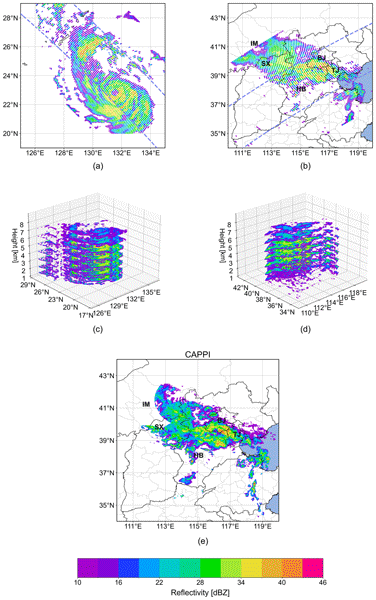
Our research improves satellite-based precipitation monitoring by using deep learning to reconstruct radar observations from passive microwave radiances. Active radar is costly, so we focus on a more accessible approach. Using data from the Fengyun-3G satellite, we successfully tracked severe weather like Typhoon Khanun and heavy rainfall in Beijing in 2023. This method enhances global precipitation data and helps better understand extreme weather.
Yongzhu Liu, Xiaoye Zhang, Wei Han, Chao Wang, Wenxing Jia, Deying Wang, Zhaorong Zhuang, and Xueshun Shen
Geosci. Model Dev., 18, 4855–4876, https://doi.org/10.5194/gmd-18-4855-2025, https://doi.org/10.5194/gmd-18-4855-2025, 2025
Short summary
Short summary
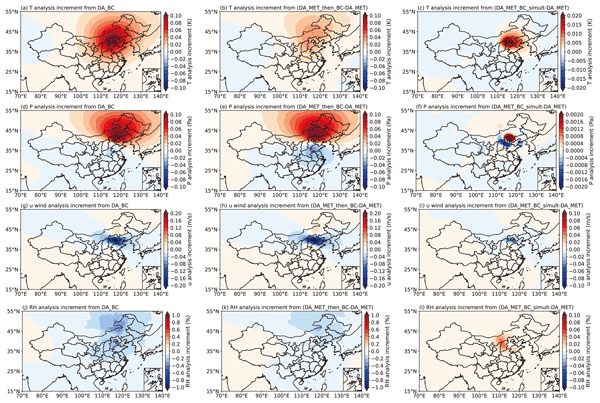
In order to investigate the feedbacks of chemical data assimilation on meteorological forecasts, we developed a strongly coupled aerosol–meteorology four-dimensional variational (4D-Var) assimilation system, CMA-GFS-AERO 4D-Var, based on the framework of the incremental analysis scheme of the China Meteorological Administration Global Forecasting System (CMA-GFS) operational global numerical weather model. The results show that assimilating BC (black carbon) observations can generate analysis increments not only for BC but also for atmospheric variables.
Mijie Pang, Jianbing Jin, Ting Yang, Xi Chen, Arjo Segers, Batjargal Buyantogtokh, Yixuan Gu, Jiandong Li, Hai Xiang Lin, Hong Liao, and Wei Han
Geosci. Model Dev., 18, 3781–3798, https://doi.org/10.5194/gmd-18-3781-2025, https://doi.org/10.5194/gmd-18-3781-2025, 2025
Short summary
Short summary
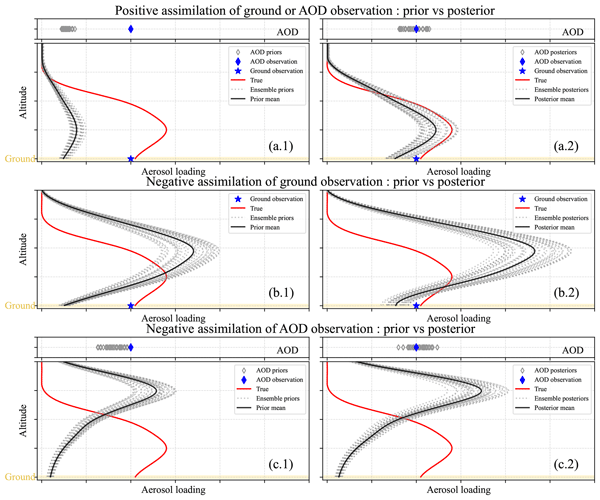
Aerosol data assimilation has gained popularity as it combines the advantages of modelling and observation. However, few studies have addressed the challenges in the prior vertical structure. Different observations are assimilated to examine the sensitivity of assimilation to vertical structure. Results show that assimilation can optimize the dust field in general. However, if the prior introduces an incorrect structure, the assimilation can significantly deteriorate the integrity of the aerosol profile.
Yi-Ning Shi, Jun Yang, Wei Han, Lujie Han, Jiajia Mao, Wanlin Kan, and Fuzhong Weng
Geosci. Model Dev., 18, 1947–1964, https://doi.org/10.5194/gmd-18-1947-2025, https://doi.org/10.5194/gmd-18-1947-2025, 2025
Short summary
Short summary
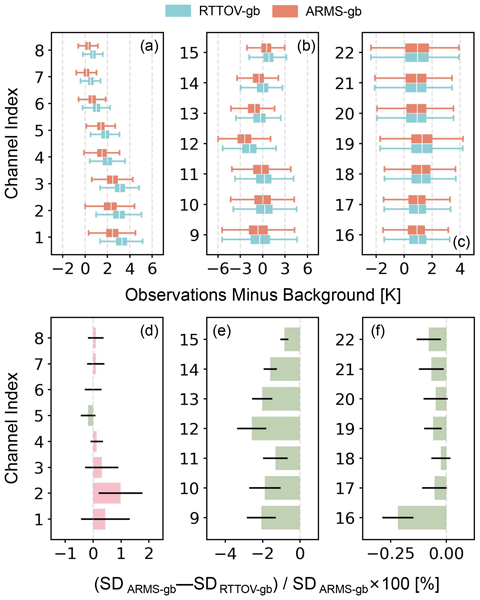
Direct assimilation of observations from ground-based microwave radiometers (GMRs) holds significant potential for improving forecast accuracy. Radiative transfer models (RTMs) play a crucial role in direct data assimilation. In this study, we introduce a new RTM, the Advanced Radiative Transfer Modeling System – Ground-Based (ARMS-gb), designed to simulate brightness temperatures observed by GMRs along with their Jacobians. Several enhancements have been incorporated to achieve higher accuracy.
Xiaoze Xu, Wei Han, Jincheng Wang, Zhiqiu Gao, Fenghui Li, Yan Cheng, and Naifeng Fu
Atmos. Meas. Tech., 18, 1339–1353, https://doi.org/10.5194/amt-18-1339-2025, https://doi.org/10.5194/amt-18-1339-2025, 2025
Short summary
Short summary
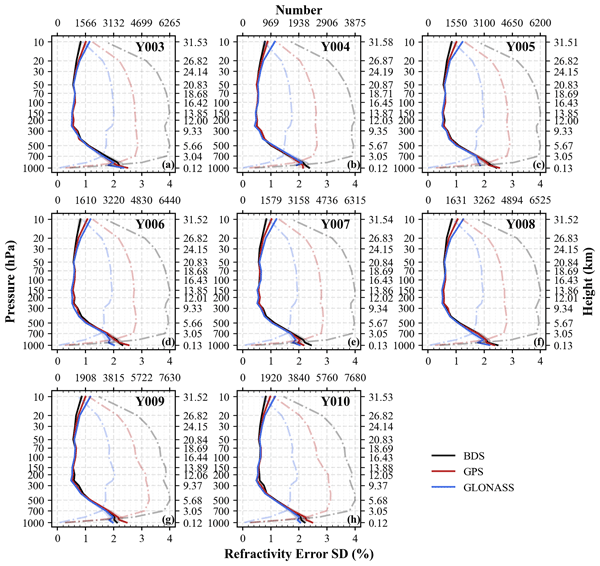
Commercial Global Navigation Satellite System (GNSS) radio occultation (RO) satellites are generally cheap and can generate a large volume of globally distributed observations in a short period of time. To evaluate the practical application value of these data, we must assess their quality. We evaluate the quality of YUNYAO RO data. By using the “three-cornered hat” method and comparing with data from Metop-C and COSMIC-2, it was found that the YUNYAO GNSS-RO data are of high quality.
Xuan Wang, Lei Bi, Hong Wang, Yaqiang Wang, Wei Han, Xueshun Shen, and Xiaoye Zhang
Geosci. Model Dev., 18, 117–139, https://doi.org/10.5194/gmd-18-117-2025, https://doi.org/10.5194/gmd-18-117-2025, 2025
Short summary
Short summary
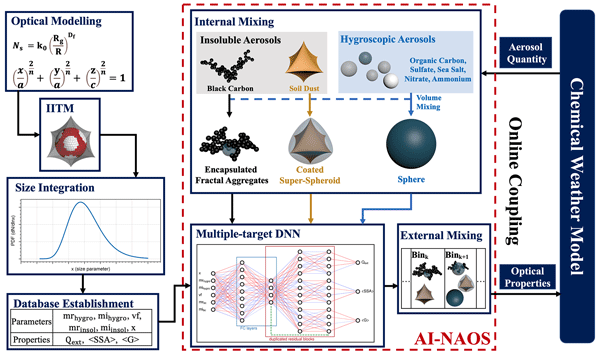
The Artificial-Intelligence-based Nonspherical Aerosol Optical Scheme (AI-NAOS) was developed to improve the estimation of the aerosol direct radiation effect and was coupled online with a chemical weather model. The AI-NAOS scheme considers black carbon as fractal aggregates and soil dust as super-spheroids, encapsulated with hygroscopic aerosols. Real-case simulations emphasize the necessity of accurately representing nonspherical and inhomogeneous aerosols in chemical weather models.
Yongbo Zhou, Yubao Liu, Wei Han, Yuefei Zeng, Haofei Sun, Peilong Yu, and Lijian Zhu
Atmos. Meas. Tech., 17, 6659–6675, https://doi.org/10.5194/amt-17-6659-2024, https://doi.org/10.5194/amt-17-6659-2024, 2024
Short summary
Short summary
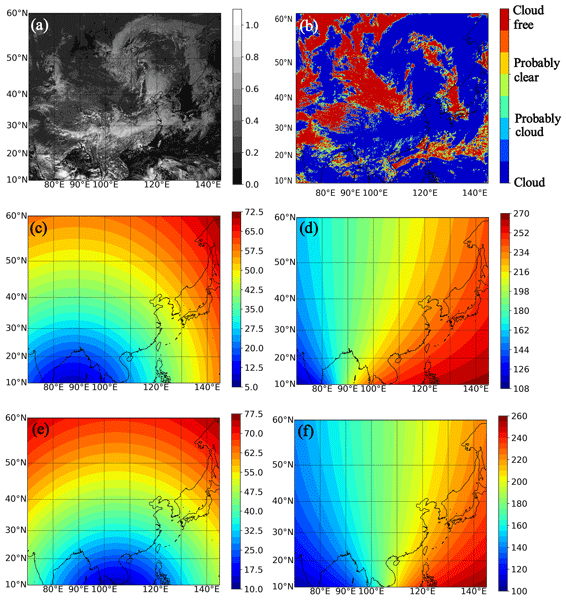
The study explored differences between the visible reflectance provided by the Fengyun-4A satellite and its equivalent derived from the China Meteorological Administration Mesoscale model using a forward operator. The observation-minus-simulation biases were able to monitor the performance of the satellite visible instrument. The biases were corrected based on a first-order approximation method, which promotes the data assimilation of satellite visible reflectance in real-world cases.
Li Fang, Jianbing Jin, Arjo Segers, Ke Li, Ji Xia, Wei Han, Baojie Li, Hai Xiang Lin, Lei Zhu, Song Liu, and Hong Liao
Geosci. Model Dev., 17, 8267–8282, https://doi.org/10.5194/gmd-17-8267-2024, https://doi.org/10.5194/gmd-17-8267-2024, 2024
Short summary
Short summary
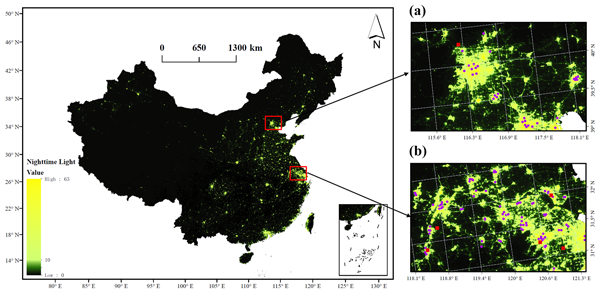
Model evaluations against ground observations are usually unfair. The former simulates mean status over coarse grids and the latter the surrounding atmosphere. To solve this, we proposed the new land-use-based representative (LUBR) operator that considers intra-grid variance. The LUBR operator is validated to provide insights that align with satellite measurements. The results highlight the importance of considering fine-scale urban–rural differences when comparing models and observation.
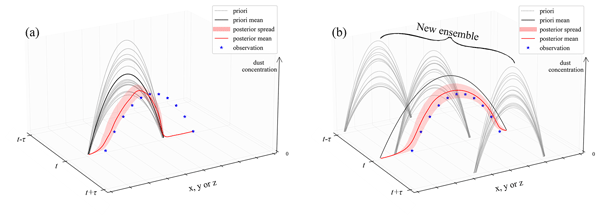
Mijie Pang, Jianbing Jin, Arjo Segers, Huiya Jiang, Wei Han, Batjargal Buyantogtokh, Ji Xia, Li Fang, Jiandong Li, Hai Xiang Lin, and Hong Liao
Geosci. Model Dev., 17, 8223–8242, https://doi.org/10.5194/gmd-17-8223-2024, https://doi.org/10.5194/gmd-17-8223-2024, 2024
Short summary
Short summary
The ensemble Kalman filter (EnKF) improves dust storm forecasts but faces challenges with position errors. The valid time shifting EnKF (VTS-EnKF) addresses this by adjusting for position errors, enhancing accuracy in forecasting dust storms, as proven in tests on 2021 events, even with smaller ensembles and time intervals.
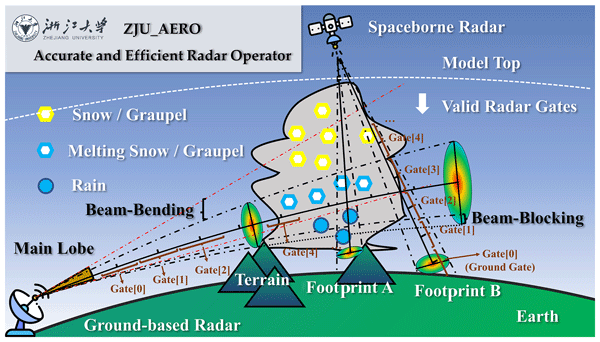
Hejun Xie, Lei Bi, and Wei Han
Geosci. Model Dev., 17, 5657–5688, https://doi.org/10.5194/gmd-17-5657-2024, https://doi.org/10.5194/gmd-17-5657-2024, 2024
Short summary
Short summary
A radar operator plays a crucial role in utilizing radar observations to enhance numerical weather forecasts. However, developing an advanced radar operator is challenging due to various complexities associated with the wave scattering by non-spherical hydrometeors, radar beam propagation, and multiple platforms. In this study, we introduce a novel radar operator named the Accurate and Efficient Radar Operator developed by ZheJiang University (ZJU-AERO) which boasts several unique features.
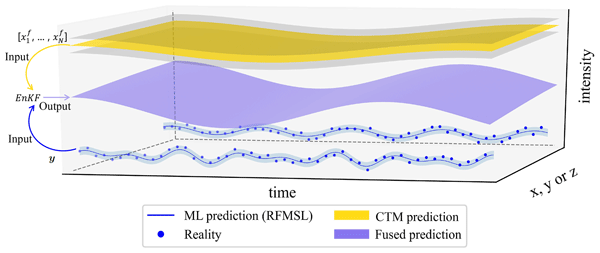
Li Fang, Jianbing Jin, Arjo Segers, Hong Liao, Ke Li, Bufan Xu, Wei Han, Mijie Pang, and Hai Xiang Lin
Geosci. Model Dev., 16, 4867–4882, https://doi.org/10.5194/gmd-16-4867-2023, https://doi.org/10.5194/gmd-16-4867-2023, 2023
Short summary
Short summary
Machine learning models have gained great popularity in air quality prediction. However, they are only available at air quality monitoring stations. In contrast, chemical transport models (CTM) provide predictions that are continuous in the 3D field. Owing to complex error sources, they are typically biased. In this study, we proposed a gridded prediction with high accuracy by fusing predictions from our regional feature selection machine learning prediction (RFSML v1.0) and a CTM prediction.
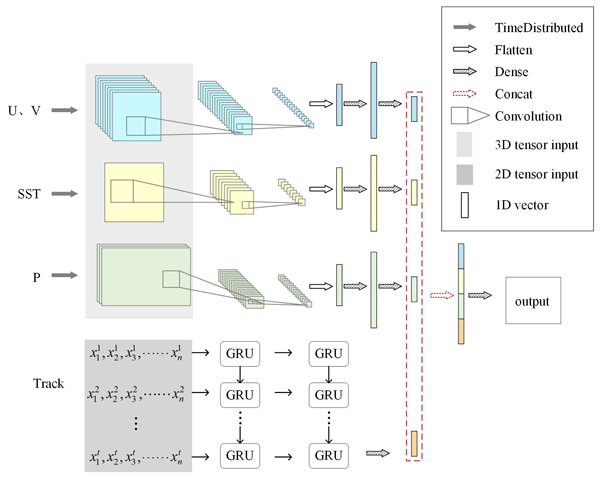
Liang Wang, Bingcheng Wan, Shaohui Zhou, Haofei Sun, and Zhiqiu Gao
Geosci. Model Dev., 16, 2167–2179, https://doi.org/10.5194/gmd-16-2167-2023, https://doi.org/10.5194/gmd-16-2167-2023, 2023
Short summary
Short summary
The past 24 h TC trajectories and meteorological field data were used to forecast TC tracks in the northwestern Pacific from hours 6–72 based on GRU_CNN, which we proposed in this paper and which has better prediction results than traditional single deep-learning methods. The historical steering flow of cyclones has a significant effect on improving the accuracy of short-term forecasting, while, in long-term forecasting, the SST and geopotential height will have a particular impact.
Jianbing Jin, Mijie Pang, Arjo Segers, Wei Han, Li Fang, Baojie Li, Haochuan Feng, Hai Xiang Lin, and Hong Liao
Atmos. Chem. Phys., 22, 6393–6410, https://doi.org/10.5194/acp-22-6393-2022, https://doi.org/10.5194/acp-22-6393-2022, 2022
Short summary
Short summary
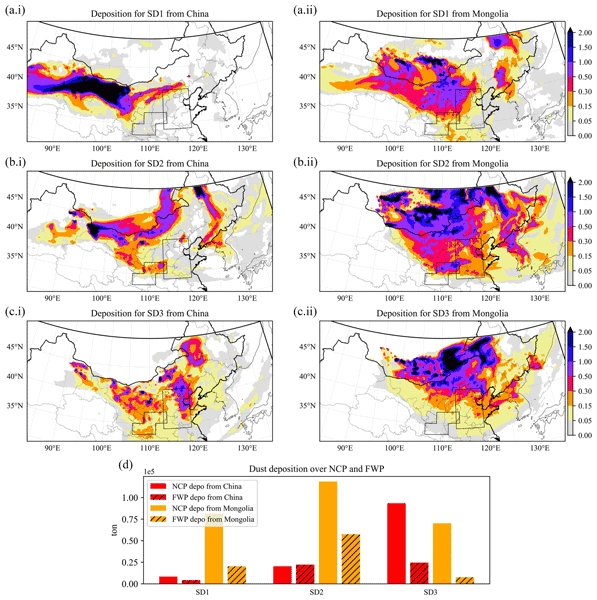
Super dust storms reappeared in East Asia last spring after being absent for one and a half decades. Accurate simulation of such super sandstorms is valuable, but challenging due to imperfect emissions. In this study, the emissions of these dust storms are estimated by assimilating multiple observations. The results reveal that emissions originated from both China and Mongolia. However, for northern China, long-distance transport from Mongolia contributes much more dust than Chinese deserts.
Cited articles
Aires, F., Prigent, C., Rossow, W. B., and Rothstein, M.: A new neural network approach including first guess for retrieval of atmospheric water vapor, cloud liquid water path, surface temperature, and emissivities over land from satellite microwave observations, J. Geophys. Res., 106, 14887–14907, https://doi.org/10.1029/2001JD900085, 2001.
Blackwell, W. J.: A neural-network technique for the retrieval of atmospheric temperature and moisture profiles from high spectral resolution sounding data, IEEE Trans. Geosci. Remote Sens., 43, 2535–2546, https://doi.org/10.1109/tgrs.2005.855071, 2005.
Boucher, E.: Designing Deep-Learning models for surface and atmospheric retrievals from the IASI infrared sounder, PhD thesis, Sorbonne Université, Paris, France, NNT: 2024SORUS145, https://theses.hal.science/tel-04701253v1 (last access: 23 March 2026), 2024.
Boucher, E. and Aires, F.: Machine learning for satellite retrievals: linear dampening of the extremes and an extreme-oriented learning formulation, Environ. Res. Lett., 18, 024025, https://doi.org/10.1088/1748-9326/acb3e3, 2023.
Boukabara, S.-A., Garrett, K., Chen, W., Iturbide-Sanchez, F., Grassotti, C., Kongoli, C., Weng, F., Liu, Q., Baelen, B., and Sun, N.: MiRS: An all-weather 1DVAR satellite data assimilation and retrieval system, IEEE Trans. Geosci. Remote Sens., 49, 3249–3272, https://doi.org/10.1109/TGRS.2011.2158438, 2011.
Burns, B. A., Wu, X., and Diak, G. R.: Model-derived brightness temperature in AMSU moisture channels for various precipitation structures: Comparison of two radiative transfer formulations, in: 1995 International Geoscience and Remote Sensing Symposium, IGARSS '95: Quantitative Remote Sensing for Science and Applications, Firenze, Italy, 10–14 July 1995, 876–878, https://doi.org/10.1109/IGARSS.1995.521084, 1995.
Burns, B. A., Wu, X., and Diak, G. R.: Effects of precipitation and cloud ice on brightness temperatures in AMSU moisture channels, IEEE Trans. Geosci. Remote Sens., 35, 1429–1437, https://doi.org/10.1109/36.649797, 1997.
Cadeddu, M. P., Turner, D. D., and Liljegren, J. C.: A Neural Network for Real-Time Retrievals of PWV and LWP From Arctic Millimeter-Wave Ground-Based Observations, IEEE Trans. Geosci. Remote Sens., 47, 1887–1900, https://doi.org/10.1109/tgrs.2009.2013205, 2009.
Cai, X., Bao, Y., Petropoulos, G. P., Lu, F., Lu, Q., Zhu, L., and Wu, Y.: Temperature and Humidity Profile Retrieval from FY4-GIIRS Hyperspectral Data Using Artificial Neural Networks, Remote Sens., 12, 1872, https://doi.org/10.3390/rs12111872, 2020.
Chen, H. and Lin, L.: Numerical simulation of temperature profile retrievals from the brightness temperatures in 6 channels near 118.75 GHz, Chin. J. Atmos. Sci., 27, 894–900, https://doi.org/10.3878/j.issn.1006-9895.2003.05.10, 2003.
Chen, K., Cai, B., Han, W., and Suo, Z.: Matching of Observation Footprints in the FY-3G MWRI-RM Using BGI, IEEE J. Sel. Top. Appl. Earth Obs. Remote Sens., 17, 1–12, https://doi.org/10.1109/JSTARS.2024.3468437, 2024.
Du, J., Kimball, J. S., and Jones, L. A.: Satellite microwave retrieval of total precipitable water vapor and surface air temperature over land from AMSR2, IEEE Trans. Geosci. Remote Sens., 53, 2520–2531, https://doi.org/10.1109/TGRS.2014.2361344, 2015.
Duan, S.-B., Li, Z.-L., and Leng, P.: A framework for the retrieval of all-weather land surface temperature at a high spatial resolution from polar-orbiting thermal infrared and passive microwave data, Remote Sens. Environ., 195, 107–117, https://doi.org/10.1016/j.rse.2017.04.008, 2017.
Ebell, K., Orlandi, E., Hünerbein, A., Löhnert, U., and Crewell, S.: Combining ground-based with satellite-based measurements in the atmospheric state retrieval: Assessment of the information content, J. Geophys. Res.-Atmos., 118, 6940–6956, https://doi.org/10.1002/jgrd.50548, 2013.
Elfwing, S., Uchibe, E., and Doya, K.: Sigmoid-weighted linear units for neural network function approximation in reinforcement learning, Neural Netw., 108, 319–331, https://doi.org/10.1016/j.neunet.2017.12.012, 2018.
Gasiewski, A. J. and Johnson, J. T.: Statistical temperature profile retrievals in clear-air using passive 118-GHz O2 observations, IEEE Trans. Geosci. Remote Sens., 31, 106–115, https://doi.org/10.1109/36.210450, 1993.
Gasiewski, A. J. and Staelin, D. H.: Statistical precipitation cell parameter estimation using passive 118-GHz O2 observations, J. Geophys. Res., 94, 18367–18378, https://doi.org/10.1029/JD094iD15p18367, 1989.
Goldberg, M. D., Qu, Y., McMillin, L. M., Wolf, W., Zhou, L., and Divakarla, M.: AIRS near-real-time products and algorithms in support of operational numerical weather prediction, IEEE Trans. Geosci. Remote Sens., 41, 379–389, https://doi.org/10.1109/TGRS.2002.808307, 2003.
Gu, S., Zhang, P., Chen, L., Shang, J., Zhang, H., Lin, M., Zhu, A., Jia, S., Yin, H., Sun, F., Xu, H., Wang, H., Li, L., Wu, Q., Guo, Y., Dou, F., and Wu, S.: Overview and prospect of the detection capability of China's first precipitation measurement satellite FY-3G, Torrential Rain Disasters, 42, 489–498, https://doi.org/10.12406/byzh.2023-106, 2023.
He, K., Zhang, X., Ren, S., and Sun, J.: Deep residual learning for image recognition, in: 2016 IEEE Conference on Computer Vision and Pattern Recognition (CVPR), Las Vegas, NV, USA, 27–30 June 2016, 770–778, https://doi.org/10.1109/CVPR.2016.90, 2016.
He, Q. R., Wang, Z. Z., and He, J. Y.: Retrieval of clear sky temperature and humidity profiles over land using measurements of FY-3C/MWHTS, J. Remote Sens., 21, 27–39, https://doi.org/10.11834/jrs.20176006, 2017.
Hersbach, H., Bell, B., Berrisford, P., Biavati, G., Horányi, A., Muñoz Sabater, J., Nicolas, J., Peubey, C., Radu, R., Rozum, I., Schepers, D., Simmons, A., Soci, C., Dee, D., and Thépaut, J.-N.: ERA5 hourly data on pressure levels from 1940 to present, Copernicus Climate Change Service (C3S) Climate Data Store (CDS) [data set], https://doi.org/10.24381/cds.bd0915c6, 2023.
Li, Z. and Han, W.: Impact of Implementing All-Sky Radiance Assimilation for FY-3E MWHS-2 in the CMA-GFS, Mon. Weather Rev., 153, 847–863, https://doi.org/10.1175/MWR-D-24-0093.1, 2025.
Liu, Y., Mao, J., Liu, J., and Li, F.: Study on BP neural network retrieval method of atmospheric profile using ground-based microwave radiometer, Plateau Meteorology, 29, 1514–1523, 2010.
Pfreundschuh, S., Brown, P. J., Kummerow, C. D., Eriksson, P., and Norrestad, T.: GPROF-NN: a neural-network-based implementation of the Goddard Profiling Algorithm, Atmos. Meas. Tech., 15, 5033–5060, https://doi.org/10.5194/amt-15-5033-2022, 2022.
Rosenkranz, P. W.: Retrieval of temperature and moisture profiles from AMSU-A and AMSU-B measurements, IEEE Trans. Geosci. Remote Sens., 39, 2429–2435, https://doi.org/10.1109/36.964979, 2001.
Sahoo, S., Bosch-Lluis, X., Reising, S. C., and Vivekanandan, J.: Radiometric Information Content for Water Vapor and Temperature Profiling in Clear Skies Between 10 and 200 GHz, IEEE J. Sel. Top. Appl. Earth Obs. Remote Sens., 8, 859–871, https://doi.org/10.1109/JSTARS.2014.2364394, 2015.
Stähli, O., Murk, A., Kämpfer, N., Mätzler, C., and Eriksson, P.: Microwave radiometer to retrieve temperature profiles from the surface to the stratopause, Atmos. Meas. Tech., 6, 2477–2494, https://doi.org/10.5194/amt-6-2477-2013, 2013.
Susskind, J., Barnet, C. D., and Blaisdell, J. M.: Retrieval of atmospheric and surface parameters from AIRS/AMSU/HSB data in the presence of clouds, IEEE Trans. Geosci. Remote Sens., 41, 390–409, https://doi.org/10.1109/TGRS.2002.808236, 2003.
Tan, Q., Yao, Z., Zhao, Z., Han, Z., and Sun, X.: Performance analysis of atmospheric temperature and humidity profile retrieval using multiband microwave radiometer, Remote Sens. Technol. Appl., 30, 170–177, 2015.
Wang, D., Tong, L., Gong, X., Guan, X., Wang, P., and Gao, B.: Retrieval of atmospheric temperature profiles from hyperspectral microwave radiative data based on the neural network, in: Proceedings of the IEEE International Geoscience and Remote Sensing Symposium (IGARSS), Brussels, Belgium, 11–16 July 2021, 7095–7098, https://doi.org/10.1109/IGARSS47720.2021.9554282, 2021.
Wang, H., Liu, D., Xia, Y., Xie, W., and Wang, Y.: Retrieval of atmospheric temperature profile from historical data and ground-based observations by using a machine learning algorithm, Remote Sens., 15, 2717, https://doi.org/10.3390/rs15112717, 2023.
Wang, X., Song, G., Yao, Z., and Li, W.: Study on the retrieval of atmospheric humidity profiles over the northwestern Pacific Ocean using AMSU data, J. Peking Univ. (Nat. Sci. Ed.), 46, 69–78, https://doi.org/10.13209/j.0479-8023.2010.011, 2010.
Wang, Y., Fu, Y., Liu, G., Liu, Q., and Sun, L.: A new water vapor algorithm for TRMM Microwave Imager (TMI) measurements based on a log linear relationship, J. Geophys. Res., 114, D21304, https://doi.org/10.1029/2008JD011057, 2009.
Xia, X., Fu, D., Shao, W., Jiang, R., Wu, S., Zhang, P., Yang, D., and Xia, X.: Retrieving precipitable water vapor over land from satellite passive microwave radiometer measurements using automated machine learning, Geophys. Res. Lett., 50, e2023GL105197, https://doi.org/10.1029/2023GL105197, 2023.
Xiao, H., Han, W., Zhang, P., and Bai, Y.: Assimilation of data from the MWHS-II onboard the first early morning satellite FY-3E into the CMA global 4D-Var system, Meteorol. Appl., 30, e2133, https://doi.org/10.1002/met.2133, 2023.
Xu, X., Han, W., Gao, Z., Li, J., and Yin, R.: Retrieval of atmospheric temperature profiles from FY-4A/GIIRS hyperspectral data based on TPE-MLP: analysis of retrieval accuracy and influencing factors, Remote Sens., 16, 1976, https://doi.org/10.3390/rs16111976, 2024.
Yao, S. H. and Guan, L.: Retrieval of atmospheric temperature and humidity profiles using a machine learning algorithm based on satellite-borne infrared hyperspectral observations, Infrared Laser Eng., 51, 461–472, 2022.
Zhang, P., Gu, S., Shang, J., Zhang, H., Chen, L., Lin, M., Zhu, A., Jia, S., Wu, S., and Xian, D.: Overview of the mission of China's first precipitation satellite – FY-3G, Int. Space, 6, 17–21, 2023a.
Zhang, P., Gu, S., Chen, L., Shang, J., Lin, M., Zhu, A., Yin, H., Wu, Q., Shou, Y., Sun, F., Xu, H., Yang, G., Wang, H., Li, L., Zhang, H., Chen, S., and Lu, N.: FY-3G Satellite Instruments and Precipitation Products: First Report of China's Fengyun Rainfall Mission In-Orbit, J. Remote Sens., 3, 0097, https://doi.org/10.34133/remotesensing.0097, 2023b.
Short summary
This research develops a machine learning approach to estimate atmospheric temperature and relative humidity profiles using satellite and weather data. The results showed that our method could accurately retrieve profiles with a high degree of precision. However, we found some limitations in very humid conditions, suggesting that further improvements to the model are needed. Our findings could help enhance the reliability of atmospheric measurements and contribute to better weather predictions.
This research develops a machine learning approach to estimate atmospheric temperature and...


