
Articles | Volume 19, issue 6
https://doi.org/10.5194/amt-19-2265-2026
© Author(s) 2026. This work is distributed under
the Creative Commons Attribution 4.0 License.
the Creative Commons Attribution 4.0 License.
https://doi.org/10.5194/amt-19-2265-2026
© Author(s) 2026. This work is distributed under
the Creative Commons Attribution 4.0 License.
the Creative Commons Attribution 4.0 License.
Research article
| 
01 Apr 2026
Research article |
| 01 Apr 2026
| 01 Apr 2026
Fast and reproducible δ13C-CO2 analysis from 1 mL of ambient atmospheric air using continuous-flow IRMS: from sampling to storage to analysis
Ecotron Européen de Montpellier (UAR 3248), Univ Montpellier, CNRS, Montferrier-sur-Lez, France
Marie-Laure Tiouchichine
Ecotron Européen de Montpellier (UAR 3248), Univ Montpellier, CNRS, Montferrier-sur-Lez, France
Alexandru Milcu
Ecotron Européen de Montpellier (UAR 3248), Univ Montpellier, CNRS, Montferrier-sur-Lez, France
CEFE, Univ Montpellier, CNRS, EPHE, IRD, 34293, Montpellier, France
Clément Piel
Ecotron Européen de Montpellier (UAR 3248), Univ Montpellier, CNRS, Montferrier-sur-Lez, France
Related authors
Clément Piel, Daniele Romanini, Morgane Farradèche, Justin Chaillot, Clémence Paul, Nicolas Bienville, Thomas Lauwers, Joana Sauze, Kévin Jaulin, Frédéric Prié, and Amaëlle Landais
Atmos. Meas. Tech., 17, 6647–6658, https://doi.org/10.5194/amt-17-6647-2024, https://doi.org/10.5194/amt-17-6647-2024, 2024
Short summary
Short summary
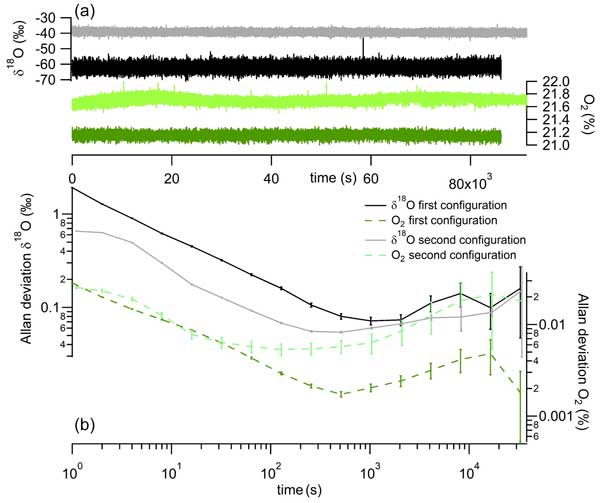
This paper introduces a new optical gas analyzer based on an optical-feedback cavity-enhanced absorption spectroscopy (OF-CEAS) technique enabling high-temporal-resolution and high-precision measurements of oxygen isotopes (δ18O) and dioxygen (O2) concentration of atmospheric O2 (respectively 0.06 ‰ and 0.002 % over 10 min integration). The results underscore the good agreement with isotope ratio mass spectrometry measurements and the ability of the instrument to monitor biological processes.
Claudia Voigt, Christine Vallet-Coulomb, Clément Piel, Joana Sauze, Ilja M. Reiter, Jean-Philippe Orts, Françoise Chalié, Christophe Cassou, Irène Xueref-Remy, and Anne Alexandre
Atmos. Chem. Phys., 26, 9295–9335, https://doi.org/10.5194/acp-26-9295-2026, https://doi.org/10.5194/acp-26-9295-2026, 2026
Short summary
Short summary
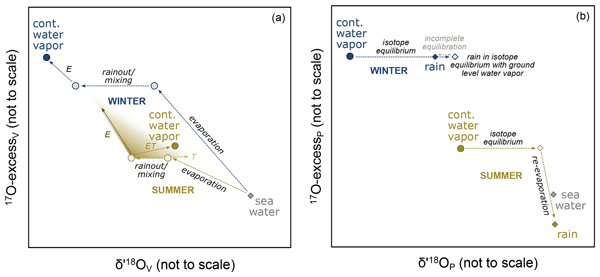
Triple oxygen isotopes (17O-excess) are an upcoming tool in hydrological studies. We present the first one-year high-resolution record of 17O-excess in atmospheric water vapor from a Mediterranean forest site. The dataset provides insights into the processes driving variability of 17O-excess in atmospheric water vapor and precipitation across seasonal, diurnal, and event scales. These findings support model validation efforts and enhance the interpretation of paleoclimate archives.
Nicolas Bienville, Amaelle Landais, Sarah Fiorini, Clément Piel, Joana Sauze, Benoit Lemaire, Nicolas Geyskens, Frederic Prie, Olivier Jossoud, Clémence Paul, Justin Chaillot, Thomas Lauwers, Simon Chollet, Samuel Abiven, and Arnaud Dapoigny
EGUsphere, https://doi.org/10.5194/egusphere-2026-1369, https://doi.org/10.5194/egusphere-2026-1369, 2026
Short summary
Short summary
This study describes an instrumented system of 4 closed aquatic biological chambers that allows determination of the oxygen isotopic fractionation factors of aquatic biosphere in controlled realistic conditions. We validated our system with a freshwater algae species and determined its ¹⁸O/¹⁶O isotopic discrimination during respiration to be −30 ‰, in the upper range of previously published values.
Clémence Paul, Clément Piel, Joana Sauze, Olivier Jossoud, Arnaud Dapoigny, Daniele Romanini, Frédéric Prié, Sébastien Devidal, Roxanne Jacob, Alexandru Milcu, and Amaëlle Landais
Geosci. Instrum. Method. Data Syst., 14, 91–101, https://doi.org/10.5194/gi-14-91-2025, https://doi.org/10.5194/gi-14-91-2025, 2025
Short summary
Short summary
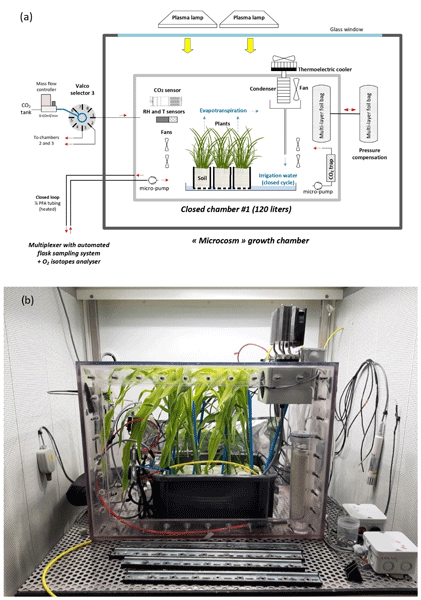
Our study investigated the influence of plant processes on oxygen dynamics, crucial for paleoclimatology. By examining maize respiration and photosynthesis using advanced techniques, we enhanced our understanding of past climates through ice core analysis.
Clément Piel, Daniele Romanini, Morgane Farradèche, Justin Chaillot, Clémence Paul, Nicolas Bienville, Thomas Lauwers, Joana Sauze, Kévin Jaulin, Frédéric Prié, and Amaëlle Landais
Atmos. Meas. Tech., 17, 6647–6658, https://doi.org/10.5194/amt-17-6647-2024, https://doi.org/10.5194/amt-17-6647-2024, 2024
Short summary
Short summary
This paper introduces a new optical gas analyzer based on an optical-feedback cavity-enhanced absorption spectroscopy (OF-CEAS) technique enabling high-temporal-resolution and high-precision measurements of oxygen isotopes (δ18O) and dioxygen (O2) concentration of atmospheric O2 (respectively 0.06 ‰ and 0.002 % over 10 min integration). The results underscore the good agreement with isotope ratio mass spectrometry measurements and the ability of the instrument to monitor biological processes.
Clémence Paul, Clément Piel, Joana Sauze, Nicolas Pasquier, Frédéric Prié, Sébastien Devidal, Roxanne Jacob, Arnaud Dapoigny, Olivier Jossoud, Alexandru Milcu, and Amaëlle Landais
Biogeosciences, 20, 1047–1062, https://doi.org/10.5194/bg-20-1047-2023, https://doi.org/10.5194/bg-20-1047-2023, 2023
Short summary
Short summary
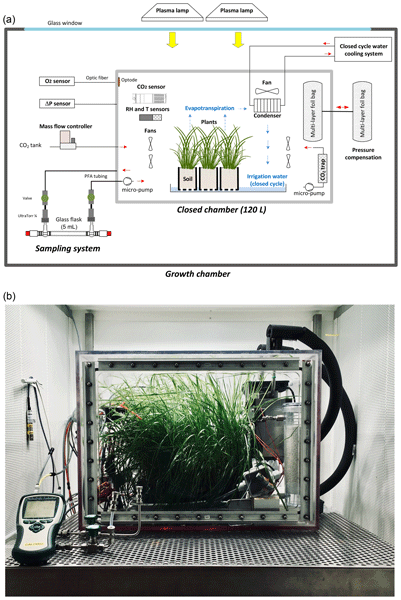
To improve the interpretation of the δ18Oatm and Δ17O of O2 in air bubbles in ice cores, we need to better quantify the oxygen fractionation coefficients associated with biological processes. We performed a simplified analogue of the terrestrial biosphere in a closed chamber. We found a respiration fractionation in agreement with the previous estimates at the microorganism scale, and a terrestrial photosynthetic fractionation was found. This has an impact on the estimation of the Dole effect.
Clément Outrequin, Anne Alexandre, Christine Vallet-Coulomb, Clément Piel, Sébastien Devidal, Amaelle Landais, Martine Couapel, Jean-Charles Mazur, Christophe Peugeot, Monique Pierre, Frédéric Prié, Jacques Roy, Corinne Sonzogni, and Claudia Voigt
Clim. Past, 17, 1881–1902, https://doi.org/10.5194/cp-17-1881-2021, https://doi.org/10.5194/cp-17-1881-2021, 2021
Short summary
Short summary
Continental atmospheric humidity is a key climate parameter poorly captured by global climate models. Model–data comparison approaches that are applicable beyond the instrumental period are essential to progress on this issue but face a lack of quantitative relative humidity proxies. Here, we calibrate the triple oxygen isotope composition of phytoliths as a new quantitative proxy of continental relative humidity suitable for past climate reconstructions.
Cited articles
Aoki, N., Ishidoya, S., Murayama, S., and Matsumoto, N.: Influence of CO2 adsorption on cylinders and fractionation of CO2 and air during the preparation of a standard mixture, Atmos. Meas. Tech., 15, 5969–5983, https://doi.org/10.5194/amt-15-5969-2022, 2022.
Belouafa, S., Habti, F., Benhar, S., Belafkih, B., Tayane, S., Hamdouch, S., and Abourriche, A.: Statistical tools and approaches to validate analytical methods: methodology and practical examples, Int. J. Metrol. Qual. Eng., 8, https://doi.org/10.1051/ijmqe/2016030, 2017.
Bereiter, B., Tuzson, B., Scheidegger, P., Kupferschmid, A., Looser, H., Mächler, L., Baggenstos, D., Schmitt, J., Fischer, H., and Emmenegger, L.: High-precision laser spectrometer for multiple greenhouse gas analysis in 1 mL air from ice core samples, Atmos. Meas. Tech., 13, 6391–6406, https://doi.org/10.5194/amt-13-6391-2020, 2020.
Berryman, E. M., Marshall, J. D., Rahn, T., Cook, S. P., and Litvak, M.: Adaptation of continuous-flow cavity ring-down spectroscopy for batch analysis of δ13C of CO2 and comparison with isotope ratio mass spectrometry, Rapid Commun. Mass Spectrom., 25, 2355–2360, https://doi.org/10.1002/rcm.5108, 2011.
Bowling, D. R., Pataki, D. E., and Randerson, J. T.: Carbon isotopes in terrestrial ecosystem pools and CO2 fluxes, New Phytol., 178, 24–40, https://doi.org/10.1111/j.1469-8137.2007.02342.x, 2008.
Brand, W. A.: High Precision Isotope Ratio Monitoring Techniques in Mass Spectrometry, J. Mass Spectrom., 31, 225–235, https://doi.org/10.1002/(SICI)1096-9888(199603)31:3<225::AID-JMS319>3.0.CO;2-L, 1996.
Brand, W. A., Assonov, S. S., and Coplen, T. B.: Correction for the 17O interference in δ(13C) measurements when analyzing CO2 with stable isotope mass spectrometry (IUPAC Technical Report), Pure Appl. Chem., 82, 1719–1733, https://doi.org/10.1351/PAC-REP-09-01-05, 2010.
Brand, W. A., Rothe, M., Sperlich, P., Strube, M., and Wendeberg, M.: Automated simultaneous measurement of the δ13C and δ2H values of methane and the δ13C and δ18O values of carbon dioxide in flask air samples using a new multi cryo-trap/gas chromatography/isotope ratio mass spectrometry system, Rapid Commun. Mass Spectrom., 30, 1523–1539, https://doi.org/10.1002/rcm.7587, 2016.
Breecker, D. O., Bergel, S., Nadel, M., Tremblay, M. M., Osuna-Orozco, R., Larson, T. E., and Sharp, Z. D.: Minor stable carbon isotope fractionation between respired carbon dioxide and bulk soil organic matter during laboratory incubation of topsoil, Biogeochemistry, 123, 83–98, https://doi.org/10.1007/s10533-014-0054-3, 2014.
Cerling, T. E. and Quade, J.: Stable carbon and oxygen isotopes in soil carbonates, Geoph. Monog. Series, 78, 217–231, https://doi.org/10.1029/GM078p0217, 1993.
Ciais, P., Sabine, C., Bala, G., Bopp, L., Brovkin, V., Canadell, J., Chhabra, A., Defries, R., Galloway, J., Heimann, M., Jones, C., Le Quéré, C., Myneni, R., Piao, S., and Thornton, P.: Carbon and Other Biogeochemical Cycles, in: In Climate Change 2013: The Physical Science Basis. Contribution of Working Group I to the Fifth Assessment Report of the Intergovernmental Panel on Climate Change Change, 465–570, 2014.
Farquhar, G. D. and Cernusak, L. A.: Ternary effects on the gas exchange of isotopologues of carbon dioxide, Plant Cell Environ., 35, 1221–1231, https://doi.org/10.1111/j.1365-3040.2012.02484.x , 2012.
Farquhar, G. D., Ehleringer, J. R., and Hubick, K. T.: Carbon Isotope Discrimination and Photosynthesis, Annu. Rev. Plant Physiol. Plant Mol. Biol., 40, 503–537, 1989.
Fiebig, J., Schöne, B. R., and Oschmann, W.: High-precision oxygen and carbon isotope analysis of very small (10–30 µg) amounts of carbonates using continuous flow isotope ratio mass spectrometry, Rapid Commun. Mass Spectrom., 19, 2355–2358, https://doi.org/10.1002/rcm.2060, 2005.
Fisher, R., Lowry, D., Wilkin, O., Sriskantharajah, S., and Nisbet, E. G.: High-precision, automated stable isotope analysis of atmospheric methane and carbon dioxide using continuous-flow isotope-ratio mass spectrometry, Rapid Commun. Mass Spectrom., 20, 200–208, https://doi.org/10.1002/rcm.2300, 2006.
Ghiara, E., Lazzari, G., Signorini, V., Ansaloni, L., Alcock, B., and Minelli, M.: Cryo-compressed CO2 sorption and diffusion in elastomers for the CO2 transport chain: Examples of FKM, EPDM and HNBR, Chem. Eng. J., 511, 161826, https://doi.org/10.1016/j.cej.2025.161826, 2025.
Giammanco, S., Krajnc, B., Kotnik, J., and Ogrinc, N.: Temporal analysis of δ13 C, Ann. Geophys., 60, S0663, https://doi.org/10.4401/ag-7305, 2017.
Gillespie, L. M., Fromin, N., Milcu, A., Buatois, B., Pontoizeau, C., and Hättenschwiler, S.: Higher tree diversity increases soil microbial resistance to drought, Commun. Biol., 3, 377, https://doi.org/10.1038/s42003-020-1112-0, 2020.
Guillot, E., Hinsinger, P., Dufour, L., Roy, J., and Bertrand, I.: With or without trees: Resistance and resilience of soil microbial communities to drought and heat stress in a Mediterranean agroforestry system, Soil Biol. Biochem., 129, 122–135, https://doi.org/10.1016/j.soilbio.2018.11.011, 2019.
Hardie, S. M. L., Garnett, M. H., Fallick, A. E., Stott, A. W., Rowland, A. P., and Ostle, N. J.: Testing the use of septum-capped vials for 13C-isotope abundance analysis of carbon dioxide, Rapid Commun. Mass Spectrom., 24, 1805–1809, https://doi.org/10.1002/rcm.4575, 2010.
Joos, O., Saurer, M., Heim, A., Hagedorn, F., Schmidt, M. W., and Siegwolf, R. T.: Can we use the CO2 concentrations determined by continuous-flow isotope ratio mass spectrometry from small samples for the Keeling plot approach?, Rapid Commun. Mass Spectrom., 22, 4029–4034, https://doi.org/10.1002/rcm.3827, 2008.
Keeling, C. D.: The concentration and isotopic abundances of atmospheric carbon dioxide in rural areas, Geochim. Cosmochim. Ac., 13, 322–334, https://doi.org/10.1016/0016-7037(58)90033-4, 1958.
Kornfeld, A., Horton, T. W., Yakir, D., Searle, S. Y., Griffin, K. L., Atkin, O. K., Subke, J., and Turnbull, M. H.: A field-compatible method for measuring alternative respiratory pathway activities in vivo using stable O2 isotopes, Plant Cell Environ., 35, 1518–1532, https://doi.org/10.1111/j.1365-3040.2012.02507.x, 2012.
Kuehfuss, S., Högy, P., and Fangmeier, A.: Influence of long-term CO2 storage on δ13C in vials capped with butyl and butyl/PTFE caps and the relevance for ecological samples, Plant Soil, 383, 99–110, https://doi.org/10.1007/s11104-014-2156-z, 2014.
Laughlin, R. J. and Stevens, R. J.: Changes in Composition of Nitrogen-15-Labeled Gases during Storage in Septum-Capped Vials, Soil Sci. Soc. Am. J., 67, 540–543, 2003.
Leitner, S., Meeran, K., and Watzinger, A.: Stable isotope analysis of atmospheric CO2 using a Gasbench II-Cold Trap-IRMS setting, Rapid Commun. Mass Spectrom., 37, e9647, https://doi.org/10.1002/rcm.9647, 2023.
Midwood, A. J. and Millard, P.: Challenges in measuring the δ13 C of the soil surface CO2 efflux, Rapid Commun. Mass Spectrom., 25, 232–242, https://doi.org/10.1002/rcm.4857, 2011.
Mortazavi, B. and Chanton, J. P.: A rapid and precise technique for measuring δ13 C-CO2 and δ18 O-CO2 ratios at ambient CO2 concentrations for biological applications and the influence of container type and storage time on the sample isotope ratios, Rapid Commun. Mass Spectrom., 16, 1398–1403, https://doi.org/10.1002/rcm.730, 2002.
Nauer, P. A., Chiri, E., Jirapanjawat, T., Greening, C., and Cook, P. L. M.: Technical note: Inexpensive modification of Exetainers for the reliable storage of trace-level hydrogen and carbon monoxide gas samples, Biogeosciences, 18, 729–737, https://doi.org/10.5194/bg-18-729-2021, 2021.
Nelson, S. T.: Sample vial influences on the accuracy and precision of carbon and oxygen isotope ratio analysis in continuous flow mass spectrometric applications, Rapid Commun. Mass Spectrom., 14, 293–297, https://doi.org/10.1002/(SICI)1097-0231(20000229)14:4<293::AID-RCM869>3.0.CO;2-L, 2000.
Pataki, D. E., Ehleringer, J. R., Flanagan, L. B., Yakir, D., Bowling, D. R., Still, C. J., Buchmann, N., Kaplan, J. O., and Berry, J. A.: The application and interpretation of Keeling plots in terrestrial carbon cycle research, Global Biogeochem. Cy., 17, 2001GB001850, https://doi.org/10.1029/2001GB001850, 2003.
Paul, D. and Skrzypek, G.: Flushing time and storage effects on the accuracy and precision of carbon and oxygen isotope ratios of sample using the Gasbench II technique, Rapid Commun. Mass Spectrom., 20, 2033–2040, https://doi.org/10.1002/rcm.2559, 2006.
Paul, D., Skrzypek, G., and Fórizs, I.: Normalization of measured stable isotopic compositions to isotope reference scales – a review, Rapid Commun. Mass Spectrom., 21, 3006–3014, https://doi.org/10.1002/rcm.3185, 2007.
Phillips, D. L. and Gregg, J. W.: Uncertainty in source partitioning using stable isotopes, Oecologia, 127, 171–179, 2001.
R Core Team: R: A language and environment for statistical computing, R Foundation for Statistical Computing, Vienna, Austria, 2024.
Rothe, M., Jordan, A., and Brand, W. A.: Trace gases, δ13C and δ18O of CO2-in-air samples: Storage in glass flasks using PCTFE seals and other effects, in: Proceedings of the 12th IAEA/WMO meeting of CO2 experts, edited by: Worthy, D. and Huang, L., Toronto, September 2003, 64–70, 2005.
Schmitt, J., Schneider, R., and Fischer, H.: A sublimation technique for high-precision measurements of δ13CO2 and mixing ratios of CO2 and N2O from air trapped in ice cores, Atmos. Meas. Tech., 4, 1445–1461, https://doi.org/10.5194/amt-4-1445-2011, 2011.
Schukraft, G. E., Itskou, I., Woodward, R. T., Van Der Linden, B., Petit, C., and Urakawa, A.: Evaluation of CO2 and H2O adsorption on a porous polymer using DFT and in situ DRIFT spectroscopy, J. Phys. Chem. B, 126, 8048–8057, https://doi.org/10.1021/acs.jpcb.2c03912, 2022.
Siegwart, L., Piton, G., Jourdan, C., Piel, C., Sauze, J., Sugihara, S., and Bertrand, I.: Carbon and nutrient colimitations control the microbial response to fresh organic carbon inputs in soil at different depths, Geoderma, 440, 116729, https://doi.org/10.1016/j.geoderma.2023.116729, 2023.
Sperlich, P., Brailsford, G. W., Moss, R. C., McGregor, J., Martin, R. J., Nichol, S., Mikaloff-Fletcher, S., Bukosa, B., Mandic, M., Schipper, C. I., Krummel, P., and Griffiths, A. D.: IRIS analyser assessment reveals sub-hourly variability of isotope ratios in carbon dioxide at Baring Head, New Zealand's atmospheric observatory in the Southern Ocean, Atmos. Meas. Tech., 15, 1631–1656, https://doi.org/10.5194/amt-15-1631-2022, 2022.
Spötl, C. and Vennemann, T. W.: Continuous-flow isotope ratio mass spectrometric analysis of carbonate minerals, Rapid Commun. Mass Spectrom., 17, 1004–1006, https://doi.org/10.1002/rcm.1010, 2003.
Squara, P., Scheeren, T. W., Aya, H. D., Bakker, J., Cecconi, M., Einav, S., and Saugel, B.: Metrology part 1: definition of quality criteria, J. Clin. Monit. Comput., 35, 17–25, https://doi.org/10.1007/s10877-020-00494-y, 2020.
Sreenath, S. and Sam, A. A: Hybrid membrane-cryogenic CO2 capture technologies: A mini-review, Front. Ener. Resear., 11, 1167024, https://doi.org/10.3389/fenrg.2023.1167024, 2023.
Steur, P. M., Scheeren, H. A., Nelson, D. D., McManus, J. B., and Meijer, H. A. J.: Simultaneous measurement of δ13C, δ18O and δ17O of atmospheric CO2 – performance assessment of a dual-laser absorption spectrometer, Atmos. Meas. Tech., 14, 4279–4304, https://doi.org/10.5194/amt-14-4279-2021, 2021.
Steur, P. M., Botter, D., Scheeren, H. A., Moossen, H., Rothe, M., and Meijer, H. A.: Preventing drift of oxygen isotopes of CO2-in-air stored in glass sample flasks: new insights and recommendations, Isot. Environ. Healt. S., 59, 309–326, https://doi.org/10.1080/10256016.2023.2234594, 2023.
Tans, P., Berry, J. A., and Keeling, R.: Oceanic 13C/12C observations: a new window on ocean CO2 uptake, Global Geochem. Cy., https://doi.org/10.1029/93GB00053, 1993.
Thermo Fisher Scientific: GasBench II Operating Manual, Ville: Thermo Fisher Scientific, 2018.
Tu, K. P., Brooks, P. D., and Dawson, T. E.: Using septum-capped vials with continuous-flow isotope ratio mass spectrometric analysis of atmospheric CO2 for Keeling plot applications, Rapid Commun. Mass Spectrom., 15, 952–956, https://doi.org/10.1002/rcm.320, 2001.
van Geldern, R., Nowak, M. E., Zimmer, M., Szizybalski, A., Myrttinen, A., Barth, J. A., and Jost, H. J.: Field-based stable isotope analysis of carbon dioxide by mid-infrared laser spectroscopy for carbon capture and storage monitoring, Anal. Chem., 86, 12191–12198, https://doi.org/10.1021/ac5031732, 2014.
Walker, B. D., Beaupré, S. R., Griffin, S., Walker, J., Druffel, E., and Xu, X.: A sealed-tube method for offline δ13C analysis of CO2 via a gas bench II continuous-flow isotope ratio mass spectrometer, Rapid Commun. Mass Spectrom., 35, e9040, https://doi.org/10.1002/rcm.9040, 2021.
Werner, C., Unger, S., Pereira, J. S., Maia, R., David, T. S., Kurz-Besson, C., David, J. S., and Máguas, C.: Importance of short-term dynamics in carbon isotope ratios of ecosystem respiration (δ13 CR) in a Mediterranean oak woodland and linkage to environmental factors, New Phytol., 172, 330–346, https://doi.org/10.1111/j.1469-8137.2006.01836.x, 2006.
Werner, R. A., Rothe, M., and Brand, W. A.: Extraction of CO2 from air samples for isotopic analysis and limits to ultra high precision δ18O determination in CO2 gas, Rapid Commun. Mass Spectrom., 15, 2152–2167, https://doi.org/10.1002/rcm.487, 2001.
West, J. B., Bowen, G. J., Cerling, T. E., and Ehleringer, J. R.: Stable isotopes as one of nature's ecological recorders, Trends Ecol. Evol., 21, 408–414, https://doi.org/10.1016/j.tree.2006.04.002, 2006.
Short summary
We present a simple workflow for high-precision δ¹³C-CO₂ analysis from 1 mL air samples using cryogenic pre-concentration and continuous-flow isotope-ratio mass spectrometry (IRMS). The method combines vial conditioning, dual sealing, and −80 °C storage to minimise gas loss. It achieves ±0.1 ‰ precision and stable isotopic values for up to one week of storage. This low-cost approach enables high-frequency δ¹³C-CO₂ measurements in volume-limited systems such as microcosm or chamber experiments.
We present a simple workflow for high-precision δ¹³C-CO₂ analysis from 1 mL air samples using...


