
Articles | Volume 19, issue 12
https://doi.org/10.5194/amt-19-4219-2026
© Author(s) 2026. This work is distributed under
the Creative Commons Attribution 4.0 License.
the Creative Commons Attribution 4.0 License.
https://doi.org/10.5194/amt-19-4219-2026
© Author(s) 2026. This work is distributed under
the Creative Commons Attribution 4.0 License.
the Creative Commons Attribution 4.0 License.
Research article
| 
26 Jun 2026
Research article |
| 26 Jun 2026
| 26 Jun 2026
Improving imputation of missing PM2.5 speciation data using PMF-informed source-receptor relationships
Wubin Zhu
State Environmental Protection Key Laboratory of Urban Ambient Air Particulate Matter Pollution Prevention and Control, College of Environmental Science and Engineering, Nankai University, Tianjin 300350, China
Mingjie Xie
Collaborative Innovation Center of Atmospheric Environment and Equipment Technology, Jiangsu Key Laboratory of Atmospheric Environment Monitoring and Pollution Control, School of Environmental Science and Engineering, Nanjing University of Information Science & Technology, 219 Ningliu Road, Nanjing, 210044, China

State Environmental Protection Key Laboratory of Urban Ambient Air Particulate Matter Pollution Prevention and Control, College of Environmental Science and Engineering, Nankai University, Tianjin 300350, China
Tianjin Key Laboratory of Software Experience and Human Computer Interaction, Tianjin 300457, China
Xiaohui Bi
State Environmental Protection Key Laboratory of Urban Ambient Air Particulate Matter Pollution Prevention and Control, College of Environmental Science and Engineering, Nankai University, Tianjin 300350, China
Yufen Zhang
State Environmental Protection Key Laboratory of Urban Ambient Air Particulate Matter Pollution Prevention and Control, College of Environmental Science and Engineering, Nankai University, Tianjin 300350, China
Yinchang Feng
State Environmental Protection Key Laboratory of Urban Ambient Air Particulate Matter Pollution Prevention and Control, College of Environmental Science and Engineering, Nankai University, Tianjin 300350, China
Related authors
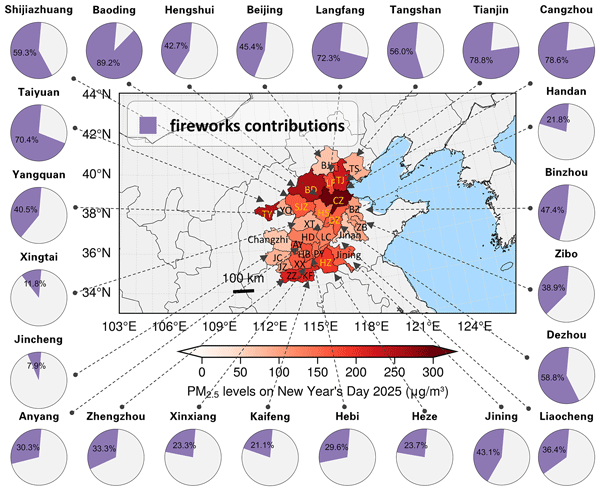
Yuan Li, Qili Dai, Wubin Zhu, Xuan Liu, Jiandong Shen, Renchang Yan, Yunshan Li, Jing Ding, Young Su Lee, Yufen Zhang, and Yinchang Feng
Atmos. Chem. Phys., 26, 5553–5566, https://doi.org/10.5194/acp-26-5553-2026, https://doi.org/10.5194/acp-26-5553-2026, 2026
Short summary
Short summary
Machine learning reveals air quality patterns shaped by holiday activities, with fireworks driving major PM2.5 spikes during Spring Festival.
Hongyu Zhang, Yating Zhang, Yang Xiao, Xiaohui Bi, Shenbo Wang, Qili Dai, and Yinchang Feng
EGUsphere, https://doi.org/10.5194/egusphere-2026-3573, https://doi.org/10.5194/egusphere-2026-3573, 2026
Short summary
Short summary
To understand how dust storms change air pollution, we analyzed fine particle data from seven central Chinese cities in April 2023, comparing dusty and clean periods. Dust brought crustal materials that raised particle acidity and altered sulfate and nitrate formation, with city differences due to local emissions and weather. Thus, effective pollution control must cut exhaust emissions and manage dust sources, especially in dust‑prone areas.
Yuan Li, Qili Dai, Wubin Zhu, Xuan Liu, Jiandong Shen, Renchang Yan, Yunshan Li, Jing Ding, Young Su Lee, Yufen Zhang, and Yinchang Feng
Atmos. Chem. Phys., 26, 5553–5566, https://doi.org/10.5194/acp-26-5553-2026, https://doi.org/10.5194/acp-26-5553-2026, 2026
Short summary
Short summary
Machine learning reveals air quality patterns shaped by holiday activities, with fireworks driving major PM2.5 spikes during Spring Festival.
Jingwen Shi, Yaqin Ji, Wenju Xu, Ruixing Shen, Jiaofan Ma, Yuexin Zhao, Xingchen Zhou, Yushang Ma, and Yinchang Feng
Earth Syst. Sci. Data Discuss., https://doi.org/10.5194/essd-2025-427, https://doi.org/10.5194/essd-2025-427, 2025
Manuscript not accepted for further review
Short summary
Short summary
In this study, we constructed China's Open Biomass Combustion Emission Inventory (COBBEI) for the years 2020–2023. This was the first fusion of Fire radiation power (FRP) data from the Fengyun-4A geostationary and polar-orbiting satellites. We further proposed 5 filtering rules based on FRP characteristics. COBBEI could fill data gaps in China's open biomass burning emission inventories and provide key data for air quality models, environmental policy development, and fire emergency response.
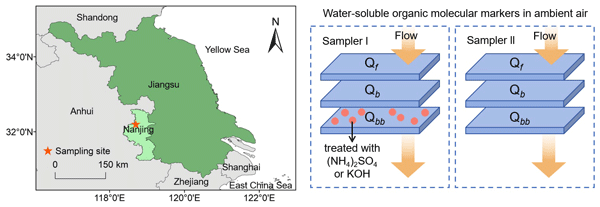
Wei Feng, Xiangyu Zhang, Zhijuan Shao, Guofeng Shen, Hong Liao, Yuhang Wang, and Mingjie Xie
Atmos. Chem. Phys., 25, 16697–16711, https://doi.org/10.5194/acp-25-16697-2025, https://doi.org/10.5194/acp-25-16697-2025, 2025
Short summary
Short summary
In this work, the relative differences in particle concentrations of water-soluble organic molecular markers (WSOMMs) between the collocated filter samples represent the uncertainties in the measurements. The comparisons between the measurements of chemically treated and untreated backup filter samples indicate that the WSOMMs detected on the backup filters may originate from heterogeneous reactions on the filter surfaces, but are not caused by the adsorption of gaseous molecules.
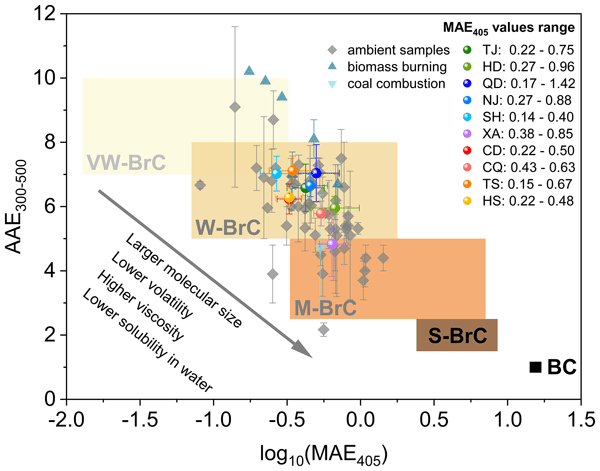
Haibiao Chen, Caiqing Yan, Liubin Huang, Lin Du, Yang Yue, Xinfeng Wang, Qingcai Chen, Mingjie Xie, Junwen Liu, Fengwen Wang, Shuhong Fang, Qiaoyun Yang, Hongya Niu, Mei Zheng, Yan Wu, and Likun Xue
Atmos. Chem. Phys., 25, 3647–3667, https://doi.org/10.5194/acp-25-3647-2025, https://doi.org/10.5194/acp-25-3647-2025, 2025
Short summary
Short summary
A comprehensive understanding of the optical properties of brown carbon (BrC) is essential to accurately assess its climatic effects. Based on multi-site spectroscopic measurements, this study demonstrated the significant spatial heterogeneity in the optical and structural properties of water-soluble organic carbon (WSOC) in different regions of China and revealed factors affecting WSOC light absorption and the relationship between fluorophores and light absorption of WSOC.
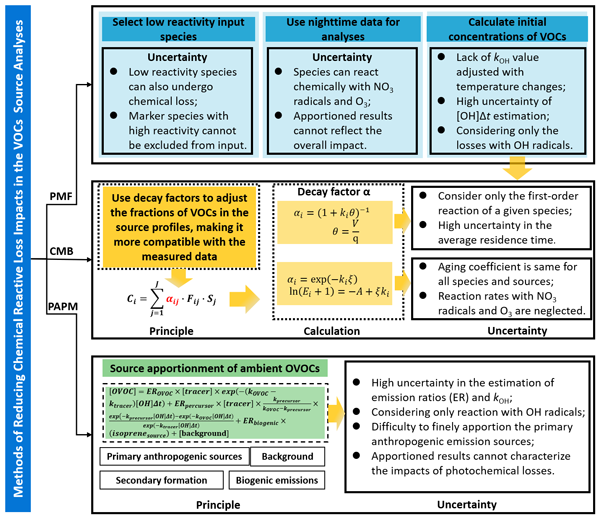
Baoshuang Liu, Yao Gu, Yutong Wu, Qili Dai, Shaojie Song, Yinchang Feng, and Philip K. Hopke
Atmos. Chem. Phys., 24, 12861–12879, https://doi.org/10.5194/acp-24-12861-2024, https://doi.org/10.5194/acp-24-12861-2024, 2024
Short summary
Short summary
Reactive loss of volatile organic compounds (VOCs) is a long-term issue yet to be resolved in VOC source analyses. We assess common methods of, and existing issues in, reducing losses, impacts of losses, and sources in current source analyses. We offer a potential supporting role for solving issues of VOC conversion. Source analyses of consumed VOCs that reacted to produce ozone and secondary organic aerosols can play an important role in the effective control of secondary pollution in air.
Haoqi Wang, Xiao Tian, Wanting Zhao, Jiacheng Li, Haoyu Yu, Yinchang Feng, and Shaojie Song
Atmos. Chem. Phys., 24, 6583–6592, https://doi.org/10.5194/acp-24-6583-2024, https://doi.org/10.5194/acp-24-6583-2024, 2024
Short summary
Short summary
pH is a key property of ambient aerosols, which affect many atmospheric processes. As aerosol pH is a non-conservative parameter, diverse averaging metrics and temporal resolutions may influence the pH values calculated by thermodynamic models. This technical note seeks to quantitatively evaluate the average pH using varied metrics and resolutions. The ultimate goal is to establish standardized reporting practices in future research endeavors.
Zhongwei Luo, Yan Han, Kun Hua, Yufen Zhang, Jianhui Wu, Xiaohui Bi, Qili Dai, Baoshuang Liu, Yang Chen, Xin Long, and Yinchang Feng
Geosci. Model Dev., 16, 6757–6771, https://doi.org/10.5194/gmd-16-6757-2023, https://doi.org/10.5194/gmd-16-6757-2023, 2023
Short summary
Short summary
This study explores how the variation in the source profiles adopted in chemical transport models (CTMs) impacts the simulated results of chemical components in PM2.5 based on sensitivity analysis. The impact on PM2.5 components cannot be ignored, and its influence can be transmitted and linked between components. The representativeness and timeliness of the source profile should be paid adequate attention in air quality simulation.
Zhenqi Xu, Wei Feng, Yicheng Wang, Haoran Ye, Yuhang Wang, Hong Liao, and Mingjie Xie
Atmos. Chem. Phys., 22, 13739–13752, https://doi.org/10.5194/acp-22-13739-2022, https://doi.org/10.5194/acp-22-13739-2022, 2022
Short summary
Short summary
This work uses a solvent (DMF) that can efficiently dissolve low-volatility OC to examine BrC absorption and sources, which will benefit future investigations on the physicochemical properties of large organic molecules. The study results also shed light on potential sources for methanol-insoluble OC. These results highlight the importance of testing different solvents to investigate the structures and light absorption of low-volatility BrC.
Baoshuang Liu, Yanyang Wang, He Meng, Qili Dai, Liuli Diao, Jianhui Wu, Laiyuan Shi, Jing Wang, Yufen Zhang, and Yinchang Feng
Atmos. Chem. Phys., 22, 8597–8615, https://doi.org/10.5194/acp-22-8597-2022, https://doi.org/10.5194/acp-22-8597-2022, 2022
Short summary
Short summary
Understanding effectiveness of air pollution regulatory measures is critical for control policy. Machine learning and dispersion-normalized approaches were applied to decouple meteorologically deduced variations in Qingdao, China. Most pollutant concentrations decreased substantially after the Clean Air Action Plan. The largest emission reduction was from coal combustion and steel-related smelting. Qingdao is at risk of increased emissions from increased vehicular population and ozone pollution.
Xinyao Feng, Yingze Tian, Qianqian Xue, Danlin Song, Fengxia Huang, and Yinchang Feng
Atmos. Chem. Phys., 21, 16219–16235, https://doi.org/10.5194/acp-21-16219-2021, https://doi.org/10.5194/acp-21-16219-2021, 2021
Short summary
Short summary
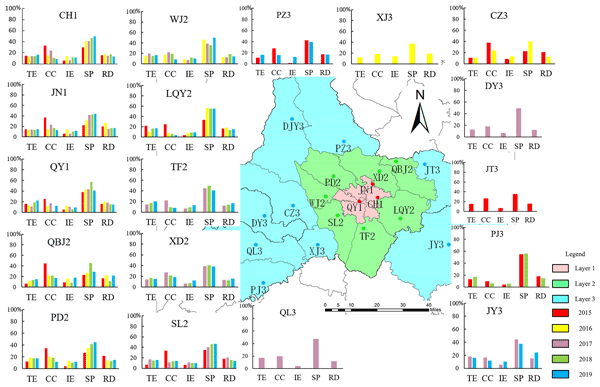
This study focused on PM2.5 compositions and sources and explored their spatiotemporal and policy-related variations based on observation at 19 sites during wintertime of 2015–2019 in a fast-developing megacity. We found that PM2.5 compositions for the outermost zone in 2019 were similar to those for the core zone 2 or 3 years ago. Percentage contributions of coal and biomass combustion dramatically declined in the core zone, while the traffic source showed an increasing trend.
Cited articles
albertbup: deep-belief-network: A Python implementation of Deep Belief Networks built upon NumPy and TensorFlow with scikit-learn compatibility, GitHub repository [code], https://github.com/albertbup/deep-belief-network, last access: 19 June 2026. a
Alwateer, M., Atlam, E.-S., Abd El-Raouf, M. M., Ghoneim, O. A., and Gad, I.: Missing data imputation: A comprehensive review, Journal of Computer and Communications, 12, 53–75, https://doi.org/10.4236/jcc.2024.1211004, 2024. a
Becagli, S., Sferlazzo, D. M., Pace, G., di Sarra, A., Bommarito, C., Calzolai, G., Ghedini, C., Lucarelli, F., Meloni, D., Monteleone, F., Severi, M., Traversi, R., and Udisti, R.: Evidence for heavy fuel oil combustion aerosols from chemical analyses at the island of Lampedusa: a possible large role of ships emissions in the Mediterranean, Atmos. Chem. Phys., 12, 3479–3492, https://doi.org/10.5194/acp-12-3479-2012, 2012. a, b
Betancourt, C., Li, C. W. Y., Kleinert, F., and Schultz, M. G.: Graph Machine Learning for Improved Imputation of Missing Tropospheric Ozone Data, Environ. Sci. Technol., 57, 18246–18258, https://doi.org/10.1021/acs.est.3c05104, 2023. a
Bi, X., Dai, Q., Wu, J., Zhang, Q., Zhang, W., Luo, R., Cheng, Y., Zhang, J., Wang, L., Yu, Z., Zhang, Y., Tian, Y., and Feng, Y.: Characteristics of the main primary source profiles of particulate matter across China from 1987 to 2017, Atmos. Chem. Phys., 19, 3223–3243, https://doi.org/10.5194/acp-19-3223-2019, 2019. a
Birch, M. E.: Occupational monitoring of particulate diesel exhaust by NIOSH method 5040, Applied Occupational and Environmental Hygiene, 17, 400–405, https://doi.org/10.1080/10473220290035390, 2002. a
Brown, S. G., Eberly, S., Paatero, P., and Norris, G. A.: Methods for estimating uncertainty in PMF solutions: Examples with ambient air and water quality data and guidance on reporting PMF results, Sci. Total Environ., 518–519, 626–635, https://doi.org/10.1016/j.scitotenv.2015.01.022, 2015. a
Canonaco, F., Tobler, A., Chen, G., Sosedova, Y., Slowik, J. G., Bozzetti, C., Daellenbach, K. R., El Haddad, I., Crippa, M., Huang, R.-J., Furger, M., Baltensperger, U., and Prévôt, A. S. H.: A new method for long-term source apportionment with time-dependent factor profiles and uncertainty assessment using SoFi Pro: application to 1 year of organic aerosol data, Atmos. Meas. Tech., 14, 923–943, https://doi.org/10.5194/amt-14-923-2021, 2021. a
Chang, Y., Huang, K., Xie, M., Deng, C., Zou, Z., Liu, S., and Zhang, Y.: First long-term and near real-time measurement of trace elements in China's urban atmosphere: temporal variability, source apportionment and precipitation effect, Atmos. Chem. Phys., 18, 11793–11812, https://doi.org/10.5194/acp-18-11793-2018, 2018. a
Cheng, K., Wang, Y., Tian, H., Gao, X., Zhang, Y., Wu, X., Zhu, C., and Gao, J.: Atmospheric Emission Characteristics and Control Policies of Five Precedent-Controlled Toxic Heavy Metals from Anthropogenic Sources in China, Environ. Sci. Technol., 49, 1206–1214, https://doi.org/10.1021/es5037332, 2015. a
Choi, E., Yi, S.-M., Lee, Y. S., Jo, H., Baek, S.-O., and Heo, J.-B.: Sources of airborne particulate matter-bound metals and spatial-seasonal variability of health risk potentials in four large cities, South Korea, Environ. Sci. Pollut. R., 29, 28359–28374, https://doi.org/10.1007/s11356-021-18445-8, 2022. a
Dai, Q., Liu, B., Bi, X., Wu, J., Liang, D., Zhang, Y., Feng, Y., and Hopke, P. K.: Dispersion Normalized PMF Provides Insights into the Significant Changes in Source Contributions to PM2.5 after the COVID-19 Outbreak, Environ. Sci. Technol., 54, 9917–9927, https://doi.org/10.1021/acs.est.0c02776, 2020. a
Dai, Q., Ding, J., Song, C., Liu, B., Bi, X., Wu, J., Zhang, Y., Feng, Y., and Hopke, P. K.: Changes in source contributions to particle number concentrations after the COVID-19 outbreak: Insights from a dispersion normalized PMF, Sci. Total Environ., 759, 143548, https://doi.org/10.1016/j.scitotenv.2020.143548, 2021. a
Emmanuel, T., Maupong, T., Mpoeleng, D., Semong, T., Mphago, B., and Tabona, O.: A survey on missing data in machine learning, Journal of Big Data, 8, 1–37, https://doi.org/10.1186/s40537-021-00516-9, 2021. a
García-Laencina, P. J., Sancho-Gómez, J.-L., and Figueiras-Vidal, A. R.: Pattern classification with missing data: a review, Neural Comput. Appl., 19, 263–282, https://doi.org/10.1007/s00521-009-0295-6, 2010. a
Hao, H., Wang, Y., Zhu, Q., Zhang, H., Rosenberg, A., Schwartz, J., Amini, H., van Donkelaar, A., Martin, R., Liu, P., Weber, R., Russel, A., Yitshak-sade, M., Chang, H., and Shi, L.: National Cohort Study of Long-Term Exposure to PM2.5 Components and Mortality in Medicare American Older Adults, Environ. Sci. Technol., 57, 6835–6843, https://doi.org/10.1021/acs.est.2c07064, 2023. a
Hopke, P. K.: Review of receptor modeling methods for source apportionment, J. Air Waste Manage., 66, 237–259, https://doi.org/10.1080/10962247.2016.1140693, 2016. a
Hu, J., Zhang, H., Chen, S., Ying, Q., Wiedinmyer, C., Vandenberghe, F., and Kleeman, M. J.: Identifying PM2.5 and PM0.1 Sources for Epidemiological Studies in California, Environ. Sci. Technol., 48, 4980–4990, https://doi.org/10.1021/es404810z, 2014. a
Jing, X., Luo, J., Wang, J., Zuo, G., and Wei, N.: A Multi-imputation method to deal with hydro-meteorological missing values by integrating chain equations and random forest, Water Resour. Manag., 36, 1159–1173, https://doi.org/10.1007/s11269-021-03037-5, 2022. a
Junger, W. and Ponce de Leon, A.: Imputation of missing data in time series for air pollutants, Atmos. Environ., 102, 96–104, https://doi.org/10.1016/j.atmosenv.2014.11.049, 2015. a
Junninen, H., Niska, H., Tuppurainen, K., Ruuskanen, J., and Kolehmainen, M.: Methods for imputation of missing values in air quality data sets, Atmos. Environ., 38, 2895–2907, https://doi.org/10.1016/j.atmosenv.2004.02.026, 2004. a, b
Khan, S. I. and Hoque, A. S. M. L.: SICE: an improved missing data imputation technique, Journal of Big Data, 7, 37, https://doi.org/10.1186/s40537-020-00313-w, 2020. a
Kim, Y., Yi, S.-M., Heo, J., Kim, H., Lee, W., Kim, H., Hopke, P. K., Lee, Y. S., Shin, H.-J., Park, J., Yoo, M., Jeon, K., and Park, J.: Is replacing missing values of PM2.5 constituents with estimates using machine learning better for source apportionment than exclusion or median replacement?, Environ. Pollut., 354, 124165, https://doi.org/10.1016/j.envpol.2024.124165, 2024. a, b
Kim, Y., Hopke, P. K., Yi, S.-M., Lee, W., Kim, H., Heo, J., Kim, H., Lee, Y. S., Jeon, K., and Park, J.: Positive matrix factorization outperforms machine learning in imputing missing PM2.5 and further identifying spatial patterns in multi-sites without external data, Urban Climate, 62, 102552, https://doi.org/10.1016/j.uclim.2025.102552, 2025a. a
Kim, Y., Kang, C., Yi, S.-M., Heo, J., Kim, H., Lee, W., Kim, H., Hopke, P. K., Lee, Y. S., Shin, H.-J., Park, J., Yoo, M., Jeon, K., and Park, J.: Imputing missing data with statistical-learning estimates: impacts on mortality risks attributable to area- and source-specific PM2.5, Atmos. Pollut. Res., 102785, https://doi.org/10.1016/j.apr.2025.102785, 2025b. a
Kowarik, A. and Templ, M.: Imputation with the R Package VIM, J. Stat. Softw., 74, 1–16, https://doi.org/10.18637/jss.v074.i07, 2016. a
Lai, W. Y. and Kuok, K.: A study on bayesian principal component analysis for addressing missing rainfall data, Water Resour. Manag., 33, 2615–2628, https://doi.org/10.1007/s11269-019-02209-8, 2019. a
Lee, S.-J., Ju, J.-T., Lee, J.-J., Song, C.-K., Shin, S.-A., Jung, H.-J., Shin, H. J., and Choi, S.-D.: Mapping nationwide concentrations of sulfate and nitrate in ambient PM2.5 in South Korea using machine learning with ground observation data, Sci. Total Environ., 926, 171884, https://doi.org/10.1016/j.scitotenv.2024.171884, 2024. a
Lee, Y. S., Choi, E., Park, M., Jo, H., Park, M., Nam, E., Kim, D. G., Yi, S.-M., and Kim, J. Y.: Feature extraction and prediction of fine particulate matter (PM2.5) chemical constituents using four machine learning models, Expert Syst. Appl., 221, 119696, https://doi.org/10.1016/j.eswa.2023.119696, 2023. a
Li, R., Wang, Q., He, X., Zhu, S., Zhang, K., Duan, Y., Fu, Q., Qiao, L., Wang, Y., Huang, L., Li, L., and Yu, J. Z.: Source apportionment of PM2.5 in Shanghai based on hourly organic molecular markers and other source tracers, Atmos. Chem. Phys., 20, 12047–12061, https://doi.org/10.5194/acp-20-12047-2020, 2020. a
Li, R., Gao, Y., Chen, Y., Peng, M., Zhao, W., Wang, G., and Hao, J.: Measurement report: Rapid changes of chemical characteristics and health risks for highly time resolved trace elements in PM2.5 in a typical industrial city in response to stringent clean air actions, Atmos. Chem. Phys., 23, 4709–4726, https://doi.org/10.5194/acp-23-4709-2023, 2023. a
Liao, K., Wang, Q., Wang, S., and Yu, J. Z.: Bayesian Inference Approach to Quantify Primary and Secondary Organic Carbon in Fine Particulate Matter Using Major Species Measurements, Environ. Sci. Technol., 57, 5169–5179, https://doi.org/10.1021/acs.est.2c09412, 2023. a
Little, R. J. and Rubin, D. B.: Statistical analysis with missing data, John Wiley & Sons, https://doi.org/10.1002/9781119482260, 2019. a
Liu, B., Wu, J., Zhang, J., Wang, L., Yang, J., Liang, D., Dai, Q., Bi, X., Feng, Y., Zhang, Y., and Zhang, Q.: Characterization and source apportionment of PM2.5 based on error estimation from EPA PMF 5.0 model at a medium city in China, Environ. Pollut., 222, 10–22, https://doi.org/10.1016/j.envpol.2017.01.005, 2017. a
Liu, M. and Matsui, H.: Aerosol radiative forcings induced by substantial changes in anthropogenic emissions in China from 2008 to 2016, Atmos. Chem. Phys., 21, 5965–5982, https://doi.org/10.5194/acp-21-5965-2021, 2021. a
Liu, X., Fu, Y., Wang, Q., Bi, Y., Zhang, L., Zhao, G., Xian, F., Cheng, P., Zhang, L., Zhou, J., and Zhou, W.: Unraveling the process of aerosols secondary formation and removal based on cosmogenic beryllium-7 and beryllium-10, Sci. Total Environ., 821, 153293, https://doi.org/10.1016/j.scitotenv.2022.153293, 2022. a
McKenzie, E. R., Money, J. E., Green, P. G., and Young, T. M.: Metals associated with stormwater-relevant brake and tire samples, Sci. Total Environ., 407, 5855–5860, https://doi.org/10.1016/j.scitotenv.2009.07.018, 2009. a
Moritz, S. and Bartz-Beielstein, T.: imputeTS: Time Series Missing Value Imputation in R, R J., 9, 207–218, https://doi.org/10.32614/RJ-2017-009, 2017. a
Norris, G., Duvall, R., Brown, S., and Bai, S.: EPA Positive Matrix Factorization (PMF) 5.0 Fundamentals and User Guide, U.S. Environmental Protection Agency, Office of Research and Development, Washington, DC, USA, EPA/600/R-14/108, https://www.epa.gov/sites/default/files/2015-02/documents/pmf_5.0_user_guide.pdf (last access: 19 June 2026), 2014. a
Paatero, P.: The Multilinear Engine: A Table-Driven, Least Squares Program for Solving Multilinear Problems, including the n-Way Parallel Factor Analysis Model, J. Comput. Graph. Stat., 8, 854–888, https://doi.org/10.1080/10618600.1999.10474853, 1999. a
Paatero, P. and Hopke, P. K.: Discarding or downweighting high-noise variables in factor analytic models, Anal. Chim. Acta, 490, 277–289, https://doi.org/10.1016/S0003-2670(02)01643-4, 2003. a
Paatero, P., Eberly, S., Brown, S. G., and Norris, G. A.: Methods for estimating uncertainty in factor analytic solutions, Atmos. Meas. Tech., 7, 781–797, https://doi.org/10.5194/amt-7-781-2014, 2014. a
Pekney, N. J., Davidson, C. I., Robinson, A., Zhou, L., Hopke, P., Eatough, D., and Rogge, W. F.: Major source categories for PM2.5 in Pittsburgh using PMF and UNMIX, Aerosol Sci. Tech., 40, 910–924, https://doi.org/10.1080/02786820500380271, 2006. a
Peng, X., Xie, T.-T., Tang, M.-X., Cheng, Y., Peng, Y., Wei, F.-H., Cao, L.-M., Yu, K., Du, K., He, L.-Y., and Huang, X.-F.: Critical Role of Secondary Organic Aerosol in Urban Atmospheric Visibility Improvement Identified by Machine Learning, Environ. Sci. Technol. Letters, 10, 976–982, https://doi.org/10.1021/acs.estlett.3c00084, 2023. a
Plaia, A. and Bondì, A.: Single imputation method of missing values in environmental pollution data sets, Atmos. Environ., 40, 7316–7330, https://doi.org/10.1016/j.atmosenv.2006.06.040, 2006. a
Polissar, A. V., Hopke, P. K., Paatero, P., Malm, W. C., and Sisler, J. F.: Atmospheric aerosol over Alaska: 2. Elemental composition and sources, J. Geophys. Res.-Atmos., 103, 19045–19057, https://doi.org/10.1029/98JD01212, 1998. a
Reff, A., Eberly, S. I., and Bhave, P. V.: Receptor modeling of ambient particulate matter data using positive matrix factorization: review of existing methods, J. Air Waste Manage., 57, 146–154, https://doi.org/10.1080/10473289.2007.10465319, 2007. a
Richardson, A. D. and Hollinger, D. Y.: A method to estimate the additional uncertainty in gap-filled NEE resulting from long gaps in the CO2 flux record, Agr. Forest Meteorol., 147, 199–208, https://doi.org/10.1016/j.agrformet.2007.06.004, 2007. a
Samal, K. K. R., Babu, K. S., and Das, S. K.: Multi-directional temporal convolutional artificial neural network for PM2.5 forecasting with missing values: A deep learning approach, Urban Climate, 36, 100800, https://doi.org/10.1016/j.uclim.2021.100800, 2021. a
Shen, H., Li, T., Yuan, Q., and Zhang, L.: Estimating Regional Ground-Level PM2.5 Directly From Satellite Top-Of-Atmosphere Reflectance Using Deep Belief Networks, J. Geophys. Res.-Atmos., 123, 13875–13886, https://doi.org/10.1029/2018JD028759, 2018. a
Song, L., Dai, Q., Feng, Y., and Hopke, P. K.: Estimating uncertainties of source contributions to PM2.5 using moving window evolving dispersion normalized PMF, Environ. Pollut., 286, 117576, https://doi.org/10.1016/j.envpol.2021.117576, 2021. a
Stacklies, W., Redestig, H., Scholz, M., Walther, D., and Selbig, J.: pcaMethods – a bioconductor package providing PCA methods for incomplete data, Bioinformatics, 23, 1164–1167, https://doi.org/10.1093/bioinformatics/btm069, 2007. a
van Donkelaar, A., Martin, R. V., Li, C., and Burnett, R. T.: Regional Estimates of Chemical Composition of Fine Particulate Matter Using a Combined Geoscience-Statistical Method with Information from Satellites, Models, and Monitors, Environ. Sci. Technol., 53, 2595–2611, https://doi.org/10.1021/acs.est.8b06392, 2019. a
Wang, Q., Qiao, L., Zhou, M., Zhu, S., Griffith, S., Li, L., and Yu, J. Z.: Source Apportionment of PM2.5 Using Hourly Measurements of Elemental Tracers and Major Constituents in an Urban Environment: Investigation of Time-Resolution Influence, J. Geophys. Res.-Atmos., 123, 5284–5300, https://doi.org/10.1029/2017JD027877, 2018. a, b, c
Xie, J.: Deep Neural Network for PM2.5 Pollution Forecasting Based on Manifold Learning, in: 2017 International Conference on Sensing, Diagnostics, Prognostics, and Control (SDPC), 236–240, https://doi.org/10.1109/SDPC.2017.52, 2017. a
Xie, M., Lu, X., Ding, F., Cui, W., Zhang, Y., and Feng, W.: Evaluating the influence of constant source profile presumption on PMF analysis of PM2.5 by comparing long- and short-term hourly observation-based modeling, Environ. Pollut., 314, 120273, https://doi.org/10.1016/j.envpol.2022.120273, 2022. a, b, c
Yu, Y., Yu, J. J., Li, V. O. K., and Lam, J. C. K.: Low-rank singular value thresholding for recovering missing air quality data, in: 2017 IEEE International Conference on Big Data (Big Data), 508–513, https://doi.org/10.1109/BigData.2017.8257965, 2017. a
Yu, Y., He, S., Wu, X., Zhang, C., Yao, Y., Liao, H., Wang, Q., and Xie, M.: PM2.5 elements at an urban site in Yangtze River Delta, China: High time-resolved measurement and the application in source apportionment, Environ. Pollut., 253, 1089–1099, https://doi.org/10.1016/j.envpol.2019.07.096, 2019. a, b
Yu, Y., Ding, F., Mu, Y., Xie, M., and Wang, Q.: High time-resolved PM2.5 composition and sources at an urban site in Yangtze River Delta, China after the implementation of the APPCAP, Chemosphere, 261, 127746, https://doi.org/10.1016/j.chemosphere.2020.127746, 2020. a, b, c, d
Zaini, N., Ean, L. W., Ahmed, A. N., and Malek, M. A.: A systematic literature review of deep learning neural network for time series air quality forecasting, Environ. Sci. Pollut. R., 1–33, https://doi.org/10.1007/s11356-021-17442-1, 2022. a
Short summary
Missing values are common in air quality measurements and can lead to biased environmental conclusions if not properly addressed. We developed a new method to reconstruct missing data by using inherent physical relationships between emission sources and measured concentrations. Unlike existing statistical imputation approaches, improves particulate matter speciation accuracy and preserves physically meaningful source information, providing a robust foundation for atmospheric research.
Missing values are common in air quality measurements and can lead to biased environmental...


