
Articles | Volume 19, issue 12
https://doi.org/10.5194/amt-19-4255-2026
© Author(s) 2026. This work is distributed under
the Creative Commons Attribution 4.0 License.
the Creative Commons Attribution 4.0 License.
https://doi.org/10.5194/amt-19-4255-2026
© Author(s) 2026. This work is distributed under
the Creative Commons Attribution 4.0 License.
the Creative Commons Attribution 4.0 License.
Research article
| 
30 Jun 2026
Research article |
| 30 Jun 2026
| 30 Jun 2026
Leveraging machine learning techniques and SEVIRI data to detect volcanic clouds composed of ash, ice, and SO2
INGV, Istituto Nazionale di Geofisica e Vulcanologia, ONT, 00143 Rome, Italy
Lorenzo Guerrieri
INGV, Istituto Nazionale di Geofisica e Vulcanologia, ONT, 00143 Rome, Italy
Stefano Corradini
INGV, Istituto Nazionale di Geofisica e Vulcanologia, ONT, 00143 Rome, Italy
Matteo Picchiani
ASI, Italian Space Agency, 00133 Rome, Italy
Luca Merucci
INGV, Istituto Nazionale di Geofisica e Vulcanologia, ONT, 00143 Rome, Italy
Dario Stelitano
INGV, Istituto Nazionale di Geofisica e Vulcanologia, ONT, 00143 Rome, Italy
Related authors
Camilo Naranjo, Marcello Bitetto, Maria Fabrizia Buongiorno, Ernesto Corrales, Jorge Andres Diaz, Alessandro Filippeschi, Matteo Gemignani, Gaetano Giudice, Lorenzo Guerrieri, Irene Marsili, Luca Merucci, Malvina Silvestri, Dario Stelitano, Angelo Vitale, Riccardo Biondi, Salvo Marcuccio, and Stefano Corradini
EGUsphere, https://doi.org/10.5194/egusphere-2026-226, https://doi.org/10.5194/egusphere-2026-226, 2026
Preprint archived
Short summary
Short summary
This work presents a new lightweight and low-cost multi-gas sensor instrument, called Volcanosonda. It is designed to be deployed into volcanic clouds using sounding balloons, enabling in-situ measurements to enhance the characterization of key volcanic gases (SO2, CO2), together with atmospheric parameters such as pressure, relative humidity, and temperature.
Lorenzo Guerrieri, Stefano Corradini, Luca Merucci, Dario Stelitano, Fred Prata, Linda Lambertucci, Camilo Naranjo, and Riccardo Biondi
Atmos. Meas. Tech., 18, 5281–5297, https://doi.org/10.5194/amt-18-5281-2025, https://doi.org/10.5194/amt-18-5281-2025, 2025
Short summary
Short summary
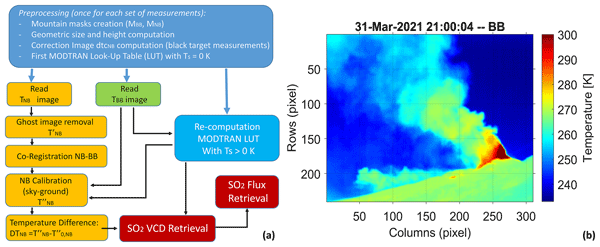
This work presents a new simplified ground-based thermal infrared (TIR) system capable of detecting and retrieving volcanic emissions during both the day and the night. Knowing the location of the instrument and the crater, it is possible to compute the geometry (height and thickness) of a volcanic plume. Furthermore, thanks to a specific filter positioned in front of one of the TIR cameras, it is possible to compute the sulfur dioxide (SO2) content emitted by the volcano at a safe distance from the vent.
Camilo Naranjo, Marcello Bitetto, Maria Fabrizia Buongiorno, Ernesto Corrales, Jorge Andres Diaz, Alessandro Filippeschi, Matteo Gemignani, Gaetano Giudice, Lorenzo Guerrieri, Irene Marsili, Luca Merucci, Malvina Silvestri, Dario Stelitano, Angelo Vitale, Riccardo Biondi, Salvo Marcuccio, and Stefano Corradini
EGUsphere, https://doi.org/10.5194/egusphere-2026-226, https://doi.org/10.5194/egusphere-2026-226, 2026
Preprint archived
Short summary
Short summary
This work presents a new lightweight and low-cost multi-gas sensor instrument, called Volcanosonda. It is designed to be deployed into volcanic clouds using sounding balloons, enabling in-situ measurements to enhance the characterization of key volcanic gases (SO2, CO2), together with atmospheric parameters such as pressure, relative humidity, and temperature.
Lorenzo Guerrieri, Stefano Corradini, Luca Merucci, Dario Stelitano, Fred Prata, Linda Lambertucci, Camilo Naranjo, and Riccardo Biondi
Atmos. Meas. Tech., 18, 5281–5297, https://doi.org/10.5194/amt-18-5281-2025, https://doi.org/10.5194/amt-18-5281-2025, 2025
Short summary
Short summary
This work presents a new simplified ground-based thermal infrared (TIR) system capable of detecting and retrieving volcanic emissions during both the day and the night. Knowing the location of the instrument and the crater, it is possible to compute the geometry (height and thickness) of a volcanic plume. Furthermore, thanks to a specific filter positioned in front of one of the TIR cameras, it is possible to compute the sulfur dioxide (SO2) content emitted by the volcano at a safe distance from the vent.
Alessandro Bigi, Giorgio Veratti, Elisabeth Andrews, Martine Collaud Coen, Lorenzo Guerrieri, Vera Bernardoni, Dario Massabò, Luca Ferrero, Sergio Teggi, and Grazia Ghermandi
Atmos. Chem. Phys., 23, 14841–14869, https://doi.org/10.5194/acp-23-14841-2023, https://doi.org/10.5194/acp-23-14841-2023, 2023
Short summary
Short summary
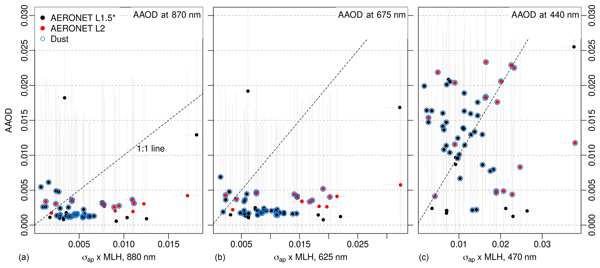
Atmospheric particles include compounds that play a key role in the greenhouse effect and air toxicity. Concurrent observations of these compounds by multiple instruments are presented, following deployment within an urban environment in the Po Valley, one of Europe's pollution hotspots. The study compares these data, highlighting the impact of ground emissions, mainly vehicular traffic and biomass burning, on the absorption of sun radiation and, ultimately, on climate change and air quality.
Herizo Narivelo, Paul David Hamer, Virginie Marécal, Luke Surl, Tjarda Roberts, Sophie Pelletier, Béatrice Josse, Jonathan Guth, Mickaël Bacles, Simon Warnach, Thomas Wagner, Stefano Corradini, Giuseppe Salerno, and Lorenzo Guerrieri
Atmos. Chem. Phys., 23, 10533–10561, https://doi.org/10.5194/acp-23-10533-2023, https://doi.org/10.5194/acp-23-10533-2023, 2023
Short summary
Short summary
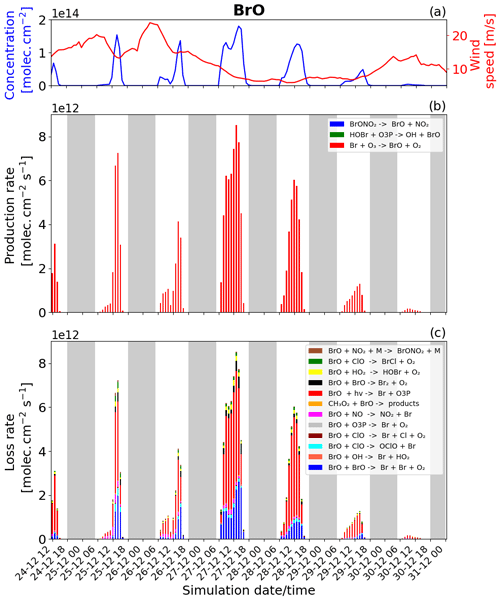
Volcanic emissions emit large quantities of gases and primary aerosols that can play an important role in atmospheric chemistry. We present a study of the fate of volcanic bromine emissions from the eruption of Mount Etna around Christmas 2018. Using a numerical model and satellite observations, we analyse the impact of the volcanic plume and how it modifies the composition of the air over the whole Mediterranean basin, in particular on tropospheric ozone through the bromine-explosion cycle.
Ilaria Petracca, Davide De Santis, Matteo Picchiani, Stefano Corradini, Lorenzo Guerrieri, Fred Prata, Luca Merucci, Dario Stelitano, Fabio Del Frate, Giorgia Salvucci, and Giovanni Schiavon
Atmos. Meas. Tech., 15, 7195–7210, https://doi.org/10.5194/amt-15-7195-2022, https://doi.org/10.5194/amt-15-7195-2022, 2022
Short summary
Short summary
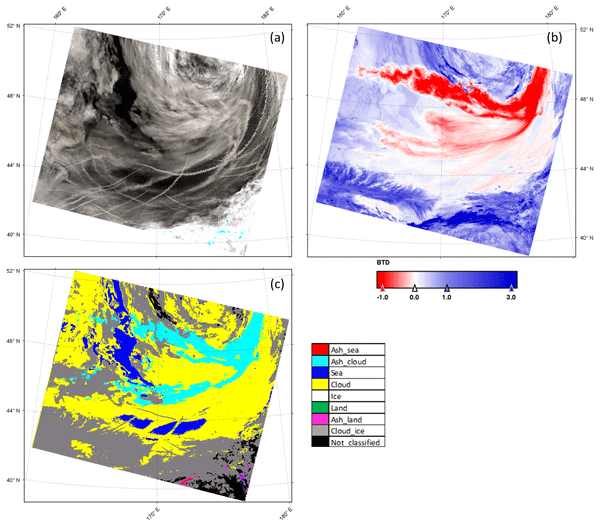
The authors propose a near-real-time procedure for the detection of volcanic clouds by means of Sentinel-3 satellite data and neural networks. The algorithm results in an automatic image classification where ashy pixels are distinguished from other surfaces with remarkable accuracy. The model is considerably faster if compared to other approaches which are time consuming, case specific, and not automatic. The algorithm can be significantly helpful for emergency management during eruption events.
Cited articles
Alexander, D.: Volcanic ash in the atmosphere and risks for civil aviation: A study in European crisis management, Int. J. Disast. Risk Sc., 4, 9–19, https://doi.org/10.1007/s13753-013-0003-0, 2013.
Ash RGB Quick Guide | EUMETSAT: User Portal, https://user.eumetsat.int/resources/user-guides/ash-rgb-quick-guide (last access: 4 March 2025).
Atkinson, P. M. and Tatnall, A. R. L.: Introduction Neural networks in remote sensing, Int. J. Remote Sens., 18, 699–709, https://doi.org/10.1080/014311697218700, 1997.
Braga-Neto, U.: Fundamentals of Pattern Recognition and Machine Learning, Springer, 1–357, https://doi.org/10.1007/978-3-030-27656-0, 2020.
Bröcker, J. and Smith, L. A.: Increasing the Reliability of Reliability Diagrams, Weather Forecast., 22, 651–661, https://doi.org/10.1175/WAF993.1, 2007.
Buades, A., Coll, B., and Morel, J. M.: A non-local algorithm for image denoising, in: Proceedings – 2005 IEEE Computer Society Conference on Computer Vision and Pattern Recognition, CVPR 2005, II, 60–65, https://doi.org/10.1109/CVPR.2005.38, 2005.
Calvari, S. and Nunnari, G.: Comparison between Automated and Manual Detection of Lava Fountains from Fixed Monitoring Thermal Cameras at Etna Volcano, Italy, Remote Sens., 14, 2392, https://doi.org/10.3390/RS14102392, 2022.
Corradini, S., Spinetti, C., Carboni, E., Tirelli, C., Buongiorno, M. F., Pugnaghi, S., and Gangale, G.: Mt. Etna tropospheric ash retrieval and sensitivity analysis using Moderate Resolution Imaging Spectroradiometer measurements, J. Appl. Remote Sens., 2, 023550, https://doi.org/10.1117/1.3046674, 2008.
Corradini, S., Merucci, L., and Prata, A. J.: Retrieval of SO2 from thermal infrared satellite measurements: correction procedures for the effects of volcanic ash, Atmos. Meas. Tech., 2, 177–191, https://doi.org/10.5194/amt-2-177-2009, 2009.
Durant, A. J., Shaw, R. A., Rose, W. I., Mi, Y., and Ernst, G. G. J.: Ice nucleation and overseeding of ice in volcanic clouds, J. Geophys. Res.-Atmos., 113, 9206, https://doi.org/10.1029/2007JD009064, 2008.
Ellrod, G. P., Connell, B. H., and Hillger, D. W.: Improved detection of airborne volcanic ash using multispectral infrared satellite data, J. Geophys. Res.-Atmos., 108, 4356, https://doi.org/10.1029/2002JD002802, 2003.
EUMETSAT: MSG Level 1.5 Image Data Format Description, Darmstadt, Germany, https://user.eumetsat.int/s3/eup-strapi-media/pdf_ten_05105_msg_img_data_e7c8b315e6.pdf (last access: 29 June 2026), 2017.
Fawcett, T.: An introduction to ROC analysis, Pattern Recognit. Lett., 27, 861–874, https://doi.org/10.1016/J.PATREC.2005.10.010, 2006.
Flora, M. L., Potvin, C. K., McGovern, A., and Handler, S.: A Machine Learning Explainability Tutorial for Atmospheric Sciences, Artificial Intelligence for the Earth Systems, 3, https://doi.org/10.1175/AIES-D-23-0018.1, 2024.
Gray, T. M. and Bennartz, R.: Automatic volcanic ash detection from MODIS observations using a back-propagation neural network, Atmos. Meas. Tech., 8, 5089–5097, https://doi.org/10.5194/amt-8-5089-2015, 2015.
Guerrieri, L., Corradini, S., Theys, N., Stelitano, D., and Merucci, L.: Volcanic Clouds Characterization of the 2020–2022 Sequence of Mt. Etna Lava Fountains Using MSG-SEVIRI and Products' Cross-Comparison, Remote Sens., 15, 2055, https://doi.org/10.3390/rs15082055, 2023.
Guo, C., Pleiss, G., Sun, Y., and Weinberger, K. Q.: On Calibration of Modern Neural Networks, in: 34th International Conference on Machine Learning, ICML 2017, 3, 2130–2143, https://doi.org/10.48550/arXiv.1706.04599, 2017.
Gupta, A. K., Bennartz, R., Fauria, K. E., and Mittal, T.: Eruption chronology of the December 2021 to January 2022 Hunga Tonga-Hunga Ha'apai eruption sequence, Commun. Earth Environ., 3, 1–10, https://doi.org/10.1038/s43247-022-00606-3, 2022.
Hillger, D. W. and Clark, J. D.: Principal Component Image Analysis of MODIS for Volcanic Ash. Part I: Most Important Bands and Implications for Future GOES Imagers, J. Appl. Meteorol., 41, 985–1001, https://doi.org/10.1175/1520-0450(2002)041<0985:PCIAOM>2.0.CO;2, 2002.
ICAO: Roadmap for International Airways Volcano Watch (IAVW) in Support of International Air Navigation, International Civil Aviation Organization, 2021.
ICAO: Quantitative Volcanic Ash (QVA) Concentration Information, International Civil Aviation Organization, 5 pp., 2024.
INGV: ETNA Bollettino Settimanale 01/03/2021–07/03/2021, Rep. N° 10/2021, 1–16 pp., https://www.ct.ingv.it/index.php/monitoraggio-e-sorveglianza/prodotti-del-monitoraggio/bollettini-settimanali-multidisciplinari/476-bollettino-settimanale-sul-monitoraggio-vulcanico-geochimico-e-sismico-del-vulcano-etna20210309/file (last access: 29 June 2026), 2021a.
INGV: ETNA Bollettino Settimanale 22/02/2021–28/02/2021, Rep. N° 09/2021, 1–15 pp., https://www.ct.ingv.it/index.php/monitoraggio-e-sorveglianza/prodotti-del-monitoraggio/bollettini-settimanali-multidisciplinari/474-bollettino-settimanale-sul-monitoraggio-vulcanico-geochimico-e-sismico-del-vulcano-etna20210302/file (last access: 29 June 2026), 2021b.
INGV: ETNA Bollettino Settimanale 29/07/2024–04/08/2024, Rep. N. 32/2024, https://www.ct.ingv.it/index.php/monitoraggio-e-sorveglianza/prodotti-del-monitoraggio/bollettini-settimanali-multidisciplinari/929-bollettino-Settimanale-sul-monitoraggio-vulcanico-geochimico-e-sismico-del-vulcano-Etna-del-2024-08-06/file (last access: 29 June 2026), 2024.
Jenkins, S., Smith, C., Allen, M., and Grainger, R.: Tonga eruption increases chance of temporary surface temperature anomaly above 1.5 °C, Nat. Clim. Change, 13, 127–129, https://doi.org/10.1038/s41558-022-01568-2, 2023.
Kingma, D. P. and Ba, J. L.: Adam: A Method for Stochastic Optimization, in: 3rd International Conference on Learning Representations, ICLR 2015 – Conference Track Proceedings, https://arxiv.org/pdf/1412.6980 (last access: 29 June 2026), 2014.
Lundberg, S. M., Allen, P. G., and Lee, S.-I.: A Unified Approach to Interpreting Model Predictions, in: 31st Conference on Neural Information Processing Systems (NIPS), https://doi.org/10.48550/arXiv.1705.07874, 2017.
Marshall, L. R., Maters, E. C., Schmidt, A., Timmreck, C., Robock, A., and Toohey, M.: Volcanic effects on climate: recent advances and future avenues, B. Volcanol., 84, 1–14, https://doi.org/10.1007/S00445-022-01559-3, 2022.
Mayberry, G. C., Rose, W. I., and Bluth, G. J. S.: Dynamics of volcanic and meteorological clouds produced on 26 December (Boxing Day) 1997 at Soufrière Hills Volcano, Montserrat, Geol. Soc. Mem., 21, 539–556, https://doi.org/10.1144/GSL.MEM.2002.021.01.24, 2002.
Naranjo, C., Guerrieri, L., Corradini, S., Picchiani, M., Merucci, L., and Stelitano, D.: Balanced Dataset of SEVIRI Observations for the Detection of Volcanic Clouds Composed of Ash, Ice, and SO2, Zenodo, https://doi.org/10.5281/zenodo.20313629, 2026.
Niculescu-Mizil, A. and Caruana, R.: Predicting good probabilities with supervised learning, in: ICML 2005 – Proceedings of the 22nd International Conference on Machine Learning, 625–632, https://doi.org/10.1145/1102351.1102430, 2005.
Ojala, M. and Garriga, G. C.: Permutation Tests for Studying Classifier Performance, Journal of Machine Learning Research, 11, 1833–1863, 2010.
Pardini, F., Barsotti, S., Bonadonna, C., Vitturi, M. de' M., Folch, A., Mastin, L., Osores, S., and Prata, A. T.: Dynamics, Monitoring, and Forecasting of Tephra in the Atmosphere, Rev. Geophys., 62, e2023RG000808, https://doi.org/10.1029/2023RG000808, 2024.
Pavolonis, M. J., Feltz, W. F., Heidinger, A. K., and Gallina, G. M.: A Daytime Complement to the Reverse Absorption Technique for Improved Automated Detection of Volcanic Ash, J. Atmos. Ocean. Technol., 23, 1422–1444, https://doi.org/10.1175/JTECH1926.1, 2006.
Pavolonis, M. J., Sieglaff, J., and Cintineo, J.: Spectrally Enhanced Cloud Objects—A generalized framework for automated detection of volcanic ash and dust clouds using passive satellite measurements: 1. Multispectral analysis, J. Geophys. Res.-Atmos., 120, 7813–7841, https://doi.org/10.1002/2014JD022968, 2015a.
Pavolonis, M. J., Sieglaff, J., and Cintineo, J.: Spectrally Enhanced Cloud Objects—A generalized framework for automated detection of volcanic ash and dust clouds using passive satellite measurements: 2. Cloud object analysis and global application, J. Geophys. Res.-Atmos., 120, 7842–7870, https://doi.org/10.1002/2014JD022969, 2015b.
Pavolonis, M. J., Sieglaff, J., and Cintineo, J.: Automated Detection of Explosive Volcanic Eruptions Using Satellite-Derived Cloud Vertical Growth Rates, Earth Space Sci., 5, 903–928, https://doi.org/10.1029/2018EA000410, 2018.
Pavolonis, M. J., Sieglaff, J. M., and Cintineo, J. L.: Remote Sensing of Volcanic Ash with the GOES-R Series, in: The GOES-R Series: A New Generation of Geostationary Environmental Satellites, Elsevier, 103–124, https://doi.org/10.1016/B978-0-12-814327-8.00010-X, 2020.
Pergola, N., Tramutoli, V., Marchese, F., Scaffidi, I., and Lacava, T.: Improving volcanic ash cloud detection by a robust satellite technique, Remote Sens. Environ., 90, 1–22, https://doi.org/10.1016/J.RSE.2003.11.014, 2004.
Petracca, I., De Santis, D., Picchiani, M., Corradini, S., Guerrieri, L., Prata, F., Merucci, L., Stelitano, D., Del Frate, F., Salvucci, G., and Schiavon, G.: Volcanic cloud detection using Sentinel-3 satellite data by means of neural networks: the Raikoke 2019 eruption test case, Atmos. Meas. Tech., 15, 7195–7210, https://doi.org/10.5194/amt-15-7195-2022, 2022.
Picchiani, M., Chini, M., Corradini, S., Merucci, L., Sellitto, P., Del Frate, F., and Stramondo, S.: Volcanic ash detection and retrievals using MODIS data by means of neural networks, Atmos. Meas. Tech., 4, 2619–2631, https://doi.org/10.5194/amt-4-2619-2011, 2011.
Picchiani, M., Chini, M., Corradini, S., Merucci, L., Piscini, A., and Del Frate, F.: Neural network multispectral satellite images classification of volcanic ash plumes in a cloudy scenario, Ann. Geophys., 57, https://doi.org/10.4401/ag-6638, 2015.
Pinheiro, J. M. H., Oliveira, S. V. B. de, Silva, T. H. S., Saraiva, P. A. R., Souza, E. F. de, Godoy, R. V., Ambrosio, L. A., and Becker, M.: The Impact of Feature Scaling in Machine Learning: Effects on Regression and Classification Tasks, IEEE Access, 13, 199903–199931, https://doi.org/10.1109/ACCESS.2025.3635541, 2025.
Piscini, A., Picchiani, M., Chini, M., Corradini, S., Merucci, L., Del Frate, F., and Stramondo, S.: A neural network approach for the simultaneous retrieval of volcanic ash parameters and SO2 using MODIS data, Atmos. Meas. Tech., 7, 4023–4047, https://doi.org/10.5194/amt-7-4023-2014, 2014.
Prata, A. J.: Infrared radiative transfer calculations for volcanic ash clouds, Geophys. Res. Lett., 16, 1293–1296, https://doi.org/10.1029/GL016i011p01293, 1989a.
Prata, A. J.: Observations of Volcanic Ash Clouds in the 10–12 micrometers window using AVHRR-2 data, https://doi.org/10.1080/01431168908903916, 1989b.
Prata, A. T., Folch, A., Prata, A. J., Biondi, R., Brenot, H., Cimarelli, C., Corradini, S., Lapierre, J., and Costa, A.: Anak Krakatau triggers volcanic freezer in the upper troposphere, Sci. Rep., 10, 1–13, https://doi.org/10.1038/s41598-020-60465-w, 2020.
Prata, A. T., Grainger, R. G., Taylor, I. A., Povey, A. C., Proud, S. R., and Poulsen, C. A.: Uncertainty-bounded estimates of ash cloud properties using the ORAC algorithm: application to the 2019 Raikoke eruption, Atmos. Meas. Tech., 15, 5985–6010, https://doi.org/10.5194/amt-15-5985-2022, 2022.
Prata, F. and Rose, B.: Volcanic Ash Hazards to Aviation, in: The Encyclopedia of Volcanoes, Academic Press, 911–934, https://doi.org/10.1016/B978-0-12-385938-9.00052-3, 2015.
Prata, F., Bluth, G., Rose, B., Schneider, D., and Tupper, A.: Comments on “Failures in detecting volcanic ash from a satellite-based technique,” Remote Sens. Environ., 78, 341–346, https://doi.org/10.1016/S0034-4257(01)00231-0, 2001.
Pugnaghi, S., Guerrieri, L., Corradini, S., Merucci, L., and Arvani, B.: A new simplified approach for simultaneous retrieval of SO2 and ash content of tropospheric volcanic clouds: an application to the Mt Etna volcano, Atmos. Meas. Tech., 6, 1315–1327, https://doi.org/10.5194/amt-6-1315-2013, 2013.
Pugnaghi, S., Guerrieri, L., Corradini, S., and Merucci, L.: Real time retrieval of volcanic cloud particles and SO2 by satellite using an improved simplified approach, Atmos. Meas. Tech., 9, 3053–3062, https://doi.org/10.5194/amt-9-3053-2016, 2016.
Rainio, O., Teuho, J., and Klén, R.: Evaluation metrics and statistical tests for machine learning, Sci. Rep., 14, 1–14, https://doi.org/10.1038/s41598-024-56706-x, 2024.
Romeo, F., Mereu, L., Scollo, S., Papa, M., Corradini, S., Merucci, L., and Marzano, F. S.: Volcanic Cloud Detection and Retrieval Using Satellite Multisensor Observations, Remote Sens., 15, 888, https://doi.org/10.3390/RS15040888, 2023.
Rose, W. I., Delene, D. J., Schneider, D. J., Bluth, G. J. S., Krueger, A. J., Sprod, I., McKee, C., Davies, H. L., and Ernst, G. G. J.: Ice in the 1994 Rabaul eruption cloud: implications for volcano hazard and atmospheric effects, Nature, 375, 477–479, https://doi.org/10.1038/375477a0, 1995.
Rose, W. I., Gu, Y., Watson, I. M., Yu, T., Bluth, G. J. S., Prata, A. J., Krueger, A. J., Krotkov, N. A., Carn, S., Fromm, M. D., Hunton, D. E., Ernst, G. G. J., Viggiano, A. A., Miller, T. M., Ballenthin, J. O., Reeves, J. M., Wilson, J. C., Anderson, B. E., and Flittner, E.: The February–March 2000 Eruption of Hekla, Iceland from a Satellite Perspective, Geoph. Monog. Series, 139, 107–132, https://doi.org/10.1029/139GM07, 2003.
Schill, G. P., Genareau, K., and Tolbert, M. A.: Deposition and immersion-mode nucleation of ice by three distinct samples of volcanic ash, Atmos. Chem. Phys., 15, 7523–7536, https://doi.org/10.5194/acp-15-7523-2015, 2015.
Schmit, T. J. and Gunshor, M. M.: ABI Imagery from the GOES-R Series, in: The GOES-R Series: A New Generation of Geostationary Environmental Satellites, Elsevier, 23–34, https://doi.org/10.1016/B978-0-12-814327-8.00004-4, 2020.
Seifert, P., Ansmann, A., Groß, S., Freudenthaler, V., Heinold, B., Hiebsch, A., Mattis, I., Schmidt, J., Schnell, F., Tesche, M., Wandinger, U., and Wiegner, M.: Ice formation in ash-influenced clouds after the eruption of the Eyjafjallajökull volcano in April 2010, J. Geophys. Res.-Atmos., 116, 0–04, https://doi.org/10.1029/2011JD015702, 2011.
Stelitano, D., Merucci, L., Ficeli, P., and Zanolin, F.: Satellite Acquisition System at INGV Rome headquarters, Rapp. Tec. INGV, 470, 1–34, https://doi.org/10.13127/rpt/470, 2023.
Stewart, C., Damby, D. E., Horwell, C. J., Elias, T., Ilyinskaya, E., Tomašek, I., Longo, B. M., Schmidt, A., Carlsen, H. K., Mason, E., Baxter, P. J., Cronin, S., and Witham, C.: Volcanic air pollution and human health: recent advances and future directions, B. Volcanol., 84:1, 84, 1–25, https://doi.org/10.1007/S00445-021-01513-9, 2021.
Sun, Z., Sandoval, L., Crystal-Ornelas, R., Mousavi, S. M., Wang, J., Lin, C., Cristea, N., Tong, D., Carande, W. H., Ma, X., Rao, Y., Bednar, J. A., Tan, A., Wang, J., Purushotham, S., Gill, T. E., Chastang, J., Howard, D., Holt, B., Gangodagamage, C., Zhao, P., Rivas, P., Chester, Z., Orduz, J., and John, A.: A review of Earth Artificial Intelligence, Comput. Geosci., 159, 105034, https://doi.org/10.1016/J.CAGEO.2022.105034, 2022.
Taylor, I. A., Grainger, R. G., Prata, A. T., Proud, S. R., Mather, T. A., and Pyle, D. M.: A satellite chronology of plumes from the April 2021 eruption of La Soufrière, St Vincent, Atmos. Chem. Phys., 23, 15209–15234, https://doi.org/10.5194/acp-23-15209-2023, 2023.
Theys, N., Campion, R., Clarisse, L., Brenot, H., van Gent, J., Dils, B., Corradini, S., Merucci, L., Coheur, P.-F., Van Roozendael, M., Hurtmans, D., Clerbaux, C., Tait, S., and Ferrucci, F.: Volcanic SO2 fluxes derived from satellite data: a survey using OMI, GOME-2, IASI and MODIS, Atmos. Chem. Phys., 13, 5945–5968, https://doi.org/10.5194/acp-13-5945-2013, 2013.
Torrisi, F., Amato, E., Corradino, C., Mangiagli, S., and Del Negro, C.: Characterization of Volcanic Cloud Components Using Machine Learning Techniques and SEVIRI Infrared Images, Sensors, 22, 7712, https://doi.org/10.3390/S22207712, 2022.
Torrisi, F., Corradino, C., Cariello, S., and Del Negro, C.: Enhancing detection of volcanic ash clouds from space with convolutional neural networks, J. Volcanol. Geoth. Res., 448, 108046, https://doi.org/10.1016/J.JVOLGEORES.2024.108046, 2024.
Velez, D. R., White, B. C., Motsinger, A. A., Bush, W. S., Ritchie, M. D., Williams, S. M., and Moore, J. H.: A balanced accuracy function for epistasis modeling in imbalanced datasets using multifactor dimensionality reduction, Genet. Epidemiol., 31, 306–315, https://doi.org/10.1002/gepi.20211, 2007.
Wang, C., Yang, P., Baum, B. A., Platnick, S., Heidinger, A. K., Hu, Y., Holz, R. E., Wang, C., Yang, P., Baum, B. A., Platnick, S., Heidinger, A. K., Hu, Y., and Holz, R. E.: Retrieval of Ice Cloud Optical Thickness and Effective Particle Size Using a Fast Infrared Radiative Transfer Model, J. Appl. Meteorol. Clim., 50, 2283–2297, https://doi.org/10.1175/JAMC-D-11-067.1, 2011.
Wang, P. K.: Physics and Dynamics of Clouds and Precipitation, Cambridge University Press, 1–460, https://doi.org/10.1017/CBO9780511794285, 2013.
Yang, X.-S.: Neural networks and deep learning, Introduction to Algorithms for Data Mining and Machine Learning, Academic Press, 139–161, https://doi.org/10.1016/B978-0-12-817216-2.00015-6, 2019.
Yu, T., Rose, W. I., and Prata, A. J.: Atmospheric correction for satellite-based volcanic ash mapping and retrievals using “split window” IR data from GOES and AVHRR, J. Geophys. Res.-Atmos, 107, AAC10-1–AAC10-19, https://doi.org/10.1029/2001JD000706, 2002.
Short summary
This work presents the development of a neural network model for detecting volcanic clouds under challenging conditions, where the cloud contains not only ash but also sulfur dioxide and ice. The presence of ice complicates detection and often leads to failures in traditional methods. Our results show that the neural network improves detection performance and supports the automatic volcanic cloud monitoring, which is crucial for aviation safety.
This work presents the development of a neural network model for detecting volcanic clouds under...


