Articles | Volume 19, issue 2
https://doi.org/10.5194/amt-19-461-2026
© Author(s) 2026. This work is distributed under
the Creative Commons Attribution 4.0 License.
https://doi.org/10.5194/amt-19-461-2026
© Author(s) 2026. This work is distributed under
the Creative Commons Attribution 4.0 License.
Have you ever seen the rain? Observing a record convective rainfall with national and local monitoring networks and opportunistic sensors

Louise Petersson Wårdh
CORRESPONDING AUTHOR
Division of Water Resources Engineering, Faculty of Engineering, Lund University, P.O. Box 118, 22100 Lund, Sweden
Swedish Meteorological and Hydrological Institute (SMHI), Folkborgsvägen 17, 601 76 Norrköping, Sweden
Hasan Hosseini
Division of Water Resources Engineering, Faculty of Engineering, Lund University, P.O. Box 118, 22100 Lund, Sweden
Swedish Meteorological and Hydrological Institute (SMHI), Folkborgsvägen 17, 601 76 Norrköping, Sweden
Remco van de Beek
Swedish Meteorological and Hydrological Institute (SMHI), Folkborgsvägen 17, 601 76 Norrköping, Sweden
Jafet C. M. Andersson
Swedish Meteorological and Hydrological Institute (SMHI), Folkborgsvägen 17, 601 76 Norrköping, Sweden
Hossein Hashemi
Division of Water Resources Engineering, Faculty of Engineering, Lund University, P.O. Box 118, 22100 Lund, Sweden
Jonas Olsson
Division of Water Resources Engineering, Faculty of Engineering, Lund University, P.O. Box 118, 22100 Lund, Sweden
Swedish Meteorological and Hydrological Institute (SMHI), Folkborgsvägen 17, 601 76 Norrköping, Sweden
Related authors
No articles found.
Nan Wu, Ke Zhang, Amir Naghibi, Hossein Hashemi, Zhongrui Ning, and Jerker Jarsjö
Hydrol. Earth Syst. Sci., 29, 5913–5930, https://doi.org/10.5194/hess-29-5913-2025, https://doi.org/10.5194/hess-29-5913-2025, 2025
Short summary
Short summary
This study explores how snow dynamics and hydropower reservoirs shape monthly runoff in the Yalong River basin, China. Using 15 years of data and an extended Budyko framework, we found that snow accumulation and melt dominate runoff in high-altitude areas, while reservoirs increasingly influence lower elevations. These factors reduce runoff seasonality at the basin outlet, emphasizing how climate change and human activity alter water availability in cold, mountainous regions.
Nan Wu, Ke Zhang, Amir Naghibi, Hossein Hashemi, Zhongrui Ning, Qinuo Zhang, Xuejun Yi, Haijun Wang, Wei Liu, Wei Gao, and Jerker Jarsjö
Hydrol. Earth Syst. Sci., 29, 3703–3725, https://doi.org/10.5194/hess-29-3703-2025, https://doi.org/10.5194/hess-29-3703-2025, 2025
Short summary
Short summary
This study enhanced a popular water flow model by adding two components: one for snow melting and another for frozen ground cycles. Tested with satellite data and streamflow, the updated model improved accuracy, especially in winter. Frozen ground delays soil drainage, boosting spring runoff by 39 %–77 % and cutting evaporation by 85 %. These findings reveal that frozen ground drives seasonal water patterns.
Erlend Øydvin, Renaud Gaban, Jafet Andersson, Remco (C. Z.) van de Beek, Mareile Astrid Wolff, Nils-Otto Kitterød, Christian Chwala, and Vegard Nilsen
Atmos. Meas. Tech., 18, 2279–2293, https://doi.org/10.5194/amt-18-2279-2025, https://doi.org/10.5194/amt-18-2279-2025, 2025
Short summary
Short summary
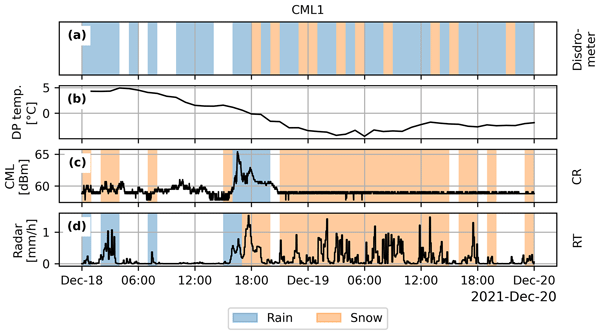
We present a novel method for classifying rain and snow by combining data from commercial microwave links (CMLs) with weather radar. We compare this to a reference method using dew point temperature for precipitation type classification. Evaluations with nearby disdrometers show that CMLs improve the classification of dry snow and rainfall, outperforming the reference method.
Hideo Amaguchi, Jonas Olsson, Akira Kawamura, and Yoshiyuki Imamura
Proc. IAHS, 386, 133–140, https://doi.org/10.5194/piahs-386-133-2024, https://doi.org/10.5194/piahs-386-133-2024, 2024
Short summary
Short summary
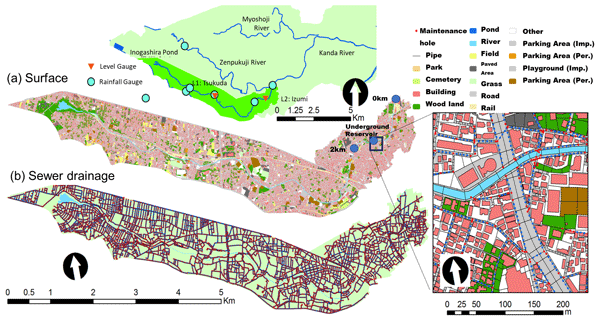
In this research, event-based simulations were conducted using inputs from a regional climate model, providing a resolution of 5 km and updating every 10 min for both present and future climate scenarios. The findings suggest that future storms may lead to increased flooding in the watershed. This study highlights the importance of using high-resolution data to understand and prepare for the potential impacts of climate change on urban rivers.
Jafet C. M. Andersson, Jonas Olsson, Remco (C. Z.) van de Beek, and Jonas Hansryd
Earth Syst. Sci. Data, 14, 5411–5426, https://doi.org/10.5194/essd-14-5411-2022, https://doi.org/10.5194/essd-14-5411-2022, 2022
Short summary
Short summary
This article presents data from three types of sensors for rain measurement, i.e. commercial microwave links (CMLs), gauges, and weather radar. Access to CML data is typically restricted, which limits research and applications. We openly share a large CML database (364 CMLs at 10 s resolution with true coordinates), along with 11 gauges and one radar composite. This opens up new opportunities to study CMLs, to benchmark algorithms, and to investigate how multiple sensors can best be combined.
Judit Lienert, Jafet C. M. Andersson, Daniel Hofmann, Francisco Silva Pinto, and Martijn Kuller
Hydrol. Earth Syst. Sci., 26, 2899–2922, https://doi.org/10.5194/hess-26-2899-2022, https://doi.org/10.5194/hess-26-2899-2022, 2022
Short summary
Short summary
Many western Africans encounter serious floods every year. The FANFAR project co-designed a pre-operational flood forecasting system (FEWS) with 50 key western African stakeholders. Participatory multi-criteria decision analysis (MCDA) helped prioritize a FEWS that meets their needs: it should provide accurate, clear, and timely flood risk information and work reliably in tough conditions. As a theoretical contribution, we propose an assessment framework for transdisciplinary hydrology research.
Erika Médus, Emma D. Thomassen, Danijel Belušić, Petter Lind, Peter Berg, Jens H. Christensen, Ole B. Christensen, Andreas Dobler, Erik Kjellström, Jonas Olsson, and Wei Yang
Nat. Hazards Earth Syst. Sci., 22, 693–711, https://doi.org/10.5194/nhess-22-693-2022, https://doi.org/10.5194/nhess-22-693-2022, 2022
Short summary
Short summary
We evaluate the skill of a regional climate model, HARMONIE-Climate, to capture the present-day characteristics of heavy precipitation in the Nordic region and investigate the added value provided by a convection-permitting model version. The higher model resolution improves the representation of hourly heavy- and extreme-precipitation events and their diurnal cycle. The results indicate the benefits of convection-permitting models for constructing climate change projections over the region.
Jonas Olsson, Peter Berg, and Remco van de Beek
Adv. Sci. Res., 18, 59–64, https://doi.org/10.5194/asr-18-59-2021, https://doi.org/10.5194/asr-18-59-2021, 2021
Short summary
Short summary
We have developed a tool to visualize rainfall observations, based on a combination of meteorological stations and weather radars, over Sweden in near real-time. By accumulating the rainfall in time (1–12 h) and space (hydrological basins), the tool is designed mainly for hydrological applications, e.g. to support flood forecasters and to facilitate post-event analyses. Despite evident uncertainties, different users have confirmed an added value of the tool in case studies.
Judit Lienert, Jafet Andersson, Daniel Hofmann, Francisco Silva Pinto, and Martijn Kuller
Hydrol. Earth Syst. Sci. Discuss., https://doi.org/10.5194/hess-2021-177, https://doi.org/10.5194/hess-2021-177, 2021
Manuscript not accepted for further review
Short summary
Short summary
West Africa faces serious floods, affecting millions of people every year. The FANFAR project co-designed a flood forecasting and warning system at lively workshops together with 50–60 key West African stakeholders. We prioritized FANFAR system configurations that best meet stakeholders’ needs and expectations. Stakeholders preferred a system producing accurate, clear, and accessible flood risk information, which works reliably under difficult West African conditions.
Cited articles
Andersson, J. C. M., Olsson, J., van de Beek, R. (C Z.), and Hansryd, J.: OpenMRG: Open data from Microwave links, Radar, and Gauges for rainfall quantification in Gothenburg, Sweden, Earth Syst. Sci. Data, 14, 5411–5426, https://doi.org/10.5194/essd-14-5411-2022, 2022.
Bárdossy, A., Seidel, J., and El Hachem, A.: The use of personal weather station observations to improve precipitation estimation and interpolation, Hydrol. Earth Syst. Sci., 25, 583–601, https://doi.org/10.5194/hess-25-583-2021, 2021.
Båserud, L., Lussana, C., Nipen, T. N., Seierstad, I. A., Oram, L., and Aspelien, T.: TITAN automatic spatial quality control of meteorological in-situ observations, Adv. Sci. Res., 17, 153–163, https://doi.org/10.5194/asr-17-153-2020, 2020.
Battan, L. J.: Radar Observation of the Atmosphere, Rev. Edn., University of Chicago Press, https://doi.org/10.1002/qj.49709942229, 1973.
Bengtsson, L.: Regn i Båstad, Vatten Tidskr, För Vattenvård J. Water Manag. Res., 1–2, 61–70, 2023.
Berne, A. and Uijlenhoet, R.: Path-averaged rainfall estimation using microwave links: Uncertainty due to spatial rainfall variability, Geophys. Res. Lett., 34, https://doi.org/10.1029/2007GL029409, 2007.
Blettner, N., Fencl, M., Bareš, V., Kunstmann, H., and Chwala, C.: Transboundary rainfall estimation using commercial microwave links, Earth Space Sci., 10, e2023EA002869, https://doi.org/10.1029/2023EA002869, 2023.
Bobotová, G., Sokol, Z., Popová, J., Fišer, O., and Zacharov, P.: Analysis of two convective storms using polarimetric X-band radar and satellite data, Remote Sens., 14, 2294, https://doi.org/10.3390/rs14102294, 2022.
Boonstra, M. M. T.: Delft Measures Rain. A quality assessment of precipitation measurements from personal weather stations, MS thesis, Delft University of Technology, the Netherlands, https://resolver.tudelft.nl/uuid:c5720b7e-1828-4948-a76a-89a6361b3e03 (last access: 12 January 2026), 2024.
Cherkassky, D., Ostrometzky, J., and Messer, H.: Precipitation classification using measurements from commercial microwave links, IEEE T. Geosci. Remote, 52, 2350–2356, https://doi.org/10.1109/TGRS.2013.2259832, 2014.
Chwala, C. and Kunstmann, H.: Commercial microwave link networks for rainfall observation: Assessment of the current status and future challenges, WIREs Water, 6, e1337, https://doi.org/10.1002/wat2.1337, 2019.
de Vos, L. W., Raupach, T. H., Leijnse, H., Overeem, A., Berne, A., and Uijlenhoet, R.: High-resolution simulation study exploring the potential of radars, crowdsourced personal weather stations, and commercial microwave links to monitor small-scale urban rainfall, Water Resour. Res., 54, 10293–10312, https://doi.org/10.1029/2018WR023393, 2018.
de Vos, L. W., Leijnse, H., Overeem, A., and Uijlenhoet, R.: Quality control for crowdsourced personal weather stations to enable operational rainfall monitoring, Geophys. Res. Lett., 46, 8820–8829, https://doi.org/10.1029/2019GL083731, 2019.
Einfalt, T., Arnbjerg-Nielsen, K., Golz, C., Jensen, N.-E., Quirmbach, M., Vaes, G., and Vieux, B.: Towards a roadmap for use of radar rainfall data in urban drainage, J. Hydrol., 299, 186–202, https://doi.org/10.1016/j.jhydrol.2004.08.004, 2004.
Fencl, M., Nebuloni, R., C. M. Andersson, J., Bares, V., Blettner, N., Cazzaniga, G., Chwala, C., Colli, M., de Vos, L., El Hachem, A., Galdies, C., Giannetti, F., Graf, M., Jacoby, D., Victor Habi, H., Musil, P., Ostrometzky, J., Roversi, G., Sapienza, F., Seidel, J., Spackova, A., van de Beek, R., Walraven, B., Wilgan, K., and Zheng, X.: Data formats and standards for opportunistic rainfall sensors, Open Res. Eur., 3, 169, https://doi.org/10.12688/openreseurope.16068.2, 2024.
Foreningen VeVa: Vejrradar i vandsektoren, https://veva.dk/ (last access: 19 May 2025), 2025.
Fuentes-Andino, D., Beven, K., Halldin, S., Xu, C.-Y., Reynolds, J. E., and Di Baldassarre, G.: Reproducing an extreme flood with uncertain post-event information, Hydrol. Earth Syst. Sci., 21, 3597–3618, https://doi.org/10.5194/hess-21-3597-2017, 2017.
Garcia-Marti, I., Overeem, A., Noteboom, J. W., de Vos, L., de Haij, M., and Whan, K.: From proof-of-concept to proof-of-value: Approaching third-party data to operational workflows of national meteorological services, Int. J. Climatol., 43, 275–292, https://doi.org/10.1002/joc.7757, 2023.
Graf, M., Chwala, C., Polz, J., and Kunstmann, H.: Rainfall estimation from a German-wide commercial microwave link network: optimized processing and validation for 1 year of data, Hydrol. Earth Syst. Sci., 24, 2931–2950, https://doi.org/10.5194/hess-24-2931-2020, 2020.
Graf, M., Chwala, C., Petersson Wårdh, L., and Seidel, J.: OpenSenseAction/pypwsqc: v0.2.1, Zenodo [code], https://doi.org/10.5281/zenodo.16748098, 2025.
Gravlund: Hagel och regnkaos över Båstad: “Aldrig sett något liknande”, https://www.svt.se/nyheter/lokalt/helsingborg/kraftiga-skyfall-over-bastad-har-aldrig-varit-med-om-nagot-liknande (last access: 14 April 2025), 2025.
Guo, Y.: Updating Rainfall IDF Relationships to Maintain Urban Drainage Design Standards, J. Hydrol. Eng., 11, 506–509, https://doi.org/10.1061/(ASCE)1084-0699(2006)11:5(506), 2006.
Gupta, H. V., Sorooshian, S., and Yapo, P. O.: Status of automatic calibration for hydrologic models: comparison with multilevel expert calibration, J. Hydrol. Eng., 4, 135–143, https://doi.org/10.1061/(ASCE)1084-0699(1999)4:2(135), 1999.
Habi, H. V. and Messer, H.: Wet-dry classification using LSTM and commercial microwave links, in: 2018 IEEE 10th Sensor Array and Multichannel Signal Processing Workshop (SAM), Sheffield, UL, 149–153, https://doi.org/10.1109/SAM.2018.8448679, 2018.
Hahn, C., Garcia-Marti, I., Sugier, J., Emsley, F., Beaulant, A.-L., Oram, L., Strandberg, E., Lindgren, E., Sunter, M., and Ziska, F.: Observations from personal weather stations – EUMETNET interests and experience, Climate, 10, 192, https://doi.org/10.3390/cli10120192, 2022.
Hosseini, S. H., Hashemi, H., Berndtsson, R., South, N., Aspegren, H., Larsson, R., Olsson, J., Persson, A., and Olsson, L.: Evaluation of a new X-band weather radar for operational use in south Sweden, Water Sci. Technol., 81, 1623–1635, https://doi.org/10.2166/wst.2020.066, 2020.
Hosseini, S. H., Hashemi, H., Larsson, R., and Berndtsson, R.: Merging dual-polarization X-band radar network intelligence for improved microscale observation of summer rainfall in south Sweden, J. Hydrol., 617, 129090, https://doi.org/10.1016/j.jhydrol.2023.129090, 2023.
Hyndman, R. J. and Koehler, A. B.: Another look at measures of forecast accuracy, Int. J. Forecast., 22, 679–688, https://doi.org/10.1016/j.ijforecast.2006.03.001, 2006.
Imhoff, R. O., Brauer, C. C., Overeem, A., Weerts, A. H., and Uijlenhoet, R.: Spatial and temporal evaluation of radar rainfall nowcasting techniques on 1,533 events, Water Resour. Res., 56, e2019WR026723, https://doi.org/10.1029/2019WR026723, 2020.
ITU-R: Recommendation ITU-R P.838-3: Specific attenuation model for rain for use in prediction methods, Radiocommunication Sector of International Telecommunication Union, https://www.itu.int/rec/R-REC-P.838-3-200503-I/en (last access: 12 January 2026), 2005.
Kaiser, M., Günnemann, S., and Disse, M.: Spatiotemporal analysis of heavy rain-induced flood occurrences in Germany using a novel event database approach, J. Hydrol., 595, 125985, https://doi.org/10.1016/j.jhydrol.2021.125985, 2021.
Kumjian, M.: Principles and applications of dual-polarization weather radar. Part I: Description of the polarimetric radar variables, J. Oper. Meteorol., 1, 226–242, https://doi.org/10.15191/nwajom.2013.0119, 2013.
Lantmäteriet: Laserdata Nedladdning, skog, https://www.lantmateriet.se/sv/geodata/vara-produkter/produktlista/laserdata-nedladdning-skog (last access: 7 November 2025), 2025.
Leijnse, H., Uijlenhoet, R., and Stricker, J. N. M.: Hydrometeorological application of a microwave link: 2. Precipitation, Water Resour. Res., 43, W04417, https://doi.org/10.1029/2006WR004989, 2007a.
Leijnse, H., Uijlenhoet, R., and Stricker, J. N. M.: Rainfall measurement using radio links from cellular communication networks, Water Resour. Res., 43, https://doi.org/10.1029/2006WR005631, 2007b.
Leijnse, H., Uijlenhoet, R., and Stricker, J. N. M.: Microwave link rainfall estimation: Effects of link length and frequency, temporal sampling, power resolution, and wet antenna attenuation, Adv. Water Resour., 31, 1481–1493, https://doi.org/10.1016/j.advwatres.2008.03.004, 2008.
Leijnse, H., Uijlenhoet, R., and Berne, A.: Errors and uncertainties in microwave link rainfall estimation explored using drop size measurements and high-resolution radar data, J. Hydrometeorol., 11, 1330–1344, https://doi.org/10.1175/2010JHM1243.1, 2010.
Lengfeld, K., Clemens, M., Merker, C., Münster, H., and Ament, F.: A simple method for attenuation correction in local X-band radar measurements using C-band radar data, J. Atmos. Ocean. Tech., 33, 2315–2329, https://doi.org/10.1175/JTECH-D-15-0091.1, 2016.
Lewis, E., Pritchard, D., Villalobos-Herrera, R., Blenkinsop, S., McClean, F., Guerreiro, S., Schneider, U., Becker, A., Finger, P., Meyer-Christoffer, A., Rustemeier, E., and Fowler, H. J.: Quality control of a global hourly rainfall dataset, Environ. Model. Softw., 144, 105169, https://doi.org/10.1016/j.envsoft.2021.105169, 2021.
Lussana, C., Baietti, E., Båserud, L., Nipen, T. N., and Seierstad, I. A.: Exploratory analysis of citizen observations of hourly precipitation over Scandinavia, Adv. Sci. Res., 20, 35–48, https://doi.org/10.5194/asr-20-35-2023, 2023.
Mailhot, A. and Duchesne, S.: Design criteria of urban drainage infrastructures under climate change, J. Water Resour. Plan. Manage., 136, 201–208, https://doi.org/10.1061/(ASCE)WR.1943-5452.0000023, 2010.
Mandement, M. and Caumont, O.: Contribution of personal weather stations to the observation of deep-convection features near the ground, Nat. Hazards Earth Syst. Sci., 20, 299–322, https://doi.org/10.5194/nhess-20-299-2020, 2020.
Marchi, L., Borga, M., Preciso, E., Sangati, M., Gaume, E., Bain, V., Delrieu, G., Bonnifait, L., and Pogačnik, N.: Comprehensive post-event survey of a flash flood in Western Slovenia: observation strategy and lessons learned, Hydrol. Process., 23, 3761–3770, https://doi.org/10.1002/hyp.7542, 2009.
Marshall, J. S. and Palmer, W. M. K.: The distribution of raindrops with size, J. Atmos. Sci., 5, 165–166, https://doi.org/10.1175/1520-0469(1948)005<0165:TDORWS>2.0.CO;2, 1948.
MEMO: MEMO, https://www.smhi.se/en/research/about-us/open-access-to-data-for-research-and-development/memo (last access: 15 April 2025), 2025.
Messer, H., Zinevich, A., and Alpert, P.: Environmental monitoring by wireless communication networks, Science, 312, 713–713, https://doi.org/10.1126/science.1120034, 2006.
Michelson, D., Henja, A., Ernes, S., Haase, G., Koistinen, J., Ośródka, K., Peltonen, T., Szewczykowski, M., and Szturc, J.: BALTRAD Advanced Weather Radar Networking, J. Open Res. Softw., 6, 12, https://doi.org/10.5334/jors.193, 2018.
Michelson, D. B. and Koistinen, J.: Gauge-Radar network adjustment for the Baltic Sea experiment, Phys. Chem. Earth Pt. B, 25, 915–920, https://doi.org/10.1016/S1464-1909(00)00125-8, 2000.
Michelson, D. B., Lewandowski, R., Szewczykowski, M., Beekhuis, H., and Haase, G.: EUMETNET OPERA weather radar information model for implementation with the HDF5 file format, version 2.2, https://eumetnet.eu/wp-content/uploads/2017/01/OPERA_hdf_description_2014.pdf (last access: 13 January 2026), 2014.
Mobini, S., Nilsson, E., Persson, A., Becker, P., and Larsson, R.: Analysis of pluvial flood damage costs in residential buildings – A case study in Malmö, Int. J. Disast. Risk Reduct., 62, 102407, https://doi.org/10.1016/j.ijdrr.2021.102407, 2021.
Nielsen, J. M., van de Beek, C. Z. R., Thorndahl, S., Olsson, J., Andersen, C. B., Andersson, J. C. M., Rasmussen, M. R., and Nielsen, J. E.: Merging weather radar data and opportunistic rainfall sensor data to enhance rainfall estimates, Atmos. Res., 300, 107228, https://doi.org/10.1016/j.atmosres.2024.107228, 2024.
Olsson, J., Södling, J., Berg, P., Wern, L., and Eronn, A.: Short-duration rainfall extremes in Sweden: a regional analysis, Hydrol. Res., 50, 945–960, https://doi.org/10.2166/nh.2019.073, 2019.
Olsson, J., Horváth-Varga, L., Beek, R. van de, Graf, M., Overeem, A., Szaton, M., Bareš, V., Bezak, N., Chwala, C., Michele, C. D., Fencl, M., Seidel, J., and Todorović, A.: How Close Are Opportunistic Rainfall Observations to Providing Societal Benefit?, J. Hydrometeorol., 26, 1585–1602, https://doi.org/10.1175/JHM-D-25-0043.1, 2025.
Overeem, A., Leijnse, H., and Uijlenhoet, R.: Two and a half years of country-wide rainfall maps using radio links from commercial cellular telecommunication networks, Water Resour. Res., 52, 8039–8065, https://doi.org/10.1002/2016WR019412, 2016.
Overeem, A., Leijnse, H., van der Schrier, G., van den Besselaar, E., Garcia-Marti, I., and de Vos, L. W.: Merging with crowdsourced rain gauge data improves pan-European radar precipitation estimates, Hydrol. Earth Syst. Sci., 28, 649–668, https://doi.org/10.5194/hess-28-649-2024, 2024.
Øydvin, E., Graf, M., Chwala, C., Wolff, M. A., Kitterød, N.-O., and Nilsen, V.: Technical note: A simple feedforward artificial neural network for high-temporal-resolution rain event detection using signal attenuation from commercial microwave links, Hydrol. Earth Syst. Sci., 28, 5163–5171, https://doi.org/10.5194/hess-28-5163-2024, 2024.
Petersson, L., ten Veldhuis, M.-C., Verhoeven, G., Kapelan, Z., Maholi, I., and Winsemius, H. C.: Community mapping supports comprehensive urban flood modeling for flood risk management in a data-scarce environment, Front. Earth Sci., 8, https://doi.org/10.3389/feart.2020.00304, 2020.
Polz, J., Chwala, C., Graf, M., and Kunstmann, H.: Rain event detection in commercial microwave link attenuation data using convolutional neural networks, Atmos. Meas. Tech., 13, 3835–3853, https://doi.org/10.5194/amt-13-3835-2020, 2020.
Polz, J., Graf, M., and Chwala, C.: Missing rainfall extremes in commercial microwave link data due to complete loss of signal, Earth Space Sci., 10, e2022EA002456, https://doi.org/10.1029/2022EA002456, 2023.
Pulkkinen, S., Nerini, D., Pérez Hortal, A. A., Velasco-Forero, C., Seed, A., Germann, U., and Foresti, L.: Pysteps: an open-source Python library for probabilistic precipitation nowcasting (v1.0), Geosci. Model Dev., 12, 4185–4219, https://doi.org/10.5194/gmd-12-4185-2019, 2019.
Rayitsfeld, A., Samuels, R., Zinevich, A., Hadar, U., and Alpert, P.: Comparison of two methodologies for long term rainfall monitoring using a commercial microwave communication system, Atmos. Res., 104–105, 119–127, https://doi.org/10.1016/j.atmosres.2011.08.011, 2012.
Schleiss, M. and Berne, A.: Identification of dry and rainy periods using telecommunication microwave links, IEEE Geosci. Remote Sens. Lett., 7, 611–615, https://doi.org/10.1109/LGRS.2010.2043052, 2010.
Seo, D.-J., Breidenbach, J., Fulton, R., Miller, D., and O'Bannon, T.: Real-time adjustment of range-dependent biases in WSR-88D rainfall estimates due to nonuniform vertical profile of reflectivity, J. Hydrometeorol., 1, 222–240, https://doi.org/10.1175/1525-7541(2000)001<0222:RTAORD>2.0.CO;2, 2000.
SMHI: Trädtoppar orsakar blockeringar för väderradar Ängelholm, https://www.smhi.se/nyheter/nyheter/2020-11-20-tradtoppar-orsakar-blockeringar-for-vaderradar (last access: 18 March 2025), 2025a.
SMHI: Nederbörd, https://www.smhi.se/data/nederbord-och-fuktighet/nederbord (last access: 14 April 2025), 2025b.
SMHI: Radarbilder, aktuella och historiska, https://www.smhi.se/data/nederbord-och-fuktighet/nederbord/radarbilder-aktuella-och-historiska (last access: 14 April 2025), 2025c.
SMHI: Normalperioden 1991–2020, https://www.smhi.se/pd/klimat/time_period_maps/normal/Nbd_Periodnormal/Nbd_Periodnormal_1991_2020_ar.png (last access: 10 November 2025), 2025d.
Sovacool, B. K. and Furszyfer Del Rio, D. D.: Smart home technologies in Europe: A critical review of concepts, benefits, risks and policies, Renew. Sustain. Energy Rev., 120, 109663, https://doi.org/10.1016/j.rser.2019.109663, 2020.
Thorndahl, S., Einfalt, T., Willems, P., Nielsen, J. E., ten Veldhuis, M.-C., Arnbjerg-Nielsen, K., Rasmussen, M. R., and Molnar, P.: Weather radar rainfall data in urban hydrology, Hydrol. Earth Syst. Sci., 21, 1359–1380, https://doi.org/10.5194/hess-21-1359-2017, 2017.
UN-Habitat: World Cities Report 2024, United Nations Human Settlements Programme, UN-Habitat, https://unhabitat.org/sites/default/files/2024/11/wcr2024_-_full_report.pdf (last access: 13 January 2026), 2024.
van de Beek, C. Z., Leijnse, H., Hazenberg, P., and Uijlenhoet, R.: Close-range radar rainfall estimation and error analysis, Atmos. Meas. Tech., 9, 3837–3850, https://doi.org/10.5194/amt-9-3837-2016, 2016.
Wang, Z., Schleiss, M., Jaffrain, J., Berne, A., and Rieckermann, J.: Using Markov switching models to infer dry and rainy periods from telecommunication microwave link signals, Atmos. Meas. Tech., 5, 1847–1859, https://doi.org/10.5194/amt-5-1847-2012, 2012.
Winsemius, H. C., Jongman, B., Veldkamp, T. I. E., Hallegatte, S., Bangalore, M., and Ward, P. J.: Disaster risk, climate change, and poverty: assessing the global exposure of poor people to floods and droughts, Environ. Dev. Econ., 23, 328–348, https://doi.org/10.1017/S1355770X17000444, 2018.
Wolf, T. and Larsson, R.: Privata regnmätare för professionell användning – Test av Netatmo regnsensor i Trelleborg och Svedala, Tidsskr. Vatten, 128–137, https://www.tidskriftenvatten.se/wp-content/uploads/2024/10/Artikel-2-2024-3.pdf (last access: 13 January 2026), 2024.
Short summary
Extreme rainfall can cause severe damage, especially in cities. However, national meteorological institutes have difficulties to observe such events. In this study we show that rainfall observations collected by local actors, such as municipalities and even citizens, can contribute to better rainfall observations. Sweden’s official monitoring network could not capture the event under study, whereas the complementary sensors contributed to a better understanding of the magnitude of the event.
Extreme rainfall can cause severe damage, especially in cities. However, national meteorological...