
Articles | Volume 19, issue 15
https://doi.org/10.5194/amt-19-5193-2026
© Author(s) 2026. This work is distributed under
the Creative Commons Attribution 4.0 License.
the Creative Commons Attribution 4.0 License.
https://doi.org/10.5194/amt-19-5193-2026
© Author(s) 2026. This work is distributed under
the Creative Commons Attribution 4.0 License.
the Creative Commons Attribution 4.0 License.
Research article
| 
10 Aug 2026
Research article |
| 10 Aug 2026
| 10 Aug 2026
Experimental determination of the lidar ratio for cirrus and polar stratospheric clouds at Dome C, Antarctica, using a Young inversion

Institute of Atmospheric Sciences and Climate (ISAC), National Research Council (CNR), Rome, Italy
Luca Di Liberto
Institute of Atmospheric Sciences and Climate (ISAC), National Research Council (CNR), Rome, Italy
Alessandro Bracci
Institute of Atmospheric Sciences and Climate (ISAC), National Research Council (CNR), Rome, Italy
Marcel Snels
Institute of Atmospheric Sciences and Climate (ISAC), National Research Council (CNR), Rome, Italy
Related authors

Mario Marcello Miglietta, Elenio Avolio, Alessandro Bracci, Massimiliano Burlando, Francesco Cairo, Federico Canepa, Vincenzo Capozzi, Sebastiano Carpentari, Federico Cassola, Alessandro Ceppi, Silvio Davolio, Francesco De Martin, Giorgio Doglioni, Costanza Di Felice Fabrizi, Luca Di Liberto, Francesco Domenichini, Stefano Federico, Massimo Enrico Ferrario, Federico Grazzini, Antonio Iengo, Sante Laviola, Agostino Manzato, Paolo Paganini, Antonio Parodi, Alessandro Pavan, Andrea Piazza, Arturo Pucillo, Giovanni Ravezzani, Francesco Sioni, Barbara Turato, Gianfranco Vulpiani, Marco Zanatta, and Dino Zardi
Nat. Hazards Earth Syst. Sci., 26, 3395–3415, https://doi.org/10.5194/nhess-26-3395-2026, https://doi.org/10.5194/nhess-26-3395-2026, 2026
Short summary
Short summary
This paper represents a summary of the contribution that the Italian meteorological community is willing to provide to the forthcoming European field campaign on Thunderstorm Intensification from Mountains to plains, planned in 2028–2030. Critical issues regard both the available instrumentation and the accuracy of numerical models. These limitations, in the context of climate change making severe convective episodes more frequent, make the need for a dedicated field campaign urgent.
Mario Marcello Miglietta, Elenio Avolio, Alessandro Bracci, Massimiliano Burlando, Francesco Cairo, Federico Canepa, Vincenzo Capozzi, Sebastiano Carpentari, Federico Cassola, Alessandro Ceppi, Silvio Davolio, Francesco De Martin, Giorgio Doglioni, Costanza Di Felice Fabrizi, Luca Di Liberto, Francesco Domenichini, Stefano Federico, Massimo Enrico Ferrario, Federico Grazzini, Antonio Iengo, Sante Laviola, Agostino Manzato, Paolo Paganini, Antonio Parodi, Alessandro Pavan, Andrea Piazza, Arturo Pucillo, Giovanni Ravezzani, Francesco Sioni, Barbara Turato, Gianfranco Vulpiani, Marco Zanatta, and Dino Zardi
Nat. Hazards Earth Syst. Sci., 26, 3395–3415, https://doi.org/10.5194/nhess-26-3395-2026, https://doi.org/10.5194/nhess-26-3395-2026, 2026
Short summary
Short summary
This paper represents a summary of the contribution that the Italian meteorological community is willing to provide to the forthcoming European field campaign on Thunderstorm Intensification from Mountains to plains, planned in 2028–2030. Critical issues regard both the available instrumentation and the accuracy of numerical models. These limitations, in the context of climate change making severe convective episodes more frequent, make the need for a dedicated field campaign urgent.

Annachiara Bellini, Henri Diémoz, Luca Di Liberto, Gian Paolo Gobbi, Alessandro Bracci, Ferdinando Pasqualini, and Francesca Barnaba
Atmos. Meas. Tech., 17, 6119–6144, https://doi.org/10.5194/amt-17-6119-2024, https://doi.org/10.5194/amt-17-6119-2024, 2024
Short summary
Short summary
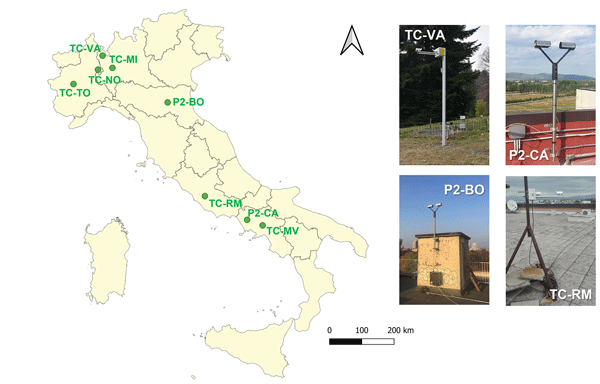
We provide a comprehensive overview of the Italian Automated LIdar-CEilometer network, ALICENET, describing its infrastructure, aerosol retrievals, and main applications. The supplement covers data-processing details. We include examples of output products, comparisons with independent data, and examples of the network capability to provide near-real-time aerosol fields over Italy. ALICENET is expected to benefit the sectors of air quality, radiative budget/solar energy, and aviation safety.
Elisa Adirosi, Federico Porcù, Mario Montopoli, Luca Baldini, Alessandro Bracci, Vincenzo Capozzi, Clizia Annella, Giorgio Budillon, Edoardo Bucchignani, Alessandra Lucia Zollo, Orietta Cazzuli, Giulio Camisani, Renzo Bechini, Roberto Cremonini, Andrea Antonini, Alberto Ortolani, Samantha Melani, Paolo Valisa, and Simone Scapin
Earth Syst. Sci. Data, 15, 2417–2429, https://doi.org/10.5194/essd-15-2417-2023, https://doi.org/10.5194/essd-15-2417-2023, 2023
Short summary
Short summary
The paper describes the database of 1 min drop size distribution (DSD) of atmospheric precipitation collected by the Italian disdrometer network over the last 10 years. These data are useful for several applications that range from climatological, meteorological and hydrological uses to telecommunications, agriculture and conservation of cultural heritage exposed to precipitation. Descriptions of the processing and of the database organization, along with some examples, are provided.
Gianluca Di Natale, David D. Turner, Giovanni Bianchini, Massimo Del Guasta, Luca Palchetti, Alessandro Bracci, Luca Baldini, Tiziano Maestri, William Cossich, Michele Martinazzo, and Luca Facheris
Atmos. Meas. Tech., 15, 7235–7258, https://doi.org/10.5194/amt-15-7235-2022, https://doi.org/10.5194/amt-15-7235-2022, 2022
Short summary
Short summary
In this paper, we describe a new approach to test the consistency of the precipitating ice cloud optical and microphysical properties in Antarctica, Dome C, retrieved from hyperspectral measurements in the far-infrared, with the reflectivity detected by a co-located micro rain radar operating at 24 GHz. The retrieved ice crystal sizes were found in accordance with the direct measurements of an optical imager, also installed at Dome C, which can collect the falling ice particles.
Laura Tositti, Erika Brattich, Claudio Cassardo, Pietro Morozzi, Alessandro Bracci, Angela Marinoni, Silvana Di Sabatino, Federico Porcù, and Alessandro Zappi
Atmos. Chem. Phys., 22, 4047–4073, https://doi.org/10.5194/acp-22-4047-2022, https://doi.org/10.5194/acp-22-4047-2022, 2022
Short summary
Short summary
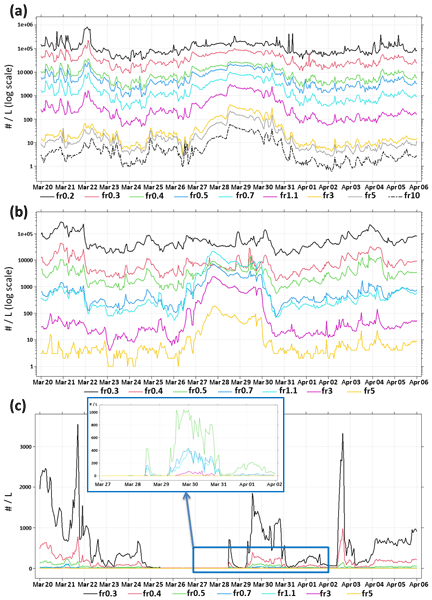
We present a thorough investigation of an anomalous transport of mineral dust over a region renowned for excess airborne particulate matter, the Italian Po Valley, which occurred in late March 2021. Both the origin of this dust outbreak, which was localized in central Asia (i.e., the so-called Aralkum Desert), and the upstream synoptic conditions, investigated here in extreme detail using multiple integrated observations including in situ measurements and remote sensing, were atypical.
Cited articles
Achtert, P., Khaplanov, M., Khosrawi, F., and Gumbel, J.: Pure rotational-Raman channels of the Esrange lidar for temperature and particle extinction measurements in the troposphere and lower stratosphere, Atmos. Meas. Tech., 6, 91–98, https://doi.org/10.5194/amt-6-91-2013, 2013. a
Adachi, H., Shibata, T., Iwasaka, Y., and Fujiwara, M.: Calibration method for the lidar-observed stratospheric depolarization ratio in the presence of liquid aerosol particles, Appl. Opt., 40, 6587–6595, https://doi.org/10.1364/AO.40.006587, 2001. a, b
Adriani, A., Massoli, P., Di Donfrancesco, G., Cairo, F., Moriconi, M., and Snels, M.: Climatology of polar stratospheric clouds based on lidar observations from 1993 to 2001 over McMurdo Station, Antarctica, J. Geophys. Res.-Atmos., 109, D24211, https://doi.org/10.1029/2004JD004932, 2004. a, b
Ansmann, A., Riebesell, M., and Weitkamp, C.: Measurement of atmospheric aerosol extinction profiles with a Raman lidar, Opt. Lett., 15, 746–748, https://doi.org/10.1364/OL.15.000746, 1990. a
Ansmann, A., Wandinger, U., Riebesell, M., Weitkamp, C., and Michaelis, W.: Independent measurement of extinction and backscatter profiles in cirrus clouds using a combined Raman elastic-backscatter lidar, Appl. Opt., 31, 7113–7131, https://doi.org/10.1364/AO.31.007113, 1992. a, b
Behrendt, A. and Nakamura, T.: Calculation of the calibration constant of polarization lidar and its dependency on atmospheric temperature, Opt. Express, 10, 805–817, https://doi.org/10.1364/OE.10.000805, 2002. a
Böckmann, C. and Ritter, C.: Properties of Polar Stratospheric Clouds over the European Arctic from Ground-Based Lidar, in: Proceedings of the 30th International Laser Radar Conference (ILRC 2022), edited by: Sullivan, J. T., Leblanc, T., Tucker, S., Demoz, B., Eloranta, E., Hostetler, C., Ishii, S., Mona, L., Moshary, F., Papayannis, A., and Rupavatharam, K., Springer Atmospheric Sciences, Springer, Cham, 325–332, https://doi.org/10.1007/978-3-031-37818-8_43, 2023. a
Cairo, F., Donfrancesco, G. D., Adriani, A., Pulvirenti, L., and Fierli, F.: Comparison of various linear depolarization parameters measured by lidar, Appl. Opt., 38, 4425–4432, https://doi.org/10.1364/AO.38.004425, 1999. a
Cairo, F., Deshler, T., Di Liberto, L., Scoccione, A., and Snels, M.: A study of optical scattering modelling for mixed-phase polar stratospheric clouds, Atmos. Meas. Tech., 16, 419–431, https://doi.org/10.5194/amt-16-419-2023, 2023. a, b
Carslaw, K. S., Luo, Be., and Peter, T.: An analytic expression for the composition of aqueous HNO3-H2SO4 stratospheric aerosols including gas phase removal of HNO3, Geophys. Res. Lett., 22, 1877–1880, https://doi.org/10.1029/95GL01668, 1995 a
Chen, W. N., Chiang, C. W., and Nee, J. B.: Lidar ratio and depolarization ratio for cirrus clouds, Appl. Opt., 41, 6470–6476, https://doi.org/10.1364/AO.41.006470, 2002. a, b, c
Córdoba-Jabonero, C., Guerrero-Rascado, J. L., Toledo, D., Parrondo, M., Yela, M., Gil, M., and Ochoa, H. A.: Depolarization ratio of polar stratospheric clouds in coastal Antarctica: comparison analysis between ground-based Micro Pulse Lidar and space-borne CALIOP observations, Atmos. Meas. Tech., 6, 703–717, https://doi.org/10.5194/amt-6-703-2013, 2013. a
David, C., Haefele, A., Keckhut, P., Marchand, M., Jumelet, J., Leblanc, T., Cénac, C., Laqui, C., Porteneuve, J., Haeffelin, M., Courcoux, Y., Snels, M., Viterbini, M., and Quatrevalet, M.: Evaluation of stratospheric ozone, temperature, and aerosol profiles from the LOANA lidar in Antarctica, Polar Sci., 6, 209–225, https://doi.org/10.1016/j.polar.2012.07.001, 2012. a
Del Guasta, M.: Errors in the retrieval of thin-cloud optical parameters by lidar, Appl. Opt., 37, 5522–5531, https://doi.org/10.1364/AO.37.005522, 1998. a
Di Liberto, L., Colao, F., Serva, F., Bracci, A., Cairo, F., and Snels, M.: 10 Years of Lidar Observations of Polar Stratospheric Clouds at Concordia Station, Remote Sens., 18, 874, https://doi.org/10.3390/rs18060874, 2026. a
Giannakaki, E., Balis, D. S., Amiridis, V., and Kazadzis, S.: Optical and geometrical characteristics of cirrus clouds over a Southern European lidar station, Atmos. Chem. Phys., 7, 5519–5530, https://doi.org/10.5194/acp-7-5519-2007, 2007. a, b
Gimmestad, G. G.: Reexamination of depolarization in lidar measurements, Appl. Opt., 47, 3795–3802, https://doi.org/10.1364/AO.47.003795, 2008. a, b
Gobbi, G. P.: Lidar observations of polar stratospheric clouds at McMurdo station, Antarctica, J. Geophys. Res.-Atmos., 100, 11219–11235, https://doi.org/10.1029/95JD00725, 1995. a
Haarig, M., Engelmann, R., Ansmann, A., Veselovskii, I., Whiteman, D. N., and Althausen, D.: 1064 nm rotational Raman lidar for particle extinction and lidar-ratio profiling: cirrus case study, Atmos. Meas. Tech., 9, 4269–4278, https://doi.org/10.5194/amt-9-4269-2016, 2016. a
Höpfner, M., Luo, B. P., Massoli, P., Cairo, F., Spang, R., Snels, M., Di Donfrancesco, G., Stiller, G., von Clarmann, T., Fischer, H., and Biermann, U.: Spectroscopic evidence for NAT, STS, and ice in MIPAS infrared limb emission measurements of polar stratospheric clouds, Atmos. Chem. Phys., 6, 1201–1219, https://doi.org/10.5194/acp-6-1201-2006, 2006. a, b, c
Hostetler, C. A., Liu, Z., Reagan, J., Vaughan, M., Winker, D., Osborn, M., Hunt, W. H., Powell, K. A., and Trepte, C.: CALIOP Algorithm Theoretical Basis Document: Calibration and Level 1 Data Products, Tech. Rep. PC-SCI-201, NASA, NASA Langley Research Center, https://ntrs.nasa.gov/citations/20250006623 (last access: 30 July 2026), 2006. a
Immler, F. and Schrems, O.: LIDAR measurements of cirrus clouds in the northern and southern midlatitudes during INCA: A comparative study, Geophys. Res. Lett., 29, 56-1–56-4, https://doi.org/10.1029/2002GL015077, 2002. a
Josset, D., Pelon, J., Hu, Y., and Zhai, P. W.: Multi-instrument calibration method for hybrid extinction and backscatter lidar: application to spaceborne measurements, J. Geophys. Res.-Atmos., 117, D05205, https://doi.org/10.1029/2011JD016959, 2012. a
Kim, M.-H., Omar, A. H., Tackett, J. L., Vaughan, M. A., Winker, D. M., Trepte, C. R., Hu, Y., Liu, Z., Poole, L. R., Pitts, M. C., Kar, J., and Magill, B. E.: The CALIPSO version 4 automated aerosol classification and lidar ratio selection algorithm, Atmos. Meas. Tech., 11, 6107–6135, https://doi.org/10.5194/amt-11-6107-2018, 2018. a, b, c
Lolli, S., Dolinar, E. K., Lewis, J. R., Salcedo-Bosch, A., Campbell, J. R., and Welton, E. J.: Long-term trends in daytime cirrus cloud radiative effects: analyzing twenty years of Micropulse Lidar Network measurements at Greenbelt, Maryland in eastern North America, Atmos. Chem. Phys., 26, 411–426, https://doi.org/10.5194/acp-26-411-2026, 2026. a
Luo, B. P., Voigt, C., Fueglistaler, S., and Peter, T.: Extreme NAT supersaturations in mountain wave ice polar stratospheric clouds: A clue to NAT formation, J. Geophys. Res.-Atmos., 108, 4441, https://doi.org/10.1029/2002JD003104, 2003. a, b, c
Nakoudi, K., Stachlewska, I. S., and Ritter, C.: An extended lidar-based cirrus cloud retrieval scheme: first application over an Arctic site, Opt. Express, 29, 8553–8578, https://doi.org/10.1364/OE.419914, 2021. a
Noel, V., Hertzog, A., and Chepfer, H.: CALIPSO observations of wave-induced PSCs with near-unity optical depth over Antarctica in 2006–2007, J. Geophys. Res.-Atmos., 114, D05202, https://doi.org/10.1029/2008JD010604, 2009. a
Peter, T. and Grooß, J.-U.: Polar Stratospheric Clouds and Sulfate Aerosol Particles: Microphysics, Denitrification and Heterogeneous Chemistry, in: Stratospheric Ozone Depletion and Climate Change, edited by: Newman, A. L., Royal Society of Chemistry, Cambridge, UK, 108–144, https://doi.org/10.1039/9781849733182-00108, 2012. a, b, c
Pitts, M. C., Poole, L. R., and Thomason, L. W.: CALIPSO polar stratospheric cloud observations: second-generation detection algorithm and composition discrimination, Atmos. Chem. Phys., 9, 7577–7589, https://doi.org/10.5194/acp-9-7577-2009, 2009. a
Pitts, M. C., Poole, L. R., and Gonzalez, R.: Polar stratospheric cloud climatology based on CALIPSO spaceborne lidar measurements from 2006 to 2017, Atmos. Chem. Phys., 18, 10881–10913, https://doi.org/10.5194/acp-18-10881-2018, 2018. a, b, c, d
Reichardt, J., Reichardt, S., Yang, P., and McGee, T. J.: Retrieval of polar stratospheric cloud microphysical properties from lidar measurements: Dependence on particle shape assumptions, J. Geophys. Res., 107, 8270, https://doi.org/10.1029/2001JD001021, 2002. a
Santacesaria, V., Mackenzie, A. R., and Stefanutti, L.: A climatological study of polar stratospheric clouds (1989–1997) from LIDAR measurements over Dumont d’Urville (Antarctica), Tellus B, 53, 306–321, https://doi.org/10.3402/tellusb.v53i3.16598, 2001. a
Serva, F., Di Liberto, L., Colao, F., Bracci, A., Cairo, F., Pitts, M. C., and Snels, M.: Impact of the Hunga Eruption on Polar Stratospheric Clouds as Seen by the Lidar Observatory at Concordia Station, Antarct. Sci., https://doi.org/10.1017/S0954102026100601, 2026. a
Snels, M., Scoccione, A., Di Liberto, L., Colao, F., Pitts, M., Poole, L., Deshler, T., Cairo, F., Cagnazzo, C., and Fierli, F.: Comparison of Antarctic polar stratospheric cloud observations by ground-based and space-borne lidar and relevance for chemistry-climate models, Atmos. Chem. Phys., 19, 955–972, https://doi.org/10.5194/acp-19-955-2019, 2019. a
Snels, M., Colao, F., Cairo, F., Shuli, I., Scoccione, A., De Muro, M., Pitts, M., Poole, L., and Di Liberto, L.: Quasi-coincident observations of polar stratospheric clouds by ground-based lidar and CALIOP at Concordia (Dome C, Antarctica) from 2014 to 2018, Atmos. Chem. Phys., 21, 2165–2178, https://doi.org/10.5194/acp-21-2165-2021, 2021. a, b, c, d, e, f, g, h
Solomon, S.: Stratospheric ozone depletion: A review of concepts and history, Rev. Geophys., 37, 275–316, https://doi.org/10.1029/1999RG900008, 1999. a
Tritscher, I., Pitts, M. C., Poole, L. R., Alexander, S. P., Cairo, F., Chipperfield, M. P., Grooß, J.-U., Höpfner, M., Lambert, A., Luo, B., Molleker, S. , Orr, A., Salawitch, R., Snels, M., Spang, R., Woiwode, W., and Peter, T.: Polar stratospheric clouds: Satellite observations, processes, and role for ozone depletion, Rev. Geophys., 59, e2020RG000702, https://doi.org/10.1029/2020RG000702, 2021. a
Vaughan, M. A., Young, S. A., Winker, D. M., Powell, K. A., Omar, A., Liu, Z., Hu, Y., and Hostetler, C. A.: Fully automated analysis of space-based lidar data: An overview of the CALIPSO retrieval algorithms and data products, in: Proc. SPIE 5575, P. Soc. Photo.-Opt. Ins., 16–30, https://doi.org/10.1117/12.572024, 2004. a
Voudouri, K. A., Giannakaki, E., Komppula, M., and Balis, D.: Variability in cirrus cloud properties using a PollyXT Raman lidar over high and tropical latitudes, Atmos. Chem. Phys., 20, 4427–4444, https://doi.org/10.5194/acp-20-4427-2020, 2020. a
Wang, W., Yi, F., Liu, F., Zhang, Y., Yu, C., and Yin, Z.: Characteristics and seasonal variations of cirrus clouds derived from ground-based lidar observations, Remote Sens., 12, 3998, https://doi.org/10.3390/rs12233998, 2020. a
Yorks, J. E., Hlavka, D. L., Hart, W. D., and McGill, M. J.: Statistics of Cloud Optical Properties from Airborne Lidar Measurements, J. Atmos. Ocean Technol., 28, 869–883, https://doi.org/10.1175/2011JTECHA1507.1, 2011. a, b
Young, S. A.: Analysis of lidar backscatter profiles in optically thin clouds, Appl. Opt., 34, 7019–7031, https://doi.org/10.1364/AO.34.007019, 1995. a
Young, S. A. and Vaughan, M. A.: The Retrieval of Profiles of Particulate Extinction from Cloud–Aerosol Lidar Infrared Pathfinder Satellite Observations (CALIPSO) Data: Algorithm Description, J. Atmos. Ocean. Technol., 26, 1105–1119, https://doi.org/10.1175/2008JTECHA1221.1, 2009. a
Short summary
Using three years of laser observations above Dome C, Antarctica, we examined high clouds made of liquid droplets, nitric-acid particles, and ice crystals. We found clear differences in how these clouds scatter light, while ice-rich clouds were the most variable because they are often layered or mixed. The results provide more realistic inputs for satellite checks and climate calculations, improving estimates of how polar clouds affect sunlight, heat, and ozone loss.
Using three years of laser observations above Dome C, Antarctica, we examined high clouds made...


