
Articles | Volume 19, issue 2
https://doi.org/10.5194/amt-19-529-2026
© Author(s) 2026. This work is distributed under
the Creative Commons Attribution 4.0 License.
the Creative Commons Attribution 4.0 License.
https://doi.org/10.5194/amt-19-529-2026
© Author(s) 2026. This work is distributed under
the Creative Commons Attribution 4.0 License.
the Creative Commons Attribution 4.0 License.
Research article
| 
21 Jan 2026
Research article |
| 21 Jan 2026
| 21 Jan 2026
Validation of SNPP OMPS limb profiler version 2.6 ozone profile retrievals against correlative satellite and ground based measurements
Nigel A. D. Richards
CORRESPONDING AUTHOR

Goddard Earth Sciences Technology and Research (GESTAR II), University of Maryland Baltimore County (UMBC), Baltimore, MD, USA
NASA Goddard Space Flight Center, Greenbelt, MD, USA
Natalya A. Kramarova
NASA Goddard Space Flight Center, Greenbelt, MD, USA
Stacey M. Frith
Science Systems and Applications, Inc., Lanham, MD, USA
NASA Goddard Space Flight Center, Greenbelt, MD, USA
Sean M. Davis
NOAA Chemical Sciences Laboratory, Boulder, CO, USA
University of Texas at Dallas, Dallas, TX, USA
Related authors
No articles found.
Jérôme Brioude, Rémi Augerai, Miloud Bessafi, Stephanie Evan, Yue Jia, Olivier Pujol, and Delia Arnold
EGUsphere, https://doi.org/10.5194/egusphere-2026-5993, https://doi.org/10.5194/egusphere-2026-5993, 2026
This preprint is open for discussion and under review for Geoscientific Model Development (GMD).
Short summary
Short summary
Lagrangian particle dispersion models are widely used in the atmospheric sciences, but running them still demands technical skills unrelated to the physics studied. EASLEE is a new model of this kind, written in Julia, that removes this barrier. No compilation is needed, the same code runs under Linux, macOS and Windows, and a run is defined by one configuration file or a web interface. It includes turbulence, convection, forward and backward transport of gases and aerosols, on CPU or GPU.
Sean M. Davis, William T. Ball, Yue Jia, Gabriel Chiodo, Justin A. Alsing, James Keeble, Hideharu Akiyoshi, Carlo Arosio, Ewa M. Bednarz, Andreas Chrysanthou, Melanie Coldewey-Egbers, Robert Damadeo, Sandip Dhomse, Mohamadou A. Diallo, Simone Dietmuller, Roland Eichinger, Stacey Frith, Birgit Hassler, Michaela I. Hegglin, Daan Hubert, Patrick Jöckel, Béatrice Josse, Natalya Kramarova, Diego Loyola, Eliane Maillard Barras, Marion Marchand, Olaf Morgenstern, David Plummer, Robert W. Portmann, Karen H. Rosenlof, Alexei Rozanov, Viktoria F. Sofieva, Johannes Staehelin, Timofei Sukhodolov, Kleareti Tourpali, Ronald J. Van der A, H. J. Ray Wang, Krzysztof Wargan, Shingo Watanabe, Mark Weber, Jeannette D. Wild, Yousuke Yamashita, and Jerry Ziemke
Atmos. Chem. Phys., 26, 13817–13843, https://doi.org/10.5194/acp-26-13817-2026, https://doi.org/10.5194/acp-26-13817-2026, 2026
Short summary
Short summary
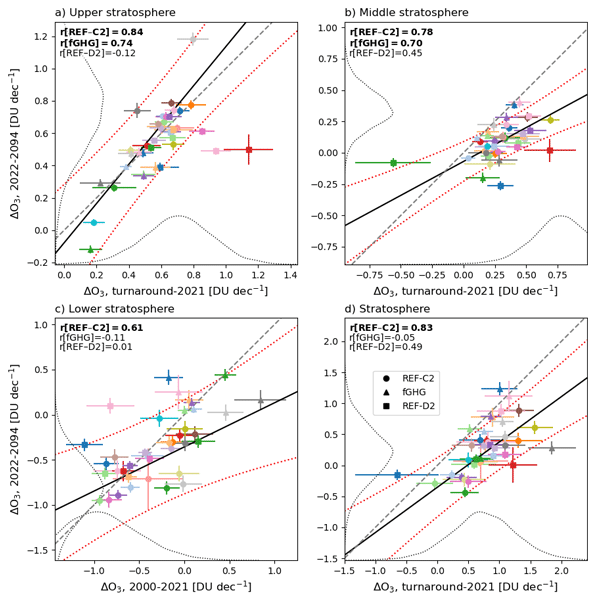
This study investigates tropical ozone changes in models and satellite observations to determine how well they agree and whether observations can constrain model projections. At some levels, satellite records disagree significantly on the magnitude of ozone changes. While early and late 21st century trends are correlated across models, suggesting a potential emergent constraint, the spread in observations means they are unable to provide guidance on the credibility of model projections.
Brian Auffarth, Mark Weber, Alexei Rozanov, Carlo Arosio, John P. Burrows, Melanie Coldewey-Egbers, Sean M. Davis, Doug Degenstein, Kimberlee Dubé, Stacey M. Frith, Lucien Froidevaux, Diego Loyola, Vitali E. Fioletov, Viktoria Sofieva, Ronald van der A, and Jeannette D. Wild
Atmos. Chem. Phys., 26, 13359–13386, https://doi.org/10.5194/acp-26-13359-2026, https://doi.org/10.5194/acp-26-13359-2026, 2026
Short summary
Short summary
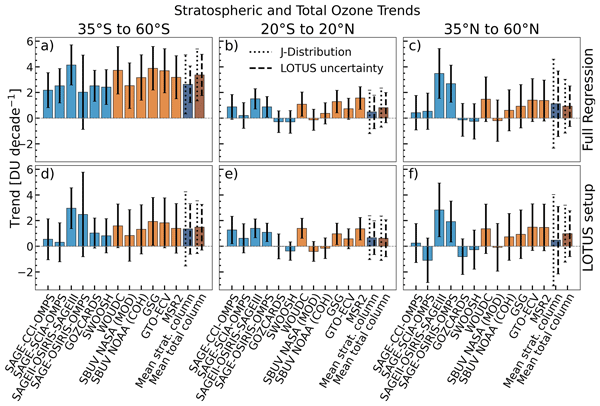
This study examines the trends of stratospheric and total ozone between 2000 and 2024, using long-term satellite datasets. Our results show positive trends in the upper stratosphere and a strong ozone recovery in the Southern Hemisphere, while changes in lower altitudes remain mostly small. The total and stratospheric trends show very similar results, indicating that tropospheric ozone contributes little to total column changes, while the stratospheric column is the dominant driver.
Pan Zhao, Jingyi Chen, Yang Yang, Yue Jia, and Yang Yu
EGUsphere, https://doi.org/10.5194/egusphere-2026-3025, https://doi.org/10.5194/egusphere-2026-3025, 2026
Short summary
Short summary
Marine cloud brightening (MCB) aims to cool climate by spraying sea-salt aerosols to brighten marine clouds, but whether aerosols can reach clouds efficiently remains uncertain. Using large-eddy simulations with Lagrangian particle tracking, we show that turbulent transport strongly depends on cloud conditions and model resolution. High-liquid-water periods favor stronger transport, while higher-resolution simulations better capture turbulence and cloud droplet activation.
Daniele Minganti, Simon Chabrillat, Sean Davis, Quentin Errera, Marc Op de beeck, Eric Ray, Sarah Vervalcke, Krzysztof Wargan, and Catherine Wespes
EGUsphere, https://doi.org/10.5194/egusphere-2026-3449, https://doi.org/10.5194/egusphere-2026-3449, 2026
Short summary
Short summary
In early 2019, an unusual increase of nitrous oxide concentrations occurred in the northern lower stratosphere (around 20 km). We show that unprecedented circulation pattern rapidly moved nitrous oxide from the tropical region to the northern mid-latitudes. This work reveals how stratospheric mid-latitudes can respond to special wind conditions in the Tropics and subtropics. Such extreme event helps improving our understanding of future changes of stratospheric transport in a warming climate.
Michael D. Himes, Natalya A. Kramarova, Krzysztof Wargan, Sean M. Davis, and Glen Jaross
Atmos. Meas. Tech., 19, 3601–3624, https://doi.org/10.5194/amt-19-3601-2026, https://doi.org/10.5194/amt-19-3601-2026, 2026
Short summary
Short summary
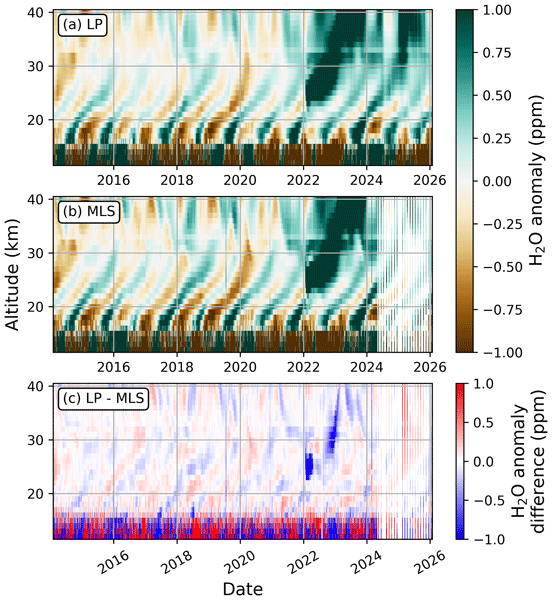
Stratospheric water vapor (SWV) influences various atmospheric processes. While the Ozone Mapping and Profiler Suite Limb Profiler (OMPS LP) was not designed to measure SWV, we utilized near-coincident measurements by the Aura Microwave Limb Sounder (MLS) and OMPS LP to develop a machine learning method to measure SWV between 11.5–40.5 km. The LP-derived SWV closely agrees with MLS. Our results suggest OMPS LP can continue the global water vapor record following the MLS mission.
Viktoria F. Sofieva, Monika E. Szelag, Natalya A. Kramarova, Robert Damadeo, Wolfgang Steinbrecht, Irina Petropavlovskikh, Corinne Vigouroux, Eliane Maillard Barras, Daniel Zawada, Kleareti Tourpali, Stacey M. Frith, Jeannette D. Wild, Sean M. Davis, Carlo Arosio, Mark Weber, Alexei Rozanov, Brian Auffarth, Lucien Froidevaux, Ryan Fuller, Doug Degenstein, Kimberlee Dube, Peter Effertz, Thierry Leblanc, Gérard Ancellet, Sophie Godin-Beekmann, Glen McConville, Richard Querel, Dan Smale, Marie-Renee DeBacker, Emmanuel Mahieu, and Ralf Sussmann
Atmos. Chem. Phys., 26, 7387–7405, https://doi.org/10.5194/acp-26-7387-2026, https://doi.org/10.5194/acp-26-7387-2026, 2026
Short summary
Short summary
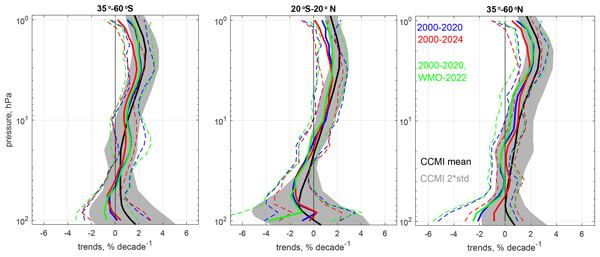
We present an updated evaluation of stratospheric ozone profile trends in the 60°S–60°N latitude range using long-term ground-based and satellite climate data records, as well as simulations by chemistry-climate models. Analyses confirm the statistically significant positive ozone trends in the upper stratosphere of ~1–3 % decade-1. The trends are close to zero in the middle stratosphere, and mostly negative in the lower stratosphere, but they are not statistically significant.
Marta Abalos, Thomas Birner, Andreas Chrysanthou, Sean Davis, Alvaro de la Cámara, Sandip Dhomse, Hella Garny, Michaela I. Hegglin, Daan Hubert, Oksana Ivaniha, James Keeble, Marianna Linz, Daniele Minganti, Jessica Neu, David Plummer, Laura Saunders, Kasturi Shah, Gabriele Stiller, Kleareti Tourpali, Darryn Waugh, Nathan Luke Abraham, Hideharu Akiyoshi, Martyn P. Chipperfield, Patrick Jöckel, Béatrice Josse, Marion Marchand, Patrick Martineau, Olaf Morgenstern, Timofei Sukhodolov, Shingo Watanabe, and Yousuke Yamashita
Atmos. Chem. Phys., 26, 5249–5291, https://doi.org/10.5194/acp-26-5249-2026, https://doi.org/10.5194/acp-26-5249-2026, 2026
Short summary
Short summary
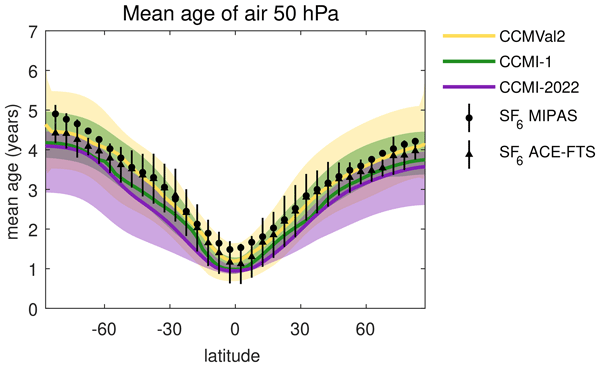
Accurate representation of stratospheric transport in Chemistry-Climate Models is essential for reliable climate projections. This study evaluates three generations of models using observational data and reanalyses, identifying persistent biases and their potential causes. Some biases persist or even worsen in newer models. These findings highlight key limitations and inform efforts to improve models and advance understanding through process-based studies and enhanced observations.
Meghan Brehon, Susann Tegtmeier, Adam Bourassa, Sean M. Davis, Udo Grabowski, Tobias Kerzenmacher, and Gabriele Stiller
Atmos. Chem. Phys., 26, 3743–3764, https://doi.org/10.5194/acp-26-3743-2026, https://doi.org/10.5194/acp-26-3743-2026, 2026
Short summary
Short summary
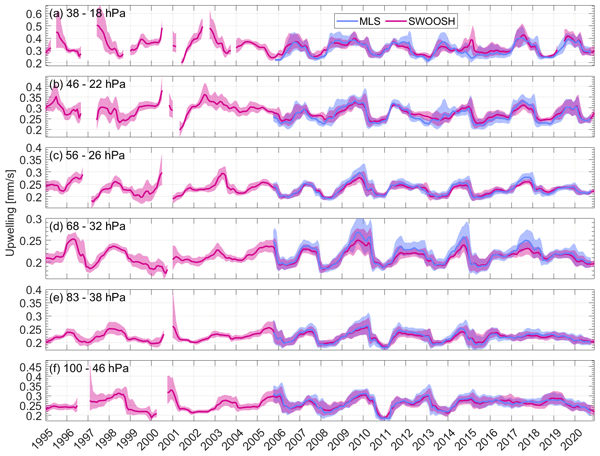
We used observations of water vapour to estimate vertical transport rates in the tropical stratosphere for 1995-2020 and analyze stratospheric variability. Our results find good agreement between our observation-based estimates and reanalysis upwelling and reveal that the variability is mainly driven by the Quasi-Biennial Oscillation (QBO) and El Niño Southern Oscillation (ENSO) with a clear signal in the upwelling time series coinciding with the recent QBO disruptions of 2015/16 and 2019/20.
Viktoria F. Sofieva, Alexandra Laeng, Thomas von Clarmann, Gabriele Stiller, Michael Kiefer, Johanna Tamminen, Alexey Rozanov, Carlo Arosio, Nathaniel Livesey, Robert Damadeo, Patrick Sheese, Kaley A. Walker, Doug Degenstein, Daniel Zawada, Natalya A. Kramarova, and Arno Keppens
Atmos. Meas. Tech., 19, 1837–1852, https://doi.org/10.5194/amt-19-1837-2026, https://doi.org/10.5194/amt-19-1837-2026, 2026
Short summary
Short summary
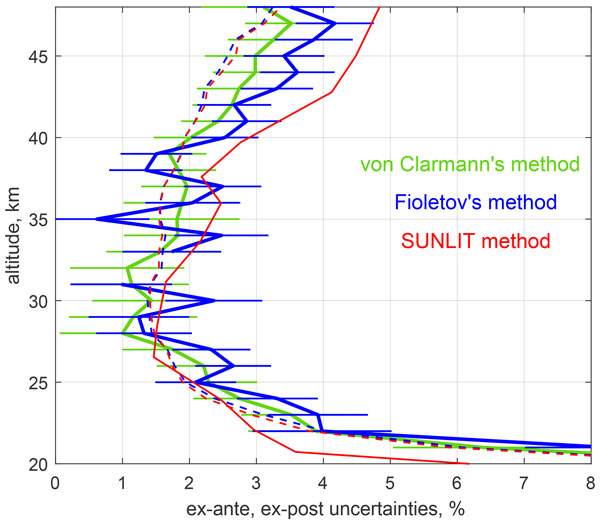
For satellite measurements of atmospheric composition, the random uncertainty estimates provided by retrieval algorithms might be imperfect due to various approximations used in the retrievals or presence of unknown error sources. This paper presents an overview of the methods used for validation of random uncertainty estimates. All methods discussed in this study are categorized, and assumptions and limitations of each method are discussed.

Robert J. D. Spurr, Matt Christi, Nickolay A. Krotkov, Won-Ei Choi, Simon Carn, Can Li, Natalya Kramarova, David Haffner, Eun-Su Yang, Nick Gorkavyi, Alexander Vasilkov, Krzysztof Wargan, Omar Torres, Diego Loyola, Serena Di Pede, J. Pepijn Veefkind, Parker Case, Thomas Schroeder, and Pawan K. Bhartia
Atmos. Meas. Tech., 19, 993–1021, https://doi.org/10.5194/amt-19-993-2026, https://doi.org/10.5194/amt-19-993-2026, 2026
Short summary
Short summary
The submarine eruption of the Hunga volcano released water vapor and sulfur dioxide directly into the stratosphere. The sulfur dioxide formed sulfuric acid aerosols leading to increased scattering of solar ultraviolet radiation (UV), interfering with satellite ozone retrievals. We present a new satellite technique for deriving the amount and height of Hunga aerosols from UV measurements, revealing an unusually low sulfuric acid concentration due to the water-rich conditions in the fresh plume.
Mona Zolghadrshojaee, Susann Tegtmeier, Sean M. Davis, Robin Pilch Kedzierski, and Leopold Haimberger
Atmos. Chem. Phys., 25, 12213–12232, https://doi.org/10.5194/acp-25-12213-2025, https://doi.org/10.5194/acp-25-12213-2025, 2025
Short summary
Short summary
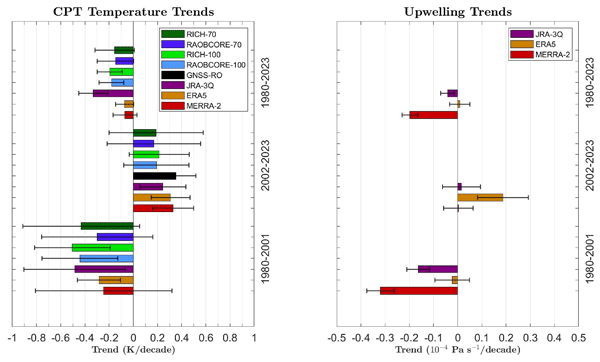
The tropical tropopause layer (TTL) is a crucial region where the troposphere transitions into the stratosphere, influencing air mass transport. This study examines temperature trends in the TTL and lower stratosphere using data from weather balloons, satellites and reanalysis datasets. We found cooling trends in the TTL from 1980 to 2001, followed by warming from 2002 to 2023. These shifts are linked to changes in atmospheric circulation and impact water vapour transport into the stratosphere.
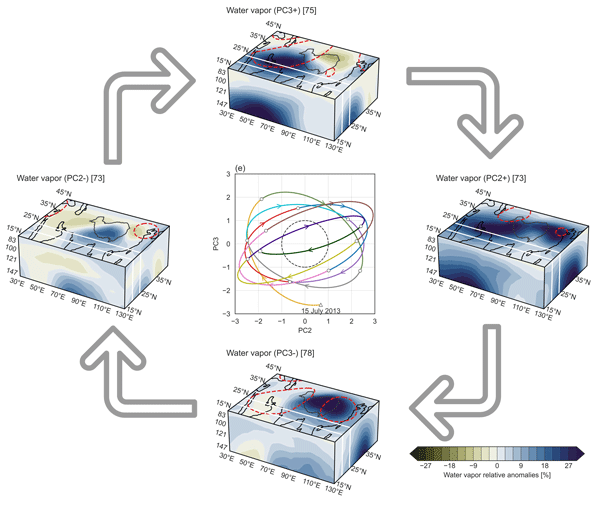
Shenglong Zhang, Jiao Chen, Jonathon S. Wright, Sean M. Davis, Jie Gao, Paul Konopka, Ninghui Li, Mengqian Lu, Susann Tegtmeier, Xiaolu Yan, Guang J. Zhang, and Nuanliang Zhu
Atmos. Chem. Phys., 25, 10109–10139, https://doi.org/10.5194/acp-25-10109-2025, https://doi.org/10.5194/acp-25-10109-2025, 2025
Short summary
Short summary
Swirling above summer storms, the Asian monsoon anticyclone functions as both gateway and gatekeeper to moisture entering the stratosphere. Although well monitored from space since 2005, many details of the anticyclone and the air that flows through it remain mysterious. Reanalyses, which combine model output and observations, may help to address how and why but only if they reliably capture the what and where of water vapor variations. Current reanalyses are beginning to meet these criteria.
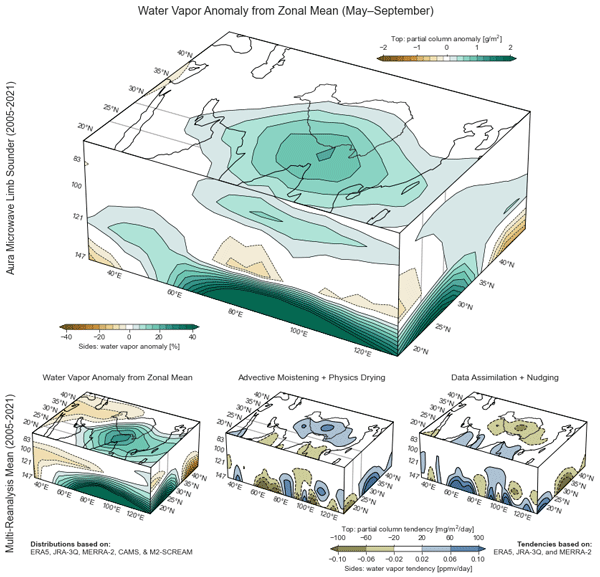
Jonathon S. Wright, Shenglong Zhang, Jiao Chen, Sean M. Davis, Paul Konopka, Mengqian Lu, Xiaolu Yan, and Guang J. Zhang
Atmos. Chem. Phys., 25, 9617–9643, https://doi.org/10.5194/acp-25-9617-2025, https://doi.org/10.5194/acp-25-9617-2025, 2025
Short summary
Short summary
Atmospheric reanalysis products reconstruct past states of the atmosphere. These products are often used to study winds and temperatures in the upper-level monsoon circulation, but their ability to reproduce composition fields like water vapor and ozone has been questionable at best. Here we report clear signs of improvement in both consistency across reanalyses and agreement with satellite observations, outline limitations, and suggest steps to further enhance the usefulness of these fields.
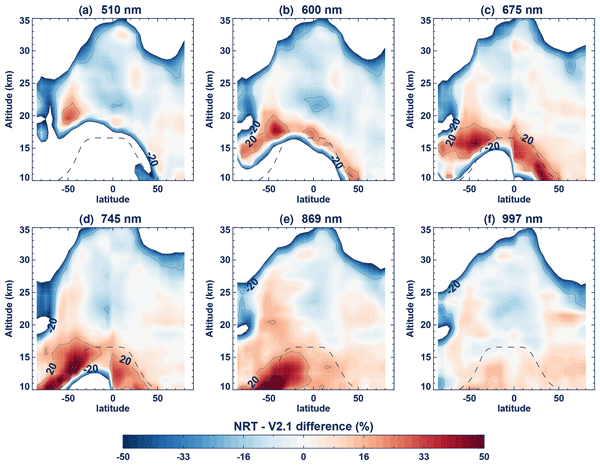
Michael D. Himes, Ghassan Taha, Daniel Kahn, Tong Zhu, and Natalya A. Kramarova
Atmos. Meas. Tech., 18, 2523–2536, https://doi.org/10.5194/amt-18-2523-2025, https://doi.org/10.5194/amt-18-2523-2025, 2025
Short summary
Short summary
The Ozone Mapping and Profiler Suite's Limb Profiler (OMPS LP) yields near-global coverage and information about how aerosols from volcanic eruptions and major wildfires is vertically distributed through the atmosphere. We developed a machine learning method to characterize aerosols using OMPS LP measurements about 60 times faster than the current approach.
Miming Zhang, Haipeng Gao, Shanshan Wang, Yue Jia, Shibo Yan, Rong Tian, Jinpei Yan, and Yanfang Wu
EGUsphere, https://doi.org/10.5194/egusphere-2025-1622, https://doi.org/10.5194/egusphere-2025-1622, 2025
Preprint archived
Short summary
Short summary
Under cold and clean conditions in the free troposphere, oceanic dimethyl sulfide (DMS) can form new particles. Using data from the field observation and Lana climatology with the FLEXPART model, we evaluated DMS contribution from surface ocean to the free troposphere. We found that cyclone enhances the contribution of oceanic dimethyl sulfide to the free troposphere over the Southern Ocean, suggesting significant DMS-derived new particles likely occurred at high altitudes in the Southern Ocean.
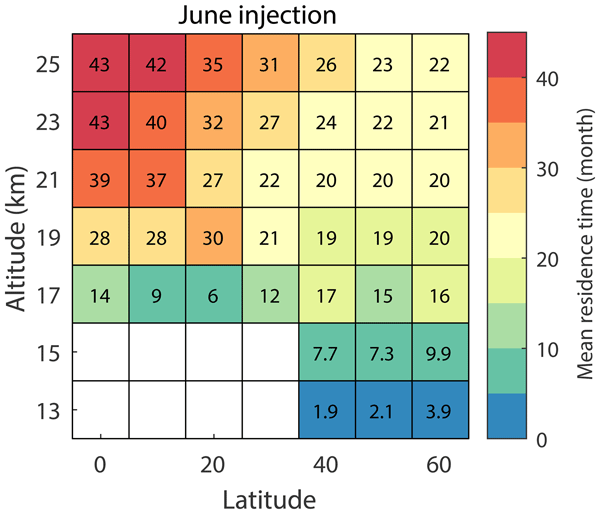
Matthew Toohey, Yue Jia, Sujan Khanal, and Susann Tegtmeier
Atmos. Chem. Phys., 25, 3821–3839, https://doi.org/10.5194/acp-25-3821-2025, https://doi.org/10.5194/acp-25-3821-2025, 2025
Short summary
Short summary
The climate impact of volcanic eruptions depends in part on how long aerosols spend in the stratosphere. We develop a conceptual model for stratospheric aerosol lifetime in terms of production and decay timescales, as well as a lag between injection and decay. We find residence time depends strongly on injection height in the lower stratosphere. We show that the lifetime of stratospheric aerosol from the 1991 Pinatubo eruption is around 22 months, significantly longer than is commonly reported.
Zirui Zhang, Kaiming Huang, Fan Yi, Wei Cheng, Fuchao Liu, Jian Zhang, and Yue Jia
Atmos. Chem. Phys., 25, 3347–3361, https://doi.org/10.5194/acp-25-3347-2025, https://doi.org/10.5194/acp-25-3347-2025, 2025
Short summary
Short summary
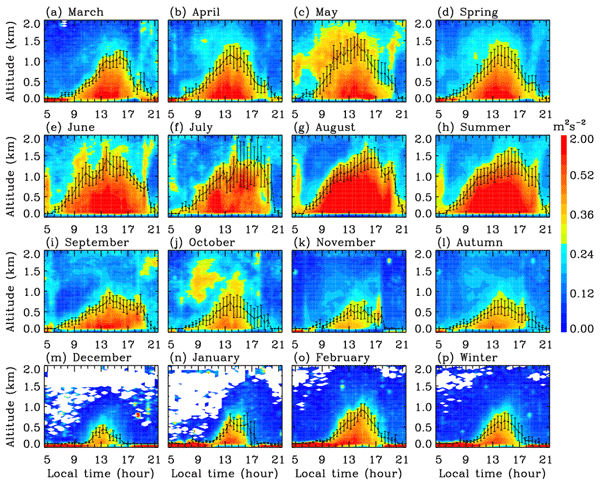
The height of the convective boundary layer (CBLH) is related to our health due to its crucial role in pollutant dispersion. The variance of vertical velocity from millimeter wave cloud radar (MMCR) can accurately capture the diurnal evolution of the CBLH, due to a small blind range and less impact by the residual layer. The CBLH is affected by radiation, humidity, cloud, and precipitation; thus, the MMCR is suitable for monitoring the CBLH, owing to its observation capability in various weather conditions.
Kimberlee Dubé, Susann Tegtmeier, Adam Bourassa, Daniel Zawada, Douglas Degenstein, William Randel, Sean Davis, Michael Schwartz, Nathaniel Livesey, and Anne Smith
Atmos. Chem. Phys., 24, 12925–12941, https://doi.org/10.5194/acp-24-12925-2024, https://doi.org/10.5194/acp-24-12925-2024, 2024
Short summary
Short summary
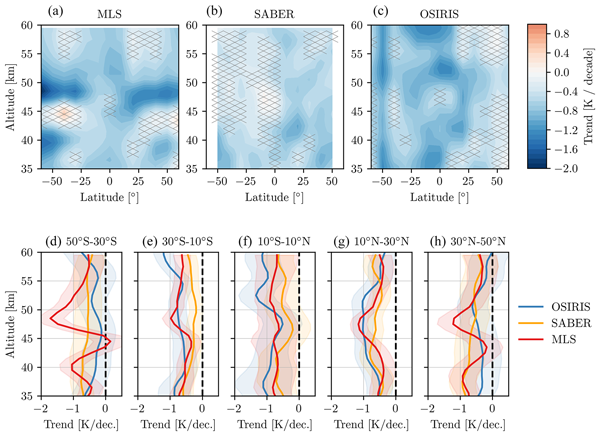
Greenhouse gas emissions that warm the troposphere also result in stratospheric cooling. The cooling rate is difficult to quantify above 35 km due to a deficit of long-term observational data with high vertical resolution in this region. We use satellite observations from several instruments, including a new temperature product from OSIRIS, to show that the upper stratosphere, from 35–60 km, cooled by 0.5 to 1 K per decade over 2005–2021 and by 0.6 K per decade over 1979–2021.
Masatomo Fujiwara, Patrick Martineau, Jonathon S. Wright, Marta Abalos, Petr Šácha, Yoshio Kawatani, Sean M. Davis, Thomas Birner, and Beatriz M. Monge-Sanz
Atmos. Chem. Phys., 24, 7873–7898, https://doi.org/10.5194/acp-24-7873-2024, https://doi.org/10.5194/acp-24-7873-2024, 2024
Short summary
Short summary
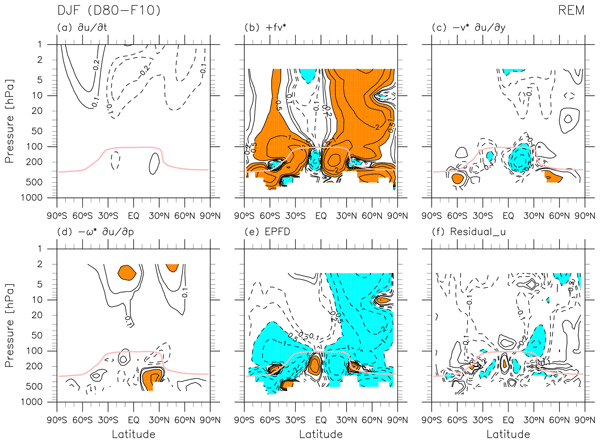
A climatology of the major variables and terms of the transformed Eulerian-mean (TEM) momentum and thermodynamic equations from four global atmospheric reanalyses is evaluated. The spread among reanalysis TEM momentum balance terms is around 10 % in Northern Hemisphere winter and up to 50 % in Southern Hemisphere winter. The largest uncertainties in the thermodynamic equation (about 50 %) are in the vertical advection, which does not show a structure consistent with the differences in heating.
Mona Zolghadrshojaee, Susann Tegtmeier, Sean M. Davis, and Robin Pilch Kedzierski
Atmos. Chem. Phys., 24, 7405–7419, https://doi.org/10.5194/acp-24-7405-2024, https://doi.org/10.5194/acp-24-7405-2024, 2024
Short summary
Short summary
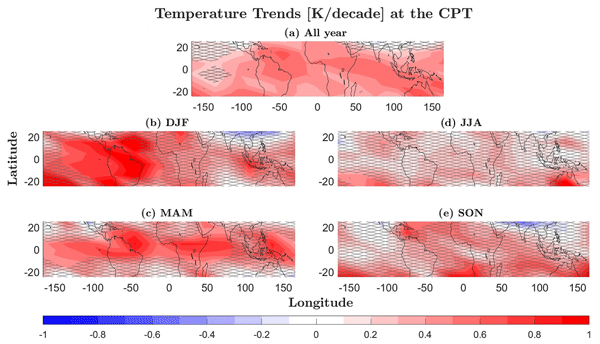
Satellite data challenge the idea of an overall cooling trend in the tropical tropopause layer. From 2002 to 2022, a warming trend was observed, diverging from earlier findings. Tropopause height changes indicate dynamic processes alongside radiative effects. Upper-tropospheric warming contrasts with lower-stratosphere temperatures. The study highlights the complex interplay of factors shaping temperature trends.
Sean M. Davis, Nicholas Davis, Robert W. Portmann, Eric Ray, and Karen Rosenlof
Atmos. Chem. Phys., 23, 3347–3361, https://doi.org/10.5194/acp-23-3347-2023, https://doi.org/10.5194/acp-23-3347-2023, 2023
Short summary
Short summary
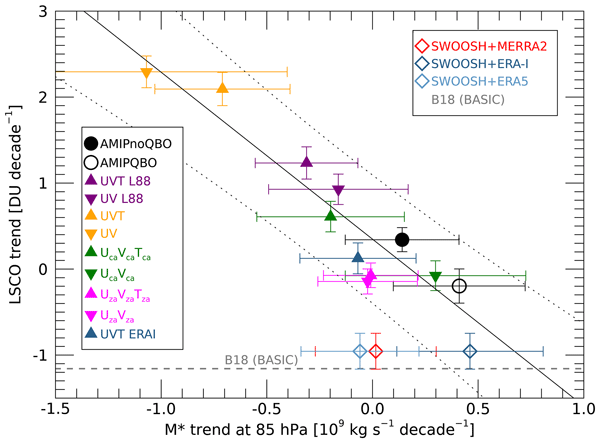
Ozone in the lower part of the stratosphere has not increased and has perhaps even continued to decline in recent decades. This study demonstrates that the amount of ozone in this region is highly sensitive to the amount of air upwelling into the stratosphere in the tropics and that simulations from a climate model nudged to historical meteorological fields often fail to accurately capture the variations in tropical upwelling that control short-term trends in lower-stratospheric ozone.
J. Douglas Goetz, Lars E. Kalnajs, Terry Deshler, Sean M. Davis, Martina Bramberger, and M. Joan Alexander
Atmos. Meas. Tech., 16, 791–807, https://doi.org/10.5194/amt-16-791-2023, https://doi.org/10.5194/amt-16-791-2023, 2023
Short summary
Short summary
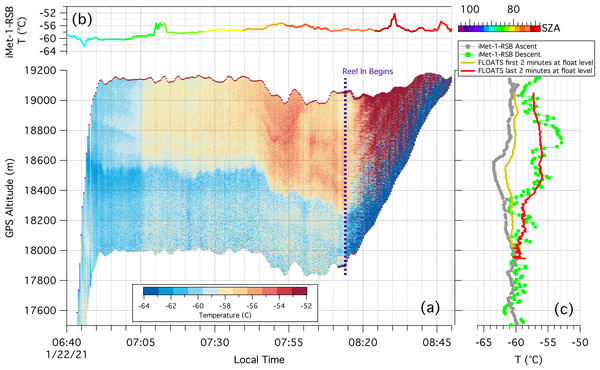
An instrument for in situ continuous 2 km vertical profiles of temperature below high-altitude balloons was developed for high-temporal-resolution measurements within the upper troposphere and lower stratosphere using fiber-optic distributed temperature sensing. The mechanical, electrical, and temperature calibration systems were validated from a short mid-latitude constant-altitude balloon flight within the lower stratosphere. The instrument observed small-scale and inertial gravity waves.
Klaus-Peter Heue, Diego Loyola, Fabian Romahn, Walter Zimmer, Simon Chabrillat, Quentin Errera, Jerry Ziemke, and Natalya Kramarova
Atmos. Meas. Tech., 15, 5563–5579, https://doi.org/10.5194/amt-15-5563-2022, https://doi.org/10.5194/amt-15-5563-2022, 2022
Short summary
Short summary
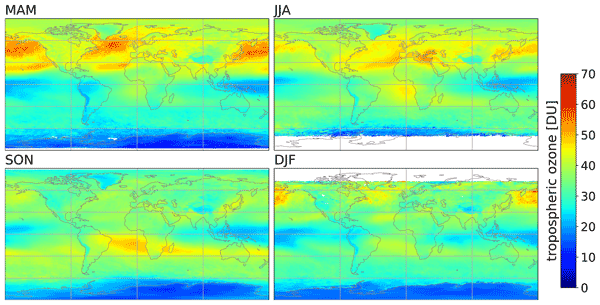
To retrieve tropospheric ozone column information, we subtract stratospheric column data of BASCOE from TROPOMI/S5P total ozone columns.
The new S5P-BASCOE data agree well with existing tropospheric data like OMPS-MERRA-2. The data are also compared to ozone soundings.
The tropospheric ozone columns show the expected temporal and spatial patterns. We will also apply the algorithm to future UV nadir missions like Sentinel 4 or 5 or to recent and ongoing missions like GOME_2 or OMI.
Sophie Godin-Beekmann, Niramson Azouz, Viktoria F. Sofieva, Daan Hubert, Irina Petropavlovskikh, Peter Effertz, Gérard Ancellet, Doug A. Degenstein, Daniel Zawada, Lucien Froidevaux, Stacey Frith, Jeannette Wild, Sean Davis, Wolfgang Steinbrecht, Thierry Leblanc, Richard Querel, Kleareti Tourpali, Robert Damadeo, Eliane Maillard Barras, René Stübi, Corinne Vigouroux, Carlo Arosio, Gerald Nedoluha, Ian Boyd, Roeland Van Malderen, Emmanuel Mahieu, Dan Smale, and Ralf Sussmann
Atmos. Chem. Phys., 22, 11657–11673, https://doi.org/10.5194/acp-22-11657-2022, https://doi.org/10.5194/acp-22-11657-2022, 2022
Short summary
Short summary
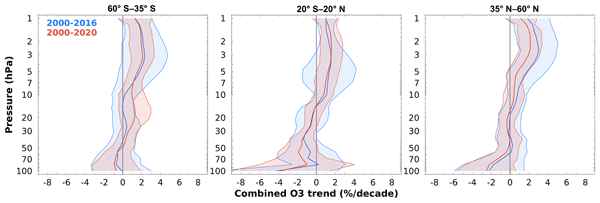
An updated evaluation up to 2020 of stratospheric ozone profile long-term trends at extrapolar latitudes based on satellite and ground-based records is presented. Ozone increase in the upper stratosphere is confirmed, with significant trends at most latitudes. In this altitude region, a very good agreement is found with trends derived from chemistry–climate model simulations. Observed and modelled trends diverge in the lower stratosphere, but the differences are non-significant.
John T. Sullivan, Arnoud Apituley, Nora Mettig, Karin Kreher, K. Emma Knowland, Marc Allaart, Ankie Piters, Michel Van Roozendael, Pepijn Veefkind, Jerry R. Ziemke, Natalya Kramarova, Mark Weber, Alexei Rozanov, Laurence Twigg, Grant Sumnicht, and Thomas J. McGee
Atmos. Chem. Phys., 22, 11137–11153, https://doi.org/10.5194/acp-22-11137-2022, https://doi.org/10.5194/acp-22-11137-2022, 2022
Short summary
Short summary
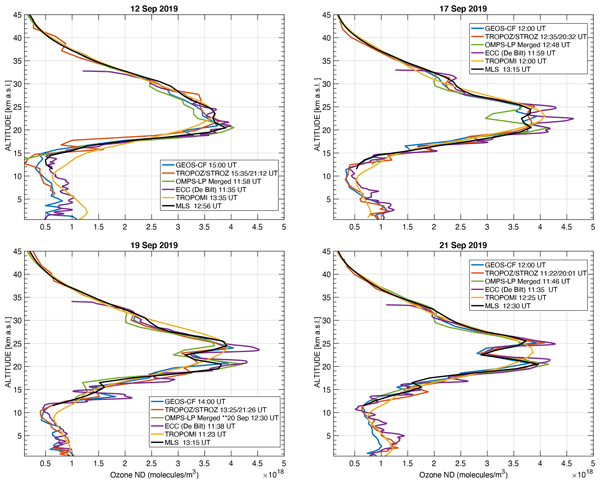
A TROPOspheric Monitoring Instrument (TROPOMI) validation campaign (TROLIX-19) was held in the Netherlands in September 2019. The research presented here focuses on using ozone lidars from NASA’s Goddard Space Flight Center to better evaluate the characterization of ozone throughout TROLIX-19 as compared to balloon-borne, space-borne and ground-based passive measurements, as well as a global coupled chemistry meteorology model.
Yue Jia, Birgit Quack, Robert D. Kinley, Ignacio Pisso, and Susann Tegtmeier
Atmos. Chem. Phys., 22, 7631–7646, https://doi.org/10.5194/acp-22-7631-2022, https://doi.org/10.5194/acp-22-7631-2022, 2022
Short summary
Short summary
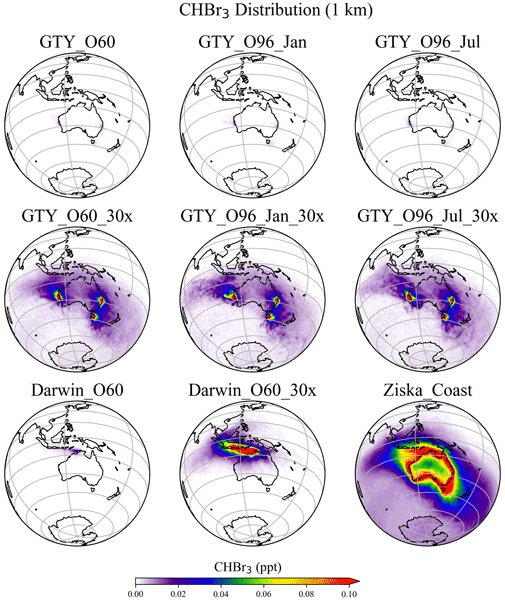
In this study, we assessed the potential risks of bromoform released from Asparagopsis farming near Australia for the stratospheric ozone layer by analyzing different cultivation scenarios. We conclude that the intended operation of Asparagopsis seaweed cultivation farms with an annual yield to meet the needs of 50 % of feedlots and cattle in either open-ocean or terrestrial cultures in Australia will not impact the ozone layer under normal operating conditions.
Shlomi Ziskin Ziv, Chaim I. Garfinkel, Sean Davis, and Antara Banerjee
Atmos. Chem. Phys., 22, 7523–7538, https://doi.org/10.5194/acp-22-7523-2022, https://doi.org/10.5194/acp-22-7523-2022, 2022
Short summary
Short summary
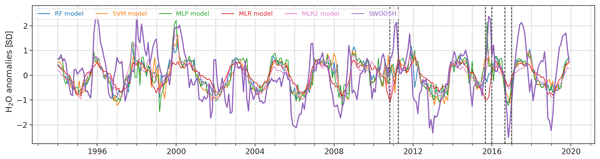
Stratospheric water vapor is important for Earth's overall greenhouse effect and for ozone chemistry; however the factors governing its variability on interannual timescales are not fully known, and previous modeling studies have indicated that models struggle to capture this interannual variability. We demonstrate that nonlinear interactions are important for determining overall water vapor concentrations and also that models have improved in their ability to capture these connections.

Mark Weber, Carlo Arosio, Melanie Coldewey-Egbers, Vitali E. Fioletov, Stacey M. Frith, Jeannette D. Wild, Kleareti Tourpali, John P. Burrows, and Diego Loyola
Atmos. Chem. Phys., 22, 6843–6859, https://doi.org/10.5194/acp-22-6843-2022, https://doi.org/10.5194/acp-22-6843-2022, 2022
Short summary
Short summary
Long-term trends in column ozone have been determined from five merged total ozone datasets spanning the period 1978–2020. We show that ozone recovery due to the decline in stratospheric halogens after the 1990s (as regulated by the Montreal Protocol) is evident outside the tropical region and amounts to half a percent per decade. The ozone recovery in the Northern Hemisphere is however compensated for by the negative long-term trend contribution from atmospheric dynamics since the year 2000.
Susann Tegtmeier, Christa Marandino, Yue Jia, Birgit Quack, and Anoop S. Mahajan
Atmos. Chem. Phys., 22, 6625–6676, https://doi.org/10.5194/acp-22-6625-2022, https://doi.org/10.5194/acp-22-6625-2022, 2022
Short summary
Short summary
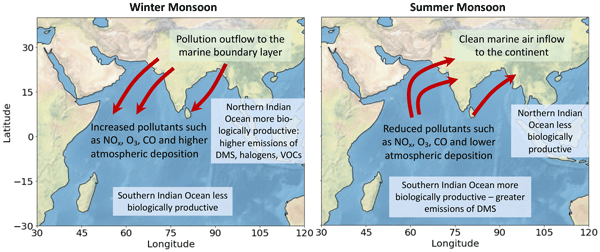
In the atmosphere over the Indian Ocean, intense anthropogenic pollution from Southeast Asia mixes with pristine oceanic air. During the winter monsoon, high pollution levels are regularly observed over the entire northern Indian Ocean, while during the summer monsoon, clean air dominates. Here, we review current progress in detecting and understanding atmospheric gas-phase composition over the Indian Ocean and its impacts on the upper atmosphere, oceanic biogeochemistry, and marine ecosystems.
Cited articles
Benito-Barca, S., Abalos, M., Calvo, M., Garny, H., Birner, T., Abraham, N. L., Akiyoshi, H., Dennison, F., Jöckel, P., Josse, B., Keeble, J., Kinnison, D., Marchand, M., Morgenstern, O., Plummer, D., Rozanov, E., Strode, S., Sukhodolov, T., Watanabe, S., and Yamashita, Y.: Recent lower stratospheric ozone trends in CCMI-2022 models: Role of natural variability and transport, J. Geophys. Res.-Atmos., 130, e2024JD042412, https://doi.org/10.1029/2024JD042412, 2025.
Bernath, P. F.: The Atmospheric Chemistry Experiment (ACE), J. Quant. Spectrosc. Ra., 186, 3–16, https://doi.org/10.1016/j.jqsrt.2016.04.006, 2017.
Bernath, P. F., McElroy, C. T., Abrams, M. C., Boone, C. D., Butler, M., Camy-Peyret, C., Carleer, M., Clerbaux, C., Coheur, P.-F., Colin, R., DeCola, P., DeMazière, M., Drummond, J. R., Dufour, D., Evans, W. F. J., Fast, H., Fussen, D., Gilbert, K., Jennings, D. E., Llewellyn, E. J., Lowe, R. P., Mahieu, E., McConnell, J. C., McHugh, M., McLeod, S. D., Michaud, R., Midwinter, C., Nassar, R., Nichitiu, F., Nowlan, C., Rinsland, C. P., Rochon, Y. J., Rowlands, N., Semeniuk, K., Simon, P., Skelton, R., Sloan, J. J., Soucy, M.-A., Strong, K., Tremblay, P., Turnbull, D., Walker, K. A., Walkty, I., Wardle, D. A., Wehrle, V., Zander, R., and Zou, J.: Atmospheric Chemistry Experiment (ACE): Mission overview, Geophys. Res. Lett., 32, L15S01, https://doi.org/10.1029/2005GL022386, 2005.
Bernath, P., Boone, C., Lecours, M., Crouse, J., Steffen, J., and Schmidt, M.: Global Satellite-Based Atmospheric Profiles from Atmospheric Chemistry Experiment SciSat Level 2 Processed Data, v5.2, 2004–2024, Federated Research Data Repository [data set], https://doi.org/10.20383/103.01245, 2025.
Cisewski, M., Zawodny, J., Gasbarre, J., Eckman, R., Topiwala, N., Rodriguez-Alvarez, O., Cheek, D., and Hall, S.: The Stratospheric Aerosol and Gas Experiment (SAGE III) on the International Space Station (ISS) Mission, Proc. SPIE 9241, Sensors, Systems, and Next-Generation Satellites XVIII, 924107, https://doi.org/10.1117/12.2073131, 2014.
Farman, J. C., Gardiner, B. G., and Shanklin, J. D.: Large losses of ozone in Antarctica reveal seasonal ClOx/NOx interaction, Nature, 315, 207–210, https://doi.org/10.1038/315207a0, 1985.
Flynn, L. E., Seftor, C. J., Larsen, J. C., and Xu, P.: The ozone mapping and profiler suite, in: Earth science satellite remote sensing, edited by: Qu, J. J.. Gao, W., Kafatos, M., Murphy, R. E., and Salomonson, V. V., Springer, 279–296, https://doi.org/10.1007/978-3-540-37293-6_15, 2006.
Frith, S. M., Bhartia, P. K., Oman, L. D., Kramarova, N. A., McPeters, R. D., and Labow, G. J.: Model-based climatology of diurnal variability in stratospheric ozone as a data analysis tool, Atmos. Meas. Tech., 13, 2733–2749, https://doi.org/10.5194/amt-13-2733-2020, 2020.
Godin-Beekmann, S., Azouz, N., Sofieva, V. F., Hubert, D., Petropavlovskikh, I., Effertz, P., Ancellet, G., Degenstein, D. A., Zawada, D., Froidevaux, L., Frith, S., Wild, J., Davis, S., Steinbrecht, W., Leblanc, T., Querel, R., Tourpali, K., Damadeo, R., Maillard Barras, E., Stübi, R., Vigouroux, C., Arosio, C., Nedoluha, G., Boyd, I., Van Malderen, R., Mahieu, E., Smale, D., and Sussmann, R.: Updated trends of the stratospheric ozone vertical distribution in the 60° S–60° N latitude range based on the LOTUS regression model , Atmos. Chem. Phys., 22, 11657–11673, https://doi.org/10.5194/acp-22-11657-2022, 2022.
Jaross, G., Bhartia, P. K., Chen, G., Kowitt, M., Haken, M., Chen, Z., Xu, P., Warner, J., and Kelly, T.: OMPS LimbProfiler instrument performance assessment, J. Geophys. Res.-Atmos., 119, 4399–4412, https://doi.org/10.1002/2013JD020482, 2014.
Kramarova, N. A., Nash, E. R., Newman, P. A., Bhartia, P. K., McPeters, R. D., Rault, D. F., Seftor, C. J., Xu, P. Q., and Labow, G. J.: Measuring the Antarctic ozone hole with the new Ozone Mapping and Profiler Suite (OMPS), Atmos. Chem. Phys., 14, 2353–2361, https://doi.org/10.5194/acp-14-2353-2014, 2014.
Kramarova, N. A., Bhartia, P. K., Jaross, G., Moy, L., Xu, P., Chen, Z., DeLand, M., Froidevaux, L., Livesey, N., Degenstein, D., Bourassa, A., Walker, K. A., and Sheese, P.: Validation of ozone profile retrievals derived from the OMPS LP version 2.5 algorithm against correlative satellite measurements, Atmos. Meas. Tech., 11, 2837–2861, https://doi.org/10.5194/amt-11-2837-2018, 2018.
Kramarova, N. A.: OMPS-NPP L2 LP ozone (O3) vertical profile swath daily center slit V2.6, Goddard Earth Sciences Data and Information Services Center (GES DISC) [data set], Greenbelt, MD, USA, https://doi.org/10.5067/8MO7DEDYTBH7, 2023.
Kramarova, N. A. and DeLand, M.: README document for the Suomi-NPP OMPS LP L2 O3 daily product, Version 2.6, Goddard Earth Sciences Data and Information Services Center (GES DISC), 36 pp., https://disc.gsfc.nasa.gov/datasets/OMPS_NPP_LP_L2_O3_DAILY_2.6/summary?keywords=OMPS (last access: 1 July 2025), 2023.
Kramarova, N. A., Xu, P., Mok, J., Bhartia, P. K., Jaross, G., Moy, L., Chen, Z., Frith, S., DeLand, M., Kahn, D., Labow, G., Li, J., Nyaku, E., Weaver, C., Ziemke, J., Davis, S., and Jia, Y.: Decade-long ozone profile record from Suomi NPP OMPS Limb Profiler: Assessment of version 2.6 data, Earth and Space Science, 11, e2024EA003707, https://doi.org/10.1029/2024EA003707, 2024.
Leblanc, T. and McDermid, I. S.: Stratospheric ozone climatology from lidar measurements at Table Mountain (34.4° N, 117.7° W) and Mauna Loa (19.5° N, 155.6° W), J. Geophys. Res., 105, 14613–14623, https://doi.org/10.1029/2000JD900030, 2000.
Livesey, N. J., Read, W. G., Wagner, P. A., Froidevaux, L., Santee, M. L., Schwartz, M. J., Lambert, A., Millán Valle, L. F., Pumphrey, H. C., Manney, G. L., Fuller, R. A., Jarnot, R. F., Knosp, B. W., and Lay, R. R.: Version 5.0x Level 2 and 3 data quality and description document, Jet Propulsion Laboratory, Tech. Rep. No. JPL D-105336 Rev. B, https://mls.jpl.nasa.gov/data/v5-0_data_quality_document.pdf (last access: 1 July 2025), 2022.
McPeters, R., Frith, S., Kramarova, N., Ziemke, J., and Labow, G.: Trend quality ozone from NPP OMPS: the version 2 processing, Atmos. Meas. Tech., 12, 977–985, https://doi.org/10.5194/amt-12-977-2019, 2019.
Rault, D. F. and Loughman, R. P.: The OMPS limb profiler environmental data record algorithm theoretical basis document and expected performance, IEEE T. Geosci. Remote, 51, 2505–2527, https://doi.org/10.1109/TGRS.2012.2213093, 2013.
SAGE III/ISS Data Products User's Guide, Version 6.0, https://asdc.larc.nasa.gov/documents/sageiii-iss/guide/data_product_users_guide_6.0.pdf (last access: 1 July 2025), 2025.
Salawitch, R. J., Smith, J. B., Selkirk, H., Wargen, K., Chipperfield, M. P., Hossaini, R., Levelt, P. F., Livesey, N. J., McBride, L. A., Millán, L. F., Moyer, E., Santee, M. L., Schoeberl, M. R., Solomon, S., Stone, K., and Worden, H.: The Imminent Data Desert: The Future of Stratospheric Monitoring in a Changing Climate, B. Am. Meteorol. Soc., 106, E540–E563, https://doi.org/10.1175/BAMS-D-23-0281.1, 2025.
Sheese, P. and Walker, K.,: Data Quality Flags for ACE-FTS Level 2 Version 5.2 Data Set, Version 16, Borealis [data set], https://doi.org/10.5683/SP3/NAYNFE, 2023.
Sheese, P. E., Walker, K. A., Boone, C. D., Bourassa, A. E., Degenstein, D. A., Froidevaux, L., McElroy, C. T., Murtagh, D., Russell III, J. M., and Zou, J.: Assessment of the quality of ACE-FTS stratospheric ozone data, Atmos. Meas. Tech., 15, 1233–1249, https://doi.org/10.5194/amt-15-1233-2022, 2022.
SPARC/IO3C/GAW: SPARC/IO3C/GAW Report on Long-term Ozone Trends and Uncertainties in the Stratosphere, edited by: Petropavlovskikh, I., Godin-Beekmann, S., Hubert, D., Damadeo, R., Hassler, B., and Sofieva, V., SPARC Report No. 9, GAW Report No. 241, WCRP-17/2018, https://doi.org/10.17874/f899e57a20b, 2019.
Stauffer, R. M., Thompson, A. M., Kollonige, D. E., Tarasick, D. W., van Malderen, R., Smit, H. G. J., Vömel, H., Morris, G. A., Johnson, B. J., Cullis, P. D., Stübi, R., Davis, J., and Yan, M. M.: An examination of the recent stability of ozonesonde global network data, Earth and Space Science, 9, e2022EA002459, https://doi.org/10.1029/2022EA002459, 2022.
Wang, H. J. R., Damadeo, R., Flittner, D., Kramarova, N., Taha, G., Davis, S., Thompson, A. M., Strahan, S., Wang, Y., Froidevaux, L., Degenstein, D., Bourassa, A., Steinbrecht, W., Walker, K. A., Querel, R., Leblanc, T., Godin-Beekmann, S., Hurst, D., and Hall, E.: Validation of SAGE III/ISS solar occultation ozone products with correlative satellite and ground based measurements, J. Geophys. Res.-Atmos., 125, e2020JD032430, https://doi.org/10.1029/2020JD032430, 2020.
Waters, J. W., Froidevaux, L., Harwood, R. S., Jarnot, R. F., Pickett, H. M., Read, W. G., Siegel, P. H., Cofield, R. E., Filipiak, M. J., Flower, D. A., Holden, J. R., Lau, G. K., Livesey, N. J., Manney, G. L., Pumphrey, H. C., Santee, M. L., Wu, D. L., Cuddy, D. T., Lay, R. R., Loo, M. S., Perun, V. S., Schwartz, M. J., Stek, P. C., Thurstans, R. P., Boyles, M. A., Chandra, K. M., Chavez, M. C., Chen, G-., Chudasama, B. V., Dodge, R., Fuller, R. A., Girard, M. A., Jiang, J. H., Jiang, Y., Knosp, B. W., LaBelle, R. C., Lam, J. C., Lee, K. A., Miller, D., Oswald, J. E., Patel, N. C., Pukala, D. M., Quintero, O., Scaff, D. M., Van Snyder, W., Tope, M. C., Wagner, P. A., and Walch, M. J.: The Earth observing system microwave limb sounder (EOS MLS) on the aura Satellite, IEEE T. Geosci. Remote, 44, 1075–1092, https://doi.org/10.1109/TGRS.2006.873771, 2006.
WMO (World Meteorological Organization): GCOS-22: The 2022 GCOS ECVs Requirements, WMO GCOS-245, WMO, https://library.wmo.int/idurl/4/58111 (last access: 1 December 2025), 2022a.
WMO (World Meteorological Organization): Scientific assessment of ozone depletion: 2022, GAW report No. 278, 509 pp., WMO, https://ozone.unep.org/science/assessment/sap (last access: 1 December 2025), 2022b.
Zou, J., Walker, K. A., Sheese, P. E., Boone, C. D., Stauffer, R. M., Thompson, A. M., and Tarasick, D. W.: Validation of ACE-FTS version 5.2 ozone data with ozonesonde measurements, Atmos. Meas. Tech., 17, 6983–7005, https://doi.org/10.5194/amt-17-6983-2024, 2024.
Short summary
The Montreal Protocol has led to a slow recovery in the Earth's ozone layer. To detect such changes, and to monitor the health of the ozone layer, long term global observations are needed. The OMPS Limb Profiler (LP) series of satellite sensors are designed to meet this need. We validate the latest version OMPS LP ozone profiles against other satellite and ground based measurements. We find that OMPS LP ozone is consistent with other data sources and is suitable for use in ozone trend studies.
The Montreal Protocol has led to a slow recovery in the Earth's ozone layer. To detect such...


