
Articles | Volume 19, issue 18
https://doi.org/10.5194/amt-19-5831-2026
© Author(s) 2026. This work is distributed under
the Creative Commons Attribution 4.0 License.
the Creative Commons Attribution 4.0 License.
https://doi.org/10.5194/amt-19-5831-2026
© Author(s) 2026. This work is distributed under
the Creative Commons Attribution 4.0 License.
the Creative Commons Attribution 4.0 License.
Research article
| 
15 Sep 2026
Research article |
| 15 Sep 2026
| 15 Sep 2026
Measuring cloud optical depth with a balloonborne microlidar operated from the stratosphere
François Ravetta
CORRESPONDING AUTHOR

LATMOS/IPSL, Sorbonne Université, UVSQ, CNRS, Paris, France
Thomas Lesigne
LATMOS/IPSL, Sorbonne Université, UVSQ, CNRS, Paris, France
Vincent Mariage
LATMOS/IPSL, Sorbonne Université, UVSQ, CNRS, Paris, France
Jacques Pelon
LATMOS/IPSL, Sorbonne Université, UVSQ, CNRS, Paris, France
Related authors
Joris Weinzaepflen, François Ravetta, Stéphane Victori, Gérard Ancellet, Cristelle Cailteau-Fischbach, Vincent Mariage, Frédéric Delahaye, Frédéric Gérôme, and Fetah Benabid
EGUsphere, https://doi.org/10.5194/egusphere-2026-2631, https://doi.org/10.5194/egusphere-2026-2631, 2026
Short summary
Short summary
This study presents a compact ozone lidar designed to monitor ozone in the lower atmosphere over urban areas. The instrument uses a new optical fiber technology to generate ultraviolet laser light while reducing size and enabling more autonomous operation compared with existing instruments. First measurements in Paris successfully captured ozone variations up to nearly two kilometers altitude, demonstrating the potential of compact lidar systems for continuous urban air quality monitoring.
Raphaël Lebrun, Yevgeny Derimian, François Ravetta, Jérôme Bureau, and Sergey Khaykin
EGUsphere, https://doi.org/10.5194/egusphere-2026-2006, https://doi.org/10.5194/egusphere-2026-2006, 2026
Short summary
Short summary
Fueled by climate change, some recent extreme wildfires have been observed to inject unprecedented levels of aerosols in the stratosphere. Partly composed of carbon, these aerosols absorb solar light and change the energy balance of the atmosphere. Using observations and radiative modeling, we show the stratospheric aerosols from the 2020 Australian wildfire have warmed the atmosphere by 0.08 to 0.19 W.m−2 globally over a year, as they tend to reduce the albedo effect of underlying clouds.
Gérard Ancellet, Camille Viatte, Anne Boynard, François Ravetta, Jacques Pelon, Cristelle Cailteau-Fischbach, Pascal Genau, Julie Capo, Axel Roy, and Philippe Nédélec
Atmos. Chem. Phys., 24, 12963–12983, https://doi.org/10.5194/acp-24-12963-2024, https://doi.org/10.5194/acp-24-12963-2024, 2024
Short summary
Short summary
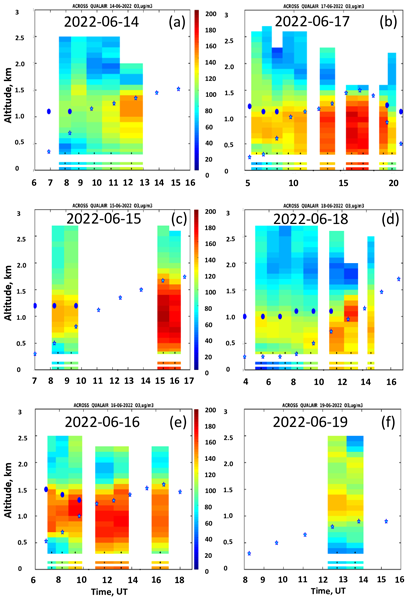
Characterization of ozone pollution in urban areas benefited from a measurement campaign in summer 2022 in the Paris region. The analysis is based on 21 d of lidar and aircraft observations. The main objective is an analysis of the sensitivity of ozone pollution to the micrometeorological processes in the urban atmospheric boundary layer and the transport of regional pollution. The paper also discusses to what extent satellite observations can track observed ozone plumes.
Thomas Lesigne, François Ravetta, Aurélien Podglajen, Vincent Mariage, and Jacques Pelon
Atmos. Chem. Phys., 24, 5935–5952, https://doi.org/10.5194/acp-24-5935-2024, https://doi.org/10.5194/acp-24-5935-2024, 2024
Short summary
Short summary
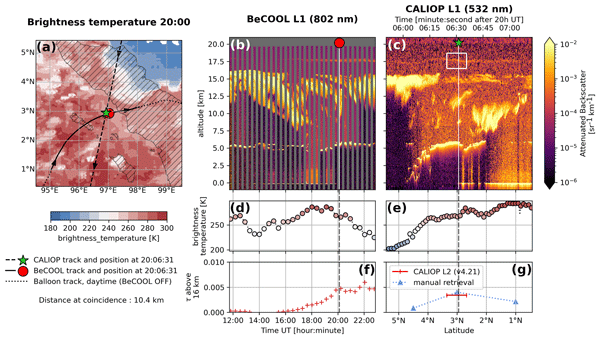
Upper tropical clouds have a strong impact on Earth's climate but are challenging to observe. We report the first long-duration observations of tropical clouds from lidars flying on board stratospheric balloons. Comparisons with spaceborne observations reveal the enhanced sensitivity of balloon-borne lidar to optically thin cirrus. These clouds, which have a significant coverage and lie in the uppermost troposphere, are linked with the dehydration of air masses on their way to the stratosphere.
Julia Maillard, Jean-Christophe Raut, and François Ravetta
Geosci. Model Dev., 17, 3303–3320, https://doi.org/10.5194/gmd-17-3303-2024, https://doi.org/10.5194/gmd-17-3303-2024, 2024
Short summary
Short summary
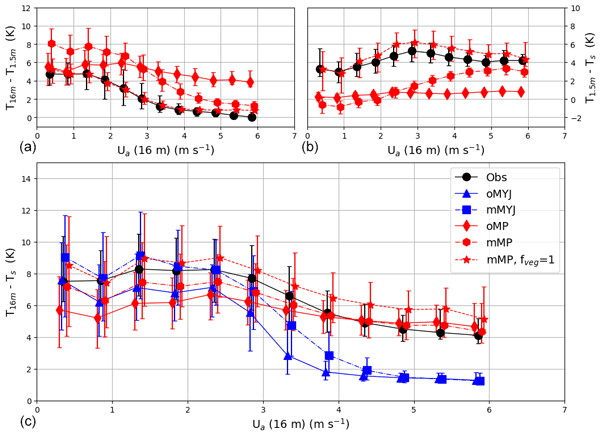
Atmospheric models struggle to reproduce the strong temperature inversions in the vicinity of the surface over forested areas in the Arctic winter. In this paper, we develop modified simplified versions of surface layer schemes widely used by the community. Our modifications are used to correct the fact that original schemes place strong limits on the turbulent collapse, leading to a lower surface temperature gradient at low wind speeds. Modified versions show a better performance.
Joris Weinzaepflen, François Ravetta, Stéphane Victori, Gérard Ancellet, Cristelle Cailteau-Fischbach, Vincent Mariage, Frédéric Delahaye, Frédéric Gérôme, and Fetah Benabid
EGUsphere, https://doi.org/10.5194/egusphere-2026-2631, https://doi.org/10.5194/egusphere-2026-2631, 2026
Short summary
Short summary
This study presents a compact ozone lidar designed to monitor ozone in the lower atmosphere over urban areas. The instrument uses a new optical fiber technology to generate ultraviolet laser light while reducing size and enabling more autonomous operation compared with existing instruments. First measurements in Paris successfully captured ozone variations up to nearly two kilometers altitude, demonstrating the potential of compact lidar systems for continuous urban air quality monitoring.
Milena Corcos, Bernd Kärcher, Thomas Lesigne, Aurélien Podglajen, and Eric J. Jensen
EGUsphere, https://doi.org/10.5194/egusphere-2026-3112, https://doi.org/10.5194/egusphere-2026-3112, 2026
This preprint is open for discussion and under review for Atmospheric Chemistry and Physics (ACP).
Short summary
Short summary
Thin ice clouds near the boundary between the troposphere and stratosphere affect Earth's climate by influencing radiation and the transport of water into the upper atmosphere. Using a model constrained by cloud observations, we investigated why some clouds disappear within hours while others persist much longer. We show that their lifetime depends on both rapid fluctuations and slower temperature changes. Long-lived clouds are rare but may have a disproportionate influence on climate.
Raphaël Lebrun, Yevgeny Derimian, François Ravetta, Jérôme Bureau, and Sergey Khaykin
EGUsphere, https://doi.org/10.5194/egusphere-2026-2006, https://doi.org/10.5194/egusphere-2026-2006, 2026
Short summary
Short summary
Fueled by climate change, some recent extreme wildfires have been observed to inject unprecedented levels of aerosols in the stratosphere. Partly composed of carbon, these aerosols absorb solar light and change the energy balance of the atmosphere. Using observations and radiative modeling, we show the stratospheric aerosols from the 2020 Australian wildfire have warmed the atmosphere by 0.08 to 0.19 W.m−2 globally over a year, as they tend to reduce the albedo effect of underlying clouds.
Gérard Ancellet, Camille Viatte, Anne Boynard, François Ravetta, Jacques Pelon, Cristelle Cailteau-Fischbach, Pascal Genau, Julie Capo, Axel Roy, and Philippe Nédélec
Atmos. Chem. Phys., 24, 12963–12983, https://doi.org/10.5194/acp-24-12963-2024, https://doi.org/10.5194/acp-24-12963-2024, 2024
Short summary
Short summary
Characterization of ozone pollution in urban areas benefited from a measurement campaign in summer 2022 in the Paris region. The analysis is based on 21 d of lidar and aircraft observations. The main objective is an analysis of the sensitivity of ozone pollution to the micrometeorological processes in the urban atmospheric boundary layer and the transport of regional pollution. The paper also discusses to what extent satellite observations can track observed ozone plumes.
Thomas Lesigne, François Ravetta, Aurélien Podglajen, Vincent Mariage, and Jacques Pelon
Atmos. Chem. Phys., 24, 5935–5952, https://doi.org/10.5194/acp-24-5935-2024, https://doi.org/10.5194/acp-24-5935-2024, 2024
Short summary
Short summary
Upper tropical clouds have a strong impact on Earth's climate but are challenging to observe. We report the first long-duration observations of tropical clouds from lidars flying on board stratospheric balloons. Comparisons with spaceborne observations reveal the enhanced sensitivity of balloon-borne lidar to optically thin cirrus. These clouds, which have a significant coverage and lie in the uppermost troposphere, are linked with the dehydration of air masses on their way to the stratosphere.
Julia Maillard, Jean-Christophe Raut, and François Ravetta
Geosci. Model Dev., 17, 3303–3320, https://doi.org/10.5194/gmd-17-3303-2024, https://doi.org/10.5194/gmd-17-3303-2024, 2024
Short summary
Short summary
Atmospheric models struggle to reproduce the strong temperature inversions in the vicinity of the surface over forested areas in the Arctic winter. In this paper, we develop modified simplified versions of surface layer schemes widely used by the community. Our modifications are used to correct the fact that original schemes place strong limits on the turbulent collapse, leading to a lower surface temperature gradient at low wind speeds. Modified versions show a better performance.
Meryl Wimmer, Gwendal Rivière, Philippe Arbogast, Jean-Marcel Piriou, Julien Delanoë, Carole Labadie, Quitterie Cazenave, and Jacques Pelon
Weather Clim. Dynam., 3, 863–882, https://doi.org/10.5194/wcd-3-863-2022, https://doi.org/10.5194/wcd-3-863-2022, 2022
Short summary
Short summary
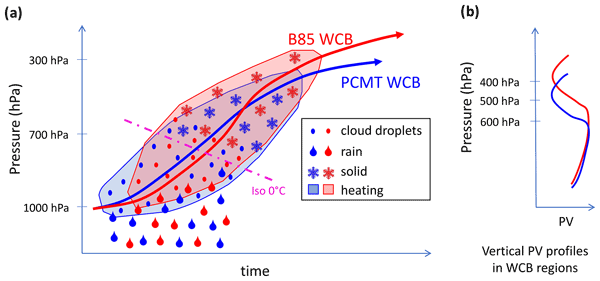
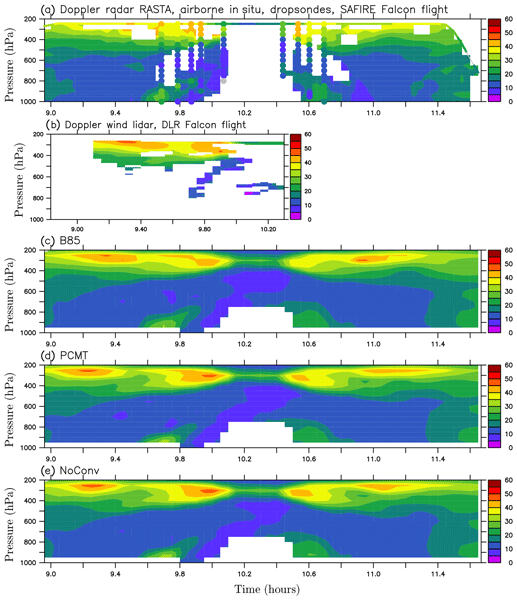
The effect of deep convection representation on the jet stream above the cold front of an extratropical cyclone is investigated in the global numerical weather prediction model ARPEGE. Two simulations using different deep convection schemes are compared with (re)analysis datasets and NAWDEX airborne observations. A deeper jet stream is observed with the less active scheme. The diabatic origin of this difference is interpreted by backward Lagrangian trajectories and potential vorticity budgets.
Thibault Vaillant de Guélis, Gérard Ancellet, Anne Garnier, Laurent C.-Labonnote, Jacques Pelon, Mark A. Vaughan, Zhaoyan Liu, and David M. Winker
Atmos. Meas. Tech., 15, 1931–1956, https://doi.org/10.5194/amt-15-1931-2022, https://doi.org/10.5194/amt-15-1931-2022, 2022
Short summary
Short summary
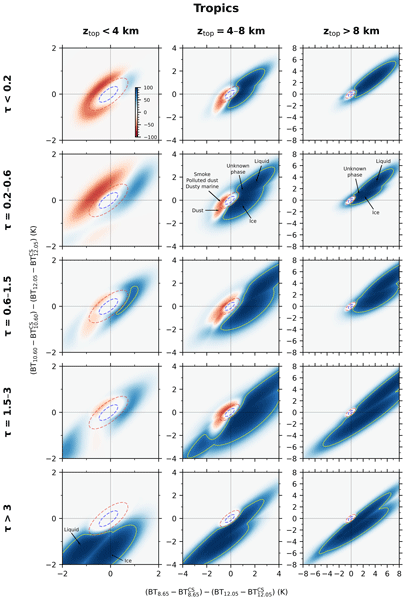
A new IIR-based cloud and aerosol discrimination (CAD) algorithm is developed using the IIR brightness temperature differences for cloud and aerosol features confidently identified by the CALIOP version 4 CAD algorithm. IIR classifications agree with the majority of V4 cloud identifications, reduce the ambiguity in a notable fraction of
not confidentV4 cloud classifications, and correct a few V4 misclassifications of cloud layers identified as dense dust or elevated smoke layers by CALIOP.
Lilian Loyer, Jean-Christophe Raut, Claudia Di Biagio, Julia Maillard, Vincent Mariage, and Jacques Pelon
Atmos. Meas. Tech. Discuss., https://doi.org/10.5194/amt-2021-326, https://doi.org/10.5194/amt-2021-326, 2021
Revised manuscript not accepted
Short summary
Short summary
The Arctic is facing drastic climate changes, and more observations are needed to better understand what is happening. Unfortunately observations are limited in the High Arctic. To obtain more observations, multiples buoys equipped with lidar, have been deployed in this region. This paper presents an approach to estimate the optical properties of clouds, and solar plus terrestrial energies from lidar measurements in the Arctic.
Gwendal Rivière, Meryl Wimmer, Philippe Arbogast, Jean-Marcel Piriou, Julien Delanoë, Carole Labadie, Quitterie Cazenave, and Jacques Pelon
Weather Clim. Dynam., 2, 1011–1031, https://doi.org/10.5194/wcd-2-1011-2021, https://doi.org/10.5194/wcd-2-1011-2021, 2021
Short summary
Short summary
Inacurracies in representing processes occurring at spatial scales smaller than the grid scales of the weather forecast models are important sources of forecast errors. This is the case of deep convection representation in models with 10 km grid spacing. We performed simulations of a real extratropical cyclone using a model with different representations of deep convection. These forecasts lead to different behaviors in the ascending air masses of the cyclone and the jet stream aloft.
Cited articles
Ancellet, G. M., Kavaya, M. J., Menzies, R. T., and Brothers, A. M.: Lidar Telescope Overlap Function and Effects of Misalignment for Unstable Resonator Transmitter and Coherent Receiver, Appl. Opt., 25, 2886, https://doi.org/10.1364/AO.25.002886, 1986. a
Bucholtz, A.: Rayleigh-scattering calculations for the terrestrial atmosphere, Appl. Opt., 34, 2765, https://doi.org/10.1364/AO.34.002765, 1995. a
Di Donfrancesco, G., Cairo, F., Buontempo, C., Adriani, A., Viterbini, M., Snels, M., Morbidini, R., Piccolo, F., Cardillo, F., Pommereau, J.-P., and Garnier, A.: Balloonborne Lidar for Cloud Physics Studies, Appl. Opt., 45, 5701, https://doi.org/10.1364/AO.45.005701, 2006. a
Fernald, F. G.: Analysis of atmospheric lidar observations: some comments, Appl. Opt., 23, 652, https://doi.org/10.1364/AO.23.000652, 1984. a
Fernald, F. G., Herman, B. M., and Reagan, J. A.: Determination of Aerosol Height Distributions by Lidar, J. Appl. Meteor., 11, 482–489, https://doi.org/10.1175/1520-0450(1972)011<0482:DOAHDB>2.0.CO;2, 1972. a
Fueglistaler, S., Dessler, A. E., Dunkerton, T. J., Folkins, I., Fu, Q., and Mote, P. W.: Tropical tropopause layer, Rev. Geophys., 47, https://doi.org/10.1029/2008RG000267, 2009. a
Garnier, A., Pelon, J., Dubuisson, P., Faivre, M., Chomette, O., Pascal, N., and Kratz, D. P.: Retrieval of Cloud Properties Using CALIPSO Imaging Infrared Radiometer. Part I: Effective Emissivity and Optical Depth, J. Appl. Meteorol. Climatol., 51, 1407–1425, https://doi.org/10.1175/JAMC-D-11-0220.1, 2012. a
Garnier, A., Pelon, J., Vaughan, M. A., Winker, D. M., Trepte, C. R., and Dubuisson, P.: Lidar multiple scattering factors inferred from CALIPSO lidar and IIR retrievals of semi-transparent cirrus cloud optical depths over oceans, Atmos. Meas. Tech., 8, 2759–2774, https://doi.org/10.5194/amt-8-2759-2015, 2015. a, b
Haase, J. S.: Around the World in 84 Days, American Geophysical Union (AGU), https://eos.org/science-updates/around-the-world-in-84-days (last access: 19 April 2026), 2018. a
Hersbach, H., Bell, B., Berrisford, P., Hirahara, S., Horányi, A., Muñoz-Sabater, J., Nicolas, J., Peubey, C., Radu, R., Schepers, D., Simmons, A., Soci, C., Abdalla, S., Abellan, X., Balsamo, G., Bechtold, P., Biavati, G., Bidlot, J., Bonavita, M., De Chiara, G., Dahlgren, P., Dee, D., Diamantakis, M., Dragani, R., Flemming, J., Forbes, R., Fuentes, M., Geer, A., Haimberger, L., Healy, S., Hogan, R. J., Hólm, E., Janisková, M., Keeley, S., Laloyaux, P., Lopez, P., Lupu, C., Radnoti, G., de Rosnay, P., Rozum, I., Vamborg, F., Villaume, S., and Thépaut, J.-N.: The ERA5 Global Reanalysis, Q. J. Roy. Meteorol. Soc., 146, 1999–2049, https://doi.org/10.1002/qj.3803, 2020. a
Kaifler, B., Rempel, D., Roßi, P., Büdenbender, C., Kaifler, N., and Baturkin, V.: A technical description of the Balloon Lidar Experiment (BOLIDE), Atmos. Meas. Tech., 13, 5681–5695, https://doi.org/10.5194/amt-13-5681-2020, 2020. a
Kar, J., Vaughan, M. A., Lee, K.-P., Tackett, J. L., Avery, M. A., Garnier, A., Getzewich, B. J., Hunt, W. H., Josset, D., Liu, Z., Lucker, P. L., Magill, B., Omar, A. H., Pelon, J., Rogers, R. R., Toth, T. D., Trepte, C. R., Vernier, J.-P., Winker, D. M., and Young, S. A.: CALIPSO lidar calibration at 532 nm: version 4 nighttime algorithm, Atmos. Meas. Tech., 11, 1459–1479, https://doi.org/10.5194/amt-11-1459-2018, 2018. a
Klett, J. D.: Stable analytical inversion solution for processing lidar returns, Appl. Opt., 20, 211, https://doi.org/10.1364/AO.20.000211, 1981. a, b
Klett, J. D.: Lidar inversion with variable backscatter/extinction ratios, Appl. Opt., 24, 1638, https://doi.org/10.1364/AO.24.001638, 1985. a
Kremser, S., Thomason, L. W., von Hobe, M., Hermann, M., Deshler, T., Timmreck, C., Toohey, M., Stenke, A., Schwarz, J. P., Weigel, R., Fueglistaler, S., Prata, F. J., Vernier, J.-P., Schlager, H., Barnes, J. E., Antuña-Marrero, J.-C., Fairlie, D., Palm, M., Mahieu, E., Notholt, J., Rex, M., Bingen, C., Vanhellemont, F., Bourassa, A., Plane, J. M. C., Klocke, D., Carn, S. A., Clarisse, L., Trickl, T., Neely, R., James, A. D., Rieger, L., Wilson, J. C., and Meland, B.: Stratospheric aerosol – Observations, processes, and impact on climate, Rev. Geophys., 54, 278–335, https://doi.org/10.1002/2015RG000511, 2016. a
LATMOS/IPSL: BeCOOL Lidar Level 1 and 2, V3, IPSL Data Catalog – Strateole2 [data set], https://doi.org/10.14768/bad47567-f844-4084-abd9-917668e18d82, 2024. a
Lesigne, T., Ravetta, F., Podglajen, A., Mariage, V., and Pelon, J.: Extensive coverage of ultrathin tropical tropopause layer cirrus clouds revealed by balloon-borne lidar observations, Atmos. Chem. Phys., 24, 5935–5952, https://doi.org/10.5194/acp-24-5935-2024, 2024. a, b
Lesigne, T., Podglajen, A., and Ravetta, F.: Tropical Cirrus Lifetime Estimated From Superpressure Balloon-Borne Lidar Observations, Geophys. Res. Lett., 52, e2025GL117353, https://doi.org/10.1029/2025GL117353, 2025. a, b
Liu, Z., Omar, A. H., Hu, Y., Vaughan, M. A., and Winker, D. M.: CALIOP Algorithm Theoretical Basis Document: Part 3 – Scene Classification Algorithms (Document No. PC-SCI-202 Part 3), Tech. Rep. PC-SCI-202 Part 3, Release 1.0, NASA Langley Research Center; National Institute of Aerospace; Science Applications International Corp., https://ntrs.nasa.gov/api/citations/20250006628/downloads/PC-SCI-202_Part3-SceneClassification_rev01a.pdf (last access: 14 November 2025), 2005. a
Maillard, J., Ravetta, F., Raut, J.-C., Mariage, V., and Pelon, J.: Characterisation and surface radiative impact of Arctic low clouds from the IAOOS field experiment, Atmos. Chem. Phys., 21, 4079–4101, https://doi.org/10.5194/acp-21-4079-2021, 2021. a
Mariage, V., Pelon, J., Blouzon, F., Victori, S., Geyskens, N., Amarouche, N., Drezen, C., Guillot, A., Calzas, M., Garracio, M., Wegmuller, N., Sennéchael, N., and Provost, C.: IAOOS Microlidar-on-Buoy Development and First Atmospheric Observations Obtained during 2014 and 2015 Arctic Drifts, Opt. Express, 25, A73–A84, https://doi.org/10.1364/OE.25.000A73, 2017. a, b
NASA/LARC/SD/ASDC: CALIPSO Lidar Level 1B profile data, V4-11, NASA Langley Atmospheric Science Data Center DAAC [data set], https://doi.org/10.5067/CALIOP/CALIPSO/CAL_LID_L1-Standard-V4-11, 2016. a
Nicolas, F., Bissonnette, L. R., and Flamant, P. H.: Lidar effective multiple-scattering coefficients in cirrus clouds, Appl. Opt., 36, 3458–3468, https://doi.org/10.1364/AO.36.003458, 1997. a
Platt, C. M. R.: Lidar and Radiometric Observations of Cirrus Clouds, J. Atmos. Sci., 30, 1191–1204, https://doi.org/10.1175/1520-0469(1973)030<1191:LAROOC>2.0.CO;2, 1973. a, b, c
Pommereau, J.-P., Garnier, A., Held, G., Gomes, A. M., Goutail, F., Durry, G., Borchi, F., Hauchecorne, A., Montoux, N., Cocquerez, P., Letrenne, G., Vial, F., Hertzog, A., Legras, B., Pisso, I., Pyle, J. A., Harris, N. R. P., Jones, R. L., Robinson, A. D., Hansford, G., Eden, L., Gardiner, T., Swann, N., Knudsen, B., Larsen, N., Nielsen, J. K., Christensen, T., Cairo, F., Fierli, F., Pirre, M., Marécal, V., Huret, N., Rivière, E. D., Coe, H., Grosvenor, D., Edvarsen, K., Di Donfrancesco, G., Ricaud, P., Berthelier, J.-J., Godefroy, M., Seran, E., Longo, K., and Freitas, S.: An overview of the HIBISCUS campaign, Atmos. Chem. Phys., 11, 2309–2339, https://doi.org/10.5194/acp-11-2309-2011, 2011. a
Randel, W. J. and Jensen, E. J.: Physical processes in the tropical tropopause layer and their roles in a changing climate, Nat. Geosci., 6, 169–176, https://doi.org/10.1038/ngeo1733, 2013. a
Sasano, Y., Browell, E. V., and Ismail, S.: Error caused by using a constant extinction/backscattering ratio in the lidar solution, Appl. Opt., 24, 3929, https://doi.org/10.1364/AO.24.003929, 1985. a
Shcherbakov, V., Szczap, F., Mioche, G., and Cornet, C.: Multiple-scattering effects on single-wavelength lidar sounding of multi-layered clouds, Atmos. Meas. Tech., 17, 3011–3028, https://doi.org/10.5194/amt-17-3011-2024, 2024. a
Winker, D. M., Vaughan, M. A., Omar, A., Hu, Y., Powell, K. A., Liu, Z., Hunt, W. H., and Young, S. A.: Overview of the CALIPSO Mission and CALIOP Data Processing Algorithms, J. Atmos. Ocean. Technol., 26, 2310–2323, https://doi.org/10.1175/2009JTECHA1281.1, 2009. a
Winker, D. M., Pelon, J., Coakley, J. A., Ackerman, S. A., Charlson, R. J., Colarco, P. R., Flamant, P., Fu, Q., Hoff, R. M., Kittaka, C., Kubar, T. L., Treut, H. L., Mccormick, M. P., Mégie, G., Poole, L., Powell, K., Trepte, C., Vaughan, M. A., and Wielicki, B. A.: The CALIPSO Mission: A Global 3D View of Aerosols and Clouds, B. Am. Meteorol. Soc., 91, 1211–1230, https://doi.org/10.1175/2010BAMS3009.1, 2010. a
Yorks, J. E., Hlavka, D. L., Hart, W. D., and McGill, M. J.: Statistics of Cloud Optical Properties from Airborne Lidar Measurements, J. Atmos. Ocean. Technol., 28, 869–883, https://doi.org/10.1175/2011JTECHA1507.1, 2011. a
Short summary
The Balloonborne Cloud Observing micrOLidar (BeCOOL) is an airborne profiler designed to be operated from the stratosphere. It weights less than 6 kg and requires on average less than 4 W to work automatically onboard a gondola attached below a stratospheric balloon. Given its sensitivity and spatial resolution, this microlidar can be used to characterize the optical properties and the life cycle of cirrus clouds, or to calibrate and validate satellite observations of clouds and aerosol layers.
The Balloonborne Cloud Observing micrOLidar (BeCOOL) is an airborne profiler designed to be...


