
Articles | Volume 19, issue 18
https://doi.org/10.5194/amt-19-5889-2026
© Author(s) 2026. This work is distributed under
the Creative Commons Attribution 4.0 License.
the Creative Commons Attribution 4.0 License.
https://doi.org/10.5194/amt-19-5889-2026
© Author(s) 2026. This work is distributed under
the Creative Commons Attribution 4.0 License.
the Creative Commons Attribution 4.0 License.
Research article
| 
16 Sep 2026
Research article |
| 16 Sep 2026
| 16 Sep 2026
Measurement of turbulence energy dissipation rate by a standalone high-resolution Doppler lidar
Abdul Haseeb Syed
DTU Wind and Energy Systems, Roskilde, Denmark
current address: Department of Mechanical Engineering, Clemson University, 29634 Clemson, USA

DTU Wind and Energy Systems, Roskilde, Denmark
Mohammadreza Manami
DTU Wind and Energy Systems, Roskilde, Denmark
Lidar Division, Lumibird SA, Lannion, France
Related authors
Abdul Haseeb Syed, Ásta Hannesdóttir, and Jakob Mann
Wind Energ. Sci., 11, 3321–3336, https://doi.org/10.5194/wes-11-3321-2026, https://doi.org/10.5194/wes-11-3321-2026, 2026
Short summary
Short summary
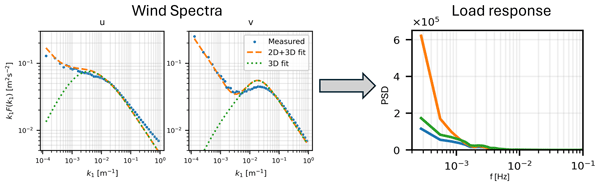
Large offshore wind turbines are exposed to slow changes in wind speed, which are often overlooked in design studies. We investigate how these slow wind variations impact the forces and motions of both fixed and floating wind turbines through computer simulations. Slow wind changes can lead to increased long-term structural wear and significantly impact platform motion in floating turbines. Accounting for these variations is crucial for the design and lifetime assessment of future turbines.
Stefan Ivanell, Bjarke T. Olsen, Antoine Mathieu, Cristina Mulet-Benzo, Abdul Haseeb Syed, Warit Chanprasert, Mikael Sjöholm, Jakob Mann, and Julia Gottschall
Wind Energ. Sci. Discuss., https://doi.org/10.5194/wes-2025-286, https://doi.org/10.5194/wes-2025-286, 2026
Preprint under review for WES
Short summary
Short summary
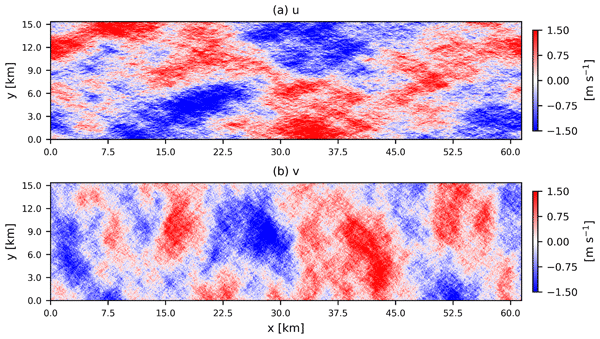
Modern GW-scale offshore wind farms face challenges from atmospheric dynamics. This study examines how boundary layer height (BLH) and large-scale turbulence affect efficiency and loads. Using WRF simulations, lidar data, and CFD modeling for a 100-turbine, 15 MW wind farm at three representative sites, we show that low BLH reduces performance. Turbulence-induced low-frequency fluctuations increase fatigue loads, underscoring the need to include BLH and turbulence in design models.
Abdul Haseeb Syed and Jakob Mann
Wind Energ. Sci., 9, 1381–1391, https://doi.org/10.5194/wes-9-1381-2024, https://doi.org/10.5194/wes-9-1381-2024, 2024
Short summary
Short summary
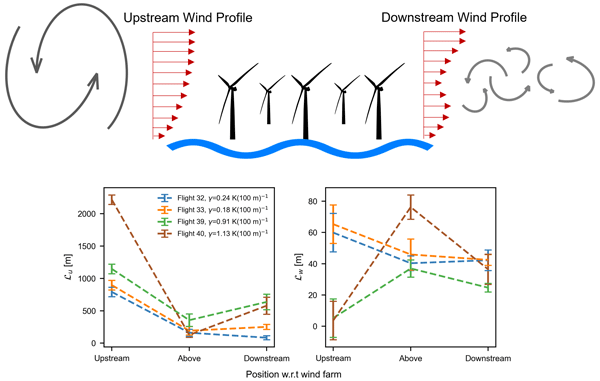
Wind flow consists of swirling patterns of air called eddies, some as big as many kilometers across, while others are as small as just a few meters. This paper introduces a method to simulate these large swirling patterns on a flat grid. Using these simulations we can better figure out how these large eddies affect big wind turbines in terms of loads and forces.
Abdul Haseeb Syed, Jakob Mann, Andreas Platis, and Jens Bange
Wind Energ. Sci., 8, 125–139, https://doi.org/10.5194/wes-8-125-2023, https://doi.org/10.5194/wes-8-125-2023, 2023
Short summary
Short summary
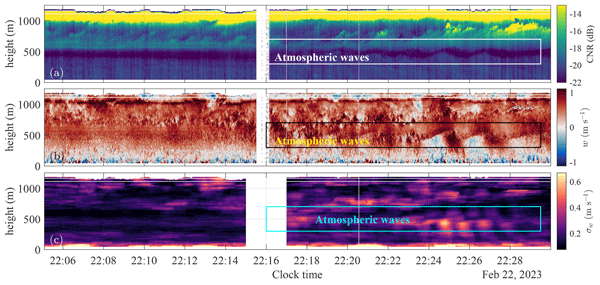
Wind turbines extract energy from the incoming wind flow, which needs to be recovered. In very large offshore wind farms, the energy is recovered mostly from above the wind farm in a process called entrainment. In this study, we analyzed the effect of atmospheric stability on the entrainment process in large offshore wind farms using measurements recorded by a research aircraft. This is the first time that in situ measurements are used to study the energy recovery process above wind farms.
Shokoufeh Malekmohammadi, Etienne Cheynet, Joachim Reuder, Claus Linnemann, Mikael Sjöholm, Jakob Mann, and Gregor Giebel
Atmos. Meas. Tech., 19, 6267–6292, https://doi.org/10.5194/amt-19-6267-2026, https://doi.org/10.5194/amt-19-6267-2026, 2026
Short summary
Short summary
This study presents a lidar measurement strategy developed during a one-year offshore campaign. A ship-based scanning lidar provided high-resolution vertical wind measurements used to study turbulent mixing and atmospheric waves, complemented by wind speed profiles from a co-located wind profiler. A scanning lidar on a fixed platform observed turbine wakes, supported by the ship-based profiler. The results demonstrate the value of the strategy and dataset for wind energy and atmospheric science.
Abdul Haseeb Syed, Ásta Hannesdóttir, and Jakob Mann
Wind Energ. Sci., 11, 3321–3336, https://doi.org/10.5194/wes-11-3321-2026, https://doi.org/10.5194/wes-11-3321-2026, 2026
Short summary
Short summary
Large offshore wind turbines are exposed to slow changes in wind speed, which are often overlooked in design studies. We investigate how these slow wind variations impact the forces and motions of both fixed and floating wind turbines through computer simulations. Slow wind changes can lead to increased long-term structural wear and significantly impact platform motion in floating turbines. Accounting for these variations is crucial for the design and lifetime assessment of future turbines.
Jakob Mann, Ansh Patel, Mikael Sjöholm, Gunhild Rolighed Thorsen, Elliot Irving Simon, Lin-Ya Hung, and Julia Gottschall
Wind Energ. Sci., 11, 3153–3170, https://doi.org/10.5194/wes-11-3153-2026, https://doi.org/10.5194/wes-11-3153-2026, 2026
Short summary
Short summary
Turbulence over the ocean at heights relevant to modern offshore wind turbines, i.e., up to 300 m or more, is not well studied. It is important to know the properties of this turbulence because it is responsible for most of the dynamic loads on these structures, and consequently it is relevant to how the latter should be designed. This data description paper explains the efforts made to provide measurements of this offshore turbulence using five Doppler lidars.
Liqin Jin and Jakob Mann
Wind Energ. Sci. Discuss., https://doi.org/10.5194/wes-2026-104, https://doi.org/10.5194/wes-2026-104, 2026
Revised manuscript under review for WES
Short summary
Short summary
Wind turbine blades bend and twist during operation, making reliable monitoring important for performance and safety. This study presents a novel non-contact measurement system using three low-cost automotive lidar sensors to track blade motion on a full-scale wind turbine. The results agree well with existing monitoring systems and reveal how blade movement changes with operating conditions. The findings demonstrate a practical and affordable method for monitoring large wind turbines.
Ansh Patel, Jakob Mann, Mikael Sjöholm, Kasper Zinck, and Karunya Raj
Wind Energ. Sci., 11, 1147–1162, https://doi.org/10.5194/wes-11-1147-2026, https://doi.org/10.5194/wes-11-1147-2026, 2026
Short summary
Short summary
This study shows that
buoyancyof the atmosphere has a large impact on the lifetime of a wind turbine. We use measurements from one of the largest wind turbines in the world to show that this feature of the atmosphere must be considered while in the design process. Our work is also motivated by the need to update the current models of the atmosphere. Indeed, as turbines increase in size, there is a concern that the deficiencies of our models might become exposed.

Mohammadreza Manami, Guillaume Léa, Jakob Mann, Mikael Sjöholm, and Guillaume Gorju
Wind Energ. Sci., 11, 585–596, https://doi.org/10.5194/wes-11-585-2026, https://doi.org/10.5194/wes-11-585-2026, 2026
Short summary
Short summary
A simple adaptive variant of the Doppler Beam Swinging (DBS) method is presented to improve the availability of wind velocity measurements in profiling lidars, particularly at higher altitudes. Following validation at the Østerild test site in Denmark, using three profiling lidars compared with cup anemometers and wind vanes, excellent agreement was observed. Availability assessments indicated a maximum increase of 16.9 percentage points over the standard approach.
Carlo L. Bottasso, Sandrine Aubrun, Nicolaos A. Cutululis, Julia Gottschall, Athanasios Kolios, Jakob Mann, and Paul Veers
Wind Energ. Sci., 11, 347–348, https://doi.org/10.5194/wes-11-347-2026, https://doi.org/10.5194/wes-11-347-2026, 2026
Short summary
Short summary
This editorial celebrates the 10th anniversary of Wind Energy Science, reflecting on a decade of rapid scientific progress and the journal’s role in advancing fundamental, interdisciplinary research. It highlights key developments in wind energy, the importance of open science and academia–industry collaboration, and emerging challenges such as data sharing and artificial intelligence. Above all, it honors the research community that has shaped the journal and looks ahead to the next decade.
Stefan Ivanell, Bjarke T. Olsen, Antoine Mathieu, Cristina Mulet-Benzo, Abdul Haseeb Syed, Warit Chanprasert, Mikael Sjöholm, Jakob Mann, and Julia Gottschall
Wind Energ. Sci. Discuss., https://doi.org/10.5194/wes-2025-286, https://doi.org/10.5194/wes-2025-286, 2026
Preprint under review for WES
Short summary
Short summary
Modern GW-scale offshore wind farms face challenges from atmospheric dynamics. This study examines how boundary layer height (BLH) and large-scale turbulence affect efficiency and loads. Using WRF simulations, lidar data, and CFD modeling for a 100-turbine, 15 MW wind farm at three representative sites, we show that low BLH reduces performance. Turbulence-induced low-frequency fluctuations increase fatigue loads, underscoring the need to include BLH and turbulence in design models.
Mohammadreza Manami, Jakob Mann, Mikael Sjöholm, Guillaume Léa, and Guillaume Gorju
Atmos. Meas. Tech., 18, 7513–7523, https://doi.org/10.5194/amt-18-7513-2025, https://doi.org/10.5194/amt-18-7513-2025, 2025
Short summary
Short summary
This research investigates a novel method for directly estimating wind velocity variances from averaged Doppler spectra in the frequency domain. Compared to the conventional time-domain approach, the proposed method offers a substantial improvement. Despite some limitations, this study marks a significant advancement in turbulence estimation using pulsed Doppler lidars, which presents promising potential for wind turbine load assessments.
Isadora L. Coimbra, Jakob Mann, José M. L. M. Palma, and Vasco T. P. Batista
Atmos. Meas. Tech., 18, 287–303, https://doi.org/10.5194/amt-18-287-2025, https://doi.org/10.5194/amt-18-287-2025, 2025
Short summary
Short summary
Dual-lidar measurements are explored here as a cost-effective alternative for measuring the wind at great heights. From measurements at a mountainous site, we showed that this methodology can accurately capture mean wind speeds and turbulence under different flow conditions, and we recommended optimal lidar placement and sampling rates. This methodology allows the construction of vertical wind profiles up to 430 m, surpassing traditional meteorological mast heights and single-lidar capabilities.
Abdul Haseeb Syed and Jakob Mann
Wind Energ. Sci., 9, 1381–1391, https://doi.org/10.5194/wes-9-1381-2024, https://doi.org/10.5194/wes-9-1381-2024, 2024
Short summary
Short summary
Wind flow consists of swirling patterns of air called eddies, some as big as many kilometers across, while others are as small as just a few meters. This paper introduces a method to simulate these large swirling patterns on a flat grid. Using these simulations we can better figure out how these large eddies affect big wind turbines in terms of loads and forces.
Liqin Jin, Mauro Ghirardelli, Jakob Mann, Mikael Sjöholm, Stephan Thomas Kral, and Joachim Reuder
Atmos. Meas. Tech., 17, 2721–2737, https://doi.org/10.5194/amt-17-2721-2024, https://doi.org/10.5194/amt-17-2721-2024, 2024
Short summary
Short summary
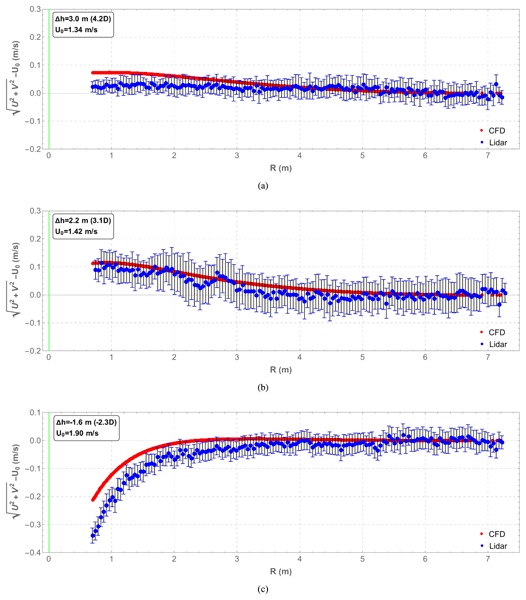
Three-dimensional wind fields can be accurately measured by sonic anemometers. However, the traditional mast-mounted sonic anemometers are not flexible in various applications, which can be potentially overcome by drones. Therefore, we conducted a proof-of-concept study by applying three continuous-wave Doppler lidars to characterize the complex flow around a drone to validate the results obtained by CFD simulations. Both methods show good agreement, with a velocity difference of 0.1 m s-1.
Liqin Jin, Jakob Mann, Nikolas Angelou, and Mikael Sjöholm
Atmos. Meas. Tech., 16, 6007–6023, https://doi.org/10.5194/amt-16-6007-2023, https://doi.org/10.5194/amt-16-6007-2023, 2023
Short summary
Short summary
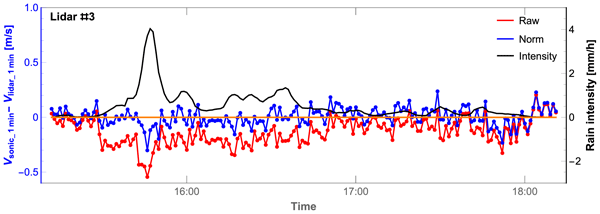
By sampling the spectra from continuous-wave Doppler lidars very fast, the rain-induced Doppler signal can be suppressed and the bias in the wind velocity estimation can be reduced. The method normalizes 3 kHz spectra by their peak values before averaging them down to 50 Hz. Over 3 h, we observe a significant reduction in the bias of the lidar data relative to the reference sonic data when the largest lidar focus distance is used. The more it rains, the more the bias is reduced.
Nikolas Angelou, Jakob Mann, and Camille Dubreuil-Boisclair
Wind Energ. Sci., 8, 1511–1531, https://doi.org/10.5194/wes-8-1511-2023, https://doi.org/10.5194/wes-8-1511-2023, 2023
Short summary
Short summary
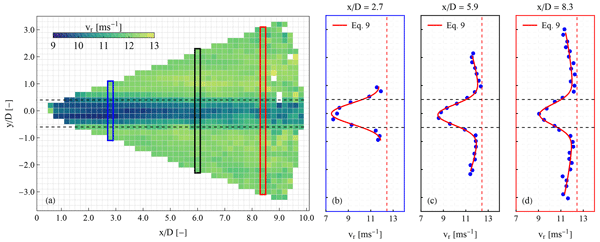
This study presents the first experimental investigation using two nacelle-mounted wind lidars that reveal the upwind and downwind conditions relative to a full-scale floating wind turbine. We find that in the case of floating wind turbines with small pitch and roll oscillating motions (< 1°), the ambient turbulence is the main driving factor that determines the propagation of the wake characteristics.
Wei Fu, Alessandro Sebastiani, Alfredo Peña, and Jakob Mann
Wind Energ. Sci., 8, 677–690, https://doi.org/10.5194/wes-8-677-2023, https://doi.org/10.5194/wes-8-677-2023, 2023
Short summary
Short summary
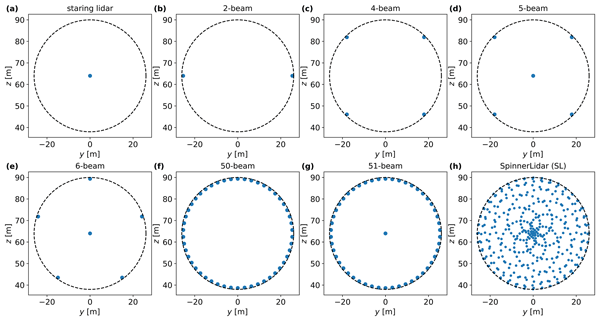
Nacelle lidars with different beam scanning locations and two types of systems are considered for inflow turbulence estimations using both numerical simulations and field measurements. The turbulence estimates from a sonic anemometer at the hub height of a Vestas V52 turbine are used as references. The turbulence parameters are retrieved using the radial variances and a least-squares procedure. The findings from numerical simulations have been verified by the analysis of the field measurements.
Abdul Haseeb Syed, Jakob Mann, Andreas Platis, and Jens Bange
Wind Energ. Sci., 8, 125–139, https://doi.org/10.5194/wes-8-125-2023, https://doi.org/10.5194/wes-8-125-2023, 2023
Short summary
Short summary
Wind turbines extract energy from the incoming wind flow, which needs to be recovered. In very large offshore wind farms, the energy is recovered mostly from above the wind farm in a process called entrainment. In this study, we analyzed the effect of atmospheric stability on the entrainment process in large offshore wind farms using measurements recorded by a research aircraft. This is the first time that in situ measurements are used to study the energy recovery process above wind farms.
Felix Kelberlau and Jakob Mann
Atmos. Meas. Tech., 15, 5323–5341, https://doi.org/10.5194/amt-15-5323-2022, https://doi.org/10.5194/amt-15-5323-2022, 2022
Short summary
Short summary
Floating lidar systems are used for measuring wind speeds offshore, and their motion influences the measurements. This study describes the motion-induced bias on mean wind speed estimates by simulating the lidar sampling pattern of a moving lidar. An analytic model is used to validate the simulations. The bias is low and depends on amplitude and frequency of motion as well as on wind shear. It has been estimated for the example of the Fugro SEAWATCH wind lidar buoy carrying a ZX 300M lidar.
Wei Fu, Alfredo Peña, and Jakob Mann
Wind Energ. Sci., 7, 831–848, https://doi.org/10.5194/wes-7-831-2022, https://doi.org/10.5194/wes-7-831-2022, 2022
Short summary
Short summary
Measuring the variability of the wind is essential to operate the wind turbines safely. Lidars of different configurations have been placed on the turbines’ nacelle to measure the inflow remotely. This work found that the multiple-beam lidar is the only one out of the three employed nacelle lidars that can give detailed information about the inflow variability. The other two commercial lidars, which have two and four beams, respectively, measure only the fluctuation in the along-wind direction.

Nikolas Angelou, Jakob Mann, and Ebba Dellwik
Atmos. Chem. Phys., 22, 2255–2268, https://doi.org/10.5194/acp-22-2255-2022, https://doi.org/10.5194/acp-22-2255-2022, 2022
Short summary
Short summary
In this study we use state-of-the-art scanning wind lidars to investigate the wind field in the near-wake region of a mature, open-grown tree. Our measurements provide for the first time a picture of the mean and the turbulent spatial fluctuations in the flow in the wake of a tree in its natural environment. Our observations support the hypothesis that even simple models can realistically simulate the turbulent fluctuations in the wake and thus predict the effect of trees in flow models.
Cited articles
Abdelazim, S., Santoro, D., Arend, M., Moshary, F., and Ahmed, S.: A Hardware Implemented Autocorrelation Technique for Estimating Power Spectral Density for Processing Signals from a Doppler Wind Lidar System, Sensors, 18, https://doi.org/10.3390/s18124170, 2018. a
Banakh, V. and Smalikho, I.: Determination of the turbulent energy dissipation rate from lidar sensing data, Atmospheric and Oceanic Optics c/c of optika atmosfery i okeana, 10, 295–302, 1997. a
Bodini, N., Lundquist, J. K., and Newsom, R. K.: Estimation of turbulence dissipation rate and its variability from sonic anemometer and wind Doppler lidar during the XPIA field campaign, Atmos. Meas. Tech., 11, 4291–4308, https://doi.org/10.5194/amt-11-4291-2018, 2018. a, b
Bonin, T. A., Choukulkar, A., Brewer, W. A., Sandberg, S. P., Weickmann, A. M., Pichugina, Y. L., Banta, R. M., Oncley, S. P., and Wolfe, D. E.: Evaluation of turbulence measurement techniques from a single Doppler lidar, Atmos. Meas. Tech., 10, 3021–3039, https://doi.org/10.5194/amt-10-3021-2017, 2017. a
Davis, J. C., Collier, C. G., Davies, F., and Bozier, K. E.: Spatial variations of sensible heat flux over an urban area measured using Doppler lidar, Meteorol. Appl., 15, 367–380, https://doi.org/10.1002/met.79, 2008. a
Dolfi-Bouteyre, A., Canat, G., Lombard, L., Valla, M., Durécu, A., and Besson, C.: Long-range wind monitoring in real time with optimized coherent lidar, Opt. Eng., 56, 031217, https://doi.org/10.1117/1.OE.56.3.031217, 2017. a
Drobinski, P., Dabas, A. M., and Flamant, P. H.: Remote Measurement of Turbulent Wind Spectra by Heterodyne DopplerLidar Technique, J. Appl. Meteorol., 39, 2434–2451, https://doi.org/10.1175/1520-0450(2000)039<2434:RMOTWS>2.0.CO;2, 2000. a
Held, D. P. and Mann, J.: Comparison of methods to derive radial wind speed from a continuous-wave coherent lidar Doppler spectrum, Atmos. Meas. Tech., 11, 6339–6350, https://doi.org/10.5194/amt-11-6339-2018, 2018. a, b
Kaimal, J. C. and Finnigan, J. J.: Atmospheric boundary layer flows: their structure and measurement, Oxford university press, ISBN 0-19-506239-6, 1994. a
Liu, H., Shah, S. L., and Jiang, W.: On-line outlier detection and data cleaning, Comput. Chem. Eng., 28, 1635–1647, https://api.semanticscholar.org/CorpusID:15696230 (last access: 10 September 2026), 2004. a
Mann, J.: The spatial structure of neutral atmospheric surface-layer turbulence, J. Fluid Mech., 273, 141–168, 1994. a
Mann, J., Cariou, J.-P. C., Parmentier, R. M., Wagner, R., Lindelöw, P., Sjöholm, M., and Enevoldsen, K.: Comparison of 3D turbulence measurements using three staring wind lidars and a sonic anemometer, Meteorol. Z., 18, 135–140, https://doi.org/10.1127/0941-2948/2009/0370, 2009. a
O'Connor, E. J., Illingworth, A. J., Brooks, I. M., Westbrook, C. D., Hogan, R. J., Davies, F., and Brooks, B. J.: A Method for Estimating the Turbulent Kinetic Energy Dissipation Rate from a Vertically Pointing Doppler Lidar, and Independent Evaluation from Balloon-Borne In Situ Measurements, J. Atmos. Ocean. Tech., 27, 1652–1664, https://doi.org/10.1175/2010JTECHA1455.1, 2010. a
Peña, A.: Østerild: A natural laboratory for atmospheric turbulence, J. Renew. Sustain. Ener., 11, 063302, https://doi.org/10.1063/1.5121486, 2019. a
Peña, A. and Hasager, C. (Eds.): Remote Sensing for Wind Energy, no. 3184(EN) in Risø-I, Risø National Laboratory for Sustainable Energy, Technical University of Denmark, https://backend.orbit.dtu.dk/ws/portalfiles/portal/114719662/Ris_I_3184.pdf (last access: 10 September 2026), 2011. a
Peña, A., Dellwik, E., and Mann, J.: A method to assess the accuracy of sonic anemometer measurements, Atmos. Meas. Tech., 12, 237–252, https://doi.org/10.5194/amt-12-237-2019, 2019. a
Peña, A., Yankova, G. G., and Mallini, V.: On the lidar-turbulence paradox and possible countermeasures, Wind Energ. Sci., 10, 83–102, https://doi.org/10.5194/wes-10-83-2025, 2025. a
Pope, S. B.: Turbulent Flows, Cambridge University Press, https://doi.org/10.1017/CBO9780511840531, 2000. a, b, c
Sathe, A. and Mann, J.: A review of turbulence measurements using ground-based wind lidars, Atmos. Meas. Tech., 6, 3147–3167, https://doi.org/10.5194/amt-6-3147-2013, 2013. a, b
Sathe, A., Mann, J., Vasiljevic, N., and Lea, G.: A six-beam method to measure turbulence statistics using ground-based wind lidars, Atmos. Meas. Tech., 8, 729–740, https://doi.org/10.5194/amt-8-729-2015, 2015. a, b
Smalikho, I. N. and Banakh, V. A.: Measurements of wind turbulence parameters by a conically scanning coherent Doppler lidar in the atmospheric boundary layer, Atmos. Meas. Tech., 10, 4191–4208, https://doi.org/10.5194/amt-10-4191-2017, 2017. a, b
Stull, R. B.: An Introduction to Boundary Layer Meteorology, vol. 13 of Atmospheric and Oceanographic Sciences Library, Kluwer Academic Publishers (Springer), Dordrecht, Boston, London, 1st edn., ISBN 978-90-277-2769-5, https://doi.org/10.1007/978-94-009-3027-8, 1988. a
Syed, A. H.: Workflow for estimating turbulence energy dissipation rate from a vertical profiling six-beam lidar, in: Atmospheric Measurement Techniques (Version 1.0), Zenodo [code], https://doi.org/10.5281/zenodo.22693339, 2026. a
Syed, A. H., Mann, J., Platis, A., and Bange, J.: Turbulence structures and entrainment length scales in large offshore wind farms, Wind Energ. Sci., 8, 125–139, https://doi.org/10.5194/wes-8-125-2023, 2023. a
Taylor, G. I.: Statistical theory of turbulence-II, P. Roy. Soc. Lond. A-Mat., 151, 444–454, 1935. a
Wildmann, N., Bodini, N., Lundquist, J. K., Bariteau, L., and Wagner, J.: Estimation of turbulence dissipation rate from Doppler wind lidars and in situ instrumentation for the Perdigão 2017 campaign, Atmos. Meas. Tech., 12, 6401–6423, https://doi.org/10.5194/amt-12-6401-2019, 2019. a
Wildmann, N., Päschke, E., Roiger, A., and Mallaun, C.: Towards improved turbulence estimation with Doppler wind lidar velocity-azimuth display (VAD) scans, Atmos. Meas. Tech., 13, 4141–4158, https://doi.org/10.5194/amt-13-4141-2020, 2020. a, b
Short summary
We present a new structure function model to estimate the turbulence energy dissipation rate using lidar velocities. The model corrects for turbulence filtering due to the lidar probe volume by applying a Gaussian weighting function. By utilizing the high 3 m range-gate resolution of the BEAM 6x pulsed lidar, we achieve excellent agreement between turbulence energy dissipation rate values derived from lidar and sonic anemometer at three heights, with correlation coefficients exceeding 0.9.
We present a new structure function model to estimate the turbulence energy dissipation rate...


