
Articles | Volume 19, issue 19
https://doi.org/10.5194/amt-19-6209-2026
© Author(s) 2026. This work is distributed under
the Creative Commons Attribution 4.0 License.
the Creative Commons Attribution 4.0 License.
https://doi.org/10.5194/amt-19-6209-2026
© Author(s) 2026. This work is distributed under
the Creative Commons Attribution 4.0 License.
the Creative Commons Attribution 4.0 License.
Research article
| 
02 Oct 2026
Research article |
| 02 Oct 2026
| 02 Oct 2026
Long-term climatology of vertical profiles of polarimetric variables and ice-microphysical retrievals at X-band – Part 1: Radar calibration

Section Meteorology, Institute of Geosciences, University of Bonn, Bonn, Germany
Velibor Pejcic
Section Meteorology, Institute of Geosciences, University of Bonn, Bonn, Germany
Silke Trömel
Section Meteorology, Institute of Geosciences, University of Bonn, Bonn, Germany
Laboratory for Clouds and Precipitation Exploration, Geoverbund ABC/J, Bonn, Germany
Related authors
Tobias Scharbach and Silke Trömel
EGUsphere, https://doi.org/10.5194/egusphere-2026-2523, https://doi.org/10.5194/egusphere-2026-2523, 2026
This preprint is open for discussion and under review for Atmospheric Measurement Techniques (AMT).
Short summary
Short summary
With more than 1000 hours of weather radar observations from the X-band radar in Bonn, Germany, collected over ten years, we examined how stratiform clouds change through the seasons and how particle properties change from ice to the liquid phase. We found that summer conditions favor larger particle concentrations, stronger snow aggregation accompanied by riming, and thicker melting layers. These results provide an important reference for e.g. improving weather prediction models.
Tobias Scharbach and Silke Trömel
EGUsphere, https://doi.org/10.5194/egusphere-2026-2523, https://doi.org/10.5194/egusphere-2026-2523, 2026
This preprint is open for discussion and under review for Atmospheric Measurement Techniques (AMT).
Short summary
Short summary
With more than 1000 hours of weather radar observations from the X-band radar in Bonn, Germany, collected over ten years, we examined how stratiform clouds change through the seasons and how particle properties change from ice to the liquid phase. We found that summer conditions favor larger particle concentrations, stronger snow aggregation accompanied by riming, and thicker melting layers. These results provide an important reference for e.g. improving weather prediction models.
Velibor Pejcic, Kamil Mroz, Kai Mühlbauer, and Silke Trömel
Atmos. Meas. Tech., 19, 211–230, https://doi.org/10.5194/amt-19-211-2026, https://doi.org/10.5194/amt-19-211-2026, 2026
Short summary
Short summary
Estimating the proportions of individual hydrometeor types (hydrometeor partitioning ratios, HPRs) in a mixture of a resolved radar volume and their evaluation is challenging. This study has three objectives, (1) to evaluate HPR retrievals, (2) to exploit the combination of dual-frequency (DF) space-borne radar (SR) and dual-polarisation (DP) ground-based radar (GR) observations for estimating HPRs based on SR DF observations and (3) to further improve HPR estimates based on DP GR observations.
Armin Blanke, Mathias Gergely, and Silke Trömel
Atmos. Chem. Phys., 25, 4167–4184, https://doi.org/10.5194/acp-25-4167-2025, https://doi.org/10.5194/acp-25-4167-2025, 2025
Short summary
Short summary
The area-wide radar-based distinction between riming and aggregation is crucial for model microphysics and data assimilation. This study introduces a discrimination algorithm based on polarimetric radar networks only. Exploiting the unique opportunity to link fall velocities from Doppler spectra to polarimetric variables in an operational setting enables us to set up and evaluate a well-performing machine learning algorithm.
Lucas Reimann, Clemens Simmer, and Silke Trömel
Atmos. Chem. Phys., 23, 14219–14237, https://doi.org/10.5194/acp-23-14219-2023, https://doi.org/10.5194/acp-23-14219-2023, 2023
Short summary
Short summary
Polarimetric radar observations were assimilated for the first time in a convective-scale numerical weather prediction system in Germany and their impact on short-term precipitation forecasts was evaluated. The assimilation was performed using microphysical retrievals of liquid and ice water content and yielded slightly improved deterministic 9 h precipitation forecasts for three intense summer precipitation cases with respect to the assimilation of radar reflectivity alone.
Armin Blanke, Andrew J. Heymsfield, Manuel Moser, and Silke Trömel
Atmos. Meas. Tech., 16, 2089–2106, https://doi.org/10.5194/amt-16-2089-2023, https://doi.org/10.5194/amt-16-2089-2023, 2023
Short summary
Short summary
We present an evaluation of current retrieval techniques in the ice phase applied to polarimetric radar measurements with collocated in situ observations of aircraft conducted over the Olympic Mountains, Washington State, during winter 2015. Radar estimates of ice properties agreed most with aircraft observations in regions with pronounced radar signatures, but uncertainties were identified that indicate issues of some retrievals, particularly in warmer temperature regimes.
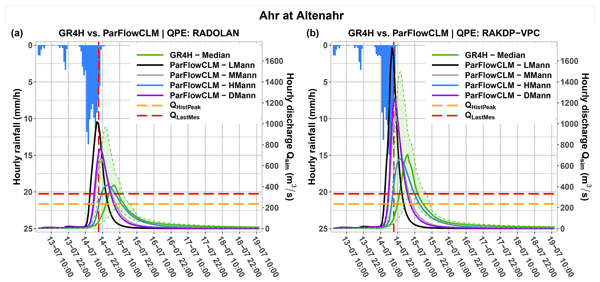
Mohamed Saadi, Carina Furusho-Percot, Alexandre Belleflamme, Ju-Yu Chen, Silke Trömel, and Stefan Kollet
Nat. Hazards Earth Syst. Sci., 23, 159–177, https://doi.org/10.5194/nhess-23-159-2023, https://doi.org/10.5194/nhess-23-159-2023, 2023
Short summary
Short summary
On 14 July 2021, heavy rainfall fell over central Europe, causing considerable damage and human fatalities. We analyzed how accurate our estimates of rainfall and peak flow were for these flooding events in western Germany. We found that the rainfall estimates from radar measurements were improved by including polarimetric variables and their vertical gradients. Peak flow estimates were highly uncertain due to uncertainties in hydrological model parameters and rainfall measurements.
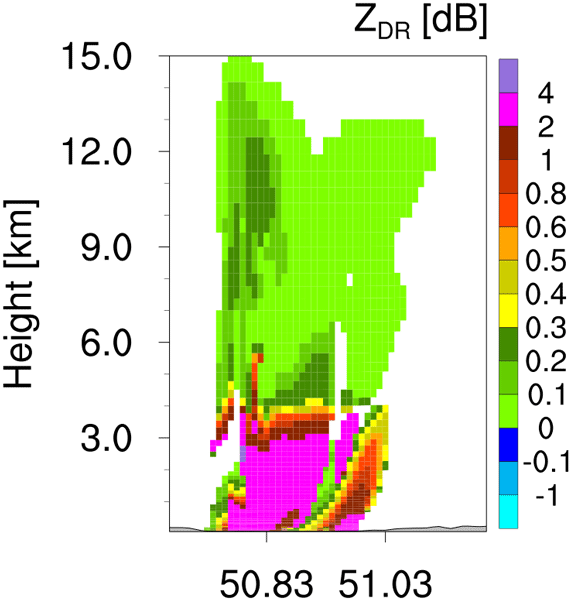
Prabhakar Shrestha, Silke Trömel, Raquel Evaristo, and Clemens Simmer
Atmos. Chem. Phys., 22, 7593–7618, https://doi.org/10.5194/acp-22-7593-2022, https://doi.org/10.5194/acp-22-7593-2022, 2022
Short summary
Short summary
The study makes use of ensemble numerical simulations with forward operator to evaluate the simulated cloud and precipitation processes with radar observations. While comparing model data with radar has its own challenges due to errors in the forward operator and processed radar measurements, the model was generally found to underestimate the high reflectivity, width/magnitude (value) of ZDR columns and high precipitation.
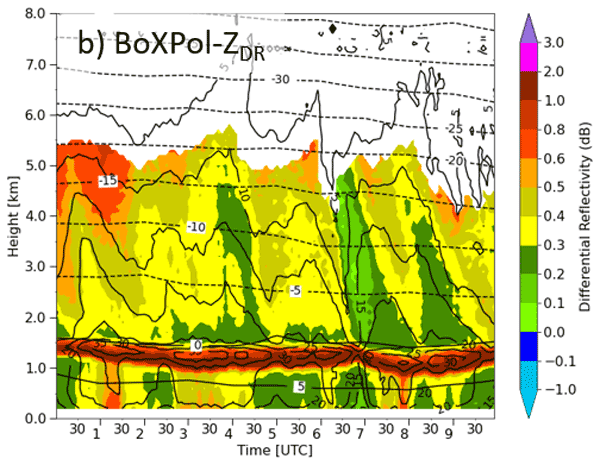
Prabhakar Shrestha, Jana Mendrok, Velibor Pejcic, Silke Trömel, Ulrich Blahak, and Jacob T. Carlin
Geosci. Model Dev., 15, 291–313, https://doi.org/10.5194/gmd-15-291-2022, https://doi.org/10.5194/gmd-15-291-2022, 2022
Short summary
Short summary
The article focuses on the exploitation of radar polarimetry for model evaluation of stratiform precipitation. The model exhibited a low bias in simulated polarimetric moments at lower levels above the melting layer where snow was found to dominate. This necessitates further research into the missing microphysical processes in these lower levels (e.g. fragmentation due to ice–ice collisions) and use of more reliable snow-scattering models in the forward operator to draw valid conclusions.
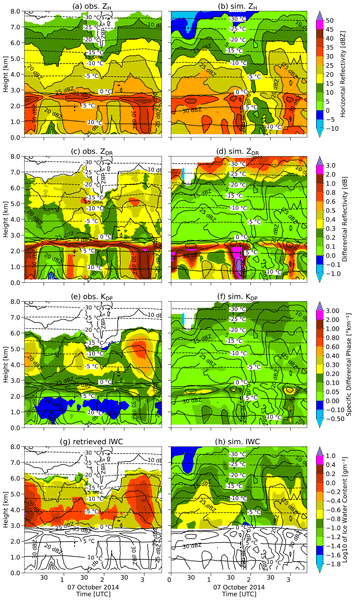
Silke Trömel, Clemens Simmer, Ulrich Blahak, Armin Blanke, Sabine Doktorowski, Florian Ewald, Michael Frech, Mathias Gergely, Martin Hagen, Tijana Janjic, Heike Kalesse-Los, Stefan Kneifel, Christoph Knote, Jana Mendrok, Manuel Moser, Gregor Köcher, Kai Mühlbauer, Alexander Myagkov, Velibor Pejcic, Patric Seifert, Prabhakar Shrestha, Audrey Teisseire, Leonie von Terzi, Eleni Tetoni, Teresa Vogl, Christiane Voigt, Yuefei Zeng, Tobias Zinner, and Johannes Quaas
Atmos. Chem. Phys., 21, 17291–17314, https://doi.org/10.5194/acp-21-17291-2021, https://doi.org/10.5194/acp-21-17291-2021, 2021
Short summary
Short summary
The article introduces the ACP readership to ongoing research in Germany on cloud- and precipitation-related process information inherent in polarimetric radar measurements, outlines pathways to inform atmospheric models with radar-based information, and points to remaining challenges towards an improved fusion of radar polarimetry and atmospheric modelling.
Cited articles
Anagnostou, E. N., Morales, C. A., and Dinku, T.: The Use of TRMM Precipitation Radar Observations in Determining Ground Radar Calibration Biases, J. Atmos. Ocean. Tech., 18, 616–628, https://doi.org/10.1175/1520-0426(2001)018<0616:tuotpr>2.0.co;2, 2001. a
Atlas, D.: Radar calibration: Some simple approaches, B. Am. Meteorol. Soc., 83, 1313–1316, https://doi.org/10.1175/1520-0477-83.9.1313, 2002. a
Atlas, D. and Mossop, S.: Calibration of a weather radar by using a standard target, B. Am. Meteorol. Soc., 41, 377–382, https://doi.org/10.1175/1520-0477-41.7.377, 1960. a
Bandt, C. and Pompe, B.: Permutation entropy: a natural complexity measure for time series, Phys. Rev. Lett., 88, 174102, https://doi.org/10.1103/PhysRevLett.88.174102, 2002. a, b
Blahak, U.: RADAR_MIE_LM and RADAR_MIELIB – Calculation of Radar Reflectivity from Model Output, Technical Report 28, Consortium for Small Scale Modeling (COSMO), https://doi.org/10.5676/DWD_pub/nwv/cosmo-tr_28, 2016. a
Blahak, U. and de Lozar, A.: EMVORADO – Efficient Modular VOlume scan RADar Operator. A User's Guide, Deutscher Wetterdienst, https://www.cosmo-model.org/content/model/documentation/core/emvorado_userguide.pdf (last access: 14 September 2026), 2021. a
Blanke, A., Gergely, M., and Trömel, S.: A new aggregation and riming discrimination algorithm based on polarimetric weather radars, Atmos. Chem. Phys., 25, 4167–4184, https://doi.org/10.5194/acp-25-4167-2025, 2025. a
Borda, M.: Fundamentals in information theory and coding, Springer Science and Business Media, https://doi.org/10.1007/978-3-642-20347-3, 2011. a, b
Brandes, E. A., Zhang, G., and Vivekanandan, J.: Experiments in rainfall estimation with a polarimetric radar in a subtropical environment, J. Appl. Meteorol. Clim., 41, 674–685, https://doi.org/10.1175/1520-0450(2002)041<0674:EIREWA>2.0.CO;2, 2002. a
Carlin, J.: The use of polarimetric radar data for informing numerical weather prediction models, PhD thesis, University of Oklahoma, https://hdl.handle.net/11244/299801, 2018. a
Carlin, J., Scharbach, T., and Chen, J.-Y.: T-matrix calculations for rain, Zenodo [code], https://doi.org/10.5281/ZENODO.20829591, 2026. a
Carlin, J. T. and Ryzhkov, A. V.: Estimation of melting-layer cooling rate from dual-polarization radar: Spectral bin model simulations, J. Appl. Meteorol. Clim., 58, 1485–1508, https://doi.org/10.1175/JAMC-D-18-0343.1, 2019. a
Chen, J.-Y., Trömel, S., Ryzhkov, A., and Simmer, C.: Assessing the benefits of specific attenuation for quantitative precipitation estimation with a C-band radar network, J. Hydrometeorol., 22, 2617–2631, https://doi.org/10.1175/JHM-D-20-0299.1, 2021. a, b, c
Chu, Z., Liu, W., Zhang, G., Kou, L., and Li, N.: Continuous monitoring of differential reflectivity bias for C-band polarimetric radar using online solar echoes in volume scans, Remote Sens.-Basel, 11, 2714, https://doi.org/10.3390/rs11222714, 2019. a
Crisologo, I.: Using spaceborne radar platforms to enhance the homogeneity of weather radar calibration, PhD thesis, Universität Potsdam, https://publishup.uni-potsdam.de/frontdoor/index/index/docId/44570, 2019. a
Crisologo, I., Warren, R. A., Mühlbauer, K., and Heistermann, M.: Enhancing the consistency of spaceborne and ground-based radar comparisons by using beam blockage fraction as a quality filter, Atmos. Meas. Tech., 11, 5223–5236, https://doi.org/10.5194/amt-11-5223-2018, 2018. a
Diederich, M., Ryzhkov, A., Simmer, C., Zhang, P., and Trömel, S.: Use of specific attenuation for rainfall measurement at X-band radar wavelengths. Part I: Radar calibration and partial beam blockage estimation, J. Hydrometeorol., 16, 487–502, https://doi.org/10.1175/JHM-D-14-0066.1, 2015. a, b
Diekema, E. and Koornwinder, T. H.: Differentiation by integration using orthogonal polynomials, a survey, J. Approx. Theory, 164, 637–667, https://doi.org/10.1016/j.jat.2012.01.003, 2012. a
Doms, G. and Baldauf, M.: A Description of the Nonhydrostatic Regional COSMO-Model LM. Part I: Dynamics and Numerics, Consortium for Smallscale Modeling (COSMO), https://doi.org/10.5676/DWD_pub/nwv/cosmo-doc_5.05_I, 2018. a
Doms, G., Förstner, J., Heise, E., Herzog, H.-J., Mirononv, D., Raschendorfer, M., Reinhardt, T., Ritter, B., Schrodin, R., Schulz, J.-P., and Vogel, G.: A Description of the Nonhydrostatic Regional COSMO-Model. Part II: Physical Parameterization, Consortium for Smallscale Modeling (COSMO), https://doi.org/10.5676/DWD_pub/nwv/cosmo-doc_5.05_II, 2018. a
Doviak, R. J. and Zrnić, D. S.: Doppler Radar and Weather Observations, 2nd edn., Academic Press, San Diego, https://doi.org/10.1016/C2009-0-22358-0, 1993. a, b
Fan, J., Han, B., Varble, A., Morrison, H., North, K., Kollias, P., Chen, B., Dong, X., Giangrande, S. E., Khain, A., Lin, Y., Mansell, E., Milbrandt, J. A., Stenz, R., Thompson, G., and Wang, Y.: Cloud-resolving model intercomparison of an MC3E squall line case: Part I – Convective updrafts, Journal of Geophysical Research: Atmospheres, 122, 9351–9378, https://doi.org/10.1002/2017JD026622, 2017. a
Figueras i Ventura, J., Boumahmoud, A., Fradon, B., Dupuy, P., and Tabary, P.: Long-term monitoring of French polarimetric radar data quality and evaluation of several polarimetric quantitative precipitation estimators in ideal conditions for operational implementation at C-band, Q. J. Roy. Meteor. Soc., 138, 2212–2228, https://doi.org/10.1002/qj.1934, 2012. a, b
Frech, M.: 9 B. 3 Monitoring the data quality of the new polarimetric weather radar network of the German Meteorological Service, https://ams.confex.com/ams/36Radar/webprogram/Paper228472.html (last access: 14 September 2026), 2013. a
Frech, M. and Hubbert, J.: Monitoring the differential reflectivity and receiver calibration of the German polarimetric weather radar network, Atmos. Meas. Tech., 13, 1051–1069, https://doi.org/10.5194/amt-13-1051-2020, 2020. a, b, c
Frech, M., Hagen, M., and Mammen, T.: Monitoring the absolute calibration of a polarimetric weather radar, J. Atmos. Ocean. Tech., 34, 599–615, https://doi.org/10.1175/JTECH-D-16-0076.1, 2017. a, b
Fridlind, A. M., Li, X., Wu, D., van Lier-Walqui, M., Ackerman, A. S., Tao, W.-K., McFarquhar, G. M., Wu, W., Dong, X., Wang, J., Ryzhkov, A., Zhang, P., Poellot, M. R., Neumann, A., and Tomlinson, J. M.: Derivation of aerosol profiles for MC3E convection studies and use in simulations of the 20 May squall line case, Atmos. Chem. Phys., 17, 5947–5972, https://doi.org/10.5194/acp-17-5947-2017, 2017. a
Gabella, M.: On the use of bright scatterers for monitoring Doppler, dual-polarization weather radars, Remote Sens.-Basel, 10, 1007, https://doi.org/10.3390/rs10071007, 2018. a
Giangrande, S. E., Krause, J. M., and Ryzhkov, A. V.: Automatic designation of the melting layer with a polarimetric prototype of the WSR-88D radar, J. Appl. Meteorol. Clim., 47, 1354–1364, https://doi.org/10.1175/2007JAMC1634.1, 2008. a
Gorgucci, E., Scarchilli, G., and Chandrasekar, V.: Calibration of radars using polarimetric techniques, IEEE T. Geosci. Remote, 30, 853–858, https://doi.org/10.1109/36.175319, 1992. a
Gorgucci, E., Scarchilli, G., and Chandrasekar, V.: A procedure to calibrate multiparameter weather radar using properties of the rain medium, IEEE T. Geosci. Remote, 37, 269–276, https://doi.org/10.1109/36.739161, 1999. a
Gorgucci, E., Baldini, L., and Chandrasekar, V.: What is the shape of a raindrop? An answer from radar measurements, J. Atmos. Sci., 63, 3033–3044, https://doi.org/10.1175/JAS3781.1, 2006. a
Gourley, J. J., Illingworth, A. J., and Tabary, P.: Absolute calibration of radar reflectivity using redundancy of the polarization observations and implied constraints on drop shapes, J. Atmos. Ocean. Tech., 26, 689–703, https://doi.org/10.1175/2008JTECHA1152.1, 2009. a
Griffin, E. M., Schuur, T. J., and Ryzhkov, A. V.: A polarimetric analysis of ice microphysical processes in snow, using quasi-vertical profiles, J. Appl. Meteorol. Clim., 57, 31–50, https://doi.org/10.1175/JAMC-D-17-0033.1, 2018. a
Han, T. S. and Kobayashi, K.: Mathematics of Information and Coding, vol. 203, American Mathematical Society, https://doi.org/10.1090/mmono/203, 2002. a
Heistermann, M., Jacobi, S., and Pfaff, T.: Technical Note: An open source library for processing weather radar data (wradlib), Hydrol. Earth Syst. Sci., 17, 863–871, https://doi.org/10.5194/hess-17-863-2013, 2013. a
Henry, M. and Judge, G.: Permutation entropy and information recovery in nonlinear dynamic economic time series, Econometrics, 7, 10, https://doi.org/10.3390/econometrics7010010, 2019. a, b
Hersbach, H., Bell, B., Berrisford, P., Hirahara, S., Horányi, A., Muñoz-Sabater, J., Nicolas, J., Peubey, C., Radu, R., Schepers, D., Simmons, A., Soci, C., Abdalla, S., Abellan, X., Balsamo, G., Bechtold, P., Biavati, G., Bidlot, J., Bonavita, M., De Chiara, G., Dahlgren, P., Dee, D., Diamantakis, M., Dragani, R., Flemming, J., Forbes, R., Fuentes, M., Geer, A., Haimberger, L., Healy, S., Hogan, R. J., Hólm, E., Janisková, M., Keeley, S., Laloyaux, P., Lopez, P., Lupu, C., Radnoti, G., de Rosnay, P., Rozum, I., Vamborg, F., Villaume, S., and Thépaut, J.‐N.: The ERA5 global reanalysis, Q. J. Roy. Meteor. Soc., 146, 1999–2049, https://doi.org/10.1002/qj.3803, 2020. a
Hersbach, H., Bell, B., Berrisford, P., Biavati, G., Horányi, A., Muñoz Sabater, J., Nicolas, J., Peubey, C., Radu, R., Rozum, I., Schepers, D., Simmons, A., Soci, C., Dee, D., and Thépaut, J.-N.: ERA5 hourly data on pressure levels from 1940 to present, Copernicus Climate Change Service (C3S) Climate Data Store (CDS) [data set], https://doi.org/10.24381/cds.bd0915c6, 2023. a
Heymsfield, A. J., Bansemer, A., Theis, A., and Schmitt, C.: Survival of snow in the melting layer: Relative humidity influence, J. Atmos. Sci., 78, 1823–1845, https://doi.org/10.1175/JAS-D-20-0353.1, 2021. a
Holleman, I., Huuskonen, A., Gill, R., and Tabary, P.: Operational monitoring of radar differential reflectivity using the sun, J. Atmos. Ocean. Tech., 27, 881–887, https://doi.org/10.1175/2010JTECHA1381.1, 2010. a, b
Holoborodko, P.: Low-noise Lanczos differentiators, Online resource, https://www.holoborodko.com/pavel/numerical-methods/numerical-derivative/lanczos-low-noise-differentiators/ (last access: 14 September 2026), 2015. a
Hou, A. Y., Kakar, R. K., Neeck, S., Azarbarzin, A. A., Kummerow, C. D., Kojima, M., Oki, R., Nakamura, K., and Iguchi, T.: The global precipitation measurement mission, B. Am. Meteorol. Soc., 95, 701–722, https://doi.org/10.1175/BAMS-D-13-00164.1, 2014. a
Houze Jr., R. A., Brodzik, S., Schumacher, C., Yuter, S. E., and Williams, C. R.: Uncertainties in oceanic radar rain maps at Kwajalein and implications for satellite validation, J. Appl. Meteorol. Clim., 43, 1114–1132, https://doi.org/10.1175/1520-0450(2004)043<1114:UIORRM>2.0.CO;2, 2004. a
Hu, J., Ryzhkov, A., and Dunnavan, E. L.: Vertical profile climatology of polarimetric radar variables and retrieved microphysical parameters in synoptic and lake effect snowstorms, J. Geophys. Res.-Atmos., 129, e2024JD041318, https://doi.org/10.1029/2024JD041318, 2024. a
Hu, J., Zhang, P., Krause, J., and Ryzhkov, A.: Calibrating Differential Reflectivity with QZdrCal: An Open System Radar Product Generator (ORPG) update with an upgraded dry aggregated snow method, J. Atmos. Ocean. Tech., https://doi.org/10.1175/jtech-d-25-0123.1, 2026. a
Hunzinger, A., Hardin, J. C., Bharadwaj, N., Varble, A., and Matthews, A.: An extended radar relative calibration adjustment (eRCA) technique for higher-frequency radars and range–height indicator (RHI) scans, Atmos. Meas. Tech., 13, 3147–3166, https://doi.org/10.5194/amt-13-3147-2020, 2020. a
Joshil, S. S. and Chandrasekar, C. V.: Calibration of D3R Weather Radar Using UAV-Hosted Target, Remote Sens.-Basel, 14, 3534, https://doi.org/10.3390/rs14153534, 2022. a
Joss, J., Gabella, M., Michaelides, S. C., and Perona, G.: Variation of weather radar sensitivity at ground level and from space: case studies and possible causes, Meteorol. Z., 15, 485–496, https://doi.org/10.1127/0941-2948/2006/0150, 2006. a
Kennedy, P. C. and Rutledge, S. A.: S-band dual-polarization radar observations of winter storms, J. Appl. Meteorol. Clim., 50, 844–858, https://doi.org/10.1175/2010JAMC2558.1, 2011. a
Kozu, T., Kawanishi, T., Kuroiwa, H., Kojima, M., Oikawa, K., Kumagai, H., Okamoto, K., Okumura, M., Nakatsuka, H., and Nishikawa, K.: Development of precipitation radar onboard the Tropical Rainfall Measuring Mission (TRMM) satellite, IEEE T. Geosci. Remote, 39, 102–116, https://doi.org/10.1109/36.898669, 2001. a
Kumjian, M. R.: Principles and Applications of Dual-Polarization Weather Radar. Part I: Description of the Polarimetric Radar Variables, Journal of Operational Meteorology, 1, https://doi.org/10.15191/nwajom.2013.0119, 2013a. a
Kumjian, M. R.: Principles and Applications of Dual-Polarization Weather Radar. Part III: Artifacts., Journal of Operational Meteorology, 1, https://doi.org/10.15191/nwajom.2013.0121, 2013b. a
Kumjian, M. R. and Ryzhkov, A. V.: The impact of evaporation on polarimetric characteristics of rain: Theoretical model and practical implications, J. Appl. Meteorol. Clim., 49, 1247–1267, https://doi.org/10.1175/2010JAMC2243.1, 2010. a
Kumjian, M. R. and Ryzhkov, A. V.: The Impact of Size Sorting on the Polarimetric Radar Variables, J. Atmos. Sci., 69, 2042–2060, https://doi.org/10.1175/JAS-D-11-0125.1, 2012. a
Kumjian, M. R., Mishra, S., Giangrande, S. E., Toto, T., Ryzhkov, A. V., and Bansemer, A.: Polarimetric radar and aircraft observations of saggy bright bands during MC3E, J. Geophys. Res.-Atmos., 121, 3584–3607, https://doi.org/10.1002/2015JD024446, 2016. a
Le Loh, J., Chang, W.-Y., Hsu, H.-W., Lin, P.-F., Chang, P.-L., Teng, Y.-L., and Liou, Y.-C.: Long-term assessment of the reflectivity biases and wet-radome effect using collocated operational s-and c-band dual-polarization radars, IEEE T. Geosci. Remote, 60, 1–17, https://doi.org/10.1109/TGRS.2022.3170609, 2022. a
Lee, J.-E., Kwon, S., and Jung, S.-H.: Real-Time Calibration and Monitoring of Radar Reflectivity on Nationwide Dual-Polarization Weather Radar Network, Remote Sens.-Basel, 13, 2936, https://doi.org/10.3390/rs13152936, 2021. a
Leinonen, J.: Python code for T-matrix scattering calculations, GitHub [code], https://github.com/jleinonen/pytmatrix (last access: 6 May 2026), 2013.
Leinonen, J.: High-level interface to T-matrix scattering calculations: architecture, capabilities and limitations, Opt. Express, 22, https://doi.org/10.1364/oe.22.001655, 2014. a
Louf, V., Protat, A., Warren, R. A., Collis, S. M., Wolff, D. B., Raunyiar, S., Jakob, C., and Petersen, W. A.: An integrated approach to weather radar calibration and monitoring using ground clutter and satellite comparisons, J. Atmos. Ocean. Tech., 36, 17–39, https://doi.org/10.1175/JTECH-D-18-0007.1, 2019. a, b, c, d, e, f, g, h, i, j, k, l, m, n, o
Loulli, E., Michaelides, S., Bühl, J., Loukas, A., and Hadjimitsis, D.: Calibration of Two X-Band Ground Radars Against GPM DPR Ku-Band, Remote Sens.-Basel, 17, 1712, https://doi.org/10.3390/rs17101712, 2025. a
Marks, D. A., Wolff, D. B., Carey, L. D., and Tokay, A.: Quality control and calibration of the dual-polarization radar at Kwajalein, RMI, J. Atmos. Ocean. Tech., 28, 181–196, https://doi.org/10.1175/2010JTECHA1462.1, 2011. a
Masaki, T., Iguchi, T., Kanemaru, K., Furukawa, K., Yoshida, N., Kubota, T., and Oki, R.: Calibration of the dual-frequency precipitation radar onboard the Global Precipitation Measurement Core Observatory, IEEE T. Geosci. Remote, 60, 1–16, https://doi.org/10.1109/TGRS.2020.3039978, 2020. a, b
Mishchenko, M. I.: Calculation of the amplitude matrix for a nonspherical particle in a fixed orientation, Appl. Optics, 39, 1026–1031, 2000. a
Mishchenko, M. I., Travis, L. D., and Mackowski, D. W.: T-matrix computations of light scattering by nonspherical particles: A review, J. Quant. Spectrosc. Ra., 55, 535–575, https://doi.org/10.1016/0022-4073(96)00002-7, 1996. a
Murphy, A. M., Ryzhkov, A., and Zhang, P.: Columnar vertical profile (CVP) methodology for validating polarimetric radar retrievals in ice using in situ aircraft measurements, J. Atmos. Ocean. Tech., 37, 1623–1642, https://doi.org/10.1175/JTECH-D-20-0011.1, 2020. a
Ori, D., Schemann, V., Karrer, M., Dias Neto, J., von Terzi, L., Seifert, A., and Kneifel, S.: Evaluation of ice particle growth in ICON using statistics of multi-frequency Doppler cloud radar observations, Q. J. Roy. Meteor. Soc., 146, 3830–3849, https://doi.org/10.1002/qj.3875, 2020. a
Pejcic, V., Saavedra Garfias, P., Mühlbauer, K., Trömel, S., and Simmer, C.: Comparison between precipitation estimates of ground-based weather radar composites and GPM’s DPR rainfall product over Germany, Meteorol. Z., https://doi.org/10.1127/metz/2020/1039, 2020. a
Planat, N., Gehring, J., Vignon, É., and Berne, A.: Identification of snowfall microphysical processes from Eulerian vertical gradients of polarimetric radar variables, Atmos. Meas. Tech., 14, 4543–4564, https://doi.org/10.5194/amt-14-4543-2021, 2021. a
Protat, A., Louf, V., Soderholm, J., Brook, J., and Ponsonby, W.: Three-way calibration checks using ground-based, ship-based, and spaceborne radars, Atmos. Meas. Tech., 15, 915–926, https://doi.org/10.5194/amt-15-915-2022, 2022. a, b
Ray, P. S.: Broadband Complex Refractive Indices of Ice and Water, Appl. Optics, 11, 1836–1844, https://doi.org/10.1364/AO.11.001836, 1972. a
Richardson, L. M., Cunningham, J. G., Zittel, W. D., Lee, R. R., Ice, R. L., Melnikov, V. M., Hoban, N. P., and Gebauer, J. G.: Bragg scatter detection by the WSR-88 D. Part I: Algorithm development, J. Atmos. Ocean. Tech., 34, 465–478, https://doi.org/10.1175/JTECH-D-16-0030.1, 2017. a
Rinehart, R. E.: Radar for Meteorologists, 3rd edn., Rinehart Publications, ISBN: 0965800202, 1997. a
Romatschke, U.: Melting layer detection and observation with the NCAR airborne W-band radar, Remote Sens.-Basel, 13, 1660, https://doi.org/10.3390/rs13091660, 2021. a
Ryzhkov, A., Pinsky, M., Pokrovsky, A., and Khain, A.: Polarimetric radar observation operator for a cloud model with spectral microphysics, J. Appl. Meteorol. Clim., 50, 873–894, https://doi.org/10.1175/2010JAMC2363.1, 2011. a
Ryzhkov, A., Zhang, P., Reeves, H., Kumjian, M., Tschallener, T., Trömel, S., and Simmer, C.: Quasi-vertical profiles – A new way to look at polarimetric radar data, J. Atmos. Ocean. Tech., 33, 551–562, https://doi.org/10.1175/JTECH-D-15-0020.1, 2016. a, b, c, d
Ryzhkov, A. V.: The impact of beam broadening on the quality of radar polarimetric data, J. Atmos. Ocean. Tech., 24, 729–744, https://doi.org/10.1175/JTECH2003.1, 2007. a
Ryzhkov, A. V., Giangrande, S. E., Melnikov, V. M., and Schuur, T. J.: Calibration issues of dual-polarization radar measurements, J. Atmos. Ocean. Tech., 22, 1138–1155, https://doi.org/10.1175/JTECH1772.1, 2005. a, b
Ryzhkov, A. V., Snyder, J., Carlin, J. T., Khain, A., and Pinsky, M.: What polarimetric weather radars offer to cloud modelers: forward radar operators and microphysical/thermodynamic retrievals, Atmosphere, 11, 362, https://doi.org/10.3390/atmos11040362, 2020. a, b, c
Scharbach, T.: ERA5 reanalysis data interpolated to the 18° QVPs generated with the X-band radar in Bonn (BoXPol), Zenodo [data set], https://doi.org/10.5281/zenodo.20799703, 2026a. a
Scharbach, T.: Python jupyter notebooks for calibration of ZH/ZDR and provided offset values, related to the study: “Long-term climatology of vertical profiles of polarimetric variables and ice-microphysical retrievals at X-band. Part 1: Radar calibration”, Zenodo [data set and code], https://doi.org/10.5281/zenodo.20796890, 2026b. a
Schneebeli, M., Leuenberger, A., Schmid, P. J., Grazioli, J., Corden, H., Berne, A., Kennedy, P., George, J., Junyent, F., and Chandrasekar, V.: Calibration of weather radars with a target simulator, Atmos. Meas. Tech., 18, 5157–5176, https://doi.org/10.5194/amt-18-5157-2025, 2025. a
Seifert, A. and Beheng, K. D.: A two-moment cloud microphysics parameterization for mixed-phase clouds. Part 1: Model description, Meteorol. Atmos. Phys., 92, 45–66, https://doi.org/10.1007/s00703-005-0112-4, 2006. a
Shannon, C. E.: A mathematical theory of communication, Bell Syst. Tech. J., 27, 379–423, https://doi.org/10.1002/j.1538-7305.1948.tb01338.x, 1948. a
Shrestha, P., Mendrok, J., Pejcic, V., Trömel, S., Blahak, U., and Carlin, J. T.: Evaluation of the COSMO model (v5.1) in polarimetric radar space – impact of uncertainties in model microphysics, retrievals and forward operators, Geosci. Model Dev., 15, 291–313, https://doi.org/10.5194/gmd-15-291-2022, 2022. a, b
Silberstein, D. S., Wolff, D. B., Marks, D. A., Atlas, D., and Pippitt, J. L.: Ground clutter as a monitor of radar stability at Kwajalein, RMI, J. Atmos. Ocean. Tech., 25, 2037–2045, https://doi.org/10.1175/2008JTECHA1063.1, 2008. a, b
Song, J. I., Yum, S. S., Park, S.-H., Kim, K.-H., Park, K.-J., and Joo, S.-W.: Climatology of melting layer heights estimated from cloud radar observations at various locations, J. Geophys. Res.-Atmos., 126, e2021JD034816, https://doi.org/10.1029/2021JD034816, 2021. a, b
Tobin, D. M. and Kumjian, M. R.: Polarimetric radar and surface-based precipitation-type observations of ice pellet to freezing rain transitions, Weather Forecast., 32, 2065–2082, https://doi.org/10.1175/WAF-D-17-0054.1, 2017. a, b
Trömel, S., Ryzhkov, A. V., Zhang, P., and Simmer, C.: Investigations of Backscatter Differential Phase in the Melting Layer, J. Appl. Meteorol. Clim., 53, https://doi.org/10.1175/JAMC-D-14-0050.1, 2014. a, b
Trömel, S., Ryzhkov, A. V., Hickman, B., Mühlbauer, K., and Simmer, C.: Polarimetric Radar Variables in the Layers of Melting and Dendritic Growth at X Band – Implications for a Nowcasting Strategy in Stratiform Rain, J. Appl. Meteorol. Clim., 58, 2497–2522, https://doi.org/10.1175/JAMC-D-19-0056.1, 2019. a, b, c, d, e
Trömel, S., Simmer, C., Blahak, U., Blanke, A., Doktorowski, S., Ewald, F., Frech, M., Gergely, M., Hagen, M., Janjic, T., Kalesse-Los, H., Kneifel, S., Knote, C., Mendrok, J., Moser, M., Köcher, G., Mühlbauer, K., Myagkov, A., Pejcic, V., Seifert, P., Shrestha, P., Teisseire, A., von Terzi, L., Tetoni, E., Vogl, T., Voigt, C., Zeng, Y., Zinner, T., and Quaas, J.: Overview: Fusion of radar polarimetry and numerical atmospheric modelling towards an improved understanding of cloud and precipitation processes, Atmos. Chem. Phys., 21, 17291–17314, https://doi.org/10.5194/acp-21-17291-2021, 2021. a
Trömel, S., Blahak, U., Evaristo, R., Mendrok, J., Neef, L., Pejcic, V., Scharbach, T., Shrestha, P., and Simmer, C.: Fusion of radar polarimetry and atmospheric modeling, in: Advances in Weather Radar, Precipitation science, scattering and processing algorithms, vol. 2, The Institution of Engineering and Technology (IET), https://doi.org/10.1049/SBRA557G_ch7, 2023. a, b, c, d, e, f
Trömel, S., Mühlbauer, K., Lennefer, M., Simmer, C., Scharbach, T., and Pejcic, V.: Polarimetric X-band radar (BoXPol) data monitored in Bonn, Germany, since 2009 to 2023, bonndata [data set], https://doi.org/10.60507/FK2/D0NVG5, 2026. a
Vulpiani, G., Montopoli, M., Passeri, L. D., Gioia, A. G., Giordano, P., and Marzano, F. S.: On the use of dual-polarized C-band radar for operational rainfall retrieval in mountainous areas, J. Appl. Meteorol. Clim., 51, 405–425, https://doi.org/10.1175/JAMC-D-10-05024.1, 2012. a
Wang, X., Shao, N., Cao, J., Ma, J., Liu, J., Yang, T., Ye, F., and Sun, H.: ARC-Based Absolute Calibration Method for Weather Radar Reflectivity, IEEE T. Geosci. Remote, 63, 1–11, https://doi.org/10.1109/tgrs.2025.3603593, 2025. a
Warren, R. A., Protat, A., Siems, S. T., Ramsay, H. A., Louf, V., Manton, M. J., and Kane, T. A.: Calibrating ground-based radars against TRMM and GPM, J. Atmos. Ocean. Tech., 35, 323–346, https://doi.org/10.1175/JTECH-D-17-0128.1, 2018. a, b
Warren, R. A., Ramsay, H. A., Siems, S. T., Manton, M. J., Peter, J. R., Protat, A., and Pillalamarri, A.: Radar-based climatology of damaging hailstorms in Brisbane and Sydney, Australia, Q. J. Roy. Meteor. Soc., 146, 505–530, https://doi.org/10.1002/qj.3693, 2020. a
Waterman, P. C.: Symmetry, unitarity, and geometry in electromagnetic scattering, Phys. Rev. D, 3, 825, https://doi.org/10.1103/PhysRevD.3.825, 1971. a
Williams, E., Hood, K., Cho, J. Y. N., Smalley, D. J., Sandifer, J. B., Zrnić, D., Melnikov, V. M., Burgess, D. W., Forsyth, D., Webster, T. M., and Erickson, D.: End-to-end calibration of NEXRAD differential reflectivity with metal spheres, in: Proceedings of the 36th Conference on Radar Meteorology, American Meteorological Society, Breckenridge, Colorado, USA, 16–20 September 2013, https://ams.confex.com/ams/36Radar/webprogram/Paper228796.html (last access: 14 September 2026), 2013. a
Wolfensberger, D., Scipion, D., and Berne, A.: Detection and characterization of the melting layer based on polarimetric radar scans, Q. J. Roy. Meteor. Soc., 142, 108–124, https://doi.org/10.1002/qj.2672, 2016. a, b
Wolff, D. B., Marks, D. A., and Petersen, W. A.: General application of the relative calibration adjustment (RCA) technique for monitoring and correcting radar reflectivity calibration, J. Atmos. Ocean. Tech., 32, 496–506, https://doi.org/10.1175/JTECH-D-13-00185.1, 2015. a
Xie, X., Evaristo, R., Simmer, C., Handwerker, J., and Trömel, S.: Precipitation and microphysical processes observed by three polarimetric X-band radars and ground-based instrumentation during HOPE, Atmos. Chem. Phys., 16, 7105–7116, https://doi.org/10.5194/acp-16-7105-2016, 2016. a
Xie, X., Shrestha, P., Mendrok, J., Carlin, J., Trömel, S., and Blahak, U.: Bonn Polarimetric Radar forward Operator (B-PRO), https://doi.org/10.5880/TR32DB.41, 2021. a
Ye, F., Wang, X., Li, L., Chen, Y., Lei, Y., Yu, H., Yin, J., Shi, L., Yang, Q., and Huang, Z.: Weather radar calibration method based on UAV-suspended metal sphere, Sensors (Basel, Switzerland), 24, 4611, https://doi.org/10.3390/s24144611, 2024. a
Zeng, Y., Blahak, U., and Jerger, D.: An efficient modular volume-scanning radar forward operator for NWP models: description and coupling to the COSMO model, Q. J. Roy. Meteor. Soc., 142, 3234–3256, https://doi.org/10.1002/qj.2904, 2016. a
Zeyong, G., Zhaoping, S., jia, G., Feifei, L., and Zhichao, B.: A Method for Calibrating Zdr by Using Light Rain Echo in Volume Scan Data, in: 2019 International Conference on Meteorology Observations (ICMO), 1–3, IEEE, https://doi.org/10.1109/icmo49322.2019.9025914, 2019. a
Zittel, W. D., Cunningham, J. G., Lee, R. R., Richardson, L. M., Ice, R. L., and Melnikov, V.: Use of hydrometeors, Bragg scatter, and sun spikes to determine system ZDR biases in the WSR-88D fleet, in: Extended Abstracts of the Eighth European Conference on Radar in Meteorology and Hydrology (ERAD 2014), vol. 12, Garmisch-Partenkirchen, Germany, https://www.pa.op.dlr.de/erad2014/programme/ExtendedAbstracts/132_Zittel.pdf (last access: 14 September 2026), 2014. a
Short summary
For the X-band radar in Bonn, the birdbath method has proven to be insufficient for calibrating differential reflectivity. This study raises awareness of the need for critically applying the birdbath method. A novel technique for calibrating the reflectivity factor is presented and compared with satellite measurements, serving as ground truth, and a known standard calibration method. The offset values agree well with the satellite and even exceed the accuracy of the standard calibration method.
For the X-band radar in Bonn, the birdbath method has proven to be insufficient for calibrating...


