
Articles | Volume 19, issue 21
https://doi.org/10.5194/amt-19-7199-2026
© Author(s) 2026. This work is distributed under
the Creative Commons Attribution 4.0 License.
the Creative Commons Attribution 4.0 License.
https://doi.org/10.5194/amt-19-7199-2026
© Author(s) 2026. This work is distributed under
the Creative Commons Attribution 4.0 License.
the Creative Commons Attribution 4.0 License.
Research article
| 
11 Nov 2026
Research article |
| 11 Nov 2026
| 11 Nov 2026
Evaluating low-cost NDIR CO2 sensors for atmospheric observations in rural settings

Yusuf Hamied Department of Chemistry, University of Cambridge, Cambridge, CB2 1EW, United Kingdom
Paolo Cicuta
Yusuf Hamied Department of Chemistry, University of Cambridge, Cambridge, CB2 1EW, United Kingdom
Rachel H. Georgiou
Yusuf Hamied Department of Chemistry, University of Cambridge, Cambridge, CB2 1EW, United Kingdom
Lawrence Tom
Yusuf Hamied Department of Chemistry, University of Cambridge, Cambridge, CB2 1EW, United Kingdom
Ray Freshwater
Yusuf Hamied Department of Chemistry, University of Cambridge, Cambridge, CB2 1EW, United Kingdom
Kelsey Leet
Yusuf Hamied Department of Chemistry, University of Cambridge, Cambridge, CB2 1EW, United Kingdom
Chiara Giorio
CORRESPONDING AUTHOR
Yusuf Hamied Department of Chemistry, University of Cambridge, Cambridge, CB2 1EW, United Kingdom
Related authors
Le Yuan, Olalekan A. M. Popoola, Christina Hood, David Carruthers, Roderic L. Jones, Haitong Zhe Sun, Huan Liu, Qiang Zhang, and Alexander T. Archibald
Atmos. Chem. Phys., 22, 8617–8637, https://doi.org/10.5194/acp-22-8617-2022, https://doi.org/10.5194/acp-22-8617-2022, 2022
Short summary
Short summary
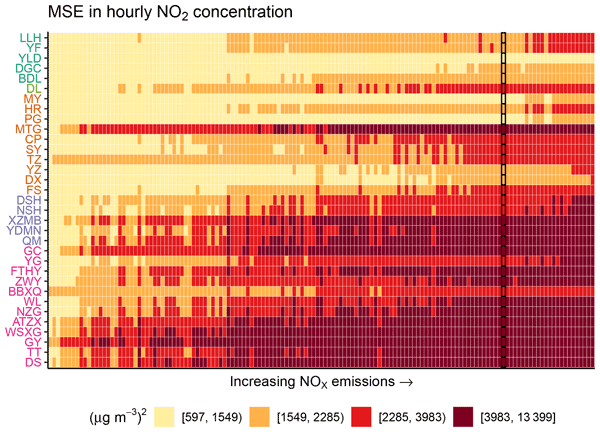
Emission estimates represent a major source of uncertainty in air quality modelling. We developed a novel approach to improve emission estimates from existing inventories using air quality models and routine in situ observations. Using this approach, we derived improved estimates of NOx emissions from the transport sector in Beijing in 2016. This approach has great potential in deriving timely updates of emissions for other pollutants, particularly in regions undergoing rapid emission changes.
Daniel R. Peters, Olalekan A. M. Popoola, Roderic L. Jones, Nicholas A. Martin, Jim Mills, Elizabeth R. Fonseca, Amy Stidworthy, Ella Forsyth, David Carruthers, Megan Dupuy-Todd, Felicia Douglas, Katie Moore, Rishabh U. Shah, Lauren E. Padilla, and Ramón A. Alvarez
Atmos. Meas. Tech., 15, 321–334, https://doi.org/10.5194/amt-15-321-2022, https://doi.org/10.5194/amt-15-321-2022, 2022
Short summary
Short summary
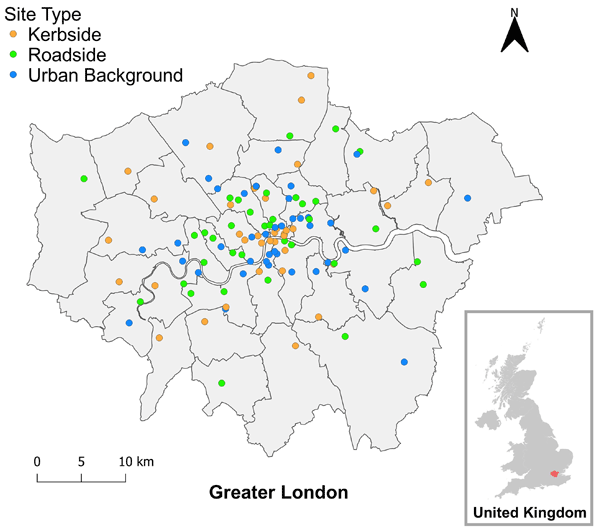
We present more than 2 years of NO2 pollution measurements from a sensor network in Greater London and compare results to an extensive network of expensive reference-grade monitors. We show the ability of our lower-cost network to generate robust insights about local air pollution. We also show how irregularities in sensor performance lead to some uncertainty in results and demonstrate ways that future users can characterize and mitigate uncertainties to get the most value from sensor data.
Lorrie S. D. Jacob, Yao Ge, Chiara Giorio, and Alexander T. Archibald
EGUsphere, https://doi.org/10.5194/egusphere-2026-4710, https://doi.org/10.5194/egusphere-2026-4710, 2026
Short summary
Short summary
Dimethyl sulfide and methanethiol are sulfur compounds released from the ocean that break down in the atmosphere, forming acids that can affect clouds and aerosols. Understanding these processes is important for improving climate predictions, but the reactions involved are too numerous for large climate models. In our work, we simplify a detailed, evaluated reaction mechanism and show that it can reproduce the original chemistry, whilst being suitable for climate models.
Paola Formenti, Danitza Klopper, Anais Feron, Mathieu Cazaunau, Servanne Chevaillier, Karine Desboeufs, Claudia Di Biagio, Clarissa Baldo, Cécile Gaimoz, Vincent Michoud, Cécile Mirande-Bret, Sylvain Triquet, François Hemeret, Richard Valorso, Stephen Broccardo, Andreas Namwoonde, Mattheus Hanghome, Chiara Giorio, and Stuart J. Piketh
Earth Syst. Sci. Data Discuss., https://doi.org/10.5194/essd-2026-95, https://doi.org/10.5194/essd-2026-95, 2026
Revised manuscript under review for ESSD
Short summary
Short summary
The southern African west coast is highly impacted by climate change and aerosols from natural and human sources, yet observations are scarce. We present measurements (2014–2019) from the Henties Bay Aerosol Observatory in Namibia, including aerosol properties, ozone and meteorology. This unique dataset will support process studies and improve regional climate modelling.

Lorrie S. D. Jacob, Benedict E. H. Harvey, Chiara Giorio, and Alexander T. Archibald
Atmos. Chem. Phys., 26, 3567–3587, https://doi.org/10.5194/acp-26-3567-2026, https://doi.org/10.5194/acp-26-3567-2026, 2026
Short summary
Short summary
We develop an approach to determine the uncertainty in reactions involved in the breakdown of dimethyl sulfide and methanethiol in the atmosphere, and run simulations spanning temperate, tropical, and polar conditions to quantify the impacts of this uncertainty on the concentration of these sulfur species and their products. We extend this analysis to identify key reactions that drive the uncertainty and highlight areas for further experimental and theoretical work.
Diana L. Pereira, Aline Gratien, Chiara Giorio, Emmanuelle Mebold, Thomas Bertin, Cécile Gaimoz, Jean-François Doussin, and Paola Formenti
Atmos. Meas. Tech., 19, 1–19, https://doi.org/10.5194/amt-19-1-2026, https://doi.org/10.5194/amt-19-1-2026, 2026
Short summary
Short summary
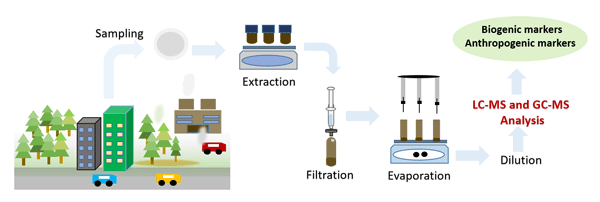
This study provides two methods for the quantification of molecular markers to improve the description of secondary organic aerosols using chromatographic techniques coupled with mass spectrometry. Compounds from various chemical functionalities (alcohols, acids, aldehydes), from biogenic and anthropogenic origin, were identified. Improved method performance was observed for nitro compounds, which have been associated with anthropogenic activities.
Chiara Giorio, Anne Monod, Valerio Di Marco, Pierre Herckes, Denise Napolitano, Amy Sullivan, Gautier Landrot, Daniel Warnes, Marika Nasti, Sara D'Aronco, Agathe Gérardin, Nicolas Brun, Karine Desboeufs, Sylvain Triquet, Servanne Chevaillier, Claudia Di Biagio, Francesco Battaglia, Frédéric Burnet, Stuart J. Piketh, Andreas Namwoonde, Jean-François Doussin, and Paola Formenti
Atmos. Chem. Phys., 25, 16107–16125, https://doi.org/10.5194/acp-25-16107-2025, https://doi.org/10.5194/acp-25-16107-2025, 2025
Short summary
Short summary
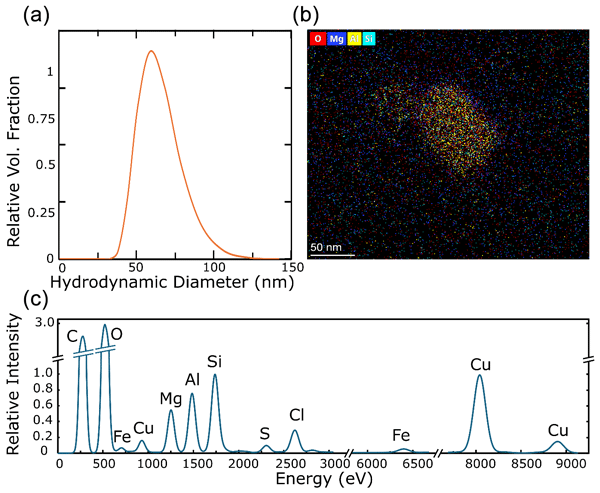
We present a comparison between concentrations of dissolved trace metals in pairs of total suspended particulate (TSP) and fog samples collected in Henties Bay, Namibia, during the AErosols, Radiation and CLOuds in southern Africa (AEROCLO-sA) field campaign. We found enhanced concentrations of dissolved metals in fog samples, which we attributed to metal–ligand complex formation in the early stages of particle activation into droplets that can then remain in a kinetically stable form in fog or lead to the formation of colloidal nanoparticles.
Paola Formenti, Chiara Giorio, Karine Desboeufs, Alexander Zherebker, Marco Gaetani, Clarissa Baldo, Gautier Landrot, Simona Montebello, Servanne Chevaillier, Sylvain Triquet, Guillaume Siour, Claudia Di Biagio, Francesco Battaglia, Jean-François Doussin, Anais Feron, Andreas Namwoonde, and Stuart John Piketh
Atmos. Chem. Phys., 25, 16127–16145, https://doi.org/10.5194/acp-25-16127-2025, https://doi.org/10.5194/acp-25-16127-2025, 2025
Short summary
Short summary
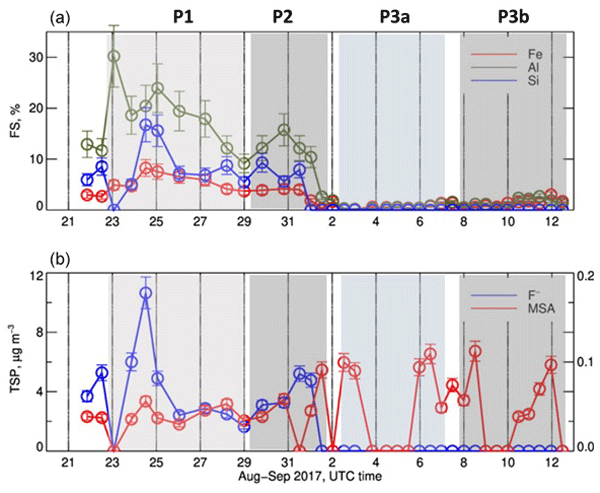
The elemental composition and solubility of several metals, including iron, at a coastal site in Namibia in August–September 2017, indicate that natural and anthropogenic dust had different solubility depending on mineralogy but mostly on the processing by fluoride ions from marine emissions, pointing to the complexity of atmospheric--oceanic interactions in this region of the world influenced by the Benguela current and significant aerosol load.
Francesco Battaglia, Paola Formenti, Chiara Giorio, Mathieu Cazaunau, Edouard Pangui, Antonin Bergé, Aline Gratien, Diana L. Pereira, Thomas Bertin, Joel F. de Brito, Manolis N. Romanias, Vincent Michoud, Clarissa Baldo, Servanne Chevaillier, Gael Noyalet, Philippe Decorse, Bénédicte Picquet-Varrault, and Jean-François Doussin
Atmos. Chem. Phys., 25, 12409–12431, https://doi.org/10.5194/acp-25-12409-2025, https://doi.org/10.5194/acp-25-12409-2025, 2025
Short summary
Short summary
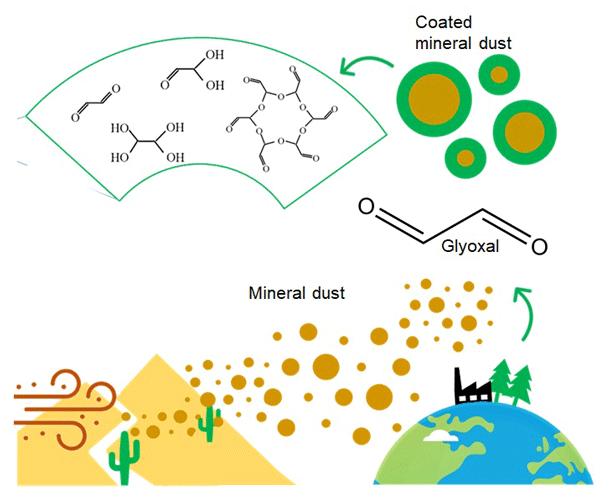
This paper presents an experimental investigation of the interactions between glyoxal, an important volatile organic compound, and mineral dust particles of size and composition typical of natural conditions. We show that their interactions modify, in a definitive way, the concentrations of the gas phase and the surface properties of the dust, which could have important implications for the atmospheric composition and the Earth's climate.
Sergio Harb, Manuela Cirtog, Stéphanie Alage, Christopher Cantrell, Mathieu Cazaunau, Vincent Michoud, Edouard Pangui, Antonin Bergé, Chiara Giorio, Francesco Battaglia, and Bénédicte Picquet-Varrault
Atmos. Chem. Phys., 25, 11003–11024, https://doi.org/10.5194/acp-25-11003-2025, https://doi.org/10.5194/acp-25-11003-2025, 2025
Short summary
Short summary
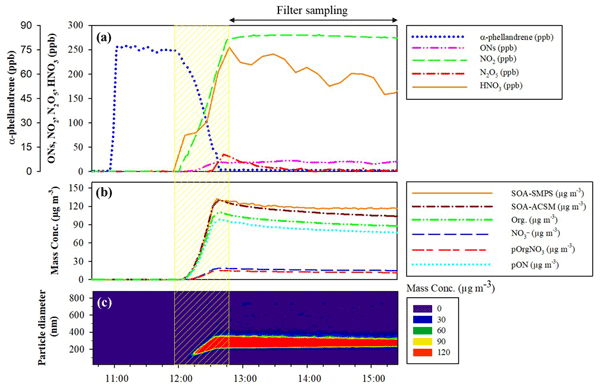
We investigated the reactions of α- and β-phellandrenes (from vegetation emissions) with NO3 radicals, a major nighttime oxidant from human activities. Using lab-based simulations, we examined these reactions and measured particle formation and by-products. Our findings reveal that α- and β-phellandrenes are efficient particle sources and enhance our understanding of biogenic–anthropogenic interactions and their contributions to atmospheric changes affecting climate and health.
Diana L. Pereira, Chiara Giorio, Aline Gratien, Alexander Zherebker, Gael Noyalet, Servanne Chevaillier, Stéphanie Alage, Elie Almarj, Antonin Bergé, Thomas Bertin, Mathieu Cazaunau, Patrice Coll, Ludovico Di Antonio, Sergio Harb, Johannes Heuser, Cécile Gaimoz, Oscar Guillemant, Brigitte Language, Olivier Lauret, Camilo Macias, Franck Maisonneuve, Bénédicte Picquet-Varrault, Raquel Torres, Sylvain Triquet, Pascal Zapf, Lelia Hawkins, Drew Pronovost, Sydney Riley, Pierre-Marie Flaud, Emilie Perraudin, Pauline Pouyes, Eric Villenave, Alexandre Albinet, Olivier Favez, Robin Aujay-Plouzeau, Vincent Michoud, Christopher Cantrell, Manuela Cirtog, Claudia Di Biagio, Jean-François Doussin, and Paola Formenti
Atmos. Chem. Phys., 25, 4885–4905, https://doi.org/10.5194/acp-25-4885-2025, https://doi.org/10.5194/acp-25-4885-2025, 2025
Short summary
Short summary
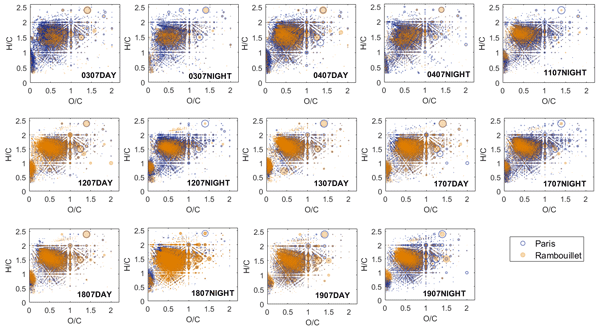
In order to study aerosols in environments influenced by anthropogenic and biogenic emissions, we performed analyses of samples collected during the ACROSS (Atmospheric Chemistry Of the Suburban Forest) campaign in summer 2022 in the greater Paris area. After analysis of the chemical composition by means of total carbon determination and high-resolution mass spectrometry, this work highlights the influence of anthropogenic inputs on the chemical composition of both urban and forested areas.
Lorrie Simone Denise Jacob, Chiara Giorio, and Alexander Thomas Archibald
Atmos. Chem. Phys., 24, 3329–3347, https://doi.org/10.5194/acp-24-3329-2024, https://doi.org/10.5194/acp-24-3329-2024, 2024
Short summary
Short summary
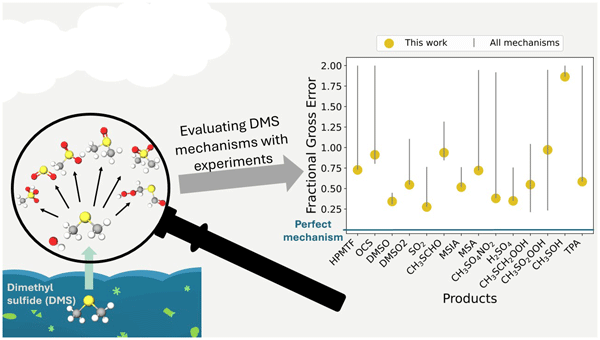
Recent studies on DMS have provided new challenges to our mechanistic understanding. Here we synthesise a number of recent studies to further develop and extend a state-of-the-art mechanism. Our new mechanism is shown to outperform all existing mechanisms when compared over a wide set of conditions. The development of an improved DMS mechanism will help lead the way to better the understanding the climate impacts of DMS emissions in past, present, and future atmospheric conditions.
Battist Utinger, Steven John Campbell, Nicolas Bukowiecki, Alexandre Barth, Benjamin Gfeller, Ray Freshwater, Hans-Rudolf Rüegg, and Markus Kalberer
Atmos. Meas. Tech., 16, 2641–2654, https://doi.org/10.5194/amt-16-2641-2023, https://doi.org/10.5194/amt-16-2641-2023, 2023
Short summary
Short summary
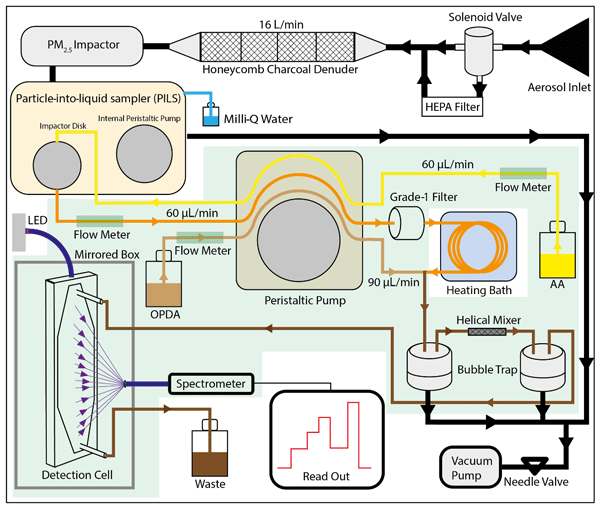
Exposure to atmospheric aerosols can lead to adverse health effect, but particle components responsible for this are unknown. Redox-active compounds, some with very short lifetimes, are considered to be a toxic class of compounds in particles. We developed the first online field instrument to quantify short-lived and stable redox-active compounds with a physiological assay based on ascorbic acid and a high time resolution and detection limits to allow measurements at unpolluted locations.
Le Yuan, Olalekan A. M. Popoola, Christina Hood, David Carruthers, Roderic L. Jones, Haitong Zhe Sun, Huan Liu, Qiang Zhang, and Alexander T. Archibald
Atmos. Chem. Phys., 22, 8617–8637, https://doi.org/10.5194/acp-22-8617-2022, https://doi.org/10.5194/acp-22-8617-2022, 2022
Short summary
Short summary
Emission estimates represent a major source of uncertainty in air quality modelling. We developed a novel approach to improve emission estimates from existing inventories using air quality models and routine in situ observations. Using this approach, we derived improved estimates of NOx emissions from the transport sector in Beijing in 2016. This approach has great potential in deriving timely updates of emissions for other pollutants, particularly in regions undergoing rapid emission changes.
Karine Desboeufs, Franck Fu, Matthieu Bressac, Antonio Tovar-Sánchez, Sylvain Triquet, Jean-François Doussin, Chiara Giorio, Patrick Chazette, Julie Disnaquet, Anaïs Feron, Paola Formenti, Franck Maisonneuve, Araceli Rodríguez-Romero, Pascal Zapf, François Dulac, and Cécile Guieu
Atmos. Chem. Phys., 22, 2309–2332, https://doi.org/10.5194/acp-22-2309-2022, https://doi.org/10.5194/acp-22-2309-2022, 2022
Short summary
Short summary
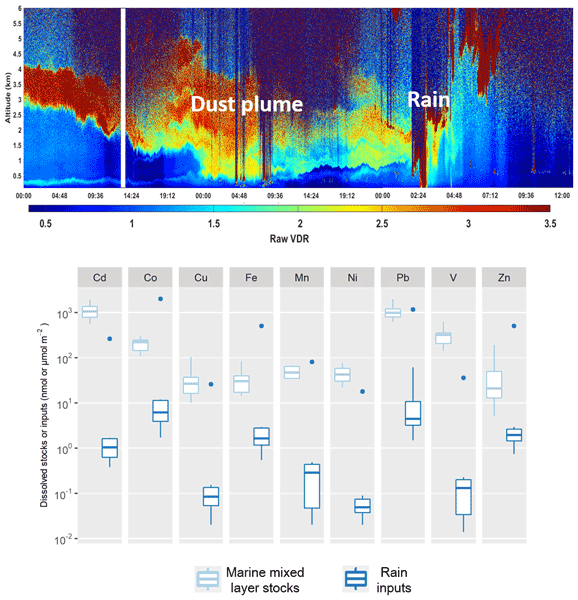
This article reports the first concurrent sampling of wet deposition samples and surface seawater and was performed during the PEACETIME cruise in the remote Mediterranean (May–June 2017). Through the chemical composition of trace metals (TMs) in these samples, it emphasizes the decrease of atmospheric metal pollution in this area during the last few decades and the critical role of wet deposition as source of TMs for Mediterranean surface seawater, especially for intense dust deposition events.
Daniel R. Peters, Olalekan A. M. Popoola, Roderic L. Jones, Nicholas A. Martin, Jim Mills, Elizabeth R. Fonseca, Amy Stidworthy, Ella Forsyth, David Carruthers, Megan Dupuy-Todd, Felicia Douglas, Katie Moore, Rishabh U. Shah, Lauren E. Padilla, and Ramón A. Alvarez
Atmos. Meas. Tech., 15, 321–334, https://doi.org/10.5194/amt-15-321-2022, https://doi.org/10.5194/amt-15-321-2022, 2022
Short summary
Short summary
We present more than 2 years of NO2 pollution measurements from a sensor network in Greater London and compare results to an extensive network of expensive reference-grade monitors. We show the ability of our lower-cost network to generate robust insights about local air pollution. We also show how irregularities in sensor performance lead to some uncertainty in results and demonstrate ways that future users can characterize and mitigate uncertainties to get the most value from sensor data.
Cited articles
Arzoumanian, E., Vogel, F. R., Bastos, A., Gaynullin, B., Laurent, O., Ramonet, M., and Ciais, P.: Characterization of a commercial lower-cost medium-precision non-dispersive infrared sensor for atmospheric CO2 monitoring in urban areas, Atmos. Meas. Tech., 12, 2665–2677, https://doi.org/10.5194/amt-12-2665-2019, 2019.
Cai, Q., Zeng, N., Yang, X., Xu, C., Wang, Z., and Han, P.: A 30-month field evaluation of low-cost CO2 sensors using a reference instrument, Atmos. Meas. Tech., 18, 4871–4884, https://doi.org/10.5194/amt-18-4871-2025, 2025.
Carslaw, D.: worldmet: Import Surface Meteorological Data from NOAA Integrated Surface Database (ISD), R package version 0.9.2, CRAN [code], https://doi.org/10.32614/CRAN.package.worldmet, 2020.
Carslaw, D. C. and Ropkins, K.: openair – An R package for air quality data analysis, Environ. Modell. Softw., 27–28, 52–61, https://doi.org/10.1016/j.envsoft.2011.09.008, 2012.
Crilley, L. R., Shaw, M., Pound, R., Kramer, L. J., Price, R., Young, S., Lewis, A. C., and Pope, F. D.: Evaluation of a low-cost optical particle counter (Alphasense OPC-N2) for ambient air monitoring, Atmos. Meas. Tech., 11, 709–720, https://doi.org/10.5194/amt-11-709-2018, 2018.
D'Acunha, B., Evans, C. D., Bodo, A., Cooper, H., Crabtree, D. E., Cumming, A., Rhymes, J. M., Rylett, D., Artz, R. R. E., and Morrison, R.: Drained agricultural peatlands as persistent carbon sources: Implications for carbon and water use intensity in food production, Glob. Change Biol., 32, https://doi.org/10.1111/gcb.70796, 2026.
Delaria, E. R., Kim, J., Fitzmaurice, H. L., Newman, C., Wooldridge, P. J., Worthington, K., and Cohen, R. C.: The Berkeley Environmental Air-quality and CO2 Network: field calibrations of sensor temperature dependence and assessment of network scale CO2 accuracy, Atmos. Meas. Tech., 14, 5487–5500, https://doi.org/10.5194/amt-14-5487-2021, 2021.
Di Antonio, A., Popoola, O. A. M., Ouyang, B., Saffell, J., and Jones, R. L.: Developing a relative humidity correction for low-cost sensors measuring ambient particulate matter, Sensors, 18, 2790, https://doi.org/10.3390/s18092790, 2018.
Dubey, R., Telles, A., Nikkel, J., Cao, C., Gewirtzman, J., Raymond, P. A., and Lee, X.: Low-Cost CO2 NDIR Sensors: Performance Evaluation and Calibration Using Machine Learning Techniques, Sensors, 24, 5675, https://doi.org/10.3390/s24175675, 2024.
Gaynullin, B., Hummelgård, C., Mattsson, C., Thungström, G., and Rödjegård, H.: Advanced pressure compensation in high accuracy NDIR sensors for environmental studies, Sensors, 23, 2872, https://doi.org/10.3390/s23052872, 2023.
Heger, A., Kleinschmidt, V., Gröngröft, A., Kutzbach, L., and Eschenbach, A.: Application of a low-cost NDIR sensor module for measurements of in situ soil CO2 concentration, EGU General Assembly 2020, Online, 4–8 May 2020, EGU2020-5819, https://doi.org/10.5194/egusphere-egu2020-5819, 2020.
IPCC (Intergovernmental Panel on Climate Change): Global warming of 1.5 °C: An IPCC special report on the impacts of global warming of 1.5 °C above pre-industrial levels and related global greenhouse gas emission pathways, IPCC, https://www.ipcc.ch/report/sr15/?utm_source=chatgpt.com (last access: 2 November 2025), 2018.
Jiao, W., Hagler, G., Williams, R., Sharpe, R., Brown, R., Garver, D., Judge, R., Caudill, M., Rickard, J., Davis, M., Weinstock, L., Zimmer-Dauphinee, S., and Buckley, K.: Community Air Sensor Network (CAIRSENSE) project: evaluation of low-cost sensor performance in a suburban environment in the southeastern United States, Atmos. Meas. Tech., 9, 5281–5292, https://doi.org/10.5194/amt-9-5281-2016, 2016.
LI-COR, USA Support: LI-7815 CO2/H2O trace gas analyzer, https://www.licor.com/env/support/LI-7815/topics/specifications.html, last access: 2 November 2025.
Lopez-Coto, I., Ghosh, S., Prasad, K. R., and Whetstone, J.: Tower-based greenhouse gas measurement network design – the National Institute of Standards and Technology North East Corridor Testbed, Adv. Atmos. Sci., 34, 1095–1105, https://doi.org/10.1007/s00376-017-6094-6, 2017.
Macagga, R., Asante, M., Sossa, G., Antonijević, D., Dubbert, M., and Hoffmann, M.: Validation and field application of a low-cost device to measure CO2 and evapotranspiration (ET) fluxes, Atmos. Meas. Tech., 17, 1317–1332, https://doi.org/10.5194/amt-17-1317-2024, 2024.
Martin, C. R., Zeng, N., Karion, A., Dickerson, R. R., Ren, X., Turpie, B. N., and Weber, K. J.: Evaluation and environmental correction of ambient CO2 measurements from a low-cost NDIR sensor, Atmos. Meas. Tech., 10, 2383–2395, https://doi.org/10.5194/amt-10-2383-2017, 2017.
Mead, M. I., Popoola, O. A. M., Stewart, G. B., Landshoff, P., Calleja, M., Hayes, M., Baldoví, J. J., McLeod, M. W., Hodgson, T. F., Dicks, J., Lewis, A. C., Cohen, J., Baron, R., Saffell, J. R., and Jones, R. L.: The use of electrochemical sensors for monitoring urban air quality in low-cost, high-density networks, Atmos. Environ., 70, 186–203, https://doi.org/10.1016/j.atmosenv.2012.11.060, 2013.
Miles, N. L., Davis, K. J., Richardson, S. J., Lauvaux, T., Martins, D. K., Deng, A. J., Balashov, N., Gurney, K. R., Liang, J., Roest, G., Wang, J. A., and Turnbull, J. C.: The influence of near-field fluxes on seasonal carbon dioxide enhancements, Carbon Balance Manag., 16, 4, https://doi.org/10.1186/s13021-020-00166-z, 2021.
Müller, M., Graf, P., Meyer, J., Pentina, A., Brunner, D., Perez-Cruz, F., Hüglin, C., and Emmenegger, L.: Integration and calibration of non-dispersive infrared (NDIR) CO2 low-cost sensors and their operation in a sensor network covering Switzerland, Atmos. Meas. Tech., 13, 3815–3834, https://doi.org/10.5194/amt-13-3815-2020, 2020.
Pereira, P. F. and Ramos, N. M. M.: Low-cost Arduino-based temperature, relative humidity and CO2 sensors – An assessment of their suitability for indoor built environments, Journal of Building Engineering, 60, 105151, https://doi.org/10.1016/j.jobe.2022.105151, 2022.
Pétron, G., Handley, P., Hakala, J., Kofler, J., Thoning, K. W., Crotwell, A., Clarke, A., Fernandez, J., Crocker, I., Burgener, R., Thomas, B., Colton, A., Jordan, S., Longren, L., Doneghey, M., Trudeau, M., Mefford, T., DeVogel, S., Searle, A., Lan, X., Mauss, J., Smith, C., Vasel, B., Morris, S., Miller, J., and Mund, J.: Atmospheric Carbon Dioxide Dry Air Mole Fractions from continuous measurements at Mauna Loa, Hawaii, Utqia
Popoola, O. A. M., Cicuta, P., Georgiou, R. H., Tom, L., and Freshwater, R.: Research data supporting [Evaluating low-cost NDIR CO2 sensors for atmospheric observations in rural settings], University of Cambridge Repository [data set], https://doi.org/10.17863/CAM.135928, 2026.
Ren, X., Wu, K., Yang, D., Liu, Y., Wang, Y., Wang, T., Cai, Z., Yao, L., Zhao, T., Wang, J., and Jiang, Z.: Effects of Environmental Factors on the Performance of Ground-Based Low-Cost CO2 Sensors, Sensors, 25, 6114, https://doi.org/10.3390/s25196114, 2025.
Senseair: K33 LP T, https://senseair.com/product/k33-lp-t/ (last access: 2 November 2025), 2025a.
Senseair: S8, https://senseair.com/product/s8/ (last access: 2 November 2025), 2025b.
Senseair: Sunrise, https://senseair.com/product/sunrise/ (last access: 2 November 2025), 2025c.
Shusterman, A. A., Kim, J., Lieschke, K. J., Newman, C., Wooldridge, P. J., and Cohen, R. C.: Observing local CO2 sources using low-cost, near-surface urban monitors, Atmos. Chem. Phys., 18, 13773–13785, https://doi.org/10.5194/acp-18-13773-2018, 2018.
Si, M., Yao, N., Li, Z.-L., Liu, X., Tang, B.-H., and Nerry, F.: Feasibility of urban-rural temperature difference method in surface urban heat island analysis under non-uniform rural landcover: a case study in 34 major urban agglomerations in China, Remote Sens., 16, 1232, https://doi.org/10.3390/rs16071232, 2024.
Sloan, G., Ali, N., Chappuies, J., Jamrog, K., Rose, T., and Dong, Y.: Designing CO2 monitoring system for agricultural land utilizing non-dispersive infrared (NDIR) sensors for citizen scientists, AgriEngineering, 7, 85, https://doi.org/10.3390/agriengineering7030085, 2025.
Song, J., Fan, S., Lin, W., Mottet, L., Woodward, H., Davies Wykes, M., and Linden, P. F.: Natural ventilation in cities: the implications of fluid mechanics, Build. Res. Inf., 46, 809–828, https://doi.org/10.1080/09613218.2018.1468158, 2018.
Spinelle, L., Gerboles, M., Villani, M.G., Aleixandre, M., and Bonavitacola, F.: Field calibration of a cluster of low-cost commercially available sensors for air quality monitoring, Part B: NO, CO and CO2, Sensor Actuat. B-Chem, 238, 706–715, https://doi.org/10.1016/j.snb.2016.07.036, 2017.
Turner, A. J., Shusterman, A. A., McDonald, B. C., Teige, V., Harley, R. A., and Cohen, R. C.: Network design for quantifying urban CO2 emissions: assessing trade-offs between precision and network density, Atmos. Chem. Phys., 16, 13465–13475, https://doi.org/10.5194/acp-16-13465-2016, 2016.
Weng, Q., Lu, D., and Schubring, J.: Estimation of land surface temperature-vegetation abundance relationship for urban heat island studies, Remote Sens. Environ., 89, 467–483, https://doi.org/10.1016/j.rse.2003.11.005, 2004.
Wu, L., Broquet, G., Ciais, P., Bellassen, V., Vogel, F., Chevallier, F., Xueref-Remy, I., and Wang, Y.: What would dense atmospheric observation networks bring to the quantification of city CO2 emissions?, Atmos. Chem. Phys., 16, 7743–7771, https://doi.org/10.5194/acp-16-7743-2016, 2016.
Wu, Z., Pang, X., Xing, B., Shang, Q., Wu, H., Lu, Y., Wu, H., Lyu, Y., Li, J., Wang, B., Ding, S., Chen, D., and Chen, J.: Development of a Portable and Sensitive CO2 Measurement Device with NDIR Sensor Clusters and Minimizing Water Vapor Impact, Sustainability, 15, 1533, https://doi.org/10.3390/su15021533, 2023.
Xu, M., Xu, Y., Tao, J., Wen, L., Zheng, C., Yu, Z., and He, S.: Development of a compact NDIR CO2 gas sensor for harsh environments, Infrared Phys. Techn., 136, 105035, https://doi.org/10.1016/j.infrared.2023.105035, 2024.
Yang, Y., Zhou, M., Wang, T., Yao, B., Han, P., Ji, D., Zhou, W., Sun, Y., Wang, G., and Wang, P.: Spatial and temporal variations of CO2 mole fractions observed at Beijing, Xianghe, and Xinglong in North China, Atmos. Chem. Phys., 21, 11741–11757, https://doi.org/10.5194/acp-21-11741-2021, 2021.
Short summary
Low-cost CO2 sensors are widely used in cities, but their use in rural environments remains limited. This study shows that, after correcting for environmental effects such as temperature and pressure, these sensors can reliably measure CO2 in agricultural landscapes. The corrected sensors closely matched high-quality reference instruments and successfully captured daily and seasonal changes in rural CO2, demonstrating their potential for long-term climate and land-use monitoring.
Low-cost CO2 sensors are widely used in cities, but their use in rural environments remains...


Altmetrics
Final-revised paper
Preprint