Articles | Volume 18, issue 24
https://doi.org/10.5194/amt-18-7865-2025
Research article
 | Highlight paper
 | 
22 Dec 2025
Research article | Highlight paper |  | 22 Dec 2025

A system for analysis of H2 and Ne in polar ice core samples

Eric S. Saltzman, Miranda H. Miranda, John D. Patterson, and Murat Aydin

Related authors

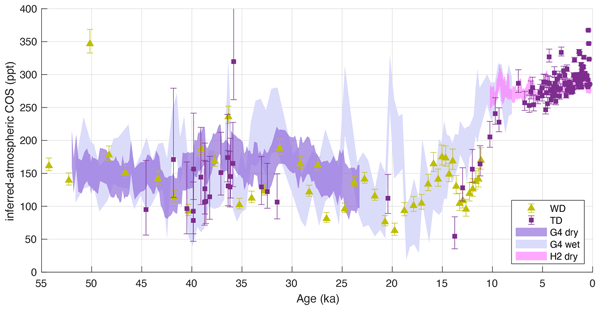
Carbonyl sulfide measurements from a South Pole ice core and implications for atmospheric variability since the last glacial period
Murat Aydin, Melinda R. Nicewonger, Gregory L. Britten, Dominic Winski, Mary Whelan, John D. Patterson, Erich Osterberg, Christopher F. Lee, Tara Harder, Kyle J. Callahan, David Ferris, and Eric S. Saltzman
Clim. Past, 20, 1885–1917, https://doi.org/10.5194/cp-20-1885-2024,https://doi.org/10.5194/cp-20-1885-2024, 2024
Short summary
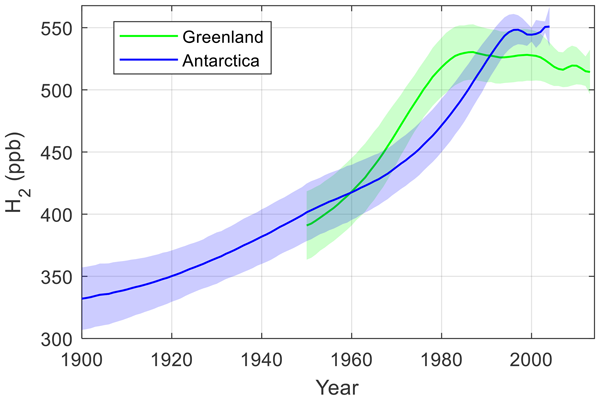
Reconstructing atmospheric H2 over the past century from bi-polar firn air records
John D. Patterson, Murat Aydin, Andrew M. Crotwell, Gabrielle Pétron, Jeffery P. Severinghaus, Paul B. Krummel, Ray L. Langenfelds, Vasilii V. Petrenko, and Eric S. Saltzman
Clim. Past, 19, 2535–2550, https://doi.org/10.5194/cp-19-2535-2023,https://doi.org/10.5194/cp-19-2535-2023, 2023
Short summary
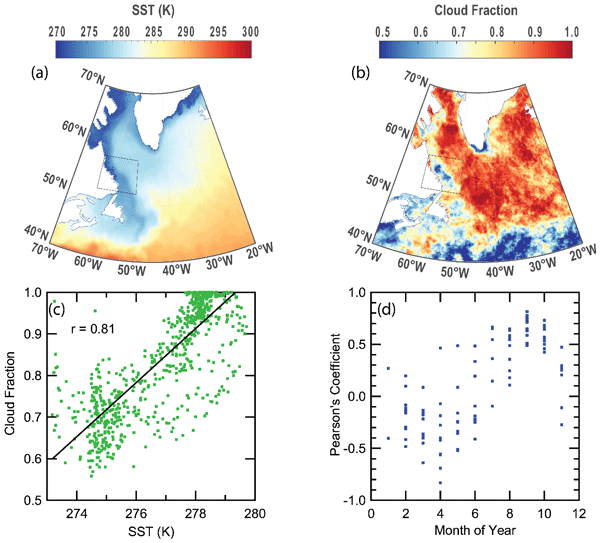
North Atlantic Ocean SST-gradient-driven variations in aerosol and cloud evolution along Lagrangian cold-air outbreak trajectories
Kevin J. Sanchez, Bo Zhang, Hongyu Liu, Matthew D. Brown, Ewan C. Crosbie, Francesca Gallo, Johnathan W. Hair, Chris A. Hostetler, Carolyn E. Jordan, Claire E. Robinson, Amy Jo Scarino, Taylor J. Shingler, Michael A. Shook, Kenneth L. Thornhill, Elizabeth B. Wiggins, Edward L. Winstead, Luke D. Ziemba, Georges Saliba, Savannah L. Lewis, Lynn M. Russell, Patricia K. Quinn, Timothy S. Bates, Jack Porter, Thomas G. Bell, Peter Gaube, Eric S. Saltzman, Michael J. Behrenfeld, and Richard H. Moore
Atmos. Chem. Phys., 22, 2795–2815, https://doi.org/10.5194/acp-22-2795-2022,https://doi.org/10.5194/acp-22-2795-2022, 2022
Short summary
Linking marine phytoplankton emissions, meteorological processes, and downwind particle properties with FLEXPART
Kevin J. Sanchez, Bo Zhang, Hongyu Liu, Georges Saliba, Chia-Li Chen, Savannah L. Lewis, Lynn M. Russell, Michael A. Shook, Ewan C. Crosbie, Luke D. Ziemba, Matthew D. Brown, Taylor J. Shingler, Claire E. Robinson, Elizabeth B. Wiggins, Kenneth L. Thornhill, Edward L. Winstead, Carolyn Jordan, Patricia K. Quinn, Timothy S. Bates, Jack Porter, Thomas G. Bell, Eric S. Saltzman, Michael J. Behrenfeld, and Richard H. Moore
Atmos. Chem. Phys., 21, 831–851, https://doi.org/10.5194/acp-21-831-2021,https://doi.org/10.5194/acp-21-831-2021, 2021
Short summary

Cited articles

Brehm, K., Ecker, K. H., Kowalewsky, H., and Weise, H. P.: Permeation through elastomeric O-ring seals, IAEA, vol. 2, 359–367, ISBN 92-0-020187-3, 1987. 
Derwent, R. G., Stevenson, D. S., Utembe, S. R., Jenkin, M. E., Khan, A. H., and Shallcross, D. E.: Global modelling studies of hydrogen and its isotopomers using STOCHEM-CRI: Likely radiative forcing consequences of a future hydrogen economy, International Journal of Hydrogen Energy, 45, 9211–9221, https://doi.org/10.1016/j.ijhydene.2020.01.125, 2020. 
Haan, D.: Teneurs en monoxyde de carbone de l'air contenu dans la glace de l'Antarctique et du Groenland, Universite Joseph Fourier – Grenoble, https://theses.hal.science/tel-00754243v1/document (last access: 15 December 2025), 1996. 
Mitchell, L., Brook, E., Lee, J. E., Buizert, C., and Sowers, T.: Constraints on the Late Holocene anthropogenic contribution to the atmospheric methane budget, Science, 33422, 964–966, 2013. 
Novelli, P. C., Lang, P. M., Masarie, K. A., Hurst, D. F., Myers, R., and Elkins, J. W.: Molecular hydrogen in the troposphere: Global distribution and budget, Journal of Geophysical Research, 104, 30427–30444, 1999. 
Download
Executive editor
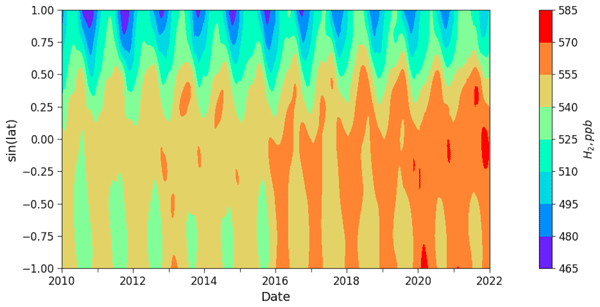
Accurately projecting atmospheric levels and climate impacts of H2 requires knowledge of its biogeochemistry on time scales longer than the modern instrumental record. H2 trapped in polar ice is a potential archive for atmospheric H2 on millennial time scales, but ice core records of H2 do not exist because its high permeability in ice causes ice cores to rapidly exchange with the modern atmosphere. This work presents an analytical system capable of measuring H2 and neon in polar ice cores in the field immediately after drilling. This method has enabled the first ice core record of H2, and may help us better understand atmospheric H2 levels in the past.
Short summary
This study describes a system for analysis of hydrogen (H2) and neon (Ne) in polar ice core samples in the field immediately after drilling. The motivation is to reconstruct the atmospheric history of H2 to improve understanding of global H2 biogeochemistry and how it has varied over time. This knowledge will help inform models used to project future atmospheric levels of H2 and assess the climate impacts of widespread utilization of H2 as an energy source.
Share