
Articles | Volume 19, issue 5
https://doi.org/10.5194/amt-19-1927-2026
© Author(s) 2026. This work is distributed under
the Creative Commons Attribution 4.0 License.
the Creative Commons Attribution 4.0 License.
https://doi.org/10.5194/amt-19-1927-2026
© Author(s) 2026. This work is distributed under
the Creative Commons Attribution 4.0 License.
the Creative Commons Attribution 4.0 License.
Research article
| 
18 Mar 2026
Research article |
| 18 Mar 2026
| 18 Mar 2026
δ13C carbon isotopic composition of CO2 in the atmosphere by Lidar – a preliminary study with a CDIAL system at 2 µm
Fabien Gibert
CORRESPONDING AUTHOR

Laboratoire de Météorologie Dynamique (LMD/IPSL), École polytechnique, Institut polytechnique de Paris, Sorbonne Université, École normale supérieure, PSL Research University, CNRS, École des Ponts, Palaiseau, France
Dimitri Edouart
Laboratoire de Météorologie Dynamique (LMD/IPSL), École polytechnique, Institut polytechnique de Paris, Sorbonne Université, École normale supérieure, PSL Research University, CNRS, École des Ponts, Palaiseau, France
Didier Mondelain
CNRS, LIPhy, Université Grenoble Alpes, Grenoble, France
Claire Cénac
Laboratoire de Météorologie Dynamique (LMD/IPSL), École polytechnique, Institut polytechnique de Paris, Sorbonne Université, École normale supérieure, PSL Research University, CNRS, École des Ponts, Palaiseau, France
Camille Yver
Laboratoire des Sciences du Climat et de l'Environnement (LSCE/IPSL), Unité mixte CEA-CNRS-UVSQ, UMR8212, 91191 Gif-sur-Yvette, France
Related authors
Mathys Thiers, Fabien Gibert, Julien Lahyani, and Nicolas Cézard
EGUsphere, https://doi.org/10.5194/egusphere-2026-4176, https://doi.org/10.5194/egusphere-2026-4176, 2026
This preprint is open for discussion and under review for Atmospheric Measurement Techniques (AMT).
Short summary
Short summary
In order to verify CO2 surface flux estimates at regional scale, lidar eddy-covariance flux profiles are needed. The present paper describes a possible architecture of the lidar and presents a performance assessment of the first CO2 turbulent flux profile in the atmosphere using a coherent differential absorption lidar and the eddy-covariance technique. The minimum flux detection limit is 11 µmol m-2 s-1 at a spatiotemporal resolution of 350 m and 4 hours.
Dimitri Edouart, Fabien Gibert, and Claire Cénac
Atmos. Meas. Tech., 19, 4875–4888, https://doi.org/10.5194/amt-19-4875-2026, https://doi.org/10.5194/amt-19-4875-2026, 2026
Short summary
Short summary
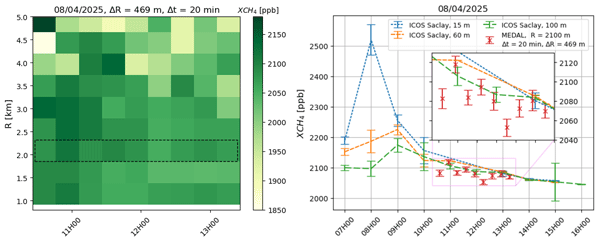
A differential absorption lidar (DIAL) based on an Er:YAG laser measured methane mixing ratio profiles along a quasi-horizontal path. A precision better than 1 % was achieved up to 3.5 km with a spatiotemporal resolution of 470 m / 20 min. The measurements were compared with in-situ instruments. An analysis of random and systematic errors shows that the main limitation is the uncertainty in the ON wavelength.
Mathys Thiers, Fabien Gibert, Julien Lahyani, and Nicolas Cézard
EGUsphere, https://doi.org/10.5194/egusphere-2026-4176, https://doi.org/10.5194/egusphere-2026-4176, 2026
This preprint is open for discussion and under review for Atmospheric Measurement Techniques (AMT).
Short summary
Short summary
In order to verify CO2 surface flux estimates at regional scale, lidar eddy-covariance flux profiles are needed. The present paper describes a possible architecture of the lidar and presents a performance assessment of the first CO2 turbulent flux profile in the atmosphere using a coherent differential absorption lidar and the eddy-covariance technique. The minimum flux detection limit is 11 µmol m-2 s-1 at a spatiotemporal resolution of 350 m and 4 hours.
Dimitri Edouart, Fabien Gibert, and Claire Cénac
Atmos. Meas. Tech., 19, 4875–4888, https://doi.org/10.5194/amt-19-4875-2026, https://doi.org/10.5194/amt-19-4875-2026, 2026
Short summary
Short summary
A differential absorption lidar (DIAL) based on an Er:YAG laser measured methane mixing ratio profiles along a quasi-horizontal path. A precision better than 1 % was achieved up to 3.5 km with a spatiotemporal resolution of 470 m / 20 min. The measurements were compared with in-situ instruments. An analysis of random and systematic errors shows that the main limitation is the uncertainty in the ON wavelength.
Camille Yver-Kwok, Michel Ramonet, Leonard Rivier, Jinghui Lian, Claudia Grossi, Roger Curcoll, Dafina Kikaj, Edward Chung, and Ute Karstens
Atmos. Chem. Phys., 25, 16085–16106, https://doi.org/10.5194/acp-25-16085-2025, https://doi.org/10.5194/acp-25-16085-2025, 2025
Short summary
Short summary
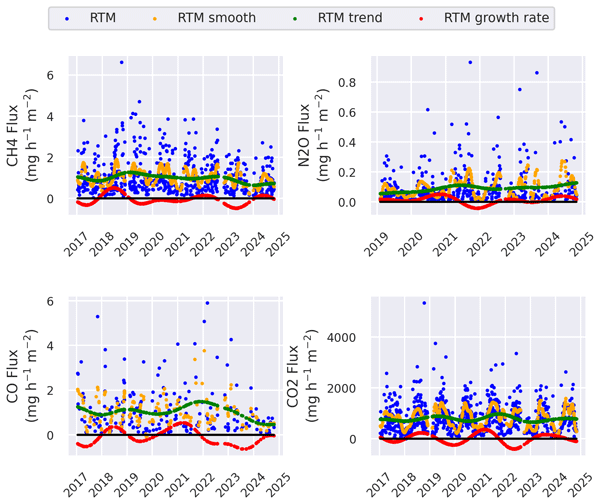
Here, we use greenhouse gas and radon data from a tall tower in France to estimate their fluxes within the station footprint from January 2017 to October 2024 using the Radon Tracer Method. Using the latest radon exhalation maps and standardized radon measurements, we found the greenhouse gas fluxes to be in agreement with the literature. Compared to inventories, there is a general agreement except for carbon dioxide where we show that the biogenic fluxes are not well represented in the model.
Laura Bouillon, Valérie Gros, Morgan Lopez, Nicolas Bonnaire, Carole Philippon, Camille Yver Kwok, Leslie David, Olivier Perrussel, Olivier Sanchez, Simone Kotthaus, Jean-Eudes Petit, Philippe Ciais, and Michel Ramonet
Earth Syst. Sci. Data Discuss., https://doi.org/10.5194/essd-2025-602, https://doi.org/10.5194/essd-2025-602, 2025
Revised manuscript accepted for ESSD
Short summary
Short summary
The Saclay observatory, 20 km southwest of Paris, monitored greenhouse and reactive gases, as well as aerosols, over 10 years to assess the impact of urban emissions. By comparing downwind and background conditions, the study revealed significant reductions in pollutants linked to traffic: -35.6 % for CO, -52.3 % for NOₓ, -56.7 % for eBC, and -15 % for CO2. These trends align with emission decrease estimates from AIRPARIF inventories over the same period.
Adil Shah, Olivier Laurent, Pramod Kumar, Grégoire Broquet, Loïc Loigerot, Timothé Depelchin, Mathis Lozano, Camille Yver Kwok, Carole Philippon, Clément Romand, Elisa Allegrini, Matthieu Trombetti, and Philippe Ciais
Atmos. Meas. Tech., 18, 3425–3451, https://doi.org/10.5194/amt-18-3425-2025, https://doi.org/10.5194/amt-18-3425-2025, 2025
Short summary
Short summary
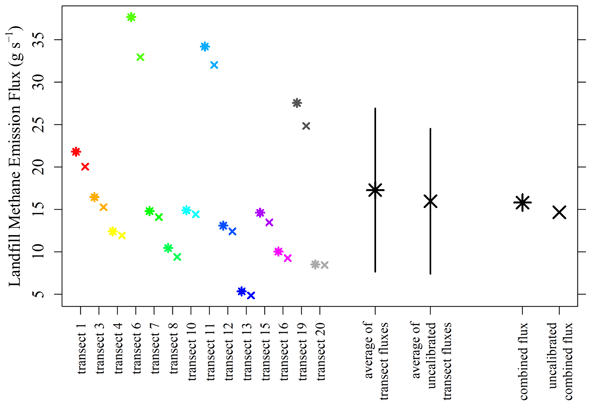
Acetylene mole fraction measurements from the Picarro G2203 were characterised. Abnormal sensor behaviour was observed in wet conditions. A dry linear calibration was derived, although this was invalid below 1.2 ppb due to unstable measurements. The instrument was used to measure acetylene as a methane tracer at a landfill site. Fluxes were derived from 14 downwind transects using both raw and calibrated acetylene mole fraction, with raw measurements resulting in 8 % flux underestimation.
Pramod Kumar, Christopher Caldow, Grégoire Broquet, Adil Shah, Olivier Laurent, Camille Yver-Kwok, Sebastien Ars, Sara Defratyka, Susan Warao Gichuki, Luc Lienhardt, Mathis Lozano, Jean-Daniel Paris, Felix Vogel, Caroline Bouchet, Elisa Allegrini, Robert Kelly, Catherine Juery, and Philippe Ciais
Atmos. Meas. Tech., 17, 1229–1250, https://doi.org/10.5194/amt-17-1229-2024, https://doi.org/10.5194/amt-17-1229-2024, 2024
Short summary
Short summary
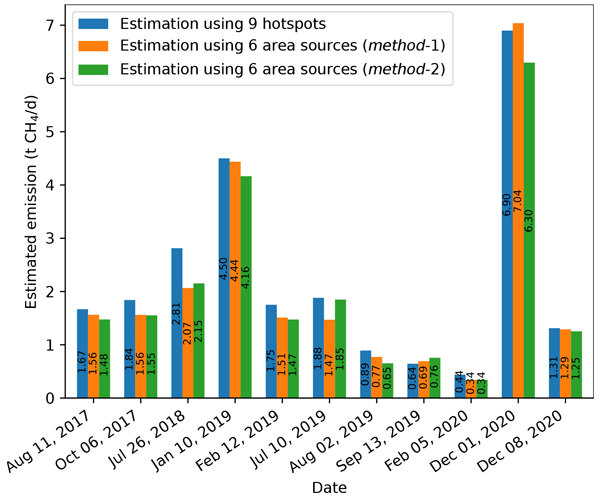
This study presents a series of mobile measurement campaigns to monitor the CH4 emissions from an active landfill. These measurements are processed using a Gaussian plume model and atmospheric inversion techniques to quantify the landfill CH4 emissions. The methane emission estimates range between ~0.4 and ~7 t CH4 per day, and their variations are analyzed. The robustness of the estimates is assessed depending on the distance of the measurements from the potential sources in the landfill.
Sara M. Defratyka, James L. France, Rebecca E. Fisher, Dave Lowry, Julianne M. Fernandez, Semra Bakkaloglu, Camille Yver-Kwok, Jean-Daniel Paris, Philippe Bousquet, Tim Arnold, Chris Rennick, Jon Helmore, Nigel Yarrow, and Euan G. Nisbet
EGUsphere, https://doi.org/10.5194/egusphere-2023-1490, https://doi.org/10.5194/egusphere-2023-1490, 2023
Preprint archived
Short summary
Short summary
We are focused on verification of δ13CH4 measurements in near-source conditions and we have provided an insight into the impact of chosen calculation methods for determined isotopic signatures. Our study offers a step forward for establishing an unified, robust, and reliable analytical technique to determine δ13CH4 of methane sources. Our recommended analytical approach reduces biases and uncertainties coming from measurement conditions, data clustering and various available fitting methods.
Peter Bergamaschi, Arjo Segers, Dominik Brunner, Jean-Matthieu Haussaire, Stephan Henne, Michel Ramonet, Tim Arnold, Tobias Biermann, Huilin Chen, Sebastien Conil, Marc Delmotte, Grant Forster, Arnoud Frumau, Dagmar Kubistin, Xin Lan, Markus Leuenberger, Matthias Lindauer, Morgan Lopez, Giovanni Manca, Jennifer Müller-Williams, Simon O'Doherty, Bert Scheeren, Martin Steinbacher, Pamela Trisolino, Gabriela Vítková, and Camille Yver Kwok
Atmos. Chem. Phys., 22, 13243–13268, https://doi.org/10.5194/acp-22-13243-2022, https://doi.org/10.5194/acp-22-13243-2022, 2022
Short summary
Short summary
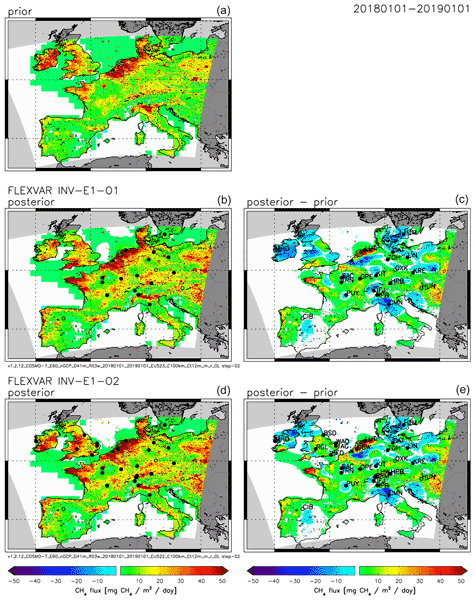
We present a novel high-resolution inverse modelling system, "FLEXVAR", and its application for the inverse modelling of European CH4 emissions in 2018. The new system combines a high spatial resolution of 7 km x 7 km with a variational data assimilation technique, which allows CH4 emissions to be optimized from individual model grid cells. The high resolution allows the observations to be better reproduced, while the derived emissions show overall good consistency with two existing models.
Malika Menoud, Carina van der Veen, Dave Lowry, Julianne M. Fernandez, Semra Bakkaloglu, James L. France, Rebecca E. Fisher, Hossein Maazallahi, Mila Stanisavljević, Jarosław Nęcki, Katarina Vinkovic, Patryk Łakomiec, Janne Rinne, Piotr Korbeń, Martina Schmidt, Sara Defratyka, Camille Yver-Kwok, Truls Andersen, Huilin Chen, and Thomas Röckmann
Earth Syst. Sci. Data, 14, 4365–4386, https://doi.org/10.5194/essd-14-4365-2022, https://doi.org/10.5194/essd-14-4365-2022, 2022
Short summary
Short summary
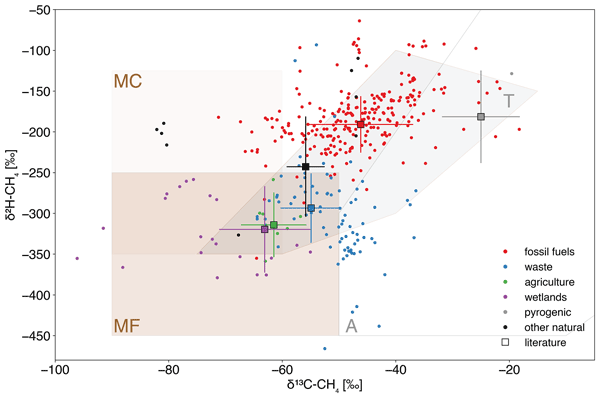
Emission sources of methane (CH4) can be distinguished with measurements of CH4 stable isotopes. We present new measurements of isotope signatures of various CH4 sources in Europe, mainly anthropogenic, sampled from 2017 to 2020. The present database also contains the most recent update of the global signature dataset from the literature. The dataset improves CH4 source attribution and the understanding of the global CH4 budget.
Cited articles
Andreev, S. N., Mironchuk, E. S., Nikolaev, I. V., Ochkin, V. N., Spiridonov, M. V., and Tskhai, S. N.: High precision measurements of the
Bruneau, D., Gibert, F., Flamant, P., and Pelon, J.: Complementary study of differential absorption lidar optimization in direct and heterodyne detections, Appl. Optics, 45, 4898–4908, https://doi.org/10.1364/AO.45.004898, 2006.
Bösenberg, J.: Ground-based differential absorption lidar for water-vapor and temperature profiling: methodology, Appl. Optics, 37, 3845–3860, https://doi.org/10.1364/AO.37.003845, 1998.
Bowling, D. R., McDowell, N. G., Bond B. J., Law, B. E., and Ehleringer, J. R.: 13C content of ecosystem respiration is linked to precipitation and vapor pressure deficit, Oecologia, 131, 113–124, https://doi.org/10.1007/s00442-001-0851-y, 2002.
Brugnoli, E., Scartazza, A., Lauteri, M., Monteverdi, M. C., and Máguas, C.: Carbon isotope discrimination in structural and non-structural carbohydrates in relation to productivity and adaptation to unfavourable conditions, in: Stable Isotopes: Integration of Biological, Ecological and Geochemical Processes, edited by: Griffiths, H., Bios Scientific Publishers Ltd. Oxford, 133–146, https://doi.org/10.1201/9781003076865, 1998.
Buchmann, N. and Ehleringer, J. R.: CO2 concentration profiles, and carbon and oxygen isotopes in C3 and C4 crop canopies, Agr. Forest Meteorol., 89, 45–58, https://doi.org/10.1016/S0168-1923(97)00059-2,1998.
Buchmann, N., Kao, W.-Y., and Ehleringer, J. R.: Influence of stand structure on carbon-13 of vegetation, soils, and canopy air within deciduous and evergreen forests in Utah, United States, Oecologia, 110, 109–119, https://doi.org/10.1007/s004420050139, 1997.
Cassidy, D. T. and Reid, J.: Atmospheric pressure monitoring of trace gases using tunable diode lasers, Appl. Optics, 21, 1185–1190, https://doi.org/10.1364/AO.21.001185, 1982.
Chen, J. M., Mo, G., and Deng, F.: A joint global carbon inversion system using both CO2 and 13CO2 atmospheric concentration data, Geosci. Model Dev., 10, 1131–1156, https://doi.org/10.5194/gmd-10-1131-2017, 2017.
Dumas, D., Rothman, J., Gibert, F., Édouart, D., Lasfargues, G., Cénac, C., Le Mounier, F., Pellegrino, J., Zanatta, J.-P., Bardoux, A., Tinto, F., and Flamant, P.: Evaluation of a HgCdTe e-APD based detector for 2 µm CO2 DIAL application, Appl. Optics, 56, 7577–7585, https://doi.org/10.1364/AO.56.007577, 2017.
Ekblad, A. and Högberg, P.: Natural abundance of 13C in CO2 respired from forest soils reveals speed of link between tree photosynthesis and root respiration, Oecologia, 127, 305–308, https://doi.org/10.1007/s004420100667, 2001.
Flanagan, L. B., Brooks, J., Varney, G. T., Berry, S. C., and Ehleringer, J. R.: Carbon isotope discrimination during photosynthesis and the isotope ratio of respired CO2 in boreal forest ecosystems, Global Biogeochem. Cy., 10, 629–640, 1996.
Gibert, F., Flamant, P. H., Bruneau, D., and Loth, C.: Two-micrometer heterodyne differential absorption lidar measurements of the atmospheric CO2 mixing ratio in the boundary layer, Appl. Optics, 45, 4448–4458, https://doi.org/10.1364/AO.45.004448, 2006.
Gibert, F., Flamant, P. H., Cuesta, J., and Bruneau, D.: Vertical 2-µm Heterodyne Differential Absorption Lidar Measurements of Mean CO2 Mixing Ratio in the Troposphere, J. Atmos. Ocean. Tech., 25, 1477–1497, https://doi.org/10.1175/2008JTECHA1070.1, 2008.
Gibert, F., Edouart, D., Cénac, C., le Mounier, F., and Dumas, A.: 2 µm Ho emitter-based coherent DIAL for CO2 profiling in the atmosphere, Opt. Lett., 40, 3093–3096, https://doi.org/10.1364/OL.40.003093, 2015.
Gibert, F. Pellegrino, J., Edouart, D., Cénac, C., Lombard, L., Le Gouët, J., Nuns, T., Cosentino, A., Spano, P., and Di Nepi, G.: 2 µm double pulse single frequency Tm:fiber laser pumped Ho:YLF laser for a space-borne CO2 lidar, Appl. Optics, 57, 10370–10379, 2018.
Gibert, F., Edouart, D., and Cénac C.: δ13C carbon isotopic composition of CO2 in the atmosphere by Lidar, 31st International Laser Radar Conference, Landshut, Germany, hal-04727479, June 2024.
Gordon, I. E., Rothman, L. S., Hargreaves, R. J., et al.: The HITRAN2020 Molecular Spectroscopic Database, J. Quant. Spectrosc. Ra., 277, 107949, https://doi.org/10.1016/j.jqsrt.2021.107949, 2022.
Hamperl, J., Dherbecourt, J.-B., Raybaut, M., Totems, J., Chazette, P., Régalia, L., Grouiez, B., Geyskens, N., Aouji, O., Amarouche, N., Melkonian, J.-M., Santagata, R., Godard, A., Evesque, C., Pasiskevicius, V., and Flamant, C.: Range-resolved detection of boundary layer stable water vapor isotopologues using a ground-based 1.98 µm differential absorption LIDAR, Opt. Express, 30, 47199–47215, 2022.
IAEA: International Atomic Energy Agency: Isotopes de l'environnement dans le cycle hydrologique, Vienne, IAEA-TCS-32/F, ISSN 1018-5518, 2008.
IPCC: Climate Change 2023: Synthesis Report, Contribution of Working Groups I, II and III to the Sixth Assessment Report of the Intergovernmental Panel on Climate Change, edited by: Core Writing Team, Lee, H., and Romero, J., IPCC, Geneva, Switzerland, 184 pp., https://doi.org/10.59327/IPCC/AR6-9789291691647, 2023.
Kasyutich, V. L., Martin, P. A., and Holdsworth, R. J.: An off-axis cavity-enhanced absorption spectrometer at 1605 nm for the
Killinger, D. K. and Menyuk, N.: Effect of turbulence-induced correlation on laser remote sensing error, Appl. Phys. Lett., 38, 968–970, 1981.
Koch, G. J., Barnes, B. W., Petros, M., Beyon, J. Y., Amzajerdian, F., Yu, J., Davis, R. E., Ismail, S., Vay, S., Kavaya, M. J., and Singh, U. N.: Coherent differential absorption lidar measurements of CO2, Appl. Optics, 43, 5092–5099, 2004.
Lahyani, J., Le Gouët, J., Gibert, F., and Cézard, N.: 2.05 µm all-fiberlaser source designed for CO2 and wind coherent lidar measurement, Appl. Optics, 60, C12–C19, https://doi.org/10.1364/AO.416821, 2021.
Lahyani, J., Thiers, M., Gibert, F., Edouart, D., Le Gouët, J., and Cézard, N.: Hybrid fiber/bulk laser source designed for CO2 and wind measurements at 2.05 µm, Opt. Lett., 49, 969–972, https://doi.org/10.1364/OL.510598, 2024.
Li, J., Li, R., Zhao, B.Guo, H., Zhang, S., Cheng, J., and Wu, X.,: Quantitative measurement of carbon isotopic composition in CO2 gas reservoir by micro-laser Raman spectroscopy, Spectrochim. Acta A, 195, 191–198, https://doi.org/10.1016/j.saa.2018.01.082, 2018.
Lin, Y.-C., Zhang, Y.-L., Xie, F., Zhang, W.-Q., Fan, M.-Y., Lin, Z., Rella, C. W., and Hoffnagle J. A.: Development of a monitoring system for semicontinuous measurements of stable carbon isotope ratios in atmospheric carbonaceous aerosols: Optimized methods and application to field measurements, Anal. Chem., 92, 14373–14382, https://doi.org/10.1021/acs.analchem.0c02063, 2020.
Lopez, M., Schmidt, M., Delmotte, M., Colomb, A., Gros, V., Janssen, C., Lehman, S. J., Mondelain, D., Perrussel, O., Ramonet, M., Xueref-Remy, I., and Bousquet, P.: CO, NOx and 13CO2 as tracers for fossil fuel CO2: results from a pilot study in Paris during winter 2010, Atmos. Chem. Phys., 13, 7343–7358, https://doi.org/10.5194/acp-13-7343-2013, 2013.
Mätzler, C.: MATLAB functions for Mie scattering and absorption, Version 2, IAP Research Rep., 11 pp., https://api.semanticscholar.org/CorpusID:123424425 (last access: 17 March 2026), 2002.
Mondelain, D., Campargue, A., Fleurbaey, H., Kassi, S., and Vasilchenko, S.: Line shape parameters of air-broadened 12CO2 transitions in the 2 µm region, with their temperature dependence, J. Quant. Spectrosc. Ra., 298, 108485, https://doi.org/10.1016/J.jqsrt.2023.108485, 2023.
Mondelain, D., Campargue, A., Gamache, R.R., Hartmann, J.-M., Gibert, F., Wagner, G., Birk, M., and Röske C.: Isotopologue dependence of the CO2-air broadening and shifting coefficients: experimental evidence and comparison with theory for 13CO2 and 12CO2, J. Quant. Spectrosc. Ra., 333, 109271, https://doi.org/10.1016/j.JQSRT.2024.109271, 2025.
Mortazavi, B., Chanton, J. P., Prater, J. L., Oishi, A. C., Oren, R., and Katul, G.: Temporal variability in 13C of respired CO2 in a pine and a hardwood forest subject to similar climatic conditions, Oecologia, 142, 57–69, https://doi.org/10.1007/s00442-004-1692-2, 2005.
Nelson, D. D., McManus, J. B., Herndon, S. C., Zahniser, M. S., Tuzson, B., and Emmenegger, L.: New method for isotopic ratio measurements of atmospheric carbon dioxide using a 4.3 µm pulsed quantum cascade laser, Appl. Phys. B, 90, 301–309, https://doi.org/10.1007/s00340-007-2894-1, 2008.
Ogée, J., Peylin, P., Ciais, P., Bariac, T., Brunet, Y., Berbigier, P., Roche, C., Richard, P., Bardoux, G., and Bonnefond, J.-M.: Partitioning net ecosystem carbon exchange into net assimilation and respiration using 13CO2 measurements: A cost-effective sampling strategy, Global Biogeochem. Cy., 17, 1070, https://doi.org/10.1029/2002GB001995, 2003.
Pataki, D. E., Ehleringer, J. R., Flanagan, L. B., Yakir, D., Bowling, D. R., Still, C. J., Buchmann, N., Kaplan, J. O., and Berry, J. A.: The application and interpretation of Keeling plots in terrestrial carbon cycle research, Global Biogeochem. Cy., 17, 1022, https://doi.org/10.1029/2001GB001850, 2003.
Shi, T., Han, G., Ma, X., Gong, W., Pei, Z., Xu, H., Qiu, R., Zhang, H., and Zhang, J.: Potential of ground-based multiwavelength differential absorption lidar to measure d13C in open detected path, IEEE Geosci. Remote S., 19, 7003204, https://doi.org/10.1109/LGRS.2021.3130585, 2022.
Shibata, Y., Nagasawa, C., and Abo, M.: Development of 16 µm DIAL using an OPG/OPA transmitter for measuring atmospheric CO2 concentration profiles, Appl. Optics, 56, 1194–1201, 2017.
Still, C. J., Berry, J. A., Collatz, G. J., and Defries, R. S.: Global distribution of C3 and C4 vegetation: carbon cycle implications, Global Biogeochem. Cy., 17, 1006, https://doi.org/10.1029/2001GB001807, 2003.
Stroud, J. R., Wagner, G. A., and Plusquellic, D. F.: Multi-Frequency Differential Absorption LIDAR (DIAL) System for Aerosol and Cloud Retrievals of
Sun, X., Abshire, J. B., and Beck, J. D.: HgCdTe e-APD detector arrays with single photon sensitivity for space LIDAR applications, Proc. SPIE 9114, 91140K, https://doi.org/10.1117/12.2053757, 2014.
Tellier, Y., Pierangelo, C., Wirth, M., Gibert, F., and Marnas, F.: Averaging bias correction for the future space-borne methane IPDA lidar mission MERLIN, Atmos. Meas. Tech., 11, 5865–5884, https://doi.org/10.5194/amt-11-5865-2018, 2018.
Weitkamp, C.: Lidar. Range-resolved optical remote sensing of the atmosphere, Springer New York, NY, 456 pp., https://doi.org/10.1007/b106786, 2005.
Widory, D. and Javoy, M.: The carbon isotope composition of atmospheric CO2 in Paris, Earth Planet. Sc. Lett., 215, 289–298, https://doi.org/10.1016/S0012-821X(03)00397-2, 2003.
WMO: State of the Global Climate 2024, WMO-No. 1368, ISBN 978-92-63-11368-9, https://library.wmo.int/idurl/4/69455 (last access: 18 November 2025), 2025.
Yu, S., Guo, K., Li, S., Han, H., Zhang, Z., and Xia, H.: Three-dimensional detection of CO2 and wind using a 1.57 µm coherent differential absorption lidar, Opt. Express, 32, 21134–21148, 2024.
Yue, B., Yu, S., Li, M., Wei, T., Yuan, J., Zhang, Z., Dong, J., Jiang, Y., Yang, Y., Gao, Z., and Xia, H.: Local-Scale Horizontal CO2 Flux Estimation Incorporating Differential Absorption Lidar and Coherent Doppler Wind Lidar, Remote Sens., 14, 5150, https://doi.org/10.3390/rs14205150, 2022.
Short summary
This paper presents first differential absorption lidar (DIAL) measurements of isotopic ratio of CO2 (δ13C) in the atmosphere in the spectral domain of 2-µm. This work investigates additional tracers of intra-atmospheric or surface-atmosphere exchanges to characterise CO2 sources and sinks.
This paper presents first differential absorption lidar (DIAL) measurements of isotopic ratio of...


