Articles | Volume 19, issue 7
https://doi.org/10.5194/amt-19-2621-2026
© Author(s) 2026. This work is distributed under
the Creative Commons Attribution 4.0 License.
https://doi.org/10.5194/amt-19-2621-2026
© Author(s) 2026. This work is distributed under
the Creative Commons Attribution 4.0 License.
Using formvar to capture atmospheric ice crystals and retrieve roughness parameters

Department of Earth and Environmental Sciences, University of Manchester, Manchester, M13 9PL, UK
Andrew R. D. Smedley
Department of Earth and Environmental Sciences, University of Manchester, Manchester, M13 9PL, UK
Paul Connolly
Department of Earth and Environmental Sciences, University of Manchester, Manchester, M13 9PL, UK
Ann R. Webb
Department of Earth and Environmental Sciences, University of Manchester, Manchester, M13 9PL, UK
Related authors
No articles found.
Michael Biggart, Thomas W. Choularton, Martin W. Gallagher, Keith N. Bower, Gary Lloyd, Paul J. Connolly, Benjamin J. Murray, Mark D. Tarn, Erin N. Raif, and Steven J. Abel
EGUsphere, https://doi.org/10.5194/egusphere-2026-1272, https://doi.org/10.5194/egusphere-2026-1272, 2026
This preprint is open for discussion and under review for Atmospheric Chemistry and Physics (ACP).
Short summary
Short summary
Microphysical processes controlling the phase of mixed-phase clouds in cold air outbreaks (CAOs) are poorly represented by climate models. Of these, secondary ice production (SIP) is a major contributor to uncertainties in the mixed-phase cloud response to warming. We examine observations made in CAOs to understand which SIP processes are dominating and under which conditions. Our results inform future modelling, helping reduce radiative flux biases and uncertainties in climate sensitivity.
Bowen Z. Portman, Paul J. Connolly, Alan M. Blyth, Rachel L. James, and Huihui Wu
EGUsphere, https://doi.org/10.5194/egusphere-2026-302, https://doi.org/10.5194/egusphere-2026-302, 2026
Short summary
Short summary
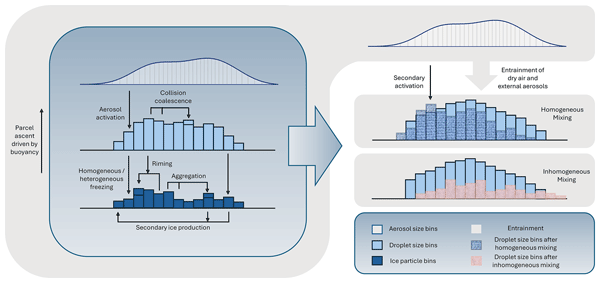
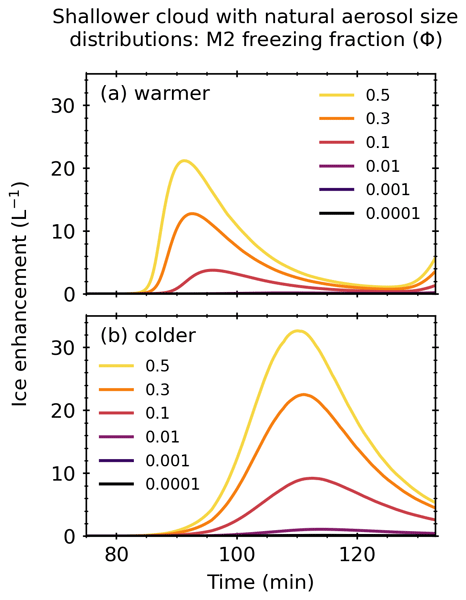
Secondary ice production (SIP) is key to explaining the high ice particle concentrations observed in deep convective clouds. We investigate secondary ice production in summer convective clouds over New Mexico, and our results show that collisions between supercooled water droplets and more massive ice particles are the dominant SIP mechanism in these clouds. We also find that the entrainment of external aerosols leads to earlier ice enhancement under homogeneous mixing.
Mengyu Sun, Paul J. Connolly, Paul R. Field, Declan L. Finney, and Alan M. Blyth
Atmos. Chem. Phys., 25, 18549–18569, https://doi.org/10.5194/acp-25-18549-2025, https://doi.org/10.5194/acp-25-18549-2025, 2025
Short summary
Short summary
We investigated how extra ice particles form inside tropical storm clouds and how they affect rainfall and sunlight reflection. By using a weather model, we found that these extra ice particles can change how clouds grow, reduce heat escaping to space, and slightly shift where rain falls. This helps improve how weather and climate models predict tropical storms.
Huihui Wu, Nicholas Marsden, Paul Connolly, Michael Flynn, Paul I. Williams, Declan Finney, Kezhen Hu, Graeme J. Nott, Navaneeth M. Thamban, Keith Bower, Alan Blyth, Martin Gallagher, and Hugh Coe
Atmos. Chem. Phys., 25, 18409–18429, https://doi.org/10.5194/acp-25-18409-2025, https://doi.org/10.5194/acp-25-18409-2025, 2025
Short summary
Short summary
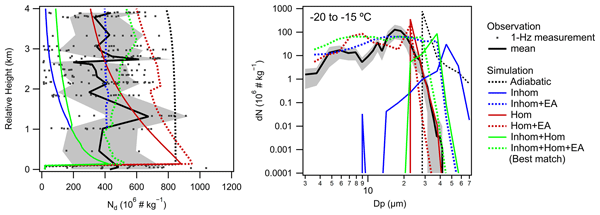
Airborne observations over the Magdalena Mountains in New Mexico underscore the combined influence of meteorological conditions and aerosol characteristics on the development of deep-convective clouds under different flow regimes. Model-observation comparisons emphasize the critical role of aerosol entrainment in reproducing the observed broad cloud droplet spectra. This study provides valuable constraints for improving parameterizations of aerosol-cloud interactions in deep convective systems.
Mengyu Sun, Paul J. Connolly, Paul R. Field, Declan L. Finney, and Alan M. Blyth
EGUsphere, https://doi.org/10.5194/egusphere-2025-5665, https://doi.org/10.5194/egusphere-2025-5665, 2025
Short summary
Short summary
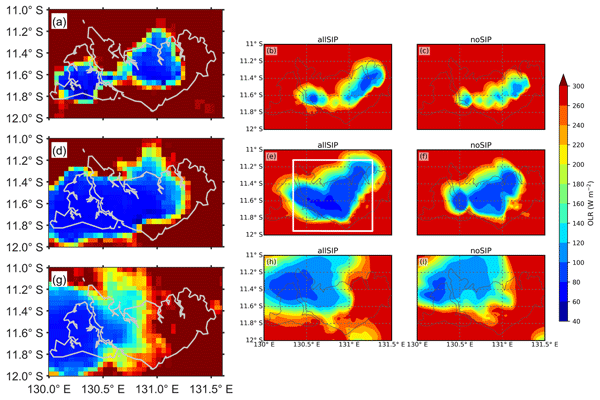
We use a high resolution weather model together with satellite and radar data to study how small particles in the air influence ice and rain in a tropical storm near Darwin. We find that when particle levels are moderate, storm clouds form more ice high in the atmosphere, spread a wider cloud cover, and produce stronger rainfall concentrated in certain regions. These results help improve how weather and climate models represent tropical storms and their rainfall.
Carmen González, José M. Vilaplana, Alberto Redondas, Javier López-Solano, José M. San Atanasio, Richard Kift, Andrew R. D. Smedley, Pavel Babal, Ana Díaz, Nis Jepsen, Guisella Gacitúa, and Antonio Serrano
Atmos. Chem. Phys., 25, 14131–14152, https://doi.org/10.5194/acp-25-14131-2025, https://doi.org/10.5194/acp-25-14131-2025, 2025
Short summary
Short summary
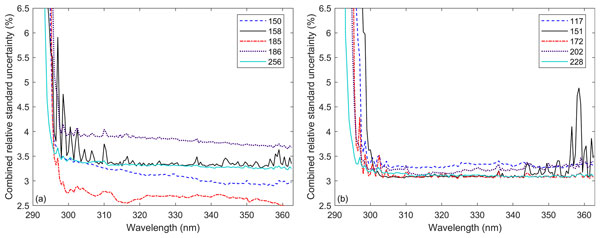
Brewer spectroradiometers are widely used instruments that have been monitoring global solar ultraviolet (UV) irradiance since the 1990s, playing a key role in solar UV research. The uncertainties of these measurements are rarely evaluated even though they are essential to determine the quality of these measurements. In this work, the uncertainty of 10 Brewers is estimated using the Monte Carlo method, showing that Brewers’ relative uncertainty is less than 5 % for wavelengths above 310 nm.
Declan L. Finney, Alan M. Blyth, Paul R. Field, Martin I. Daily, Benjamin J. Murray, Mengyu Sun, Paul J. Connolly, Zhiqiang Cui, and Steven Böing
Atmos. Chem. Phys., 25, 10907–10929, https://doi.org/10.5194/acp-25-10907-2025, https://doi.org/10.5194/acp-25-10907-2025, 2025
Short summary
Short summary
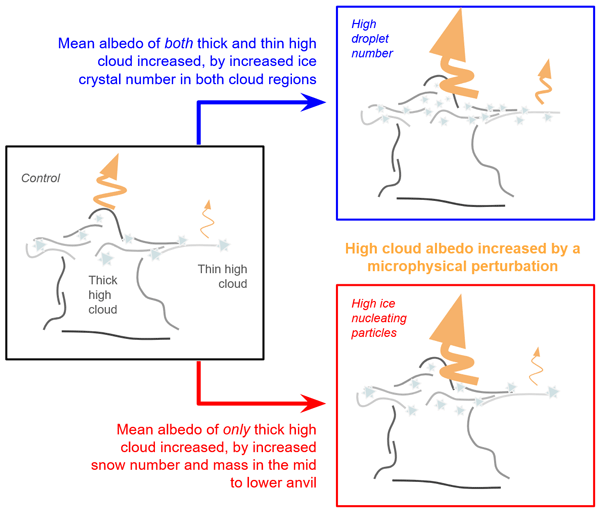
We present observation-informed modelling from the Deep Convective Microphysics Experiment (DCMEX) to study how environmental conditions and cloud processes affect anvil cloud albedo and radiation. Aerosols influencing cloud droplets or influencing ice formation yield varying radiative effects. We introduce fingerprint metrics to discern these effects. Using detailed observations and modelling, we offer insights into high-cloud radiative effects and feedbacks.
Declan L. Finney, Alan M. Blyth, Martin Gallagher, Huihui Wu, Graeme J. Nott, Michael I. Biggerstaff, Richard G. Sonnenfeld, Martin Daily, Dan Walker, David Dufton, Keith Bower, Steven Böing, Thomas Choularton, Jonathan Crosier, James Groves, Paul R. Field, Hugh Coe, Benjamin J. Murray, Gary Lloyd, Nicholas A. Marsden, Michael Flynn, Kezhen Hu, Navaneeth M. Thamban, Paul I. Williams, Paul J. Connolly, James B. McQuaid, Joseph Robinson, Zhiqiang Cui, Ralph R. Burton, Gordon Carrie, Robert Moore, Steven J. Abel, Dave Tiddeman, and Graydon Aulich
Earth Syst. Sci. Data, 16, 2141–2163, https://doi.org/10.5194/essd-16-2141-2024, https://doi.org/10.5194/essd-16-2141-2024, 2024
Short summary
Short summary
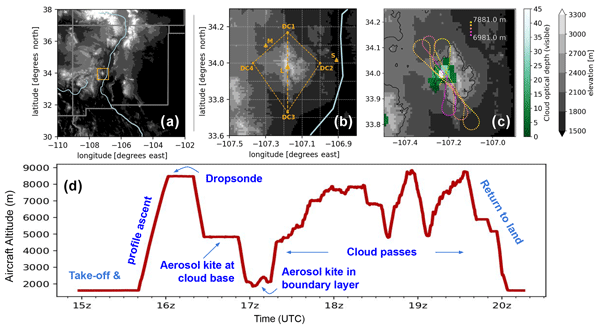
The DCMEX (Deep Convective Microphysics Experiment) project undertook an aircraft- and ground-based measurement campaign of New Mexico deep convective clouds during July–August 2022. The campaign coordinated a broad range of instrumentation measuring aerosol, cloud physics, radar signals, thermodynamics, dynamics, electric fields, and weather. The project's objectives included the utilisation of these data with satellite observations to study the anvil cloud radiative effect.
Rachel L. James, Jonathan Crosier, and Paul J. Connolly
Atmos. Chem. Phys., 23, 9099–9121, https://doi.org/10.5194/acp-23-9099-2023, https://doi.org/10.5194/acp-23-9099-2023, 2023
Short summary
Short summary
Secondary ice production (SIP) may significantly enhance the ice particle concentration in mixed-phase clouds. We present a systematic modelling study of secondary ice formation in idealised shallow convective clouds for various conditions. Our results suggest that the SIP mechanism of collisions of supercooled water drops with more massive ice particles may be a significant ice formation mechanism in shallow convective clouds outside the rime-splintering temperature range (−3 to −8 °C).
Rachel L. James, Vaughan T. J. Phillips, and Paul J. Connolly
Atmos. Chem. Phys., 21, 18519–18530, https://doi.org/10.5194/acp-21-18519-2021, https://doi.org/10.5194/acp-21-18519-2021, 2021
Short summary
Short summary
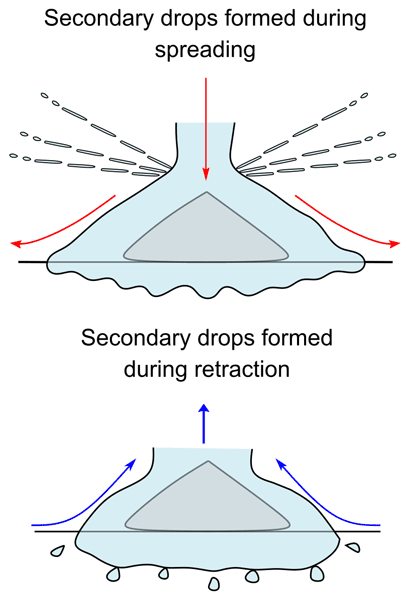
Secondary ice production (SIP) plays an important role in ice formation within mixed-phase clouds. We present a laboratory investigation of a potentially new SIP mechanism involving the collisions of supercooled water drops with ice particles. At impact, the supercooled water drop fragments form smaller secondary drops. Approximately 30 % of the secondary drops formed during the retraction phase of the supercooled water drop impact freeze over a temperature range of −4 °C to −12 °C.
Panagiotis G. Kosmopoulos, Stelios Kazadzis, Alois W. Schmalwieser, Panagiotis I. Raptis, Kyriakoula Papachristopoulou, Ilias Fountoulakis, Akriti Masoom, Alkiviadis F. Bais, Julia Bilbao, Mario Blumthaler, Axel Kreuter, Anna Maria Siani, Kostas Eleftheratos, Chrysanthi Topaloglou, Julian Gröbner, Bjørn Johnsen, Tove M. Svendby, Jose Manuel Vilaplana, Lionel Doppler, Ann R. Webb, Marina Khazova, Hugo De Backer, Anu Heikkilä, Kaisa Lakkala, Janusz Jaroslawski, Charikleia Meleti, Henri Diémoz, Gregor Hülsen, Barbara Klotz, John Rimmer, and Charalampos Kontoes
Atmos. Meas. Tech., 14, 5657–5699, https://doi.org/10.5194/amt-14-5657-2021, https://doi.org/10.5194/amt-14-5657-2021, 2021
Short summary
Short summary
Large-scale retrievals of the ultraviolet index (UVI) in real time by exploiting the modern Earth observation data and techniques are capable of forming operational early warning systems that raise awareness among citizens of the health implications of high UVI doses. In this direction a novel UVI operating system, the so-called UVIOS, was introduced for massive outputs, while its performance was tested against ground-based measurements revealing a dependence on the input quality and resolution.
Cited articles
Agar, A. W. and Revell, R. S.: A study of the formvar replica process, British Journal of Applied Physics, https://doi.org/10.1088/0508-3443/7/1/305, 1956.
Bailey, M. P. and Hallett, J.: A comprehensive habit diagram for atmospheric ice crystals: confirmation from the laboratory, AIRS II, and other field studies, J. Atmos. Sci., 66, 2888–2899, https://doi.org/10.1175/2009JAS2883.1, 2009.
Baran, A. J., Hill, P., Walters, D., Hardiman, S. C., Furtado, K., Field, P. R., and Manners, J.: The impact of two coupled cirrus microphysics–radiation parameterizations on the temperature and specific humidity biases in the tropical tropopause layer in a climate model, J. Climate, 29, 5299–5316, https://doi.org/10.1175/JCLI-D-15-0821.1, 2016.
Butterfield, N., Rowe, P. M., Stewart, E., Roesel, D., and Neshyba, S.: Quantitative three-dimensional ice roughness from scanning electron microscopy, Journal of Geophysical Research: Atmospheres, 122, 3023–3041, https://doi.org/10.1002/2016JD026094, 2017.
Collier, C., Hesse, E., Taylor, L., Ulanowski, Z., Penttila, A., and Nousiainen, T.: Effects of surface roughness with two scales on light scattering by hexagonal ice crystals large compared to the wavelength: DDA results, J. Quant. Spectrosc. Radiat. Transf., 182, 225–239, https://doi.org/10.1016/j.jqsrt.2016.06.007, 2016.
Connolly, P. J., Saunders, C. P. R., Gallagher, M. W., Bower, K. N., Flynn, M. J., Choularton, T. W., Whiteway, J., and Lawson, R. P.: Aircraft observations of the influence of electric fields on the aggregation, Quarterly Journal of the Royal Meteorological Society, 131, 1695–1712, https://doi.org/10.1256/qj.03.217, 2005.
Finnegan, W. G. and Pitter, R. L.: Atmospheric ice crystal processes. Nonlinear Optical Beam Manipulation, Beam Combining, and Atmospheric Propagation, SPIE, Los Angeles, https://doi.org/10.1117/12.943866, 1988.
Forster, L. and Mayer, B.: Ice crystal characterization in cirrus clouds III: retrieval of ice crystal shape and roughness from observations of halo displays, Atmos. Chem. Phys., 22, 15179–15205, https://doi.org/10.5194/acp-22-15179-2022, 2022.
Gadelmawla, E. S., Koura, M. M., Maksoud, T. M., Elewa, I. M., and Soliman, H. H.: Roughness parameters, Journal of Material Processing Technology, 123, 133–145, https://doi.org/10.1016/S0924-0136(02)00060-2, 2002.
Griggs, D. and Jayaratne, E.: The replication of ice crystals using formvar: techniques and precautions, J. Atmos. Ocean. Technol., 3, 547–551, https://doi.org/10.1175/1520-0426(1986)003<0547:TROICU>2.0.CO;2, 1986.
Gwyddion: Free SPM data analysis software, https://gwyddion.net/ (last access: 26 March 2026), 2004.
Intergovernmental Panel on Climate Change (IPCC): Climate change 2013, Cambridge University Press, Cambridge, https://doi.org/10.1017/CBO9781107415324, 2013. Intergovernmental Panel on Climate Change (IPCC): Climate Change 2023: Synthesis Report, IPCC, Geneva, https://doi.org/10.59327/IPCC/AR6-9789291691647, 2023.
Järvinen, E., Wernli, H., and Schnaiter, M.: Investigations of Mesoscopic Complexity of Small Ice Crystals in Midlatitude Cirrus, Geophys. Res. Lett., 45, 11, https://doi.org/10.1029/2018GL079079, 2018.
Kahler, H., Lloyd, B. J., and Eden, M.: Electron microscopic and other studies on a copper-cystine complex, J. Phys. Chem., 56, 768–770, https://doi.org/10.1021/j150498a029, 1952.
Kawamura, P. I. and Mackay, D.: The evaporation of volatile liquids, J. Hazard Mater., 15, 343–364, https://doi.org/10.1016/0304-3894(87)85034-3, 1987.
Libbrecht, K. G.: The physics of snow crystals, Reports on Progress in Physics, 68, 855–895, https://doi.org/10.1088/0034-4885/68/4/R03, 2005.
Linstrom, P. J. and Mallard, W. G.: NIST Chemistry WebBook, NIST Standard Reference Database Number 69, National Institute of Standards and Technology, https://webbook.nist.gov/cgi/cbook.cgi?ID=C67663, last access: 26 March 2026.
Magee, N. B., Miller, A., Amaral, M., and Cumiskey, A.: Mesoscopic surface roughness of ice crystals pervasive across a wide range of ice crystal conditions, Atmos. Chem. Phys., 14, 12357–12371, https://doi.org/10.5194/acp-14-12357-2014, 2014.
Magono, C. and Lee, C. W.: Meteorological classification of natural snow crystals, Journal of the Faculty of Science, Hokkaido University, Series, 7, Geophysics, 2, 321–335, 1966.
Miloshevich, L. M. and Heymsfield, A. J.: A balloon-borne continuous cloud particle replicator for measuring vertical profiles of cloud microphysical properties: instrument design, performance, and collection efficiency analysis, J. Atmos. Ocean. Technol., 14, 753–768, 1997.
Rucklidge, J.: The examination by electron microscope of ice crystal nuclei from cloud chamber experiments, J. Atmos. Sci., 301–308, https://doi.org/10.1175/1520-0469(1965)022<0301:TEBEMO>2.0.CO;2, 1965.
Saunders, C. P. and Wahab, N. M.: The influence of electric fields on the aggregation of ice crystals, Journal of the Meteorological Society of Japan, Ser., I, 2, https://doi.org/10.2151/jmsj1965.53.2_121, 1975.
Schaefer, V. J.: A method for making snowflake replicas, Science, 93, 239–240, https://doi.org/10.1126/science.93.2410.239, 1941.
Sinha, N.: Dislocations in ice as revealed by etching, Philosophical Magazine, 36, 1385–1404, https://doi.org/10.1080/14786437708238524, 1977.
Sinha, N.: Observation of Basal Dislocations in Ice by Etching and Replicating, Journal of Glaciology, 21, 385–395, https://doi.org/10.3189/S0022143000033554, 1978.
Smedley, A. R. D.: Spectral scattering properties of cloud types, PhD thesis, University of Manchester, Manchester, UK, 2003.
Smith, H. R., Connolly, P. J., Baran, A. J., Hesse, E., Smedley, A. R. D., and Webb, A. R.: Cloud chamber laboratory investigations into scattering properties of hollow ice particles, J. Quant. Spectrosc. Radiat. Transf., 157, 106–118, https://doi.org/10.1016/j.jqsrt.2015.02.015, 2015a.
Smith, H. R., Connolly, P. J., Webb, A. R., and Baran, A. J.: Exact and near backscattering measurements of the linear depolarisation ratio of various ice crystal habits generated in a laboratory cloud chamber, J. Quant. Spectrosc. Radiat. Transf., 178, 361–378, https://doi.org/10.1016/j.jqsrt.2016.01.030, 2015b.
Ulanowski, Z., Hesse, E., Kaye, P. H., and Baran, A. J.: Light scattering by complex ice-analogue crystals, J. Quant. Spectrosc. Radiat. Transf., 100, 1–3, https://doi.org/10.1016/j.jqsrt.2005.11.052, 2006.
Ulanowski, Z., Kaye, P. H., Hirst, E., Greenaway, R. S., Cotton, R. J., Hesse, E., and Collier, C. T.: Incidence of rough and irregular atmospheric ice particles from Small Ice Detector 3 measurements, Atmos. Chem. Phys., 14, 1649–1662, https://doi.org/10.5194/acp-14-1649-2014, 2014.
Voigtländer, J., Chou, C., Bieligk, H., Clauss, T., Hartmann, S., Herenz, P., Niedermeier, D., Ritter, G., Stratmann, F., and Ulanowski, Z.: Surface roughness during depositional growth and sublimation of ice crystals, Atmos. Chem. Phys., 18, 13687–13702, https://doi.org/10.5194/acp-18-13687-2018, 2018.
Warburton, J. A., Keyser, G., and Purcell, R. G.: A Portable Ice Crystal Replicator For Use In Snowfall Transmission Studies, Optical Engineering for Cold Environments, 0414, Arlington, https://doi.org/10.1117/12.935862, 1983.
Short summary
The surface structure of ice crystals in clouds influences how sunlight travels through the atmosphere and contributes to uncertainty in climate predictions. Because these features are difficult to observe, we present a practical approach for mapping ice crystal surface structure using an established capture technique. Ice crystals were produced in a laboratory cloud chamber and their surfaces were measured in detail. This approach enables reliable mapping of ice crystal surfaces.
The surface structure of ice crystals in clouds influences how sunlight travels through the...