
the Creative Commons Attribution 4.0 License.
the Creative Commons Attribution 4.0 License.
 | 23 Apr 2026
The sensitivity of the Far-infrared Outgoing Radiation Understanding and Monitoring (FORUM) mission to dust aerosols: a pseudo-observations analysis
Pasquale Sellitto
Maxim Eremenko
Paola Formenti
Perla Alalam
Michael Höpfner
Claudia Di Biagio
The Earth Explorer 9 Far-infrared Outgoing Radiation Understanding and Monitoring (FORUM) mission will bring the first satellite instrument capable of observing the Earth's far infrared (FIR) spectra with a high spectral resolution. Using an ad-hoc pseudo-observations (PO) simulator, we generate FORUM PO that we use to evaluate its sensitivity to dust aerosols. We compare the sensitivity of the FIR (15–100 µm) part of the spectra to that of the mid infrared (MIR, 2.5–15 µm) as observed by the Infrared Atmospheric Sounder Interferometer – New Generation (IASI-NG) instrument. Different dust scenarios are tested, in terms of mineralogy, source region and background atmosphere, burden and vertical distribution. The simulations in this study show a clear FIR spectral signature of dust in the Earth's atmosphere, and a corresponding dust sensitivity in the FIR spectra. The analysis of spectral signatures and Jacobians suggests that the FORUM observations are expected to bring an added value to dust observations from satellite, with respect to MIR-only, especially in cases of large burdens of mid-to-long-range transported plumes of dust in the free and upper troposphere. At these conditions, the FIR contributes up to the 50 % of the overall infrared sensitivity, and the impact of interfering species, like water vapour, is limited. More quantitative estimations of the inherent information content are needed to corroborate our results.
- Article
(3787 KB) - Full-text XML
-
Supplement
(1032 KB) - BibTeX
- EndNote


Airborne mineral dust is likely the most abundant aerosol type by mass in the Earth's atmosphere, accounting for several Tg of emissions per year (Huneeus et al., 2011; Kok et al., 2023). Dust aerosols are emitted by aeolian erosion of bare soils and can be transported at long distances through atmospheric dynamics (e.g. Prospero, 1999; Di Biagio et al., 2021; Merdji et al., 2023). Mineral dust emission and its transport have important impacts on the Earth's system, by perturbing the atmospheric composition, clouds fields and biogeochemical processes, e.g. through deposition into the oceans (Knippertz and Stuut, 2014). In addition, due to their interaction with shortwave and longwave radiation, dust layers play also a crucial role in the Earth's radiative balance and climate system (e.g. Miller et al., 2014; Kok et al., 2023). These impacts of dust particles are dependent on their mineralogical composition, size, shape and spatial and vertical distribution (e.g., Liao and Seinfeld, 1998; Colarco et al., 2014).
Dust layers can be detected, and the spatiotemporal variability of their burden can be reasonably characterised at large spatial scales, using satellite observations. These observation capabilities have progressed with increasing precision since about three decades (e.g. Husar et al., 1997; Banks and Brindley, 2013; Cuesta et al., 2015; Zheng et al., 2022). Nevertheless, dust optical, microphysical and chemical properties are not yet sufficiently constrained with such measurements. Of particular importance is the characterisation of dust mineralogy. The information on mineralogy is not yet fully accessible from satellite observations, even though mineral signatures exist in the ultraviolet–visible (UV–Vis, ∼ 300–800 nm), Visible to Short Wavelength Infrared (VSWIR, ∼ 350–2500 nm) and infrared (IR) regions (Sokolik and Toon, 1999; Sokolik, 2002; Di Biagio et al., 2014, 2023). In particular, the UV-Vis and VSWIR spectral domains include the absorption signatures of minerals contained in the dust fine-fraction, such as iron oxides and clays, while the mid IR range (MIR, 2.5–15 µm) is more sensitive to the presence of coarse-sized silicates and carbonates (Moosmüller et al., 2012; Di Biagio et al., 2017, 2019, 2023; Sadrian et al., 2023). Retrieval of dust mineral content based on optical signatures in satellite observations started to be exploited only recently using UV-Vis and VSWIR observations (Go et al., 2022, Sanwlani and Das, 2022), including those from the EMIT (Earth Mineral dust source InvesTigation) mission (Green et al., 2020; Connelly et al., 2021), as well as MIR observations from the IASI (Infrared Atmospheric Sounder Interferometer) mission (Alalam et al., 2024). Other parameters of the dust layer, like the size and vertical distribution, are also still scarcely accessible with existing satellite observing systems despite growing efforts of the scientific community (e.g. Pierangelo et al., 2005; Vandenbussche et al., 2013; Cuesta et al., 2020; Zheng et al., 2023).
The far-infrared (FIR, 15–100 µm) region of the atmospheric spectrum is expected to contain spectral dust signatures, so to be potentially useful to detect and characterize dust from space (Di Biagio et al., 2026). In addition, high-spectral-resolution FIR observations contain signatures of many essential climate variables, driving and responding to climate change, like parameters associated with clouds, water vapour and the Earth's surface (e.g. Palchetti et al., 2020). More in general, an effective and global observation of the full infrared spectrum of the radiation emitted by the Earth and atmosphere is essential to quantify and follow the temporal evolutions of the Earth's radiative budget. Up to now however while the Earth's spectra in the MIR have been routinely observed from space-borne instruments since a relatively long time, e.g. with the IASI series (e.g. Clerbaux et al., 2009), the outgoing FIR spectral radiation has not been yet observed routinely and at high spectral resolution from satellites.
To fill this gap and gather insights into the Earth's emission spectra in the FIR range, the Far-infrared Outgoing Radiation Understanding and Monitoring (FORUM) mission has been selected by the European Space Agency (ESA) for the Earth Explorer 9 programme and is expected to be launched in 2027 (https://www.forum-ee9.eu, last access: 17 March 2026). The overarching goal of the FORUM mission will be to evaluate the role of the FIR spectral region on climate (Palchetti et al., 2020). The main FORUM instrument will be a nadir sounder that will cover the FIR spectrum from 100 to 1600 (100–6.25 µm) with a nominal spectral resolution of 0.5 cm−1, thus filling the existing observational gap across the FIR. An additional spectral broadband imager will also be present on the FORUM spacecraft, but its observations are not simulated in this paper. The observation geometry of the FORUM sounder will be based on an individual nadir ground footprint of 15 km horizontal resolution and an across-track sampling of about 100 km. The FORUM spacecraft will fly, in a sun-synchronous orbit, in loose formation with IASI-NG (Infrared Atmospheric Sounder Interferometer – New Generation), so to exploit possible synergies of FIR and MIR observations. The IASI-NG (Crevoisier et al., 2014), heritage of the IASI instrument, is a nadir MIR (645–2760 cm−1, i.e. 3.62–15.50 µm) instrument, onboard the MetOP-SG (Meteorological Operational Satellite – Second Generation) satellite series. The first MetOP-SG satellite was launched on August 2025 (https://cnes.fr/projets/iasi-ng, last access: 17 March 2026).
The expected sensitivity of the FIR spectra observed by FORUM to a number of climate variables, i.e. water vapour concentration, surface emissivity, radiative fluxes and clouds properties, was discussed by Palchetti et al. (2020). In this paper, and with an assessment methodology similar to the one of Palchetti et al. (2020), we extend their results to the estimation of the expected sensitivity of FORUM observations to dust aerosol layers, their burden, mineralogical composition and vertical profile shape. This analysis is performed in different background atmospheres, in particular typical of polar and tropical conditions. A comparative analysis of FIR and MIR observation capabilities of dust, and their complementarity, is carried out to put the expected dust sensitivity of the FORUM observations into the more general context of infrared satellite observations and their coupling. As done by Palchetti et al. (2020), we limit our study to the analysis of the FIR dust spectral signatures, for different atmospheric and dust scenarios, and of the FORUM sensitivity to dust in terms of Jacobians, and their comparisons with the MIR-only sensitivity of IASI-NG. This represents a first analysis of the expected sensitivity to dust of FORUM observations, and of the FIR spectral range in general. This work paves the way to more quantitative estimations of the dust information content in the FIR and FORUM observations, e.g. though an established retrieval algorithm, which are not carried out in the present work.
2.1 FORUM and IASI-NG PO simulator
This analysis is carried out using a set of spectral radiance pseudo-observations (PO), i.e. synthetic observations of the outgoing infrared spectra, generated with the PO simulator based on the conceptual scheme shown in Fig. 1. We simulate spectral observations of FORUM and IASI-NG, so to compare the dust sensitivity in the FIR (provided by FORUM PO) with the one in the MIR (provided by IASI-NG PO).
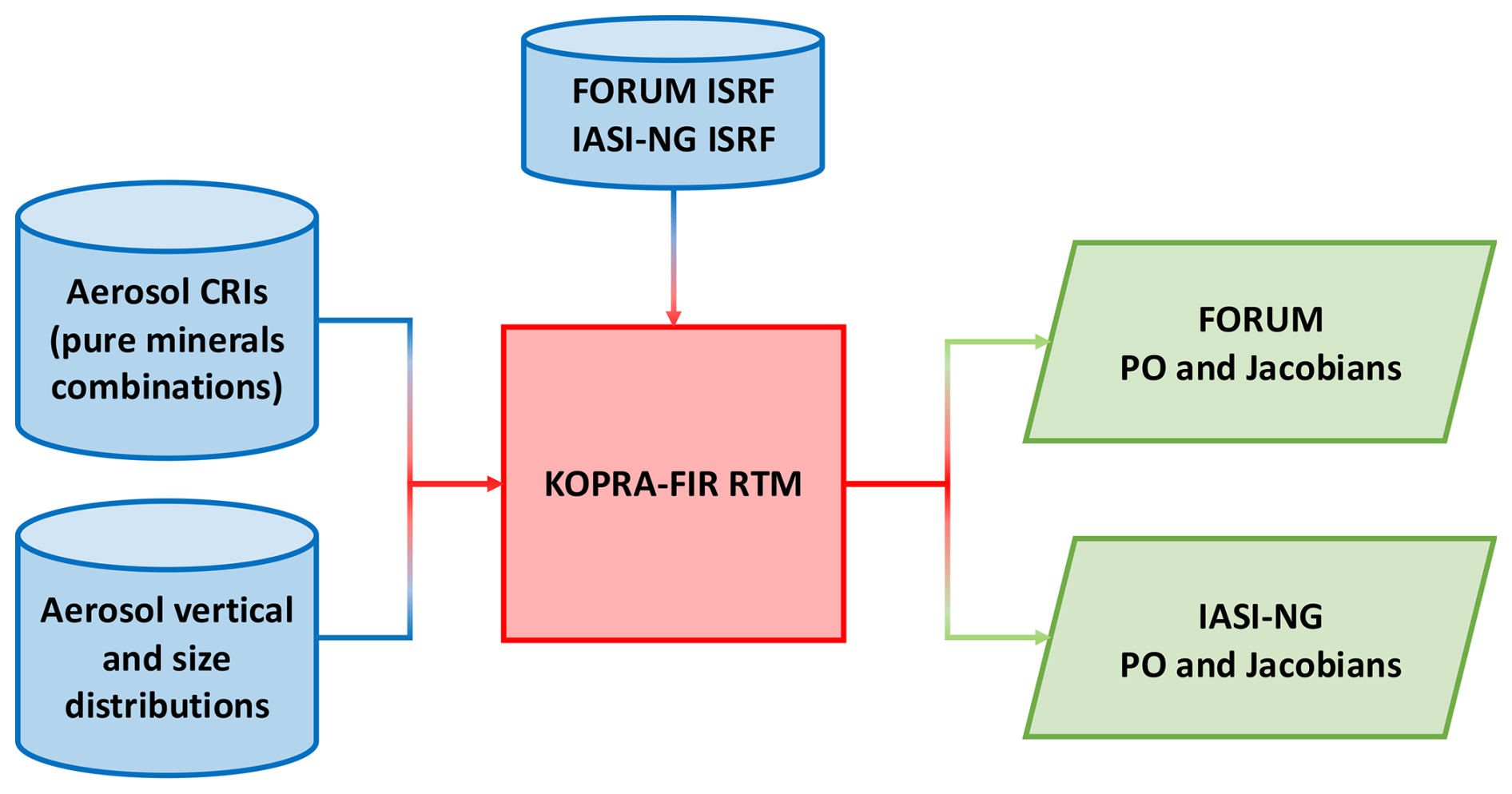
The two instruments, FORUM and IASI-NG, are defined by means of their technical specifications, and in particular their Instrumental Spectral Response Function (ISRF) and spectral sampling. These specifications are obtained though CNES (Centre National d'Etudes Spatiales) official working groups for the two instruments. The spectral resolution is 0.50 cm−1, for FORUM PO, and 0.25 cm−1, for IASI-NG PO (Crevoisier et al., 2014), respectively. In our simulations, the instrumental radiometric noise is not added to the PO, as this is expected to provide a very minor impact on the measurement of broad-band spectral features such as those associated with aerosols. The simulations are realised as individual and isolated nadir observations (with zero-nadir-angle geometry only), without any detailed representation of FORUM and IASI-NG observation geometry at larger spatiotemporal scales. Spatiotemporal co-location of the two instruments is also not represented in this work.
Core of the PO simulator is the Karlsruhe Optimized and Precise Radiative transfer Algorithm (KOPRA) radiative transfer model (RTM) (Stiller et al., 2002). The KOPRA RTM, initially developed for simulating the observation of MIR spectra (e.g. Eremenko et al., 2008, Sellitto et al., 2013), is here extended to the FIR (i.e. the RTM here called KOPRA-FIR). A pure nadir observation geometry is used in this work, so with a zero-azimuth angle. The background atmospheric state is defined with vertical profiles of temperature, water vapour, ozone and other trace gases at 1 km vertical resolution, for two standard AFGL (Air Force Geophysical Laboratory) atmospheres (Anderson et al., 1986), i.e. a tropical and a polar atmosphere. Temperature and water vapour concentration profiles for the two background atmospheric states are shown in Fig. S1 in the Supplement. Dust aerosol layers are put into these two standard atmospheres, and are described in the following sections.
2.2 Dust models for vertical distribution, size, composition and complex refractive index
Radiative transfer calculations are performed using the KOPRA RTM, incorporating dust aerosol parameters as inputs, including their vertical distribution, size distribution (SD), and complex refractive index (CRI).
In this study, two different vertical distributions are tested, one with a maximum at the surface and the other peaked at 5 km altitude, to simulate both local and transported dust layers. The choice of a 5 km high peak for transported dust is made to represent an average case, considering that the altitude for dust transport can be variable but reported to reach up to 10 km (e.g. Merdji et al., 2023; Ratcliffe et al., 2024; Di Iorio et al., 2009). The two dust vertical profiles are shown in Fig. S2.
The particle SD is defined in the KOPRA RTM as single lognormal mode centred at the number median diameter (NMD) of 2.03 µm and a width (σ) of 1.9. This corresponds to an average volume median diameter (VMD) of 7.0 µm which is within the source and mid-range transport VMD value as synthetized by Formenti and Di Biagio (2024). To note that due to a technical limitation in the RTM, the σ of the dust size distribution cannot be higher than 2, resulting however in a SD narrower than the synthesis reported in Formenti and Di Biagio (2024) (see Fig. S3). These SD parameters are similar to what used in IASI retrievals, e.g. by Clarisse et al. (2019).
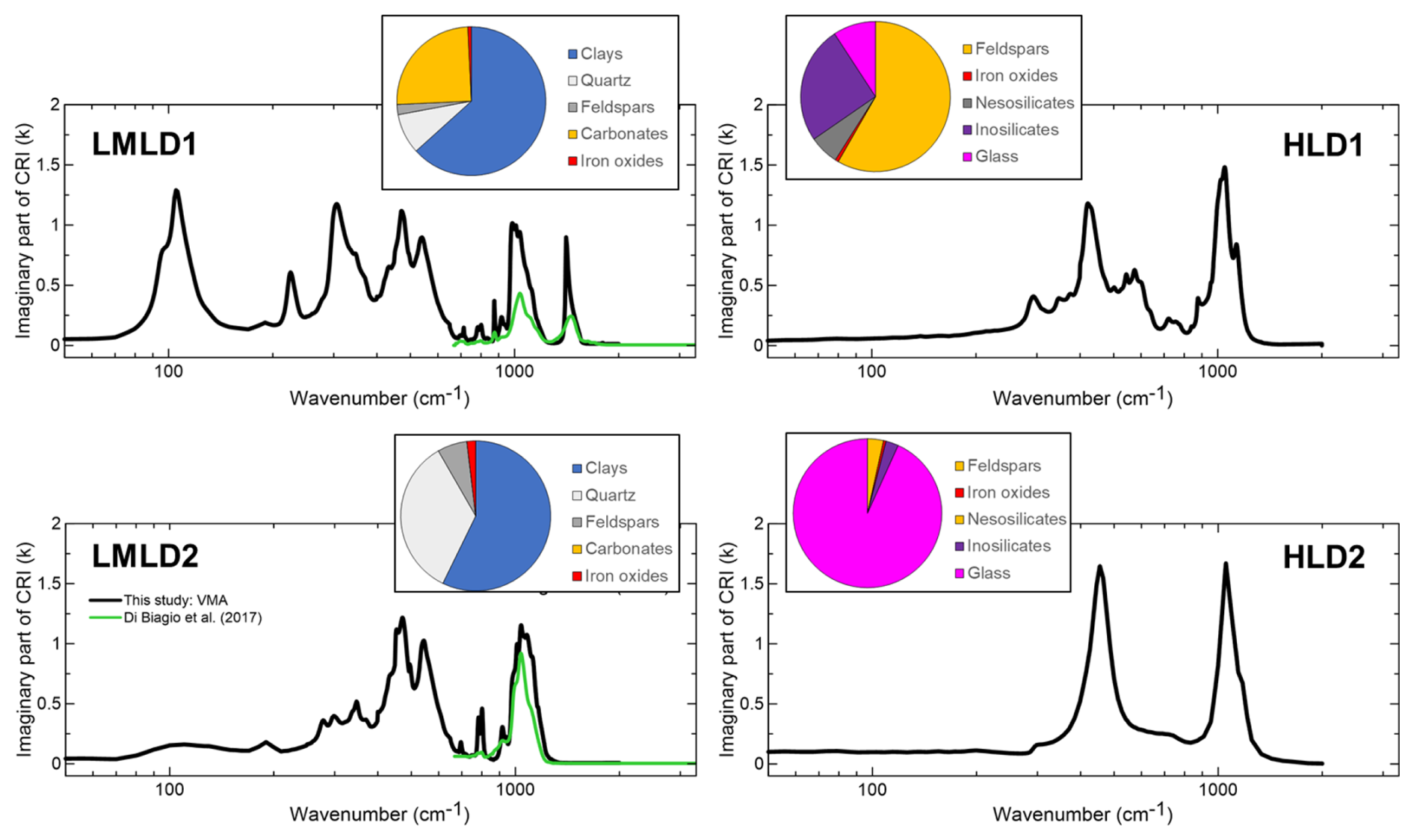
Figure 2The spectral imaginary part of the complex refractive indices calculated using the VMA method (in black) compared with the experimental measurements from Di Biagio et al. (2017) for LMLD1 and LMLD2 (in green). The mineralogical composition (% in volume) of the four dust samples is also shown in the inlets. The spectral data for the real part of the CRI are shown in Fig. S2.
In terms of the CRI, data are not presently available in the literature for dust, in the FIR spectral range. Therefore the spectral CRI is calculated based on the volume mixing approximation (VMA) in the whole 2.5 to 100 µm spectral range including MIR and FIR, based on existing CRI for single minerals that compose dust aerosols. The VMA assumes that the mineral phases in the dust samples are internally mixed, so that the real and imaginary parts of the dust CRI are obtained as the volume-average of the CRI of its single mineral constituents as:
where vi is the volume fraction of each individual mineral composing dust and CRIi is its complex refractive index. The internal mixing hypothesis differs from the real conditions as minerals in dust are externally mixed, except for iron oxides, which may be found as inclusions in clays (Sokolik and Toon, 1999). This hypothesis, combined with the fact that the CRI for single minerals is often not perfectly representative of aerosol particles, leads to a general misprediction of the CRI (e.g., Sadrian et al., 2023). However, the internal mixing hypothesis can represent a mean of evaluating the effect of the variability of composition on dust optical properties especially when those are unknown in a spectral region, as it is the case of the FIR spectral range. In the present analysis, the objective is to test the sensitivity of FORUM observations to dust presence and differences in their characteristics. To this aim, the CRI was calculated considering four different dust mineralogical compositions, including two cases representative of low and mid latitude dust (LMLD), and two cases representative of high latitude dust (HLD). The mineralogical compositions and the spectral imaginary part of the CRI, for the four samples, are shown in Fig. 2. For LMLD the mineralogy of Morocco (referred as LMLD1) and Australia (referred as LMLD2) dust as reported by Di Biagio et al. (2017) are chosen. These two represent contrasted cases, with LMLD1 dust richer in carbonates compared to LMLD2, which has instead a higher iron oxides and quartz content. For HLD, two mineralogical compositions are set being close to the ones reported by Baldo et al. (2020) for two contrasted Icelandic samples, the Iceand-H (Hagavatn) (referred as HLD1) and the Iceland-M (Mýrdalssandur) (referred as HLD2). The HLD1 sample is characterized by a very low glass content and high feldspar content, while the HLD2 is dominated by amorphous glass. Including HLD in our analysis is of relevance from a climate change perspective, considering the emerging role of HLD in the Arctic climate (Meinander et al., 2022) and the key contribution of the infrared spectral domain to the radiative budget in polar areas. To note however that, as current knowledge on HLD is limited to Iceland, which can be considered a specific case due to the volcanic origin of the surface sediments, the regional representativeness of HLD1 and HLD2 remains limited. For this study the effective real and imaginary part of the CRIs was calculated using the VMA from 100 to 2000 cm−1 (5 to 100 µm), while data between 2000 and 30 000 cm−1 (0.33 to 5 µm) are linearly extrapolated based on the experimental indices from Di Biagio et al. (2019) and Baldo et al. (2020) between 0.37 and 0.95 µm for the same samples. Further details of the CRI calculations and the references for the individual minerals data are reported in the Supplement. The general spectral features of the calculated VMA-based CRIs used in this work are consistent with experimental CRIs in the MIR for Moroccan and Australian dust when compared to the ones of Di Biagio et al. (2017). Despite, a significant overestimation of the imaginary part of the CRI is observed for the VMA calculations (Fig. 2) as well as relevant discrepancies of the absolute value of the real part in correspondence of resonant peaks (Fig. S4).
The SD and CRI information described above, at the different altitudes identified by the vertical distribution information, is used to estimate the spectral optical properties of the dust layers (extinction, angular scattering and absorption properties of the layer) though a Mie code for homogeneous spherical particles embedded within KOPRA-FIR. The effect of dust particles asphericity on their optical properties calculations with a Mie code was estimated smaller than 10 % in the MIR (e.g. Pierangelo et al., 2004) and is expected to be even smaller at longer wavelengths in the FIR spectral region (e.g. Bohren and Huffman, 1983).
2.3 Pseudo-observations (PO) output data set for FORUM and IASI-NG
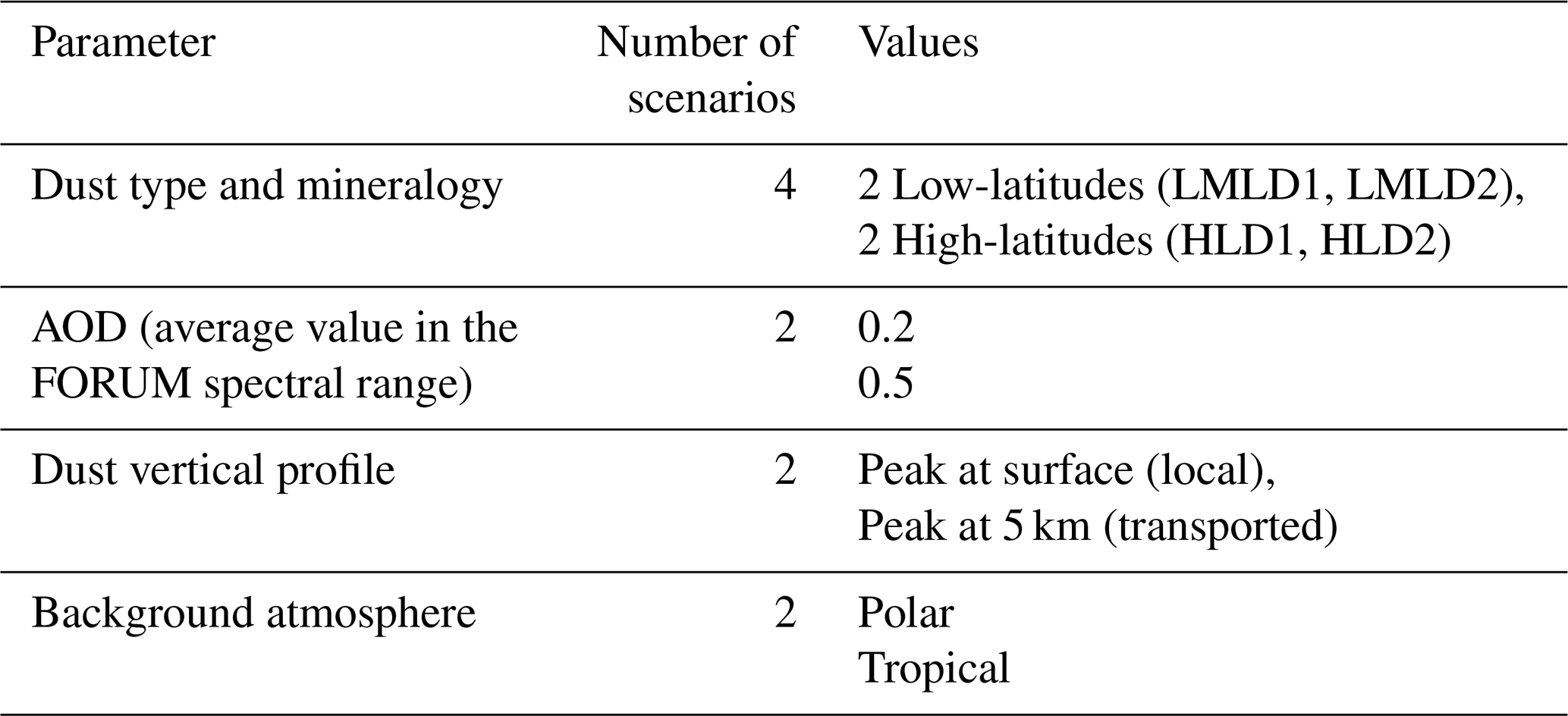
The outputs of the PO simulator are the FORUM and IASI-NG spectral radiance POs R(ν) (where ν is the wavenumber), for background atmospheres and for atmospheres with dust layers. In case of dust presence, we consider different scenarios, summarised in Table 1. Based on polar or tropical background atmosphere, we vary the dust type (LMLD or HLD) its mineralogy, its burden in terms of AOD and its vertical profile distribution. In addition, to get more insights into the sensitivity of the PO spectra, we also compute the Jacobian matrices K(ν,z) (where z is the altitude) for each experiment and for the two instruments, i.e. the partial derivative of the radiance spectra R(ν) with respect to the dust number distribution N(z):
Table 1Different atmospheric and dust scenarios considered in the present study.
3.1 Dust spectral signature in the FIR
As a first experiment, we analyse the scenarios with both LMLD and HLD in a polar atmosphere, with a dust vertical profile peaking at 5 km altitude. This configuration is intended to represent cases of different types of dust uplifted and possibly transported towards the poles. On the one hand, poleward transport represents an established pathway for LMLD injections at high altitudes, in link to episodes of emissions over major desert source regions coupled with vertical transport due to strong convection (e.g. Zhao et al., 2006, 2022). On the other hand, this configuration can be associated with a larger FIR sensitivity to dust than at tropics due to a dryer atmosphere and a higher altitude of the dust layer. Figure 3a, b show FORUM and IASI-NG PO spectra for the four dust types and the two AOD values, at these conditions, as well as PO spectra with a background atmosphere. These latter are defined as PO spectra obtained with the same atmospheric and instrumental configurations but without any dust layer, and are used as a baseline reference spectrum. Figure 3c, d show the spectral signatures of the four dust types and two AOD values, defined as the difference of the background and the dust-laden FORUM and IASI-NG PO. One notable aspect of the FORUM PO and, more in general, FIR spectral signatures is that they are, as expected, strongly affected by water vapour absorption lines. This is one marked difference with respect to IASI-NG PO and MIR signatures. The very large sensitivity of FORUM observations, and FIR observations more in general, to water vapour is discussed by Palchetti et al. (2020) and its implications will be further discussed for our FORUM PO in Sect. 3.3. Despite this, for these atmospheric and dust configurations, Fig. 3 shows that the magnitude of the impacts of dust on infrared PO spectra is comparable in the FIR and the MIR, reaching, in both cases, peak signatures around 10–25 mW m−2 sr−1 cm−1 depending on the AOD. The spectral signatures of these dust layers on the FORUM and IASI-NG are up to two orders of magnitudes larger than FORUM and IASI-NG radiometric noise. This latter is represented as the FORUM and IASI-NG noise equivalent spectral radiance (NESR), set as values of 0.4 and 0.1 mW m−2 sr−1 cm−1, for FORUM and IASI-NG, respectively. It is well known that dust exhibits distinct spectral features in the MIR range, which have been used in the past for its detection and characterisation with instruments such as IASI (e.g. Cuesta et al., 2015; Capelle et al., 2018; Clarisse et al., 2019). The simulations in this study show additionally a clear FIR spectral signature of dust in the Earth's atmosphere. Despite a comparable spectral radiance signature in the MIR and the FIR, Fig. 3 suggests that the FIR is slightly less sensitive than the MIR to the dust type (mineralogy). Both the FIR and the MIR spectral signatures vary considerably with the AOD, and then the dust burden (2 to 3 times larger signatures for AOD = 0.5 than 0.2, in this case).
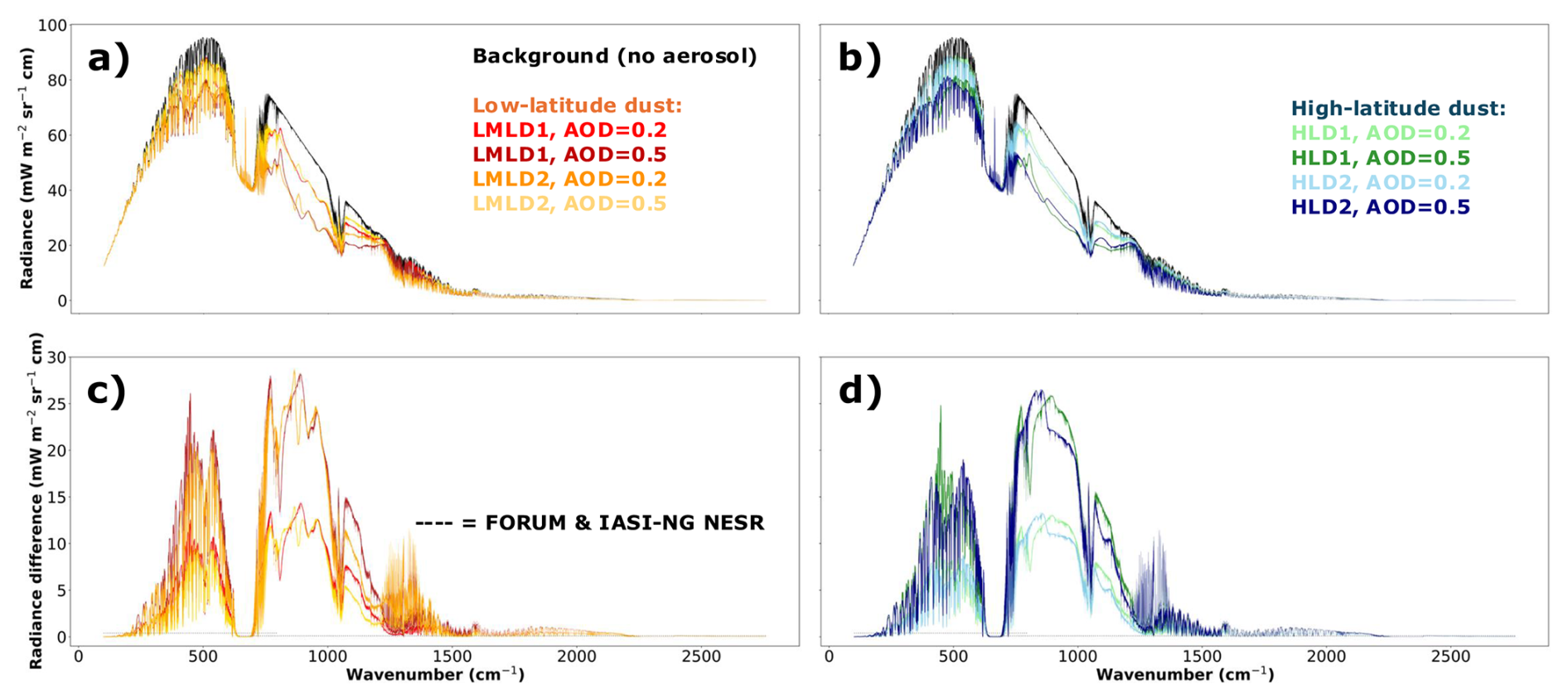
Figure 3Merged FORUM and IASI-NG PO spectra for low- (a, curves in red and yellow shades) and high-latitude dust (b, curves in green and blue shades), with different FIR AOD values (see Table 1). The aerosol source regions, for both low- and high-latitudes dust samples (see Fig. 2) are indicated in the panels. A background spectrum, i.e. with the same configuration but without any dust layer, is shown as a black curve in panels (a) and (b), as a baseline reference. Spectral signatures of the different dust layers, i.e. the difference of the background and the dust-laden FORUM and IASI-NG PO are shown in panels (c) and (d). The FORUM and IASI-NG average noise equivalent spectral radiance (NESR) is shown in panels (c) and (d).
Then, we analyse the role of the vertical distribution of the dust layer on influencing the PO spectra and the dust spectral signatures. Figure 4 shows FORUM and IASI-NG PO spectra and background-screened spectral signature, for a fixed atmosphere (polar) and aerosol type (LMLD1 sample) and burden (AOD = 0.5), with the two vertical distributions in our data set, i.e. peaking at surface and at 5 km altitude. As expected, higher-altitude dust layers are associated with larger and better distinguishable spectral signatures. The spectral signatures depend less on the vertical distribution of the dust layer than on its AOD (compare Figs. 3 and 4). Nevertheless, Fig. 4 suggests that the FIR spectral signature is more sensitive to the dust vertical profile than in the MIR. The difference in the spectral signatures for the two vertical profiles reaches values as large as 40 % in the FIR, between 400 and 500 cm−1, and does not exceed 15 %–25 % in the MIR, peaking at about 1100–1200 cm−1.
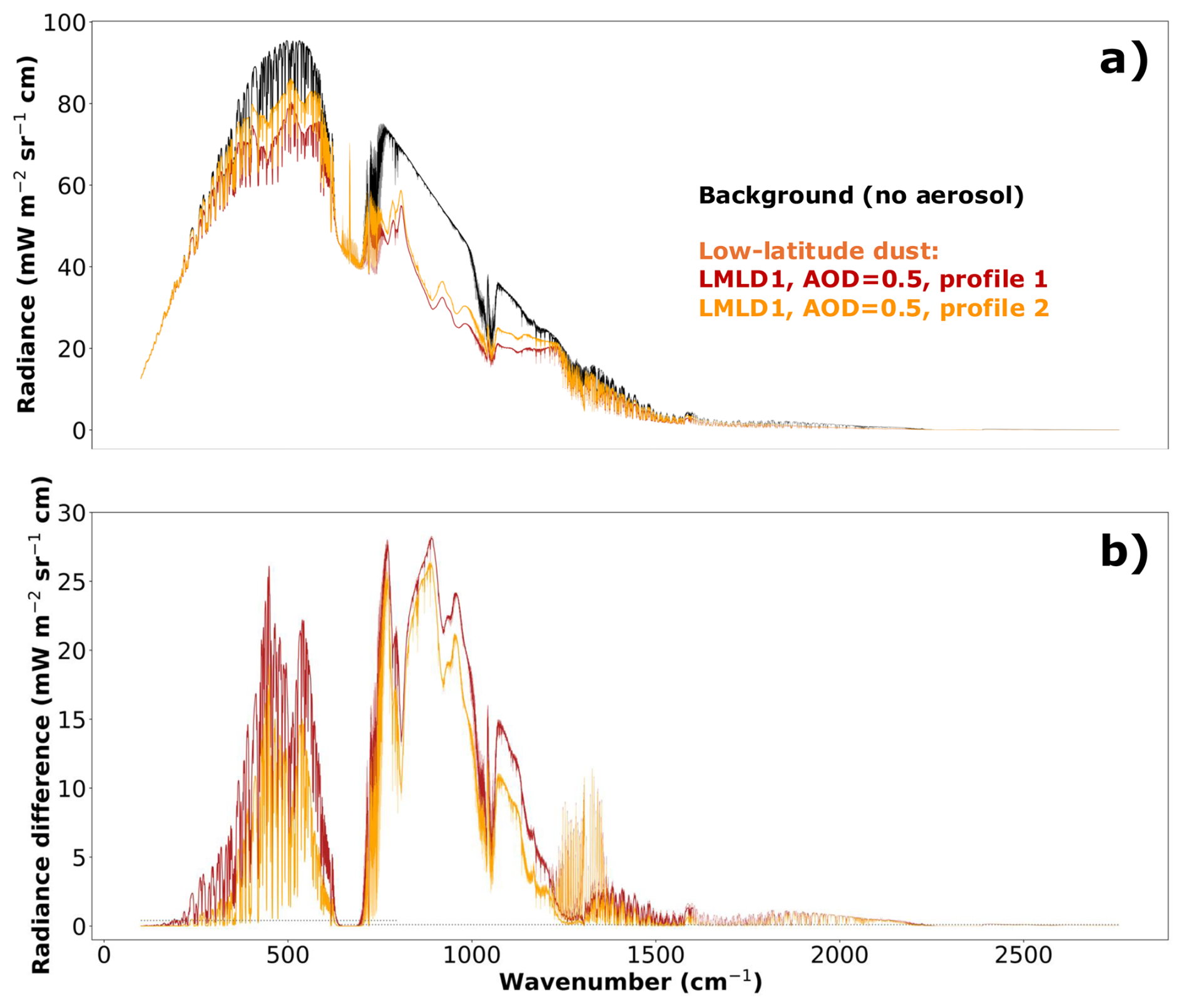
Figure 4Merged FORUM and IASI-NG PO spectra for the case of Australia dust sample, with a FIR AOD = 0.5, and the two different vertical profiles (profile 1, red curve: peaking at 5 km altitude; profile 2, yellow curve: peaking at surface) (a). A background spectrum, i.e. with the same configuration but without any dust layer, is shown as a black curve in panel a, as a baseline reference. Corresponding spectral signatures (b).
3.2 FORUM spectral sensitivity
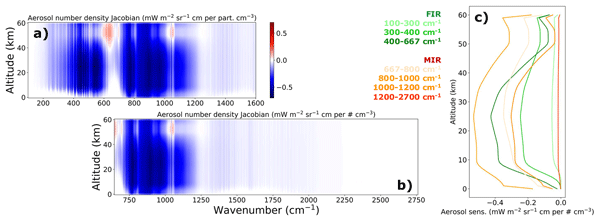
With a similar method as done by Palchetti et al. (2020) for other atmospheric parameters, we estimate the sensitivity of FORUM PO using the Jacobians K(ν,z) with respect to dust number concentration. This quantity represents the variability of the PO spectra for a unit variation of dust number concentration (here in particles per cm3) at a given altitude. Figure 5a, b show the dust Jacobians for FORUM and IASI-NG, for a polar scenario with LMLD2 sample dust, with an AOD = 0.2 and a vertical dust profile peaking at 5 km altitude. As the addition of dust in an infrared nadir observation decreases the observed spectral radiance, due to dust absorption and scattering of infrared radiation (see, e.g. Figs. 3 and 4), the values of the Jacobians are consistently negative, reaching values as large as a few mW m−2 sr−1 cm−1 for a unit increase of dust number concentration in sensitive bands. Two main sensitive bands can be found in the FIR (about 100 to 650 cm−1) and the MIR (about 700 to 1200 cm−1), for dust perturbations at about 5 to 40 km altitude range. It is worth mentioning that dust perturbations at altitudes higher than 10 km are very unlikely, due to typical dust emission and vertical transport processes (Huang et al., 2015). One notable aspect emerging from the comparison of the FORUM and IASI-NG Jacobians in Fig. 5a and b is that the full extent of the spectral sensitive regions to dust is contained in FORUM spectra, which cover the two mentioned sensitive FIR and MIR bands. It is still important to notice, however, that FORUM has a lower spectral resolution, a larger radiometric noise and significantly scarcer spatiotemporal coverage than to IASI-NG. Nonetheless, FORUM will be the only instrument to offer full spectral coverage of dust sensitive bands FIR and MIR. As such, FORUM observations would provide the additional FIR sensitive band noticeable in Figs. 3–5 to the much spatiotemporally denser IASI-NG observations.
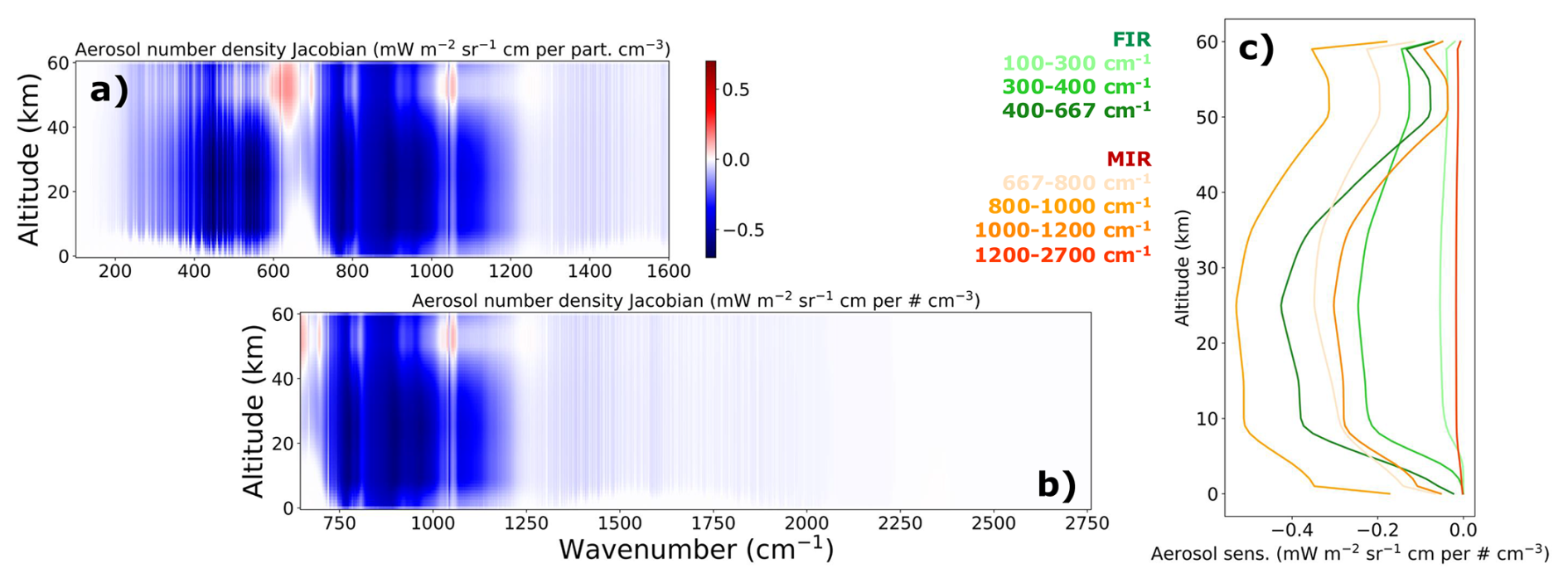
Figure 5FORUM (a) and IASI-NG (b) Jacobians K(νz) with respect to the aerosol number density, for the case of Australia dust sample, with a FIR AOD = 0.2, a vertical profile peaking at 5 km altitude, in a polar atmosphere. Average aerosol sensitivity, quantified through the average Jacobians at different FIR (curves in green shades) and MIR sub-regions (curves in yellow-red shades) (c). Specific spectral intervals of these sub-regions are listed in the figure, with colours corresponding to those of the curves in panel (c). The spectral aerosol sensitivity is estimated using FORUM Jacobians, for the FIR, and IASI-NG Jacobians, for the MIR.
We also provide the average dust sensitivity in selected FIR and MIR sub-bands in Fig. 5c. The different spectral ranges for these sub-bands, selected based on the main intervals of different sensitivity visible in Fig. 5a–b, are mentioned in the figure. Most of the sensitivity is in the sub-bands 400–667 cm−1 for the FIR, and 800–1000 cm−1 for the MIR. Comparing these two sub-bands in Fig. 5c, it is apparent that the FIR has a significant integrated dust sensitivity, even though it is still slightly smaller than the MIR (about 20 % smaller, on average). The sensitivities in the FIR and MIR are somewhat complementary. The FIR has, in general, a more peaked average sensitivity at about 5–10 km, while the MIR has a lesser vertical variability (see Fig. 5c). This suggests a possible added-value of the FORUM observations to increase vertical sensitivity of dust retrievals, e.g. when coupled with IASI-NG observations. The more defined peak at 5–10 km also suggests the possible capability of FORUM to observe high-altitude and long-range transport of dust plumes. On the contrary, the FIR region is much less sensitive than the MIR region to dust in the lower troposphere.
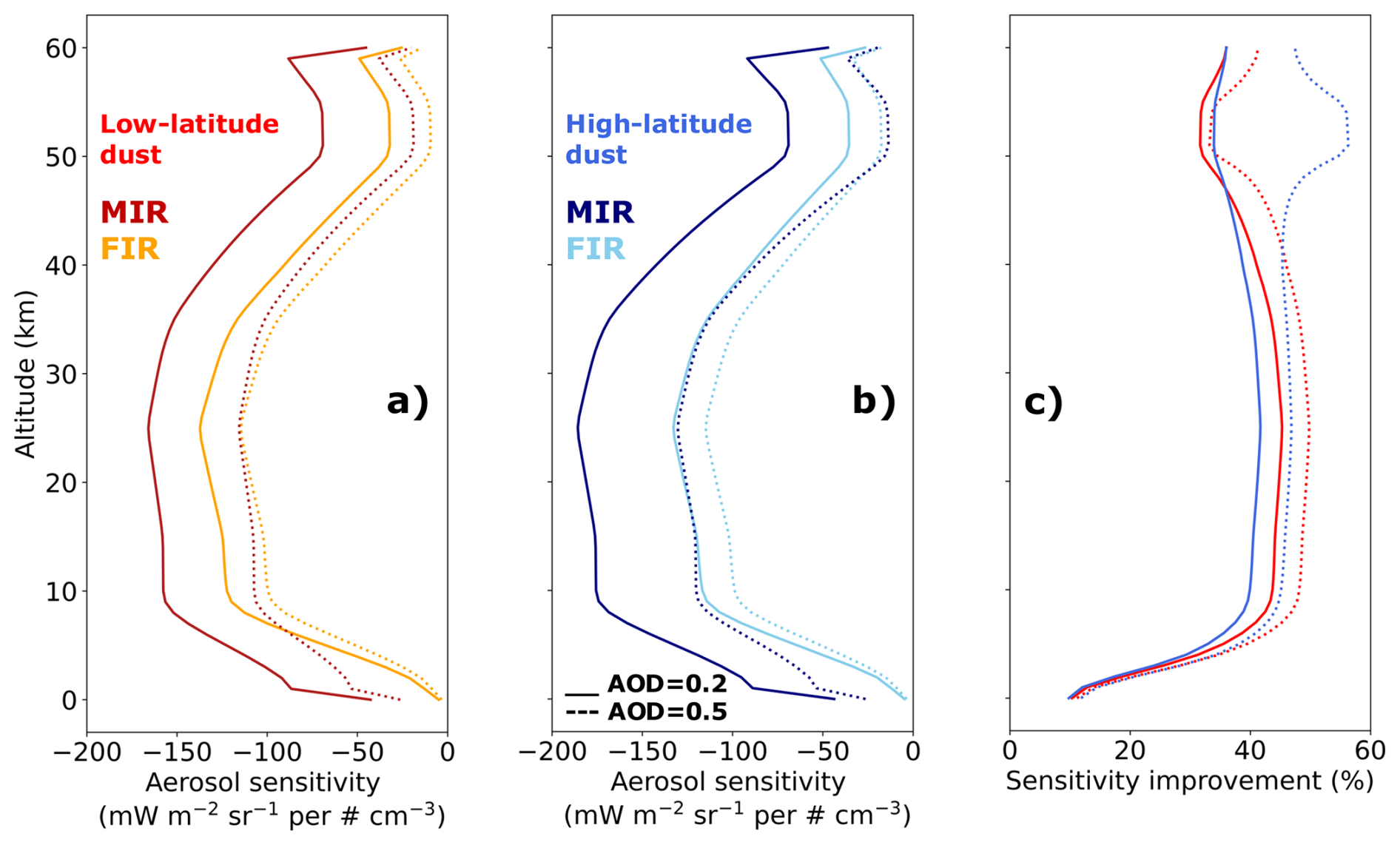
Figure 6Aerosol sensitivity integrated in the sensitive FIR (300–667 cm−1) and MIR (800–1200 cm−1) spectral regions, for a low-latitude (LMLD2, a) and a high-latitude (HLD1, b) dust sample. The FIR sensitivity is represented by yellow (a) and light blue (b), and the MIR sensitivity is represented by red (a) and dark blue (b) curves. In both panels (a) and (b), scenarios with AOD = 0.2 and 0.5 are represented as solid and dotted lines, respectively. The sensitivity improvement for the four scenarios is in panel (c): red and blue curves are for low- and high-latitude dust, solid and dotted lines for AOD = 0.2 and 0.5 respectively. All scenarios are for a dust layer peaking at 5 km altitude and for a polar background atmosphere.
Having identified the main dust-sensitive spectral sub-regions in the FIR and the MIR, we derived the integrated dust sensitivity, by summing up the Jacobians in the FIR (300–667 cm−1) and MIR (800–1200 cm−1) spectral regions mentioned above. This is a parameter that can be directly compared with the water vapour FIR sensitivity estimated by Palchetti et al. (2020) (see Fig. 6 therein). Figure 6a, b show the total dust sensitivity, for the same atmospheric scenario and dust vertical profile of Fig. 5, for an AOD = 0.2 and 0.5, and for two dust types representing low to mid- (LMLD2) and high-latitude dust (HLD1). Total dust sensitivities peaking at values in the range 130–100 mW m−2 sr−1 per unit number concentration, for the FIR, and 200–120 mW m−2 sr−1 per unit number concentration, for the MIR, are obtained. The relative importance of FIR and MIR total sensitivities depends on both the burden and type/mineralogy of dust. In general, a smaller sensitivity is observed for both the FIR and MIR in case of larger burdens in terms of the AOD. This can be explained by the definition itself of the Jacobians, i.e. the spectral radiance variability for a unit number concentration increase. In case of large burdens, a unit increase of number concentration is associated with a smaller percent increase in the dust concentration, and then a smaller impact on the spectra. The FIR sensitivity has a larger relative importance in the case of large burdens. The FIR relative importance seems larger for LMLD2 than HLD1, suggesting a sensitivity to the specific mineralogical features.
To quantify the improvement in the overall infrared sensitivity to dust expected from the inclusion of the FIR observations of FORUM, we estimated the parameter ξ defined as:
where SFIR and SMIR are the total FIR and MIR dust sensitivity of Fig. 6a, b. Figure 6c shows the vertical profiles of the sensitivity improvement ξ for the four cases of Fig. 6a, b and discussed above. The FIR sensitivity improvement of Fig. 6 confirms the main points mentioned above. The FIR contribution is larger at altitudes higher than about 5 km, contributing about 40 %–50 % of the overall infrared sensitivity e.g. in the upper troposphere, this contribution being larger for large dust burdens and the tested HLD mineralogical cases. Thus, the FORUM observations are expected to bring a marked added value to dust observations from satellite, especially in cases of large burdens of mid-to-long-range transport of dust in the free to upper troposphere.
3.3 Concurrent sensitivity to dust and water vapour
Even if Fig. 6 suggests a comparable sensitivity to dust in the FIR and the MIR, with the FIR contributing up to 50 % to the overall infrared sensitivity to dust (Fig. 6c), it is important to also consider the possible interferences of the spectral sensitivities to other atmospheric parameters. In particular, it is worth evaluating if water vapour significanly masks the FIR sensitivity to dust, especially in the more humid background tropical atmosphere. Water vapour has a much larger impact on the FIR spectra than in the MIR, which renders the water vapour observation one primary target of the FORUM mission (e.g. Palchetti et al., 2020). The large impact of the absorption lines of water vapour to the FORUM PO is clearly visible e.g. in Figs. 3 and 4. To evaluate the relative sensitivity of FORUM PO, and FIR spectral observations in general, to water vapour and dust, we calculated the total sensitivity of FIR and MIR spectra to water vapour (in mW m−2 sr−1 per unit water vapour mixing ratio, in part per millions – ppm), which is shown in Fig. 7. Both polar and tropical atmospheres are considered in the figure. These results are very consistent with what shown by Palchetti et al. (2020, Fig. 6 therein). The water vapour total sensitivity is negligible in the MIR, if compared with FIR. In the FIR, the water vapour sensitivity peaks at about −2 mW m−2 sr−1 ppm−1, at 8–15 km. To compare with the dust total sensitivity in the FIR, shown in Fig. 6a, b, the following consideration must be done. We focus on the regions of larger sensitivity of FIR spectra to dust, so we make the case of two altitudes, one in the free troposphere (FT, about 5 km altitude) and one in the upper troposphere (UT, about 10 km altitude). In the FT, typical water vapour mixing ratios are of the order of 103 ppm, so that 1 ppm represents a 0.1 % perturbation. From Fig. 7, it can be seen that the total FIR sensitivity to water vapour at 5 km does not exceed −1 mW m−2 sr−1 ppm−1, so about −10 mW m−2 sr−1 %−1 change in water vapour. In the same vertical region, number concentrations of dust do not exceed a few particles per cm3; in our dust scenarios, this upper limit is 5 particles cm−3, so that 1 particle cm−3 represents a 20 % perturbation. From Fig. 6a, b, it can be seen that the total FIR sensitivity to dust at 5 km is approximately in the range between −60 and −80 mW m−2 sr−1 per unit number concentration, so about −3 to −4 mW m−2 sr−1 %−1 change in dust number concentration. At these altitudes, the water vapour sensitivity in the FIR is 2–3 times larger than the dust sensitivity. Higher, in the UT, with similar considerations, we obtain about −2 mW m−2 sr−1 %−1 change in water vapour (typical mixing ratios of the order of 102 ppm and total FIR sensitivity not exceeding −2 mW m−2 sr−1 ppm−1) and about −1 to −3 mW m−2 sr−1 %−1 change in dust number concentration (typical number concentrations of 1–2 particles cm−3 and total FIR sensitivity in the range −100 to −120 mW m−2 sr−1 per unit number concentration). At these altitudes, the dust and water vapour sensitivity in the FIR are comparable or the dust sensitivity can be larger, at certain conditions. Thus, in general, while in the lower troposphere the dust sensitivity is expected to fade due to the effect of water vapour, in the FT and UT the dust sensitivity in the FIR is concurrent with the water vapour sensitivity. This reinforces the previous results, suggesting a potentially promising added value of the FORUM observations in retrieving information on the high-altitude transported dust plumes.
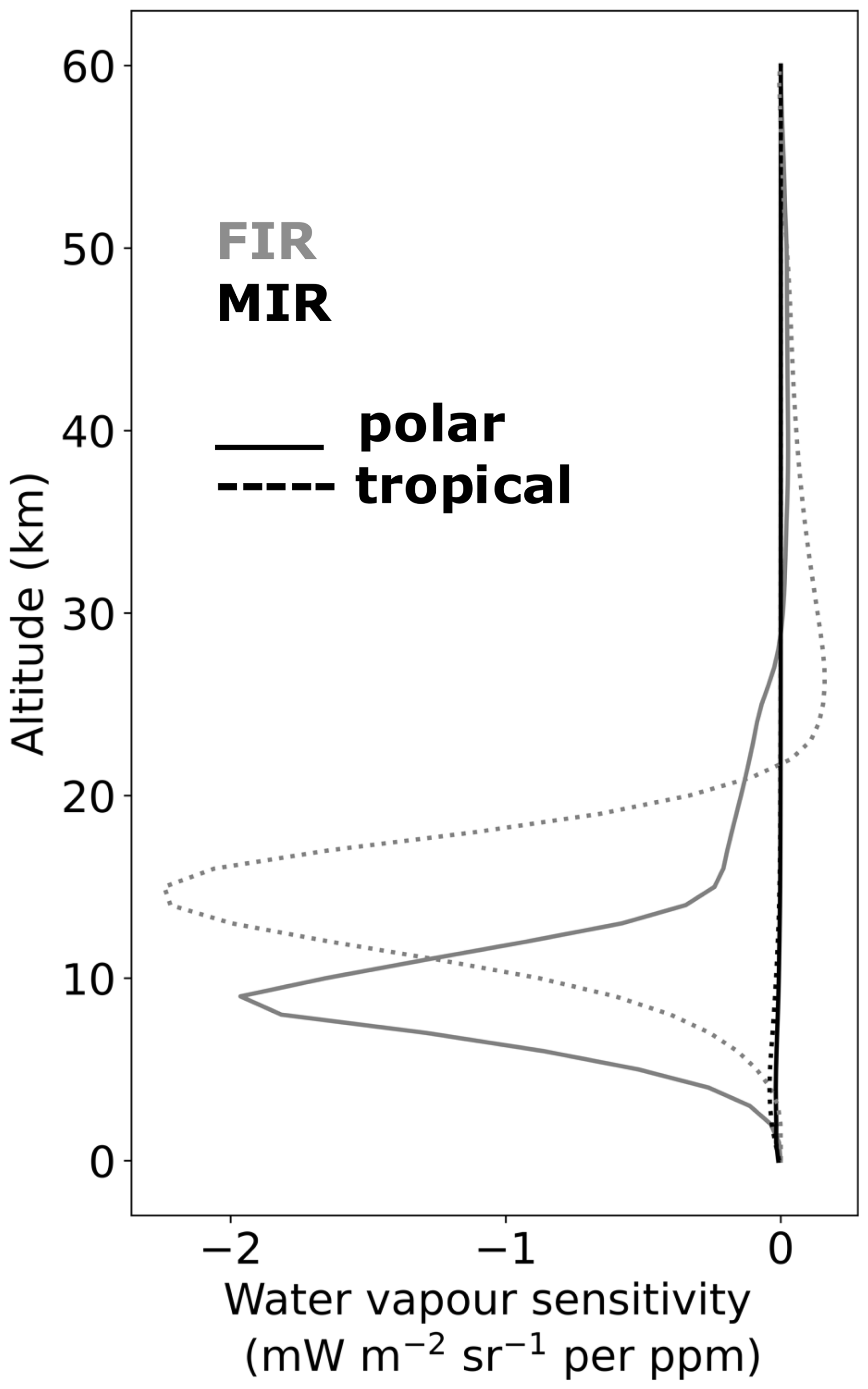
Figure 7Water vapour sensitivity integrated in the full FIR (grey lines) and MIR (black lines) spectral regions, for a polar (solid lines) and a tropical background atmospheres.
The ESA EE9 FORUM mission will carry the first satellite instrument capable to globally and routinely observe the Earth's FIR spectra at relatively high spectral resolution, filling a long-standing gap on the observation capabilities in this crucial spectral range. Based on a set of FORUM PO, generated with an ad-hoc simulator, in this paper we analyse its expected sensitivity to dust aerosols. To contextualise FORUM in the broader panorama of the future nadir infrared instruments, we also generated IASI-NG PO, and extended the scopes of this work to the comparative analysis of the FIR and MIR spectra sensitivity to dust. This is the first time the FIR spectral signatures of dust aerosols are analysed, as observable from satellite platform. We generated spectral PO and dust Jacobians for different atmospheric (polar and tropical background atmospheres) and dust scenarios (different dust types representing low to high-latitude sources with contrasting mineralogy, different burdens in terms of the AOD and different vertical distributions). With our spectral PO, we generate dust spectral signatures by subtracting spectral POs from background atmospheres (i.e. without dust). With dust Jacobians, we estimate the total dust sensitivity, as done by Palchetti et al. (2020) for other atmospheric and surface parameters, though an integration over sensitive sub-bands. We identified FIR dust-sensitive spectral sub-regions, and the main one between 400 and 667 cm−1, for these mineralogical compositions of dust. The spectral signatures of the dust layers in the FIR have comparable magnitude as in the MIR and have, for all scenarios, orders of magnitudes larger magnitudes than FORUM radiometric noise. These results suggest that the FORUM observations would likely bring a sensitive added value in the observation of dust layers. First, the FIR spectral signature is somewhat more sensitive to the dust vertical profile than the MIR spectral signature. This result is confirmed with the analysis of the FIR dust sensitivity through the Jacobians. The FIR has, in general, a more peaked total sensitivity at about 5–10 km, while the MIR has a lesser vertical variability. On the contrary, the FIR has less sensitivity to the dust mineralogical composition. A sensitivity improvement parameter ξ is calculated, to quantify the part of the overall infrared sensitivity to dust brought by the FIR. We showed that the FIR contribution is larger at altitudes higher than about 5 km, contributing about 40 %–50 % of the overall infrared sensitivity e.g. in the FT and UT. This contribution was found larger for larger dust burdens and high-latitude dust type. The main concurrent sensitivity in the FIR is the one from water vapour, which can interfere with dust sensitivity. Nevertheless, we showed that, contrarily to the lower troposphere, in the FT and UT the total sensitivity to water vapour does not systematically exceed the dust sensitivity. Thus, the FORUM observations are expected to bring a possible added value to dust observations from satellite, especially in cases of large burdens of mid-to-long-range transported plumes of dust in the free and upper troposphere. The FORUM radiometric noise, spectral resolution and spatiotemporal coverage are scarcer than future nadir MIR instruments like IASI-NG. Nevertheless, coupling these two sources of dust information, notably with the inclusion of the new FIR information content from FORUM, will likely be beneficial towards a better characterisation of dust plumes. More quantitative studies of the dust information content in FIR satellite observations and their coupling with MIR observations, e.g. with a full retrieval algorithm, are needed to confirm these initial results.
The FORUM and IASI-NG PO spectra generated for this work can be found at https://doi.org/10.57932/c54d9d54-3b6e-4e81-a65a-f154796369e1 (Sellitto, 2026).
The supplement related to this article is available online at https://doi.org/10.5194/amt-19-2751-2026-supplement.
PS, ME and CDB designed the study. ME and MH extended the KOPRA RTM to the FIR. CDB and PF produced the size distribution data. PA and CDB produced the CRI input data. ME run the PO simulations. PS, CDB, and PF contributed to funding acquisition and administration of the project. PS wrote the first version of the manuscript that was reviewed by all authors.
The contact author has declared that none of the authors has any competing interests.
Publisher's note: Copernicus Publications remains neutral with regard to jurisdictional claims made in the text, published maps, institutional affiliations, or any other geographical representation in this paper. The authors bear the ultimate responsibility for providing appropriate place names. Views expressed in the text are those of the authors and do not necessarily reflect the views of the publisher.
The discussions with Hervé Herbin (Laboratoire d'Optique Atmosphérique – LOA, Villeneuve d'Ascq, France), Quentin Libois (Centre National de Recherches Météorologiques – CNRM, Toulouse, France) and Adrien Deschamps (Centre National d'Études Spatiales – CNES, Toulouse, France), in the context of the CNES FORUM project are gratefully acknowledged.
This research has been supported by the Centre National d’Etudes Spatiales (grant no. FORUM) and the Programme National de Télédétection Spatiale (grant no. IR-DUST)
This paper was edited by Zhao-Cheng Zeng and reviewed by two anonymous referees.
Alalam, P., Ducos, F., and Herbin, H.: The role of refractive indices in measuring mineral dust with high-spectral-resolution infrared satellite sounders: application to the Gobi Desert, Atmos. Chem. Phys., 24, 12277–12294, https://doi.org/10.5194/acp-24-12277-2024, 2024.
Anderson, G. P., Clough, S. A., Kneizys, F. X., Chetwynd, J. H., and Shettle, E. P.: AFGL atmospheric constituent profiles (0–120 km), DTIC, https://apps.dtic.mil/sti/pdfs/ADA175173.pdf (last access: 14 May 2025), 1986.
Baldo, C., Formenti, P., Nowak, S., Chevaillier, S., Cazaunau, M., Pangui, E., Di Biagio, C., Doussin, J.-F., Ignatyev, K., Dagsson-Waldhauserova, P., Arnalds, O., MacKenzie, A. R., and Shi, Z.: Distinct chemical and mineralogical composition of Icelandic dust compared to northern African and Asian dust, Atmos. Chem. Phys., 20, 13521–13539, https://doi.org/10.5194/acp-20-13521-2020, 2020.
Banks, J. R. and Brindley, H. E.: Evaluation of MSG-SEVIRI mineral dust retrieval products over North Africa and the Middle East,. Remote Sens. Environ., 128, 58–73, https://doi.org/10.1016/j.rse.2012.07.017, 2013.
Bohren, C. F. and Huffman, D. R.: Absorption and scattering of light by small particles, A Wiley-Interscience Publication, John Wiley & Sons, Inc., New York, ISBN 9780471293408, 1983.
Capelle, V., Chédin, A., Pondrom, M., Crevoisier, C., Armante, R., Crepeau, L., and Scott, N.: Infrared dust aerosol optical depth retrieved daily from IASI and comparison with AERONET over the period 2007–2016, Remote Sens. Environ., 206, 15–32, https://doi.org/10.1016/j.rse.2017.12.008, 2018.
Clarisse, L., Clerbaux, C., Franco, B., Hadji-Lazaro, J., Whitburn, S., Kopp, A. K., Hurtmans, D., and Coheur, P.-F.: A decadal data set of global atmospheric dust retrieved from IASI satellite measurements, J. Geophys. Res.-Atmos., 124, 1618–1647, https://doi.org/10.1029/2018JD029701, 2019.
Clerbaux, C., Boynard, A., Clarisse, L., George, M., Hadji-Lazaro, J., Herbin, H., Hurtmans, D., Pommier, M., Razavi, A., Turquety, S., Wespes, C., and Coheur, P.-F.: Monitoring of atmospheric composition using the thermal infrared IASI/MetOp sounder, Atmos. Chem. Phys., 9, 6041–6054, https://doi.org/10.5194/acp-9-6041-2009, 2009.
Colarco, P. R., Nowottnick, E. P., Randles, C. A., Yi, B., Yang, P., Kim, K.-M., Smith, J. A., and Bardeen, C. G.: Impact of radiatively interactive dust aerosols in the NASA GEOS-5 climate model: Sensitivity to dust particle shape and refractive index, J. Geophys. Res.-Atmos., 119, 753–786, https://doi.org/10.1002/2013JD020046, 2014.
Connelly, D. S., Thompson, D. R., Mahowald, N. H., Li, L., Carmon, N., Okin, G. S., and Green, R. O.: The EMIT mission information yield for mineral dust radiative forcing, Remote Sens. Environ., 258, 112380, https://doi.org/10.1016/j.rse.2021.112380, 2021.
Crevoisier, C., Clerbaux, C., Guidard, V., Phulpin, T., Armante, R., Barret, B., Camy-Peyret, C., Chaboureau, J.-P., Coheur, P.-F., Crépeau, L., Dufour, G., Labonnote, L., Lavanant, L., Hadji-Lazaro, J., Herbin, H., Jacquinet-Husson, N., Payan, S., Péquignot, E., Pierangelo, C., Sellitto, P., and Stubenrauch, C.: Towards IASI-New Generation (IASI-NG): impact of improved spectral resolution and radiometric noise on the retrieval of thermodynamic, chemistry and climate variables, Atmos. Meas. Tech., 7, 4367–4385, https://doi.org/10.5194/amt-7-4367-2014, 2014.
Cuesta, J., Eremenko, M., Flamant, C., Dufour, G., Laurent, B., Bergametti, G., Höpfner, M., Orphal, J., and Zhou, D.: Three-dimensional distribution of a major desert dust outbreak over East Asia in March 2008 derived from IASI satellite observations, J. Geophys. Res.-Atmos., 120, 7099–7127, https://doi.org/10.1002/2014JD022406, 2015.
Cuesta, J., Flamant, C., Gaetani, M., Knippertz, P., Fink, A. H., Chazette, P., Eremenko, M., Dufour, G., Di Biagio, C., and Formenti, P.: Three-dimensional pathways of dust over the Sahara during summer 2011 as revealed by new Infrared Atmospheric Sounding Interferometer observations, Q. J. R. Meteorol. Soc., 146, 2731–2755, https://doi.org/10.1002/qj.3814, 2020.
Di Biagio, C., Boucher, H., Caquineau, S., Chevaillier, S., Cuesta, J., and Formenti, P.: Variability of the infrared complex refractive index of African mineral dust: experimental estimation and implications for radiative transfer and satellite remote sensing, Atmos. Chem. Phys., 14, 11093–11116, https://doi.org/10.5194/acp-14-11093-2014, 2014.
Di Biagio, C., Formenti, P., Balkanski, Y., Caponi, L., Cazaunau, M., Pangui, E., Journet, E., Nowak, S., Caquineau, S., Andreae, M. O., Kandler, K., Saeed, T., Piketh, S., Seibert, D., Williams, E., and Doussin, J.-F.: Global scale variability of the mineral dust long-wave refractive index: a new dataset of in situ measurements for climate modeling and remote sensing, Atmos. Chem. Phys., 17, 1901–1929, https://doi.org/10.5194/acp-17-1901-2017, 2017.
Di Biagio, C., Formenti, P., Balkanski, Y., Caponi, L., Cazaunau, M., Pangui, E., Journet, E., Nowak, S., Andreae, M. O., Kandler, K., Saeed, T., Piketh, S., Seibert, D., Williams, E., and Doussin, J.-F.: Complex refractive indices and single-scattering albedo of global dust aerosols in the shortwave spectrum and relationship to size and iron content, Atmos. Chem. Phys., 19, 15503–15531, https://doi.org/10.5194/acp-19-15503-2019, 2019.
Di Biagio, C., Banks, J. R., and Gaetani, M.: Dust Atmospheric Transport Over Long Distances, Reference Module in Earth Systems and Environmental Sciences, Elsevier, 2021, ISBN 9780124095489, https://doi.org/10.1016/B978-0-12-818234-5.00033-X, 2021.
Di Biagio, C., Doussin, J.-F., Cazaunau, M., Pangui, E., Cuesta, J., Sellitto, P., Ródenas, M., and Formenti, P.: Infrared optical signature reveals the source–dependency and along–transport evolution of dust mineralogy as shown by laboratory study, Sci. Rep., 13, 13252, https://doi.org/10.1038/s41598-023-39336-7, 2023.
Di Biagio, C., Bru, E., Orta, A., Chevaillier, S., Baldo, C., Bergé, A., Cazaunau, M., Lafon, S., Nowak, S., Pangui, E., Andreae, M. O., Dagsson-Waldhauserova, P., Dintwe, K., Kandler, K., King, J. S., Chaput, A., Okin, G. S., Piketh, S., Saeed, T., Seibert, D., Shi, Z., Williams, E., Sellitto, P., and Formenti, P.: Mid- and far-infrared spectral signatures of mineral dust from low- to high-latitude regions: significance and implications, Atmos. Chem. Phys., 26, 1079–1091, https://doi.org/10.5194/acp-26-1079-2026, 2026.
Di Iorio, T., di Sarra, A., Sferlazzo, D. M., Cacciani, M., Meloni, D., Monteleone, F., Fuà, D., and Fiocco, G.: Seasonal evolution of the tropospheric aerosol vertical profile in the central Mediterranean and role of desert dust, J. Geophys. Res., 114, D02201, https://doi.org/10.1029/2008JD010593, 2009.
Eremenko, M., Dufour, G., Foret, G., Keim, C., Orphal, J., Beekmann, M., Bergametti, G., and Flaud, J.-M.: Tropospheric ozone distributions over Europe during the heat wave in July 2007 observed from infrared nadir spectra recorded by IASI, Geophys. Res. Lett., 35, L18805, https://doi.org/10.1029/2008GL034803, 2008.
Formenti, P. and Di Biagio, C.: Large synthesis of in situ field measurements of the size distribution of mineral dust aerosols across their life cycles, Earth Syst. Sci. Data, 16, 4995–5007, https://doi.org/10.5194/essd-16-4995-2024, 2024.
Go, S., Lyapustin, A., Schuster, G. L., Choi, M., Ginoux, P., Chin, M., Kalashnikova, O., Dubovik, O., Kim, J., da Silva, A., Holben, B., and Reid, J. S.: Inferring iron-oxide species content in atmospheric mineral dust from DSCOVR EPIC observations, Atmos. Chem. Phys., 22, 1395–1423, https://doi.org/10.5194/acp-22-1395-2022, 2022.
Green, R. O., Mahowald, N., Ung, C., et al.: The earth surface mineral dust source investigation: an earth science imaging spectroscopy mission. in: 2020 IEEE Aerospace Conference, 1–15, https://doi.org/10.1109/AERO47225.2020.9172731, 2020.
Huang, J., Guo, J., Wang, F., Liu, Z., Jeong, M.-J., Yu, H., and Zhang, Z., CALIPSO inferred most probable heights of global dust and smoke layers, J. Geophys. Res.-Atmos., 120, 5085–5100, https://doi.org/10.1002/2014JD022898, 2015.
Huneeus, N., Schulz, M., Balkanski, Y., Griesfeller, J., Prospero, J., Kinne, S., Bauer, S., Boucher, O., Chin, M., Dentener, F., Diehl, T., Easter, R., Fillmore, D., Ghan, S., Ginoux, P., Grini, A., Horowitz, L., Koch, D., Krol, M. C., Landing, W., Liu, X., Mahowald, N., Miller, R., Morcrette, J.-J., Myhre, G., Penner, J., Perlwitz, J., Stier, P., Takemura, T., and Zender, C. S.: Global dust model intercomparison in AeroCom phase I, Atmos. Chem. Phys., 11, 7781–7816, https://doi.org/10.5194/acp-11-7781-2011, 2011.
Husar, R. B., Prospero, J. M., and Stowe, L. L.: Characterization of tropospheric aerosols over the oceans with the NOAA AVHRR optical thickness product, J. Geophys. Res., 102, 16889–16909, 1997.
Knippertz, P. and Stuut, J.-B. W. (Eds.): Mineral Dust: A Key Player in the Earth System, Springer Netherlands, https://doi.org/10.1007/978-94-017-8978-3, 2014.
Kok, J. F., Storelvmo, T., Karydis, V. A., Adebiyi, A. A., Mahowald, N. M., Evan, A. T., He, C., and Leung, D. M.: Mineral dust aerosol impacts on global climate and climate change, Nat. Rev. Earth Environ., 4, 71–86, https://doi.org/10.1038/s43017-022-00379-5, 2023.
Liao, H. and Seinfeld, J. H.: Radiative forcing by mineral dust aerosols: Sensitivity to key variables, J. Geophys. Res., 103, 31637–31645, https://doi.org/10.1029/1998JD200036, 1998.
Meinander, O., Dagsson-Waldhauserova, P., Amosov, P., Aseyeva, E., Atkins, C., Baklanov, A., Baldo, C., Barr, S. L., Barzycka, B., Benning, L. G., Cvetkovic, B., Enchilik, P., Frolov, D., Gassó, S., Kandler, K., Kasimov, N., Kavan, J., King, J., Koroleva, T., Krupskaya, V., Kulmala, M., Kusiak, M., Lappalainen, H. K., Laska, M., Lasne, J., Lewandowski, M., Luks, B., McQuaid, J. B., Moroni, B., Murray, B., Möhler, O., Nawrot, A., Nickovic, S., O’Neill, N. T., Pejanovic, G., Popovicheva, O., Ranjbar, K., Romanias, M., Samonova, O., Sanchez-Marroquin, A., Schepanski, K., Semenkov, I., Sharapova, A., Shevnina, E., Shi, Z., Sofiev, M., Thevenet, F., Thorsteinsson, T., Timofeev, M., Umo, N. S., Uppstu, A., Urupina, D., Varga, G., Werner, T., Arnalds, O., and Vukovic Vimic, A.: Newly identified climatically and environmentally significant high-latitude dust sources, Atmos. Chem. Phys., 22, 11889–11930, https://doi.org/10.5194/acp-22-11889-2022, 2022.
Merdji, A. B., Lu, C., Xu, X., and Mhawish, A.: Long-term three-dimensional distribution and transport of Saharan dust: Observation from CALIPSO, MODIS, and reanalysis data, Atmos. Res., 286, https://doi.org/10.1016/j.atmosres.2023.106658, 2023.
Miller, R. L., Knippertz, P., Pérez García-Pando, C., Perlwitz, J.P., and Tegen I.: Impact of dust radiative forcing upon climate, in: Mineral Dust: A Key Player in the Earth System, edited by: Knippertz, P. and Stuut, J.-B. W., Springer, 327–357, https://doi.org/10.1007/978-94-017-8978-3_13, 2014.
Moosmüller, H., Skiba, M., Frey, G., Chakrabarty, R. K., Arnott, W. P., and Engelbrecht, J. P.: Single Scattering Albedo of Fine Mineral Dust Aerosols Controlled by Iron Concentration, J. Geophys. Res., 117, D11210, https://doi.org/10.1029/2011JD016909, 2012.
Palchetti, L., Brindley, H., Bantges, R., Buehler, S. A., Camy-Peyret, C., Carli, B., Cortesi, U., Del Bianco, S., Di Natale, G., Dinelli, B. M., Feldman, D., Huang, X. L., C.-Labonnote, L., Libois, Q., Maestri, T., Mlynczak, M. G., Murray, J. E., Oetjen, H., Ridolfi, M., Riese, M., Russell, J., Saunders, R., and Serio, C.: FORUM: Unique Far-Infrared Satellite Observations to Better Understand How Earth Radiates Energy to Space, B. Am. Meteorol. Soc., 101, E2030–E2046, https://doi.org/10.1175/BAMS-D-19-0322.1, 2020.
Pierangelo, C., Chédin, A., Heilliette, S., Jacquinet-Husson, N., and Armante, R.: Dust altitude and infrared optical depth from AIRS, Atmos. Chem. Phys., 4, 1813–1822, https://doi.org/10.5194/acp-4-1813-2004, 2004.
Pierangelo, C., Mishchenko, M., Balkanski, Y., and Chédin, A.: Retrieving the effective radius of Saharan dust coarse mode from AIRS, Geophys. Res. Lett., 32, L20813, https://doi.org/10.1029/2005GL023425, 2005.
Prospero, J. M.: Long-range transport of mineral dust in the global atmosphere: Impact of African dust on the environment of the southeastern United States, P. Natl. Acad. Sci. USA, 96, 3396–3403, 1999.
Ratcliffe, N. G., Ryder, C. L., Bellouin, N., Woodward, S., Jones, A., Johnson, B., Wieland, L.-M., Dollner, M., Gasteiger, J., and Weinzierl, B.: Long-range transport of coarse mineral dust: an evaluation of the Met Office Unified Model against aircraft observations, Atmos. Chem. Phys., 24, 12161–12181, https://doi.org/10.5194/acp-24-12161-2024, 2024.
Sadrian, M. R., Calvin, W. M., Engelbrecht, J. P., and Moosmüller, H.: Spectral characterization of parent soils from globally important dust aerosol entrainment regions, J. Geophys. Res.-Atmos., 128, e2022JD037666, https://doi.org/10.1029/2022JD037666, 2023.
Sanwlani, N. and Das, R.: Understanding haze: Modeling size-resolved mineral aerosol from satellite remote sensing, Remote Sens., 14, 761, https://doi.org/10.3390/rs14030761, 2022.
Sellitto, P.: FORUM and IASI-NG pseudo-observations, Easydata [data set], https://doi.org/10.57932/c54d9d54-3b6e-4e81-a65a-f154796369e1, 2026.
Sellitto, P., Dufour, G., Eremenko, M., Cuesta, J., Dauphin, P., Forêt, G., Gaubert, B., Beekmann, M., Peuch, V.-H., and Flaud, J.-M.: Analysis of the potential of one possible instrumental configuration of the next generation of IASI instruments to monitor lower tropospheric ozone, Atmos. Meas. Tech., 6, 621–635, https://doi.org/10.5194/amt-6-621-2013, 2013.
Sokolik, I. N.: The spectral radiative signature of wind-blown mineral dust: Implications for remote sensing in the thermal IR region, Geophys. Res. Lett., 29, 2154, https://doi.org/10.1029/2002GL015910, 2002.
Sokolik, I. N. and Toon, O. B.: Incorporation of mineralogical composition into models of the radiative properties of mineral aerosol from UV to IR wavelengths, J. Geophys. Res.-Atmos., 104, 9423–9444, 1999.
Stiller, G. P., von Clarmann, T., Funke, B., Glatthor, N., Hase, F., Höpfner, M., and Linden, A.: Sensitivity of trace gas abundances retrievals from infrared limb emission spectra to simplifying approximations in radiative transfer modelling, J. Quant. Spectrosc. Ra., 72, 249–280, https://doi.org/10.1016/S0022-4073(01)00123-6, 2002.
Vandenbussche, S., Kochenova, S., Vandaele, A. C., Kumps, N., and De Mazière, M.: Retrieval of desert dust aerosol vertical profiles from IASI measurements in the TIR atmospheric window, Atmos. Meas. Tech., 6, 2577–2591, https://doi.org/10.5194/amt-6-2577-2013, 2013.
Zhao, T. L., Gong, S. L., Zhang, X. Y., Blanchet, J. P., McKendry, I. G., and Zhou, Z. J.: A simulated climatology of Asian dust aerosol and its trans-Pacific transport, Part I: Mean climate and validation, J. Climate, 19, 88–103, 2006.
Zhao, X., Huang, K., Fu, J. S., and Abdullaev, S. F.: Long-range transport of Asian dust to the Arctic: identification of transport pathways, evolution of aerosol optical properties, and impact assessment on surface albedo changes, Atmos. Chem. Phys., 22, 10389–10407, https://doi.org/10.5194/acp-22-10389-2022, 2022.
Zheng, J., Zhang, Z., Garnier, A., Yu, H., Song, Q., Wang, C., Dubuisson, P., and Di Biagio, C.: The thermal infrared optical depth of mineral dust retrieved from integrated CALIOP and IIR observations, Rem. Sens. Environ., 270, 112841, https://doi.org/10.1016/j.rse.2021.112841, 2022.
Zheng, J., Zhang, Z., Yu, H., Garnier, A., Song, Q., Wang, C., Di Biagio, C., Kok, J. F., Derimian, Y., and Ryder, C.: Thermal infrared dust optical depth and coarse-mode effective diameter over oceans retrieved from collocated MODIS and CALIOP observations, Atmos. Chem. Phys., 23, 8271–8304, https://doi.org/10.5194/acp-23-8271-2023, 2023.