
Articles | Volume 19, issue 9
https://doi.org/10.5194/amt-19-2923-2026
© Author(s) 2026. This work is distributed under
the Creative Commons Attribution 4.0 License.
the Creative Commons Attribution 4.0 License.
https://doi.org/10.5194/amt-19-2923-2026
© Author(s) 2026. This work is distributed under
the Creative Commons Attribution 4.0 License.
the Creative Commons Attribution 4.0 License.
Research article
| 
04 May 2026
Research article |
| 04 May 2026
| 04 May 2026
Evaluating machine learning model performance in a two-step colocation process for TVOC and BTEX sensor calibration
Caroline Frischmon
CORRESPONDING AUTHOR

Department of Mechanical Engineering, University of Colorado Boulder, 1111 Engineering Drive, Boulder, CO, 80309, USA
Jack Porter
South Coast Air Quality Monitoring District, 21865 Copley Drive, Diamond Bar, CA, 91765, USA
Ethan Balagopalan
South Coast Air Quality Monitoring District, 21865 Copley Drive, Diamond Bar, CA, 91765, USA
William Senga
South Coast Air Quality Monitoring District, 21865 Copley Drive, Diamond Bar, CA, 91765, USA
Jill Johnston
Department of Environmental and Occupational Health, University of California Irvine, 856 Health Sciences Quad, Irvine, CA, 92697, USA
Michael Hannigan
Department of Mechanical Engineering, University of Colorado Boulder, 1111 Engineering Drive, Boulder, CO, 80309, USA
Related authors
Caroline Frischmon, Grace E. Berg, MiKyla Harjamaki, Gabriela Cortes, Evan R. Coffey, and Michael P. Hannigan
EGUsphere, https://doi.org/10.5194/egusphere-2026-4589, https://doi.org/10.5194/egusphere-2026-4589, 2026
This preprint is open for discussion and under review for Atmospheric Measurement Techniques (AMT).
Short summary
Short summary
Low-cost sensor networks capture air quality dynamics at high spatiotemporal scales, but many insights depend on disentangling local and background influences. We applied four approaches for isolating local impacts to three datasets, each representing a different context. There was no single best approach; instead, we identified tradeoffs in each's flexibility, sensitivity to bias and data gaps, and outputs. Future work could explore approaches that define local impacts in both space and time.
Caroline Frischmon, Jonathan Silberstein, Annamarie Guth, Erick Mattson, Jack Porter, and Michael Hannigan
Atmos. Meas. Tech., 18, 3147–3159, https://doi.org/10.5194/amt-18-3147-2025, https://doi.org/10.5194/amt-18-3147-2025, 2025
Short summary
Short summary
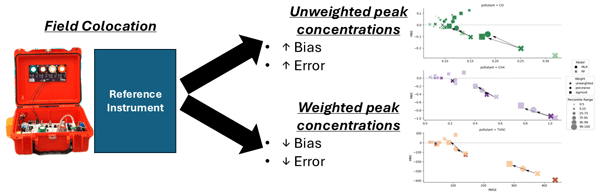
Air quality sensors often underpredict peak concentrations, which is a major issue in applications such as emission event detection. Here, we detail a novel approach involving data weighting to improve quantification of these peak values. To demonstrate its effectiveness, we applied data weighting to carbon monoxide, methane, and volatile organic compound sensor data. This work broadens our ability to use air sensors in contexts where accurate quantification of peak concentrations is essential.
Caroline Frischmon, Grace E. Berg, MiKyla Harjamaki, Gabriela Cortes, Evan R. Coffey, and Michael P. Hannigan
EGUsphere, https://doi.org/10.5194/egusphere-2026-4589, https://doi.org/10.5194/egusphere-2026-4589, 2026
This preprint is open for discussion and under review for Atmospheric Measurement Techniques (AMT).
Short summary
Short summary
Low-cost sensor networks capture air quality dynamics at high spatiotemporal scales, but many insights depend on disentangling local and background influences. We applied four approaches for isolating local impacts to three datasets, each representing a different context. There was no single best approach; instead, we identified tradeoffs in each's flexibility, sensitivity to bias and data gaps, and outputs. Future work could explore approaches that define local impacts in both space and time.
Caroline Frischmon, Jonathan Silberstein, Annamarie Guth, Erick Mattson, Jack Porter, and Michael Hannigan
Atmos. Meas. Tech., 18, 3147–3159, https://doi.org/10.5194/amt-18-3147-2025, https://doi.org/10.5194/amt-18-3147-2025, 2025
Short summary
Short summary
Air quality sensors often underpredict peak concentrations, which is a major issue in applications such as emission event detection. Here, we detail a novel approach involving data weighting to improve quantification of these peak values. To demonstrate its effectiveness, we applied data weighting to carbon monoxide, methane, and volatile organic compound sensor data. This work broadens our ability to use air sensors in contexts where accurate quantification of peak concentrations is essential.
Kevin J. Sanchez, Bo Zhang, Hongyu Liu, Matthew D. Brown, Ewan C. Crosbie, Francesca Gallo, Johnathan W. Hair, Chris A. Hostetler, Carolyn E. Jordan, Claire E. Robinson, Amy Jo Scarino, Taylor J. Shingler, Michael A. Shook, Kenneth L. Thornhill, Elizabeth B. Wiggins, Edward L. Winstead, Luke D. Ziemba, Georges Saliba, Savannah L. Lewis, Lynn M. Russell, Patricia K. Quinn, Timothy S. Bates, Jack Porter, Thomas G. Bell, Peter Gaube, Eric S. Saltzman, Michael J. Behrenfeld, and Richard H. Moore
Atmos. Chem. Phys., 22, 2795–2815, https://doi.org/10.5194/acp-22-2795-2022, https://doi.org/10.5194/acp-22-2795-2022, 2022
Short summary
Short summary
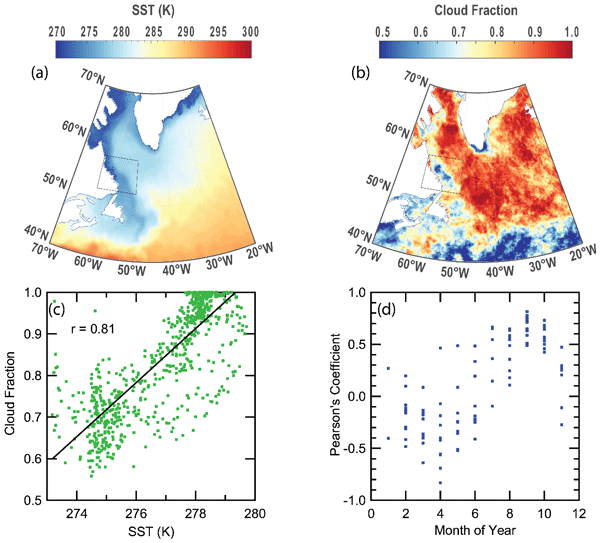
Atmospheric particle concentrations impact clouds, which strongly impact the amount of sunlight reflected back into space and the overall climate. Measurements of particles over the ocean are rare and expensive to collect, so models are necessary to fill in the gaps by simulating both particle and clouds. However, some measurements are needed to test the accuracy of the models. Here, we measure changes in particles in different weather conditions, which are ideal for comparison with models.
Cited articles
Barkjohn, K. K., Gantt, B., and Clements, A. L.: Development and application of a United States-wide correction for PM2.5 data collected with the PurpleAir sensor, Atmos. Meas. Tech., 14, 4617–4637, https://doi.org/10.5194/amt-14-4617-2021, 2021. a
Breiman, L.: Random forests, Machine learning, 45, 5–32, https://doi.org/10.1023/A:1010933404324, 2001. a, b
Cabello-Solorzano, K., Ortigosa de Araujo, I., Peña, M., Correia, L., and J. Tallón-Ballesteros, A.: The impact of data normalization on the accuracy of machine learning algorithms: a comparative analysis, in: International conference on soft computing models in industrial and environmental applications, pp. 344–353, Springer, https://doi.org/10.1007/978-3-031-42536-3_33, 2023. a
Casey, J. G. and Hannigan, M. P.: Testing the performance of field calibration techniques for low-cost gas sensors in new deployment locations: across a county line and across Colorado, Atmos. Meas. Tech., 11, 6351–6378, https://doi.org/10.5194/amt-11-6351-2018, 2018. a, b
Castell, N., Dauge, F. R., Schneider, P., Vogt, M., Lerner, U., Fishbain, B., Broday, D., and Bartonova, A.: Can commercial low-cost sensor platforms contribute to air quality monitoring and exposure estimates?, Environ. Int., 99, 293–302, https://doi.org/10.1016/j.envint.2016.12.007, 2017. a
Chen, T. and Guestrin, C.: Xgboost: A scalable tree boosting system, in: Proceedings of the 22nd international conference on knowledge discovery and data mining, pp. 785–794, https://doi.org/10.1145/2939672.2939785, 2016. a
Clements, A. L., Griswold, W. G., Rs, A., Johnston, J. E., Herting, M. M., Thorson, J., Collier-Oxandale, A., and Hannigan, M.: Low-cost air quality monitoring tools: from research to practice (a workshop summary), Sensors, 17, 2478, https://doi.org/10.3390/s17112478, 2017. a, b, c
Collier-Oxandale, A., Casey, J. G., Piedrahita, R., Ortega, J., Halliday, H., Johnston, J., and Hannigan, M. P.: Assessing a low-cost methane sensor quantification system for use in complex rural and urban environments, Atmos. Meas. Tech., 11, 3569–3594, https://doi.org/10.5194/amt-11-3569-2018, 2018. a, b
Collier-Oxandale, A., Wong, N., Navarro, S., Johnston, J., and Hannigan, M.: Using gas-phase air quality sensors to disentangle potential sources in a Los Angeles neighborhood, Atmos. Environ., 233, 117519, https://doi.org/10.1016/j.atmosenv.2020.117519, 2020. a
Collier-Oxandale, A. M., Thorson, J., Halliday, H., Milford, J., and Hannigan, M.: Understanding the ability of low-cost MOx sensors to quantify ambient VOCs, Atmos. Meas. Tech., 12, 1441–1460, https://doi.org/10.5194/amt-12-1441-2019, 2019. a, b, c
Commodore, A., Wilson, S., Muhammad, O., Svendsen, E., and Pearce, J.: Community-based participatory research for the study of air pollution: a review of motivations, approaches, and outcomes, Environ. Monit. Assess., 189, 1–30, https://doi.org/10.1007/s10661-017-6063-7, 2017. a
Concas, F., Mineraud, J., Lagerspetz, E., Varjonen, S., Liu, X., Puolamäki, K., Nurmi, P., and Tarkoma, S.: Low-cost outdoor air quality monitoring and sensor calibration: A survey and critical analysis, ACM Transactions on Sensor Networks (TOSN), 17, 1–44, https://doi.org/10.1145/3446005, 2021. a
Considine, E. M., Reid, C. E., Ogletree, M. R., and Dye, T.: Improving accuracy of air pollution exposure measurements: Statistical correction of a municipal low-cost airborne particulate matter sensor network, Environ. Pollut., 268, 115833, https://doi.org/10.1016/j.envpol.2020.115833, 2021. a
De Vito, S., Massera, E., Piga, M., Martinotto, L., and Di Francia, G.: On field calibration of an electronic nose for benzene estimation in an urban pollution monitoring scenario, Sensors and Actuators B: Chemical, 129, 750–757, https://doi.org/10.1016/j.snb.2007.09.060, 2008. a
Edgerton, S. A., Holdren, M. W., Smith, D. L., and Shah, J. J.: Inter-urban comparison of ambient volatile organic compound concentrations in US cities, JAPCA, 39, 729–732, https://doi.org/10.1080/08940630.1989.10466561, 1989. a
Fanti, G., Borghi, F., Spinazzè, A., Rovelli, S., Campagnolo, D., Keller, M., Cattaneo, A., Cauda, E., and Cavallo, D. M.: Features and practicability of the next-generation sensors and monitors for exposure assessment to airborne pollutants: a systematic review, Sensors, 21, 4513, https://doi.org/10.3390/s21134513, 2021. a
Frischmon, C. and Hannigan, M.: Low-cost sensor data for VOC and BTEX calibration, Mendeley Data, V1 [data set], https://doi.org/10.17632/fs25d4b64k.1, 2026. a
Frischmon, C., Crosslin, J., Burks, L., Weckesser, B., Hannigan, M., and Duderstadt, K.: Detecting air pollution episodes and exploring their impacts using low-cost sensor data and simultaneous community symptom and odor reports, Environ. Res. Lett., https://doi.org/10.1088/1748-9326/adc28a, 2025a. a, b
Frischmon, C., Silberstein, J., Guth, A., Mattson, E., Porter, J., and Hannigan, M.: Improving the quantification of peak concentrations for air quality sensors via data weighting, Atmos. Meas. Tech., 18, 3147–3159, https://doi.org/10.5194/amt-18-3147-2025, 2025b. a, b
Galar, M., Fernandez, A., Barrenechea, E., Bustince, H., and Herrera, F.: A review on ensembles for the class imbalance problem: bagging-, boosting-, and hybrid-based approaches, IEEE T. Syst. Man Cy. C, 42, 463–484, https://doi.org/10.1109/TSMCC.2011.2161285, 2011. a
Griffith, D. W.: Synthetic calibration and quantitative analysis of gas-phase FT-IR spectra, Appl. Spectrosc., 50, 59–70, https://doi.org/10.1366/0003702963906627, 1996. a
Haagen-Smit, A. J., Bradley, C., and Fox, M.: Ozone formation in photochemical oxidation of organic substances, Ind. Eng. Chem., 45, 2086–2089, https://doi.org/10.5254/1.3543469, 1953. a
Hoerl, A. E. and Kennard, R. W.: Ridge regression: Biased estimation for nonorthogonal problems, Technometrics, 12, 55–67, https://doi.org/10.2307/1271436, 1970. a
Hong, G.-H., Le, T.-C., Lin, G.-Y., Cheng, H.-W., Yu, J.-Y., Dejchanchaiwong, R., Tekasakul, P., and Tsai, C.-J.: Long-term field calibration of low-cost metal oxide VOC sensor: Meteorological and interference gas effects, Atmos. Environ., 310, 119955, https://doi.org/10.1016/j.atmosenv.2023.119955, 2023. a
Johansson, J. K., Mellqvist, J., Samuelsson, J., Offerle, B., Lefer, B., Rappenglück, B., Flynn, J., and Yarwood, G.: Emission measurements of alkenes, alkanes, SO2, and NO2 from stationary sources in Southeast Texas over a 5 year period using SOF and mobile DOAS, J. Geophys. Res.-Atmos., 119, 1973–1991, https://doi.org/10.1002/2013JD020485, 2014. a
Johnson, N. E., Bonczak, B., and Kontokosta, C. E.: Using a gradient boosting model to improve the performance of low-cost aerosol monitors in a dense, heterogeneous urban environment, Atmos. Environ., 184, 9–16, https://doi.org/10.1016/j.atmosenv.2018.04.019, 2018. a
Kampa, M. and Castanas, E.: Human health effects of air pollution, Environ. Pollut., 151, 362–367, https://doi.org/10.1016/j.envpol.2007.06.012, 2008. a, b
Karagulian, F., Barbiere, M., Kotsev, A., Spinelle, L., Gerboles, M., Lagler, F., Redon, N., Crunaire, S., and Borowiak, A.: Review of the performance of low-cost sensors for air quality monitoring, Atmosphere, 10, 506, https://doi.org/10.3390/atmos10090506, 2019. a, b
Krogh, A.: What are artificial neural networks?, Nat. Biotechnol., 26, 195–197, https://doi.org/10.1038/nbt1386, 2008. a
Kumar, V. and Sahu, M.: Evaluation of nine machine learning regression algorithms for calibration of low-cost PM2.5 sensor, J. Aerosol Sci., 157, 105809, https://doi.org/10.1016/j.jaerosci.2021.105809, 2021. a, b
Laaksonen, A., Kulmala, M., O'Dowd, C. D., Joutsensaari, J., Vaattovaara, P., Mikkonen, S., Lehtinen, K. E. J., Sogacheva, L., Dal Maso, M., Aalto, P., Petäjä, T., Sogachev, A., Yoon, Y. J., Lihavainen, H., Nilsson, D., Facchini, M. C., Cavalli, F., Fuzzi, S., Hoffmann, T., Arnold, F., Hanke, M., Sellegri, K., Umann, B., Junkermann, W., Coe, H., Allan, J. D., Alfarra, M. R., Worsnop, D. R., Riekkola, M.-L., Hyötyläinen, T., and Viisanen, Y.: The role of VOC oxidation products in continental new particle formation, Atmos. Chem. Phys., 8, 2657–2665, https://doi.org/10.5194/acp-8-2657-2008, 2008. a
Leidinger, M., Sauerwald, T., Reimringer, W., Ventura, G., and Schütze, A.: Selective detection of hazardous VOCs for indoor air quality applications using a virtual gas sensor array, J. Sensor. Sensor Syst., 3, 253–263, https://doi.org/10.5194/jsss-3-253-2014, 2014. a
Levy Zamora, M., Buehler, C., Datta, A., Gentner, D. R., and Koehler, K.: Identifying optimal co-location calibration periods for low-cost sensors, Atmos. Meas. Tech., 16, 169–179, https://doi.org/10.5194/amt-16-169-2023, 2023. a
Lewis, A. C., Lee, J. D., Edwards, P. M., Shaw, M. D., Evans, M. J., Moller, S. J., Smith, K. R., Buckley, J. W., Ellis, M., Gillot, S. R., and White, A.: Evaluating the performance of low cost chemical sensors for air pollution research, Faraday Discuss., 189, 85–103, https://doi.org/10.1039/C5FD00201J, 2016. a
Li, Z., Ma, Z., Zhang, Z., Zhang, L., Tian, E., Zhang, H., Yang, R., Zhu, D., Li, H., Wang, Z., Zhang, Y., Xu, P., Xu, Y., Wwang, D., Wang, G., Kim, M., Yuan, Y., Qiao, X., Li, M., Xie, Y., and Jiang, J.: High-density volatile organic compound monitoring network for identifying pollution sources, Sci. Total Environ., 855, 158872, https://doi.org/10.1016/j.scitotenv.2022.158872, 2023. a
Liang, L.: Calibrating low-cost sensors for ambient air monitoring: Techniques, trends, and challenges, Environ. Res., 197, 111163, https://doi.org/10.1016/j.envres.2021.111163, 2021. a, b, c
Liu, X., Jayaratne, R., Thai, P., Kuhn, T., Zing, I., Christensen, B., Lamont, R., Dunbabin, M., Zhu, S., Gao, J., Wainwright, D., Neale, D., Kan, R., Kirkwood, J., and Morawska, L.: Low-cost sensors as an alternative for long-term air quality monitoring, Environ. Res., 185, 109438, https://doi.org/10.1016/j.envres.2020.109438, 2020. a
Malings, C., Tanzer, R., Hauryliuk, A., Kumar, S. P. N., Zimmerman, N., Kara, L. B., Presto, A. A., and R. Subramanian: Development of a general calibration model and long-term performance evaluation of low-cost sensors for air pollutant gas monitoring, Atmos. Meas. Tech., 12, 903–920, https://doi.org/10.5194/amt-12-903-2019, 2019. a
Malyan, V., Kumar, V., Moni, M., Sahu, M., Prakash, J., Choudhary, S., Raliya, R., Chadha, T. S., Fang, J., and Biswas, P.: Assessing the spatial transferability of calibration models across a low-cost sensors network, J. Aerosol Sci., 181, 106437, https://doi.org/10.1016/j.jaerosci.2024.106437, 2024. a
Masiol, M., Squizzato, S., Chalupa, D., Rich, D. Q., and Hopke, P. K.: Evaluation and field calibration of a low-cost ozone monitor at a regulatory urban monitoring station, Aerosol Air Qual. Res., 18, 2029–2037, https://doi.org/10.4209/aaqr.2018.02.0056, 2018. a
Mellqvist, J., Samuelsson, J., Isoz, O., Brohede, S., Andersson, P., Ericsson, M., and Johansson, J.: Emission measurements of VOCs, NO2 and SO2 from the refineries in the south coast air basin using solar occultation flux and other optical remote sensing methods, FluxSense/SCAQMD-2015, https://www.aqmd.gov/docs/default-source/fenceline_monitoring/project_1/fluxsense_scaqmd2015_project1_finalreport(040717).pdf (last access: 28 April 2026), 2017. a
Natekin, A. and Knoll, A.: Gradient boosting machines, a tutorial, Front. Neurorobot., 7, 21, https://doi.org/10.3389/fnbot.2013.00021, 2013. a, b
Nowack, P., Konstantinovskiy, L., Gardiner, H., and Cant, J.: Machine learning calibration of low-cost NO2 and PM10 sensors: non-linear algorithms and their impact on site transferability, Atmos. Meas. Tech., 14, 5637–5655, https://doi.org/10.5194/amt-14-5637-2021, 2021. a, b
Okorn, K. and Hannigan, M.: Applications and limitations of quantifying speciated and source-apportioned vocs with metal oxide sensors, Atmosphere, 12, 1383, https://doi.org/10.3390/atmos12111383, 2021a. a, b
Okorn, K. and Hannigan, M.: Improving Air Pollutant Metal Oxide Sensor Quantification Practices through: An Exploration of Sensor Signal Normalization, Multi-Sensor and Universal Calibration Model Generation, and Physical Factors Such as Co-Location Duration and Sensor Age, Atmosphere, 12, 645, https://doi.org/10.3390/atmos12050645, 2021b. a, b, c, d
Okorn, K. and Iraci, L. T.: An overview of outdoor low-cost gas-phase air quality sensor deployments: current efforts, trends, and limitations, Atmos. Meas. Tech., 17, 6425–6457, https://doi.org/10.5194/amt-17-6425-2024, 2024. a, b
Okorn, K., Jimenez, A., Collier-Oxandale, A., Johnston, J., and Hannigan, M.: Characterizing methane and total non-methane hydrocarbon levels in Los Angeles communities with oil and gas facilities using air quality monitors, Sci. Total Environ., 777, 146194, https://doi.org/10.1016/j.scitotenv.2021.146194, 2021. a
Ou-Yang, C.-F., Liao, W.-C., Chang, C.-C., Hsieh, H.-C., and Wang, J.-L.: Guided episodic sampling for capturing and characterizing industrial plumes, Atmos. Environ., 174, 188–193, https://doi.org/10.1016/j.atmosenv.2017.11.044, 2018. a
Raheja, G., Harper, L., Hoffman, A., Gorby, Y., Freese, L., O’Leary, B., Deron, N., Smith, S., Auch, T., Goodwin, M., and Westervelt, D.: Community-based participatory research for low-cost air pollution monitoring in the wake of unconventional oil and gas development in the Ohio River Valley: Empowering impacted residents through community science, Environ. Res. Lett., 17, 065006, https://doi.org/10.1088/1748-9326/ac6ad6, 2022. a
Robin, Y., Amann, J., Baur, T., Goodarzi, P., Schultealbert, C., Schneider, T., and Schütze, A.: High-performance VOC quantification for IAQ monitoring using advanced sensor systems and deep learning, Atmosphere, 12, 1487, https://doi.org/10.3390/atmos12111487, 2021. a, b, c
Rothman, L. S., Jacquemart, D., Barbe, A., Benner, D. C., Birk, M., Brown, L., Carleer, M., Chackerian Jr, C., Chance, K., Coudert, L., Dana, V., Devi, V., JM, F., Gamache, R., Goldman, A., Hartmann, J., Jucks, K., Maki, A., Mandin, J., Massie, S., Orphal, J., Perrin, A., Rinsland, C., Smith, M., Tennyson, J., Tochenov, R., Toth, R., Vander Auwera, J., Varanasi, P., and Wagner, G.: The HITRAN 2004 molecular spectroscopic database, J. Quant. Spectrosc. Ra., 96, 139–204, https://doi.org/10.1016/j.jqsrt.2004.10.008, 2005. a
Sharpe, S. W., Johnson, T. J., Sams, R. L., Chu, P. M., Rhoderick, G. C., and Johnson, P. A.: Gas-phase databases for quantitative infrared spectroscopy, Appl. Spectrosc., 58, 1452–1461, https://doi.org/10.1366/0003702042641281, 2004. a
Silberstein, J., Wellbrook, M., and Hannigan, M.: Utilization of a Low-Cost Sensor Array for Mobile Methane Monitoring, Sensors, 24, 519, https://doi.org/10.3390/s24020519, 2024. a, b
Smola, A. J. and Schölkopf, B.: A tutorial on support vector regression, Stat. Comput., 14, 199–222, https://doi.org/10.1023/b:stco.0000035301.49549.88, 2004. a
Song, Y.-Y. and Ying, L.: Decision tree methods: applications for classification and prediction, Shanghai Archives of Psychiatry, 27, 130, https://doi.org/10.11919/j.issn.1002-0829.215044, 2015. a
Spinelle, L., Gerboles, M., Kok, G., Persijn, S., and Sauerwald, T.: Performance evaluation of low-cost BTEX sensors and devices within the EURAMET key-VOCs project, in: Proceedings, vol. 1, p. 425, MDPI, https://doi.org/10.3390/proceedings1040425, 2017a. a
Spinelle, L., Gerboles, M., Kok, G., Persijn, S., and Sauerwald, T.: Review of portable and low-cost sensors for the ambient air monitoring of benzene and other volatile organic compounds, Sensors, 17, 1520, https://doi.org/10.3390/s17071520, 2017b. a
Srishti, S., Agrawal, P., Kulkarni, P., Gautam, H. C., Kushwaha, M., and Sreekanth, V.: Multiple PM low-cost sensors, multiple seasons’ data, and multiple calibration models, Aerosol Air Qual. Res., 23, 220428, https://doi.org/10.4209/aaqr.220428, 2023. a
Tibshirani, R.: Regression shrinkage and selection via the lasso: a retrospective, J. Roy. Stat. Soc. B, 58, 267–288, 1996. a
Vikram, S., Collier-Oxandale, A., Ostertag, M. H., Menarini, M., Chermak, C., Dasgupta, S., Rosing, T., Hannigan, M., and Griswold, W. G.: Evaluating and improving the reliability of gas-phase sensor system calibrations across new locations for ambient measurements and personal exposure monitoring, Atmos. Meas. Tech., 12, 4211–4239, https://doi.org/10.5194/amt-12-4211-2019, 2019. a
Wang, Z.: Evaluating the efficacy of machine learning in calibrating low-cost sensors, Appl. Comput. Eng., 71, 30–38, https://doi.org/10.54254/2755-2721/71/20241635, 2024. a
Wesolowski, M. and Suchacz, B.: Artificial neural networks: theoretical background and pharmaceutical applications: a review, J. AOAC Int., 95, 652–668, https://doi.org/10.5740/jaoacint.sge_wesolowski_ann, 2012. a
Yurko, G., Roostaei, J., Dittrich, T., Xu, L., Ewing, M., Zhang, Y., and Shreve, G.: Real-time sensor response characteristics of 3 commercial metal oxide sensors for detection of BTEX and chlorinated aliphatic hydrocarbon organic vapors, Chemosensors, 7, 40, https://doi.org/10.3390/chemosensors7030040, 2019. a
Zhang, Z.: A gentle introduction to artificial neural networks, Ann. Trans. Med., 4, 370, https://doi.org/10.21037/atm.2016.06.20, 2016. a
Zimmerman, N., Presto, A. A., Kumar, S. P. N., Gu, J., Hauryliuk, A., Robinson, E. S., Robinson, A. L., and R. Subramanian: A machine learning calibration model using random forests to improve sensor performance for lower-cost air quality monitoring, Atmos. Meas. Tech., 11, 291–313, https://doi.org/10.5194/amt-11-291-2018, 2018. a, b
Short summary
We implemented a two-step colocation strategy to improve the transferability of sensor calibration models to field conditions, particularly for total volatile organic compound (TVOC) and benzene, toluene, ethylbenzene, and xylene (BTEX) sensors. In our comparison of various calibration models, we found that they generally performed well even as they tended to overpredict baseline concentrations and underpredict peaks. This work provides important insights on TVOC and BTEX sensor calibration.
We implemented a two-step colocation strategy to improve the transferability of sensor...


