
Articles | Volume 19, issue 9
https://doi.org/10.5194/amt-19-2961-2026
© Author(s) 2026. This work is distributed under
the Creative Commons Attribution 4.0 License.
the Creative Commons Attribution 4.0 License.
https://doi.org/10.5194/amt-19-2961-2026
© Author(s) 2026. This work is distributed under
the Creative Commons Attribution 4.0 License.
the Creative Commons Attribution 4.0 License.
Research article
| 
04 May 2026
Research article |
| 04 May 2026
| 04 May 2026
A novel framework for automatic scanning radar pointing calibration using the Sun
Paul Ockenfuß
CORRESPONDING AUTHOR

Meteorologisches Institut, Ludwig-Maximilians-Universität München, Germany
Gregor Köcher
Meteorologisches Institut, Ludwig-Maximilians-Universität München, Germany
Matthias Bauer-Pfundstein
METEK Meteorologische Messtechnik GmbH, Elmshorn, Germany
Stefan Kneifel
Meteorologisches Institut, Ludwig-Maximilians-Universität München, Germany
Related authors
Paul Ockenfuß, Gregor Köcher, Isabel Petit, and Stefan Kneifel
EGUsphere, https://doi.org/10.5194/egusphere-2026-3446, https://doi.org/10.5194/egusphere-2026-3446, 2026
Short summary
Short summary
Remote sensing instruments often point vertically, producing time-height cross-sections of the atmosphere. In this case, each particle is observed only once. To learn about particle evolution, we need either assumptions about their distribution or scanning observations to "follow" them. In this work, we do both. To illustrate, we introduce new techniques to reveal the spatial distribution of rimed snowflakes, and we discuss the observed patterns and rimed particle evolution.
Paul Ockenfuß, Michael Frech, Mathias Gergely, and Stefan Kneifel
Atmos. Meas. Tech., 19, 2125–2147, https://doi.org/10.5194/amt-19-2125-2026, https://doi.org/10.5194/amt-19-2125-2026, 2026
Short summary
Short summary
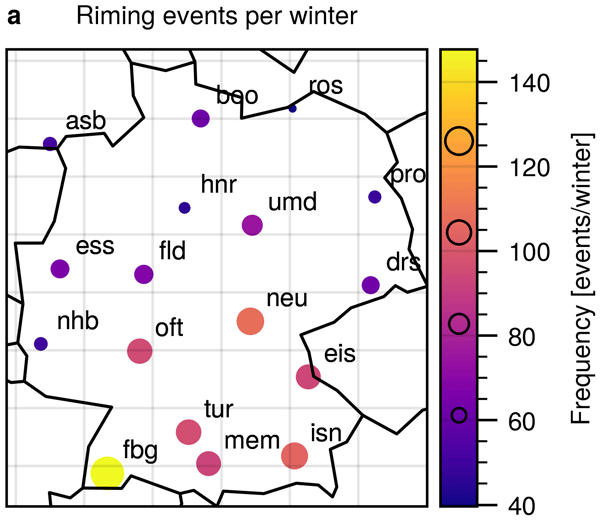
The 17 operational German weather radars regularly point vertical for calibration. We proof that this data also contains valuable scientific information. To demonstrate this, we use it to detect the melting level in clouds and strong snowflake riming. Riming is the collision of a snowflake with liquid droplets, which can create precipitation. We analyze the frequency and temperature dependence of riming for all German weather radar sites and relate it to the local precipitation climatology.
Leonie von Terzi, Axel Seifert, Christoph Siewert, Fabian Jakub, and Stefan Kneifel
EGUsphere, https://doi.org/10.5194/egusphere-2026-3865, https://doi.org/10.5194/egusphere-2026-3865, 2026
Short summary
Short summary
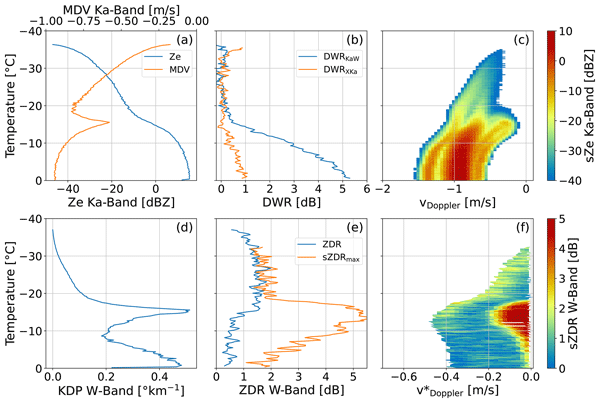
A distinct temperature layer in clouds promotes growth of dendritic ice crystals, producing characteristic radar signatures whose origin has remained unclear. We combined radar observations with microphysical simulations to identify the dominant microphysical processes. Collisions breaking particles into fragments prove essential to reproducing the signatures, alongside crystal growth and aggregation, clarifying the link between radar signals and ice processes for weather models.
Paul Ockenfuß, Gregor Köcher, Isabel Petit, and Stefan Kneifel
EGUsphere, https://doi.org/10.5194/egusphere-2026-3446, https://doi.org/10.5194/egusphere-2026-3446, 2026
Short summary
Short summary
Remote sensing instruments often point vertically, producing time-height cross-sections of the atmosphere. In this case, each particle is observed only once. To learn about particle evolution, we need either assumptions about their distribution or scanning observations to "follow" them. In this work, we do both. To illustrate, we introduce new techniques to reveal the spatial distribution of rimed snowflakes, and we discuss the observed patterns and rimed particle evolution.
Lukas Pieper, Patric Seifert, Hannes Griesche, Albert Ansmann, George McCosh, Florian Ewald, and Stefan Kneifel
EGUsphere, https://doi.org/10.5194/egusphere-2026-3092, https://doi.org/10.5194/egusphere-2026-3092, 2026
This preprint is open for discussion and under review for Atmospheric Chemistry and Physics (ACP).
Short summary
Short summary
Using ground-based cloud Doppler radar observations and aerosol model data, a strong relationship between Saharan dust and enhanced turbulence in cirrus clouds over Europe was identified. Dust-infused cirrus formed mainly within moist, dust-laden air masses and showed strong correlation with in-cloud turbulence. The results provide a baseline observational overview on dust-turbulence-cirrus interactions, informing weather and climate models regarding possible methodological improvements.
Paul Ockenfuß, Michael Frech, Mathias Gergely, and Stefan Kneifel
Atmos. Meas. Tech., 19, 2125–2147, https://doi.org/10.5194/amt-19-2125-2026, https://doi.org/10.5194/amt-19-2125-2026, 2026
Short summary
Short summary
The 17 operational German weather radars regularly point vertical for calibration. We proof that this data also contains valuable scientific information. To demonstrate this, we use it to detect the melting level in clouds and strong snowflake riming. Riming is the collision of a snowflake with liquid droplets, which can create precipitation. We analyze the frequency and temperature dependence of riming for all German weather radar sites and relate it to the local precipitation climatology.
Leonie von Terzi, Davide Ori, and Stefan Kneifel
Geosci. Model Dev., 19, 887–910, https://doi.org/10.5194/gmd-19-887-2026, https://doi.org/10.5194/gmd-19-887-2026, 2026
Short summary
Short summary
We present a new database of radar-relevant optical properties for a wide range of ice particle shapes, computed using the Discrete Dipole Approximation (DDA) at 5.6, 9.6, 35.6, and 94 GHz. The database is designed to support habit-evolving microphysical schemes, which predict continuous changes in ice particle properties rather than the traditionally assumed fixed categories. It includes over 2600 individual crystals and 450 aggregates with varying riming degrees and morphology.
Gregor Köcher and Tobias Zinner
Geosci. Model Dev., 18, 8363–8377, https://doi.org/10.5194/gmd-18-8363-2025, https://doi.org/10.5194/gmd-18-8363-2025, 2025
Short summary
Short summary
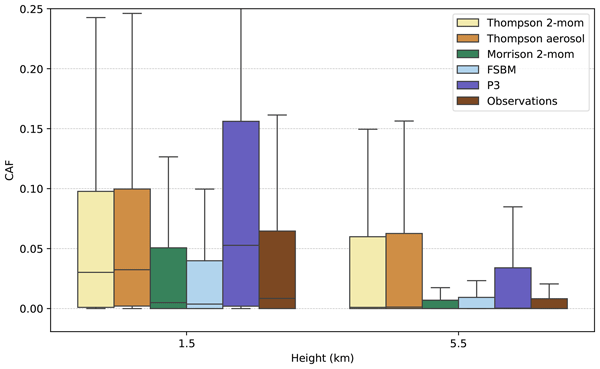
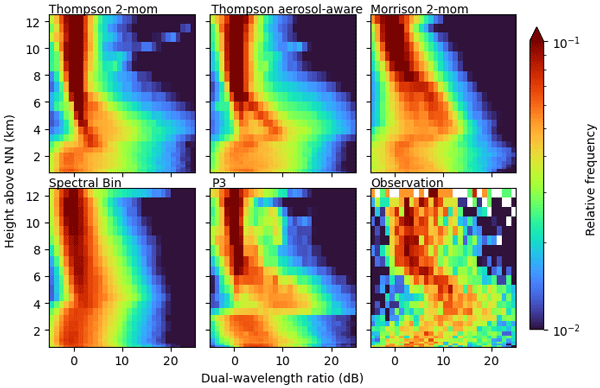
Simulations of convective precipitation events with microphysics schemes of varying complexity are statistically evaluated against polarimetric radar observations. Convective precipitation is potentially hazardous and difficult to predict. Cloud microphysics schemes contribute significantly to this uncertainty. Depending on the microphysics used, the simulated precipitation distribution varies significantly. The main reason for these differences are the underlying rain drop size distributions.
Anna Weber, Gregor Köcher, and Bernhard Mayer
Atmos. Meas. Tech., 18, 5805–5821, https://doi.org/10.5194/amt-18-5805-2025, https://doi.org/10.5194/amt-18-5805-2025, 2025
Short summary
Short summary
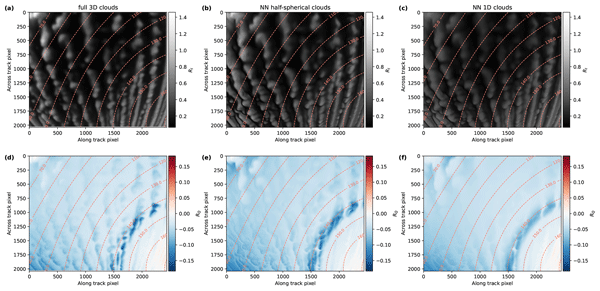
A neural-network-based fast forward operator for polarized 3D radiative transfer is presented. The forward operator uses the new InDEpendent column local halF-sphere ApproXimation (IDEFAX). Polarized radiances simulated with IDEFAX and the forward operator were validated against full 3D radiative transfer simulations with MYSTIC and show a significantly improved representation of 3D radiative effects compared to the plane-parallel independent column approximation at comparable computation times.
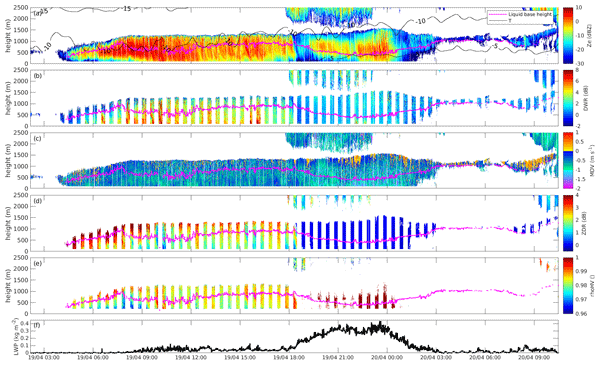
Giovanni Chellini, Rosa Gierens, Kerstin Ebell, Theresa Kiszler, Pavel Krobot, Alexander Myagkov, Vera Schemann, and Stefan Kneifel
Earth Syst. Sci. Data, 15, 5427–5448, https://doi.org/10.5194/essd-15-5427-2023, https://doi.org/10.5194/essd-15-5427-2023, 2023
Short summary
Short summary
We present a comprehensive quality-controlled dataset of remote sensing observations of low-level mixed-phase clouds (LLMPCs) taken at the high Arctic site of Ny-Ålesund, Svalbard, Norway. LLMPCs occur frequently in the Arctic region, and substantially warm the surface. However, our understanding of microphysical processes in these clouds is incomplete. This dataset includes a comprehensive set of variables which allow for extensive investigation of such processes in LLMPCs at the site.
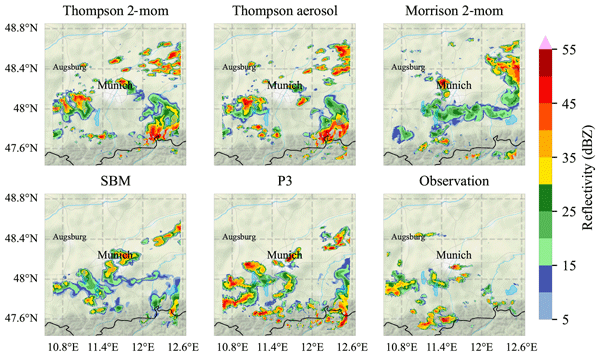
Gregor Köcher, Tobias Zinner, and Christoph Knote
Atmos. Chem. Phys., 23, 6255–6269, https://doi.org/10.5194/acp-23-6255-2023, https://doi.org/10.5194/acp-23-6255-2023, 2023
Short summary
Short summary
Polarimetric radar observations of 30 d of convective precipitation events are used to statistically analyze 5 state-of-the-art microphysics schemes of varying complexity. The frequency and area of simulated heavy-precipitation events are in some cases significantly different from those observed, depending on the microphysics scheme. Analysis of simulated particle size distributions and reflectivities shows that some schemes have problems reproducing the correct particle size distributions.
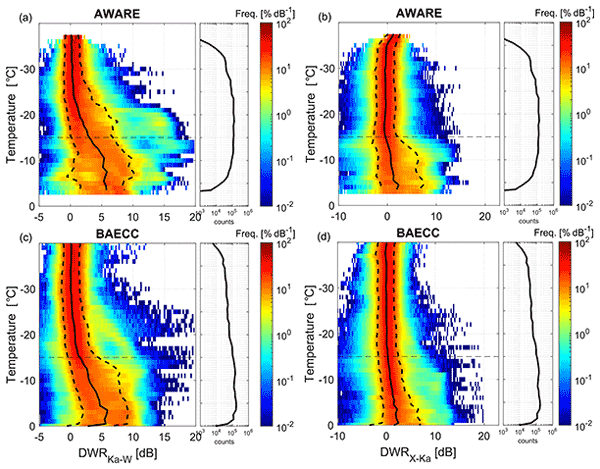
Frederic Tridon, Israel Silber, Alessandro Battaglia, Stefan Kneifel, Ann Fridlind, Petros Kalogeras, and Ranvir Dhillon
Atmos. Chem. Phys., 22, 12467–12491, https://doi.org/10.5194/acp-22-12467-2022, https://doi.org/10.5194/acp-22-12467-2022, 2022
Short summary
Short summary
The role of ice precipitation in the Earth water budget is not well known because ice particles are complex, and their formation involves intricate processes. Riming of ice crystals by supercooled water droplets is an efficient process, but little is known about its importance at high latitudes. In this work, by exploiting the deployment of an unprecedented number of remote sensing systems in Antarctica, we find that riming occurs at much lower temperatures compared with the mid-latitudes.
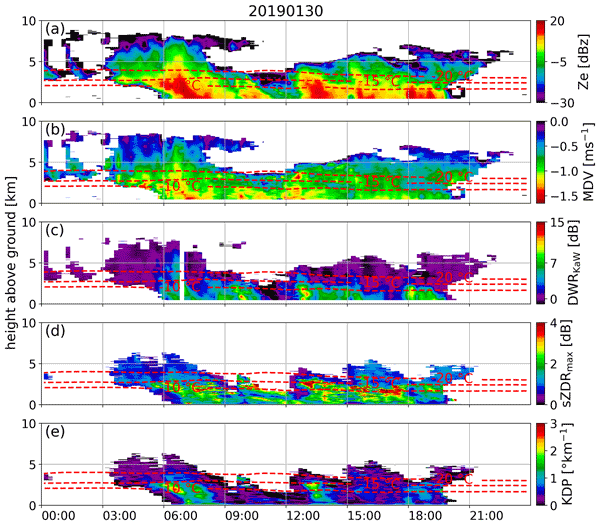
Leonie von Terzi, José Dias Neto, Davide Ori, Alexander Myagkov, and Stefan Kneifel
Atmos. Chem. Phys., 22, 11795–11821, https://doi.org/10.5194/acp-22-11795-2022, https://doi.org/10.5194/acp-22-11795-2022, 2022
Short summary
Short summary
We present a statistical analysis of ice microphysical processes (IMP) in mid-latitude clouds. Combining various radar approaches, we find that the IMP active at −20 to −10 °C seems to be the main driver of ice particle size, shape and concentration. The strength of aggregation at −20 to −10 °C correlates with the increase in concentration and aspect ratio of locally formed ice particles. Despite ongoing aggregation, the concentration of ice particles stays enhanced until −4 °C.
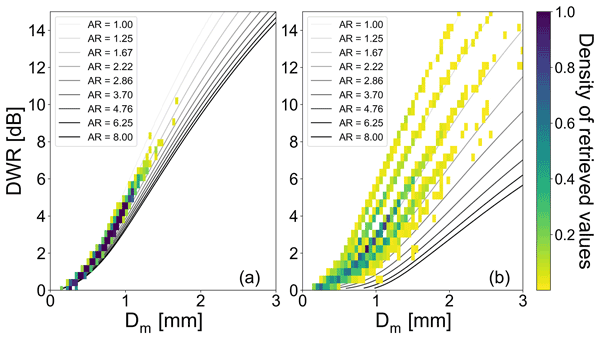
Eleni Tetoni, Florian Ewald, Martin Hagen, Gregor Köcher, Tobias Zinner, and Silke Groß
Atmos. Meas. Tech., 15, 3969–3999, https://doi.org/10.5194/amt-15-3969-2022, https://doi.org/10.5194/amt-15-3969-2022, 2022
Short summary
Short summary
We use the C-band POLDIRAD and the Ka-band MIRA-35 to perform snowfall dual-wavelength polarimetric radar measurements. We develop an ice microphysics retrieval for mass, apparent shape, and median size of the particle size distribution by comparing observations to T-matrix ice spheroid simulations while varying the mass–size relationship. We furthermore show how the polarimetric measurements from POLDIRAD help to narrow down ambiguities between ice particle shape and size.
Gregor Köcher, Tobias Zinner, Christoph Knote, Eleni Tetoni, Florian Ewald, and Martin Hagen
Atmos. Meas. Tech., 15, 1033–1054, https://doi.org/10.5194/amt-15-1033-2022, https://doi.org/10.5194/amt-15-1033-2022, 2022
Short summary
Short summary
We present a setup for systematic characterization of differences between numerical weather models and radar observations for convective weather situations. Radar observations providing dual-wavelength and polarimetric variables to infer information about hydrometeor shapes and sizes are compared against simulations using microphysics schemes of varying complexity. Differences are found in ice and liquid phase, pointing towards issues of some schemes in reproducing particle size distributions.

Teresa Vogl, Maximilian Maahn, Stefan Kneifel, Willi Schimmel, Dmitri Moisseev, and Heike Kalesse-Los
Atmos. Meas. Tech., 15, 365–381, https://doi.org/10.5194/amt-15-365-2022, https://doi.org/10.5194/amt-15-365-2022, 2022
Short summary
Short summary
We are using machine learning techniques, a type of artificial intelligence, to detect graupel formation in clouds. The measurements used as input to the machine learning framework were performed by cloud radars. Cloud radars are instruments located at the ground, emitting radiation with wavelenghts of a few millimeters vertically into the cloud and measuring the back-scattered signal. Our novel technique can be applied to different radar systems and different weather conditions.
Martin Hagen, Florian Ewald, Silke Groß, Lothar Oswald, David A. Farrell, Marvin Forde, Manuel Gutleben, Johann Heumos, Jens Reimann, Eleni Tetoni, Gregor Köcher, Eleni Marinou, Christoph Kiemle, Qiang Li, Rebecca Chewitt-Lucas, Alton Daley, Delando Grant, and Kashawn Hall
Earth Syst. Sci. Data, 13, 5899–5914, https://doi.org/10.5194/essd-13-5899-2021, https://doi.org/10.5194/essd-13-5899-2021, 2021
Short summary
Short summary
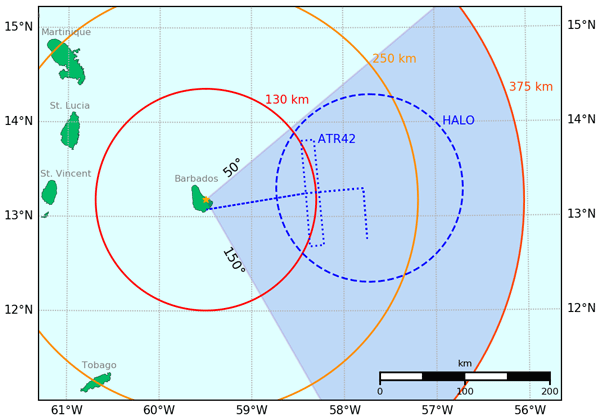
The German polarimetric weather radar Poldirad was deployed for the international campaign EUREC4A on Barbados. The focus was monitoring clouds and precipitation in the trade wind region east of Barbados. Observations were with a temporal sequence of 5 min and a maximum range of 375 km. Examples of mesoscale precipitation patterns, rain rate accumulation, diurnal cycle, and vertical distribution show the potential for further studies on the life cycle of precipitating shallow cumulus clouds.
Silke Trömel, Clemens Simmer, Ulrich Blahak, Armin Blanke, Sabine Doktorowski, Florian Ewald, Michael Frech, Mathias Gergely, Martin Hagen, Tijana Janjic, Heike Kalesse-Los, Stefan Kneifel, Christoph Knote, Jana Mendrok, Manuel Moser, Gregor Köcher, Kai Mühlbauer, Alexander Myagkov, Velibor Pejcic, Patric Seifert, Prabhakar Shrestha, Audrey Teisseire, Leonie von Terzi, Eleni Tetoni, Teresa Vogl, Christiane Voigt, Yuefei Zeng, Tobias Zinner, and Johannes Quaas
Atmos. Chem. Phys., 21, 17291–17314, https://doi.org/10.5194/acp-21-17291-2021, https://doi.org/10.5194/acp-21-17291-2021, 2021
Short summary
Short summary
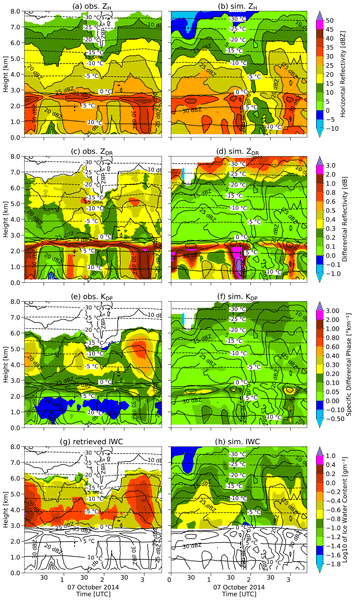
The article introduces the ACP readership to ongoing research in Germany on cloud- and precipitation-related process information inherent in polarimetric radar measurements, outlines pathways to inform atmospheric models with radar-based information, and points to remaining challenges towards an improved fusion of radar polarimetry and atmospheric modelling.
Markus Karrer, Axel Seifert, Davide Ori, and Stefan Kneifel
Atmos. Chem. Phys., 21, 17133–17166, https://doi.org/10.5194/acp-21-17133-2021, https://doi.org/10.5194/acp-21-17133-2021, 2021
Short summary
Short summary
Modeling precipitation is of great relevance, e.g., for mitigating damage caused by extreme weather. A key component in accurate precipitation modeling is aggregation, i.e., sticking together of snowflakes. Simulating aggregation is difficult due to multiple parameters that are not well-known. Knowing how these parameters affect aggregation can help its simulation. We put new parameters in the model and select a combination of parameters with which the model can simulate observations better.
Cited articles
Altube, P., Bech, J., Argemí, O., and Rigo, T.: Quality Control of Antenna Alignment and Receiver Calibration Using the Sun: Adaptation to Midrange Weather Radar Observations at Low Elevation Angles, J. Atmos. Ocean. Tech., 32, 927–942, https://doi.org/10.1175/JTECH-D-14-00116.1, 2015. a
Altube, P., Bech, J., Argemí, O., Rigo, T., and Pineda, N.: Intercomparison and Potential Synergies of Three Methods for Weather Radar Antenna Pointing Assessment, J. Atmos. Ocean. Tech., 33, 331–343, https://doi.org/10.1175/JTECH-D-15-0075.1, 2016. a, b, c
Arnott, N., Richardson, Y., Wurman, J., and Lutz, J.: A solar alignment technique for determining mobile radar pointing angles, in: Preprints, 31st Int. Conf. on Radar Meteorology, Seattle, WA, Amer. Meteor. Soc., 492, p. 494, 2003. a
Baars, J.: The measurement of large antennas with cosmic radio sources, IEEE T. Antenn. Propag., 21, 461–474, https://doi.org/10.1109/TAP.1973.1140521, 1973. a
Currie, M. J., Berry, D. S., Jenness, T., Gibb, A. G., Bell, G. S., and Draper, P. W.: Starlink Software in 2013, in: Astronomical Data Analysis Software and Systems XXIII, edited by: Manset, N. and Forshay, P., Astronomical Society of the Pacific Conference Series, 485, p. 391, 2014. a
Darlington, T., Kitchen, M., Sugier, J., and de Rohan-Truba, J.: Automated real-time monitoring of radar sensitivity and antenna pointing accuracy, in: 31st International Conference on Radar Meteorology, American Meteorological Society, 7B.6, https://ams.confex.com/ams/32BC31R5C/techprogram/paper_63543.htm (last access: 24 April 2026), 2003. a
Frech, M., Mammen, T., and Lange, B.: Pointing Accuracy of an Operational Polarimetric Weather Radar, Remote Sensing, 11, 1115, https://doi.org/10.3390/rs11091115, 2019. a
Gao, F. and Han, L.: Implementing the Nelder-Mead simplex algorithm with adaptive parameters, Comput. Optim. Appl., 51, 259–277, https://doi.org/10.1007/s10589-010-9329-3, 2010. a
Görsdorf, U., Lehmann, V., Bauer-Pfundstein, M., Peters, G., Vavriv, D., Vinogradov, V., and Volkov, V.: A 35-GHz Polarimetric Doppler Radar for Long-Term Observations of Cloud Parameters–Description of System and Data Processing, J. Atmos. Ocean. Tech., 32, 675–690, https://doi.org/10.1175/jtech-d-14-00066.1, 2015. a
Haberreiter, M., Schmutz, W., and Kosovichev, A. G.: Solving the Discrepancy between the Seismic and Photospheric Solar Radius, Astrophys. J., 675, L53–L56, https://doi.org/10.1086/529492, 2008. a
Holleman, I., Huuskonen, A., Kurri, M., and Beekhuis, H.: Operational Monitoring of Weather Radar Receiving Chain Using the Sun, J. Atmos. Ocean. Tech., 27, 159–166, https://doi.org/10.1175/2009jtecha1213.1, 2010. a
Holleman, I., Huuskonen, A., and Taylor, B.: Solar Monitoring of the NEXRAD WSR-88D Network Using Operational Scan Data, J. Atmos. Ocean. Tech., 39, 125–139, https://doi.org/10.1175/jtech-d-20-0204.1, 2022. a
Holton, J. R. and Hakim, G. J.: An Introduction to Dynamic Meteorology, Elsevier, https://doi.org/10.1016/c2009-0-63394-8, ISBN 9780123848666, 2013. a
Houze Jr., R. A.: Cloud dynamics, Vol. 104 of International Geophysics Series, Academic Press, Oxford, England, 2nd edn., Chap. 3.2.7, ISBN 9780080921464, 2014. a
Kalesse, H. and Kollias, P.: Climatology of High Cloud Dynamics Using Profiling ARM Doppler Radar Observations, J. Climate, 26, 6340–6359, https://doi.org/10.1175/JCLI-D-12-00695.1, 2013. a
Kneifel, S., Kollias, P., Battaglia, A., Leinonen, J., Maahn, M., Kalesse, H., and Tridon, F.: First observations of triple‐frequency radar Doppler spectra in snowfall: Interpretation and applications, Geophys. Res. Lett., 43, 2225–2233, https://doi.org/10.1002/2015gl067618, 2016. a
Kraus, J. D.: Antennas, McGraw-Hill series in electrical engineering, McGraw-Hill, New York, NY, 2nd edn., Chap. 12.7, ISBN 0070354227, 1988. a
Laj, P., Myhre, C. L., Riffault, V., Amiridis, V., Fuchs, H., Eleftheriadis, K., Petäjä, T., Salameh, T., Kivekäs, N., Juurola, E., Saponaro, G., Philippin, S., Cornacchia, C., Arboledas, L. A., Baars, H., Claude, A., Mazière, M. D., Dils, B., Dufresne, M., Evangeliou, N., Favez, O., Fiebig, M., Haeffelin, M., Herrmann, H., Höhler, K., Illmann, N., Kreuter, A., Ludewig, E., Marinou, E., Möhler, O., Mona, L., Murberg, L. E., Nicolae, D., Novelli, A., O’Connor, E., Ohneiser, K., Altieri, R. M. P., Picquet-Varrault, B., van Pinxteren, D., Pospichal, B., Putaud, J.-P., Reimann, S., Siomos, N., Stachlewska, I., Tillmann, R., Voudouri, K. A., Wandinger, U., Wiedensohler, A., Apituley, A., Comerón, A., Gysel-Beer, M., Mihalopoulos, N., Nikolova, N., Pietruczuk, A., Sauvage, S., Sciare, J., Skov, H., Svendby, T., Swietlicki, E., Tonev, D., Vaughan, G., Zdimal, V., Baltensperger, U., Doussin, J.-F., Kulmala, M., Pappalardo, G., Sundet, S. S., and Vana, M.: Aerosol, Clouds and Trace Gases Research Infrastructure (ACTRIS): The European Research Infrastructure Supporting Atmospheric Science, B. Am. Meteorol. Soc., 105, E1098–E1136, https://doi.org/10.1175/BAMS-D-23-0064.1, 2024. a
Manceron, P.: IKPy, v3.4.2, Zenodo [code], https://doi.org/10.5281/zenodo.13304536, 2024. a
Mano, K. and Altshuler, E.: Tropospheric refractive angle and range error corrections utilizing exoatmospheric sources, Radio Sci., 16, 191–195, 1981. a
Manz, A., Smith, A., and Hardaker, P.: Comparison of different methods of end to end calibration of the U.K. weather radar network, Phys. Chem. Earth Pt. B, 25, 1157–1162, https://doi.org/10.1016/S1464-1909(00)00171-4, 2000. a
Mather, J. H. and Voyles, J. W.: The Arm Climate Research Facility: A Review of Structure and Capabilities, B. Am. Meteorol. Soc., 94, 377–392, https://doi.org/10.1175/BAMS-D-11-00218.1, 2013. a
METEK GmbH: MIRA-35: Vertical Doppler Cloud RADAR – System Specifications, METEK GmbH, Fritz-Strassmann-Str. 4, 25337 Elmshorn, Germany, https://metek.de/wp-content/uploads/2014/05/Metek-Vertical-Doppler-Cloud-RADAR-MIRA-35-Datasheet.pdf (last access: 24 April 2026), 2013. a
Mills, D. L.: Precision synchronization of computer network clocks, ACM SIGCOMM Comp. Com., 24, 28–43, https://doi.org/10.1145/185595.185651, 1994. a
Muth, X., Schneebeli, M., and Berne, A.: A sun-tracking method to improve the pointing accuracy of weather radar, Atmos. Meas. Tech., 5, 547–555, https://doi.org/10.5194/amt-5-547-2012, 2012. a
NOAA Global Monitoring Laboratory: NOAA Solar Calculator: Find Sunrise, Sunset, Solar Noon and Solar Position for Any Place on Earth, https://gml.noaa.gov/grad/solcalc/ (last access: 10 November 2025), 2025. a
Ockenfuß, P. and Köcher, G.: SunscanPy, Zenodo [code], https://doi.org/10.5281/zenodo.18862011, 2026a. a, b
Ockenfuß, P. and Köcher, G.: SunscanPy: v0.1.3, Zenodo [code], https://doi.org/10.5281/zenodo.18862012, 2026b. a
Radiometer Physics GmbH (RPG): RPG-FMCW-DP-KW 35/94 GHz Dual Frequency Cloud Doppler Radar: Instrument Installation Guide, Radiometer Physics GmbH (RPG), Meckenheim, Germany, issue 01, Revision 04, 42 pp., https://www.radiometer-physics.de/download/PDF/Cloud%20Radar/RPG-FMCW-dual-frequency-35-94-Installation_Manual.pdf (last access: 24 April 2026), 2024. a
Reimann, J. and Hagen, M.: Antenna pattern measurements of weather radars using the sun and a point source, J. Atmos. Ocean. Tech., 33, 891–898, https://doi.org/10.1175/JTECH-D-15-0185.1, 2016. a
Rueger, J. M.: Refractive Index Formulae for Electronic Distance Measurement with Radio and Millimetre Waves, Tech. Rep. S-68, School of Surveying and Spatial Information Systems, University of New South Wales, Sydney, Australia, 2002a. a
Rueger, J. M.: Refractive Index Formulae for Radio Waves, in: FIG XXII International Congress: JS28 Integration of Techniques and Corrections to Achieve Accurate Engineering, FIG, Washington, D.C., USA, 2002b. a
Selhorst, C. L., Silva, A. V. R., Costa, J. E. R., and Shibasaki, K.: Temporal and angular variation of the solar limb brightening at 17 GHz, Astron. Astrophys., 401, 1143–1150, https://doi.org/10.1051/0004-6361:20030071, 2003. a
Stafford, B.: Pysolar Python Library, Zenodo [code], https://doi.org/10.5281/zenodo.1461065, 2021. a
The SunPy Community, Barnes, W. T., Bobra, M. G., Christe, S. D., Freij, N., Hayes, L. A., Ireland, J., Mumford, S., Perez-Suarez, D., Ryan, D. F., Shih, A. Y., Chanda, P., Glogowski, K., Hewett, R., Hughitt, V. K., Hill, A., Hiware, K., Inglis, A., Kirk, M. S. F., Konge, S., Mason, J. P., Maloney, S. A., Murray, S. A., Panda, A., Park, J., Pereira, T. M. D., Reardon, K., Savage, S., Sipőcz, B. M., Stansby, D., Jain, Y., Taylor, G., Yadav, T., Rajul, and Dang, T. K.: The SunPy Project: Open Source Development and Status of the Version 1.0 Core Package, Astrophys. J., 890, 68, https://doi.org/10.3847/1538-4357/ab4f7a, 2020. a
Tridon, F. and Battaglia, A.: Dual‐frequency radar Doppler spectral retrieval of rain drop size distributions and entangled dynamics variables, J. Geophys. Res.-Atmos., 120, 5585–5601, https://doi.org/10.1002/2014jd023023, 2015. a
Short summary
The pointing of scanning weather and cloud radars must be very accurate, to within 0.1°. We present a general method to calibrate the pointing of a scanning radar with an elevation and an azimuth axis. Using the Sun as a reference, we can determine the specific misalignments of the radar pedestal, axes and antenna. Once the misalignments are known, we can correct for them by steering the scanner motors accordingly. We provide recommendations and code to apply this method to any scanning radar.
The pointing of scanning weather and cloud radars must be very accurate, to within 0.1°. We...


