
Articles | Volume 19, issue 9
https://doi.org/10.5194/amt-19-3019-2026
© Author(s) 2026. This work is distributed under
the Creative Commons Attribution 4.0 License.
the Creative Commons Attribution 4.0 License.
https://doi.org/10.5194/amt-19-3019-2026
© Author(s) 2026. This work is distributed under
the Creative Commons Attribution 4.0 License.
the Creative Commons Attribution 4.0 License.
Research article
| 
06 May 2026
Research article |
| 06 May 2026
| 06 May 2026
Methane quantification of LNG gas-fired power plant in Seoul, South Korea
Jaewon Joo
Environmental Planning Institute, Seoul National University, Seoul, Republic of Korea
Climate Tech Center, Seoul National University, Seoul, Republic of Korea

Environmental Planning Institute, Seoul National University, Seoul, Republic of Korea
Department of Environmental Management, Graduate school of Environmental Studies, Seoul National University, Seoul 08826, Republic of Korea
Climate Tech Center, Seoul National University, Seoul, Republic of Korea
Hyuckjae Lee
Department of Environmental Management, Graduate school of Environmental Studies, Seoul National University, Seoul 08826, Republic of Korea
Yeonsoo Kim
Department of Environmental Management, Graduate school of Environmental Studies, Seoul National University, Seoul 08826, Republic of Korea
Jaewon Shin
Department of Environmental Management, Graduate school of Environmental Studies, Seoul National University, Seoul 08826, Republic of Korea
Donghee Kim
Department of Environmental Management, Graduate school of Environmental Studies, Seoul National University, Seoul 08826, Republic of Korea
Dong Yeong Chang
Environmental Planning Institute, Seoul National University, Seoul, Republic of Korea
Climate Tech Center, Seoul National University, Seoul, Republic of Korea
Related authors
Hayoung Park, Sujong Jeong, Jaewon Joo, Dong Yeong Chang, Yu-Ri Lee, Hyuckjae Lee, Jueun Kim, Jaewon Shin, Jonghyuk Lee, Jaemin Hong, Jae Hyun Lim, Donghee Kim, Isamu Morino, Matthias M. Frey, Gwangju Moon, Hyojin Eom, Sumin Kim, Sunran Lee, Jungho Yu, and Kyucheol Shin
EGUsphere, https://doi.org/10.5194/egusphere-2026-3755, https://doi.org/10.5194/egusphere-2026-3755, 2026
Short summary
Short summary
This study analyzed greenhouse gas emissions from one of South Korea’s largest petrochemical complexes using ground, mobile, aircraft, and satellite measurements. The results revealed higher emissions, including methane leaks, than what was reported in existing inventory estimates. By integrating different types of observations, this study shows a more accurate way to measure industrial emissions and provides information that can support better emissions reporting and climate action.
Donghee Kim, Sujong Jeong, Dong Yeong Chang, and Jaewon Joo
Atmos. Chem. Phys., 26, 7789–7802, https://doi.org/10.5194/acp-26-7789-2026, https://doi.org/10.5194/acp-26-7789-2026, 2026
Short summary
Short summary
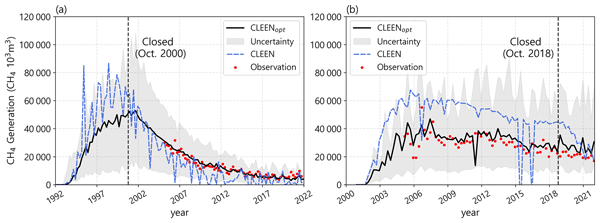
This study uses data and machine learning to better estimate methane emissions from a major landfill in South Korea. By considering local weather conditions like temperature and rain, the research improves how landfill methane is tracked over time. The results help us understand how climate affects emissions and provide tools that can be used worldwide to improve greenhouse gas monitoring and climate action planning.
Hayoung Park, Sujong Jeong, Jaewon Joo, Dong Yeong Chang, Yu-Ri Lee, Hyuckjae Lee, Jueun Kim, Jaewon Shin, Jonghyuk Lee, Jaemin Hong, Jae Hyun Lim, Donghee Kim, Isamu Morino, Matthias M. Frey, Gwangju Moon, Hyojin Eom, Sumin Kim, Sunran Lee, Jungho Yu, and Kyucheol Shin
EGUsphere, https://doi.org/10.5194/egusphere-2026-3755, https://doi.org/10.5194/egusphere-2026-3755, 2026
Short summary
Short summary
This study analyzed greenhouse gas emissions from one of South Korea’s largest petrochemical complexes using ground, mobile, aircraft, and satellite measurements. The results revealed higher emissions, including methane leaks, than what was reported in existing inventory estimates. By integrating different types of observations, this study shows a more accurate way to measure industrial emissions and provides information that can support better emissions reporting and climate action.
Jeonghyeok Moon, Wonbae Jeon, Sujong Jeong, Yunsoo Choi, Hyun Cheol Kim, Soon-Young Park, Juseon Bak, Jung-Woo Yoo, Jaehyeong Park, Dongjin Kim, Hyeonsik Choe, Chae-Yeong Yang, and Min Heo
Atmos. Chem. Phys., 26, 10379–10398, https://doi.org/10.5194/acp-26-10379-2026, https://doi.org/10.5194/acp-26-10379-2026, 2026
Short summary
Short summary
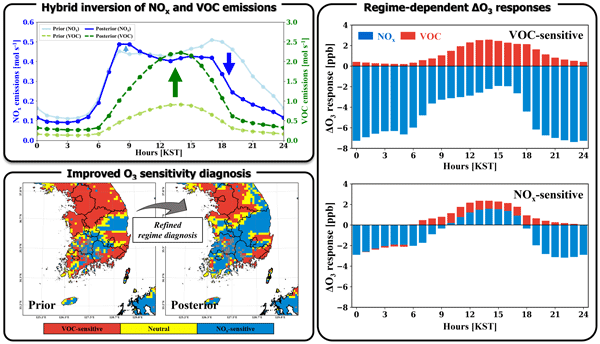
This study develops a hybrid inverse modeling framework to better estimate the spatiotemporal distributions of nitrogen oxides (NOx) and volatile organic compound (VOC) emissions over South Korea. The optimized emissions improve ozone simulations and clarify whether ozone formation is more sensitive to NOx or to VOC. By identifying when precursor emissions exert the strongest influence on ozone, this work provides time-resolved guidance for region-specific air quality strategies.
Donghee Kim, Sujong Jeong, Dong Yeong Chang, and Jaewon Joo
Atmos. Chem. Phys., 26, 7789–7802, https://doi.org/10.5194/acp-26-7789-2026, https://doi.org/10.5194/acp-26-7789-2026, 2026
Short summary
Short summary
This study uses data and machine learning to better estimate methane emissions from a major landfill in South Korea. By considering local weather conditions like temperature and rain, the research improves how landfill methane is tracked over time. The results help us understand how climate affects emissions and provide tools that can be used worldwide to improve greenhouse gas monitoring and climate action planning.
Anna Martin, Klaus Klingmüller, Benedikt Steil, Sergey Gromov, Yu-Ri Lee, Dong Yeong Chang, Nic Surawski, Jos Lelieveld, Sujong Jeong, and Andrea Pozzer
EGUsphere, https://doi.org/10.5194/egusphere-2026-371, https://doi.org/10.5194/egusphere-2026-371, 2026
Short summary
Short summary
We evaluate a new model simulating soil uptake of methane and hydrogen from the atmosphere. Coupled to an atmospheric chemistry and land surface model, it accounts for weather and soil conditions. Our results match observations, showing accurate removal depending on soil properties, temperature, moisture, and atmospheric conditions. This work improves the model’s ability to represent natural cycles of methane and hydrogen.
Sojung Sim and Sujong Jeong
Atmos. Chem. Phys., 25, 18509–18526, https://doi.org/10.5194/acp-25-18509-2025, https://doi.org/10.5194/acp-25-18509-2025, 2025
Short summary
Short summary
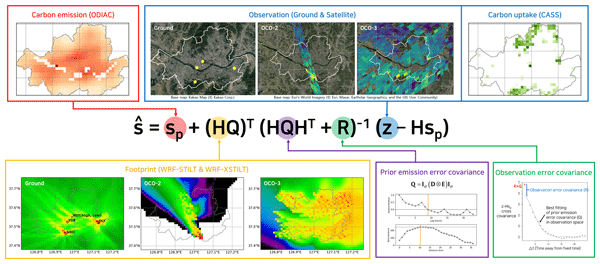
This study develops a high-resolution inverse modeling framework that combines ground-based and satellite CO2 observations to improve urban emission estimates in Seoul. By integrating atmospheric data and transport models, the research reduces uncertainties in CO2 emissions and reveals spatial and temporal patterns. The method offers a valuable tool for supporting climate policies and can be applied to other cities for better emission verification.
Ran Chen, Jin-Soo Kim, Jung-Eun Chu, Hyo-Jeong Kim, Bora Lee, Sujong Jeong, and Gabriela Schaepman-Strub
EGUsphere, https://doi.org/10.5194/egusphere-2025-5805, https://doi.org/10.5194/egusphere-2025-5805, 2025
Short summary
Short summary
We investigated the responses of mangroves to temperature and solar radiation, and further projected future climate favourability for mangroves across East Asia. East Asian mangrove growth is positively linked to temperature and solar radiation, particularly in cumulative anomalies on seasonal time scales. Winter isotherm shifts suggest northward mangrove expansion under global warming, but low solar radiation from aerosol emissions in East Asia may still constrain their growth.
Brendan Byrne, David F. Baker, Sourish Basu, Michael Bertolacci, Kevin W. Bowman, Dustin Carroll, Abhishek Chatterjee, Frédéric Chevallier, Philippe Ciais, Noel Cressie, David Crisp, Sean Crowell, Feng Deng, Zhu Deng, Nicholas M. Deutscher, Manvendra K. Dubey, Sha Feng, Omaira E. García, David W. T. Griffith, Benedikt Herkommer, Lei Hu, Andrew R. Jacobson, Rajesh Janardanan, Sujong Jeong, Matthew S. Johnson, Dylan B. A. Jones, Rigel Kivi, Junjie Liu, Zhiqiang Liu, Shamil Maksyutov, John B. Miller, Scot M. Miller, Isamu Morino, Justus Notholt, Tomohiro Oda, Christopher W. O'Dell, Young-Suk Oh, Hirofumi Ohyama, Prabir K. Patra, Hélène Peiro, Christof Petri, Sajeev Philip, David F. Pollard, Benjamin Poulter, Marine Remaud, Andrew Schuh, Mahesh K. Sha, Kei Shiomi, Kimberly Strong, Colm Sweeney, Yao Té, Hanqin Tian, Voltaire A. Velazco, Mihalis Vrekoussis, Thorsten Warneke, John R. Worden, Debra Wunch, Yuanzhi Yao, Jeongmin Yun, Andrew Zammit-Mangion, and Ning Zeng
Earth Syst. Sci. Data, 15, 963–1004, https://doi.org/10.5194/essd-15-963-2023, https://doi.org/10.5194/essd-15-963-2023, 2023
Short summary
Short summary
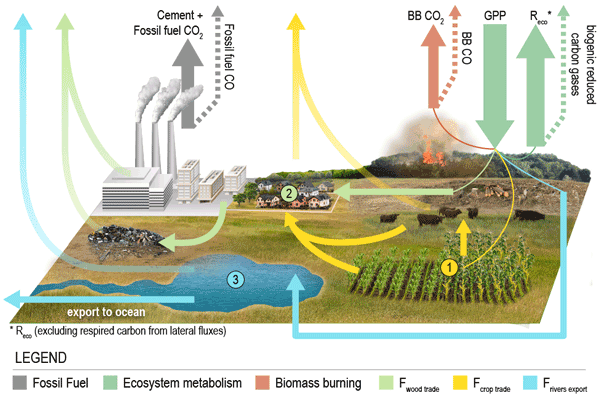
Changes in the carbon stocks of terrestrial ecosystems result in emissions and removals of CO2. These can be driven by anthropogenic activities (e.g., deforestation), natural processes (e.g., fires) or in response to rising CO2 (e.g., CO2 fertilization). This paper describes a dataset of CO2 emissions and removals derived from atmospheric CO2 observations. This pilot dataset informs current capabilities and future developments towards top-down monitoring and verification systems.
Carlos Alberti, Frank Hase, Matthias Frey, Darko Dubravica, Thomas Blumenstock, Angelika Dehn, Paolo Castracane, Gregor Surawicz, Roland Harig, Bianca C. Baier, Caroline Bès, Jianrong Bi, Hartmut Boesch, André Butz, Zhaonan Cai, Jia Chen, Sean M. Crowell, Nicholas M. Deutscher, Dragos Ene, Jonathan E. Franklin, Omaira García, David Griffith, Bruno Grouiez, Michel Grutter, Abdelhamid Hamdouni, Sander Houweling, Neil Humpage, Nicole Jacobs, Sujong Jeong, Lilian Joly, Nicholas B. Jones, Denis Jouglet, Rigel Kivi, Ralph Kleinschek, Morgan Lopez, Diogo J. Medeiros, Isamu Morino, Nasrin Mostafavipak, Astrid Müller, Hirofumi Ohyama, Paul I. Palmer, Mahesh Pathakoti, David F. Pollard, Uwe Raffalski, Michel Ramonet, Robbie Ramsay, Mahesh Kumar Sha, Kei Shiomi, William Simpson, Wolfgang Stremme, Youwen Sun, Hiroshi Tanimoto, Yao Té, Gizaw Mengistu Tsidu, Voltaire A. Velazco, Felix Vogel, Masataka Watanabe, Chong Wei, Debra Wunch, Marcia Yamasoe, Lu Zhang, and Johannes Orphal
Atmos. Meas. Tech., 15, 2433–2463, https://doi.org/10.5194/amt-15-2433-2022, https://doi.org/10.5194/amt-15-2433-2022, 2022
Short summary
Short summary
Space-borne greenhouse gas missions require ground-based validation networks capable of providing fiducial reference measurements. Here, considerable refinements of the calibration procedures for the COllaborative Carbon Column Observing Network (COCCON) are presented. Laboratory and solar side-by-side procedures for the characterization of the spectrometers have been refined and extended. Revised calibration factors for XCO2, XCO and XCH4 are provided, incorporating 47 new spectrometers.
Cited articles
Al-Kuwari, O.: The future of liquified natural gas (LNG) in the energy transition: options and implications for the LNG industry in a decarbonising world, UCL (University College London), 2023.
Alvarez, R. A., Zavala-Araiza, D., Lyon, D. R., Allen, D. T., Barkley, Z. R., Brandt, A. R., Davis, K. J., Herndon, S. C., Jacob, D. J., and Karion, A.: Assessment of methane emissions from the US oil and gas supply chain, Science, 361, 186–188, https://doi.org/10.1126/science.aar7204, 2018.
Brandt, A. R., Heath, G., Kort, E., O'Sullivan, F., Pétron, G., Jordaan, S. M., Tans, P., Wilcox, J., Gopstein, A., and Arent, D.: Methane leaks from North American natural gas systems, Science, 343, 733–735, https://doi.org/10.1126/science.1247045, 2014.
Chen, J., Dietrich, F., Maazallahi, H., Forstmaier, A., Winkler, D., Hofmann, M. E. G., Denier van der Gon, H., and Röckmann, T.: Methane emissions from the Munich Oktoberfest, Atmos. Chem. Phys., 20, 3683–3696, https://doi.org/10.5194/acp-20-3683-2020, 2020.
GIIGNL: The LNG Industry – GIIGNL Annual Report 2024, GIIGNL, Paris, 2024, https://giignl.org (last access: 10 October 2025).
Howarth, R. W.: Ideas and perspectives: is shale gas a major driver of recent increase in global atmospheric methane?, Biogeosciences, 16, 3033–3046, https://doi.org/10.5194/bg-16-3033-2019, 2019.
Howarth, R. W.: The greenhouse gas footprint of liquefied natural gas (LNG) exported from the United States, Energy Sci. Eng., 12, 4843–4859, https://doi.org/10.1002/ese3.1934, 2024.
International Gas Union (IGU): World LNG Report 2024, IGU, https://www.igu.org (last access: 10 October 2025), 2024.
IPCC: Climate Change 2021 – The Physical Science Basis: Working Group I Contribution to the Sixth Assessment Report of the Intergovernmental Panel on Climate Change, Cambridge University Press, Cambridge, https://doi.org/10.1017/9781009157896, 2023.
Jia, W., Jia, P., Gu, L., Ren, L., Zhang, Y., Chen, H., Wu, X., Feng, W., and Cai, J.: Quantification of methane emissions from typical natural gas stations using on-site measurement technology, Journal of Pipeline Science and Engineering, 5, https://doi.org/10.1016/j.jpse.2024.100229, 2025.
Joo, J., Jeong, S., Shin, J., and Chang, D. Y.: Missing methane emissions from urban sewer networks, Environ. Pollut., 342, 123101, https://doi.org/10.1016/j.envpol.2023.123101, 2024.
Karion, A., Sweeney, C., Pétron, G., Frost, G., Michael Hardesty, R., Kofler, J., Miller, B. R., Newberger, T., Wolter, S., and Banta, R.: Methane emissions estimate from airborne measurements over a western United States natural gas field, Geophys. Res. Lett., 40, 4393–4397, https://doi.org/10.1002/grl.50811, 2013.
Korea Gas Corporation (KOGAS): Natural gas tariff for power generation, Korea Gas Corporation, https://www.kogas.or.kr/site/koGas/1040402000000, last access: 21 January 2026 (in Korean).
Korea Midland Power Co., Ltd. (KOMIPO): Seoul Power Generation Site Division, https://www.komipo.co.kr/eng/content/198/main.do?mnCd=EN010403, last access: 27 January 2026.
Korea Power Exchange (KPX): Real-time power generation data, Korea Power Exchange, https://new.kpx.or.kr/board.es?mid=a10109020400&bid=0068, last access: 10 October 2025 (in Korean).
Korea Research Institute of Standards and Science (KRISS): CIPM MRA, Korea Research Institute of Standards and Science, https://www.kriss.re.kr/menu.es?mid=80a20105020000, last access: 23 January 2026.
Lyon, D. R., Zavala-Araiza, D., Alvarez, R. A., Harriss, R., Palacios, V., Lan, X., Talbot, R., Lavoie, T., Shepson, P., and Yacovitch, T. I.: Constructing a spatially resolved methane emission inventory for the Barnett Shale region, Environ. Sci. Technol., 49, 8147–8157, https://doi.org/10.1021/es506359c, 2015.
Maazallahi, H., Fernandez, J. M., Menoud, M., Zavala-Araiza, D., Weller, Z. D., Schwietzke, S., von Fischer, J. C., Denier van der Gon, H., and Röckmann, T.: Methane mapping, emission quantification, and attribution in two European cities: Utrecht (NL) and Hamburg (DE), Atmos. Chem. Phys., 20, 14717–14740, https://doi.org/10.5194/acp-20-14717-2020, 2020.
Maazallahi, H., Delre, A., Scheutz, C., Fredenslund, A. M., Schwietzke, S., Denier van der Gon, H., and Röckmann, T.: Intercomparison of detection and quantification methods for methane emissions from the natural gas distribution network in Hamburg, Germany, Atmos. Meas. Tech., 16, 5051–5073, https://doi.org/10.5194/amt-16-5051-2023, 2023.
Mitchell, A. L., Tkacik, D. S., Roscioli, J. R., Herndon, S. C., Yacovitch, T. I., Martinez, D. M., Vaughn, T. L., Williams, L. L., Sullivan, M. R., and Floerchinger, C.: Measurements of methane emissions from natural gas gathering facilities and processing plants: Measurement results, Environ. Sci. Technol., 49, 3219–3227, https://doi.org/10.1021/es5052809, 2015.
Plant, G., Kort, E. A., Brandt, A. R., Chen, Y., Fordice, G., Gorchov Negron, A. M., and Zavala-Araiza, D.: Inefficient and unlit natural gas flares both emit large quantities of methane, Science, 377, 1566–1571, https://doi.org/10.1126/science.abq0385, 2022.
Rutherford, J. S., Sherwin, E. D., Ravikumar, A. P., Heath, G. A., Englander, J. G., Cooley, D., Lyon, D., Omara, M., Langfitt, Q., and Brandt, A. R.: Closing the methane gap in US oil and natural gas production emissions inventories, Nat. Commun., 12, 4715, https://doi.org/10.1038/s41467-021-25017-4, 2021.
Seoul Carbon Neutrality Support Center (SCNSC): 2023 Greenhouse Gas Inventory Report of Seoul, Seoul Carbon Neutrality Support Center, https://news.seoul.go.kr/env/climate-environment/climatechange-strategy/green-inventory-report#view/451138 last access: 29 January 2026 (in Korean).
Thoma, E. and Squier, B.: OTM 33 geospatial measurement of air pollution, remote emissions quantification (gmap-req) and OTM33A geospatial measurement of air pollution-remote emissions quantification-direct assessment (GMAP-REQ-DA), US Environmental Protection Agency, Cincinnati, OH, 2014.
Turner, D.: Workbook of atmospheric dispersion estimates, US Environmental Protection Agency, Environment Health Series Air Pollution, 84, 16, 1970.
Vogel, F., Ars, S., Wunch, D., Lavoie, J., Gillespie, L., Maazallahi, H., Röckmann, T., Nęcki, J., Bartyzel, J., and Jagoda, P.: Ground-based mobile measurements to track urban methane emissions from natural gas in 12 cities across eight countries, Environ. Sci. Technol., 58, 2271–2281, https://doi.org/10.1021/acs.est.3c03160, 2024.
Weller, Z. D., Hamburg, S. P., and von Fischer, J. C.: A national estimate of methane leakage from pipeline mains in natural gas local distribution systems, Environ. Sci. Technol., 54(14), 8958–8967, https://doi.org/10.1021/acs.est.0c00437, 2020.
Williams, J. P., Omara, M., Himmelberger, A., Zavala-Araiza, D., MacKay, K., Benmergui, J., Sargent, M., Wofsy, S. C., Hamburg, S. P., and Gautam, R.: Small emission sources in aggregate disproportionately account for a large majority of total methane emissions from the US oil and gas sector, Atmos. Chem. Phys., 25, 1513–1532, https://doi.org/10.5194/acp-25-1513-2025, 2025.
Zavala-Araiza, D., Lyon, D., Alvarez, R. A., Palacios, V., Harriss, R., Lan, X., Talbot, R., and Hamburg, S. P.: Toward a functional definition of methane super-emitters: Application to natural gas production sites, Environ. Sci. Technol., 49, 8167–8174, https://doi.org/10.1021/acs.est.5b00133, 2015.
Zimmerle, D. J., Williams, L. L., Vaughn, T. L., Quinn, C., Subramanian, R., Duggan, G. P., Willson, B., Opsomer, J. D., Marchese, A. J., Martinez, H. E., and Robinson, A. L.: Methane emissions from the natural gas transmission and storage system in the United States, Environ. Sci. Technol., 49, 9374–9383, https://doi.org/10.1021/acs.est.5b01669, 2015.
Short summary
This research presents an assessment of fugitive methane emissions from a liquefied natural gas (LNG) power plant in Seoul, using a mobile greenhouse gas (GHG) measurement platform. Three key emission hotspots were identified, including continuous methane leaks and one stochastic super-emitter from the LNG power plant facilities. Our measurements revealed significant discrepancies compared to bottom-up inventories, which fail to capture these intermittent, high-emission events.
This research presents an assessment of fugitive methane emissions from a liquefied natural gas...


