
Articles | Volume 19, issue 10
https://doi.org/10.5194/amt-19-3539-2026
© Author(s) 2026. This work is distributed under
the Creative Commons Attribution 4.0 License.
the Creative Commons Attribution 4.0 License.
https://doi.org/10.5194/amt-19-3539-2026
© Author(s) 2026. This work is distributed under
the Creative Commons Attribution 4.0 License.
the Creative Commons Attribution 4.0 License.
Research article
| 
29 May 2026
Research article |
| 29 May 2026
| 29 May 2026
Extraction of spatially confined small-scale waves from high-resolution all-sky airglow images based on machine learning
Erdbeobachtungszentrum, Deutsches Zentrum für Luft- und Raumfahrt Oberpfaffenhofen, 82234 Wessling, Germany
Jakob Strutz
formerly at: Erdbeobachtungszentrum, Deutsches Zentrum für Luft- und Raumfahrt Oberpfaffenhofen, 82234 Wessling, Germany
now at: Infineon Technologies AG, Germany
Patrick Hannawald
Erdbeobachtungszentrum, Deutsches Zentrum für Luft- und Raumfahrt Oberpfaffenhofen, 82234 Wessling, Germany
Jonas Steffen
formerly at: Institut für Physik, Universität Augsburg, 86159 Augsburg, Germany
Rainer Lienhart
Institut für Informatik, Universität Augsburg, 86159 Augsburg, Germany
Michael Bittner
Erdbeobachtungszentrum, Deutsches Zentrum für Luft- und Raumfahrt Oberpfaffenhofen, 82234 Wessling, Germany
Institut für Physik, Universität Augsburg, 86159 Augsburg, Germany
Related authors
Thomas Trickl, Hannes Vogelmann, Michael Bittner, Gerald Nedoluha, Carsten Schmidt, Wolfgang Steinbrecht, and Sabine Wüst
Atmos. Meas. Tech., 18, 7477–7496, https://doi.org/10.5194/amt-18-7477-2025, https://doi.org/10.5194/amt-18-7477-2025, 2025
Short summary
Short summary
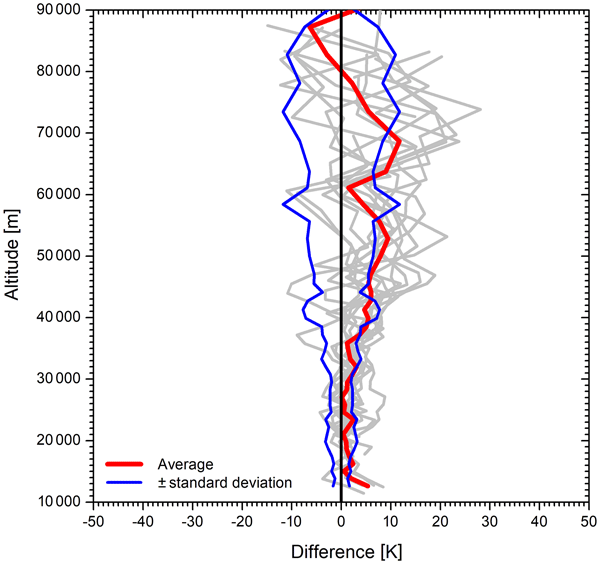
A powerful lidar system has been installed at the high-altitude observatory Schneefernerhaus (2575 m) to allow for atmospheric temperature measurements up to more than 80 km within just one hour. The temperature profiles are calibrated by values obtained from chemiluminscence of the hydroxyl radical around 86 km. The temperature profiles are successfully compared with satellite and lidar data.
Sabine Wüst, Lisa Küchelbacher, Franziska Trinkl, and Michael Bittner
Atmos. Meas. Tech., 18, 1591–1607, https://doi.org/10.5194/amt-18-1591-2025, https://doi.org/10.5194/amt-18-1591-2025, 2025
Short summary
Short summary
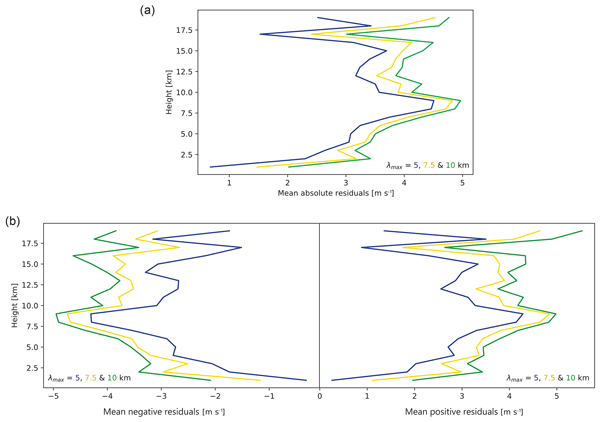
Information on the energy transported by atmospheric gravity waves (GWs) is crucial for improving atmosphere models. Most space-based studies report the potential energy. We use Aeolus wind data to estimate the kinetic energy (density). However, the data quality is a challenge for such analyses, as the accuracy of the data is in the range of typical GW amplitudes. We find a temporal coincidence between enhanced or breaking planetary waves and enhanced gravity wave kinetic energy density.
Carsten Schmidt, Lisa Küchelbacher, Sabine Wüst, and Michael Bittner
Atmos. Meas. Tech., 16, 4331–4356, https://doi.org/10.5194/amt-16-4331-2023, https://doi.org/10.5194/amt-16-4331-2023, 2023
Short summary
Short summary
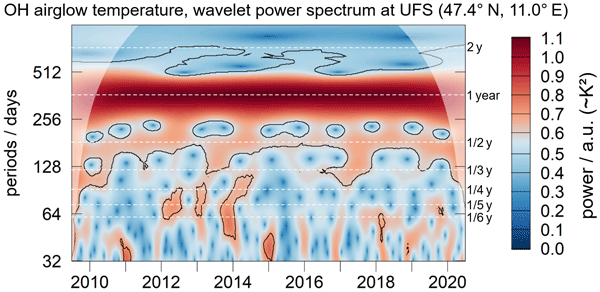
Two identical instruments in a parallel setup were used to observe the mesospheric OH airglow for more than 10 years (2009–2020) at 47.42°N, 10.98°E. This allows unique analyses of data quality aspects and their impact on the obtained results. During solar cycle 24 the influence of the sun was strong (∼6 K per 100 sfu). A quasi-2-year oscillation (QBO) of ±1 K is observed mainly during the maximum of the solar cycle. Unlike the stratospheric QBO the variation has a period of or below 24 months.
René Sedlak, Andreas Welscher, Patrick Hannawald, Sabine Wüst, Rainer Lienhart, and Michael Bittner
Atmos. Meas. Tech., 16, 3141–3153, https://doi.org/10.5194/amt-16-3141-2023, https://doi.org/10.5194/amt-16-3141-2023, 2023
Short summary
Short summary
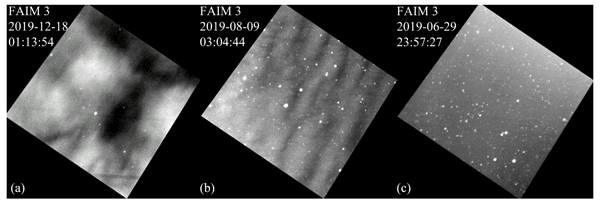
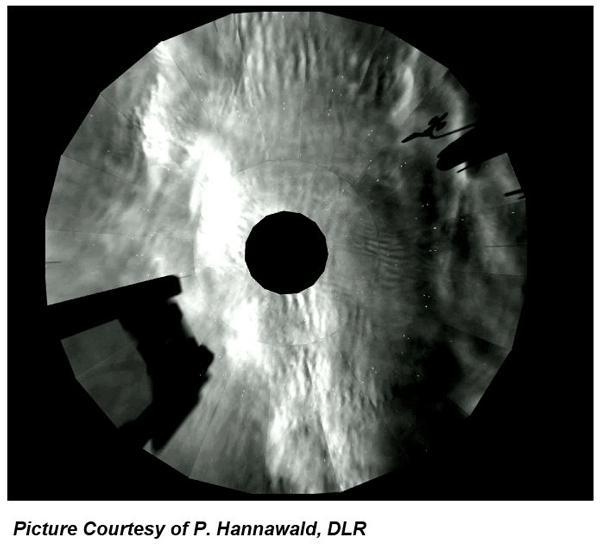
We show that machine learning can help in classifying images of the OH* airglow, a thin layer in the middle atmosphere (ca. 86 km height) emitting infrared radiation, in an efficient way. By doing this,
dynamicepisodes of strong movement in the OH* airglow caused predominantly by waves can be extracted automatically from large data sets. Within these dynamic episodes, turbulent wave breaking can also be found. We use these observations of turbulence to derive the energy released by waves.
Sabine Wüst, Michael Bittner, Patrick J. Espy, W. John R. French, and Frank J. Mulligan
Atmos. Chem. Phys., 23, 1599–1618, https://doi.org/10.5194/acp-23-1599-2023, https://doi.org/10.5194/acp-23-1599-2023, 2023
Short summary
Short summary
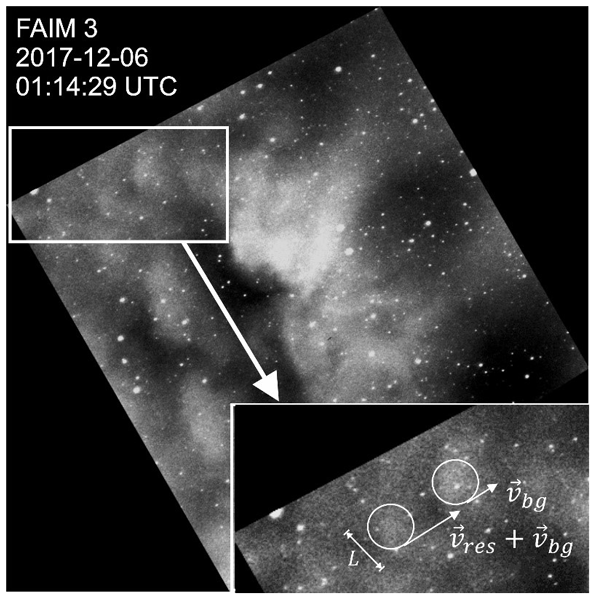
Ground-based OH* airglow measurements have been carried out for almost 100 years. Advanced detector technology has greatly simplified the automatic operation of OH* airglow observing instruments and significantly improved the temporal and/or spatial resolution. Studies based on long-term measurements or including a network of instruments are reviewed, especially in the context of deriving gravity wave properties. Scientific and technical challenges for the next few years are described.
René Sedlak, Patrick Hannawald, Carsten Schmidt, Sabine Wüst, Michael Bittner, and Samo Stanič
Atmos. Meas. Tech., 14, 6821–6833, https://doi.org/10.5194/amt-14-6821-2021, https://doi.org/10.5194/amt-14-6821-2021, 2021
Short summary
Short summary
High-resolution images of the OH* airglow layer (ca. 87 km height) acquired at Otlica Observatory, Slovenia, have been analysed. A statistical analysis of small-scale wave structures with horizontal wavelengths up to 4.5 km suggests strong presence of instability features in the upper mesosphere or lower thermosphere. The dissipated energy of breaking gravity waves is derived from observations of turbulent vortices. It is concluded that dynamical heating plays a vital role in the atmosphere.
Jaroslav Chum, Zbyšek Mošna, Jiří Baše, Jan Zedník, Carsten Schmidt, Patrick Hannawald, Jan Rusz, Jaroslav Urbář, and Šimon Mackovjak
Atmos. Chem. Phys., 26, 9559–9569, https://doi.org/10.5194/acp-26-9559-2026, https://doi.org/10.5194/acp-26-9559-2026, 2026
Short summary
Short summary
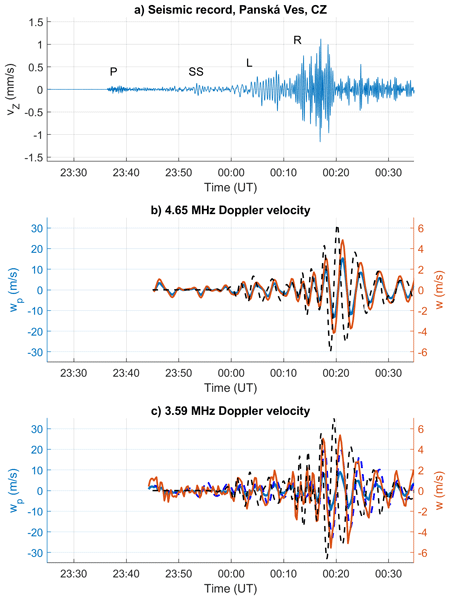
An analysis of unique observations of long period infrasound waves (~200 s) recorded in the ionosphere over Central Europe at record heights by continuous Doppler sounding is presented. The infrasound was generated by the Long-period surface seismic waves induced by the M8.8 Kamchatka earthquake on July 29, 2025. The time delay of the infrasound detection in the ionosphere relative to the vertical motion of the ground surface is consistent with the numerical simulation of infrasound propagation.
Thomas Trickl, Hannes Vogelmann, Michael Bittner, Gerald Nedoluha, Carsten Schmidt, Wolfgang Steinbrecht, and Sabine Wüst
Atmos. Meas. Tech., 18, 7477–7496, https://doi.org/10.5194/amt-18-7477-2025, https://doi.org/10.5194/amt-18-7477-2025, 2025
Short summary
Short summary
A powerful lidar system has been installed at the high-altitude observatory Schneefernerhaus (2575 m) to allow for atmospheric temperature measurements up to more than 80 km within just one hour. The temperature profiles are calibrated by values obtained from chemiluminscence of the hydroxyl radical around 86 km. The temperature profiles are successfully compared with satellite and lidar data.
Stefan Noll, Carsten Schmidt, Patrick Hannawald, Wolfgang Kausch, and Stefan Kimeswenger
Geosci. Model Dev., 18, 4353–4398, https://doi.org/10.5194/gmd-18-4353-2025, https://doi.org/10.5194/gmd-18-4353-2025, 2025
Short summary
Short summary
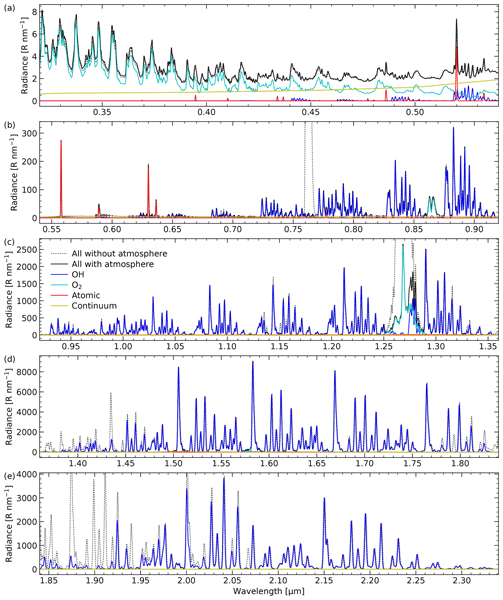
Non-thermal emission from chemical reactions in the Earth's middle und upper atmosphere strongly contributes to the brightness of the night sky below about 2.3 µm. The new Paranal Airglow Line And Continuum Emission model calculates the emission spectrum and its variability with an unprecedented accuracy. Relying on a large spectroscopic data set from astronomical spectrographs and theoretical molecular/atomic data, this model is valuable for airglow research and astronomical observatories.
Sabine Wüst, Lisa Küchelbacher, Franziska Trinkl, and Michael Bittner
Atmos. Meas. Tech., 18, 1591–1607, https://doi.org/10.5194/amt-18-1591-2025, https://doi.org/10.5194/amt-18-1591-2025, 2025
Short summary
Short summary
Information on the energy transported by atmospheric gravity waves (GWs) is crucial for improving atmosphere models. Most space-based studies report the potential energy. We use Aeolus wind data to estimate the kinetic energy (density). However, the data quality is a challenge for such analyses, as the accuracy of the data is in the range of typical GW amplitudes. We find a temporal coincidence between enhanced or breaking planetary waves and enhanced gravity wave kinetic energy density.
Stefan Noll, John M. C. Plane, Wuhu Feng, Konstantinos S. Kalogerakis, Wolfgang Kausch, Carsten Schmidt, Michael Bittner, and Stefan Kimeswenger
Atmos. Chem. Phys., 24, 1143–1176, https://doi.org/10.5194/acp-24-1143-2024, https://doi.org/10.5194/acp-24-1143-2024, 2024
Short summary
Short summary
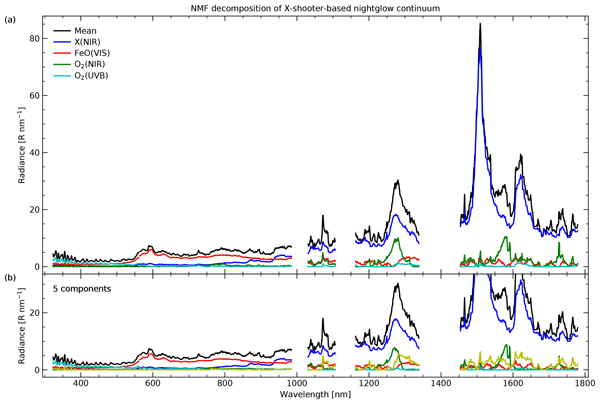
The Earth's nighttime radiation in the range from the near-UV to the near-IR mainly originates between 75 and 105 km and consists of lines of different species, which are important indicators of the chemistry and dynamics at these altitudes. Based on astronomical spectra, we have characterised the structure and variability of a pseudo-continuum of a high number of faint lines and discovered a new emission process in the near-IR. By means of simulations, we identified HO2 as the likely emitter.
Carsten Schmidt, Lisa Küchelbacher, Sabine Wüst, and Michael Bittner
Atmos. Meas. Tech., 16, 4331–4356, https://doi.org/10.5194/amt-16-4331-2023, https://doi.org/10.5194/amt-16-4331-2023, 2023
Short summary
Short summary
Two identical instruments in a parallel setup were used to observe the mesospheric OH airglow for more than 10 years (2009–2020) at 47.42°N, 10.98°E. This allows unique analyses of data quality aspects and their impact on the obtained results. During solar cycle 24 the influence of the sun was strong (∼6 K per 100 sfu). A quasi-2-year oscillation (QBO) of ±1 K is observed mainly during the maximum of the solar cycle. Unlike the stratospheric QBO the variation has a period of or below 24 months.
René Sedlak, Andreas Welscher, Patrick Hannawald, Sabine Wüst, Rainer Lienhart, and Michael Bittner
Atmos. Meas. Tech., 16, 3141–3153, https://doi.org/10.5194/amt-16-3141-2023, https://doi.org/10.5194/amt-16-3141-2023, 2023
Short summary
Short summary
We show that machine learning can help in classifying images of the OH* airglow, a thin layer in the middle atmosphere (ca. 86 km height) emitting infrared radiation, in an efficient way. By doing this,
dynamicepisodes of strong movement in the OH* airglow caused predominantly by waves can be extracted automatically from large data sets. Within these dynamic episodes, turbulent wave breaking can also be found. We use these observations of turbulence to derive the energy released by waves.
Sabine Wüst, Michael Bittner, Patrick J. Espy, W. John R. French, and Frank J. Mulligan
Atmos. Chem. Phys., 23, 1599–1618, https://doi.org/10.5194/acp-23-1599-2023, https://doi.org/10.5194/acp-23-1599-2023, 2023
Short summary
Short summary
Ground-based OH* airglow measurements have been carried out for almost 100 years. Advanced detector technology has greatly simplified the automatic operation of OH* airglow observing instruments and significantly improved the temporal and/or spatial resolution. Studies based on long-term measurements or including a network of instruments are reviewed, especially in the context of deriving gravity wave properties. Scientific and technical challenges for the next few years are described.
René Sedlak, Patrick Hannawald, Carsten Schmidt, Sabine Wüst, Michael Bittner, and Samo Stanič
Atmos. Meas. Tech., 14, 6821–6833, https://doi.org/10.5194/amt-14-6821-2021, https://doi.org/10.5194/amt-14-6821-2021, 2021
Short summary
Short summary
High-resolution images of the OH* airglow layer (ca. 87 km height) acquired at Otlica Observatory, Slovenia, have been analysed. A statistical analysis of small-scale wave structures with horizontal wavelengths up to 4.5 km suggests strong presence of instability features in the upper mesosphere or lower thermosphere. The dissipated energy of breaking gravity waves is derived from observations of turbulent vortices. It is concluded that dynamical heating plays a vital role in the atmosphere.
Cited articles
Baker, D. J. and Stair, A. T.: Rocket measurements of the altitude distributions of the hydroxyl airglow, Phys. Scripta, 37, 611–622, https://doi.org/10.1088/0031-8949/37/4/021, 1988.
Becker, E. and Vadas, S. L.: Secondary gravity waves in the winter mesosphere: Results from a high-resolution global circulation model, J. Geophys. Res.-Atmos., 123, 2605–2627, https://doi.org/10.1002/2017JD027460, 2018.
Berger, U. and von Zahn, U.: The two-level structure of the mesopause: A model study, J. Geophys. Res.-Atmos., 104, 22083–22093, https://doi.org/10.1029/1999JD900389, 1999.
Fritts, D. C., Isler, J. R., Hecht, J. H., Walterscheid, R. L., and Andreassen, Ø.: Wave breaking signatures in sodium densities and OH nightglow: 2. Simulation of wave and instability structures, J. Geophys. Res.-Atmos., 102, 6669–6684, https://doi.org/10.1029/96JD01902, 1997.
Fritts, D. C., Vadas, S. L., and Yamada, Y.: An estimate of strong local body forcing and gravity wave radiation based on OH airglow and meteor radar observations, Geophys. Res. Lett., 29, https://doi.org/10.1029/2001gl013753, 2002.
Hannawald, P., Schmidt, C., Wüst, S., and Bittner, M.: A fast SWIR imager for observations of transient features in OH airglow, Atmos. Meas. Tech., 9, 1461–1472, https://doi.org/10.5194/amt-9-1461-2016, 2016.
Hannawald, P., Schmidt, C., Sedlak, R., Wüst, S., and Bittner, M.: Seasonal and intra-diurnal variability of small-scale gravity waves in OH airglow at two Alpine stations, Atmos. Meas. Tech., 12, 457–469, https://doi.org/10.5194/amt-12-457-2019, 2019.
Hecht, J. H.: Instability layers and airglow imaging, Rev. Geophys., 42, https://doi.org/10.1029/2003RG000131, 2004.
Hecht, J. H., Fritts, D. C., Gelinas, L. J., Rudy, R. J., Walterscheid, R. L., and Liu, A. Z.: Kelvin-Helmholtz billow interactions and instabilities in the mesosphere over the Andes Lidar Observatory: 1. Observations, J. Geophys. Res., 126, e2020JD033414, https://doi.org/10.1029/2020JD033414, 2021.
Hendrycks, D., Mazeika, M., Kadavath, S., and Song, D.: Using Self-Supervised Learning Can Improve Model Robustness and Uncertainty, Adv. Neur. In., 32, 15663–15674, 2019.
Hersbach, H., Bell, B., Berrisford, P., Hirahara, S., Horányi, A., Muñoz-Sabater, J., Nicolas, J., Peubey, C., Radu, R., Schepers, D., Simmons, A., Soci, C., Abdalla, S., Abellan, X., Balsamo, G., Bechtold, P., Biavati, G., Bidlot, J., Bonavita, M., de Chiara, G., Dahlgren, P., Dee, D., Diamantakis, M., Dragani, R., Flemming, J., Forbes, R., Fuentes, M., Geer, A., Haimberger, L., Healy, S., Hogan, R. J., Hólm, E., Janisková, M., Keeley, S., Laloyaux, P., Lopez, P., Lupu, C., Radnoti, G., de Rosnay, P., Rozum, I., Vamborg, F., Villaume, S., and Thépaut, J.-N.: The ERA5 global reanalysis, Q. J. Roy. Meteor. Soc., 146, 1999–2049, https://doi.org/10.1002/qj.3803, 2020.
Hersbach, H., Bell, B., Berrisford, P., Biavati, G., Horányi, A., Muñoz Sabater, J., Nicolas, J., Peubey, C., Radu, R., Rozum, I., Schepers, D., Simmons, A., Soci, C., Dee, D., and Thépaut, J.-N.: ERA5 hourly data on single levels from 1940 to present, Copernicus Climate Change Service (C3S) Climate Data Store (CDS) [data set], https://doi.org/10.24381/cds.adbb2d47, 2023.
Jacobi, C., Lilienthal, F., Geißler, C., and Krug, A.: Long-term variability of mid-latitude mesosphere-lower thermosphere winds over Collm (51° N, 13° E), J. Atmos. Sol.-Terr. Phy., 136, 174–186, https://doi.org/10.1016/j.jastp.2015.05.006, 2015.
Jaen, J., Renkwitz, T., Liu, H., Jacobi, C., Wing, R., Kuchař, A., Tsutsumi, M., Gulbrandsen, N., and Chau, J. L.: Long-term studies of the summer wind in the mesosphere and lower thermosphere at middle and high latitudes over Europe, Atmos. Chem. Phys., 23, 14871–14887, https://doi.org/10.5194/acp-23-14871-2023, 2023.
Lai, C., Xu, J., Yue, J., Yuan, W., Liu, X., Li, W., and Li, Q.: Automatic extraction of gravity waves from all-sky airglow image based on machine learning, Remote Sens.-Basel, 11, 1516, https://doi.org/10.3390/rs11131516, 2019.
Li, J., Li, T., Dou, X., Fang, X., Cao, B., She, C.-Y., Nakamura, T., Manson, A., Meek, C., and Thorsen, D.: Characteristics of ripple structures revealed in OH airglow images, J. Geophys. Res.-Space, 122, 3748–3759, https://doi.org/10.1002/2016JA023538, 2017.
Li, T., She, C. Y., Williams, B. P., Yuan, T., Collins, R. L., Kieffaber, L. M., and Peterson, A. W.: Concurrent OH imager and sodium temperature/wind lidar observation of localized ripples over northern Colorado, J. Geophys. Res.-Atmos., 110, D13110, https://doi.org/10.1029/2004JD004885, 2005.
López-González, M. J., García-Comas, M., Rodríguez, E., López-Puertas, M., Olivares, I., Jerónimo-Zafra, J. M., Robles-Muñoz, N. F., Pérez-Silvente, T., Shepherd, M. G., Shepherd, G. G., and Sargoytchev, S.: Gravity wave activity in the middle atmosphere from SATI airglow observations at northern mid-latitude: Seasonal variation and comparison with tidal and planetary wave-like activity, J. Atmos. Sol.-Terr. Phy., https://doi.org/10.1016/j.jastp.2020.105329, 2020.
Meinel, I. A.: OH emission bands in the spectrum of the night sky, Astrophys. J., 111, 555–564, 1950.
Meng, X., Li, C., Li, J., Li, X., Guo, F., and Xiao, Z.: YOLOv7-MA: Improved YOLOv7-Based Wheat Head Detection and Counting, Remote Sens.-Basel, 15, 3770, https://doi.org/10.3390/rs15153770, 2023.
Neubeck, A. and van Gool, L.: Efficient Non-Maximum Suppression, in: 18th International Conference on Pattern Recognition (ICPR'06), Hong Kong, China, 2006, 850–855, https://doi.org/10.1109/ICPR.2006.479, 2006.
Offermann, D., Goussev, O., Donner, M., Forbes, J. M., Hagan, M., Mlynczak, M. G., Oberheide, J., Preusse, P., Schmidt, H., and Russell, J. M.: Relative intensities of middle atmosphere waves, J. Geophys. Res.-Atmos., 114, D06110, https://doi.org/10.1029/2008JD010662, 2009.
Ren, S., He, K., Girshick, R., and Sun, J.: Faster R-CNN: Towards Real-Time Object Detection with Region Proposal Networks, IEEE T. Pattern Anal., 39, 1137–1149, https://doi.org/10.1109/TPAMI.2016.2577031, 2017.
Rourke, S., Mulligan, F. J., French, W. J., and Murphy, D. J.: A climatological study of short-period gravity waves and ripples at Davis Station, Antarctica (68° S, 78° E), during the (austral winter February–October) period 1999–2013, J. Geophys. Res.-Atmos., 122, 11308–11404, https://doi.org/10.1002/2017JD026998, 2017.
Sedlak, R., Hannawald, P., Schmidt, C., Wüst, S., and Bittner, M.: High-resolution observations of small-scale gravity waves and turbulence features in the OH airglow layer, Atmos. Meas. Tech., 9, 5955–5963, https://doi.org/10.5194/amt-9-5955-2016, 2016.
Sedlak, R., Zuhr, A., Schmidt, C., Wüst, S., Bittner, M., Didebulidze, G. G., and Price, C.: Intra-annual variations of spectrally resolved gravity wave activity in the upper mesosphere/lower thermosphere (UMLT) region, Atmos. Meas. Tech., 13, 5117–5128, https://doi.org/10.5194/amt-13-5117-2020, 2020.
Sedlak, R., Hannawald, P., Schmidt, C., Wüst, S., Bittner, M., and Stanič, S.: Gravity wave instability structures and turbulence from more than 1.5 years of OH* airglow imager observations in Slovenia, Atmos. Meas. Tech., 14, 6821–6833, https://doi.org/10.5194/amt-14-6821-2021, 2021.
Sedlak, R., Welscher, A., Hannawald, P., Wüst, S., Lienhart, R., and Bittner, M.: Analysis of 2D airglow imager data with respect to dynamics using machine learning, Atmos. Meas. Tech., 16, 3141–3153, https://doi.org/10.5194/amt-16-3141-2023, 2023.
She, C. Y., Chen, S., Hu, Z., Sherman, J., Vance, J. D., Vasoli, V., White, M. A., Yu, J., and Krueger, D. A.: Eight-year climatology of nocturnal temperature and sodium density in the mesopause region (80 to 105 km) over Fort Collins, Co (41° N, 105° W), Geophys. Res. Lett., 27, 3289–3292, https://doi.org/10.1029/2000GL003825, 2000.
Suzuki, S., Tsutsumi, M., Palo, S. E., Ebihara, Y., Taguchi, M., and Ejiri, M.: Short-period gravity waves and ripples in the South Pole mesosphere, J. Geophys. Res.-Atmos., 116, D19116, https://doi.org/10.1029/2011JD015882, 2011.
Takahashi, H., Batista, P. P., Sahai, Y., and Clemesha, B. R.: Atmospheric wave propagations in the mesopause region observed by the OH (8, 3) band, NaD, O2A (8645 Å) band and OI 5577 Å nightglow emissions, Planet. Space Sci., 33, 381–384, https://doi.org/10.1016/0032-0633(85)90081-9, 1985.
Taylor, M.: A review of advances in imaging techniques for measuring short period gravity waves in the mesosphere and lower thermosphere, Adv. Space Res., 19, 667–676, https://doi.org/10.1016/s0273-1177(97)00161-0, 1997.
Taylor, M. J., Bishop, M. B., and Taylor, V.: All-sky measurements of short period waves imaged in the OI (557.7 nm), Na (589.2 nm) and near infrared OH and O2 (0, 1) nightglow emissions during the ALOHA-93 campaign, Geophys. Res. Lett., 22, 2833–2836, https://doi.org/10.1029/95GL02946, 1995.
von Savigny, C.: Variability of OH(3–1) emission altitude from 2003 to 2011: Long-term stability and universality of the emission rate–altitude relationship, J. Atmos. Sol.-Terr. Phy., 127, 120–128, https://doi.org/10.1016/j.jastp.2015.02.001, 2015.
Wachter, P., Schmidt, C., Wüst, S., and Bittner, M.: Spatial gravity wave characteristics obtained from multiple OH(3-1) airglow temperature time series, J. Atmos. Sol.-Terr. Phy., 135, 192–201, 2015.
Wang, C.-Y., Bochkovskiy, A., and Liao, H.-Y. M.: YOLOv7: Trainable bag-of-freebies sets new state-of-the-art for real-time object detectors, 2023 IEEE/CVF Conference on Computer Vision and Pattern Recognition (CVPR), Vancouver, BC, Canada, 2023, 7464–7475, https://doi.org/10.1109/CVPR52729.2023.00721, 2023.
Wu, H., Xu, X., Luo, T., Yang, Y., Xiong, Z., and Wang, Y.: Variation and comparison of cloud cover in MODIS and four reanalysis datasets of ERA-interim, ERA5, MERRA-2 and NCEP, Atmos. Res., 281, 106477, https://doi.org/10.1016/j.atmosres.2022.106477, 2023.
Wüst, S., Wendt, V., Schmidt, C., Lichtenstern, S., Bittner, M., Yee, J.-H., Mlynczak, M. G., and Russell III, J. M.: Derivation of gravity wave potential energy density from NDMC measurements, J. Atmos. Sol.-Terr. Phy., 138, 32–46, https://doi.org/10.1016/j.jastp.2015.12.003, 2016.
Wüst, S., Bittner, M., Yee, J.-H., Mlynczak, M. G., and Russell III, J. M.: Variability of the Brunt–Väisälä frequency at the OH* layer height, Atmos. Meas. Tech., 10, 4895–4903, https://doi.org/10.5194/amt-10-4895-2017, 2017.
Wüst, S., Offenwanger, T., Schmidt, C., Bittner, M., Jacobi, C., Stober, G., Yee, J.-H., Mlynczak, M. G., and Russell III, J. M.: Derivation of gravity wave intrinsic parameters and vertical wavelength using a single scanning OH(3-1) airglow spectrometer, Atmos. Meas. Tech., 11, 2937–2947, https://doi.org/10.5194/amt-11-2937-2018, 2018.
Wüst, S., Bittner, M., Yee, J.-H., Mlynczak, M. G., and Russell III, J. M.: Variability of the Brunt–Väisälä frequency at the OH*-airglow layer height at low and midlatitudes, Atmos. Meas. Tech., 13, 6067–6093, https://doi.org/10.5194/amt-13-6067-2020, 2020.
Yamada, Y., Fukunishi, H., Nakamura, T., and Tsuda, T.: Breaking of small-scale gravity wave and transition to turbulence observed in OH airglow, Geophys. Res. Lett., 28, 2153–2156, https://doi.org/10.1029/2000GL011945, 2001.
Yue, J., Nakamura, T., She, C.-Y., Weber, M., Lyons, W., and Li, T.: Seasonal and local time variability of ripples from airglow imager observations in US and Japan, Ann. Geophys., 28, 1401–1408, https://doi.org/10.5194/angeo-28-1401-2010, 2010.
Zhao, K., Zhao, L., Zhao, Y., and Deng, H.: Study on Lightweight Model of Maize Seedling Object Detection Based on YOLOv7, Appl. Sci.-Basel, 13, 7731, https://doi.org/10.3390/app13137731, 2023.
Zheng, Z., Wang, P., Liu, W., Li, J., Ye, R., and Ren, D.: Distance-IoU Loss: Faster and Better Learning for Bounding Box Regression, Proceedings of the AAAI Conference on Artificial Intelligence, 34, 12993–13000, https://doi.org/10.1609/aaai.v34i07.6999, 2019.
Short summary
Since June 2019, an infrared camera has been scanning the nearly entire sky (diameter: 500 km) above DLR Oberpfaffenhofen (48.09° N, 11.28° E), Germany, every night providing images of the OH* airglow layer (height: 85–87 km), with a high spatial and temporal resolution (150 m, 2 min). We analysed three years of data for spatially confined small-scale wave structures with a machine learning approach. We derived seasonal variations and deduced that wave breaking is mostly observed in summer.
Since June 2019, an infrared camera has been scanning the nearly entire sky (diameter: 500 km)...


