
Articles | Volume 19, issue 11
https://doi.org/10.5194/amt-19-3581-2026
© Author(s) 2026. This work is distributed under
the Creative Commons Attribution 4.0 License.
the Creative Commons Attribution 4.0 License.
https://doi.org/10.5194/amt-19-3581-2026
© Author(s) 2026. This work is distributed under
the Creative Commons Attribution 4.0 License.
the Creative Commons Attribution 4.0 License.
Research article
| Highlight paper
| 
02 Jun 2026
Research article | Highlight paper |
| 02 Jun 2026
| 02 Jun 2026
Arctic Weather Satellite assessment and assimilation at ECMWF

ECMWF, Reading, UK
Niels Bormann
ECMWF, Reading, UK
Marijana Crepulja
ECMWF, Reading, UK
Mohamed Dahoui
ECMWF, Reading, UK
Alan J. Geer
ECMWF, Reading, UK
Christophe Accadia
EUMETSAT, Darmstadt, Germany
Sabatino Di Michele
EUMETSAT, Darmstadt, Germany
Tim J. Hewison
EUMETSAT, Darmstadt, Germany
Ville Kangas
ESA, Noordwijk, the Netherlands
Related authors
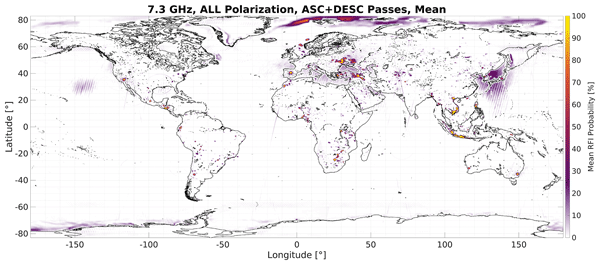
Raul Onrubia, Roger Oliva, David Duncan, Niels Bormann, Jose Barbosa, Ioannis Nestoras, Adriano Jordão, Flavio Jorge, Juliette Challot, and Yan Soldo
Atmos. Meas. Tech., 19, 4141–4163, https://doi.org/10.5194/amt-19-4141-2026, https://doi.org/10.5194/amt-19-4141-2026, 2026
Short summary
Short summary
We studied how common unwanted man-made radio frequency interferes affect Earth observation (EO) satellites used for weather and climate studies. We scanned frequencies from 6 to 200 GHz in 2022. We found strong interference at lower ranges, including first signs at 23.8 and 36.5 gigahertz, while higher ranges were mostly clean. These results highlight the need for real-time monitoring, stronger protection from authorities, and on-board and on-ground mitigation systems in EO missions.
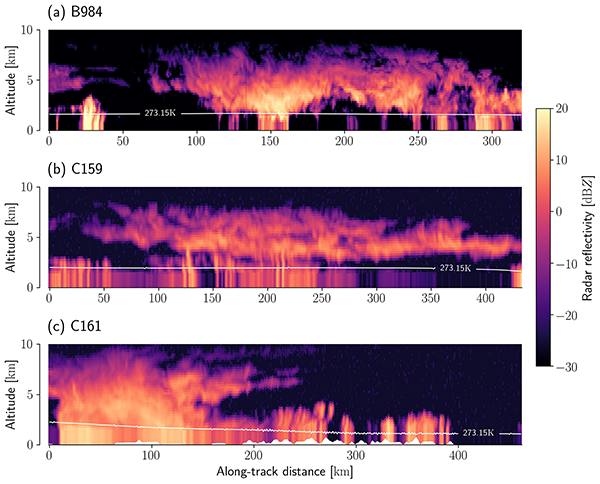
Simon Pfreundschuh, Stuart Fox, Patrick Eriksson, David Duncan, Stefan A. Buehler, Manfred Brath, Richard Cotton, and Florian Ewald
Atmos. Meas. Tech., 15, 677–699, https://doi.org/10.5194/amt-15-677-2022, https://doi.org/10.5194/amt-15-677-2022, 2022
Short summary
Short summary
We test a novel method to remotely measure ice particles in clouds. This is important because such measurements are required to improve climate and weather models. The method combines a radar with newly developed sensors measuring microwave radiation at very short wavelengths. We use observations made from aircraft flying above the cloud and compare them to real measurements from inside the cloud. This works well given that one can model the ice particles in the cloud sufficiently well.
Alan J. Geer, Philip Browne, and Tracy Scanlon
EGUsphere, https://doi.org/10.5194/egusphere-2026-3421, https://doi.org/10.5194/egusphere-2026-3421, 2026
This preprint is open for discussion and under review for The Cryosphere (TC).
Short summary
Short summary
Weather forecasting models represent not just the atmosphere but also the ocean, sea ice and land. In polar regions, most observations come from satellites measuring a mix of radiation from the surface and the atmosphere. We show how to extract information about the atmosphere and sea ice more directly than has been done previously. This improves our knowledge of sea ice conditions and leads to improved weather forecasts several days later, not just in polar areas but more globally.
Raul Onrubia, Roger Oliva, David Duncan, Niels Bormann, Jose Barbosa, Ioannis Nestoras, Adriano Jordão, Flavio Jorge, Juliette Challot, and Yan Soldo
Atmos. Meas. Tech., 19, 4141–4163, https://doi.org/10.5194/amt-19-4141-2026, https://doi.org/10.5194/amt-19-4141-2026, 2026
Short summary
Short summary
We studied how common unwanted man-made radio frequency interferes affect Earth observation (EO) satellites used for weather and climate studies. We scanned frequencies from 6 to 200 GHz in 2022. We found strong interference at lower ranges, including first signs at 23.8 and 36.5 gigahertz, while higher ranges were mostly clean. These results highlight the need for real-time monitoring, stronger protection from authorities, and on-board and on-ground mitigation systems in EO missions.
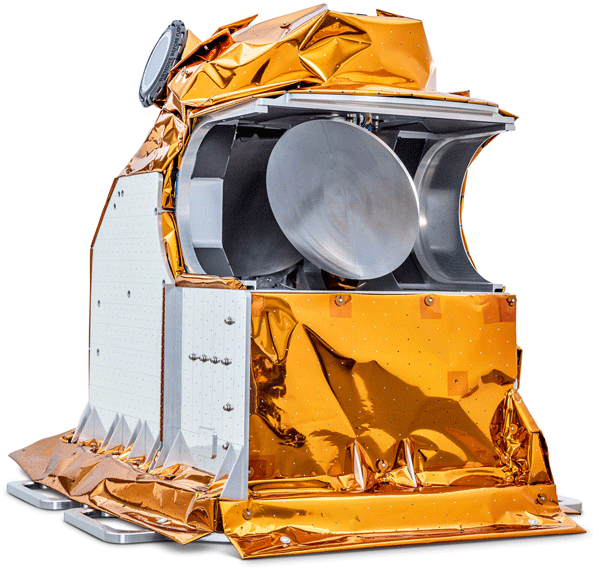
Patrick Eriksson, Anders Emrich, Kalle Kempe, Johan Riesbeck, Alhassan Aljarosha, Olivier Auriacombe, Joakim Kugelberg, Enne Hekma, Roland Albers, Axel Murk, Søren Møller Pedersen, Laurenz John, Jan Stake, Peter McEvoy, Bengt Rydberg, Adam Dybbroe, Anke Thoss, Alessio Canestri, Christophe Accadia, Paolo Colucci, Daniele Gherardi, and Ville Kangas
Atmos. Meas. Tech., 18, 4709–4729, https://doi.org/10.5194/amt-18-4709-2025, https://doi.org/10.5194/amt-18-4709-2025, 2025
Short summary
Short summary
The Arctic Weather Satellite (AWS), developed by the European Space Agency, highlights a new approach in satellite design, aiming to expand the network of operational microwave sensors cost-effectively. Launched in August 2024, AWS features a 19-channel microwave cross-track radiometer. Notably, it introduces groundbreaking channels at 325.15 GHz. In addition, AWS acts as the stepping stone to a suggested constellation of satellites, denoted as EUMETSAT Polar System Sterna.
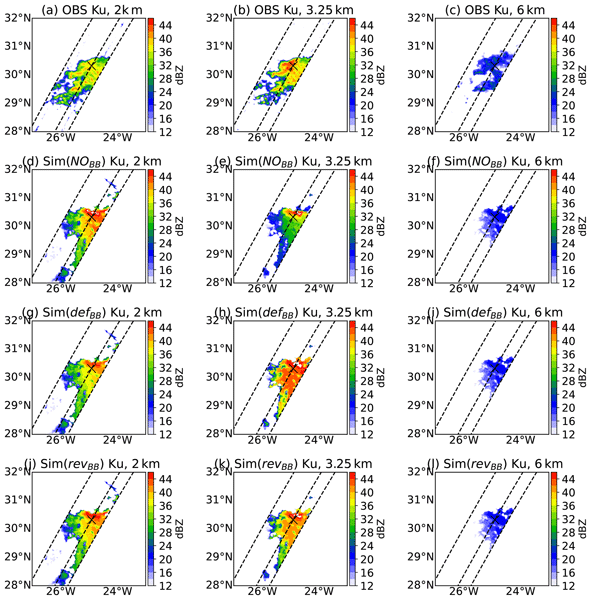
Rohit Mangla, Mary Borderies, Philippe Chambon, Alan Geer, and James Hocking
Atmos. Meas. Tech., 18, 2751–2779, https://doi.org/10.5194/amt-18-2751-2025, https://doi.org/10.5194/amt-18-2751-2025, 2025
Short summary
Short summary
This study provides a detailed description of the radar simulator available within version 13 of the RTTOV (Radiative Transfer for the TIROS Operational Vertical Sounder) software. It is applied to the Météo-France global numerical weather prediction model, with the objective of simulating Dual-frequency Precipitation Radar reflectivity observations. Additionally, the simulation of the bright band is addressed and then successfully applied to model forecasts for the purpose of classifying NWP (numerical weather prediction) model columns between stratiform and convective categories.
Simon Pfreundschuh, Stuart Fox, Patrick Eriksson, David Duncan, Stefan A. Buehler, Manfred Brath, Richard Cotton, and Florian Ewald
Atmos. Meas. Tech., 15, 677–699, https://doi.org/10.5194/amt-15-677-2022, https://doi.org/10.5194/amt-15-677-2022, 2022
Short summary
Short summary
We test a novel method to remotely measure ice particles in clouds. This is important because such measurements are required to improve climate and weather models. The method combines a radar with newly developed sensors measuring microwave radiation at very short wavelengths. We use observations made from aircraft flying above the cloud and compare them to real measurements from inside the cloud. This works well given that one can model the ice particles in the cloud sufficiently well.
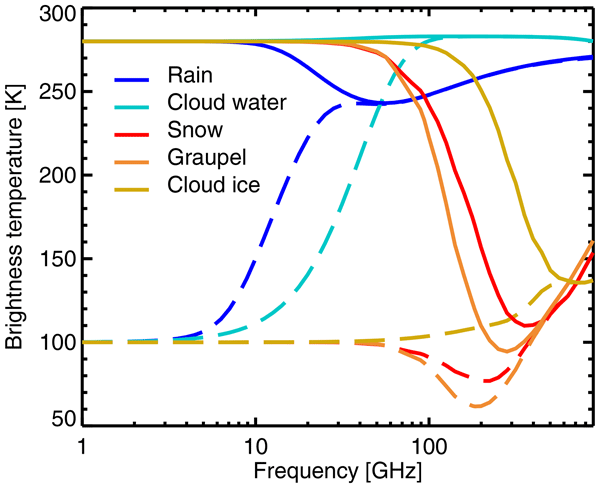
Alan J. Geer, Peter Bauer, Katrin Lonitz, Vasileios Barlakas, Patrick Eriksson, Jana Mendrok, Amy Doherty, James Hocking, and Philippe Chambon
Geosci. Model Dev., 14, 7497–7526, https://doi.org/10.5194/gmd-14-7497-2021, https://doi.org/10.5194/gmd-14-7497-2021, 2021
Short summary
Short summary
Satellite observations of radiation from the earth can have strong sensitivity to cloud and precipitation in the atmosphere, with applications in weather forecasting and the development of models. Computing the radiation received at the satellite sensor using radiative transfer theory requires a simulation of the optical properties of a volume containing a large number of cloud and precipitation particles. This article describes the physics used to generate these
bulkoptical properties.
Cited articles
Albers, R., Emrich, A., and Murk, A.: Antenna Design for the Arctic Weather Satellite Microwave Sounder, IEEE Open J. Antennas Propag., 4, 686–694, https://doi.org/10.1109/OJAP.2023.3295390, 2023. a
Bell, W., English, S. J., Candy, B., Atkinson, N., Hilton, F., Baker, N., Swadley, S. D., Campbell, W. F., Bormann, N., Kelly, G., and Kazumori, M.: The Assimilation of SSMIS Radiances in Numerical Weather Prediction Models, IEEE T. Geosci. Remote, 46, 884–900, https://doi.org/10.1109/TGRS.2008.917335, 2008. a
Bormann, N., Fouilloux, A., and Bell, W.: Evaluation and assimilation of ATMS data in the ECMWF system, J. Geophys. Res.-Atmos., 118, 12970–12980, https://doi.org/10.1002/2013JD020325, 2013. a
Bormann, N., Duncan, D., English, S., Healy, S., Lonitz, K., Chen, K., Lawrence, H., and Lu, Q.: Growing operational use of FY-3 data in the ECMWF system, Adv. Atmos. Sci., 38, 1285–1298, https://doi.org/10.1007/s00376-020-0207-3, 2021. a
Cardinali, C.: Monitoring the observation impact on the short-range forecast, Q. J. Roy. Meteor. Soc., 135, 239–250, https://doi.org/10.1002/qj.366, 2009. a
Dee, D. P.: Variational bias correction of radiance data in the ECMWF system, in: ECMWF workshop proceedings: Assimilation of high spectral resolution sounders in NWP, Shinfield Park, Reading, 28 June–1 July 2004, 97–112, ECMWF, Reading, UK, https://www.ecmwf.int/sites/default/files/elibrary/2004/74143-variational-bias-correction-radiance-data-ecmwf-system_0.pdf (last access: 28 May 2026), 2004. a
Duncan, D. I., Bormann, N., and Hólm, E.: On the Addition of Microwave Sounders and Numerical Weather Prediction Skill, Q. J. Roy. Meteor. Soc., 147, 3703–3718, https://doi.org/10.1002/qj.4149, 2021. a
Duncan, D. I., Bormann, N., Geer, A. J., and Weston, P.: Superobbing and Thinning Scales for All-Sky Humidity Sounder Assimilation, Mon. Weather Rev., 152, 1821–1837, https://doi.org/10.1175/MWR-D-24-0020.1, 2024a. a, b, c, d
Duncan, D. I., Geer, A., Bormann, N., and Dahoui, M.: Vicarious calibration monitoring of MWI and ICI using NWP fields, Tech. rep., EUMETSAT Contract Report, https://doi.org/10.21957/7c2d18d2e1, 2024b. a, b
Duncan, D. I., Bormann, N., Fielding, M. D., Geer, A. J., McEvoy, P., May, E., and Eriksson, P.: A first global view of sub-millimetre radiances from the Arctic Weather Satellite, ESS Open Archive [preprint], https://doi.org/10.22541/essoar.176279324.43846104/v1, 2025b. a
ECMWF: IFS Documentation CY49R1 - Part II: Data Assimilation, ECMWF, Chap. 2, https://doi.org/10.21957/105cb1333c, 2024. a, b, c, d
Eriksson, P., Rydberg, B., Mattioli, V., Thoss, A., Accadia, C., Klein, U., and Buehler, S. A.: Towards an operational Ice Cloud Imager (ICI) retrieval product, Atmos. Meas. Tech., 13, 53–71, https://doi.org/10.5194/amt-13-53-2020, 2020. a
Eriksson, P., Emrich, A., Kempe, K., Riesbeck, J., Aljarosha, A., Auriacombe, O., Kugelberg, J., Hekma, E., Albers, R., Murk, A., Møller Pedersen, S., John, L., Stake, J., McEvoy, P., Rydberg, B., Dybbroe, A., Thoss, A., Canestri, A., Accadia, C., Colucci, P., Gherardi, D., and Kangas, V.: The Arctic Weather Satellite radiometer, Atmos. Meas. Tech., 18, 4709–4729, https://doi.org/10.5194/amt-18-4709-2025, 2025. a, b, c, d, e, f, g
Geer, A., Lupu, C., Duncan, D., Bormann, N., and English, S.: SURFEM-ocean microwave surface emissivity evaluated, ECMWF Technical Memoranda, 915, https://doi.org/10.21957/0af49d82e2, 2024. a
Geer, A. J.: Significance of changes in medium-range forecast scores, Tellus A, 68, 30229, https://doi.org/10.3402/tellusa.v68.30229, 2016. a
Geer, A. J. and Bauer, P.: Observation errors in all-sky data assimilation, Q. J. Roy. Meteor. Soc., 137, 2024–2037, https://doi.org/10.1002/qj.830, 2011. a, b, c
Geer, A. J., Bauer, P., and Lopez, P.: Direct 4D-Var assimilation of all-sky radiances. Part II: Assessment, Q. J. Roy. Meteor. Soc., 136, 1886–1905, https://doi.org/10.1002/qj.681, 2010. a, b
Geer, A. J., Baordo, F., Bormann, N., and English, S.: All-sky assimilation of microwave humidity sounders, ECMWF Technical Memoranda, 741, https://doi.org/10.21957/obosmx154, 2014. a, b, c
Geer, A. J., Bauer, P., Lonitz, K., Barlakas, V., Eriksson, P., Mendrok, J., Doherty, A., Hocking, J., and Chambon, P.: Bulk hydrometeor optical properties for microwave and sub-millimetre radiative transfer in RTTOV-SCATT v13.0, Geosci. Model Dev., 14, 7497–7526, https://doi.org/10.5194/gmd-14-7497-2021, 2021. a
Geer, A. J., Lonitz, K., Duncan, D. I., and Bormann, N.: Improved Surface Treatment for All-sky Microwave Observations, ECMWF Technical Memoranda, 894, https://doi.org/10.21957/zi7q6hau, 2022. a, b
Healy, S., Bormann, N., Geer, A., Holm, E., Ingleby, B., Lean, K., Lonitz, K., and Lupu, C.: Methods for assessing the impact of current and future components of the global observing system, ECMWF Technical Memoranda, 916, https://doi.org/10.21957/2f240fe55f, 2024. a
Janjić, T., Bormann, N., Bocquet, M., Carton, J. A., Cohn, S. E., Dance, S. L., Losa, S. N., Nichols, N. K., Potthast, R., Waller, J. A., and Weston, P.: On the representation error in data assimilation, Q. J. Roy. Meteor. Soc., 144, 1257–1278, https://doi.org/10.1002/qj.3130, 2018. a
Kilic, L., Prigent, C., Jimenez, C., Turner, E., Hocking, J., English, S., Meissner, T., and Dinnat, E.: Development of the SURface Fast Emissivity Model for Ocean (SURFEM-Ocean) Based on the PARMIO Radiative Transfer Model, Earth Space Sci., 10, e2022EA002785, https://doi.org/10.1029/2022EA002785, 2023. a
Laloyaux, P., Alexe, M., Boucher, E., Lean, P., Pinnington, E., Lang, S., Necker, T., and McNally, A.: Using data assimilation tools to dissect GraphDOP, arXiv [preprint], https://doi.org/10.48550/arXiv.2510.27388, 31 October 2025. a
Lawrence, H., Bormann, N., Geer, A. J., Lu, Q., and English, S. J.: Evaluation and Assimilation of the Microwave Sounder MWHS-2 Onboard FY-3C in the ECMWF Numerical Weather Prediction System, IEEE T. Geosci. Remote, 56, 3333–3349, https://doi.org/10.1109/TGRS.2018.2798292, 2018. a, b
Lean, K. and Bormann, N.: Evaluation of the EPS-Sterna 325 GHz channels in the Ensemble of Data Assimilations, ECMWF, Tech. rep., https://doi.org/10.21957/f53d05c057, 2024. a
Lean, K., Bormann, N., and Healy, S.: Evaluation of initial future EPS-Sterna constellations with 50 and 183 GHz, ECMWF, Tech. rep., https://doi.org/10.21957/0a695fcc39, 2023. a
Lean, K., Bormann, N., Healy, S., English, S., Schüttemeyer, D., and Drusch, M.: Assessing forecast benefits of future constellations of microwave sounders on small satellites using an ensemble of data assimilations, Q. J. Roy. Meteor. Soc., 151, e4939, https://doi.org/10.1002/qj.4939, 2025. a
Magnusson, L., Majumdar, S. J., Dahoui, M. L., Bormann, N., Bonavita, M., Browne, P. A., Brown, A. R., De Chiara, G., Duncan, D. I., English, S., Geer, A. J., Healy, S., Ingleby, B., McNally, A. P., Pappenberger, F., Prates, F., Rabier, F., de Rosnay, P., Rennie, M. P., and Warrick, F.: The role of observations in ECMWF tropical cyclone initialisation and forecasting, Q. J. Roy. Meteor. Soc., 151, e4924, https://doi.org/10.1002/qj.4924, 2025. a
McNally, A. P.: On the sensitivity of a 4D-Var analysis system to satellite observations located at different times within the assimilation window, Q. J. Roy. Meteor. Soc., 145, 2806–2816, https://doi.org/10.1002/qj.3596, 2019. a
Newman, S., Carminati, F., Lawrence, H., Bormann, N., Salonen, K., and Bell, W.: Assessment of New Satellite Missions within the Framework of Numerical Weather Prediction, Remote Sens., 12, https://doi.org/10.3390/rs12101580, 2020. a
Okamoto, K., McNally, A. P., and Bell, W.: Progress towards the assimilation of all-sky infrared radiances: an evaluation of cloud effects, Q. J. Roy. Meteor. Soc., 140, 1603–1614, https://doi.org/10.1002/qj.2242, 2014. a
Rivoire, L., Marty, R., Carrel-Billiard, T., Chambon, P., Fourrié, N., Audouin, O., Martet, M., Birman, C., Accadia, C., and Ackermann, J.: A global observing-system simulation experiment for the EPS–Sterna microwave constellation, Q. J. Roy. Meteor. Soc., 150, 2991–3012, https://doi.org/10.1002/qj.4747, 2024. a
Steele, L., Bormann, N., and Duncan, D. I.: Assimilating FY-3E MWHS-2 observations, and assessing all-sky humidity sounder thinning scales, EUMETSAT/ECMWF Fellowship Programme Research Report, RR62, https://doi.org/10.21957/f42a9d9542, 2023. a, b, c
Stephens, G., Freeman, A., Richard, E., Pilewskie, P., Larkin, P., Chew, C., Tanelli, S., Brown, S., Posselt, D., and Peral, E.: The Emerging Technological Revolution in Earth Observations, B. Am. Meteorol. Soc., 101, E274–E285, https://doi.org/10.1175/BAMS-D-19-0146.1, 2020. a
Voosen, P.: Small, nimble weather satellites join traditional behemoths, Science, 384, https://doi.org/10.1126/science.adr3312, 2024. a
Weng, F., Zou, X., Wang, X., Yang, S., and Goldberg, M. D.: Introduction to Suomi national polar-orbiting partnership advanced technology microwave sounder for numerical weather prediction and tropical cyclone applications, J. Geophys. Res.-Atmos., 117, https://doi.org/10.1029/2012JD018144, 2012. a
Editorial statement
This paper assesses the radiometric performance of the Arctic Weather Satellite (AWS) with respect to the ECMWF data assimilation system and heritage sensors. The AWS is the first mission of the European Space Agency designed according to “NewSpace” principles. Its objective is to improve weather forecasting through a rapidly developed, low-cost mission. AWS also serves as a pathfinder for the recently approved Polar System (EPS) Sterna constellation, representing a paradigm shift in operational satellite meteorology. Despite its compact size, AWS has proven to be a high-performing radiometer, delivering data quality suitable for operational assimilation in numerical weather prediction, where it has been used operationally for nearly one year.
This paper assesses the radiometric performance of the Arctic Weather Satellite (AWS) with...
Short summary
Satellite data used in weather forecast models needs to be of a very high quality. Previously, this has been delivered by bus-sized satellites. The new Arctic Weather Satellite shifts this paradigm, delivering high quality observations from a small satellite. Here we analyse the performance and test its impact with a state-of-the-art weather forecast model. It compares well to heritage instruments and has a positive impact on forecast skill.
Satellite data used in weather forecast models needs to be of a very high quality. Previously,...


