Articles | Volume 19, issue 11
https://doi.org/10.5194/amt-19-3781-2026
© Author(s) 2026. This work is distributed under
the Creative Commons Attribution 4.0 License.
https://doi.org/10.5194/amt-19-3781-2026
© Author(s) 2026. This work is distributed under
the Creative Commons Attribution 4.0 License.
Processing multiple GNSS RO data using FSI and ROPP: results from the ROMEX
NOAA/NESDIS/STAR, College Park, MD, 20740, USA
Xinjia Zhou
ERT, Laurel, MD, 20707, USA
Xin Jing
CISESS/ESSIC, University of Maryland, College Park, MD, 20740, USA
Shu-Peng Ho
NOAA/NESDIS/STAR, College Park, MD, 20740, USA
Xi Shao
CISESS/ESSIC, University of Maryland, College Park, MD, 20740, USA
Tung-Chang Liu
CISESS/ESSIC, University of Maryland, College Park, MD, 20740, USA
Related authors
William J. Miller, Yong Chen, Shu-Peng Ho, and Xi Shao
EGUsphere, https://doi.org/10.5194/egusphere-2026-1000, https://doi.org/10.5194/egusphere-2026-1000, 2026
Short summary
Short summary
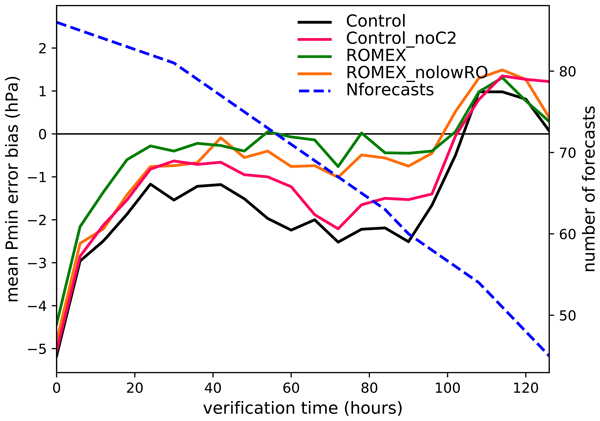
This study evaluates the impacts of assimilating commercial Global Navigation Satellite System (GNSS) radio occultation (RO) observations on HAFS regional model forecasts of four 2022 Atlantic hurricanes. Containing about 20,000 daily profiles, the commercial dataset roughly triples the volume of GNSS RO observations assimilated operationally. Findings show that the temperature and water information provided when assimilating the commercial RO dataset reduces an over-intensification bias.
Xi Shao, Shu-Peng Ho, Xin Jing, Xinjia Zhou, Yong Chen, Tung-Chang Liu, Bin Zhang, and Jun Dong
Atmos. Chem. Phys., 23, 14187–14218, https://doi.org/10.5194/acp-23-14187-2023, https://doi.org/10.5194/acp-23-14187-2023, 2023
Short summary
Short summary
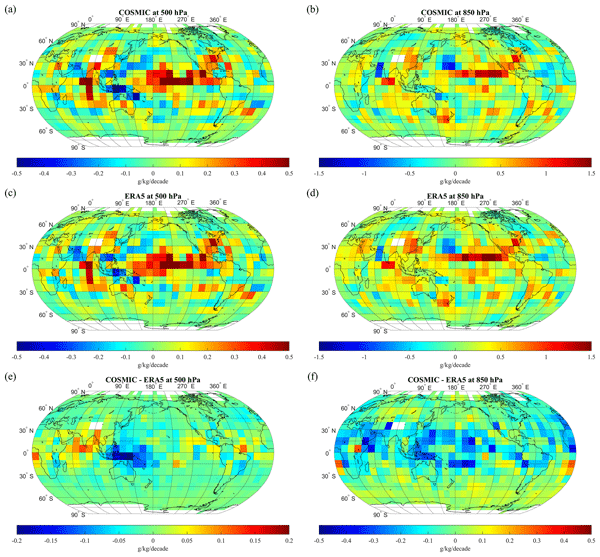
Atmospheric water vapor plays an essential role in the global energy balance, hydrological cycle, and climate system. This paper characterizes and compares the global, latitudinal, and regional variabilities of COSMIC and ERA5 water vapor distribution, as well as the seasonality and long-term trends at selected pressure levels from 2007 to 2018. Evaluation of spatiotemporal variabilities of atmospheric water vapor ensures the qualities of COSMIC and reanalysis water vapor for climate studies.
William J. Miller, Yong Chen, Shu-Peng Ho, and Xi Shao
EGUsphere, https://doi.org/10.5194/egusphere-2026-1000, https://doi.org/10.5194/egusphere-2026-1000, 2026
Short summary
Short summary
This study evaluates the impacts of assimilating commercial Global Navigation Satellite System (GNSS) radio occultation (RO) observations on HAFS regional model forecasts of four 2022 Atlantic hurricanes. Containing about 20,000 daily profiles, the commercial dataset roughly triples the volume of GNSS RO observations assimilated operationally. Findings show that the temperature and water information provided when assimilating the commercial RO dataset reduces an over-intensification bias.
Tim Trent, Marc Schröder, Shu-Peng Ho, Steffen Beirle, Ralf Bennartz, Eva Borbas, Christian Borger, Helene Brogniez, Xavier Calbet, Elisa Castelli, Gilbert P. Compo, Wesley Ebisuzaki, Ulrike Falk, Frank Fell, John Forsythe, Hans Hersbach, Misako Kachi, Shinya Kobayashi, Robert E. Kursinski, Diego Loyola, Zhengzao Luo, Johannes K. Nielsen, Enzo Papandrea, Laurence Picon, Rene Preusker, Anthony Reale, Lei Shi, Laura Slivinski, Joao Teixeira, Tom Vonder Haar, and Thomas Wagner
Atmos. Chem. Phys., 24, 9667–9695, https://doi.org/10.5194/acp-24-9667-2024, https://doi.org/10.5194/acp-24-9667-2024, 2024
Short summary
Short summary
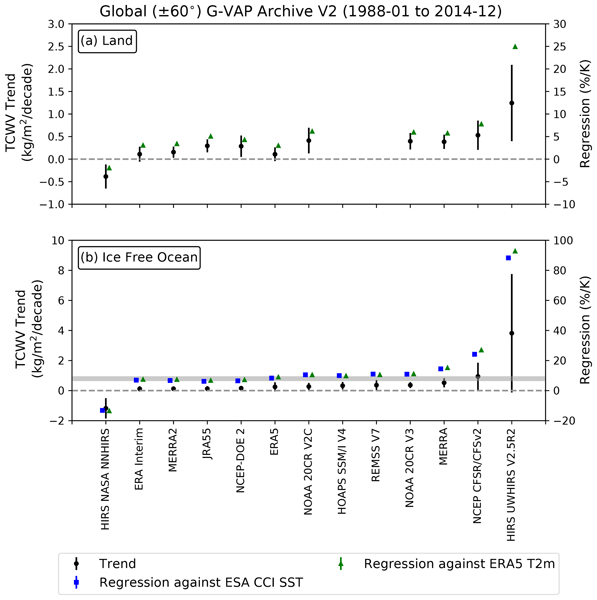
In a warmer future, water vapour will spend more time in the atmosphere, changing global rainfall patterns. In this study, we analysed the performance of 28 water vapour records between 1988 and 2014. We find sensitivity to surface warming generally outside expected ranges, attributed to breakpoints in individual record trends and differing representations of climate variability. The implication is that longer records are required for high confidence in assessing climate trends.
Xi Shao, Shu-Peng Ho, Xin Jing, Xinjia Zhou, Yong Chen, Tung-Chang Liu, Bin Zhang, and Jun Dong
Atmos. Chem. Phys., 23, 14187–14218, https://doi.org/10.5194/acp-23-14187-2023, https://doi.org/10.5194/acp-23-14187-2023, 2023
Short summary
Short summary
Atmospheric water vapor plays an essential role in the global energy balance, hydrological cycle, and climate system. This paper characterizes and compares the global, latitudinal, and regional variabilities of COSMIC and ERA5 water vapor distribution, as well as the seasonality and long-term trends at selected pressure levels from 2007 to 2018. Evaluation of spatiotemporal variabilities of atmospheric water vapor ensures the qualities of COSMIC and reanalysis water vapor for climate studies.
Cited articles
Adhikari, L., Xie, F., and Haase, J. S.: Application of the full spectrum inversion algorithm to simulated airborne GPS radio occultation signals, Atmos. Meas. Tech., 9, 5077–5087, https://doi.org/10.5194/amt-9-5077-2016, 2016.
Adhikari, A., Ho, S.-P., and Zhou, X.: Inverting COSMIC-2 phase data to bending angle and refractivity using the Full Spectrum Inversion method, Remote Sens., 13, 1793, https://doi.org/10.3390/rs13091793, 2021.
Anthes, R., Sjoberg, J., Starr, J., and Zeng, Z.: Evaluation of biases and uncertainties in ROMEX radio occultation observations, Atmos. Meas. Tech., 18, 6997–7019, https://doi.org/10.5194/amt-18-6997-2025, 2025.
Anthes, R. A.: Exploring Earth's atmosphere with radio occultation: contributions to weather, climate and space weather, Atmos. Meas. Tech., 4, 1077–1103, https://doi.org/10.5194/amt-4-1077-2011, 2011.
Anthes, R. A., Bernhardt, P. A., Chen, Y., Cucurull, L., Dymond, K. F., Ector, D., Healy, S. B., Ho, S.-P., Hunt, D. C., Kuo, Y.-H., Liu, H., Manning, K., McCormick, C., Meehan, T. K., Randel, W. J., Rocken, C., Schreiner, W. S., Sokolovskiy, S. V., Syndergaard, S., Thompson, D. C., Trenberth, K. E., Wee, T.-K., Yen, N. L., and Zeng, Z.: The COSMIC/FORMOSAT-3 Mission: Early Results, B. Am. Meteorol. Soc., 89, 313–334, https://doi.org/10.1175/BAMS-89-3-313, 2008.
Anthes, R. A., Marquardt, C., Ruston, B., and Shao, H.: Radio Occultation Modeling Experiment (ROMEX): Determining the impact of radio occultation observations on numerical weather prediction, B. Am. Meteorol. Soc., 105, E1552–E1568, https://doi.org/10.1175/BAMS-D-23-0326.1, 2024.
Born, M. and Wolf, E.: Principles of Optics, Cambridge University Press, New York, 452 pp., 1999.
Chen, Y., Zhou, X., Ho, S.-P., Shao, X., and Liu, T.-C.: Comparison of Radio Occultation Bending Angle and Refractivity Processed by Different Inversion Algorithms from Multi-RO Missions, in: IGARSS 2024 IEEE Int. Geosci. Remote Sens. Symp., Athens, Greece, 2024, 8904–8907, https://doi.org/10.1109/IGARSS53475.2024.10641034, 2024.
Cucurull, L., Derber, J. C., Treadon, R., and Purser, R. J.: Assimilation of global positioning system radio occultation observations into NCEP's Global Data Assimilation System, Mon. Weather Rev., 135, 3174–3193, https://doi.org/10.1175/MWR3461.1, 2007.
Culverwell, I.: The Radio Occultation Processing Package (ROPP) Pre-processor Module User Guide, version 10.0, ROM SAF Consortium, Ref: SAF/ROM/METO/UG/ROPP/004, 30 September 2020.
Fjeldbo, G. F., Kliore, A. J., and Eshelman, V. R.: The neutral atmosphere of Venus as studied with the Mariner V radio occultation experiments, J. Astro., 76, 123–140, 1971.
Gorbunov, M., Irisov, V., and Rocken, C.: The Influence of the Signal-to-Noise Ratio upon Radio Occultation Retrievals, Remote Sens., 14, 2742, https://doi.org/10.3390/rs14122742, 2022a.
Gorbunov, M., Irisov, V., and Rocken, C.: Noise Floor and Signal-to-Noise Ratio of Radio Occultation Observations: A Cross-Mission Statistical Comparison, Remote Sens., 14, 691, https://doi.org/10.3390/rs14030691, 2022b.
Gorbunov, M. E.: Radioholographic analysis of radio occultation data in multipath zones, Radio Sci., 37, 1008, https://doi.org/10.1029/2000RS002577, 2002a.
Gorbunov, M. E.: Canonical transform method for processing radio occultation data in the lower troposphere, Radio Sci., 37, 1076, https://doi.org/10.1029/2000RS002592, 2002b.
Gorbunov, M. E.: Ionospheric correction and statistical optimization of radio occultation data, Radio Sci., 37, https://doi.org/10.1029/2000RS002370, 2002c.
Gorbunov, M. E., Lauritsen, K. B., Rhodin, A., Tomassini, M., and Kornblueh, L.: Analysis of the CHAMP experimental data on radio-occultation sounding of the Earth's atmosphere, Izv. Atmos. Ocean. Phys., 41, 798–813, 2005.
Healy, S. B.: Forecast impact experiment with a constellation of GPS radio occultation receivers, Atmos. Sci. Lett., 9, 111–118, https://doi.org/10.1002/asl.169, 2008.
Hedin, A. E.: Extension of the MSIS thermosphere model into the middle and lower atmosphere, J. Geophys. Res., 96, 1159–1172, 1991.
Hersbach, H., Bell, B., Berrisford, P., Biavati, G., Horányi, A., Muñoz Sabater, J., Nicolas, J., Peubey, C., Radu, R., Rozum, I., Schepers, D., Simmons, A., Soci, C., Dee, D., and Thépaut, J.-N.: ERA5 hourly data on pressure levels from 1940 to present, Copernicus Climate Change Service (C3S) Climate Data Store (CDS) [data set], https://doi.org/10.24381/cds.bd0915c6, 2023.
Ho, S.-P., Hunt, D., Steiner, A. K., Mannucci, A. J., Kirchengast, G., Gleisner, H., Heise, S., von Engeln, A., Marquardt, C., Sokolovskiy, S., Schreiner, W., Scherllin-Pirscher, B., Ao, C., Wickert, J., Syndergaard, S., Lauritsen, K. B., Leroy, S., Kursinski, E. R., Kuo, Y.-H., Foelsche, U., Schmidt, T., and Gorbunov, M.: Reproducibility of GPS radio occultation data for climate monitoring: Profile-to-profile inter-comparison of CHAMP climate records 2002 to 2008 from six data centers, J. Geophys. Res., 117, D18111, https://doi.org/10.1029/2012JD017665, 2012.
Ho, S.-P., Anthes, R. A., Ao, C. O., Healy, S., Horányi, A., Hunt, D., Mannucci, A. J., Pedatella, N., Randel, W. J., and Simmons, A.: The COSMIC/FORMOSAT-3 Radio Occultation Mission after 12 Years: Accomplishments, Remaining Challenges, and Potential Impacts of COSMIC-2, B. Am. Meteorol. Soc., 101, E1107–E1136, https://doi.org/10.1175/BAMS-D-19-0027.1, 2020.
Ho, S.-P., Zhou, X., Shao, X., Chen, Y., Jing, X., and Miller, W.: Using the Commercial GNSS RO Spire Data in the Neutral Atmosphere for Climate and Weather Prediction Studies, Remote Sens., 15, 4836, https://doi.org/10.3390/rs15194836, 2023.
Ho, S.-P., Shao, X., Chen, Y., Zhou, J., Gu, G., Miller, W., and Jing, X.: Lessons Learned from the Preparation and Evaluation of Multiple GNSS RO Data for the ROMEX from NOAA/STAR. Presentation at the COSMIC/JCSDA Workshop and IROWG-10, Boulder, Colorado, 12–18 September 2024, https://www.cosmic.ucar.edu/events/cosmic-jcsda-workshop-irowg-10/agenda (last access: 5 June 2026), 2024.
Ho, S.-P., Shao, X., Chen, Y., Zhou, J., and Miller, W.: Advances in ROMEX data processing and evaluation: Lessons from NOAA STAR. Presentation at the 2nd ROMEX Workshop, 27 February 2025, at EUMETSAT, Darmstadt, Germany, https://cdn.eventsforce.net/files/ef-xnn67yq56ylu/website/66/b267dc61-7c6c-4d4c-ba67-30810806a1c2/14_20250225_benho_nesdis_star_romex.pdf (last access: 5 June 2026), 2025.
Jensen, A. S., Lohmann, M., Benzon, H.-H., and Nielsen, A. S.: Full spectrum inversion of radio occultation signals, Radio Sci., 38, 1040, https://doi.org/10.1029/2002RS002763, 2003.
Jensen, A. S., Lohmann, M., Nielsen, A. S., and Benzon, H.-H.: Geometrical optics phase matching of radio occultation signals, Radio Sci., 39, RS3009, https://doi.org/10.1029/2003RS002899, 2004.
Kursinski, E. R., Hajj, G. A., Schofield, J. T., Linfield, R. P., and Hardy, K. R.: Observing Earth's atmosphere with radio occultation measurements using the Global Positioning System, J. Geophys. Res., 102, 23429–23465, https://doi.org/10.1029/97JD01569, 1997.
Liu, H., Kuo, Y.-H., Sokolovskiy, S., Zou, X., Zeng, Z., Hsiao, L.-F., and Ruston. B.: A quality control procedure based on bending angle measurement uncertainty for radio occultation data assimilation in the tropical lower troposphere, J. Atmos. Ocean. Tech., 35 2117–2131, https://doi.org/10.1175/JTECH-D-17-0224.1, 2018.
Luzum, B. and Petit, G.: The IERS conventions (2010): Reference systems and new models, Proc. Int. Astron. Union, 10, 227–228, 2012.
Miller, W., Chen, Y., Ho, S.-P., and Shao, X.: Exploring the Value of Spire GNSS Radio Occultation Bending Angle Assimilation for Improving HWRF Model Forecasts of Atlantic Hurricane Intensity, Weather Forecast., 40, 809–827, https://doi.org/10.1175/waf-d-24-0092.1, 2025.
Paolella, S., Von Engeln, A., Padovan, S., Notarpietro, R., Marquardt, C., Sancho, F., Rivas Boscan, V., Morew, N., and Martin Alemany, F.: Assessment of operational non-time-critical Sentinel-6A Michael Freilich radio occultation data: insights into tropospheric GNSS signal cut-off strategies and processor improvements, Atmos. Meas. Tech., 18, 2825–2846, https://doi.org/10.5194/amt-18-2825-2025, 2025.
Petit, G. and Luzum, B. (Eds.): IERS Technical Note No. 36, IERS, Frankfurt am Main, 2010, https://apps.dtic.mil/sti/citations/ADA535671 (last access: 27 May 2026).
Schreiner, W. S., Weiss, J. P., Anthes, R. A., Braun, J., Chu, V., Fong, J., Hunt, D., Kuo, Y.-H., Meehan, T., Serafino, W., Sjoberg, J., Sokolovskiy, S., Talaat, E., Wee, T. K., and Zeng, Z.: COSMIC-2 radio occultation constellation: First results, Geophys. Res. Lett., 47, e2019GL086841, https://doi.org/10.1029/2019GL086841, 2020.
Shao, H., and Folsche, U.: ROMEX: Status and First Lessons Learned, Presentation at IROWG CGMS-52 Plenary, 2024, Washington, DC, USA, https://irowg.org/wpcms/wp-content/uploads/2025/04/CGMS-52-IROWG-WP-03.pdf (last access: 5 June 2026), 2024.
Sokolovskiy, S., Rocken, C., Schreiner, W., Hunt, D., and Johnson, J.: Postprocessing of L1 GPS radio occultation signals recorded in open-loop mode, Radio Sci., 44, RS2002, https://doi.org/10.1029/2008RS003907, 2009.
Sokolovskiy, S., Rocken, C., Schreiner, W., and Hunt, D.: On the uncertainty of radio occultation inversions in the lower troposphere, J. Geophys. Res., 115, D22111, https://doi.org/10.1029/2010JD014058, 2010.
Steiner, A. K., Ladstädter, F., Ao, C. O., Gleisner, H., Ho, S.-P., Hunt, D., Schmidt, T., Foelsche, U., Kirchengast, G., Kuo, Y.-H., Lauritsen, K. B., Mannucci, A. J., Nielsen, J. K., Schreiner, W., Schwärz, M., Sokolovskiy, S., Syndergaard, S., and Wickert, J.: Consistency and structural uncertainty of multi-mission GPS radio occultation records, Atmos. Meas. Tech., 13, 2547–2575, https://doi.org/10.5194/amt-13-2547-2020, 2020.
Vorob'ev, V. V. and Krasil'nikova, T. G.: Estimation of the accuracy of the atmospheric refractive index recovery from Doppler shift measurements at frequencies used in the NAVSTAR system, USSR Phys. Atmos. Ocean, Engl. Transl., 29, 602–609, 1994.
Short summary
We developed a Full Spectrum Inversion algorithm to process Global Navigation Satellite System Radio Occultation (RO) data, a key source for weather forecasting. Comparing it with standard systems, we found strong agreement mid-atmosphere but larger differences near the surface and upper levels. This clarifies processing uncertainties and supports improved use of RO data in numerical weather prediction and atmospheric research.
We developed a Full Spectrum Inversion algorithm to process Global Navigation Satellite System...