Articles | Volume 19, issue 2
https://doi.org/10.5194/amt-19-405-2026
Research article
 | 
20 Jan 2026
Research article |  | 20 Jan 2026

Signal processing to denoise and retrieve water vapor from multi-pulse-length lidar data

Matthew Hayman, Robert A. Stillwell, Adam Karboski, and Scott M. Spuler

Related authors

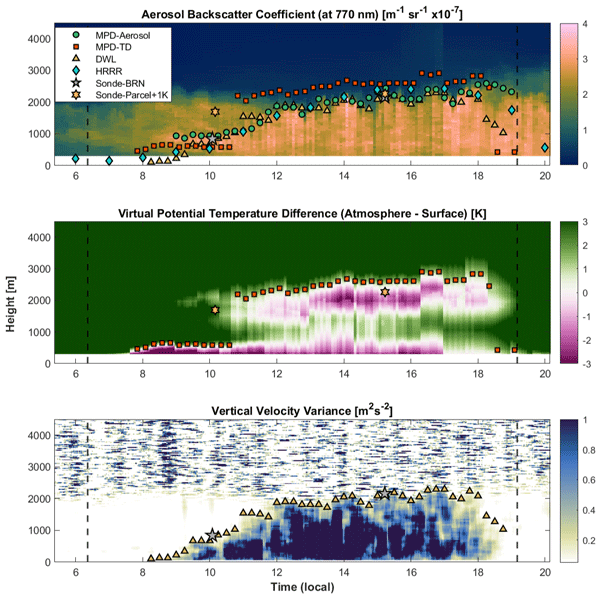
Mixed layer height retrievals using MicroPulse Differential Absorption Lidar
Luke Colberg, Kevin S. Repasky, Matthew Hayman, Robert A. Stillwell, and Scott M. Spuler
Atmos. Meas. Tech., 18, 6069–6092, https://doi.org/10.5194/amt-18-6069-2025,https://doi.org/10.5194/amt-18-6069-2025, 2025
Short summary
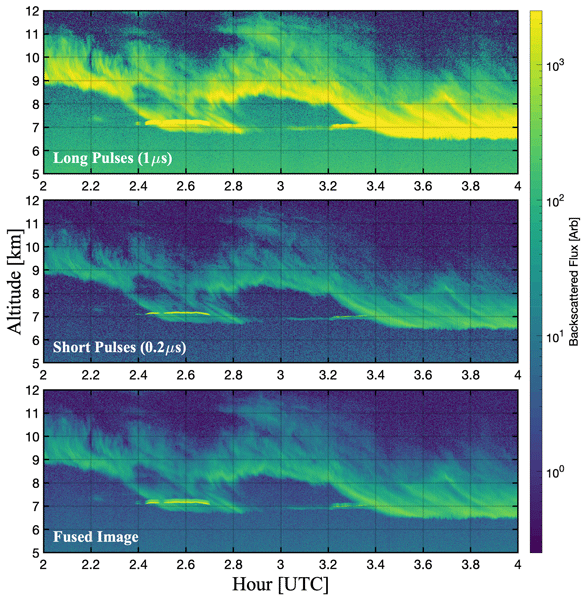
Expanding observational capabilities of diode-laser-based lidar through shot-to-shot modification of laser pulse characteristics
Robert A. Stillwell, Adam Karboski, Matthew Hayman, and Scott M. Spuler
Atmos. Meas. Tech., 18, 4119–4130, https://doi.org/10.5194/amt-18-4119-2025,https://doi.org/10.5194/amt-18-4119-2025, 2025
Short summary
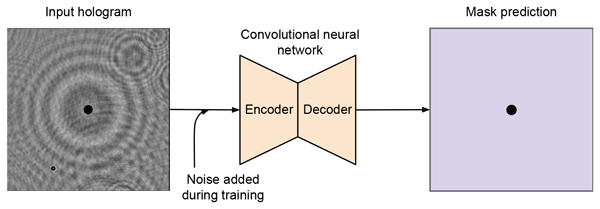
Neural network processing of holographic images
John S. Schreck, Gabrielle Gantos, Matthew Hayman, Aaron Bansemer, and David John Gagne
Atmos. Meas. Tech., 15, 5793–5819, https://doi.org/10.5194/amt-15-5793-2022,https://doi.org/10.5194/amt-15-5793-2022, 2022
Short summary
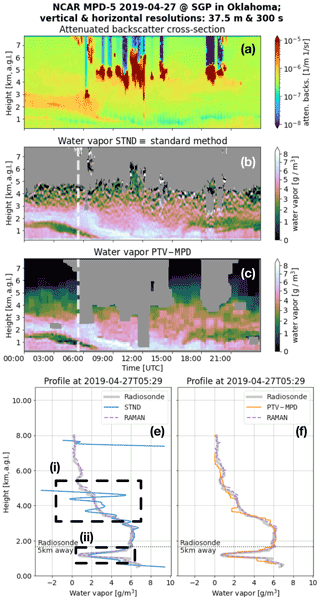
Extending water vapor measurement capability of photon-limited differential absorption lidars through simultaneous denoising and inversion
Willem J. Marais and Matthew Hayman
Atmos. Meas. Tech., 15, 5159–5180, https://doi.org/10.5194/amt-15-5159-2022,https://doi.org/10.5194/amt-15-5159-2022, 2022
Short summary
MicroPulse DIAL (MPD) – a diode-laser-based lidar architecture for quantitative atmospheric profiling
Scott M. Spuler, Matthew Hayman, Robert A. Stillwell, Joshua Carnes, Todd Bernatsky, and Kevin S. Repasky
Atmos. Meas. Tech., 14, 4593–4616, https://doi.org/10.5194/amt-14-4593-2021,https://doi.org/10.5194/amt-14-4593-2021, 2021
Short summary

Cited articles

Beck, A. and Teboulle, M.: Fast gradient-based algorithms for constrained total variation image denoising and deblurring problems, IEEE Transactions on Image Processing, 18, 2419–2434, https://doi.org/10.1109/TIP.2009.2028250, 2009. a
Copernicus Climate Change Service (C3S): ERA5: Fifth generation of ECMWF atmospheric reanalyses of the global climate, Copernicus Climate Change Service Climate Data Store (CDS), https://doi.org/10.26023/WKM7-HNCF-FX0B, 2025. a, b
Groß, S., Wirth, M., Schäfler, A., Fix, A., Kaufmann, S., and Voigt, C.: Potential of airborne lidar measurements for cirrus cloud studies, Atmos. Meas. Tech., 7, 2745–2755, https://doi.org/10.5194/amt-7-2745-2014, 2014. a
Harmany, Z. T., Marcia, R. F., and Willett, R. M.: This is SPIRAL-TAP: Sparse Poisson Intensity Reconstruction ALgorithms – Theory and Practice, IEEE Transactions on Image Processing, 21, 1084–1096, https://doi.org/10.1109/TIP.2011.2168410, 2012. a
Hayman, M. and Spuler, S.: Demonstration of a diode-laser-based high spectral resolution lidar (HSRL) for quantitative profiling of clouds and aerosols, Optics Express, 25, A1096–A1110, https://doi.org/10.1364/OE.25.0A1096, 2017. a
Download
Short summary
A new processing method for lidar data obtained from rapidly changing laser pulse lengths enables measurement of atmospheric water vapor from the ground up to 6 km. The technique blends all captured data to reveal hidden water vapor structures, especially near the surface. This solution offers continuous, high-resolution insights, key for improving weather forecasts. It showcases how flexible laser technology can enhance atmospheric observation.
Share