
Articles | Volume 19, issue 12
https://doi.org/10.5194/amt-19-4277-2026
© Author(s) 2026. This work is distributed under
the Creative Commons Attribution 4.0 License.
the Creative Commons Attribution 4.0 License.
https://doi.org/10.5194/amt-19-4277-2026
© Author(s) 2026. This work is distributed under
the Creative Commons Attribution 4.0 License.
the Creative Commons Attribution 4.0 License.
Research article
| 
30 Jun 2026
Research article |
| 30 Jun 2026
| 30 Jun 2026
Monitoring of lower thermospheric neutral density variations using meteor head echoes
Devin Huyghebaert
CORRESPONDING AUTHOR

Leibniz Institute of Atmospheric Physics, University of Rostock, Rostock, Germany
Department of Physics and Technology, UiT The Arctic University of Norway, Tromsø, Norway
Juha Vierinen
Department of Physics and Technology, UiT The Arctic University of Norway, Tromsø, Norway
Leibniz Institute of Atmospheric Physics, University of Rostock, Rostock, Germany
Björn Gustavsson
Department of Physics and Technology, UiT The Arctic University of Norway, Tromsø, Norway
Ralph Latteck
Leibniz Institute of Atmospheric Physics, University of Rostock, Rostock, Germany
Toralf Renkwitz
Leibniz Institute of Atmospheric Physics, University of Rostock, Rostock, Germany
Marius Zecha
Leibniz Institute of Atmospheric Physics, University of Rostock, Rostock, Germany
Claudia C. Stephan
Leibniz Institute of Atmospheric Physics, University of Rostock, Rostock, Germany
J. Federico Conte
Leibniz Institute of Atmospheric Physics, University of Rostock, Rostock, Germany
Daniel Kastinen
Swedish Institute for Space Physics, Kiruna, Sweden
Johan Kero
Swedish Institute for Space Physics, Kiruna, Sweden
Jorge L. Chau
Leibniz Institute of Atmospheric Physics, University of Rostock, Rostock, Germany
Related authors
Juha Vierinen, Dabrowka Knach, Jorge Luis Chau, Gerd Baumgarten, Devin Huyghebaert, Matthias Clahsen, Nico Pfeffer, Toralf Renkwitz, Robin Wing, Kenneth Obenberger, Björn Gustavsson, and Daniel Kastinen
EGUsphere, https://doi.org/10.5194/egusphere-2026-2857, https://doi.org/10.5194/egusphere-2026-2857, 2026
Short summary
Short summary
We observed the re-entry of a Falcon 9 rocket upper stage over Europe using a network of cameras and radars normally used to study meteors. The measurements showed how hot ionized gas formed around the debris during hypervelocity entry, producing strong radio echoes high in the atmosphere. As the number of satellites and rocket launches increases, these observations can help improve monitoring of space waste re-entering the atmosphere and its possible environmental effects.
Magnus F. Ivarsen, Kaili Song, Luca Spogli, Jean-Pierre St-Maurice, Devin Ray Huyghebaert, Brian Pitzel, Saif Marei, Yangyang Shen, Satoshi Kasahara, Kunihiro Keika, Yoshizumi Miyoshi, Tomo Hori, Atsuki Shinbori, Kazuhiro Yamamoto, David Russel Themens, P. Thayyil Jayachandran, Yoichi Kazama, Shiang-Yu Wang, Ayako Matsuoka, Iku Shinohara, Takefumi Mitani, Takeshi Takashima, Shoichiro Yokota, Yoshiya Kasahara, and Glenn Hussey
EGUsphere, https://doi.org/10.5194/egusphere-2026-2344, https://doi.org/10.5194/egusphere-2026-2344, 2026
Short summary
Short summary
During geomagnetic storms, the sun drives auroral plasma turbulence that disrupts GPS signals. This turbulence spans sizes from hundreds of kilometers to meters, but most instruments see only a narrow slice. We combined radar and GPS receiver data to build a continuous turbulence spectrum across four orders of magnitude in scale, validated by satellite conjunctions. The spectrum suggests the ionosphere directly mirrors magnetospheric energy input, providing a baseline for space weather models.
Theresa Rexer, Björn Gustavsson, Juha Vierinen, Andres Spicher, Devin Ray Huyghebaert, Andreas Kvammen, Robert Gillies, and Asti Bhatt
Geosci. Instrum. Method. Data Syst., 15, 127–139, https://doi.org/10.5194/gi-15-127-2026, https://doi.org/10.5194/gi-15-127-2026, 2026
Short summary
Short summary
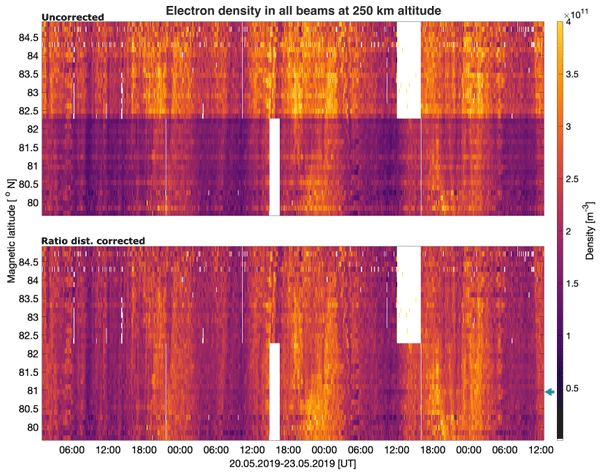
We present a second-level calibration method for electron density measurements from multi-beam incoherent scatter radars. It is based on the well-known Flat field correction method used in imaging and photography. The method improves data quality and useability as it accounts for unaccounted and unpredictable variations in the radar system. This is valuable for studies where inter-beam calibration is important such as studies of polar cap patches, plasma irregularities and turbulence.
Kian Sartipzadeh, Andreas Kvammen, Björn Gustavsson, Njål Gulbrandsen, Magnar G. Johnsen, Devin Huyghebaert, and Juha Vierinen
Ann. Geophys., 44, 85–107, https://doi.org/10.5194/angeo-44-85-2026, https://doi.org/10.5194/angeo-44-85-2026, 2026
Short summary
Short summary
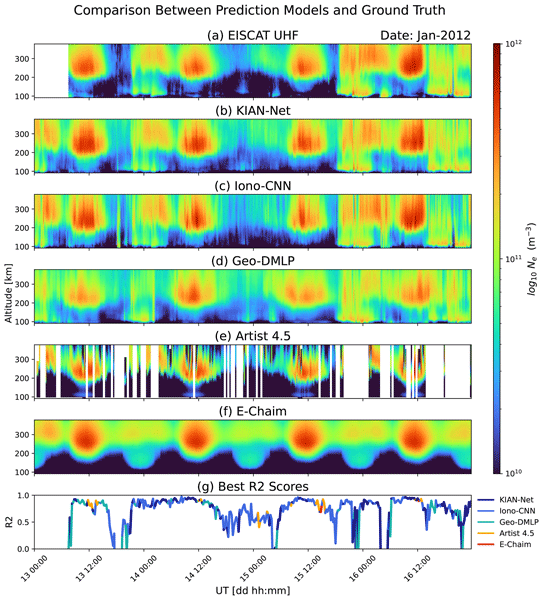
Knowledge of the charged environment in the upper atmosphere is essential for understanding space weather effects on satellites and radio communication. This environment is difficult to estimate at high latitudes, where aurora cause strong variability. We developed an artificial intelligence model to estimate this environment continuously. Our results show that the model provides reliable estimates even during auroral activity, improving monitoring of the polar upper atmosphere.
Spencer Mark Hatch, Ilkka Virtanen, Karl Magnus Laundal, Habtamu Wubie Tesfaw, Juha Vierinen, Devin Ray Huyghebaert, Andres Spicher, and Jens Christian Hessen
Ann. Geophys., 43, 633–649, https://doi.org/10.5194/angeo-43-633-2025, https://doi.org/10.5194/angeo-43-633-2025, 2025
Short summary
Short summary
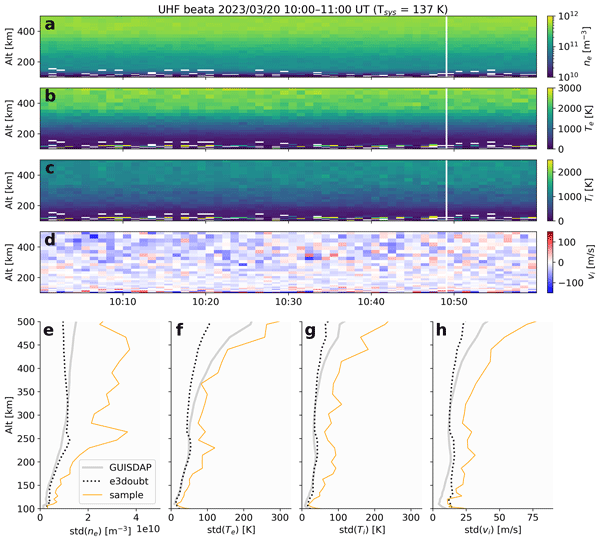
This study addresses the design of next-generation incoherent scatter radar experiments used to study the ionosphere, particularly with systems that have multiple sites. We have developed a method to estimate uncertainties of measurements of plasma density, temperature, and ion drift. Our method is open-source, and helps to optimize radar configurations and assess the effectiveness of an experiment. This method ultimately serves to enhance our understanding of Earth's space environment.
Devin Huyghebaert, Björn Gustavsson, Juha Vierinen, Andreas Kvammen, Matthew Zettergren, John Swoboda, Ilkka Virtanen, Spencer M. Hatch, and Karl M. Laundal
Ann. Geophys., 43, 99–113, https://doi.org/10.5194/angeo-43-99-2025, https://doi.org/10.5194/angeo-43-99-2025, 2025
Short summary
Short summary
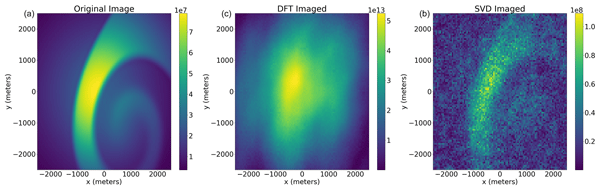
The EISCAT_3D radar is a new ionospheric radar under construction in the Fennoscandia region. The radar will make measurements of plasma characteristics at altitudes above approximately 60 km. The capability of the system to make these measurements at spatial scales of less than 100 m using multiple digitised signals from each of the radar antenna panels is highlighted. There are many ionospheric small-scale processes that will be further resolved using the techniques discussed here.
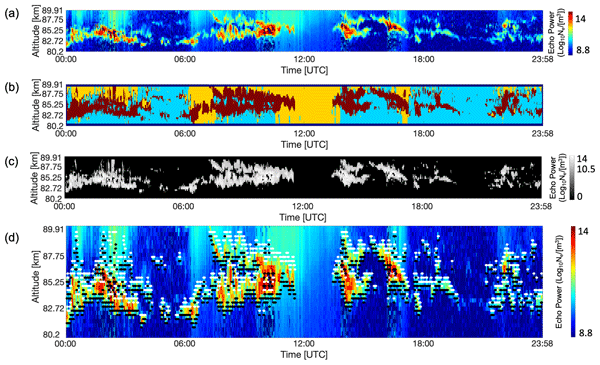
Dorota Jozwicki, Puneet Sharma, Devin Huyghebaert, and Ingrid Mann
Ann. Geophys., 42, 431–453, https://doi.org/10.5194/angeo-42-431-2024, https://doi.org/10.5194/angeo-42-431-2024, 2024
Short summary
Short summary
We investigated the relationship between polar mesospheric summer echo (PMSE) layers and the solar cycle. Our results indicate that the average altitude of PMSEs, the echo power in the PMSEs and the thickness of the layers are, on average, higher during the solar maximum than during the solar minimum. We infer that higher electron densities at ionospheric altitudes might be necessary to observe multilayered PMSEs. We observe that the thickness decreases as the number of multilayers increases.
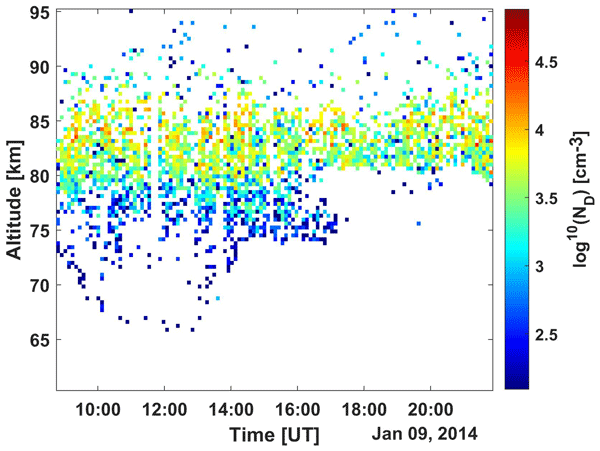
Tinna L. Gunnarsdottir, Ingrid Mann, Wuhu Feng, Devin R. Huyghebaert, Ingemar Haeggstroem, Yasunobu Ogawa, Norihito Saito, Satonori Nozawa, and Takuya D. Kawahara
Ann. Geophys., 42, 213–228, https://doi.org/10.5194/angeo-42-213-2024, https://doi.org/10.5194/angeo-42-213-2024, 2024
Short summary
Short summary
Several tons of meteoric particles burn up in our atmosphere each day. This deposits a great deal of material that binds with other atmospheric particles and forms so-called meteoric smoke particles. These particles are assumed to influence radar measurements. Here, we have compared radar measurements with simulations of a radar spectrum with and without dust particles and found that dust influences the radar spectrum in the altitude range of 75–85 km.
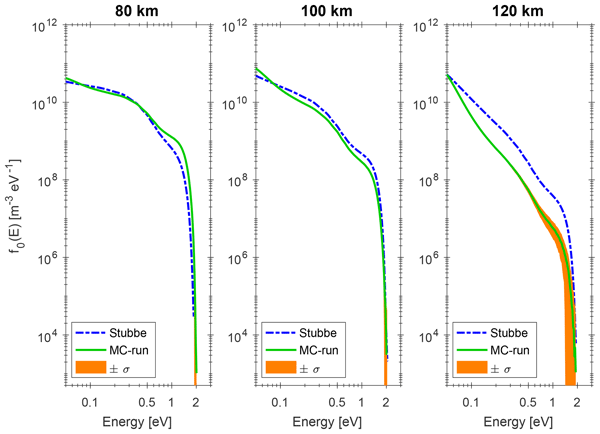
Margaretha Myrvang and Björn Gustavsson
Ann. Geophys., 44, 921–935, https://doi.org/10.5194/angeo-44-921-2026, https://doi.org/10.5194/angeo-44-921-2026, 2026
Short summary
Short summary
This paper investigate how radio wave heating affect the electron distribution in the D region. Radio wave heating can lead to absorption of radio wave energy by electrons, thereby increasing the temperature. Electrons are cooled by inelastic collisions with the neutrals atmosphere, affecting the electron distribution since electrons lose energy by exciting different states in neutrals. Thus, electrons are redistributed to lower energies, which changes the shape of the electron distribution.
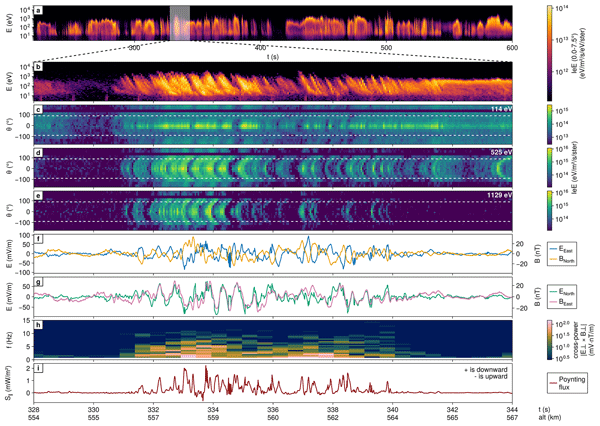
Etienne Gavazzi, Andres Spicher, Björn Gustavsson, Juha Vierinen, James Clemmons, Robert Pfaff, and Douglas Rowland
Ann. Geophys., 44, 903–920, https://doi.org/10.5194/angeo-44-903-2026, https://doi.org/10.5194/angeo-44-903-2026, 2026
Short summary
Short summary
Auroras are caused by energetic electrons entering the upper atmosphere. For the smallest and most dynamic auroras, scientists think electrons are accelerated by waves (called Alfvén waves) thousands of kilometers above Earth. In this paper, we analyse data from a rocket that flew through auroras, applying existing and new techniques to estimate where the acceleration took place. Our results match theory, and we show how they can be used to study conditions in the near-Earth space environment.
Yadu Krishnan Krishnakumar, Toralf Renkwitz, and Andreas Ahrens
Atmos. Chem. Phys., 26, 9571–9587, https://doi.org/10.5194/acp-26-9571-2026, https://doi.org/10.5194/acp-26-9571-2026, 2026
Short summary
Short summary
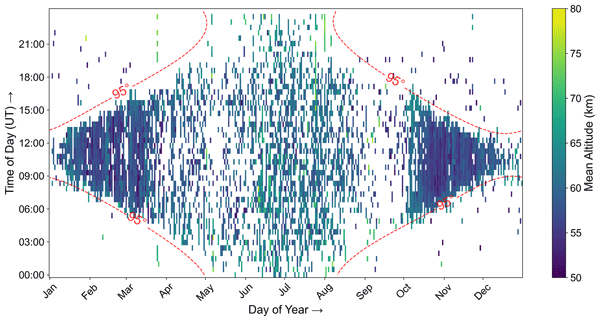
We report on the observations of radar echoes at the lower HF range from the lower part of the ionosphere, below 60 km altitude. The observed echoes are actually seen below and isolated to the generally accepted lowermost ionospheric D region. For the detection of these echoes we employed machine learning techniques for the inspection of 4 years of radar raw data. We derived statistical parameters of their occurrence and hypothesised a connection for galactic cosmic rays as an ionisation source.
Zuzana Procházková, Erfan Mahmoudi, Ray Chew, Stamen Dolaptchiev, Claudia Christine Stephan, Georg Sebastian Völker, and Ulrich Achatz
Atmos. Chem. Phys., 26, 9541–9558, https://doi.org/10.5194/acp-26-9541-2026, https://doi.org/10.5194/acp-26-9541-2026, 2026
Short summary
Short summary
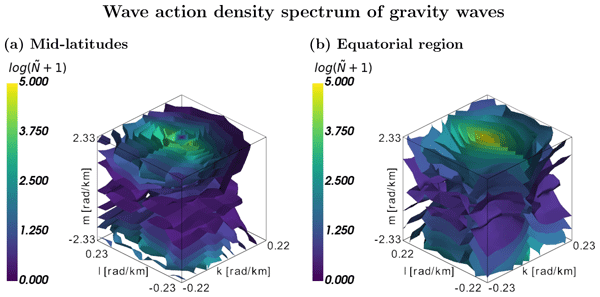
The study analyzes gravity waves in a high-resolution simulation. A unique methodology is applied to compute three-dimensional gravity wave spectra while keeping the data on the original triangular model grid and using linear wave theory. The results show the structure of gravity waves that would remain unresolved by a model with lower horizontal resolution. It is shown that the spectra can be highly simplified, which can help constructing precise but efficient gravity wave parametrisation.
Christoph Jacobi, Ales Kuchar, Manfred Ern, Toralf Renkwitz, Ralph Latteck, and Jorge L. Chau
Adv. Radio Sci., 24, 15–28, https://doi.org/10.5194/ars-24-15-2026, https://doi.org/10.5194/ars-24-15-2026, 2026
Short summary
Short summary
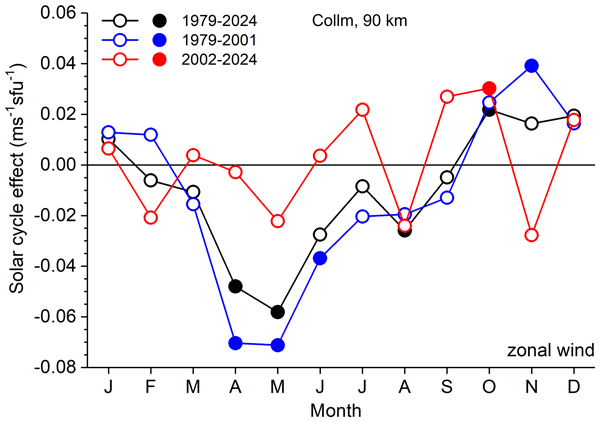
Analyses of more than four decades (1979–2024) of mean horizontal winds in the mesopause region at about 90 km altitude show long-term trends and an influence of the 11-year solar cycle. After the 1990s, both linear trends and the solar cycle effect change and strongly weaken, indicating a change in dynamics or solar forcing. Gravity wave proxies also show a solar cycle effect, which decreases after the 1990s.
Gunter Stober, Hanli Liu, Zishun Qiao, Kaoru Sato, Loretta Pearl Poku, Witali Krochin, Alan Liu, Alexander Kozlovsky, Diego Janches, Jie Zeng, Wen Yi, Masaki Tsutsumi, Njål Gulbrandsen, Satonori Nozawa, Mark Lester, Johan Kero, and Nicholas Mitchell
EGUsphere, https://doi.org/10.5194/egusphere-2026-3156, https://doi.org/10.5194/egusphere-2026-3156, 2026
This preprint is open for discussion and under review for Atmospheric Measurement Techniques (AMT).
Short summary
Short summary
Vertical winds are a crucial atmospheric parameter in the mesosphere/lower thermosphere and are connected to adiabatic heating and cooling of the atmosphere. Mesospheric temperatures are affected by the vertical transport driven by a pole-to-pole circulation with upwelling in the summer hemisphere and downwelling in the winter hemisphere. We present results based on a new retrieval technique for the seasonal climatological vertical winds and an intercomparison to current state-of-the-art models.
Juha Vierinen, Dabrowka Knach, Jorge Luis Chau, Gerd Baumgarten, Devin Huyghebaert, Matthias Clahsen, Nico Pfeffer, Toralf Renkwitz, Robin Wing, Kenneth Obenberger, Björn Gustavsson, and Daniel Kastinen
EGUsphere, https://doi.org/10.5194/egusphere-2026-2857, https://doi.org/10.5194/egusphere-2026-2857, 2026
Short summary
Short summary
We observed the re-entry of a Falcon 9 rocket upper stage over Europe using a network of cameras and radars normally used to study meteors. The measurements showed how hot ionized gas formed around the debris during hypervelocity entry, producing strong radio echoes high in the atmosphere. As the number of satellites and rocket launches increases, these observations can help improve monitoring of space waste re-entering the atmosphere and its possible environmental effects.
Andreas Dörnbrack, Andreas Giez, Christian Mallaun, and Claudia Christine Stephan
EGUsphere, https://doi.org/10.5194/egusphere-2026-2628, https://doi.org/10.5194/egusphere-2026-2628, 2026
Short summary
Short summary
Upper-tropospheric turbulence over the Atlantic intertropical convergence zone is quantified from in situ measurements onboard the German research aircraft HALO, with a focus on whether the anticipated subsidence in the doldrums leads to reduced turbulence.
Phoebe Noble, Haruka Okui, Joan Alexander, Manfred Ern, Neil P. Hindley, Lars Hoffmann, Laura Holt, Annelize van Niekerk, Riwal Plougonven, Inna Polichtchouk, Claudia C. Stephan, Martina Bramberger, Milena Corcos, William Putnam, Christopher Kruse, and Corwin J. Wright
Atmos. Chem. Phys., 26, 7607–7630, https://doi.org/10.5194/acp-26-7607-2026, https://doi.org/10.5194/acp-26-7607-2026, 2026
Short summary
Short summary
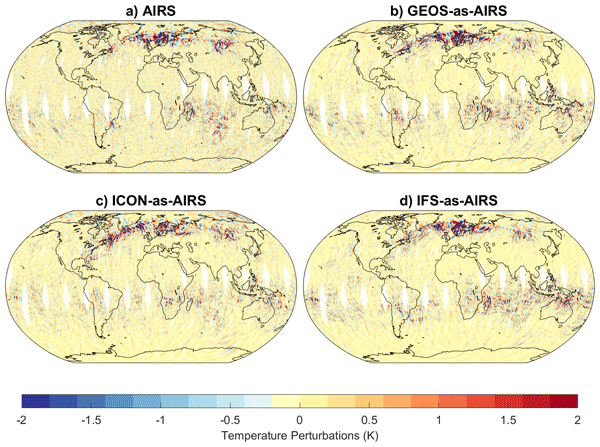
Gravity waves are small-scale processes that drive the circulation in the middle and upper atmosphere. In this work, we assess 3 new high-resolution (3-5km horizontal resolution) models against satellite data. Generally, models capture the spatial patterns and represent stratospheric northern hemisphere mountain generated waves well. However, they still underestimate amplitudes globally and struggle with the representation of southern hemispheric convective waves.
Magnus F. Ivarsen, Kaili Song, Luca Spogli, Jean-Pierre St-Maurice, Devin Ray Huyghebaert, Brian Pitzel, Saif Marei, Yangyang Shen, Satoshi Kasahara, Kunihiro Keika, Yoshizumi Miyoshi, Tomo Hori, Atsuki Shinbori, Kazuhiro Yamamoto, David Russel Themens, P. Thayyil Jayachandran, Yoichi Kazama, Shiang-Yu Wang, Ayako Matsuoka, Iku Shinohara, Takefumi Mitani, Takeshi Takashima, Shoichiro Yokota, Yoshiya Kasahara, and Glenn Hussey
EGUsphere, https://doi.org/10.5194/egusphere-2026-2344, https://doi.org/10.5194/egusphere-2026-2344, 2026
Short summary
Short summary
During geomagnetic storms, the sun drives auroral plasma turbulence that disrupts GPS signals. This turbulence spans sizes from hundreds of kilometers to meters, but most instruments see only a narrow slice. We combined radar and GPS receiver data to build a continuous turbulence spectrum across four orders of magnitude in scale, validated by satellite conjunctions. The spectrum suggests the ionosphere directly mirrors magnetospheric energy input, providing a baseline for space weather models.
Ralph Latteck and Franz-Josef Lübken
Adv. Radio Sci., 24, 1–13, https://doi.org/10.5194/ars-24-1-2026, https://doi.org/10.5194/ars-24-1-2026, 2026
Short summary
Short summary
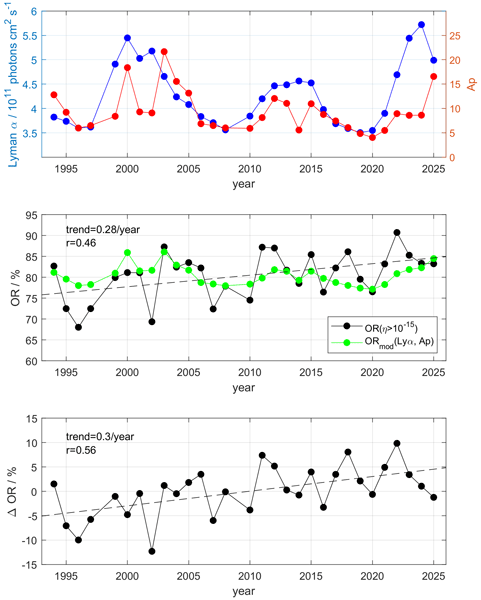
Using 30 years of radar observations at Andøya, this study presents the world’s longest record of a rare summer phenomenon high above the Arctic. The season lasts about 104 days and is gradually starting earlier and ending later. Even after accounting for solar and geomagnetic effects, a small but steady rise remains. The strongest signals occur about 84 km up and show no long-term change, offering new insight into ongoing shifts in the upper atmosphere.
Theresa Rexer, Björn Gustavsson, Juha Vierinen, Andres Spicher, Devin Ray Huyghebaert, Andreas Kvammen, Robert Gillies, and Asti Bhatt
Geosci. Instrum. Method. Data Syst., 15, 127–139, https://doi.org/10.5194/gi-15-127-2026, https://doi.org/10.5194/gi-15-127-2026, 2026
Short summary
Short summary
We present a second-level calibration method for electron density measurements from multi-beam incoherent scatter radars. It is based on the well-known Flat field correction method used in imaging and photography. The method improves data quality and useability as it accounts for unaccounted and unpredictable variations in the radar system. This is valuable for studies where inter-beam calibration is important such as studies of polar cap patches, plasma irregularities and turbulence.
Loretta Pearl Poku, Gunter Stober, Witali Krochin, Alan Liu, Alexander Kozlovsky, Diego Janches, Jie Zeng, Wen Yi, Masaki Tsutsumi, Njål Gulbrandsen, Satonori Nozawa, Mark Lester, Johan Kero, and Nicholas Mitchell
EGUsphere, https://doi.org/10.5194/egusphere-2025-6377, https://doi.org/10.5194/egusphere-2025-6377, 2026
Short summary
Short summary
This study presents 3D spatially resolved wind fields in the MLT using advanced retrieval techniques. Specifically, a novel SVVP method in spherical coordinates to enhance the physical consistency of wind retrievals compared to the conventional VVP method in plane geometry and the 3DVAR+DIV method. The SVVP provides a robust framework for future MLT dynamics studies, and the 3DVAR+DIV retrieval is beneficial for high-resolution case studies due to its ability to capture small-scale variability.
Alex Timothy Chartier, Ryan Poffenbarger, Rafael Mesquita, Diego Janches, Jorge Chau, Toralf Renkwitz, Ralph Latteck, and William Bristow
EGUsphere, https://doi.org/10.5194/egusphere-2026-1634, https://doi.org/10.5194/egusphere-2026-1634, 2026
Short summary
Short summary
We created a new long-term record of upper atmosphere winds using data from a global network of radars spanning more than 30 years. Because these measurements do not directly show altitude, we developed a method to estimate where the signals come from and tested it against other observations and models. The results show good agreement, meaning these data can now be used with greater confidence to study atmospheric motion and its effects on communication and space systems.
Margaretha Myrvang and Björn Johan Gustavsson
EGUsphere, https://doi.org/10.5194/egusphere-2026-1118, https://doi.org/10.5194/egusphere-2026-1118, 2026
Short summary
Short summary
This is the second of two papers. The first paper demonstrate that the electron distribution becomes non-Maxwellian during radio wave heating. Electron cooling rates are macroscopic properties of the electron gas, where electrons transfer some of their kinetic energy through collisions with neutrals and ions, and can be determined by integrating over the electron distribution. Any changes in the electron distribution affect the cooling rates.
Toralf Renkwitz, Matthias Clahsen, and Ralph Latteck
Atmos. Meas. Tech., 19, 1825–1835, https://doi.org/10.5194/amt-19-1825-2026, https://doi.org/10.5194/amt-19-1825-2026, 2026
Short summary
Short summary
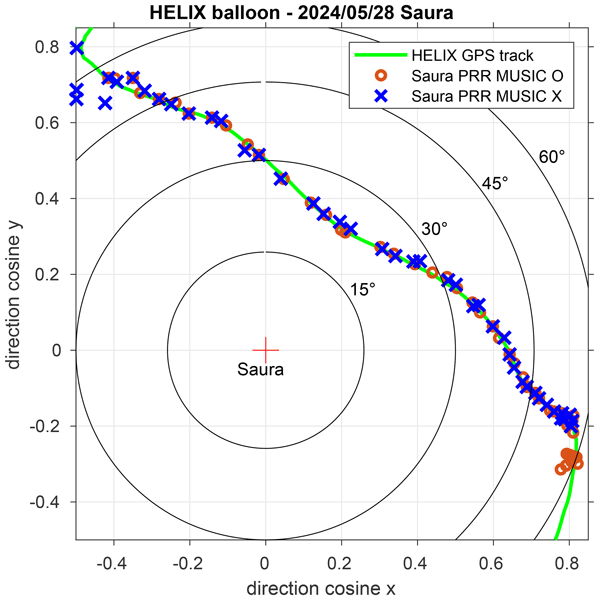
We describe the use of a nearby drifting stratospheric balloon to calibrate three different radar systems. While for radars in the VHF range different calibration options exist, it is much more complicate to do this in the lower HF range. The main complication is the required distance and size of the target, which is especially challenging for vertical pointing radars. We also present the validation of proper phase calibration and the general radiation pattern.
Oliver Stalder, Björn Gustavsson, and Ilkka Virtanen
Ann. Geophys., 44, 123–135, https://doi.org/10.5194/angeo-44-123-2026, https://doi.org/10.5194/angeo-44-123-2026, 2026
Short summary
Short summary
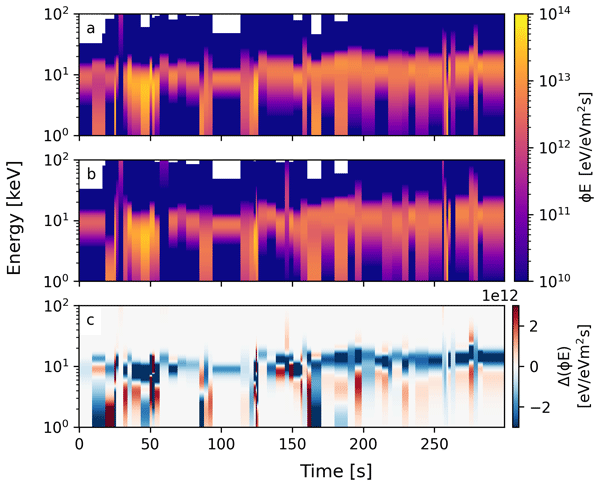
The rapid changes in ion composition during auroral are dynamically modeled by integrating the coupled continuity equations for 15 ionospheric species. The effect of the ionospheric variation on the inversion of incoherent scatter radar (ISR) electron density profiles to differential energy spectra of precipitating electrons is studied. A systematic overestimation at high electron energies can be removed using a dynamic model. Comparisons are made with static and steady-state ionospheric models.
Kian Sartipzadeh, Andreas Kvammen, Björn Gustavsson, Njål Gulbrandsen, Magnar G. Johnsen, Devin Huyghebaert, and Juha Vierinen
Ann. Geophys., 44, 85–107, https://doi.org/10.5194/angeo-44-85-2026, https://doi.org/10.5194/angeo-44-85-2026, 2026
Short summary
Short summary
Knowledge of the charged environment in the upper atmosphere is essential for understanding space weather effects on satellites and radio communication. This environment is difficult to estimate at high latitudes, where aurora cause strong variability. We developed an artificial intelligence model to estimate this environment continuously. Our results show that the model provides reliable estimates even during auroral activity, improving monitoring of the polar upper atmosphere.

Daniel J. Emmons, Cornelius Csar Jude H. Salinas, Dong L. Wu, Nimalan Swarnalingam, Eugene V. Dao, Jorge L. Chau, Yosuke Yamazaki, Kyle E. Fitch, and Victoriya V. Forsythe
Ann. Geophys., 44, 17–34, https://doi.org/10.5194/angeo-44-17-2026, https://doi.org/10.5194/angeo-44-17-2026, 2026
Short summary
Short summary
The E-region of the Earth’s ionosphere plays an important role in atmospheric energy balance and High Frequency radio propagation. In this paper, we compare predictions from two recently developed ionospheric models to observations by ionospheric sounders (ionosondes). Overall, the models show reasonable agreement with the observations. However, there are several areas for improvement in the models as well as questions about the accuracy of the automatically processed ionosonde dataset.

Etienne Gavazzi, Andres Spicher, Björn Gustavsson, James Clemmons, Robert Pfaff, and Douglas Rowland
Ann. Geophys., 44, 1–15, https://doi.org/10.5194/angeo-44-1-2026, https://doi.org/10.5194/angeo-44-1-2026, 2026
Short summary
Short summary
Auroral precipitation refers to energetic particles that come down into the upper part of our atmosphere, the ionosphere. There, they collide with atoms and molecules and transfer some of their energy, causing aurora. The most rapid time-variation of this energy deposition and its consequences on the ionosphere are not fully understood. We show here that one can use a new model to study auroral precipitation on sub-second timescales and advance our understanding about small-scale dynamic aurora.
J. Federico Conte, Jorge L. Chau, Toralf Renkwitz, Ralph Latteck, Masaki Tsutsumi, Christoph Jacobi, Njål Gulbrandsen, and Satonori Nozawa
Ann. Geophys., 43, 603–619, https://doi.org/10.5194/angeo-43-603-2025, https://doi.org/10.5194/angeo-43-603-2025, 2025
Short summary
Short summary
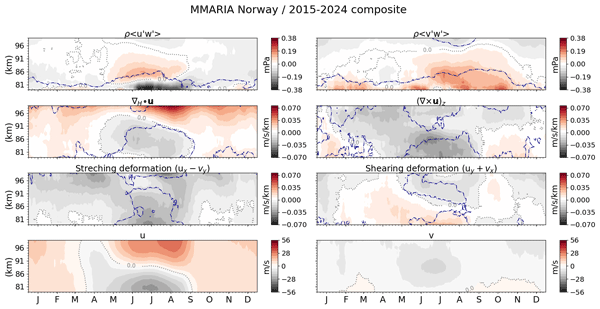
Analysis of 10 years of continuous measurements provided MMARIA/SIMONe Norway and MMARIA/SIMONe Germany reveals that the divergent and vortical motions in the mesosphere and lower thermosphere exchange the dominant role depending on the height and the time of the year. At summer mesopause altitudes over middle latitudes, the horizontal divergence and the relative vorticity contribute approximately the same, indicating an energetic balance between mesoscale divergent and vortical motions.
Spencer Mark Hatch, Ilkka Virtanen, Karl Magnus Laundal, Habtamu Wubie Tesfaw, Juha Vierinen, Devin Ray Huyghebaert, Andres Spicher, and Jens Christian Hessen
Ann. Geophys., 43, 633–649, https://doi.org/10.5194/angeo-43-633-2025, https://doi.org/10.5194/angeo-43-633-2025, 2025
Short summary
Short summary
This study addresses the design of next-generation incoherent scatter radar experiments used to study the ionosphere, particularly with systems that have multiple sites. We have developed a method to estimate uncertainties of measurements of plasma density, temperature, and ion drift. Our method is open-source, and helps to optimize radar configurations and assess the effectiveness of an experiment. This method ultimately serves to enhance our understanding of Earth's space environment.
Arthur Gauthier, Claudia Borries, Alexander Kozlovsky, Diego Janches, Peter Brown, Denis Vida, Christoph Jacobi, Damian Murphy, Masaki Tsutsumi, Njål Gulbrandsen, Satonori Nozawa, Mark Lester, Johan Kero, Nicholas Mitchell, Tracy Moffat-Griffin, and Gunter Stober
Ann. Geophys., 43, 427–440, https://doi.org/10.5194/angeo-43-427-2025, https://doi.org/10.5194/angeo-43-427-2025, 2025
Short summary
Short summary
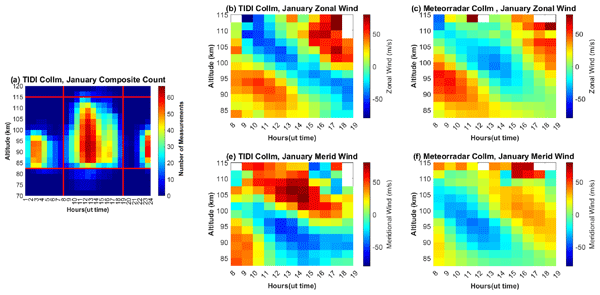
This study focuses on a TIMED Doppler Interferometer (TIDI)–meteor radar (MR) comparison of zonal and meridional winds and their dependence on local time and latitude. The correlation calculation between TIDI wind measurements and MR winds shows good agreement. A TIDI–MR seasonal comparison and analysis of the altitude–latitude dependence for winds are performed. TIDI reproduces the mean circulation well when compared with MRs and may be a useful lower boundary for general circulation models.
Florian Günzkofer, Gunter Stober, Johan Kero, David R. Themens, Anders Tjulin, Njål Gulbrandsen, Masaki Tsutsumi, and Claudia Borries
Ann. Geophys., 43, 331–348, https://doi.org/10.5194/angeo-43-331-2025, https://doi.org/10.5194/angeo-43-331-2025, 2025
Short summary
Short summary
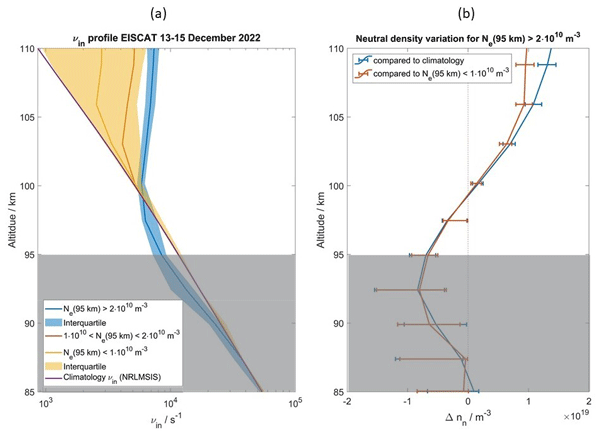
The Earth’s magnetic field is not closed at high latitudes. Electrically charged particles can penetrate the Earth’s atmosphere, deposit their energy, and heat the local atmosphere–ionosphere. This presumably causes an upwelling of the neutral atmosphere, which affects the atmosphere–ionosphere coupling. We apply a new analysis technique to infer the atmospheric density from incoherent scatter radar measurements. We identify signs of particle precipitation impact on the neutral atmosphere.
Markus Kunze, Christoph Zülicke, Tarique A. Siddiqui, Claudia C. Stephan, Yosuke Yamazaki, Claudia Stolle, Sebastian Borchert, and Hauke Schmidt
Geosci. Model Dev., 18, 3359–3385, https://doi.org/10.5194/gmd-18-3359-2025, https://doi.org/10.5194/gmd-18-3359-2025, 2025
Short summary
Short summary
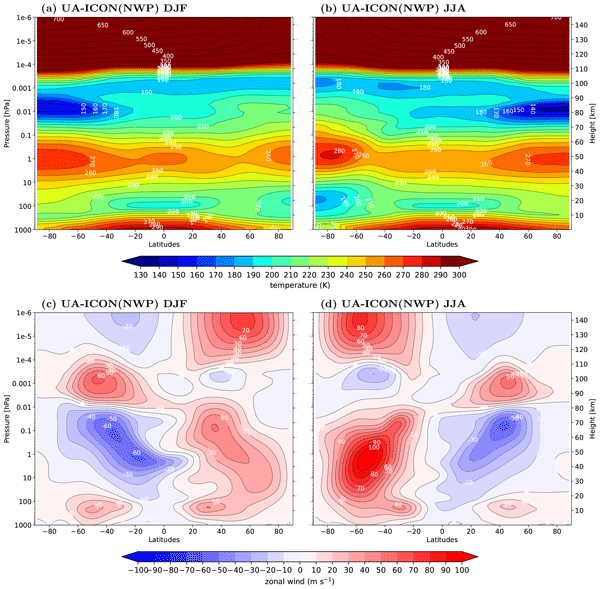
We present the Icosahedral Nonhydrostatic (ICON) general circulation model with an upper-atmospheric extension with the physics package for numerical weather prediction (UA-ICON(NWP)). We optimized the parameters for the gravity wave parameterizations and achieved realistic modeling of the thermal and dynamic states of the mesopause regions. UA-ICON(NWP) now shows a realistic frequency of major sudden stratospheric warmings and well-represented solar tides in temperature.
Christoph Jacobi, Khalil Karami, Ales Kuchar, Manfred Ern, Toralf Renkwitz, Ralph Latteck, and Jorge L. Chau
Adv. Radio Sci., 23, 21–31, https://doi.org/10.5194/ars-23-21-2025, https://doi.org/10.5194/ars-23-21-2025, 2025
Short summary
Short summary
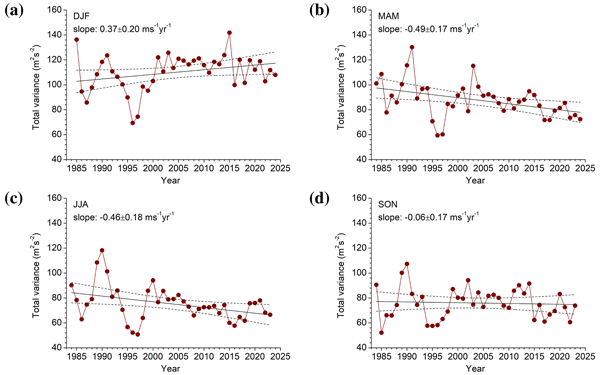
Half-hourly mean winds have been obtained using ground-based low-frequency and very high frequency radio observations of the mesopause region at Collm, Germany, since 1984. Long-term changes of wind variances, which are proxies for short-period atmospheric gravity waves, have been analysed. Gravity wave amplitudes increase with time in winter, but mainly decrease in summer. The trends are consistent with mean wind changes according to wave theory.
Claudia Christine Stephan and Bjorn Stevens
Atmos. Chem. Phys., 25, 1209–1226, https://doi.org/10.5194/acp-25-1209-2025, https://doi.org/10.5194/acp-25-1209-2025, 2025
Short summary
Short summary
Tropical precipitation cluster area and intensity distributions follow power laws, but the physical processes responsible for this behavior remain unknown. We analyze global simulations that realistically represent precipitation processes. We consider Earth-like planets as well as virtual planets to realize different types of large-scale dynamics. Our finding is that power laws in Earth’s precipitation cluster statistics stem from the robust power laws in Earth’s atmospheric wind field.
Devin Huyghebaert, Björn Gustavsson, Juha Vierinen, Andreas Kvammen, Matthew Zettergren, John Swoboda, Ilkka Virtanen, Spencer M. Hatch, and Karl M. Laundal
Ann. Geophys., 43, 99–113, https://doi.org/10.5194/angeo-43-99-2025, https://doi.org/10.5194/angeo-43-99-2025, 2025
Short summary
Short summary
The EISCAT_3D radar is a new ionospheric radar under construction in the Fennoscandia region. The radar will make measurements of plasma characteristics at altitudes above approximately 60 km. The capability of the system to make these measurements at spatial scales of less than 100 m using multiple digitised signals from each of the radar antenna panels is highlighted. There are many ionospheric small-scale processes that will be further resolved using the techniques discussed here.
Dorota Jozwicki, Puneet Sharma, Devin Huyghebaert, and Ingrid Mann
Ann. Geophys., 42, 431–453, https://doi.org/10.5194/angeo-42-431-2024, https://doi.org/10.5194/angeo-42-431-2024, 2024
Short summary
Short summary
We investigated the relationship between polar mesospheric summer echo (PMSE) layers and the solar cycle. Our results indicate that the average altitude of PMSEs, the echo power in the PMSEs and the thickness of the layers are, on average, higher during the solar maximum than during the solar minimum. We infer that higher electron densities at ionospheric altitudes might be necessary to observe multilayered PMSEs. We observe that the thickness decreases as the number of multilayers increases.
Tinna L. Gunnarsdottir, Ingrid Mann, Wuhu Feng, Devin R. Huyghebaert, Ingemar Haeggstroem, Yasunobu Ogawa, Norihito Saito, Satonori Nozawa, and Takuya D. Kawahara
Ann. Geophys., 42, 213–228, https://doi.org/10.5194/angeo-42-213-2024, https://doi.org/10.5194/angeo-42-213-2024, 2024
Short summary
Short summary
Several tons of meteoric particles burn up in our atmosphere each day. This deposits a great deal of material that binds with other atmospheric particles and forms so-called meteoric smoke particles. These particles are assumed to influence radar measurements. Here, we have compared radar measurements with simulations of a radar spectrum with and without dust particles and found that dust influences the radar spectrum in the altitude range of 75–85 km.
Yoshimasa Tanaka, Yasunobu Ogawa, Akira Kadokura, Takehiko Aso, Björn Gustavsson, Urban Brändström, Tima Sergienko, Genta Ueno, and Satoko Saita
Ann. Geophys., 42, 179–190, https://doi.org/10.5194/angeo-42-179-2024, https://doi.org/10.5194/angeo-42-179-2024, 2024
Short summary
Short summary
We present via simulation how useful monochromatic images taken by a multi-point imager network are for auroral research in the EISCAT_3D project. We apply the generalized-aurora computed tomography (G-ACT) to modeled multiple auroral images and ionospheric electron density data. It is demonstrated that G-ACT provides better reconstruction results than the normal ACT and can interpolate ionospheric electron density at a much higher spatial resolution than observed by the EISCAT_3D radar.
Gunter Stober, Sharon L. Vadas, Erich Becker, Alan Liu, Alexander Kozlovsky, Diego Janches, Zishun Qiao, Witali Krochin, Guochun Shi, Wen Yi, Jie Zeng, Peter Brown, Denis Vida, Neil Hindley, Christoph Jacobi, Damian Murphy, Ricardo Buriti, Vania Andrioli, Paulo Batista, John Marino, Scott Palo, Denise Thorsen, Masaki Tsutsumi, Njål Gulbrandsen, Satonori Nozawa, Mark Lester, Kathrin Baumgarten, Johan Kero, Evgenia Belova, Nicholas Mitchell, Tracy Moffat-Griffin, and Na Li
Atmos. Chem. Phys., 24, 4851–4873, https://doi.org/10.5194/acp-24-4851-2024, https://doi.org/10.5194/acp-24-4851-2024, 2024
Short summary
Short summary
On 15 January 2022, the Hunga Tonga-Hunga Ha‘apai volcano exploded in a vigorous eruption, causing many atmospheric phenomena reaching from the surface up to space. In this study, we investigate how the mesospheric winds were affected by the volcanogenic gravity waves and estimated their propagation direction and speed. The interplay between model and observations permits us to gain new insights into the vertical coupling through atmospheric gravity waves.
Peter Dalin, Urban Brändström, Johan Kero, Peter Voelger, Takanori Nishiyama, Trond Trondsen, Devin Wyatt, Craig Unick, Vladimir Perminov, Nikolay Pertsev, and Jonas Hedin
Atmos. Meas. Tech., 17, 1561–1576, https://doi.org/10.5194/amt-17-1561-2024, https://doi.org/10.5194/amt-17-1561-2024, 2024
Short summary
Short summary
A novel infrared imaging instrument (OH imager) was put into operation in November 2022 at the Swedish Institute of Space Physics in Kiruna (Sweden). The OH imager is dedicated to the study of nightglow emissions coming from the hydroxyl (OH) and molecular oxygen (O2) layers in the mesopause (80–100 km). Based on a brightness ratio of two OH emission lines, the neutral temperature is estimated at around 87 km. The average daily winter temperature for the period January–April 2023 is 203±10 K.
Ralph Latteck and Damian J. Murphy
Ann. Geophys., 42, 55–68, https://doi.org/10.5194/angeo-42-55-2024, https://doi.org/10.5194/angeo-42-55-2024, 2024
Short summary
Short summary
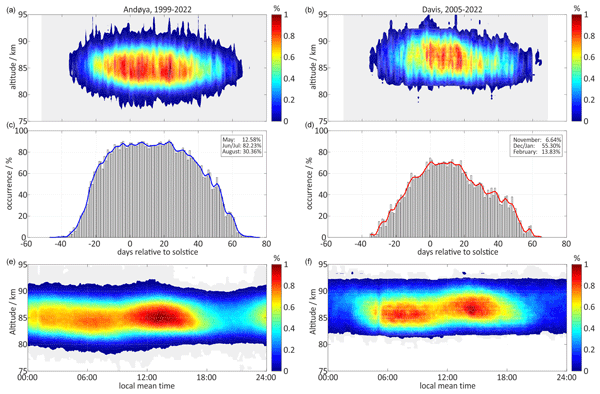
This paper gives an overview of continuous measurements of polar mesophere summer echoes (PMSE) by VHF radars at Andøya (69° N) and Davis (69° S). PMSE signal strengths are of the same order of magnitude; significantly fewer PMSE were observed in the Southern than the Northern Hemisphere. Compared to Andøya, the PMSE season over Davis starts ~7 d later and ends 9 d earlier; PMSE occur less frequently but with greater seasonal/diurnal occurrence variability, reaching higher peak altitudes.
Jennifer Hartisch, Jorge L. Chau, Ralph Latteck, Toralf Renkwitz, and Marius Zecha
Ann. Geophys., 42, 29–43, https://doi.org/10.5194/angeo-42-29-2024, https://doi.org/10.5194/angeo-42-29-2024, 2024
Short summary
Short summary
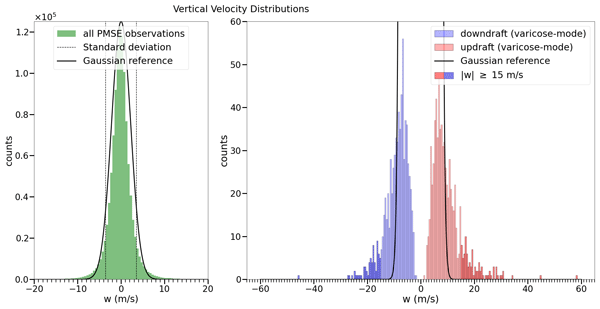
Scientists are studying the mesosphere and lower thermosphere using radar in northern Norway. They found peculiar events with strong upward and downward air movements, happening frequently (up to 2.5 % per month) from 2015 to 2021. Over 700 such events were noted, lasting around 20 min and expanding the studied layer. A total of 17 % of these events had extreme vertical speeds, showing their unique nature.
Thomas B. Leyser, Tima Sergienko, Urban Brändström, Björn Gustavsson, and Michael T. Rietveld
Ann. Geophys., 41, 589–600, https://doi.org/10.5194/angeo-41-589-2023, https://doi.org/10.5194/angeo-41-589-2023, 2023
Short summary
Short summary
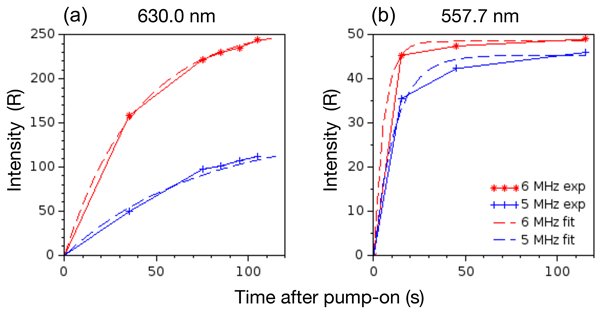
Powerful radio waves transmitted into the ionosphere from the ground were used to study electron energization in the pumped ionospheric plasma turbulence, by detecting optical emissions from atomic oxygen. Our results obtained with the EISCAT (European Incoherent Scatter Scientific Association) facilities in northern Norway and optical detection with the ALIS (Auroral Large Imaging System) in northern Sweden suggest that long-wavelength upper hybrid waves are important in accelerating electrons.
Christoph Jacobi, Ales Kuchar, Toralf Renkwitz, and Juliana Jaen
Adv. Radio Sci., 21, 111–121, https://doi.org/10.5194/ars-21-111-2023, https://doi.org/10.5194/ars-21-111-2023, 2023
Short summary
Short summary
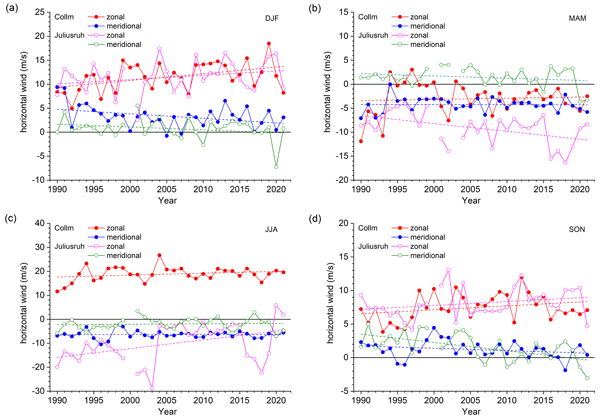
Middle atmosphere long-term changes show the signature of climate change. We analyse 43 years of mesopause region horizontal winds obtained at two sites in Germany. We observe mainly positive trends of the zonal prevailing wind throughout the year, while the meridional winds tend to decrease in magnitude in both summer and winter. Furthermore, there is a change in long-term trends around the late 1990s, which is most clearly visible in summer winds.
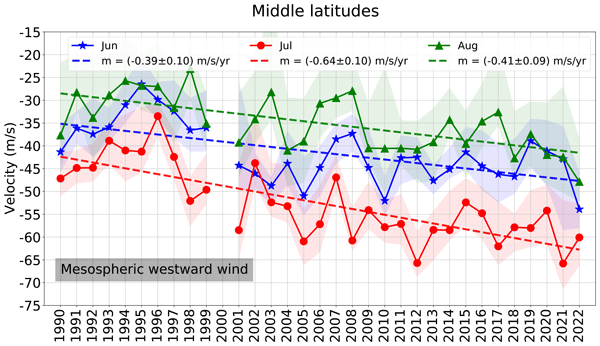
Juliana Jaen, Toralf Renkwitz, Huixin Liu, Christoph Jacobi, Robin Wing, Aleš Kuchař, Masaki Tsutsumi, Njål Gulbrandsen, and Jorge L. Chau
Atmos. Chem. Phys., 23, 14871–14887, https://doi.org/10.5194/acp-23-14871-2023, https://doi.org/10.5194/acp-23-14871-2023, 2023
Short summary
Short summary
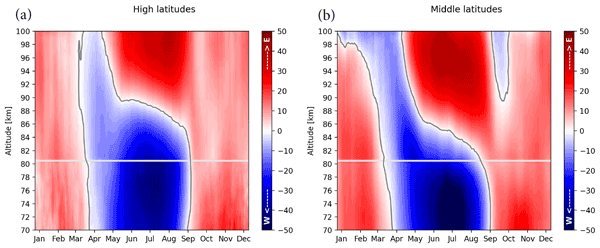
Investigation of winds is important to understand atmospheric dynamics. In the summer mesosphere and lower thermosphere, there are three main wind flows: the mesospheric westward, the mesopause southward (equatorward), and the lower-thermospheric eastward wind. Combining almost 2 decades of measurements from different radars, we study the trend, their interannual oscillations, and the effects of the geomagnetic activity over these wind maxima.
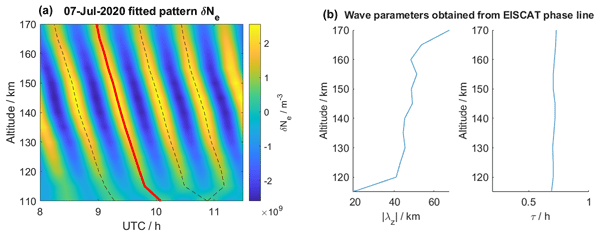
Florian Günzkofer, Dimitry Pokhotelov, Gunter Stober, Ingrid Mann, Sharon L. Vadas, Erich Becker, Anders Tjulin, Alexander Kozlovsky, Masaki Tsutsumi, Njål Gulbrandsen, Satonori Nozawa, Mark Lester, Evgenia Belova, Johan Kero, Nicholas J. Mitchell, and Claudia Borries
Ann. Geophys., 41, 409–428, https://doi.org/10.5194/angeo-41-409-2023, https://doi.org/10.5194/angeo-41-409-2023, 2023
Short summary
Short summary
Gravity waves (GWs) are waves in Earth's atmosphere and can be observed as cloud ripples. Under certain conditions, these waves can propagate up into the ionosphere. Here, they can cause ripples in the ionosphere plasma, observable as oscillations of the plasma density. Therefore, GWs contribute to the ionospheric variability, making them relevant for space weather prediction. Additionally, the behavior of these waves allows us to draw conclusions about the atmosphere at these altitudes.
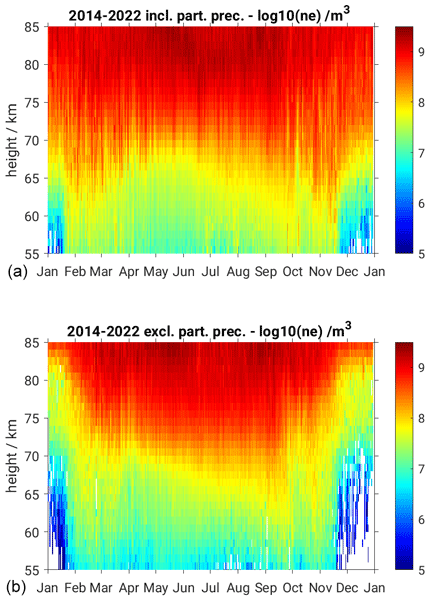
Toralf Renkwitz, Mani Sivakandan, Juliana Jaen, and Werner Singer
Atmos. Chem. Phys., 23, 10823–10834, https://doi.org/10.5194/acp-23-10823-2023, https://doi.org/10.5194/acp-23-10823-2023, 2023
Short summary
Short summary
The paper focuses on remote sensing of the lowermost part of the ionosphere (D region) between ca. 50 and 90 km altitude, which overlaps widely with the mesosphere. We present a climatology of electron density over northern Norway, covering solar-maximum and solar-minimum conditions (2014–2022). Excluding detected energetic particle precipitation events, we derived a quiet-profile climatology. We also found a spring–fall asymmetry, while a symmetric solar zenith angle dependence was expected.
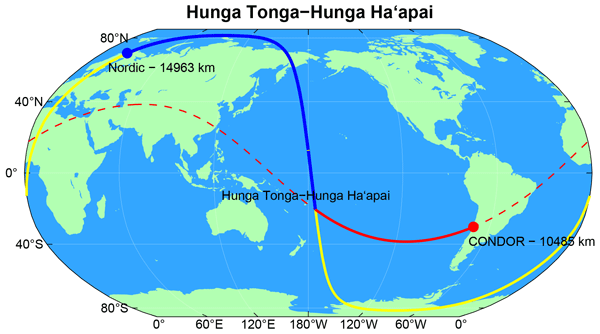
Gunter Stober, Alan Liu, Alexander Kozlovsky, Zishun Qiao, Witali Krochin, Guochun Shi, Johan Kero, Masaki Tsutsumi, Njål Gulbrandsen, Satonori Nozawa, Mark Lester, Kathrin Baumgarten, Evgenia Belova, and Nicholas Mitchell
Ann. Geophys., 41, 197–208, https://doi.org/10.5194/angeo-41-197-2023, https://doi.org/10.5194/angeo-41-197-2023, 2023
Short summary
Short summary
The Hunga Tonga–Hunga Ha‘apai volcanic eruption was one of the most vigorous volcanic explosions in the last centuries. The eruption launched many atmospheric waves traveling around the Earth. In this study, we identify these volcanic waves at the edge of space in the mesosphere/lower-thermosphere, leveraging wind observations conducted with multi-static meteor radars in northern Europe and with the Chilean Observation Network De Meteor Radars (CONDOR).
Cathy Hohenegger, Peter Korn, Leonidas Linardakis, René Redler, Reiner Schnur, Panagiotis Adamidis, Jiawei Bao, Swantje Bastin, Milad Behravesh, Martin Bergemann, Joachim Biercamp, Hendryk Bockelmann, Renate Brokopf, Nils Brüggemann, Lucas Casaroli, Fatemeh Chegini, George Datseris, Monika Esch, Geet George, Marco Giorgetta, Oliver Gutjahr, Helmuth Haak, Moritz Hanke, Tatiana Ilyina, Thomas Jahns, Johann Jungclaus, Marcel Kern, Daniel Klocke, Lukas Kluft, Tobias Kölling, Luis Kornblueh, Sergey Kosukhin, Clarissa Kroll, Junhong Lee, Thorsten Mauritsen, Carolin Mehlmann, Theresa Mieslinger, Ann Kristin Naumann, Laura Paccini, Angel Peinado, Divya Sri Praturi, Dian Putrasahan, Sebastian Rast, Thomas Riddick, Niklas Roeber, Hauke Schmidt, Uwe Schulzweida, Florian Schütte, Hans Segura, Radomyra Shevchenko, Vikram Singh, Mia Specht, Claudia Christine Stephan, Jin-Song von Storch, Raphaela Vogel, Christian Wengel, Marius Winkler, Florian Ziemen, Jochem Marotzke, and Bjorn Stevens
Geosci. Model Dev., 16, 779–811, https://doi.org/10.5194/gmd-16-779-2023, https://doi.org/10.5194/gmd-16-779-2023, 2023
Short summary
Short summary
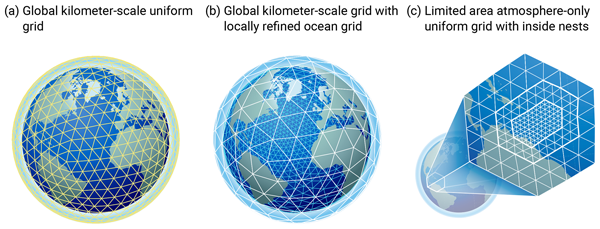
Models of the Earth system used to understand climate and predict its change typically employ a grid spacing of about 100 km. Yet, many atmospheric and oceanic processes occur on much smaller scales. In this study, we present a new model configuration designed for the simulation of the components of the Earth system and their interactions at kilometer and smaller scales, allowing an explicit representation of the main drivers of the flow of energy and matter by solving the underlying equations.

Johann Stamm, Juha Vierinen, Björn Gustavsson, and Andres Spicher
Ann. Geophys., 41, 55–67, https://doi.org/10.5194/angeo-41-55-2023, https://doi.org/10.5194/angeo-41-55-2023, 2023
Short summary
Short summary
The study of some ionospheric events benefit from the knowledge of how the physics varies over a volume and over time. Examples are studies of aurora or energy deposition. With EISCAT3D, measurements of ion velocity vectors in a volume will be possible for the first time. We present a technique that uses a set of such measurements to estimate electric field and neutral wind. The technique relies on adding restrictions to the estimates. We successfully consider restrictions based on physics.
Daniel K. Whiter, Noora Partamies, Björn Gustavsson, and Kirsti Kauristie
Ann. Geophys., 41, 1–12, https://doi.org/10.5194/angeo-41-1-2023, https://doi.org/10.5194/angeo-41-1-2023, 2023
Short summary
Short summary
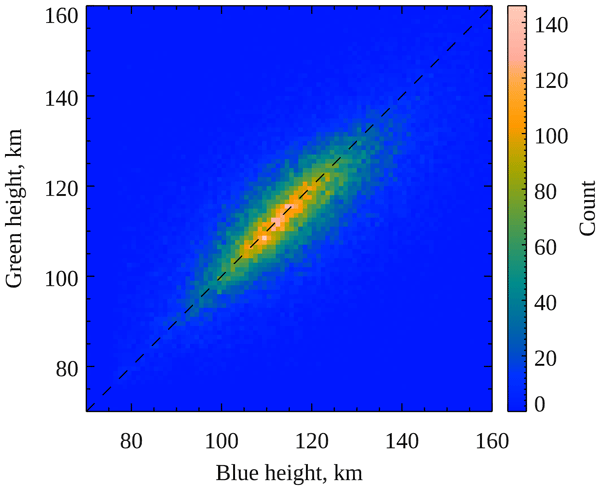
We measured the height of green and blue aurorae using thousands of camera images recorded over a 7-year period. Both colours are typically brightest at about 114 km altitude. When they peak at higher altitudes the blue aurora is usually higher than the green aurora. This information will help other studies which need an estimate of the auroral height. We used a computer model to explain our observations and to investigate how the green aurora is produced.
Gunter Stober, Alan Liu, Alexander Kozlovsky, Zishun Qiao, Ales Kuchar, Christoph Jacobi, Chris Meek, Diego Janches, Guiping Liu, Masaki Tsutsumi, Njål Gulbrandsen, Satonori Nozawa, Mark Lester, Evgenia Belova, Johan Kero, and Nicholas Mitchell
Atmos. Meas. Tech., 15, 5769–5792, https://doi.org/10.5194/amt-15-5769-2022, https://doi.org/10.5194/amt-15-5769-2022, 2022
Short summary
Short summary
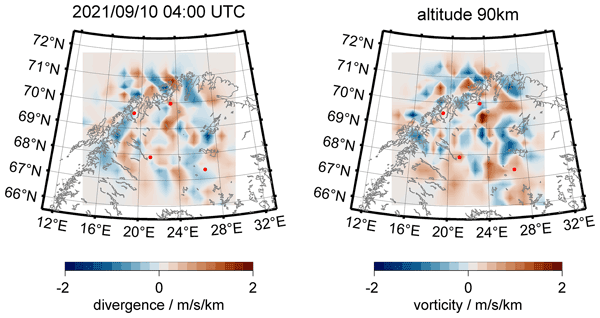
Precise and accurate measurements of vertical winds at the mesosphere and lower thermosphere are rare. Although meteor radars have been used for decades to observe horizontal winds, their ability to derive reliable vertical wind measurements was always questioned. In this article, we provide mathematical concepts to retrieve mathematically and physically consistent solutions, which are compared to the state-of-the-art non-hydrostatic model UA-ICON.
Knut Ola Dølven, Juha Vierinen, Roberto Grilli, Jack Triest, and Bénédicte Ferré
Geosci. Instrum. Method. Data Syst., 11, 293–306, https://doi.org/10.5194/gi-11-293-2022, https://doi.org/10.5194/gi-11-293-2022, 2022
Short summary
Short summary
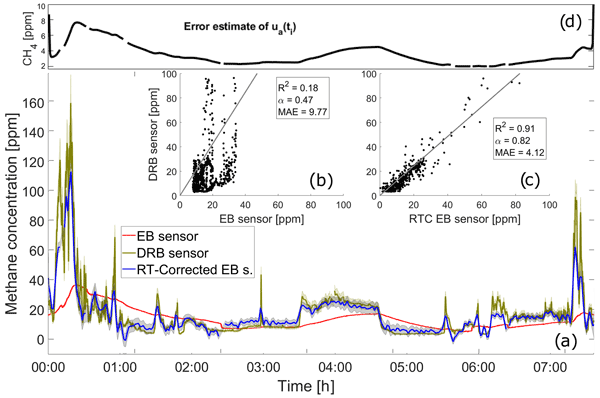
Sensors capable of measuring rapid fluctuations are important to improve our understanding of environmental processes. Many sensors are unable to do this, due to their reliance on the transfer of the measured property, for instance a gas, across a semi-permeable barrier. We have developed a mathematical tool which enables the retrieval of fast-response signals from sensors with this type of sensor design.
Carsten Baumann, Antti Kero, Shikha Raizada, Markus Rapp, Michael P. Sulzer, Pekka T. Verronen, and Juha Vierinen
Ann. Geophys., 40, 519–530, https://doi.org/10.5194/angeo-40-519-2022, https://doi.org/10.5194/angeo-40-519-2022, 2022
Short summary
Short summary
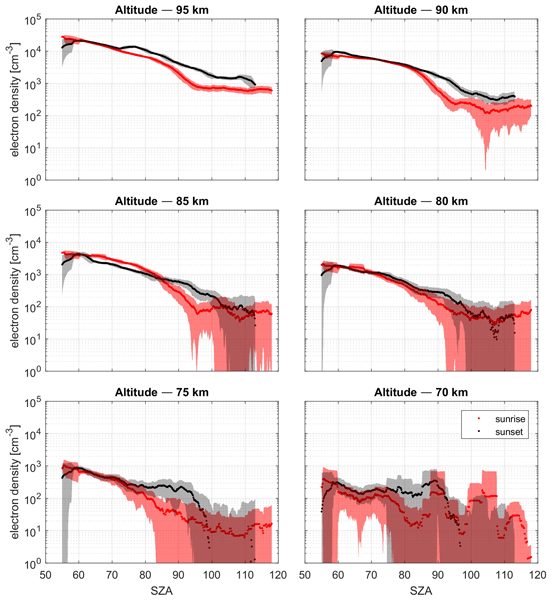
The Arecibo radar was used to probe free electrons of the ionized atmosphere between 70 and 100 km altitude. This is also the altitude region were meteors evaporate and form secondary particulate matter, the so-called meteor smoke particles (MSPs). Free electrons attach to these MSPs when the sun is below the horizon and cause a drop in the number of free electrons, which are the subject of these measurements. We also identified a different number of free electrons during sunset and sunrise.
Mizuki Fukizawa, Takeshi Sakanoi, Yoshimasa Tanaka, Yasunobu Ogawa, Keisuke Hosokawa, Björn Gustavsson, Kirsti Kauristie, Alexander Kozlovsky, Tero Raita, Urban Brändström, and Tima Sergienko
Ann. Geophys., 40, 475–484, https://doi.org/10.5194/angeo-40-475-2022, https://doi.org/10.5194/angeo-40-475-2022, 2022
Short summary
Short summary
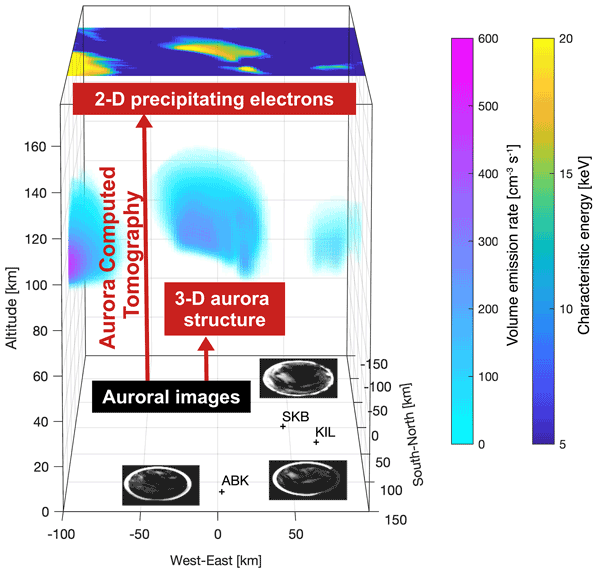
The pulsating auroral generation mechanism has been investigated by observing precipitating electrons using rockets or satellites. However, it is difficult for such observations to distinguish temporal changes from spatial ones. In this study, we reconstructed the horizontal 2-D distribution of precipitating electrons using only auroral images. The 3-D aurora structure was also reconstructed. We found that there were both spatial and temporal changes in the precipitating electron energy.
Sumanta Sarkhel, Gunter Stober, Jorge L. Chau, Steven M. Smith, Christoph Jacobi, Subarna Mondal, Martin G. Mlynczak, and James M. Russell III
Ann. Geophys., 40, 179–190, https://doi.org/10.5194/angeo-40-179-2022, https://doi.org/10.5194/angeo-40-179-2022, 2022
Short summary
Short summary
A rare gravity wave event was observed on the night of 25 April 2017 over northern Germany. An all-sky airglow imager recorded an upward-propagating wave at different altitudes in mesosphere with a prominent wave front above 91 km and faintly observed below. Based on wind and satellite-borne temperature profiles close to the event location, we have found the presence of a leaky thermal duct layer in 85–91 km. The appearance of this duct layer caused the wave amplitudes to diminish below 91 km.

Derek McKay, Juha Vierinen, Antti Kero, and Noora Partamies
Geosci. Instrum. Method. Data Syst., 11, 25–35, https://doi.org/10.5194/gi-11-25-2022, https://doi.org/10.5194/gi-11-25-2022, 2022
Short summary
Short summary
When radio waves from our galaxy enter the Earth's atmosphere, they are absorbed by electrons in the upper atmosphere. It was thought that by measuring the amount of absorption, it would allow the height of these electrons in the atmosphere to be determined. If so, this would have significance for future instrument design. However, this paper demonstrates that it is not possible to do this, but it does explain how multiple-frequency measurements can nevertheless be useful.
Juliana Jaen, Toralf Renkwitz, Jorge L. Chau, Maosheng He, Peter Hoffmann, Yosuke Yamazaki, Christoph Jacobi, Masaki Tsutsumi, Vivien Matthias, and Chris Hall
Ann. Geophys., 40, 23–35, https://doi.org/10.5194/angeo-40-23-2022, https://doi.org/10.5194/angeo-40-23-2022, 2022
Short summary
Short summary
To study long-term trends in the mesosphere and lower thermosphere (70–100 km), we established two summer length definitions and analyzed the variability over the years (2004–2020). After the analysis, we found significant trends in the summer beginning of one definition. Furthermore, we were able to extend one of the time series up to 31 years and obtained evidence of non-uniform trends and periodicities similar to those known for the quasi-biennial oscillation and El Niño–Southern Oscillation.
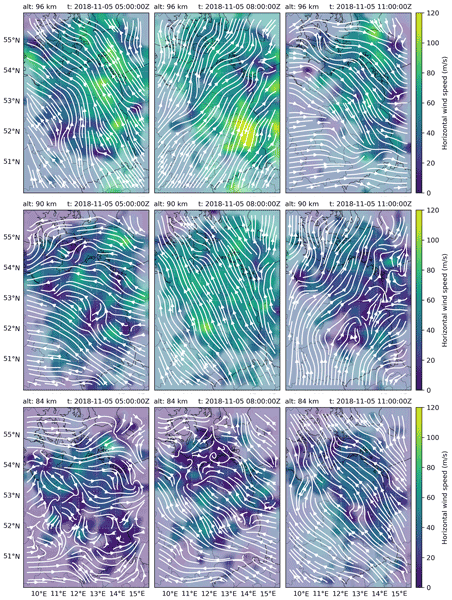
Ryan Volz, Jorge L. Chau, Philip J. Erickson, Juha P. Vierinen, J. Miguel Urco, and Matthias Clahsen
Atmos. Meas. Tech., 14, 7199–7219, https://doi.org/10.5194/amt-14-7199-2021, https://doi.org/10.5194/amt-14-7199-2021, 2021
Short summary
Short summary
We introduce a new way of estimating winds in the upper atmosphere (about 80 to 100 km in altitude) from the observed Doppler shift of meteor trails using a statistical method called Gaussian process regression. Wind estimates and, critically, the uncertainty of those estimates can be evaluated smoothly (i.e., not gridded) in space and time. The effective resolution is set by provided parameters, which are limited in practice by the number density of the observed meteors.
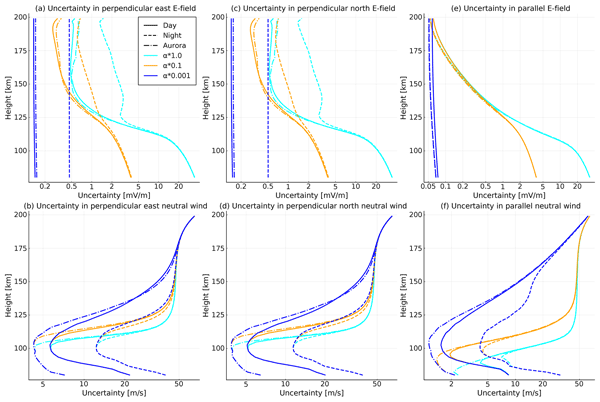
Johann Stamm, Juha Vierinen, and Björn Gustavsson
Ann. Geophys., 39, 961–974, https://doi.org/10.5194/angeo-39-961-2021, https://doi.org/10.5194/angeo-39-961-2021, 2021
Short summary
Short summary
Measurements of the electric field and neutral wind in the ionosphere are important for understanding energy flows or electric currents. With incoherent scatter radars (ISRs), we can measure the velocity of the ions, which depends on both the electrical field and the neutral wind. In this paper, we investigate methods to use ISR data to find reasonable values for both parameters. We find that electric field can be well measured down to 125 km height and neutral wind below this height.
Cited articles
Blaauw, R. C., Campbell-Brown, M. D., and Weryk, R. J.: Mass distribution indices of sporadic meteors using radar data, Mon. Not. R. Astron. Soc., 412, 2033–2039, https://doi.org/10.1111/j.1365-2966.2010.18038.x, 2011. a
Campbell-Brown, M.: High resolution radiant distribution and orbits of sporadic radar meteoroids, Icarus, 196, 144–163, https://doi.org/10.1016/j.icarus.2008.02.022, 2008. a
Chau, J. L. and Woodman, R. F.: Observations of meteor-head echoes using the Jicamarca 50 MHz radar in interferometer mode, Atmos. Chem. Phys., 4, 511–521, https://doi.org/10.5194/acp-4-511-2004, 2004. a
Chau, J. L., Woodman, R. F., and Galindo, F.: Sporadic meteor sources as observed by the Jicamarca high-power large-aperture VHF radar, Icarus, 188, 162–174, https://doi.org/10.1016/j.icarus.2006.11.006, 2007. a
Close, S., Oppenheim, M., Hunt, S., and Coster, A.: A technique for calculating meteor plasma density and meteoroid mass from radar head echo scattering, Icarus, 168, 43–52, https://doi.org/10.1016/j.icarus.2003.11.018, 2004. a
Close, S., Hamlin, T., Oppenheim, M., Cox, L., and Colestock, P.: Dependence of radar signal strength on frequency and aspect angle of nonspecular meteor trails, J. Geophys. Res.-Space, 113, https://doi.org/10.1029/2007JA012647, 2008. a
Close, S., Kelley, M., Vertatschitsch, L., Colestock, P., Oppenheim, M., and Yee, J.: Polarization and scattering of a long-duration meteor trail, J. Geophys. Res.-Space, 116, https://doi.org/10.1029/2010JA015968, 2011. a
Close, S., Volz, R., Loveland, R., Macdonell, A., Colestock, P., Linscott, I., and Oppenheim, M.: Determining meteoroid bulk densities using a plasma scattering model with high-power large-aperture radar data, Icarus, 221, 300–309, https://doi.org/10.1016/j.icarus.2012.07.033, 2012. a
Dawkins, E. C. M., Janches, D., Stober, G., Carrillo-Sánchez, J. D., Lieberman, R. S., Jacobi, C., Moffat-Griffin, T., Mitchell, N. J., Cobbett, N., Batista, P. P., Andrioli, V. F., Buriti, R. A., Murphy, D. J., Kero, J., Gulbrandsen, N., Tsutsumi, M., Kozlovsky, A., Lester, M., Kim, J.-H., Lee, C., Liu, A., Fuller, B., O’Connor, D., Palo, S. E., Taylor, M. J., Marino, J., and Rainville, N.: Seasonal and Local Time Variation in the Observed Peak of the Meteor Altitude Distributions by Meteor Radars, J. Geophys. Res.-Atmos., 129, e2024JD040978, https://doi.org/10.1029/2024JD040978, 2024. a, b
Dimant, Y. S. and Oppenheim, M. M.: Formation of plasma around a small meteoroid: 1. Kinetic theory, J. Geophys. Res.-Space, 122, 4669–4696, https://doi.org/10.1002/2017JA023960, 2017a. a, b
Dimant, Y. S. and Oppenheim, M. M.: Formation of plasma around a small meteoroid: 2. Implications for radar head echo, J. Geophys. Res.-Space, 122, 4697–4711, https://doi.org/10.1002/2017JA023963, 2017b. a, b
Doornbos, E.: Empirical Modelling of the Thermosphere, Springer Berlin Heidelberg, Berlin, Heidelberg, 21–57, ISBN 978-3-642-25129-0, https://doi.org/10.1007/978-3-642-25129-0_2, 2012. a, b
Dyrud, L., Wilson, D., Boerve, S., Trulsen, J., Pecseli, H., Close, S., Chen, C., and Lee, Y.: Plasma and electromagnetic wave simulations of meteors, Adv. Space Res., 42, 136–142, https://doi.org/10.1016/j.asr.2007.03.048, 2008. a
Emmert, J. T., Drob, D. P., Picone, J. M., Siskind, D. E., Jones Jr., M., Mlynczak, M. G., Bernath, P. F., Chu, X., Doornbos, E., Funke, B., Goncharenko, L. P., Hervig, M. E., Schwartz, M. J., Sheese, P. E., Vargas, F., Williams, B. P., and Yuan, T.: NRLMSIS 2.0: A Whole-Atmosphere Empirical Model of Temperature and Neutral Species Densities, Earth Space Sci., 8, e2020EA001321, https://doi.org/10.1029/2020EA001321, 2021. a
Emmert, J. T., Jones Jr, M., Siskind, D. E., Drob, D. P., Picone, J. M., Stevens, M. H., Bailey, S. M., Bender, S., Bernath, P. F., Funke, B., Hervig, M. E., and Pérot, K.: NRLMSIS 2.1: An Empirical Model of Nitric Oxide Incorporated Into MSIS, J. Geophys. Res.-Space, 127, e2022JA030896, https://doi.org/10.1029/2022JA030896, 2022. a
Günzkofer, F., Stober, G., Pokhotelov, D., Miyoshi, Y., and Borries, C.: Difference spectrum fitting of the ion–neutral collision frequency from dual-frequency EISCAT measurements, Atmos. Meas. Tech., 16, 5897–5907, https://doi.org/10.5194/amt-16-5897-2023, 2023. a
Hall, C. M., Holmen, S. E., Meek, C. E., Manson, A. H., and Nozawa, S.: Change in turbopause altitude at 52 and 70° N, Atmos. Chem. Phys., 16, 2299–2308, https://doi.org/10.5194/acp-16-2299-2016, 2016. a
Huyghebaert, D. and Vierinen, J.: HuyghebaertAMT2025, Leibniz Institute of Atmospheric Physics at the University of Rostock [data set], https://doi.org/10.22000/yk29t2gu0h4jhkjg, 2026. a
Huyghebaert, D., Clahsen, M., Chau, J. L., Renkwitz, T., Latteck, R., Johnsen, M. G., and Vierinen, J.: Multiple E-Region Radar Propagation Modes Measured by the VHF SIMONe Norway System During Active Ionospheric Conditions, Front. Astron. Space Sci., 9, https://doi.org/10.3389/fspas.2022.886037, 2022. a
Jaen, J., Renkwitz, T., Liu, H., Jacobi, C., Wing, R., Kuchař, A., Tsutsumi, M., Gulbrandsen, N., and Chau, J. L.: Long-term studies of the summer wind in the mesosphere and lower thermosphere at middle and high latitudes over Europe, Atmos. Chem. Phys., 23, 14871–14887, https://doi.org/10.5194/acp-23-14871-2023, 2023. a
Janches, D., Heinselman, C. J., Chau, J. L., Chandran, A., and Woodman, R.: Modeling the global micrometeor input function in the upper atmosphere observed by high power and large aperture radars, J. Geophys. Res.-Space, 111, https://doi.org/10.1029/2006JA011628, 2006. a
Kero, J., Szasz, C., Wannberg, G., Pellinen-Wannberg, A., and Westman, A.: On the meteoric head echo radar cross section angular dependence, Geophys. Res. Lett., 35, https://doi.org/10.1029/2008GL033402, 2008. a
Kero, J., Szasz, C., Nakamura, T., Meisel, D. D., Ueda, M., Fujiwara, Y., Terasawa, T., Nishimura, K., and Watanabe, J.: The 2009–2010 MU radar head echo observation programme for sporadic and shower meteors: radiant densities and diurnal rates: The 2009–2010 MU radar head echo observation programme, Mon. Not. R. Astron. Soc., 425, 135–146, https://doi.org/10.1111/j.1365-2966.2012.21407.x, 2012. a
Kunze, M., Zülicke, C., Siddiqui, T. A., Stephan, C. C., Yamazaki, Y., Stolle, C., Borchert, S., and Schmidt, H.: UA-ICON with the NWP physics package (version ua-icon-2.1): mean state and variability of the middle atmosphere, Geosci. Model Dev., 18, 3359–3385, https://doi.org/10.5194/gmd-18-3359-2025, 2025. a, b
Latteck, R., Singer, W., Rapp, M., Vandepeer, B., Renkwitz, T., Zecha, M., and Stober, G.: MAARSY: The new MST radar on Andøya – System description and first results, Radio Sci., 47, https://doi.org/10.1029/2011RS004775, 2012. a, b
Li, A. and Close, S.: Neutral density estimation derived from meteoroid measurements using high-power, large-aperture radar, J. Geophys. Res.-Atmos., 121, 8023–8037, https://doi.org/10.1002/2015JD024547, 2016. a, b
Limonta, L., Close, S., and Marshall, R. A.: A technique for inferring lower thermospheric neutral density from meteoroid ablation, Planet. Space Sci., 180, 104735, https://doi.org/10.1016/j.pss.2019.104735, 2020. a, b, c, d
Lucas, G.: pymsis, Zenodo [code], https://doi.org/10.5281/zenodo.7581692, 2023. a
Marshall, R. A., Brown, P., and Close, S.: Plasma distributions in meteor head echoes and implications for radar cross section interpretation, Planet. Space Sci., 143, 203–208, https://doi.org/10.1016/j.pss.2016.12.011, 2017. a
Picone, J. M., Hedin, A. E., Drob, D. P., and Aikin, A. C.: NRLMSISE-00 empirical model of the atmosphere: Statistical comparisons and scientific issues, J. Geophys. Res.-Space, 107, SIA 15-1–SIA 15-16, https://doi.org/10.1029/2002JA009430, 2002. a, b
Sato, K., Tomikawa, Y., Kohma, M., Yasui, R., Koshin, D., Okui, H., Watanabe, S., Miyazaki, K., Tsutsumi, M., Murphy, D., Meek, C., Tian, Y., Ern, M., Baumgarten, G., Chau, J. L., Chu, X., Collins, R., Espy, P. J., Hashiguchi, H., Kavanagh, A. J., Latteck, R., Lübken, F.-J., Milla, M., Nozawa, S., Ogawa, Y., Shiokawa, K., Alexander, M. J., Nakamura, T., and Ward, W. E.: Interhemispheric Coupling Study by Observations and Modelling (ICSOM): Concept, Campaigns, and Initial Results, J. Geophys. Res.-Atmos., 128, e2022JD038249, https://doi.org/10.1029/2022JD038249, 2023. a
Schult, C., Stober, G., Chau, J. L., and Latteck, R.: Determination of meteor-head echo trajectories using the interferometric capabilities of MAARSY, Ann. Geophys., 31, 1843–1851, https://doi.org/10.5194/angeo-31-1843-2013, 2013. a, b
Schult, C., Stober, G., Janches, D., and Chau, J. L.: Results of the first continuous meteor head echo survey at polar latitudes, Icarus, 297, 1–13, https://doi.org/10.1016/j.icarus.2017.06.019, 2017. a
Schult, C., Brown, P., Pokorný, P., Stober, G., and Chau, J. L.: A meteoroid stream survey using meteor head echo observations from the Middle Atmosphere ALOMAR Radar System (MAARSY), Icarus, 309, 177–186, https://doi.org/10.1016/j.icarus.2018.02.032, 2018. a, b
Sparks, J. J. and Janches, D.: Latitudinal dependence of the variability of the micrometeor altitude distribution, Geophys. Res. Lett., 36, https://doi.org/10.1029/2009GL038485, 2009. a
Stober, G., Jacobi, C., Matthias, V., Hoffmann, P., and Gerding, M.: Neutral air density variations during strong planetary wave activity in the mesopause region derived from meteor radar observations, J. Atmos. Sol.-Terr. Phy., 74, 55–63, https://doi.org/10.1016/j.jastp.2011.10.007, 2012. a, b
Stober, G., Matthias, V., Brown, P., and Chau, J. L.: Neutral density variation from specular meteor echo observations spanning one solar cycle, Geophys. Res. Lett., 41, 6919–6925, https://doi.org/10.1002/2014GL061273, 2014. a, b
Sugar, G., Oppenheim, M. M., Dimant, Y. S., and Close, S.: Formation of Plasma Around a Small Meteoroid: Simulation and Theory, J. Geophys. Res.-Space, 123, 4080–4093, https://doi.org/10.1002/2018JA025265, 2018. a, b
Thomas, N., Kero, A., Virtanen, I., Nozawa, S., and Saito, N.: D-region ion-neutral collision frequency observed by incoherent scatter spectral width combined with LIDAR measurements, ESS Open Archive, https://doi.org/10.22541/essoar.172081412.21962979/v1, 2024. a
Vida, D., Brown, P. G., Campbell-Brown, M., Weryk, R. J., Stober, G., and McCormack, J. P.: High precision meteor observations with the Canadian automated meteor observatory: Data reduction pipeline and application to meteoroid mechanical strength measurements, Icarus, 354, 114097, https://doi.org/10.1016/j.icarus.2020.114097, 2021. a
Vondrak, T., Plane, J. M. C., Broadley, S., and Janches, D.: A chemical model of meteoric ablation, Atmos. Chem. Phys., 8, 7015–7031, https://doi.org/10.5194/acp-8-7015-2008, 2008. a, b
Yamazaki, Y., Stolle, C., Stephan, C., and Mlynczak, M. G.: Lower Thermospheric Temperature Response to Geomagnetic Activity at High Latitudes, J. Geophys. Res.-Space, 129, e2024JA032639, https://doi.org/10.1029/2024JA032639, 2024. a
Yi, W., Xue, X., Reid, I. M., Younger, J. P., Chen, J., Chen, T., and Li, N.: Estimation of Mesospheric Densities at Low Latitudes Using the Kunming Meteor Radar Together With SABER Temperatures, J. Geophys. Res.-Space, 123, 3183–3195, https://doi.org/10.1002/2017JA025059, 2018. a
Younger, J. P., Reid, I. M., Vincent, R. A., and Murphy, D. J.: A method for estimating the height of a mesospheric density level using meteor radar, Geophys. Res. Lett., 42, 6106–6111, https://doi.org/10.1002/2015GL065066, 2015. a, b
Zhou, B., Yi, W., Xue, X., Ye, H., Zeng, J., Li, G., Tsutsumi, M., Gulbrandsen, N., Chen, T., and Dou, X.: Impact of sudden stratospheric warmings on the neutral density, temperature and wind in the MLT region, Front. Astron. Space Sci., 10, https://doi.org/10.3389/fspas.2023.1192985, 2023. a, b
Short summary
The phenomena of meteors occurs at altitudes of 60–120 km and can be used to measure the neutral atmosphere. We use a large high power radar system in Norway (Middle Atmosphere Alomar Radar System (MAARSY)) to measure the meteors and determine changes to the atmospheric density between the years of 2016–2023 at altitudes of 85–115 km. The same time period between years are compared, minimizing changes to the measurements due to factors other than the atmosphere.
The phenomena of meteors occurs at altitudes of 60–120 km and can be used to measure the neutral...


