Articles | Volume 18, issue 15
https://doi.org/10.5194/amt-18-3635-2025
© Author(s) 2025. This work is distributed under
the Creative Commons Attribution 4.0 License.
https://doi.org/10.5194/amt-18-3635-2025
© Author(s) 2025. This work is distributed under
the Creative Commons Attribution 4.0 License.
Seasonal effects in the application of the MOment MAtching (MOMA) remote calibration tool to outdoor PM2.5 air sensors
Lena Francesca Weissert
CORRESPONDING AUTHOR
Aeroqual Ltd, 460 Rosebank Road, Te Whau / Avondale, Tāmaki Makaurau / Auckland, 1026, Aotearoa / New Zealand
Geoff Stephen Henshaw
Aeroqual Ltd, 460 Rosebank Road, Te Whau / Avondale, Tāmaki Makaurau / Auckland, 1026, Aotearoa / New Zealand
Andrea Lee Clements
U.S. Environmental Protection Agency, Office of Research and Development, Center for Environmental Measurement and Modelling, 109 T.W. Alexander Drive, P.O. Box 12055, Research Triangle Park, NC 27711, USA
Rachelle Monique Duvall
U.S. Environmental Protection Agency, Office of Research and Development, Center for Environmental Measurement and Modelling, 109 T.W. Alexander Drive, P.O. Box 12055, Research Triangle Park, NC 27711, USA
Carry Croghan
U.S. Environmental Protection Agency, Office of Research and Development, Center for Environmental Measurement and Modelling, 109 T.W. Alexander Drive, P.O. Box 12055, Research Triangle Park, NC 27711, USA
retired
Related authors
Lena Francesca Weissert, Geoff Steven Henshaw, David Edward Williams, Brandon Feenstra, Randy Lam, Ashley Collier-Oxandale, Vasileios Papapostolou, and Andrea Polidori
Atmos. Meas. Tech., 16, 4709–4722, https://doi.org/10.5194/amt-16-4709-2023, https://doi.org/10.5194/amt-16-4709-2023, 2023
Short summary
Short summary
We apply a previously developed remote calibration framework to a network of particulate matter (PM) sensors deployed in Southern California. Our results show that a remote calibration can improve the accuracy of PM data, which was particularly visible for PM10. We highlight that sensor drift was mostly due to differences in particle composition than monitor operational factors. Thus, PM sensors may require frequent calibration if PM sources vary with different wind conditions or seasons.
Lena Francesca Weissert, Geoff Steven Henshaw, David Edward Williams, Brandon Feenstra, Randy Lam, Ashley Collier-Oxandale, Vasileios Papapostolou, and Andrea Polidori
Atmos. Meas. Tech., 16, 4709–4722, https://doi.org/10.5194/amt-16-4709-2023, https://doi.org/10.5194/amt-16-4709-2023, 2023
Short summary
Short summary
We apply a previously developed remote calibration framework to a network of particulate matter (PM) sensors deployed in Southern California. Our results show that a remote calibration can improve the accuracy of PM data, which was particularly visible for PM10. We highlight that sensor drift was mostly due to differences in particle composition than monitor operational factors. Thus, PM sensors may require frequent calibration if PM sources vary with different wind conditions or seasons.
Karoline K. Barkjohn, Brett Gantt, and Andrea L. Clements
Atmos. Meas. Tech., 14, 4617–4637, https://doi.org/10.5194/amt-14-4617-2021, https://doi.org/10.5194/amt-14-4617-2021, 2021
Short summary
Short summary
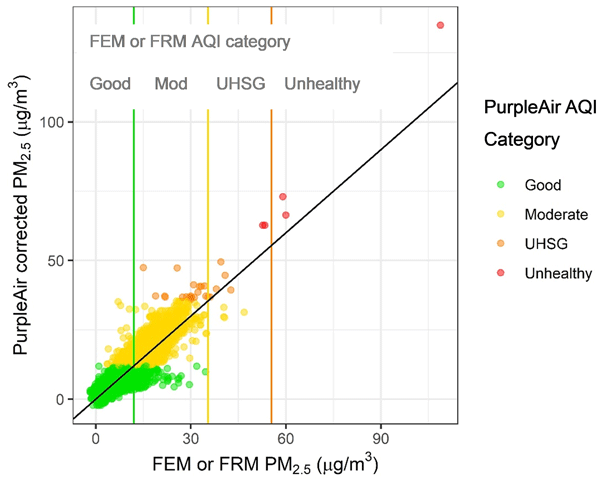
Although widely used, air sensor measurements are often biased. In this work we develop a correction with a relative humidity term that reduces the bias and improves consistency between different United States regions. This correction equation, along with proposed data cleaning criteria, has been applied to PurpleAir PM2.5 measurements across the US on the AirNow Fire and Smoke Map and has the potential to be successfully used in other air quality and public health applications.
Cited articles
Ardon-Dryer, K., Dryer, Y., Williams, J. N., and Moghimi, N.: Measurements of PM2.5 with PurpleAir under atmospheric conditions, Atmos. Meas. Tech., 13, 5441–5458, https://doi.org/10.5194/amt-13-5441-2020, 2020.
Badura, M., Batog, P., Drzeniecka-Osiadacz, A., and Modzel, P.: Evaluation of Low-Cost Sensors for Ambient PM2.5 Monitoring, J. Sensors, 2018, 1–16, https://doi.org/10.1155/2018/5096540, 2018.
Barkjohn, K. K., Gantt, B., and Clements, A. L.: Development and application of a United States-wide correction for PM2.5 data collected with the PurpleAir sensor, Atmos. Meas. Tech., 14, 4617–4637, https://doi.org/10.5194/amt-14-4617-2021, 2021.
Barkjohn, K. K., Holder, A. L., Frederick, S. G., and Clements, A. L.: Correction and Accuracy of PurpleAir PM2.5 Measurements for Extreme Wildfire Smoke, Sensors, 22, 9669, https://doi.org/10.3390/s22249669, 2022.
Carslaw, D. and Davison, J. Worldmet: Import Surface Meteorological Data from NOAA Integrated Surface Database (ISD), R package version 0.9.9.9000, GitHub, https://github.com/openair-project/worldmet (last access: 25 July 2025), 2025.
Castell, N., Dauge, F. R., Schneider, P., Vogt, M., Lerner, U., Fishbain, B., Broday, D., and Bartonova, A.: Can commercial low-cost sensor platforms contribute to air quality monitoring and exposure estimates?, Environ. Int., 99, 293–302, https://doi.org/10.1016/j.envint.2016.12.007, 2017.
Clements, A.: Phoenix-as-a-Testbed for Air Quality Sensors (P-TAQS) Dataset used in exploring the Seasonal Effects in the Application of the MOMA Remote Calibration Tool to Outdoor PM2.5 Air Sensors, U. S. EPA Office of Research and Development (ORD) [data set], https://doi.org/10.23719/1532147, 2025.
Clements, A., Kimbrough, E. S., VonWald, I., Croghan, C., Deshmukh, P., Davis, B., Pope, R., Domsky, I., and Dyer, R.: Phoenix-as-a-Testbed for Air Quality Sensors (P-TAQS) Dataset (v1), Zenodo [data set], https://doi.org/10.5281/zenodo.15174476, 2025.
Collier-Oxandale, A., Feenstra, B., Papapostolou, V., and Polidori, A.: AirSensor v1.0: Enhancements to the open-source R package to enable deep understanding of the long-term performance and reliability of PurpleAir sensors, Environ. Model. Softw., 148, 105256, https://doi.org/10.1016/j.envsoft.2021.105256, 2022.
Eagar, J. D., Herckes, P., and Hartnett, H. E.: The characterization of haboobs and the deposition of dust in Tempe, AZ from 2005 to 2014, Aeolian Res., 24, 81–91, https://doi.org/10.1016/j.aeolia.2016.11.004, 2017.
Elliott, C. T. and Copes, R.: Burden of mortality due to ambient fine particulate air pollution (PM2.5) in interior and Northern BC, Can. J. Public Health, 102, 390–393, https://doi.org/10.1007/BF03404182, 2011.
English, P. B., Olmedo, L., Bejarano, E., Lugo, H., Murillo, E., Seto, E., Wong, M., King, G., Wilkie, A., Meltzer, D., Carvlin, G., Jerrett, M., and Northcross, A.: The Imperial County Community Air Monitoring Network: A Model for Community-based Environmental Monitoring for Public Health Action, Environ. Health Persp., 125, 074501, https://doi.org/10.1289/EHP1772, 2017.
Fann, N., Lamson, A. D., Anenberg, S. C., Wesson, K., Risley, D., and Hubbell, B. J.: Estimating the national public health burden associated with exposure to ambient PM2.5 and ozone., Risk Anal., 32, 81–95, https://doi.org/10.1111/j.1539-6924.2011.01630.x, 2012.
Feenstra, B., Papapostolou, V., Hasheminassab, S., Zhang, H., Boghossian, B. D., Cocker, D., and Polidori, A.: Performance evaluation of twelve low-cost PM2.5 sensors at an ambient air monitoring site, Atmos. Environ., 216, 116946, https://doi.org/10.1016/j.atmosenv.2019.116946, 2019.
Grineski, S., Bolin, B., and Boone, C: Criteria Air Pollution and Marginalized Populations: Environmental Inequity in Metropolitan Phoenix, Arizona, Soc. Sci. Quart., 88, 535–554, https://doi.org/10.1111/j.1540-6237.2007.00470.x, 2007.
He, M., Kuerbanjiang, N., and Dhaniyala, S.: Performance characteristics of the low-cost Plantower PMS optical sensor, Aerosol Sci. Tech., 54, 232–241, https://doi.org/10.1080/02786826.2019.1696015, 2020.
Holder, A. L., Mebust, A. K., Maghran, L. A., McGown, M. R., Stewart, K. E., Vallano, D. M., Elleman, R. A., and Baker, K. R.: Field Evaluation of Low-Cost Particulate Matter Sensors for Measuring Wildfire Smoke, Sensors, 20, 4796, https://doi.org/10.3390/s20174796, 2020.
Jaffe, D. A., Miller, C., Thompson, K., Finley, B., Nelson, M., Ouimette, J., and Andrews, E.: An evaluation of the U.S. EPA's correction equation for PurpleAir sensor data in smoke, dust, and wintertime urban pollution events, Atmos. Meas. Tech., 16, 1311–1322, https://doi.org/10.5194/amt-16-1311-2023, 2023.
Keeley, J. E. and Syphard, A. D.: Large California wildfires: 2020 fires in historical context, Fire Ecol., 17, 22, https://doi.org/10.1186/s42408-021-00110-7, 2021.
Kosmopoulos, G., Salamalikis, V., Matrali, A., Pandis, S. N., and Kazantzidis, A.: Insights about the Sources of PM2.5 in an Urban Area from Measurements of a Low-Cost Sensor Network, Atmosphere, 13, 440, https://doi.org/10.3390/atmos13030440, 2022.
Kuula, J., Mäkelä, T., Aurela, M., Teinilä, K., Varjonen, S., González, Ó., and Timonen, H.: Laboratory evaluation of particle-size selectivity of optical low-cost particulate matter sensors, Atmos. Meas. Tech., 13, 2413–2423, https://doi.org/10.5194/amt-13-2413-2020, 2020.
Long, R. W., Urbanski, S. P., Lincoln, E., Colón, M., Kaushik, S., Krug, J. D., Vanderpool, R. W., and Landis, M. S.: Summary of PM2.5 measurement artifacts associated with the Teledyne T640 PM Mass Monitor under controlled chamber experimental conditions using polydisperse ammonium sulfate aerosols and biomass smoke, J. Air Waste Manage., 73, 295–312, https://doi.org/10.1080/10962247.2023.2171156, 2023.
Magi, B. I., Cupini, C., Francis, J., Green, M., and Hauser, C.: Evaluation of PM2.5 measured in an urban setting using a low-cost optical particle counter and a Federal Equivalent Method Beta Attenuation Monitor, Aerosol Sci. Tech., 54, 147–159, https://doi.org/10.1080/02786826.2019.1619915, 2020.
Malings, C., Tanzer, R., Hauryliuk, A., Saha, P. K., Robinson, A. L., Presto, A. A., and Subramanian, R.: Fine particle mass monitoring with low-cost sensors: Corrections and long-term performance evaluation, Aerosol Sci. Tech., 54, 160–174, https://doi.org/10.1080/02786826.2019.1623863, 2020.
McCrowey, C., Sharac, T., Mangus, N., Jager, D., Brown, R., Garver, D., Wells, B., and Brittingham, H.: A R Interface to the US EPA Air Quality System Data Mart API, https://cran.r-project.org/package=RAQSAPI (last access: 25 July 2025), 2023.
Midwest Research Institute (MRI): Analysis of the Fine Fraction of Particulate Matter in Fugitive Dust – Final Report, Western Governors' Association Western Regional Air Partnership (WRAP), MRI Project No. 110397, Denver, Colorado, 2005.
Miskell, G., Salmond, J. A., and Williams, D. E.: Solution to the Problem of Calibration of Low-Cost Air Quality Measurement Sensors in Networks, ACS Sens., 3, 832–843, https://doi.org/10.1021/acssensors.8b00074, 2018.
Miskell, G., Alberti, K., Feenstra, B., Henshaw, G. S., Papapostolou, V., Patel, H., Polidori, A., Salmond, J. A., Weissert, L., and Williams, D. E.: Reliable data from low cost ozone sensors in a hierarchical network, Atmos. Environ., 214, 116870, https://doi.org/10.1016/j.atmosenv.2019.116870, 2019.
Morawska, L., Thai, P. K., Liu, X., Asumadu-Sakyi, A., Ayoko, G., Bartonova, A., Bedini, A., Chai, F., Christensen, B., Dunbabin, M., Gao, J., Hagler, G. S. W., Jayaratne, R., Kumar, P., Lau, A. K. H., Louie, P. K. K., Mazaheri, M., Ning, Z., Motta, N., Mullins, B., Rahman, M. M., Ristovski, Z., Shafiei, M., Tjondronegoro, D., Westerdahl, D., and Williams, R.: Applications of low-cost sensing technologies for air quality monitoring and exposure assessment: How far have they gone?, Environ. Int., 116, 286–299, https://doi.org/10.1016/j.envint.2018.04.018, 2018.
Ouimette, J., Arnott, W. P., Laven, P., Whitwell, R., Radhakrishnan, N., Dhaniyala, S., Sandink, M., Tryner, J., and Volckens, J.: Fundamentals of low-cost aerosol sensor design and operation, Aerosol Sci. Tech., 58, 1–15, https://doi.org/10.1080/02786826.2023.2285935, 2024.
Ouimette, J. R., Malm, W. C., Schichtel, B. A., Sheridan, P. J., Andrews, E., Ogren, J. A., and Arnott, W. P.: Evaluating the PurpleAir monitor as an aerosol light scattering instrument, Atmos. Meas. Tech., 15, 655–676, https://doi.org/10.5194/amt-15-655-2022, 2022.
Ramadan, Z., Song, X.-H., and Hopke, P. K.: Identification of Sources of Phoenix Aerosol by Positive Matrix Factorization, J. Air Waste Manage., 50, 1308–1320, https://doi.org/10.1080/10473289.2000.10464173, 2000.
Robinson, D. L.: Accurate, Low Cost PM2.5 Measurements Demonstrate the Large Spatial Variation in Wood Smoke Pollution in Regional Australia and Improve Modeling and Estimates of Health Costs, Atmosphere, 11, 856, https://doi.org/10.3390/atmos11080856, 2020.
Sandhu, T., Robinson, M. C., Rawlins, E., and Ardon-Dryer, K.: Identification of dust events in the greater Phoenix area, Atmos. Pollut. Res., 15, 102275, https://doi.org/10.1016/j.apr.2024.102275, 2024.
Sayahi, T., Butterfield, A., and Kelly, K. E.: Long-term field evaluation of the Plantower PMS low-cost particulate matter sensors, Environ. Pollut., 245, 932–940, https://doi.org/10.1016/j.envpol.2018.11.065, 2019.
Snyder, E. G., Watkins, T. H., Solomon, P. A., Thoma, E. D., Williams, R. W., Hagler, G. S. W., Shelow, D., Hindin, D. A., Kilaru, V. J., and Preuss, P. W.: The Changing Paradigm of Air Pollution Monitoring, Environ. Sci. Technol., 47, 11369–11377, https://doi.org/10.1021/es4022602, 2013.
Stavroulas, I., Grivas, G., Michalopoulos, P., Liakakou, E., Bougiatioti, A., Kalkavouras, P., Fameli, K., Hatzianastassiou, N., Mihalopoulos, N., and Gerasopoulos, E.: Field Evaluation of Low-Cost PM Sensors (Purple Air PA-II) Under Variable Urban Air Quality Conditions, in Greece, Atmosphere, 11, 926, https://doi.org/10.3390/atmos11090926, 2020.
Tong, D. Q., Dan, M., Wang, T., and Lee, P.: Long-term dust climatology in the western United States reconstructed from routine aerosol ground monitoring, Atmos. Chem. Phys., 12, 5189–5205, https://doi.org/10.5194/acp-12-5189-2012, 2012.
Tryner, J., Mehaffy, J., Miller-Lionberg, D., and Volckens, J.: Effects of aerosol type and simulated aging on performance of low-cost PM sensors, J. Aerosol Sci., 150, 105654, https://doi.org/10.1016/j.jaerosci.2020.105654, 2020a.
Tryner, J., L'Orange, C., Mehaffy, J., Miller-Lionberg, D., Hofstetter, J. C., Wilson, A., and Volckens, J.: Laboratory evaluation of low-cost PurpleAir PM monitors and in-field correction using co-located portable filter samplers, Atmos. Environ., 220, 117067, https://doi.org/10.1016/j.atmosenv.2019.117067, 2020b.
U.S. EPA: Integrated Science Assessment for Particulate Matter (December 2019), U. S. Environmental Protection Agency, Washington, DC, 2019.
Wallace, L., Bi, J., Ott, W. R., Sarnat, J., and Liu, Y.: Calibration of low-cost PurpleAir outdoor monitors using an improved method of calculating PM2.5, Atmos. Environ., 256, 118432, https://doi.org/10.1016/j.atmosenv.2021.118432, 2021.
Wallace, L., Zhao, T., and Klepeis, N. E.: Calibration of PurpleAir PA-I and PA-II Monitors Using Daily Mean PM2.5 Concentrations Measured in California, Washington, and Oregon from 2017 to 2021, Sensors, 22, 4741, https://doi.org/10.3390/s22134741, 2022.
Weissert, L., Miles, E., Miskell, G., Alberti, K., Feenstra, B., Henshaw, G. S., Papapostolou, V., Patel, H., Polidori, A., Salmond, J. A., and Williams, D. E.: Hierarchical network design for nitrogen dioxide measurement in urban environments, Atmos. Environ., 228, 117428, https://doi.org/10.1016/j.atmosenv.2020.117428, 2020.
Weissert, L. F., Henshaw, G. S., Williams, D. E., Feenstra, B., Lam, R., Collier-Oxandale, A., Papapostolou, V., and Polidori, A.: Performance evaluation of MOMA (MOment MAtching) – a remote network calibration technique for PM2.5 and PM10 sensors, Atmos. Meas. Tech., 16, 4709–4722, https://doi.org/10.5194/amt-16-4709-2023, 2023.
White, J. R., Balling, R. C., and Cerveny, R. S.: Trajectory analysis of central Sonoran Desert dust storms, J. Arid Environ., 219, 105077, https://doi.org/10.1016/j.jaridenv.2023.105077, 2023.
Williams, D. E.: Low Cost Sensor Networks: How Do We Know the Data Are Reliable?, ACS Sens., 4, 2558–2565, https://doi.org/10.1021/acssensors.9b01455, 2019.
Short summary
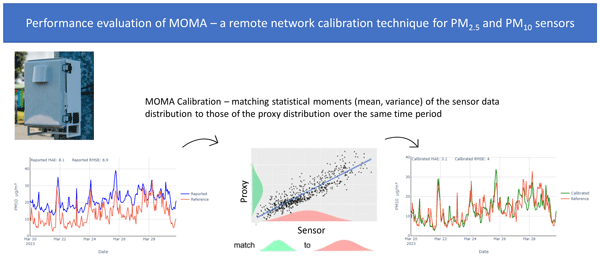
This study evaluates a remote calibration tool, referred to as MOment MAtching (MOMA), for calibrating PurpleAir PM2.5 sensors, especially for varying PM sources, and compares it with the Environmental Protection Agency (EPA) correction. MOMA improved the accuracy of PurpleAir sensor data comparable to the EPA correction. Although reliant on nearby reference sites, MOMA offers valuable insights into potential PM sources, thereby increasing the overall value of PurpleAir sensor networks.
This study evaluates a remote calibration tool, referred to as MOment MAtching (MOMA), for...