
Articles | Volume 19, issue 3
https://doi.org/10.5194/amt-19-1039-2026
© Author(s) 2026. This work is distributed under
the Creative Commons Attribution 4.0 License.
the Creative Commons Attribution 4.0 License.
https://doi.org/10.5194/amt-19-1039-2026
© Author(s) 2026. This work is distributed under
the Creative Commons Attribution 4.0 License.
the Creative Commons Attribution 4.0 License.
Research article
| 
12 Feb 2026
Research article |
| 12 Feb 2026
| 12 Feb 2026
Implementation of a multiresolution analysis method to characterize multi-scale wave structures in lidar data
Samuel Trémoulu
CORRESPONDING AUTHOR

LACy, CNRS/Météo-France, UMR 8105, Université de La Réunion, 97744 Saint-Denis de La Réunion, France
Fabrice Chane Ming
LACy, CNRS/Météo-France, UMR 8105, Université de La Réunion, 97744 Saint-Denis de La Réunion, France
Alain Hauchecorne
LATMOS-IPSL, CNRS/INSU, UMR 8190, Université de Paris-Saclay, 78280 Guyancourt, France
Gordien Strato, 78280 Guyancourt, France
Sergey Khaykin
LATMOS-IPSL, CNRS/INSU, UMR 8190, Université de Paris-Saclay, 78280 Guyancourt, France
Mathieu Ratynski
Rosenstiel School of Marine and Atmospheric Science (RSMAS), University of Miami, Miami, Florida, USA
Philippe Keckhut
LATMOS-IPSL, CNRS/INSU, UMR 8190, Université de Paris-Saclay, 78280 Guyancourt, France
Related authors
No articles found.
Océane Soares, Sergey Khaykin, Sophie Godin-Beekmann, Nikolay Kadygrov, and Loic Vieille
EGUsphere, https://doi.org/10.5194/egusphere-2026-5644, https://doi.org/10.5194/egusphere-2026-5644, 2026
This preprint is open for discussion and under review for Atmospheric Chemistry and Physics (ACP).
Short summary
Short summary
Volcanic eruptions and extreme wildfires can send particles high into the atmosphere, where they rapidly change after their release. Using satellite observations, we compare major events during their first months and show that particles from volcanoes and fires evolve differently in shape, size and height. These differences help explain why some events have longer-lasting effects in the atmosphere than others.
Océane Soares, Sergey Khaykin, Sophie Godin-Beekmann, Artem Feofilov, Tetsu Sakai, Yoshita Jin, Isamu Morino, Ben Liley, and Richard Querel
EGUsphere, https://doi.org/10.5194/egusphere-2026-5639, https://doi.org/10.5194/egusphere-2026-5639, 2026
This preprint is open for discussion and under review for Atmospheric Chemistry and Physics (ACP).
Short summary
Short summary
Volcanic eruptions and extreme wildfires can send particles high into the atmosphere, where they can remain for months or even years. Using nearly two decades of satellite observations together with measurements from the ground, we compare major events and show that their impacts can last for very different lengths of time. Our results help explain what controls how long these particles remain in the atmosphere.
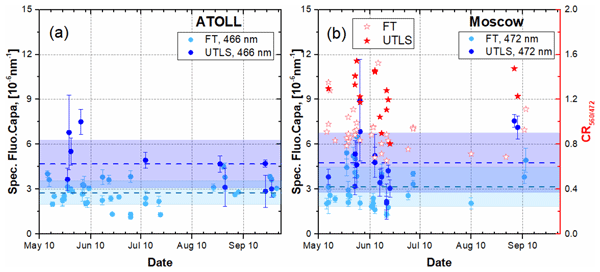
Qiaoyun Hu, Philippe Goloub, Igor Veselovskii, Thierry Podvin, Gaël Dubois, Sergey Khaykin, William Boissière, Fabrice Ducos, and Mikhail Korenskiy
Atmos. Chem. Phys., 26, 13027–13053, https://doi.org/10.5194/acp-26-13027-2026, https://doi.org/10.5194/acp-26-13027-2026, 2026
Short summary
Short summary
This study reports dual-site fluorescence lidar observations of long-range transported Canadian wildfire biomass burning aerosols (BBAs) from May to September 2023. Upper troposphere–lower stratosphere (UTLS) layers showed higher depolarization, lower Ångström exponents, and fluorescence redshift compared to tropospheric layers. Moderate correlations are found between layer altitude and BBA properties. Notably, limited hygroscopicity was found in more than 100 identified BBA layers. Cross-site comparison shows consistent fluorescence signatures.
Mélanie Ghysels, Luca Palchetti, Silvia Viciani, Claudio Belotti, Marco Barucci, Gwenaël Berthet, Elizabeth Asher, Emrys Hall, Alex Fritz, Armin Afchine, Christian Rolf, Thomas Kuhn, Chris Stopford, Alain Hauchecorne, Nadir Amarouche, Georges Durry, Jean-Christophe Samake, Lars E. Kalnajs, Terry Deshler, Samuele Del Bianco, and Paolo Pettinari
Earth Syst. Sci. Data Discuss., https://doi.org/10.5194/essd-2026-557, https://doi.org/10.5194/essd-2026-557, 2026
Preprint under review for ESSD
Short summary
Short summary
ATMOSFER, a CNES-supported 2024 balloon campaign in Kiruna, Sweden, prepared ESA’s FORUM mission by measuring far-infrared radiation, water vapor, clouds and aerosols in the UTLS. FIRMOS-B (balloon borne demonstrator of FORUM) showed excellent performance, while hygrometers agreed closely. The campaign observed cirrus clouds, ice crystals and stratospheric aerosol layers linked to wildfire and tropical air masses, improving climate observations and FORUM validation.
Kimberlee Dubé, William Randel, Adam Bourassa, Susann Tegtmeier, Xinyue Wang, Jun Zhang, Eilidh Hlady, Meghan Brehon, Sergey Khaykin, and Douglas Degenstein
EGUsphere, https://doi.org/10.5194/egusphere-2026-4022, https://doi.org/10.5194/egusphere-2026-4022, 2026
Short summary
Short summary
The Hunga volcanic eruption in January 2022 increased the total stratospheric water vapor (H2O) mass by 10 %. The study uses satellite observations and models to track the transport of the Hunga H2O. We find that there is substantially more H2O in the observations than the model during 2024 and 2025, suggesting that the modelled transport across the lower stratosphere is too fast. We also find evidence that some of the H2O that reaches the lower stratosphere is mixed back into the tropics.
Eddy Poncet, Sergey Khaykin, Sophie Godin-Beekmann, and Thierry Leblanc
EGUsphere, https://doi.org/10.5194/egusphere-2026-4358, https://doi.org/10.5194/egusphere-2026-4358, 2026
Short summary
Short summary
High particles in the atmosphere affect climate and the ozone layer, so measurements from a new European-Japanese satellite, EarthCARE (launched 2024), need checking. We compared its laser data with a trusted instrument on the International Space Station and two ground stations, in clear, volcanic and wildfire conditions. A method using the satellite's raw signal stayed accurate even when particles were scarce, unlike the standard product, so we recommend it for reliable long-term monitoring.
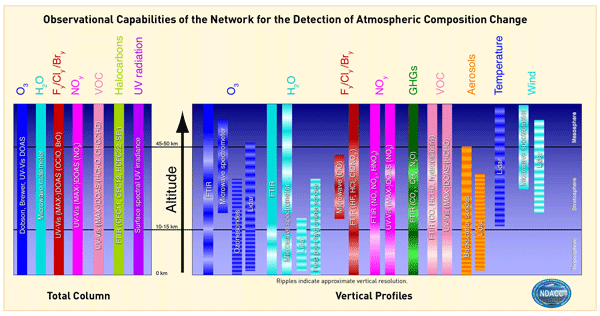
Irina Petropavlovskikh, Martine De Mazière, Anne M. Thompson, Jeannette D. Wild, James W. Hannigan, Henry B. Selkirk, Reem A. Hannun, Wolfgang Steinbrecht, Jean-Christopher Lambert, Roeland Van Malderen, Elizabeth Asher, Raul R. Cordero, Sophie Godin-Beekmann, Daan Hubert, Sergey Khaykin, Karin Kreher, Thierry Leblanc, Emmanuel Mahieu, Eliane Maillard Barras, Glen McConville, Gerald Nedoluha, Ivan Ortega, Alberto Redondas Marrero, Gunther Seckmeyer, Ryan M. Stauffer, Sarah A. Strode, Kim Strong, Takafumi Sugita, Michel Van Roozendael, Voltaire Velazco, Corinne Vigouroux, and Bärbel Vogel
Atmos. Chem. Phys., 26, 8637–8675, https://doi.org/10.5194/acp-26-8637-2026, https://doi.org/10.5194/acp-26-8637-2026, 2026
Short summary
Short summary
This introduction to the special issue "Achievements and perspectives of the Network for the Detection of Atmospheric Composition Change after 35 years of operation” provides an overview of important research findings achieved under the NDACC objectives. The future of NDACC is discussed in the light of the evolution of the scientific questions, evolving collaborations with partners and Cooperating Networks, and the current landscape of gaps in satellite and ground-based observations.
Dimitri Trapon, Holger Baars, Sebastian Bley, Albert Ansmann, Michael Rennie, Sergey Khaykin, and Michael Sicard
EGUsphere, https://doi.org/10.5194/egusphere-2026-2575, https://doi.org/10.5194/egusphere-2026-2575, 2026
Short summary
Short summary
The study presents observations of the 2022 Hunga volcanic aerosol in the stratosphere made by the European Space Agency’s Aeolus satellite. Aeolus tracks the long-range transported plumes that circumnavigate the Earth at distinct latitudes and altitudes up to 30 km. Vertical gradient of optical properties measured with the ultraviolet lidar signal are shown, such as decreasing trends over time. This helps to understand the stratospheric residence time of aerosols in the Southern Hemisphere.
Raphaël Lebrun, Yevgeny Derimian, François Ravetta, Jérôme Bureau, and Sergey Khaykin
EGUsphere, https://doi.org/10.5194/egusphere-2026-2006, https://doi.org/10.5194/egusphere-2026-2006, 2026
Short summary
Short summary
Fueled by climate change, some recent extreme wildfires have been observed to inject unprecedented levels of aerosols in the stratosphere. Partly composed of carbon, these aerosols absorb solar light and change the energy balance of the atmosphere. Using observations and radiative modeling, we show the stratospheric aerosols from the 2020 Australian wildfire have warmed the atmosphere by 0.08 to 0.19 W.m−2 globally over a year, as they tend to reduce the albedo effect of underlying clouds.
Sidy Diarra, Nadège Montoux, Jean-Luc Baray, Philippe Keckhut, Jean-Charles Dupont, Antoine Farah, and Dunya Alraddawi
EGUsphere, https://doi.org/10.5194/egusphere-2026-482, https://doi.org/10.5194/egusphere-2026-482, 2026
Short summary
Short summary
This study examined the quality of water vapor observations in the troposphere. We compared five years of balloon measurements over France with weather model reanalysis. The observations showed moister air and more frequent supersaturation than the model in the upper troposphere, where natural cirrus clouds and aircraft induced clouds formed. These results suggest that current models underestimate upper air humidity and need improvement to assess climate impacts of clouds.
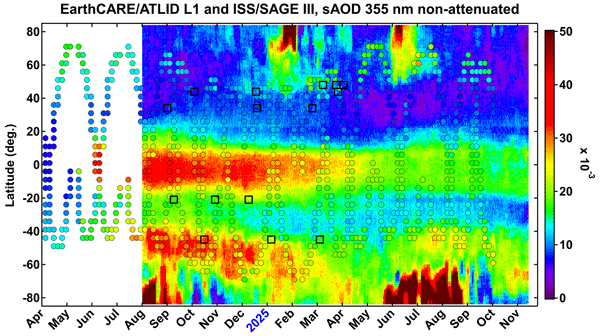
Sergey Khaykin, Michaël Sicard, Thierry Leblanc, Tetsu Sakai, Nickolay Balugin, Gwenaël Berthet, Stëphane Chevrier, Fernando Chouza, Artem Feofilov, Dominique Gantois, Sophie Godin-Beekmann, Arezki Haddouche, Yoshitaka Jin, Isamu Morino, Nicolas Kadygrov, Thomas Lecas, Ben Liley, Richard Querel, Ghasssan Taha, and Vladimir Yushkov
Atmos. Chem. Phys., 26, 607–622, https://doi.org/10.5194/acp-26-607-2026, https://doi.org/10.5194/acp-26-607-2026, 2026
Short summary
Short summary
In April 2024, the Ruang volcano in Indonesia sent large amounts of gas and particles high into the atmosphere, which then spread worldwide. Using the new European EarthCARE satellite and its advanced laser instrument ATLID (Atmospheric LIDar), together with ground and balloon observations, we tracked how these particles doubled levels in the tropics and spread into both hemispheres. The study shows ATLID’s power to reveal how eruptions can affect climate, clouds, and ozone for more than a year.
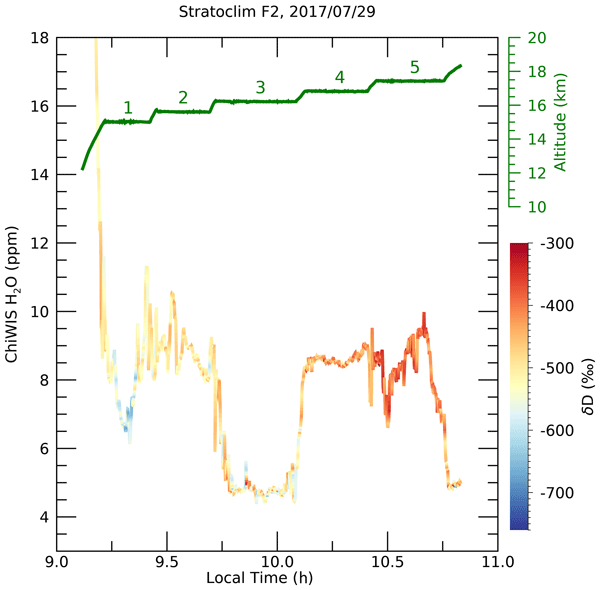
Benjamin W. Clouser, Laszlo C. Sarkozy, Clare E. Singer, Carly C. KleinStern, Adrien Desmoulin, Dylan Gaeta, Sergey Khaykin, Stephen Gabbard, Stephen Shertz, and Elisabeth J. Moyer
Atmos. Meas. Tech., 18, 6465–6491, https://doi.org/10.5194/amt-18-6465-2025, https://doi.org/10.5194/amt-18-6465-2025, 2025
Short summary
Short summary
The water molecule comes in several different varieties, which are nearly indistinguishable in daily life. However, slight differences between the water molecule types can be exploited to achieve better scientific understanding of parts of Earth's atmosphere. In this work we describe the design, construction, and operation of an instrument meant to measure these molecules aboard research aircraft up to altitudes of 20 km.
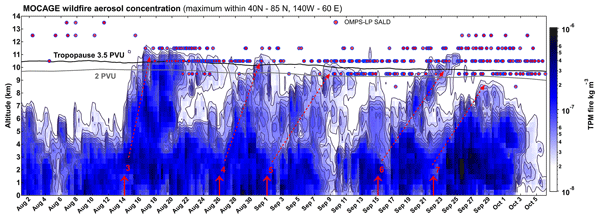
Sergey Khaykin, Slimane Bekki, Sophie Godin-Beekmann, Michael D. Fromm, Philippe Goloub, Qiaoyun Hu, Béatrice Josse, Alexandra Laeng, Mehdi Meziane, David A. Peterson, Sophie Pelletier, and Valérie Thouret
Atmos. Chem. Phys., 25, 14551–14571, https://doi.org/10.5194/acp-25-14551-2025, https://doi.org/10.5194/acp-25-14551-2025, 2025
Short summary
Short summary
In 2023, massive wildfires in Canada injected huge amounts of smoke into the atmosphere. Surprisingly, despite their intensity, the smoke did not rise very high but lingered at flight cruising altitudes, causing widespread pollution. This study shows how two different pathways lifted smoke into the lower stratosphere and reveals new insights into how wildfires affect air quality and climate, challenging what we thought we knew about fire and atmospheric impacts.
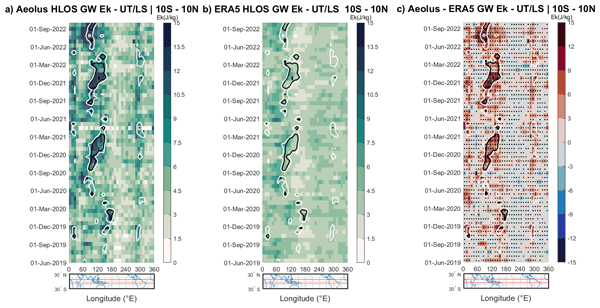
Mathieu Ratynski, Sergey Khaykin, Alain Hauchecorne, M. Joan Alexander, Alexis Mariaccia, Philippe Keckhut, and Antoine Mangin
Atmos. Chem. Phys., 25, 13769–13798, https://doi.org/10.5194/acp-25-13769-2025, https://doi.org/10.5194/acp-25-13769-2025, 2025
Short summary
Short summary
This study investigates how tropical convection generates gravity waves, which play a key role in transporting energy across the atmosphere. By combining Aeolus satellite data with ERA5 reanalysis data and radio occultation measurements, we identified significant wave activity overlooked by ERA5, particularly over the Indian Ocean. Aeolus fills major gaps in wind data, offering a clearer picture of wave dynamics and challenging assumptions about their behavior, thereby improving climate models.
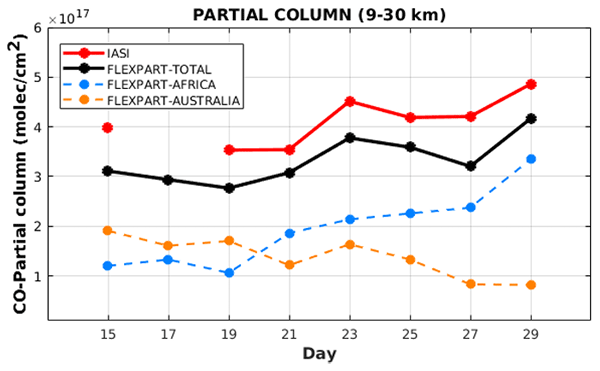
Nelson Bègue, Alexandre Baron, Gisèle Krysztofiak, Gwenaël Berthet, Corinna Kloss, Fabrice Jégou, Sergey Khaykin, Marion Ranaivombola, Tristan Millet, Thierry Portafaix, Valentin Duflot, Philippe Keckhut, Hélène Vérèmes, Guillaume Payen, Mahesh Kumar Sha, Pierre-François Coheur, Cathy Clerbaux, Michaël Sicard, Tetsu Sakai, Richard Querel, Ben Liley, Dan Smale, Isamu Morino, Osamu Uchino, Tomohiro Nagai, Penny Smale, John Robinson, and Hassan Bencherif
Atmos. Chem. Phys., 24, 8031–8048, https://doi.org/10.5194/acp-24-8031-2024, https://doi.org/10.5194/acp-24-8031-2024, 2024
Short summary
Short summary
During the 2020 austral summer, the pristine atmosphere of the southwest Indian Ocean basin experienced significant perturbations. Numerical models indicated that the lower-stratospheric aerosol content was influenced by the intense and persistent stratospheric aerosol layer generated during the 2019–2020 extreme Australian bushfire events. Ground-based observations at Réunion confirmed the simultaneous presence of African and Australian aerosol layers.
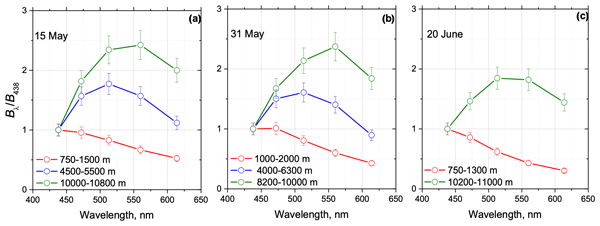
Igor Veselovskii, Qiaoyun Hu, Philippe Goloub, Thierry Podvin, William Boissiere, Mikhail Korenskiy, Nikita Kasianik, Sergey Khaykyn, and Robin Miri
Atmos. Meas. Tech., 17, 1023–1036, https://doi.org/10.5194/amt-17-1023-2024, https://doi.org/10.5194/amt-17-1023-2024, 2024
Short summary
Short summary
Measurements of transported smoke layers were performed with a lidar in Lille and a five-channel fluorescence lidar in Moscow. Results show the peak of fluorescence in the boundary layer is at 438 nm, while in the smoke layer it shifts to longer wavelengths. The fluorescence depolarization is 45 % to 55 %. The depolarization ratio of the water vapor channel is low (2 ± 0.5 %) in the absence of fluorescence and can be used to evaluate the contribution of fluorescence to water vapor signal.
Francesco Cairo, Martina Krämer, Armin Afchine, Guido Di Donfrancesco, Luca Di Liberto, Sergey Khaykin, Lorenza Lucaferri, Valentin Mitev, Max Port, Christian Rolf, Marcel Snels, Nicole Spelten, Ralf Weigel, and Stephan Borrmann
Atmos. Meas. Tech., 16, 4899–4925, https://doi.org/10.5194/amt-16-4899-2023, https://doi.org/10.5194/amt-16-4899-2023, 2023
Short summary
Short summary
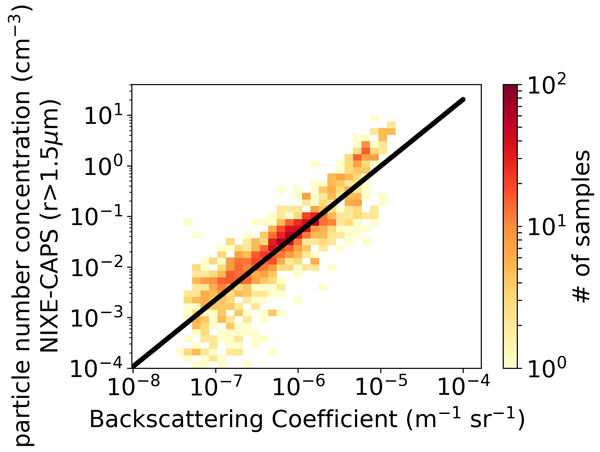
Cirrus clouds have been observed over the Himalayan region between 10 km and the tropopause at 17–18 km. Data from backscattersonde, hygrometers, and particle cloud spectrometers have been compared to assess their consistency. Empirical relationships between optical parameters accessible with remote sensing lidars and cloud microphysical parameters (such as ice water content, particle number and surface area density, and particle aspherical fraction) have been established.
Paul Konopka, Christian Rolf, Marc von Hobe, Sergey M. Khaykin, Benjamin Clouser, Elisabeth Moyer, Fabrizio Ravegnani, Francesco D'Amato, Silvia Viciani, Nicole Spelten, Armin Afchine, Martina Krämer, Fred Stroh, and Felix Ploeger
Atmos. Chem. Phys., 23, 12935–12947, https://doi.org/10.5194/acp-23-12935-2023, https://doi.org/10.5194/acp-23-12935-2023, 2023
Short summary
Short summary
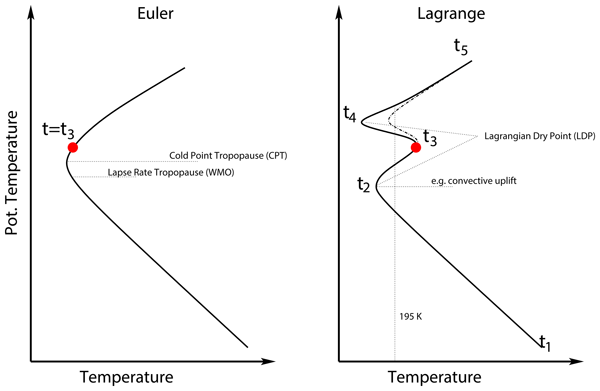
We studied water vapor in a critical region of the atmosphere, the Asian summer monsoon anticyclone, using rare in situ observations. Our study shows that extremely high water vapor values observed in the stratosphere within the Asian monsoon anticyclone still undergo significant freeze-drying and that water vapor concentrations set by the Lagrangian dry point are a better proxy for the stratospheric water vapor budget than rare observations of enhanced water mixing ratios.
Mathieu Ratynski, Sergey Khaykin, Alain Hauchecorne, Robin Wing, Jean-Pierre Cammas, Yann Hello, and Philippe Keckhut
Atmos. Meas. Tech., 16, 997–1016, https://doi.org/10.5194/amt-16-997-2023, https://doi.org/10.5194/amt-16-997-2023, 2023
Short summary
Short summary
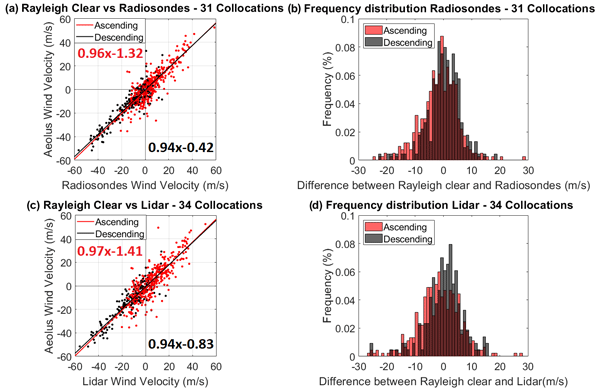
Aeolus is the first spaceborne wind lidar providing global wind measurements since 2018. This study offers a comprehensive analysis of Aeolus instrument performance, using ground-based wind lidars and meteorological radiosondes, at tropical and mid-latitudes sites. The analysis allows assessing the long-term evolution of the satellite's performance for more than 3 years. The results will help further elaborate the understanding of the error sources and the behavior of the Doppler wind lidar.
Fayçal Lamraoui, Martina Krämer, Armin Afchine, Adam B. Sokol, Sergey Khaykin, Apoorva Pandey, and Zhiming Kuang
Atmos. Chem. Phys., 23, 2393–2419, https://doi.org/10.5194/acp-23-2393-2023, https://doi.org/10.5194/acp-23-2393-2023, 2023
Short summary
Short summary
Cirrus in the tropical tropopause layer (TTL) can play a key role in vertical transport. We investigate the role of different cloud regimes and the associated ice habits in regulating the properties of the TTL. We use high-resolution numerical experiments at the scales of large-eddy simulations (LESs) and aircraft measurements. We found that LES-scale parameterizations that predict ice shape are crucial for an accurate representation of TTL cirrus and thus the associated (de)hydration process.

Florent Tencé, Julien Jumelet, Marie Bouillon, David Cugnet, Slimane Bekki, Sarah Safieddine, Philippe Keckhut, and Alain Sarkissian
Atmos. Chem. Phys., 23, 431–451, https://doi.org/10.5194/acp-23-431-2023, https://doi.org/10.5194/acp-23-431-2023, 2023
Short summary
Short summary
Polar stratospheric clouds (PSCs) are critical precursors to stratospheric ozone depletion, and measurement-driven classifications remain a key to accurate cloud modelling. We present PSC lidar observations conducted at the French Antarctic station Dumont d'Urville between 2007 and 2020. This dataset is analyzed using typical PSC classification schemes. We present a PSC climatology along with a significant and slightly negative 14-year trend of PSC occurences of −4.6 PSC days per decade.
Bernard Legras, Clair Duchamp, Pasquale Sellitto, Aurélien Podglajen, Elisa Carboni, Richard Siddans, Jens-Uwe Grooß, Sergey Khaykin, and Felix Ploeger
Atmos. Chem. Phys., 22, 14957–14970, https://doi.org/10.5194/acp-22-14957-2022, https://doi.org/10.5194/acp-22-14957-2022, 2022
Short summary
Short summary
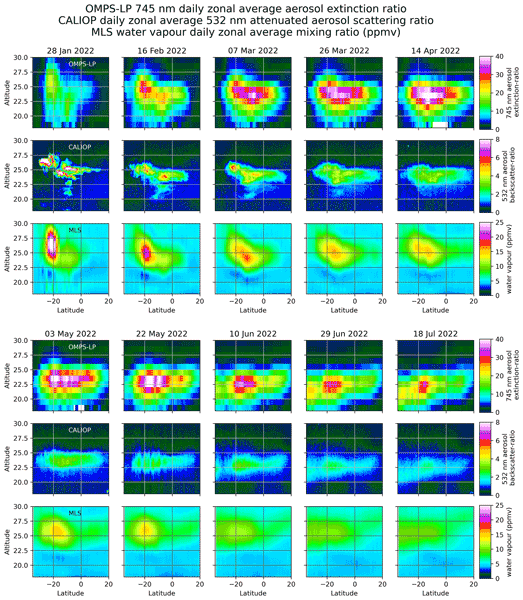
The long-duration atmospheric impact of the Tonga eruption in January 2022 is a plume of water and sulfate aerosols in the stratosphere that persisted for more than 6 months. We study this evolution using several satellite instruments and analyse the unusual behaviour of this plume as sulfates and water first moved down rapidly and then separated into two layers. We also report the self-organization in compact and long-lived patches.
Mohamadou A. Diallo, Felix Ploeger, Michaela I. Hegglin, Manfred Ern, Jens-Uwe Grooß, Sergey Khaykin, and Martin Riese
Atmos. Chem. Phys., 22, 14303–14321, https://doi.org/10.5194/acp-22-14303-2022, https://doi.org/10.5194/acp-22-14303-2022, 2022
Short summary
Short summary
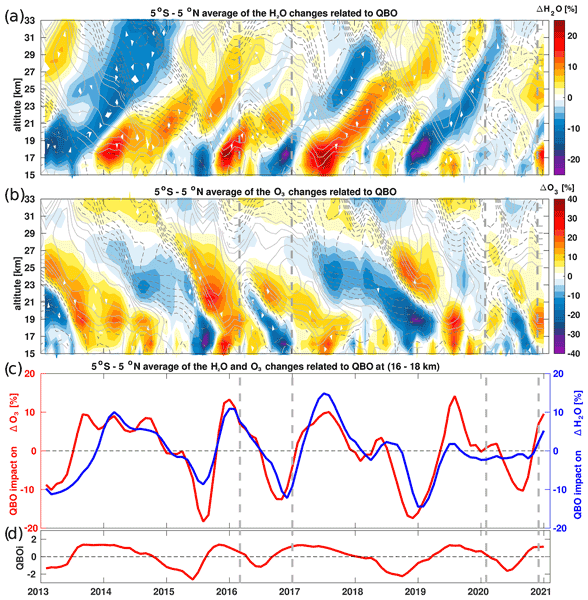
The quasi-biennial oacillation disruption events in both 2016 and 2020 decreased lower-stratospheric water vapour and ozone. Differences in the strength and depth of the anomalous lower-stratospheric circulation and ozone are due to differences in tropical upwelling and cold-point temperature induced by lower-stratospheric planetary and gravity wave breaking. The differences in water vapour are due to higher cold-point temperature in 2020 induced by Australian wildfire.
Clare E. Singer, Benjamin W. Clouser, Sergey M. Khaykin, Martina Krämer, Francesco Cairo, Thomas Peter, Alexey Lykov, Christian Rolf, Nicole Spelten, Armin Afchine, Simone Brunamonti, and Elisabeth J. Moyer
Atmos. Meas. Tech., 15, 4767–4783, https://doi.org/10.5194/amt-15-4767-2022, https://doi.org/10.5194/amt-15-4767-2022, 2022
Short summary
Short summary
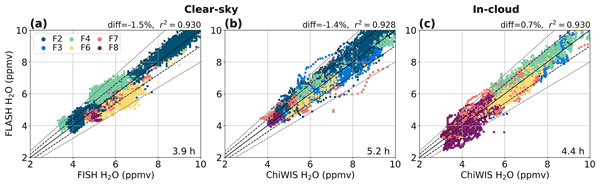
In situ measurements of water vapor in the upper troposphere are necessary to study cloud formation and hydration of the stratosphere but challenging due to cold–dry conditions. We compare measurements from three water vapor instruments from the StratoClim campaign in 2017. In clear sky (clouds), point-by-point differences were <1.5±8 % (<1±8 %). This excellent agreement allows detection of fine-scale structures required to understand the impact of convection on stratospheric water vapor.
Fernando Chouza, Thierry Leblanc, Mark Brewer, Patrick Wang, Giovanni Martucci, Alexander Haefele, Hélène Vérèmes, Valentin Duflot, Guillaume Payen, and Philippe Keckhut
Atmos. Meas. Tech., 15, 4241–4256, https://doi.org/10.5194/amt-15-4241-2022, https://doi.org/10.5194/amt-15-4241-2022, 2022
Short summary
Short summary
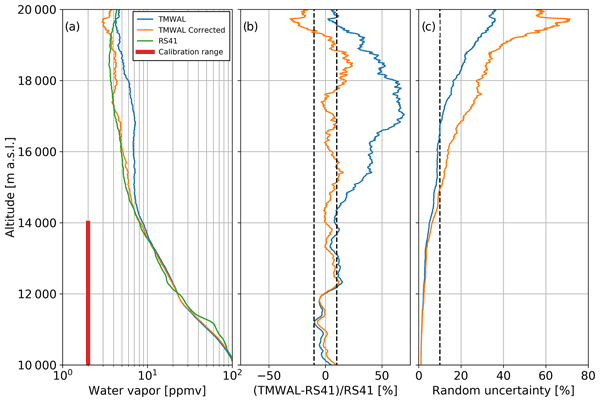
The comparison of water vapor lidar measurements with co-located radiosondes and aerosol backscatter profiles indicates that laser-induced aerosol fluorescence in smoke layers injected into the stratosphere can introduce very large and chronic wet biases above 15 km, thus impacting the ability of these systems to accurately estimate long-term water vapor trends. The proposed correction method presented in this work is able to reduce this fluorescence-induced bias from 75 % to under 5 %.
Sergey M. Khaykin, Elizabeth Moyer, Martina Krämer, Benjamin Clouser, Silvia Bucci, Bernard Legras, Alexey Lykov, Armin Afchine, Francesco Cairo, Ivan Formanyuk, Valentin Mitev, Renaud Matthey, Christian Rolf, Clare E. Singer, Nicole Spelten, Vasiliy Volkov, Vladimir Yushkov, and Fred Stroh
Atmos. Chem. Phys., 22, 3169–3189, https://doi.org/10.5194/acp-22-3169-2022, https://doi.org/10.5194/acp-22-3169-2022, 2022
Short summary
Short summary
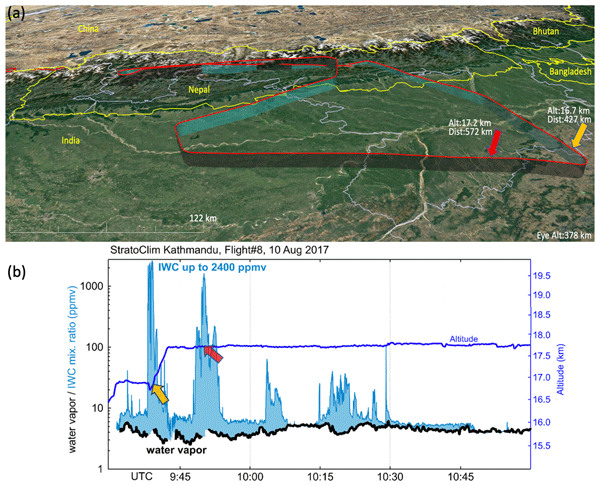
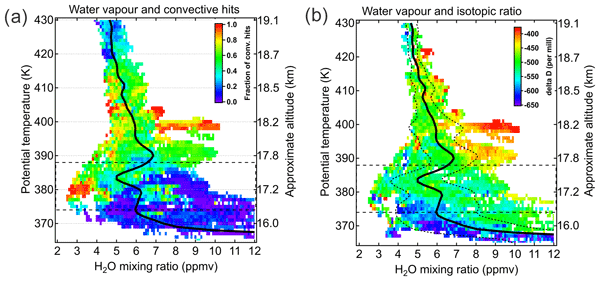
The Asian monsoon anticyclone is the key contributor to the global annual maximum in lower stratospheric water vapour. We investigate the impact of deep convection on the lower stratospheric water using a unique set of observations aboard the high-altitude M55-Geophysica aircraft deployed in Nepal in summer 2017 within the EU StratoClim project. We find that convective plumes of wet air can persist within the Asian anticyclone for weeks, thereby enhancing the occurrence of high-level clouds.
Abhinna K. Behera, Emmanuel D. Rivière, Sergey M. Khaykin, Virginie Marécal, Mélanie Ghysels, Jérémie Burgalat, and Gerhard Held
Atmos. Chem. Phys., 22, 881–901, https://doi.org/10.5194/acp-22-881-2022, https://doi.org/10.5194/acp-22-881-2022, 2022
Short summary
Short summary
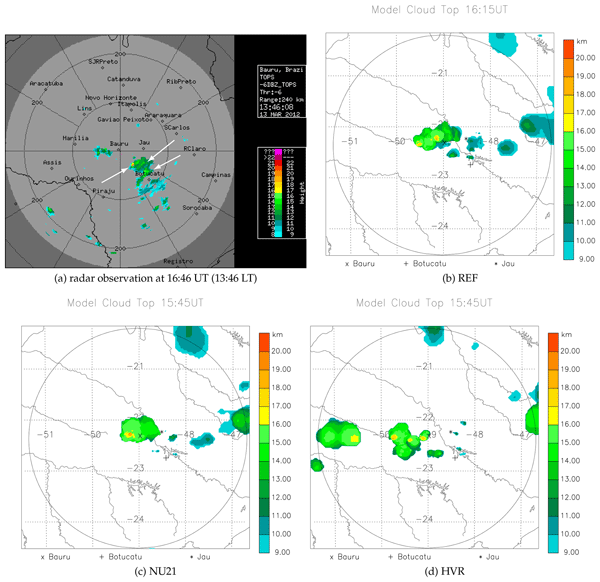
Deep convection overshooting the stratosphere's contribution to the global stratospheric water budget is still being quantified. We ran three different cloud-resolving simulations of an observed case of overshoots in Bauru during the TRO-Pico balloon campaign in the context of upscaling the impact of overshoots at a large scale. These simulations, which have been validated with balloon-borne and S-band radar measurements, shed light on the local-scale variability and composition of overshoots.
Cited articles
Achatz, U., Alexander, M. J., Becker, E., Chun, H.-Y., Dörnbrack, A., Holt, L., Plougonven, R., Polichtchouk, I., Sato, K., Sheshadri, A., Stephan, C. C., Van Niekerk, A., and Wright, C. J.: Atmospheric Gravity Waves: Processes and Parameterization, J. Atmos. Sci., 81, 237–262, https://doi.org/10.1175/JAS-D-23-0210.1, 2024. a
Alexander, S. P., Klekociuk, A. R., and Murphy, D. J.: Rayleigh lidar observations of gravity wave activity in the winter upper stratosphere and lower mesosphere above Davis, Antarctica (69° S, 78° E), J. Geophys. Res., 116, D13109, https://doi.org/10.1029/2010JD015164, 2011. a, b
Andrews, D. G., Leovy, C. B., and Holton, J. R.: Middle Atmosphere Dynamics, vol. 40, Academic Press, ISBN 978-0-12-058576-2, 1987. a
Baray, J.-L., Courcoux, Y., Keckhut, P., Portafaix, T., Tulet, P., Cammas, J.-P., Hauchecorne, A., Godin Beekmann, S., De Mazière, M., Hermans, C., Desmet, F., Sellegri, K., Colomb, A., Ramonet, M., Sciare, J., Vuillemin, C., Hoareau, C., Dionisi, D., Duflot, V., Vérèmes, H., Porteneuve, J., Gabarrot, F., Gaudo, T., Metzger, J.-M., Payen, G., Leclair de Bellevue, J., Barthe, C., Posny, F., Ricaud, P., Abchiche, A., and Delmas, R.: Maïdo observatory: a new high-altitude station facility at Reunion Island (21° S, 55° E) for long-term atmospheric remote sensing and in situ measurements, Atmos. Meas. Tech., 6, 2865–2877, https://doi.org/10.5194/amt-6-2865-2013, 2013. a
Bègue, N., Mbatha, N., Bencherif, H., Loua, R. T., Sivakumar, V., and Leblanc, T.: Statistical analysis of the mesospheric inversion layers over two symmetrical tropical sites: Réunion (20.8° S, 55.5° E) and Mauna Loa (19.5° N, 155.6° W), Ann. Geophys., 35, 1177–1194, https://doi.org/10.5194/angeo-35-1177-2017, 2017. a
Binder, M. and Dörnbrack, A.: Observing Gravity Waves Generated by Moving Sources With Ground‐Based Rayleigh Lidars, J. Geophys. Res.-Atmos., 129, e2023JD040156, https://doi.org/10.1029/2023JD040156, 2024. a
Brhian, A., Ridenti, M. A., Roberto, M., De Abreu, A. J., Abalde Guede, J. R., and De Campos, E.: A Survey on Gravity Waves in the Brazilian Sector Based on Radiosonde Measurements From 32 Aerodromes, J. Geophys. Res.-Atmos., 129, e2023JD039811, https://doi.org/10.1029/2023JD039811, 2024. a
Chane Ming, F., Hauchecorne, A., Bellisario, C., Simoneau, P., Keckhut, P., Trémoulu, S., Listowski, C., Berthet, G., Jégou, F., Khaykin, S., Tidiga, M., and Le Pichon, A.: Case Study of a Mesospheric Temperature Inversion over Maïdo Observatory through a Multi-Instrumental Observation, Remote Sensing, 15, 2045, https://doi.org/10.3390/rs15082045, 2023. a, b, c, d
Chanin, M. and Hauchecorne, A.: Lidar observation of gravity and tidal waves in the stratosphere and mesosphere, J. Geophys. Res.-Oceans, 86, 9715–9721, https://doi.org/10.1029/JC086iC10p09715, 1981. a
Chanin, M. L., Garnier, A., Hauchecorne, A., and Porteneuve, J.: A Doppler lidar for measuring winds in the middle atmosphere, Geophys. Res. Lett., 16, 1273–1276, https://doi.org/10.1029/GL016i011p01273, 1989. a
Chen, C., Chu, X., Zhao, J., Roberts, B. R., Yu, Z., Fong, W., Lu, X., and Smith, J. A.: Lidar observations of persistent gravity waves with periods of 3–10 h in the Antarctic middle and upper atmosphere at McMurdo (77.83° S, 166.67° E), J. Geophys. Res.-Space, 121, 1483–1502, https://doi.org/10.1002/2015JA022127, 2016. a
Duck, T. J., Whiteway, J. A., and Carswell, A. I.: The Gravity Wave–Arctic Stratospheric Vortex Interaction, J. Atmos. Sci., 58, 3581–3596, https://doi.org/10.1175/1520-0469(2001)058<3581:TGWASV>2.0.CO;2, 2001. a, b
Eckermann, S. D., Hirota, I., and Hocking, W. K.: Gravity wave and equatorial wave morphology of the stratosphere derived from long‐term rocket soundings, Q. J. Roy. Meteor. Soc., 121, 149–186, https://doi.org/10.1002/qj.49712152108, 1995. a, b
Ehard, B., Achtert, P., and Gumbel, J.: Long-term lidar observations of wintertime gravity wave activity over northern Sweden, Ann. Geophys., 32, 1395–1405, https://doi.org/10.5194/angeo-32-1395-2014, 2014. a, b
Ehard, B., Kaifler, B., Kaifler, N., and Rapp, M.: Evaluation of methods for gravity wave extraction from middle-atmospheric lidar temperature measurements, Atmos. Meas. Tech., 8, 4645–4655, https://doi.org/10.5194/amt-8-4645-2015, 2015. a, b
Fritts, D. C. and Alexander, M. J.: Gravity wave dynamics and effects in the middle atmosphere, Rev. Geophys., 41, 2001RG000106, https://doi.org/10.1029/2001RG000106, 2003. a
Gantois, D., Payen, G., Sicard, M., Duflot, V., Bègue, N., Marquestaut, N., Portafaix, T., Godin-Beekmann, S., Hernandez, P., and Golubic, E.: Multiwavelength aerosol lidars at the Maïdo supersite, Réunion Island, France: instrument description, data processing chain, and quality assessment, Earth Syst. Sci. Data, 16, 4137–4159, https://doi.org/10.5194/essd-16-4137-2024, 2024. a
Gardner, C. S., Miller, M. S., and Liu, C. H.: Rayleigh Lidar Observations of Gravity Wave Activity in the Upper Stratosphere at Urbana, Illinois, J. Atmos. Sci., 46, 1838–1854, https://doi.org/10.1175/1520-0469(1989)046<1838:RLOOGW>2.0.CO;2, 1989. a, b
Gardner, C. S., Hostetler, C. A., and Franke, S. J.: Gravity wave models for the horizontal wave number spectra of atmospheric velocity and density fluctuations, J. Geophys. Res.-Atmos., 98, 1035–1049, https://doi.org/10.1029/92JD02051, 1993. a
Geller, M. A. and Gong, J.: Gravity wave kinetic, potential, and vertical fluctuation energies as indicators of different frequency gravity waves, J. Geophys. Res.-Atmos., 115, 2009JD012266, https://doi.org/10.1029/2009JD012266, 2010. a, b
Guest, F. M., Reeder, M. J., Marks, C. J., and Karoly, D. J.: Inertia–Gravity Waves Observed in the Lower Stratosphere over Macquarie Island, J. Atmos. Sci., 57, 737–752, https://doi.org/10.1175/1520-0469(2000)057<0737:IGWOIT>2.0.CO;2, 2000. a, b
Guo, T., Zhang, T., Lim, E., Lopez-Benitez, M., Ma, F., and Yu, L.: A Review of Wavelet Analysis and Its Applications: Challenges and Opportunities, IEEE Access, 10, 58869–58903, https://doi.org/10.1109/ACCESS.2022.3179517, 2022. a
Gupta, A., Birner, T., Dörnbrack, A., and Polichtchouk, I.: Importance of Gravity Wave Forcing for Springtime Southern Polar Vortex Breakdown as Revealed by ERA5, Geophys. Res. Lett., 48, e2021GL092762, https://doi.org/10.1029/2021GL092762, 2021. a
Hauchecorne, A. and Chanin, M.: Density and temperature profiles obtained by lidar between 35 and 70 km, Geophys. Res. Lett., 7, 565–568, https://doi.org/10.1029/GL007i008p00565, 1980. a
Hauchecorne, A., Gonzalez, N., Souprayen, C., Manson, A., Meek, C., Singer, W., Fakhrutdinova, A., Hoppe, U.-P., Bos̆ka, J., Laštovička, J., Scheer, J., Reisin, E., and Graef, H.: Gravity-wave activity and its relation with prevailing winds during DYANA, J. Atmos. Terr. Phys., 56, 1765–1778, https://doi.org/10.1016/0021-9169(94)90009-4, 1994. a, b
Hersbach, H., Bell, B., Berrisford, P., Hirahara, S., Horányi, A., Muñoz‐Sabater, J., Nicolas, J., Peubey, C., Radu, R., Schepers, D., Simmons, A., Soci, C., Abdalla, S., Abellan, X., Balsamo, G., Bechtold, P., Biavati, G., Bidlot, J., Bonavita, M., De Chiara, G., Dahlgren, P., Dee, D., Diamantakis, M., Dragani, R., Flemming, J., Forbes, R., Fuentes, M., Geer, A., Haimberger, L., Healy, S., Hogan, R. J., Hólm, E., Janisková, M., Keeley, S., Laloyaux, P., Lopez, P., Lupu, C., Radnoti, G., de Rosnay, P., Rozum, I., Vamborg, F., Villaume, S., and Thépaut, J.-N.: Complete ERA5 from 1940: Fifth generation of ECMWF atmospheric reanalyses of the global climate, Copernicus Climate Change Service (C3S) Data Store (CDS) [data set], https://doi.org/10.24381/cds.143582cf, 2017. a
Hersbach, H., Bell, B., Berrisford, P., Hirahara, S., Horányi, A., Muñoz‐Sabater, J., Nicolas, J., Peubey, C., Radu, R., Schepers, D., Simmons, A., Soci, C., Abdalla, S., Abellan, X., Balsamo, G., Bechtold, P., Biavati, G., Bidlot, J., Bonavita, M., De Chiara, G., Dahlgren, P., Dee, D., Diamantakis, M., Dragani, R., Flemming, J., Forbes, R., Fuentes, M., Geer, A., Haimberger, L., Healy, S., Hogan, R. J., Hólm, E., Janisková, M., Keeley, S., Laloyaux, P., Lopez, P., Lupu, C., Radnoti, G., De Rosnay, P., Rozum, I., Vamborg, F., Villaume, S., and Thépaut, J.: The ERA5 global reanalysis, Q. J. Roy. Meteor. Soc., 146, 1999–2049, https://doi.org/10.1002/qj.3803, 2020. a, b, c
Hertzog, A., Souprayen, C., and Hauchecorne, A.: Measurements of gravity wave activity in the lower stratosphere by Doppler lidar, J. Geophys. Res.-Atmos., 106, 7879–7890, https://doi.org/10.1029/2000JD900646, 2001. a, b
Hirota, I.: Climatology of gravity waves in the middle atmosphere, J. Atmos. Terr. Phys., 46, 767–773, https://doi.org/10.1016/0021-9169(84)90057-6, 1984. a, b
Hirota, I. and Niki, T.: A Statistical Study of Inertia-Gravity Waves in the Middle Atmosphere, J. Meteorol. Soc. Jpn., Ser. II, 63, 1055–1066, https://doi.org/10.2151/jmsj1965.63.6_1055, 1985. a, b
Holton, J. R. and Alexander, M. J.: The role of waves in the transport circulation of the middle atmosphere, in: Geophysical Monograph Series, American Geophysical Union, Washington, D. C., 123, 21–35, https://doi.org/10.1029/GM123p0021, ISBN 978-0-87590-981-3, 2000. a
Hubbard, B. B.: The World According to Wavelets: The Story of a Mathematical Technique in the Making, 2nd edn., A K Peters/CRC Press, https://doi.org/10.1201/9781439864555, ISBN 978-0-429-06462-3, 1998. a
Kaifler, B., Lübken, F., Höffner, J., Morris, R. J., and Viehl, T. P.: Lidar observations of gravity wave activity in the middle atmosphere over Davis (69° S, 78° E), Antarctica, J. Geophys. Res.-Atmos., 120, 4506–4521, https://doi.org/10.1002/2014JD022879, 2015. a, b
Khaykin, S. M., Hauchecorne, A., Mzé, N., and Keckhut, P.: Seasonal variation of gravity wave activity at midlatitudes from 7 years of COSMIC GPS and Rayleigh lidar temperature observations, Geophys. Res. Lett., 42, 1251–1258, https://doi.org/10.1002/2014gl062891, 2015. a
Khaykin, S. M., Hauchecorne, A., Porteneuve, J., Mariscal, J.-F., D'Almeida, E., Cammas, J.-P., Payen, G., Evan, S., and Keckhut, P.: Ground-Based Rayleigh-Mie Doppler Lidar for Wind Measurements in the Middle Atmosphere, EPJ Web Conf., 119, 13005, https://doi.org/10.1051/epjconf/201611913005, 2016. a
Khaykin, S. M., Godin-Beekmann, S., Keckhut, P., Hauchecorne, A., Jumelet, J., Vernier, J.-P., Bourassa, A., Degenstein, D. A., Rieger, L. A., Bingen, C., Vanhellemont, F., Robert, C., DeLand, M., and Bhartia, P. K.: Variability and evolution of the midlatitude stratospheric aerosol budget from 22 years of ground-based lidar and satellite observations, Atmos. Chem. Phys., 17, 1829–1845, https://doi.org/10.5194/acp-17-1829-2017, 2017. a
Khaykin, S. M., Hauchecorne, A., Cammas, J.-P., Marqestaut, N., Mariscal, J.-F., Posny, F., Payen, G., Porteneuve, J., and Keckhut, P.: Exploring fine-scale variability of stratospheric wind above the tropical la reunion island using rayleigh-mie doppler lidar, EPJ Web Conf., 176, 03004, https://doi.org/10.1051/epjconf/201817603004, 2018. a, b
Kishore, P., Venkat Ratnam, M., Velicogna, I., Sivakumar, V., Bencherif, H., Clemesha, B. R., Simonich, D. M., Batista, P. P., and Beig, G.: Long-term trends observed in the middle atmosphere temperatures using ground based LIDARs and satellite borne measurements, Ann. Geophys., 32, 301–317, https://doi.org/10.5194/angeo-32-301-2014, 2014. a
Kruse, C. G., Alexander, M. J., Hoffmann, L., Van Niekerk, A., Polichtchouk, I., Bacmeister, J. T., Holt, L., Plougonven, R., Šácha, P., Wright, C., Sato, K., Shibuya, R., Gisinger, S., Ern, M., Meyer, C. I., and Stein, O.: Observed and Modeled Mountain Waves from the Surface to the Mesosphere near the Drake Passage, J. Atmos. Sci., 79, 909–932, https://doi.org/10.1175/JAS-D-21-0252.1, 2022. a
Li, H., Zhang, J., Sheng, B., Fan, Y., Ji, X., and Li, Q.: The Gravity Wave Activity during Two Recent QBO Disruptions Revealed by U.S. High-Resolution Radiosonde Data, Remote Sensing, 15, 472, https://doi.org/10.3390/rs15020472, 2023. a
Li, T., Leblanc, T., McDermid, I. S., Keckhut, P., Hauchecorne, A., and Dou, X.: Middle atmosphere temperature trend and solar cycle revealed by long-term Rayleigh lidar observations, J. Geophys. Res., 116, D00P05, https://doi.org/10.1029/2010JD015275, 2011. a
Liu, H., Marsh, D. R., She, C., Wu, Q., and Xu, J.: Momentum balance and gravity wave forcing in the mesosphere and lower thermosphere, Geophys. Res. Lett., 36, 2009GL037252, https://doi.org/10.1029/2009GL037252, 2009. a
Lu, X., Chu, X., Fong, W., Chen, C., Yu, Z., Roberts, B. R., and McDonald, A. J.: Vertical evolution of potential energy density and vertical wave number spectrum of Antarctic gravity waves from 35 to 105 km at McMurdo (77.8° S, 166.7° E), J. Geophys. Res.-Atmos., 120, 2719–2737, https://doi.org/10.1002/2014JD022751, 2015. a
Lu, X., Chu, X., Li, H., Chen, C., Smith, J. A., and Vadas, S. L.: Statistical characterization of high-to-medium frequency mesoscale gravity waves by lidar-measured vertical winds and temperatures in the MLT, J. Atmos. Sol.-Terr. Phy., 162, 3–15, https://doi.org/10.1016/j.jastp.2016.10.009, 2017. a
Mallat, S.: A theory for multiresolution signal decomposition: the wavelet representation, IEEE T. Pattern Anal., 11, 674–693, https://doi.org/10.1109/34.192463, 1989. a, b
Medvedev, A. S. and Yiğit, E.: Gravity Waves in Planetary Atmospheres: Their Effects and Parameterization in Global Circulation Models, Atmosphere, 10, 531, https://doi.org/10.3390/atmos10090531, 2019. a
Pahlavan, H. A., Wallace, J. M., and Fu, Q.: Characteristics of Tropical Convective Gravity Waves Resolved by ERA5 Reanalysis, J. Atmos. Sci., 80, 777–795, https://doi.org/10.1175/JAS-D-22-0057.1, 2023. a
Picone, J. M., Hedin, A. E., Drob, D. P., and Aikin, A. C.: NRLMSISE‐00 empirical model of the atmosphere: Statistical comparisons and scientific issues, J. Geophys. Res.-Space, 107, https://doi.org/10.1029/2002JA009430, 2002. a
Placke, M., Hoffmann, P., Gerding, M., Becker, E., and Rapp, M.: Testing linear gravity wave theory with simultaneous wind and temperature data from the mesosphere, J. Atmos. Sol.-Terr. Phy., 93, 57–69, https://doi.org/10.1016/j.jastp.2012.11.012, 2013. a
Plougonven, R. and Zhang, F.: Internal gravity waves from atmospheric jets and fronts, Rev. Geophys., 52, 33–76, https://doi.org/10.1002/2012RG000419, 2014. a
Polichtchouk, I., Wedi, N., and Kim, Y.: Resolved gravity waves in the tropical stratosphere: Impact of horizontal resolution and deep convection parametrization, Q. J. Roy. Meteor. Soc., 148, 233–251, https://doi.org/10.1002/qj.4202, 2022. a
Preusse, P., Ern, M., Bechtold, P., Eckermann, S. D., Kalisch, S., Trinh, Q. T., and Riese, M.: Characteristics of gravity waves resolved by ECMWF, Atmos. Chem. Phys., 14, 10483–10508, https://doi.org/10.5194/acp-14-10483-2014, 2014. a, b
Ratynski, M., Khaykin, S., Hauchecorne, A., Wing, R., Cammas, J.-P., Hello, Y., and Keckhut, P.: Validation of Aeolus wind profiles using ground-based lidar and radiosonde observations at Réunion island and the Observatoire de Haute-Provence, Atmos. Meas. Tech., 16, 997–1016, https://doi.org/10.5194/amt-16-997-2023, 2023. a
Rauthe, M., Gerding, M., and Lübken, F.-J.: Seasonal changes in gravity wave activity measured by lidars at mid-latitudes, Atmos. Chem. Phys., 8, 6775–6787, https://doi.org/10.5194/acp-8-6775-2008, 2008. a, b, c
Reichert, R., Kaifler, B., Kaifler, N., Dörnbrack, A., Rapp, M., and Hormaechea, J. L.: High‐Cadence Lidar Observations of Middle Atmospheric Temperature and Gravity Waves at the Southern Andes Hot Spot, J. Geophys. Res.-Atmos., 126, e2021JD034683, https://doi.org/10.1029/2021JD034683, 2021. a
Reichert, R., Kaifler, N., and Kaifler, B.: Limitations in wavelet analysis of non-stationary atmospheric gravity wave signatures in temperature profiles, Atmos. Meas. Tech., 17, 4659–4673, https://doi.org/10.5194/amt-17-4659-2024, 2024. a
Savitzky, A. and Golay, M. J. E.: Smoothing and Differentiation of Data by Simplified Least Squares Procedures, Anal. Chem., 36, 1627–1639, https://doi.org/10.1021/ac60214a047, 1964. a
Souprayen, C., Garnier, A., Hertzog, A., Hauchecorne, A., and Porteneuve, J.: Rayleigh–Mie Doppler wind lidar for atmospheric measurements. I. Instrumental setup, validation, and first climatological results, Appl. Optics, 38, 2410, https://doi.org/10.1364/AO.38.002410, 1999. a
Strelnikova, I., Almowafy, M., Baumgarten, G., Baumgarten, K., Ern, M., Gerding, M., and Lübken, F.-J.: Seasonal Cycle of Gravity Wave Potential Energy Densities from Lidar and Satellite Observations at 54° and 69° N, J. Atmos. Sci., 78, 1359–1386, https://doi.org/10.1175/JAS-D-20-0247.1, 2021. a
Ungermann, J. and Reichert, R.: JuWavelet – continuous wavelet transform and S transform for wave analysis, Geosci. Model Dev., 18, 8613–8626, https://doi.org/10.5194/gmd-18-8613-2025, 2025. a
Vadas, S. L., Becker, E., Bossert, K., Baumgarten, G., Hoffmann, L., and Harvey, V. L.: Secondary Gravity Waves From the Stratospheric Polar Vortex Over ALOMAR Observatory on 12–14 January 2016: Observations and Modeling, J. Geophys. Res.-Atmos., 128, e2022JD036985, https://doi.org/10.1029/2022JD036985, 2023. a
Vallis, G. K.: Atmospheric and Oceanic Fluid Dynamics: Fundamentals and Large-Scale Circulation, Cambridge University Press, 2nd edn., https://doi.org/10.1017/9781107588417, ISBN 978-1-107-06550-5, 2017. a
Whiteway, J. A. and Carswell, A. I.: Lidar observations of gravity wave activity in the upper stratosphere over Toronto, J. Geophys. Res.-Atmos., 100, 14113–14124, https://doi.org/10.1029/95JD00511, 1995. a, b
Wilson, R., Hauchecorne, A., and Chanin, M. L.: Gravity wave spectra in the middle atmosphere as observed by Rayleigh lidar, Geophys. Res. Lett., 17, 1585–1588, https://doi.org/10.1029/GL017i010p01585, 1990. a
Wilson, R., Chanin, M. L., and Hauchecorne, A.: Gravity waves in the middle atmosphere observed by Rayleigh lidar: 2. Climatology, J. Geophys. Res.-Atmos., 96, 5169–5183, https://doi.org/10.1029/90JD02610, 1991. a, b, c
Wüst, S., Küchelbacher, L., Trinkl, F., and Bittner, M.: Gravity waves above the northern Atlantic and Europe during streamer events using Aeolus, Atmos. Meas. Tech., 18, 1591–1607, https://doi.org/10.5194/amt-18-1591-2025, 2025. a
Yamashita, C., Chu, X., Liu, H., Espy, P. J., Nott, G. J., and Huang, W.: Stratospheric gravity wave characteristics and seasonal variations observed by lidar at the South Pole and Rothera, Antarctica, J. Geophys. Res.-Atmos., 114, D12101, https://doi.org/10.1029/2008JD011472, 2009. a
Short summary
We developed a new method to better detect and study small-scale gravity waves in the middle atmosphere using lidar data. This technique more clearly reveals wave patterns than older methods and gives more accurate energy estimates, especially high up near the stratopause. Our approach helps scientists understand how these waves behave and interact across different scales, improving knowledge of atmospheric dynamics.
We developed a new method to better detect and study small-scale gravity waves in the middle...


