
Articles | Volume 19, issue 4
https://doi.org/10.5194/amt-19-1245-2026
© Author(s) 2026. This work is distributed under
the Creative Commons Attribution 4.0 License.
the Creative Commons Attribution 4.0 License.
https://doi.org/10.5194/amt-19-1245-2026
© Author(s) 2026. This work is distributed under
the Creative Commons Attribution 4.0 License.
the Creative Commons Attribution 4.0 License.
Research article
| 
19 Feb 2026
Research article |
| 19 Feb 2026
| 19 Feb 2026
Considering the observation and illumination angular configuration for an improved detection and quantification of methane emissions

Research Institute of Water and Environmental Engineering (IIAMA), Universitat Politècnica de València, València, Spain
Zhipeng Pei
State Key Laboratory of Information Engineering in Surveying, Mapping and Remote Sensing, Wuhan University, Wuhan 430079, China
Adriana Valverde
Research Institute of Water and Environmental Engineering (IIAMA), Universitat Politècnica de València, València, Spain
Luis Guanter
Research Institute of Water and Environmental Engineering (IIAMA), Universitat Politècnica de València, València, Spain
Environmental Defense Fund, Reguliersgracht 79, 1017 LN Amsterdam, the Netherlands
Related authors
Francesco Bove and Javier Gorroño
EGUsphere, https://doi.org/10.5194/egusphere-2026-2803, https://doi.org/10.5194/egusphere-2026-2803, 2026
This preprint is open for discussion and under review for Earth Observation (EO).
Short summary
Short summary
Satellites that observe Earth must agree with each other so their data can be combined into long, reliable records. We compared two major missions, Landsat-9 and Sentinel-2, using a third satellite, EMIT, as a bridge. By matching images of the same locations worldwide, we found the two missions agree to within a few percent across most spectral bands. This approach avoids problems that affect direct comparisons and can be applied to future, more accurate calibration satellites.
Javier Roger, Luis Guanter, and Javier Gorroño
Atmos. Meas. Tech., 18, 5545–5567, https://doi.org/10.5194/amt-18-5545-2025, https://doi.org/10.5194/amt-18-5545-2025, 2025
Short summary
Short summary
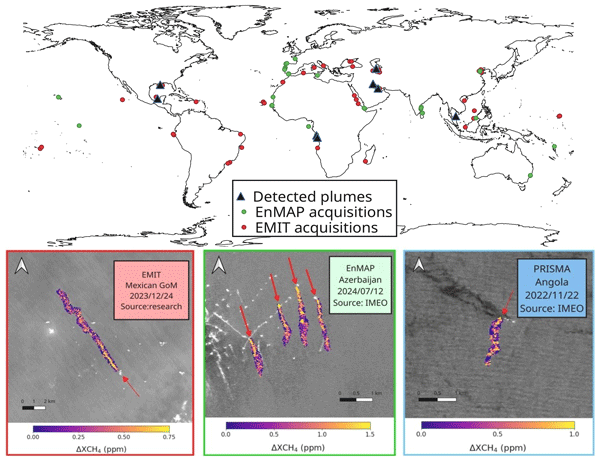
Detection of methane point source emissions with satellite-based imaging spectrometers is assessed in offshore areas. After integrating simulations into data from 2 different satellite missions, we extract the probability of detection. We compare our results with real plumes, which shows the consistency of the models. Detection and monitoring efforts can be optimized by filtering data based on these results, reducing unnecessary searches and increasing the action taken on these emissions.
Javier Roger, Luis Guanter, Javier Gorroño, and Itziar Irakulis-Loitxate
Atmos. Meas. Tech., 17, 1333–1346, https://doi.org/10.5194/amt-17-1333-2024, https://doi.org/10.5194/amt-17-1333-2024, 2024
Short summary
Short summary
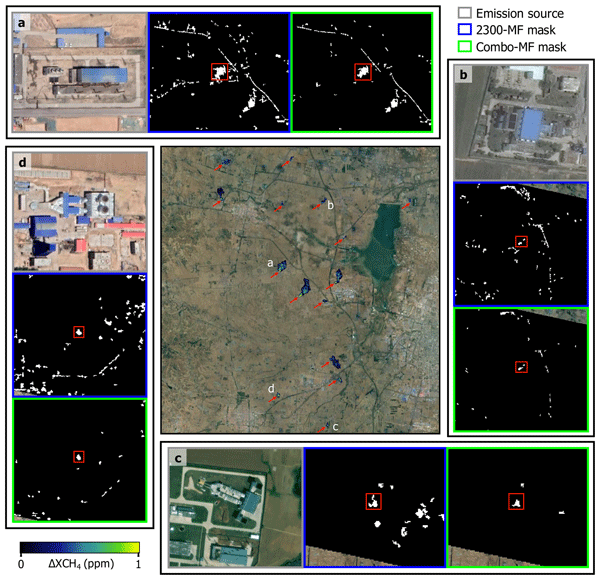
Methane emissions can be identified using remote sensing, but surface-related structures disturb detection. In this work, a variation of the matched filter method that exploits a large fraction of the near-infrared range (1000–2500 nm) is applied. In comparison to the raw matched filter, it reduces background noise and strongly attenuates the surface-related artifacts, which leads to a greater detection capability. We propose this variation as a standard methodology for methane detection.
Berend J. Schuit, Joannes D. Maasakkers, Pieter Bijl, Gourav Mahapatra, Anne-Wil van den Berg, Sudhanshu Pandey, Alba Lorente, Tobias Borsdorff, Sander Houweling, Daniel J. Varon, Jason McKeever, Dylan Jervis, Marianne Girard, Itziar Irakulis-Loitxate, Javier Gorroño, Luis Guanter, Daniel H. Cusworth, and Ilse Aben
Atmos. Chem. Phys., 23, 9071–9098, https://doi.org/10.5194/acp-23-9071-2023, https://doi.org/10.5194/acp-23-9071-2023, 2023
Short summary
Short summary
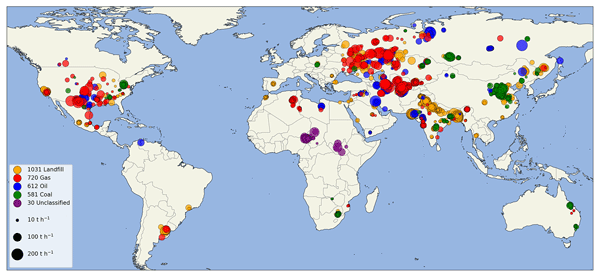
Using two machine learning models, which were trained on TROPOMI methane satellite data, we detect 2974 methane plumes, so-called super-emitters, in 2021. We detect methane emissions globally related to urban areas or landfills, coal mining, and oil and gas production. Using our monitoring system, we identify 94 regions with frequent emissions. For 12 locations, we target high-resolution satellite instruments to enlarge and identify the exact infrastructure responsible for the emissions.

Javier Gorroño, Daniel J. Varon, Itziar Irakulis-Loitxate, and Luis Guanter
Atmos. Meas. Tech., 16, 89–107, https://doi.org/10.5194/amt-16-89-2023, https://doi.org/10.5194/amt-16-89-2023, 2023
Short summary
Short summary
We present a methane flux rate retrieval methodology using the Sentinel-2 mission, validating the algorithm for different scenes and plumes. The detection limit is 1000–2000 kg h−1 for homogeneous scenes and temporally invariant surfaces and above 5000 kg h−1 for heterogeneous ones. Dominant quantification errors are wind-related or plume mask-related. For heterogeneous scenes, the surface structure underlying the methane plume can become a dominant source of uncertainty.
Lulu Si, Shanyu Zhou, Itziar Irakulis-Loitxate, Javier Roger, and Luis Guanter
Earth Syst. Sci. Data, 18, 6545–6564, https://doi.org/10.5194/essd-18-6545-2026, https://doi.org/10.5194/essd-18-6545-2026, 2026
Short summary
Short summary
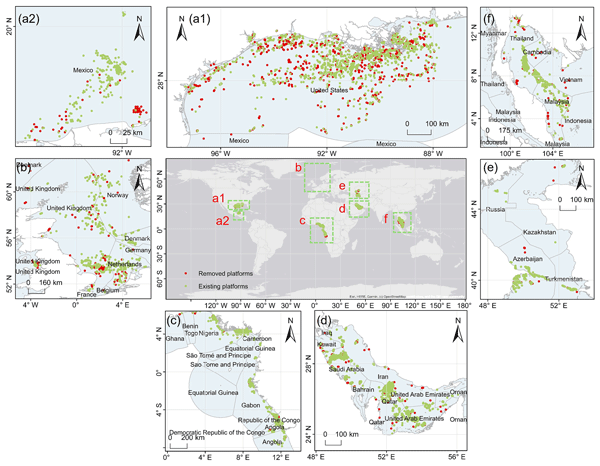
We constructed a dataset of offshore oil and gas platforms to improve knowledge of human activities at sea and their environmental impacts. Using satellite images from the Sentinel-1 and Sentinel-2 missions, we identified over 5000 platforms in six major offshore basins between 2017 and 2023 and recorded their locations and status. This open dataset extends existing records and supports environmental monitoring, offshore infrastructure management, and planning of mitigation strategies.
Daniel A. Potts, Harjinder Sembhi, Matthieu Dogniaux, Joannes D. Maasakkers, Berend J. Schuit, Dirk Schuettemeyer, Timon Hummel, Rocio Barrio Guillo, Oliver Schneising, Luis Guanter, and Ilse Aben
EGUsphere, https://doi.org/10.5194/egusphere-2026-3797, https://doi.org/10.5194/egusphere-2026-3797, 2026
This preprint is open for discussion and under review for Atmospheric Chemistry and Physics (ACP).
Short summary
Short summary
Routine monitoring of industrial emissions is vital to understand the location, frequency, and intensity of methane emissions. We used satellite and aircraft measurements to understand methane emissions from Madrid across various scales and sectors. Using a range of methods, we identify a clear gap between top-down and bottom-up approaches, discuss challenges associated with satellite interpretation, connect emissions to on-site practices, and make recommendations towards operational use.
Francesco Bove and Javier Gorroño
EGUsphere, https://doi.org/10.5194/egusphere-2026-2803, https://doi.org/10.5194/egusphere-2026-2803, 2026
This preprint is open for discussion and under review for Earth Observation (EO).
Short summary
Short summary
Satellites that observe Earth must agree with each other so their data can be combined into long, reliable records. We compared two major missions, Landsat-9 and Sentinel-2, using a third satellite, EMIT, as a bridge. By matching images of the same locations worldwide, we found the two missions agree to within a few percent across most spectral bands. This approach avoids problems that affect direct comparisons and can be applied to future, more accurate calibration satellites.
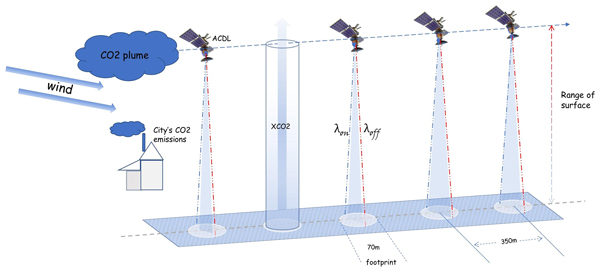
Jinchun Yi, Yiyang Huang, Zhipeng Pei, and Ge Han
Atmos. Chem. Phys., 25, 13687–13710, https://doi.org/10.5194/acp-25-13687-2025, https://doi.org/10.5194/acp-25-13687-2025, 2025
Short summary
Short summary
The inventory overestimated emissions in Beijing and Riyadh by 10–20 % and underestimated emissions in Cairo by 10–30 %. The biosphere flux has a 20–40 % impact on emissions in Beijing during certain periods. Moreover, using night-time and day-time biosphere flux data separately can improve the simulation accuracy of the same orbit by 20–70 % compared to using daily average data.
Javier Roger, Luis Guanter, and Javier Gorroño
Atmos. Meas. Tech., 18, 5545–5567, https://doi.org/10.5194/amt-18-5545-2025, https://doi.org/10.5194/amt-18-5545-2025, 2025
Short summary
Short summary
Detection of methane point source emissions with satellite-based imaging spectrometers is assessed in offshore areas. After integrating simulations into data from 2 different satellite missions, we extract the probability of detection. We compare our results with real plumes, which shows the consistency of the models. Detection and monitoring efforts can be optimized by filtering data based on these results, reducing unnecessary searches and increasing the action taken on these emissions.
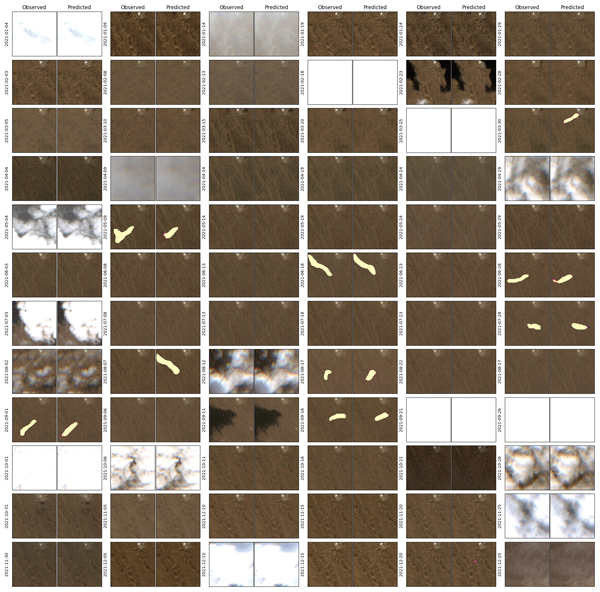
Anna Vaughan, Gonzalo Mateo-García, Luis Gómez-Chova, Vít Růžička, Luis Guanter, and Itziar Irakulis-Loitxate
Atmos. Meas. Tech., 17, 2583–2593, https://doi.org/10.5194/amt-17-2583-2024, https://doi.org/10.5194/amt-17-2583-2024, 2024
Short summary
Short summary
Methane is a potent greenhouse gas that has been responsible for around 25 % of global warming since the industrial revolution. Consequently identifying and mitigating methane emissions comprise an important step in combating the climate crisis. We develop a new deep learning model to automatically detect methane plumes from satellite images and demonstrate that this can be applied to monitor large methane emissions resulting from the oil and gas industry.
Russell Doughty, Yujie Wang, Jennifer Johnson, Nicholas Parazoo, Troy Magney, Zoe Pierrat, Xiangming Xiao, Luis Guanter, Philipp Köhler, Christian Frankenberg, Peter Somkuti, Shuang Ma, Yuanwei Qin, Sean Crowell, and Berrien Moore III
EGUsphere, https://doi.org/10.22541/essoar.168167172.20799710/v1, https://doi.org/10.22541/essoar.168167172.20799710/v1, 2024
Preprint archived
Short summary
Short summary
Here we present a novel model of global photosynthesis, ChloFluo, which uses spaceborne chlorophyll fluorescence to estimate the amount of photosynthetically active radiation absorbed by chlorophyll. Potential uses of our model are to advance our understanding of the timing and magnitude of photosynthesis, its effect on atmospheric carbon dioxide fluxes, and vegetation response to climate events and change.
Javier Roger, Luis Guanter, Javier Gorroño, and Itziar Irakulis-Loitxate
Atmos. Meas. Tech., 17, 1333–1346, https://doi.org/10.5194/amt-17-1333-2024, https://doi.org/10.5194/amt-17-1333-2024, 2024
Short summary
Short summary
Methane emissions can be identified using remote sensing, but surface-related structures disturb detection. In this work, a variation of the matched filter method that exploits a large fraction of the near-infrared range (1000–2500 nm) is applied. In comparison to the raw matched filter, it reduces background noise and strongly attenuates the surface-related artifacts, which leads to a greater detection capability. We propose this variation as a standard methodology for methane detection.
Berend J. Schuit, Joannes D. Maasakkers, Pieter Bijl, Gourav Mahapatra, Anne-Wil van den Berg, Sudhanshu Pandey, Alba Lorente, Tobias Borsdorff, Sander Houweling, Daniel J. Varon, Jason McKeever, Dylan Jervis, Marianne Girard, Itziar Irakulis-Loitxate, Javier Gorroño, Luis Guanter, Daniel H. Cusworth, and Ilse Aben
Atmos. Chem. Phys., 23, 9071–9098, https://doi.org/10.5194/acp-23-9071-2023, https://doi.org/10.5194/acp-23-9071-2023, 2023
Short summary
Short summary
Using two machine learning models, which were trained on TROPOMI methane satellite data, we detect 2974 methane plumes, so-called super-emitters, in 2021. We detect methane emissions globally related to urban areas or landfills, coal mining, and oil and gas production. Using our monitoring system, we identify 94 regions with frequent emissions. For 12 locations, we target high-resolution satellite instruments to enlarge and identify the exact infrastructure responsible for the emissions.
Javier Gorroño, Daniel J. Varon, Itziar Irakulis-Loitxate, and Luis Guanter
Atmos. Meas. Tech., 16, 89–107, https://doi.org/10.5194/amt-16-89-2023, https://doi.org/10.5194/amt-16-89-2023, 2023
Short summary
Short summary
We present a methane flux rate retrieval methodology using the Sentinel-2 mission, validating the algorithm for different scenes and plumes. The detection limit is 1000–2000 kg h−1 for homogeneous scenes and temporally invariant surfaces and above 5000 kg h−1 for heterogeneous ones. Dominant quantification errors are wind-related or plume mask-related. For heterogeneous scenes, the surface structure underlying the methane plume can become a dominant source of uncertainty.
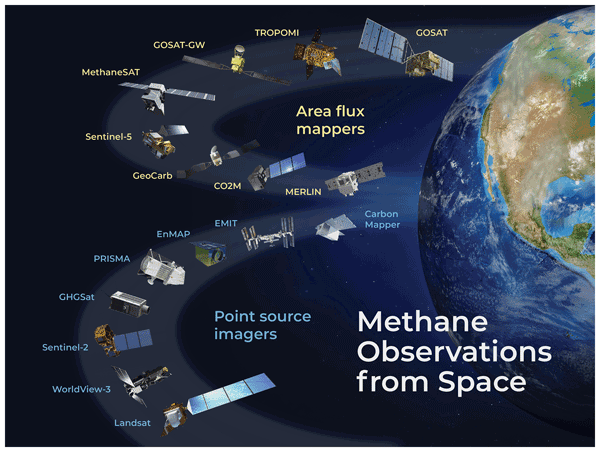
Daniel J. Jacob, Daniel J. Varon, Daniel H. Cusworth, Philip E. Dennison, Christian Frankenberg, Ritesh Gautam, Luis Guanter, John Kelley, Jason McKeever, Lesley E. Ott, Benjamin Poulter, Zhen Qu, Andrew K. Thorpe, John R. Worden, and Riley M. Duren
Atmos. Chem. Phys., 22, 9617–9646, https://doi.org/10.5194/acp-22-9617-2022, https://doi.org/10.5194/acp-22-9617-2022, 2022
Short summary
Short summary
We review the capability of satellite observations of atmospheric methane to quantify methane emissions on all scales. We cover retrieval methods, precision requirements, inverse methods for inferring emissions, source detection thresholds, and observations of system completeness. We show that current instruments already enable quantification of regional and national emissions including contributions from large point sources. Coverage and resolution will increase significantly in coming years.
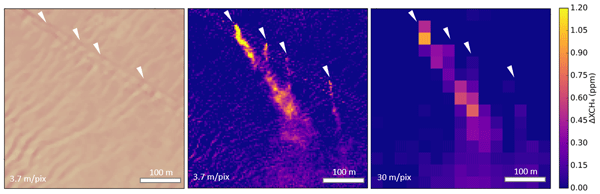
Elena Sánchez-García, Javier Gorroño, Itziar Irakulis-Loitxate, Daniel J. Varon, and Luis Guanter
Atmos. Meas. Tech., 15, 1657–1674, https://doi.org/10.5194/amt-15-1657-2022, https://doi.org/10.5194/amt-15-1657-2022, 2022
Short summary
Short summary
This study seeks to present the as-yet-unknown potential use of WorldView-3 for the mapping of methane point source emissions. The proposed retrieval methodology is based on the idea that the spectral channels not affected by methane can be used to predict the methane-affected band through regression analysis. The results show the precise location of 26 independent point emissions over different methane hotspot regions worldwide, which prove the game-changing potential that this mission entails.
Luis Guanter, Cédric Bacour, Andreas Schneider, Ilse Aben, Tim A. van Kempen, Fabienne Maignan, Christian Retscher, Philipp Köhler, Christian Frankenberg, Joanna Joiner, and Yongguang Zhang
Earth Syst. Sci. Data, 13, 5423–5440, https://doi.org/10.5194/essd-13-5423-2021, https://doi.org/10.5194/essd-13-5423-2021, 2021
Short summary
Short summary
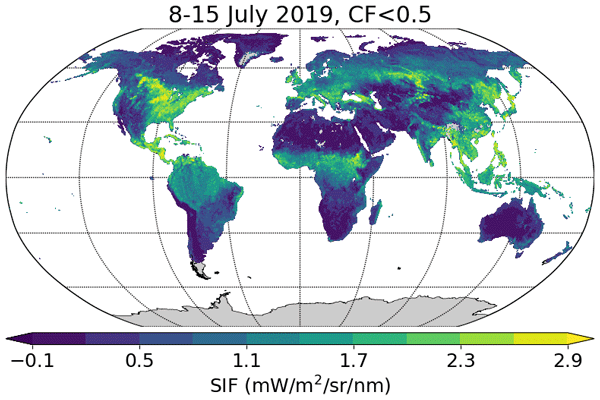
Sun-induced chlorophyll fluorescence (SIF) is an electromagnetic signal emitted by plants in the red and far-red parts of the spectrum. It has a functional link to photosynthesis and can be measured by satellite instruments, which makes it an important variable for the remote monitoring of the photosynthetic activity of vegetation ecosystems around the world. In this contribution we present a SIF dataset derived from the new Sentinel-5P TROPOMI missions.
Cited articles
Borchardt, J., Gerilowski, K., Krautwurst, S., Bovensmann, H., Thorpe, A. K., Thompson, D. R., Frankenberg, C., Miller, C. E., Duren, R. M., and Burrows, J. P.: Detection and quantification of CH4 plumes using the WFM-DOAS retrieval on AVIRIS-NG hyperspectral data, Atmos. Meas. Tech., 14, 1267–1291, https://doi.org/10.5194/amt-14-1267-2021, 2021. a, b
Borger, C., Beirle, S., Butz, A., Scheidweiler, L. O., and Wagner, T.: High-resolution observations of NO2 and CO2 emission plumes from EnMAP satellite measurements, Environmental Research Letters, 20, 044034, https://doi.org/10.1088/1748-9326/adc0b1, 2025. a
Butz, A., Guerlet, S., Hasekamp, O., Schepers, D., Galli, A., Aben, I., Frankenberg, C., Hartmann, J.-M., Tran, H., Kuze, A., Keppel-Aleks, G., Toon, G., Wunch, D., Wennberg, P., Deutscher, N., Griffith, D., Macatangay, R., Messerschmidt, J., Notholt, J., and Warneke, T.: Toward accurate CO2 and CH4 observations from GOSAT, Geophys. Res. Lett., 38, https://doi.org/10.1029/2011GL047888, 2011. a
Cusworth, D. H., Jacob, D. J., Varon, D. J., Chan Miller, C., Liu, X., Chance, K., Thorpe, A. K., Duren, R. M., Miller, C. E., Thompson, D. R., Frankenberg, C., Guanter, L., and Randles, C. A.: Potential of next-generation imaging spectrometers to detect and quantify methane point sources from space, Atmos. Meas. Tech., 12, 5655–5668, https://doi.org/10.5194/amt-12-5655-2019, 2019. a
Eastwood, M. L., Thompson, D. R., Green, R. O., Fahlen, J. E., Adams, T. J., Brandt, A. R., Brodrick, P. G., Chlus, A., Kort, E. A., Reuland, F., and Thorpe, A. K.: Direct measurement of plume velocity to characterize point source emissions, Proceedings of the National Academy of Sciences, 122, e2507350122, https://doi.org/10.1073/pnas.2507350122, 2025. a, b
Foote, M. D., Dennison, P. E., Thorpe, A. K., Thompson, D. R., Jongaramrungruang, S., Frankenberg, C., and Joshi, S. C.: Fast and Accurate Retrieval of Methane Concentration From Imaging Spectrometer Data Using Sparsity Prior, IEEE Transactions on Geoscience and Remote Sensing, 58, 6480–6492, 2020. a
Frankenberg, C., Platt, U., and Wagner, T.: Iterative maximum a posteriori (IMAP)-DOAS for retrieval of strongly absorbing trace gases: Model studies for CH4 and CO2 retrieval from near infrared spectra of SCIAMACHY onboard ENVISAT, Atmos. Chem. Phys., 5, 9–22, https://doi.org/10.5194/acp-5-9-2005, 2005. a
Frankenberg, C., Thorpe, A. K., Thompson, D. R., Hulley, G., Kort, E. A., Vance, N., Borchardt, J., Krings, T., Gerilowski, K., Sweeney, C., Conley, S., Bue, B. D., Aubrey, A. D., Hook, S., and Green, R. O.: Airborne methane remote measurements reveal heavy-tail flux distribution in Four Corners region, Proceedings of the National Academy of Sciences, 113, 9734–9739, https://doi.org/10.1073/pnas.1605617113, 2016. a
Gorroño, J.: LARS-UPV/CH4unc: First release of LES_sensitivity (to angular configuration), Zenodo [code], https://doi.org/10.5281/zenodo.18242174, 2026. a, b, c, d
Gorroño, J., Pei, Z., and Guanter, L.: Benchmark simulations for methane emissions validation and sensitivity studies, Zenodo [data set], https://doi.org/10.5281/zenodo.18161182, 2026. a, b, c
Guanter, L., Irakulis-Loitxate, I., Gorroño, J., Sánchez-García, E., Cusworth, D. H., Varon, D. J., Cogliati, S., and Colombo, R.: Mapping methane point emissions with the PRISMA spaceborne imaging spectrometer, Remote Sensing of Environment, 265, 112671, https://doi.org/10.1016/j.rse.2021.112671, 2021. a, b
Irakulis-Loitxate, I., Guanter, L., Liu, Y.-N., Varon, D. J., Maasakkers, J. D., Zhang, Y., Chulakadabba, A., Wofsy, S. C., Thorpe, A. K., Duren, R. M., Frankenberg, C., Lyon, D. R., Hmiel, B., Cusworth, D. H., Zhang, Y., Segl, K., Gorroño, J., Sánchez-García, E., Sulprizio, M. P., Cao, K., Zhu, H., Liang, J., Li, X., Aben, I., and Jacob, D. J.: Satellite-based survey of extreme methane emissions in the Permian basin, Science Advances, 7, https://doi.org/10.1126/sciadv.abf4507, 2021. a
Jacob, D. J., Varon, D. J., Cusworth, D. H., Dennison, P. E., Frankenberg, C., Gautam, R., Guanter, L., Kelley, J., McKeever, J., Ott, L. E., Poulter, B., Qu, Z., Thorpe, A. K., Worden, J. R., and Duren, R. M.: Quantifying methane emissions from the global scale down to point sources using satellite observations of atmospheric methane, Atmos. Chem. Phys., 22, 9617–9646, https://doi.org/10.5194/acp-22-9617-2022, 2022. a
Jervis, D., McKeever, J., Durak, B. O. A., Sloan, J. J., Gains, D., Varon, D. J., Ramier, A., Strupler, M., and Tarrant, E.: The GHGSat-D imaging spectrometer, Atmos. Meas. Tech., 14, 2127–2140, https://doi.org/10.5194/amt-14-2127-2021, 2021. a
Jongaramrungruang, S., Frankenberg, C., Matheou, G., Thorpe, A. K., Thompson, D. R., Kuai, L., and Duren, R. M.: Towards accurate methane point-source quantification from high-resolution 2-D plume imagery, Atmos. Meas. Tech., 12, 6667–6681, https://doi.org/10.5194/amt-12-6667-2019, 2019. a
Jongaramrungruang, S., Matheou, G., Thorpe, A. K., Zeng, Z.-C., and Frankenberg, C.: Remote sensing of methane plumes: instrument tradeoff analysis for detecting and quantifying local sources at global scale, Atmos. Meas. Tech., 14, 7999–8017, https://doi.org/10.5194/amt-14-7999-2021, 2021. a
Jongaramrungruang, S., Thorpe, A. K., Matheou, G., and Frankenberg, C.: MethaNet – An AI-driven approach to quantifying methane point-source emission from high-resolution 2-D plume imagery, Remote Sensing of Environment, 269, 112809, https://doi.org/10.1016/j.rse.2021.112809, 2022. a
Krings, T., Gerilowski, K., Buchwitz, M., Reuter, M., Tretner, A., Erzinger, J., Heinze, D., Pflüger, U., Burrows, J. P., and Bovensmann, H.: MAMAP – a new spectrometer system for column-averaged methane and carbon dioxide observations from aircraft: retrieval algorithm and first inversions for point source emission rates, Atmos. Meas. Tech., 4, 1735–1758, https://doi.org/10.5194/amt-4-1735-2011, 2011. a
Kushner, D. S., Lopez, T., Kern, C., Arellano, S., Pérez, N. M., and Barrancos, J.: The ghost plume phenomenon and its impact on zenith-facing remote sensing measurements of volcanic SO2 emission rates, J. Volcanol. Geoth. Res., 457, 108217, https://doi.org/10.1016/j.jvolgeores.2024.108217, 2025. a
Meier, S., Vögtli, M., Hueni, A., McManemin, A., Brandt, A. R., Juéry, C., Blandin, V., Brunner, D., and Kuhlmann, G.: Quantifying CH4 point source emissions with airborne remote sensing: first results from AVIRIS-4, Atmos. Meas. Tech., 19, 333–358, https://doi.org/10.5194/amt-19-333-2026, 2026. a, b
Ocko, I. B., Sun, T., Shindell, D., Oppenheimer, M., Hristov, A. N., Pacala, S. W., Mauzerall, D. L., Xu, Y., and Hamburg, S. P.: Acting rapidly to deploy readily available methane mitigation measures by sector can immediately slow global warming, Environmental Research Letters, 16, 054042, https://doi.org/10.1088/1748-9326/abf9c8, 2021. a
O'Dell, C. W., Eldering, A., Wennberg, P. O., Crisp, D., Gunson, M. R., Fisher, B., Frankenberg, C., Kiel, M., Lindqvist, H., Mandrake, L., Merrelli, A., Natraj, V., Nelson, R. R., Osterman, G. B., Payne, V. H., Taylor, T. E., Wunch, D., Drouin, B. J., Oyafuso, F., Chang, A., McDuffie, J., Smyth, M., Baker, D. F., Basu, S., Chevallier, F., Crowell, S. M. R., Feng, L., Palmer, P. I., Dubey, M., García, O. E., Griffith, D. W. T., Hase, F., Iraci, L. T., Kivi, R., Morino, I., Notholt, J., Ohyama, H., Petri, C., Roehl, C. M., Sha, M. K., Strong, K., Sussmann, R., Te, Y., Uchino, O., and Velazco, V. A.: Improved retrievals of carbon dioxide from Orbiting Carbon Observatory-2 with the version 8 ACOS algorithm, Atmos. Meas. Tech., 11, 6539–6576, https://doi.org/10.5194/amt-11-6539-2018, 2018. a
Ouerghi, E., Ehret, T., Facciolo, G., Meinhardt, E., Marion, R., and Morel, J.-M.: Tightening up methane plume source rate estimation in EnMAP and PRISMA images, Atmos. Meas. Tech., 18, 4611–4629, https://doi.org/10.5194/amt-18-4611-2025, 2025. a
Plewa, T., Butz, A., Frankenberg, C., Thorpe, A. K., and Marshall, J.: Improvements of AI-driven emission estimation for point sources applied to high resolution 2-D methane-plume imagery, Remote Sensing of Environment, 331, 115002, https://doi.org/10.1016/j.rse.2025.115002, 2025. a
Sánchez-García, E., Gorroño, J., Irakulis-Loitxate, I., Varon, D. J., and Guanter, L.: Mapping methane plumes at very high spatial resolution with the WorldView-3 satellite, Atmos. Meas. Tech., 15, 1657–1674, https://doi.org/10.5194/amt-15-1657-2022, 2022. a, b, c, d
Schwaerzel, M., Emde, C., Brunner, D., Morales, R., Wagner, T., Berne, A., Buchmann, B., and Kuhlmann, G.: Three-dimensional radiative transfer effects on airborne and ground-based trace gas remote sensing, Atmos. Meas. Tech., 13, 4277–4293, https://doi.org/10.5194/amt-13-4277-2020, 2020. a
Shukla, P. R., Skea, J., Slade, R., Al Khourdajie, A., van Diemen, R., McCollum, D., Pathak, M., Some, S., Vyas, P., Fradera, R., et al.: Climate change 2022: Mitigation of climate change, Contribution of working group III to the sixth assessment report of the Intergovernmental Panel on Climate Change, 10, http://digitallibrary.un.org/record/4019730 (last access: 16 February 2026), 2022. a
Thompson, D. R., Leifer, I., Bovensmann, H., Eastwood, M., Fladeland, M., Frankenberg, C., Gerilowski, K., Green, R. O., Kratwurst, S., Krings, T., Luna, B., and Thorpe, A. K.: Real-time remote detection and measurement for airborne imaging spectroscopy: a case study with methane, Atmos. Meas. Tech., 8, 4383–4397, https://doi.org/10.5194/amt-8-4383-2015, 2015. a
Thompson, D. R., Thorpe, A. K., Frankenberg, C., Green, R. O., Duren, R., Guanter, L., Hollstein, A., Middleton, E., Ong, L., and Ungar, S.: Space-based remote imaging spectroscopy of the Aliso Canyon CH4 superemitter, Geophys. Res. Lett., 43, 6571–6578, https://doi.org/10.1002/2016GL069079, 2016. a
Thorpe, A. K., Frankenberg, C., and Roberts, D. A.: Retrieval techniques for airborne imaging of methane concentrations using high spatial and moderate spectral resolution: application to AVIRIS, Atmos. Meas. Tech., 7, 491–506, https://doi.org/10.5194/amt-7-491-2014, 2014. a
Valverde, A. and Gorroño, J.: Geometric projection of methane plumes, Valverde, Adriana, TIB AV-Portal [video], https://doi.org/10.5446/71693, 2025. a, b
Varon, D. J., Jacob, D. J., Jervis, D., and McKeever, J.: Quantifying Time-Averaged Methane Emissions from Individual Coal Mine Vents with GHGSat-D Satellite Observations, Environmental Science & Technology, 54, 10246–10253, https://doi.org/10.1021/acs.est.0c01213, 2020. a
Varon, D. J., Jervis, D., Pandey, S., Gallardo, S. L., Balasus, N., Yang, L. H., and Jacob, D. J.: Quantifying NOx point sources with Landsat and Sentinel-2 satellite observations of NO2 plumes, Proceedings of the National Academy of Sciences, 121, e2317077121, https://doi.org/10.1073/pnas.2317077121, 2024. a
Vaughan, A., Mateo-García, G., Gómez-Chova, L., Růžička, V., Guanter, L., and Irakulis-Loitxate, I.: CH4Net: a deep learning model for monitoring methane super-emitters with Sentinel-2 imagery, Atmos. Meas. Tech., 17, 2583–2593, https://doi.org/10.5194/amt-17-2583-2024, 2024. a
Wang, C., Luo, Z. J., and Huang, X.: Parallax correction in collocating CloudSat and Moderate Resolution Imaging Spectroradiometer (MODIS) observations: Method and application to convection study, Journal of Geophysical Research: Atmospheres, 116, https://doi.org/10.1029/2011JD016097, 2011. a
Short summary
Methane plumes can be detected with several instruments from space at a high spatial resolution nowadays. We see a ground projection of these methane plumes from the satellites that, similarly to clouds or buildings, are distorted depending on the observation and illumination angle. Here we highlight this issue and propose a methodology to account for it using simulations that could enhance current and upcoming retrieval and quantification algorithms.
Methane plumes can be detected with several instruments from space at a high spatial resolution...


