
Articles | Volume 19, issue 1
https://doi.org/10.5194/amt-19-135-2026
© Author(s) 2026. This work is distributed under
the Creative Commons Attribution 4.0 License.
the Creative Commons Attribution 4.0 License.
https://doi.org/10.5194/amt-19-135-2026
© Author(s) 2026. This work is distributed under
the Creative Commons Attribution 4.0 License.
the Creative Commons Attribution 4.0 License.
Research article
| 
07 Jan 2026
Research article |
| 07 Jan 2026
| 07 Jan 2026
Optimal estimation retrieval framework for daytime clear-sky total column water vapour from MTG-FCI near-infrared measurements
Jan El Kassar
CORRESPONDING AUTHOR

Institute of Meteorology, Freie Universität Berlin, Carl-Heinrich-Becker-Weg 6–10, 12165 Berlin, Germany
Spectral Earth GmbH, Baseler Str. 91a, 12205 Berlin, Germany
Cintia Carbajal Henken
Institute of Meteorology, Freie Universität Berlin, Carl-Heinrich-Becker-Weg 6–10, 12165 Berlin, Germany
Xavier Calbet
Agencia Estatal de Meteorología, Leonardo Prieto Castro 8, Ciudad Universitaria, 28071 Madrid, Spain
Pilar Rípodas
Agencia Estatal de Meteorología, Leonardo Prieto Castro 8, Ciudad Universitaria, 28071 Madrid, Spain
Rene Preusker
Institute of Meteorology, Freie Universität Berlin, Carl-Heinrich-Becker-Weg 6–10, 12165 Berlin, Germany
Jürgen Fischer
Institute of Meteorology, Freie Universität Berlin, Carl-Heinrich-Becker-Weg 6–10, 12165 Berlin, Germany
Spectral Earth GmbH, Baseler Str. 91a, 12205 Berlin, Germany
Related authors
No articles found.
Gaël Kermarrec, Xavier Calbet, Nishant Pawar, and Zhiguo Deng
EGUsphere, https://doi.org/10.5194/egusphere-2026-4148, https://doi.org/10.5194/egusphere-2026-4148, 2026
This preprint is open for discussion and under review for Atmospheric Chemistry and Physics (ACP).
Short summary
Short summary
Every GNSS positioning station measures the overhead water vapour, and its fast fluctuations are usually discarded as noise. We show they track how patchy water vapour is, horizontally, near the top of the boundary layer, at scales of hundreds of metres to a few kilometres. Vertical sounding and reanalysis miss this structure. Because it is already measured worldwide, day and night, it offers a free new view of the moisture patterns that help set where convection begins.
Sebastian Bley, Anja Hünerbein, Edward Baudrez, Nils Madenach, Nicole Docter, Rene Preusker, Michael Eisinger, Fabien Marnas, Antje Ludewig, Manuel Ángel Ruiz Saldaña, Cameron Bean, Shweta Agarwal, Lennart Zimmermann, and Timon Hummel
EGUsphere, https://doi.org/10.5194/egusphere-2026-2652, https://doi.org/10.5194/egusphere-2026-2652, 2026
This preprint is open for discussion and under review for Atmospheric Measurement Techniques (AMT).
Short summary
Short summary
The joint ESA-JAXA EarthCARE satellite, launched on 28 May 2024, carries a unique combination of active and passive instruments. We present the first in-orbit calibration and validation of the Multi-Spectral Imager (MSI) Level-1 data. We performed ad-hoc vicarious calibration of the MSI radiances using deep convective cloud scenes from the MTG Flexible Combined Imager and show that all corrections, made in the first 1.5 years, significantly improved the geometric and radiometric performance.
Nils Madenach, Florian Tornow, Howard Barker, Rene Preusker, and Jürgen Fischer
Atmos. Meas. Tech., 19, 935–947, https://doi.org/10.5194/amt-19-935-2026, https://doi.org/10.5194/amt-19-935-2026, 2026
Short summary
Short summary
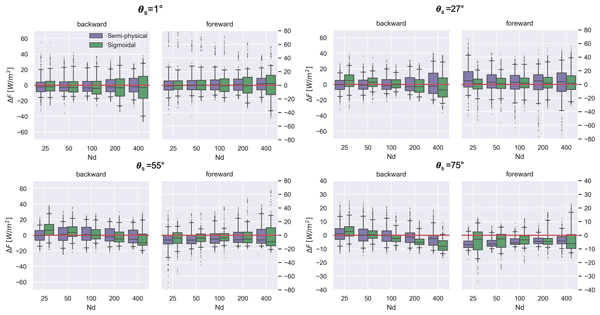
In this study three-dimensional cloud fields with different macro- and microphysical properties are generated and used to simulate the top of atmosphere short wave radiances and fluxes. The simulations are compared to two radiance-to-irradiance conversion approaches. Especially for viewing angles in the backscattering direction the approach that is aware of the cloud microphysics results in better flux estimates.
Gaël Kermarrec, Xavier Calbet, Zhiguo Deng, and Cintia Carbajal Henken
Atmos. Chem. Phys., 25, 3567–3581, https://doi.org/10.5194/acp-25-3567-2025, https://doi.org/10.5194/acp-25-3567-2025, 2025
Short summary
Short summary
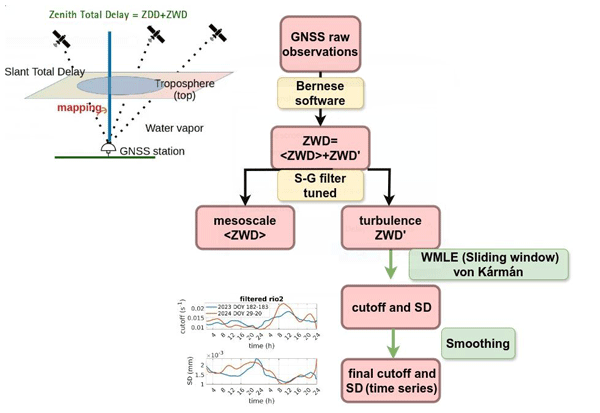
Atmospheric delays affect global navigation satellite system (GNSS) signals. This study analyses the wet delay, a variable component caused by atmospheric water vapor, using a novel filtering method to examine small-scale turbulent variations. Case studies at five global stations revealed daily and seasonal turbulence patterns. This research will improve water vapour and cloud models, enhance nowcasting, and refine stochastic modelling for GNSS and very long baseline interferometry.
Tim Trent, Marc Schröder, Shu-Peng Ho, Steffen Beirle, Ralf Bennartz, Eva Borbas, Christian Borger, Helene Brogniez, Xavier Calbet, Elisa Castelli, Gilbert P. Compo, Wesley Ebisuzaki, Ulrike Falk, Frank Fell, John Forsythe, Hans Hersbach, Misako Kachi, Shinya Kobayashi, Robert E. Kursinski, Diego Loyola, Zhengzao Luo, Johannes K. Nielsen, Enzo Papandrea, Laurence Picon, Rene Preusker, Anthony Reale, Lei Shi, Laura Slivinski, Joao Teixeira, Tom Vonder Haar, and Thomas Wagner
Atmos. Chem. Phys., 24, 9667–9695, https://doi.org/10.5194/acp-24-9667-2024, https://doi.org/10.5194/acp-24-9667-2024, 2024
Short summary
Short summary
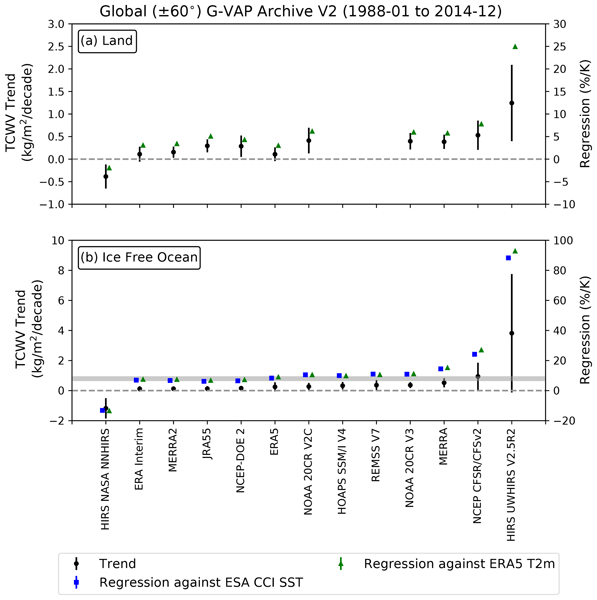
In a warmer future, water vapour will spend more time in the atmosphere, changing global rainfall patterns. In this study, we analysed the performance of 28 water vapour records between 1988 and 2014. We find sensitivity to surface warming generally outside expected ranges, attributed to breakpoints in individual record trends and differing representations of climate variability. The implication is that longer records are required for high confidence in assessing climate trends.
Nicole Docter, Anja Hünerbein, David P. Donovan, Rene Preusker, Jürgen Fischer, Jan Fokke Meirink, Piet Stammes, and Michael Eisinger
Atmos. Meas. Tech., 17, 2507–2519, https://doi.org/10.5194/amt-17-2507-2024, https://doi.org/10.5194/amt-17-2507-2024, 2024
Short summary
Short summary
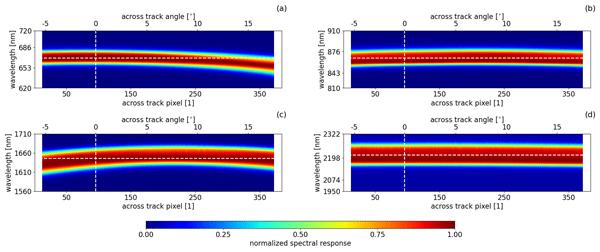
MSI is the imaging spectrometer on board EarthCARE and will provide across-track information on clouds and aerosol properties. The MSI solar channels exhibit a spectral misalignment effect (SMILE) in the measurements. This paper describes and evaluates how the SMILE will affect the cloud and aerosol retrievals that do not account for it.
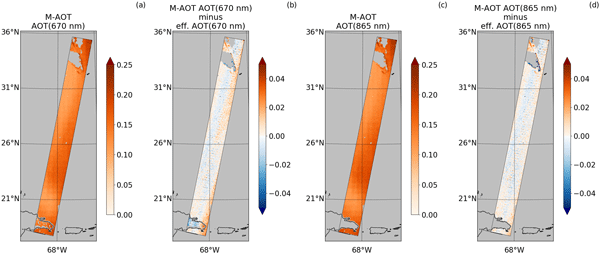
Nicole Docter, Rene Preusker, Florian Filipitsch, Lena Kritten, Franziska Schmidt, and Jürgen Fischer
Atmos. Meas. Tech., 16, 3437–3457, https://doi.org/10.5194/amt-16-3437-2023, https://doi.org/10.5194/amt-16-3437-2023, 2023
Short summary
Short summary
We describe the stand-alone retrieval algorithm used to derive aerosol properties relying on measurements of the Multi-Spectral Imager (MSI) aboard the upcoming Earth Clouds, Aerosols and Radiation Explorer (EarthCARE) satellite. This aerosol data product will be available as M-AOT after the launch of EarthCARE. Additionally, we applied the algorithm to simulated EarthCARE MSI and Moderate Resolution Imaging Spectroradiometer (MODIS) data for prelaunch algorithm verification.
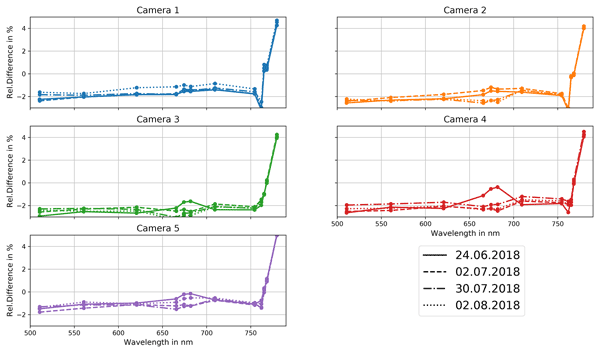
Lena Katharina Jänicke, Rene Preusker, Marco Celesti, Marin Tudoroiu, Jürgen Fischer, Dirk Schüttemeyer, and Matthias Drusch
Atmos. Meas. Tech., 16, 3101–3121, https://doi.org/10.5194/amt-16-3101-2023, https://doi.org/10.5194/amt-16-3101-2023, 2023
Short summary
Short summary
To compare two top-of-atmosphere radiances measured by instruments with different spectral characteristics, a transfer function has been developed. It is applied to a tandem data set of Sentinel-3A and B, for which OLCI-B mimicked the ESA’s eighth Earth Explorer FLEX. We found that OLCI-A measured radiances about 2 % brighter than OLCI-FLEX. Only at larger wavelengths were OLCI-A measurements about 5 % darker. The method is thus successful, being sensitive to calibration and processing issues.
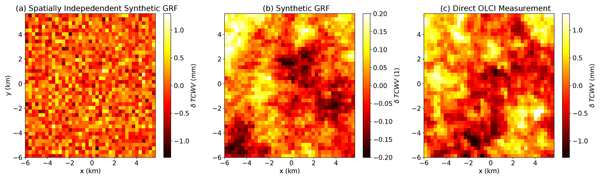
Xavier Calbet, Cintia Carbajal Henken, Sergio DeSouza-Machado, Bomin Sun, and Tony Reale
Atmos. Meas. Tech., 15, 7105–7118, https://doi.org/10.5194/amt-15-7105-2022, https://doi.org/10.5194/amt-15-7105-2022, 2022
Short summary
Short summary
Water vapor concentration in the atmosphere at small scales (< 6 km) is considered. The measurements show Gaussian random field behavior following Kolmogorov's theory of turbulence two-thirds law. These properties can be useful when estimating the water vapor variability within a given observed satellite scene or when different water vapor measurements have to be merged consistently.
Cited articles
Ackerman, S., Frey, R., Strabala, K., Liu, Y., Liam, G., Baum, B., and Menzel, P.: Discriminating Clear-Sky from Cloud with MODIS – Algorithm Theoretical Basis Document (MOD35), ATBD Reference Number: ATBD-MOD-06, Goddard Space Flight Center, Tech. rep., NASA, https://modis-images.gsfc.nasa.gov/_docs/MOD35:MYD35_ATBD_C005.pdf (last access: 29 August 2024), 2002. a
Albert, P., Bennartz, R., Preusker, R., Leinweber, R., and Fischer, J.: Remote Sensing of Atmospheric Water Vapor Using the Moderate Resolution Imaging Spectroradiometer, J. Atmos. Ocean. Tech., 22, 309–314, https://doi.org/10.1175/JTECH1708.1, 2005. a
Allen, M. R. and Ingram, W. J.: Constraints on future changes in climate and the hydrologic cycle, Nature, 419, https://doi.org/10.1038/nature01092, 2002. a
Benevides, P., Catalao, J., and Miranda, P. M. A.: On the inclusion of GPS precipitable water vapour in the nowcasting of rainfall, Nat. Hazards Earth Syst. Sci., 15, 2605–2616, https://doi.org/10.5194/nhess-15-2605-2015, 2015. a
Bennartz, R. and Fischer, J.: Retrieval of columnar water vapour over land from backscattered solar radiation using the medium resolution imaging spectrometer, Remote Sens. Environ., 78, 274–283, https://doi.org/10.1016/S0034-4257(01)00218-8, 2001. a, b
Cadeddu, M. P., Liljegren, J. C., and Turner, D. D.: The Atmospheric radiation measurement (ARM) program network of microwave radiometers: instrumentation, data, and retrievals, Atmos. Meas. Tech., 6, 2359–2372, https://doi.org/10.5194/amt-6-2359-2013, 2013. a
Carbajal Henken, C. K., Diedrich, H., Preusker, R., and Fischer, J.: MERIS full-resolution total column water vapor: Observing horizontal convective rolls, Geophys. Res. Lett., 42, 10074–10081, https://doi.org/10.1002/2015GL066650, 2015. a, b
Casadio, S., Castelli, E., Papandrea, E., Dinelli, B. M., Pisacane, G., Burini, A., and Bojkov, B. R.: Total column water vapour from along track scanning radiometer series using thermal infrared dual view ocean cloud free measurements: The Advanced Infra-Red WAter Vapour Estimator (AIRWAVE) algorithm, Remote Sens. Environ., 172, 1–14, https://doi.org/10.1016/j.rse.2015.10.037, 2016. a
Chen, J. and Dai, A.: The atmosphere has become increasingly unstable during 1979–2020 over the Northern Hemisphere, Geophys. Res. Lett., 50, e2023GL106125, https://doi.org/10.1029/2023GL106125, 2023. a
Copernicus Climate Change Service and Climate Data Store: Aerosol properties gridded data from 1995 to present derived from satellite observation, Copernicus Climate Change Service (C3S) Climate Data Store (CDS) [data set], https://doi.org/10.24381/cds.239d815c, 2019. a, b
Copernicus Climate Change Service and Climate Data Store: ERA5 hourly data on single levels from 1940 to present, Copernicus Climate Change Service (C3S) Climate Data Store (CDS) [data set], https://doi.org/10.24381/cds.adbb2d47, 2023. a, b
Cox, C. and Munk, W.: Measurement of the Roughness of the Sea Surface from Photographs of the Sun's Glitter, J. Opt. Soc. Am., 44, 838, https://doi.org/10.1364/josa.44.000838, 1954. a
Dauhut, T., Chaboureau, J. P., Haynes, P. H., and Lane, T. P.: The mechanisms leading to a stratospheric hydration by overshooting convection, J. Atmos. Sci., 75, 4383–4398, https://doi.org/10.1175/JAS-D-18-0176.1, 2018. a
Diedrich, H., Preusker, R., Lindstrot, R., and Fischer, J.: Retrieval of daytime total columnar water vapour from MODIS measurements over land surfaces, Atmos. Meas. Tech., 8, 823–836, https://doi.org/10.5194/amt-8-823-2015, 2015. a, b
Donlon, C., Berruti, B., Buongiorno, A., Ferreira, M., Féménias, P., Frerick, J., Goryl, P., Klein, U., Laur, H., Mavrocordatos, C., Nieke, J., Rebhan, H., Seitz, B., Stroede, J., and Sciarra, R.: The global monitoring for environment and security (GMES) sentinel-3 mission, Remote Sens. Environ., 120, 37–57, https://doi.org/10.1016/j.rse.2011.07.024, 2012. a
Doppler, L., Carbajal-Henken, C., Pelon, J., Ravetta, F., and Fischer, J.: Extension of radiative transfer code MOMO, matrix-operator model to the thermal infrared–Clear air validation by comparison to RTTOV and application to CALIPSO-IIR, J. Quant. Spectrosc. Ra., 144, 49–67, 2014. a
Dostalek, J. F., Grasso, L. D., Noh, Y.-J., Wu, T.-C., Zeitler, J. W., Weinman, H. G., Cohen, A. E., and Lindsey, D. T.: Using GOES ABI Split-Window Radiances to Retrieve Daytime Low-Level Water Vapor for Convective Forecasting, E-Journal of Severe Storms Meteorology, 16, 1–19, https://doi.org/10.55599/ejssm.v16i2.79, 2021. a, b
Doswell, C. A., Brooks, H. E., and Maddox, R. A.: Flash Flood Forecasting: An Ingredients-Based Methodology, Weather Forecast., 11, 560–581, https://doi.org/10.1175/1520-0434(1996)011<0560:FFFAIB>2.0.CO;2, 1996. a
Durand, Y., Hallibert, P., Wilson, M., Lekouara, M., Grabarnik, S., Aminou, D., Blythe, P., Napierala, B., Canaud, J.-L., Pigouche, O., Ouaknine, J., and Verez, B.: The flexible combined imager onboard MTG: from design to calibration, Sensors, Systems, and Next-Generation Satellites XIX, 9639, 963903, https://doi.org/10.1117/12.2196644, 2015. a
El Kassar, J., Carbajal Henken, C., Preusker, R., and Fischer, J.: Optimal Estimation MSG-SEVIRI Clear-Sky Total Column Water Vapour Retrieval Using the Split Window Difference, Atmosphere, 12, 1256, https://doi.org/10.3390/atmos12101256, 2021. a, b
EUMETSAT: MTGTD-505 FCI 1C Example Products for Compatibility Testing – Package Description, 1–8, https://sftp.eumetsat.int/public/folder/UsCVknVOOkSyCdgp MimJNQ/User-Materials/Test-Data/MTG/MTG_FCI_L1C_ RC72-20240113_TD-505_Feb2024/MTGTD-505 FCI 1C Example Products for Compatibility Testing - Package Description.pdf (last access: 11 December 2025), 2024a. a
EUMETSAT: New MTG FCI test dataset (MTGTD-505), https://user.eumetsat.int/news-events/news/new-mtg-fci-test-
dataset-mtgtd-505 (last access: 11 December 2025), 2024b. a
EUMETSAT: EUMETSAT Data Store, https://data.eumetsat.int/, last access: 11 December 2025. a
Fabry, F.: The spatial variability of moisture in the boundary layer and its effect on convection initiation: Project-long characterization, Mon. Weather Rev., 134, 79–91, 2006. a
Fell, F. and Fischer, J.: Numerical simulation of the light field in the atmosphere–ocean system using the matrix-operator method, J. Quant. Spectrosc. Ra., 69, 351–388, https://doi.org/10.1016/S0022-4073(00)00089-3, 2001. a
Fischer, J.: High resolution spectroscopy for remote sensing of physical cloud properties and water vapour, in: Current Problems in Atmospheric Radiation, edited by: Lenoble, J. and Geleyn, J. F., Deepak Publishing, Hampton, VA, USA, 151–156, 1988. a
Gao, B.-C. and Kaufman Y. J.: The MODIS Near-IR Water Vapor Algorithm Product ID: MOD05 – Total Precipitable Water, Algorithm Technical Background Document, 1–25, https://modis.gsfc.nasa.gov/data/atbd/atbd_mod03.pdf (last access: 11 December 2025), 1992. a
Gao, B. C., Montes, M. J., Davis, C. O., and Goetz, A. F.: Atmospheric correction algorithms for hyperspectral remote sensing data of land and ocean, Remote Sens. Environ., 113, https://doi.org/10.1016/j.rse.2007.12.015, 2009. a
García-Pereda, J., Rípodas, P., Lliso, L., Calbet, X., Martinez, M., Lahuerta, A., Bartolomé, V., Gléau, H., Kerdraon, G., Péré, S., France, M., Moisselin, J.-M., Autones, F., Claudon, M., Jann, A., Wirth, A., Alonso, O., Fernandez, L., and Gallardo, J: Use of NWCSAF NWC/GEO software package with MSG, Himawari-8/9 and GOES-13/16 satellites, in: EUMETSAT/AMS/NOAA, October, Boston, USA, https://repositorio.aemet.es/handle/20.500.11765/12152 (last access: 11 December 2025), 2019. a
Hersbach, H., Bell, B., Berrisford, P., Hirahara, S., Horányi, A., Muñoz-Sabater, J., Nicolas, J., Peubey, C., Radu, R., Schepers, D., Simmons, A., Soci, C., Abdalla, S., Abellan, X., Balsamo, G., Bechtold, P., Biavati, G., Bidlot, J., Bonavita, M., Chiara, G. D., Dahlgren, P., Dee, D., Diamantakis, M., Dragani, R., Flemming, J., Forbes, R., Fuentes, M., Geer, A., Haimberger, L., Healy, S., Hogan, R. J., Hólm, E., Janisková, M., Keeley, S., Laloyaux, P., Lopez, P., Lupu, C., Radnoti, G., de Rosnay, P., Rozum, I., Vamborg, F., Villaume, S., and Thépaut, J. N.: The ERA5 global reanalysis, Q. J. Roy. Meteor. Soc., 146, 1999–2049, https://doi.org/10.1002/qj.3803, 2020. a
Hess, M., Koepke, P., and Schult, I.: Optical Properties of Aerosols and Clouds: The Software Package OPAC, B. Am. Meteorol. Soc., 79, 831–844, https://doi.org/10.1175/1520-0477(1998)079<0831:OPOAAC>2.0.CO;2, 1998. a
Hogan, R. J. and Matricardi, M.: Evaluating and improving the treatment of gases in radiation schemes: the Correlated K-Distribution Model Intercomparison Project (CKDMIP), Geosci. Model Dev., 13, 6501–6521, https://doi.org/10.5194/gmd-13-6501-2020, 2020. a
Holben, B. N., Eck, T. F., Slutsker, I., Tanré, D., Buis, J. P., Setzer, A., Vermote, E., Reagan, J. A., Kaufman, Y. J., Nakajima, T., Lavenu, F., Jankowiak, I., and Smirnov, A.: AERONET – A federated instrument network and data archive for aerosol characterization, Remote Sens. Environ., 66, 1–16, https://doi.org/10.1016/S0034-4257(98)00031-5, 1998. a
Hollstein, A. and Fischer, J.: Radiative transfer solutions for coupled atmosphere ocean systems using the matrix operator technique, J. Quant. Spectrosc. Ra., 113, 536–548, https://doi.org/10.1016/j.jqsrt.2012.01.010, 2012. a
Holmlund, K., Grandell, J., Schmetz, J., Stuhlmann, R., Bojkov, B., Munro, R., Lekouara, M., Coppens, D., Viticchie, B., August, T., Theodore, B., Watts, P., Dobber, M., Fowler, G., Bojinski, S., Schmid, A., and Salonen, K., Tjemkes S., Aminou D., and Blythe P: Meteosat Third Generation (MTG): Continuation and innovation of observations from geostationary orbit, B. Am. Meteorol. Soc., 102, E990–E1015, https://doi.org/10.1175/BAMS-D-19-0304.1, 2021. a, b
Hu, J., Tang, S., Liu, H., and Min, M.: An operational precipitable water vapor retrieval algorithm for Fengyun-2F/VLSSR using a modified three-band physical split-window method, J. Meteorol. Res.-PRC, 33, 276–288, https://doi.org/10.1007/s13351-019-8111-4, 2019. a
Hünerbein, A., Bley, S., Horn, S., Deneke, H., and Walther, A.: Cloud mask algorithm from the EarthCARE Multi-Spectral Imager: the M-CM products, Atmos. Meas. Tech., 16, 2821–2836, https://doi.org/10.5194/amt-16-2821-2023, 2023. a
Iannone, R. Q., Niro, F., Goryl, P., Dransfeld, S., Hoersch, B., Stelzer, K., Kirches, G., Paperin, M., Brockmann, C., Gomez-Chova, L., Mateo-Garcia, G., Preusker, R., Fischer, J., Amato, U., Serio, C., Gangkofner, U., Berthelot, B., Iordache, M. D., Bertels, L., Wolters, E., Dierckx, W., Benhadj, I., and Swinnen, E.: Proba-V cloud detection Round Robin: Validation results and recommendations, 2017 9th International Workshop on the Analysis of Multitemporal Remote Sensing Images, MultiTemp 2017, https://doi.org/10.1109/Multi-Temp.2017.8035219, 2017. a
Johns, R. H. and Doswell, C. A.: Severe Local Storms Forecasting, Weather Forecast., 7, 588–612, https://doi.org/10.1175/1520-0434(1992)007<0588:SLSF>2.0.CO;2, 1992. a
Khordakova, D., Rolf, C., Grooß, J.-U., Müller, R., Konopka, P., Wieser, A., Krämer, M., and Riese, M.: A case study on the impact of severe convective storms on the water vapor mixing ratio in the lower mid-latitude stratosphere observed in 2019 over Europe, Atmos. Chem. Phys., 22, 1059–1079, https://doi.org/10.5194/acp-22-1059-2022, 2022. a
Kleespies, T. J. and McMillin, L. M.: Retrieval of precipitable water from observations in the split window over varying surface temperatures, J. Appl. Meteorol. Clim., 29, 851–862, https://doi.org/10.1175/1520-0450(1990)029<0851:ROPWFO>2.0.CO;2, 1990. a
Knist, C., Kayser, M., Löffler, M., Vural, J., Schomburg, A., Görsdorf, U., Lauermann, F., Leinweber, R., Klink, S., and Lehmann, V.: DWD Pilotstation – Evaluating ground-based remote sensing systems for future observing networks, EMS Annual Meeting 2022, Bonn, Germany, 5–9 Sep 2022, EMS2022-119, https://doi.org/10.5194/ems2022-119, 2022. a
Koenig, M. and De Coning, E.: The MSG global instability indices product and its use as a nowcasting tool, Weather Forecast., 24, 272–285, https://doi.org/10.1175/2008WAF2222141.1, 2009. a
Langley, S. P.: Annals of the Astrophysical Observatory of the Smithsonian Institution, Volume I, Mon. Weather Rev., 30, 258–260, https://doi.org/10.1175/1520-0493-30.5.258, 1902. a
Lindsey, D. T., Grasso, L., Dostalek, J. F., and Kerkmann, J.: Use of the GOES-R split-window difference to diagnose deepening low-level water vapor, J. Appl. Meteorol. Clim., 53, 2005–2016, https://doi.org/10.1175/JAMC-D-14-0010.1, 2014. a
Lindsey, D. T., Bikos, D., and Grasso, L.: Using the GOES-16 split window difference to detect a boundary prior to cloud formation, B. Am. Meteorol. Soc., 99, 1541–1544, https://doi.org/10.1175/BAMS-D-17-0141.1, 2018. a
Lindsey, D. T., Heidinger, A. K., Sullivan, P. C., McCorkel, J., Schmit, T. J., Tomlinson, M., Vandermeulen, R., Frost, G. J., Kondragunta, S., and Rudlosky, S.: GeoXO NOAA's Future Geostationary Satellite System, B. Am. Meteorol. Soc., 105, E660–E679, https://doi.org/10.1175/BAMS-D-23-0048.1, 2024. a
Lindstrot, R., Preusker, R., Diedrich, H., Doppler, L., Bennartz, R., and Fischer, J.: 1D-Var retrieval of daytime total columnar water vapour from MERIS measurements, Atmos. Meas. Tech., 5, 631–646, https://doi.org/10.5194/amt-5-631-2012, 2012. a, b, c, d
Lyapustin, A., Alexander, M. J., Ott, L., Molod, A., Holben, B., Susskind, J., and Wang, Y.: Observation of mountain lee waves with MODIS NIR column water vapor, Geophys. Res. Lett., 41, 710–716, https://doi.org/10.1002/2013GL058770, 2014. a
Martin, P. P., Durand, Y., Aminou, D., Gaudin-Delrieu, C., and Lamard, J.-L.: FCI instrument on-board MeteoSat Third Generation satellite: design and development status, in: International Conference on Space Optics – ICSO 2020, SPIE, 11852, 125–140, https://doi.org/10.1117/12.2599152, 2021. a
Martinez, M. A., Calbet, X., and Ripodas, P.: Scientific and Validation Report for the iSHAI Processors of the NWC/GEO, https://www.nwcsaf.org/Downloads/GEO/2021/Documents/Scientific_Docs/NWC-CDOP3-GEO-AEMET-SCI-VR-iSHAI_v2.0.pdf (last access: 11 December 2025), 2022. a
Mather, J. H. and Voyles, J. W.: The arm climate research facility: A review of structure and capabilities, B. Am. Meteorol. Soc., 94, 377–392, https://doi.org/10.1175/BAMS-D-11-00218.1, 2013. a
Meerdink, S. K., Hook, S. J., Roberts, D. A., and Abbott, E. A.: The ECOSTRESS spectral library version 1.0, Remote Sens. Environ., 230, 111196, https://doi.org/10.1016/j.rse.2019.05.015, 2019. a, b
Müller, J.: MSG Level 1.5 image data format description, EUM/MSG/ICD/105, p. 127, https://user.eumetsat.int/s3/eup-strapi-media/pdf_ten_05105_msg_img_data_e7c8b315e6.pdf (last access: 11 December 2025), 2017. a
Neelin, J. D., Martinez-Villalobos, C., Stechmann, S. N., Ahmed, F., Chen, G., Norris, J. M., Kuo, Y. H., and Lenderink, G.: Precipitation Extremes and Water Vapor: Relationships in Current Climate and Implications for Climate Change, Current Climate Change Reports, 8, 17–33, https://doi.org/10.1007/s40641-021-00177-z, 2022. a
Pérez-Ramírez, D., Whiteman, D. N., Smirnov, A., Lyamani, H., Holben, B. N., Pinker, R., Andrade, M., and Alados-Arboledas, L.: Evaluation of AERONET precipitable water vapor versus microwave radiometry, GPS, and radiosondes at ARM sites, J. Geophys. Res., 119, 9596–9613, https://doi.org/10.1002/2014JD021730, 2014. a
Peters, J. M., Nielsen, E. R., Parker, M. D., Hitchcock, S. M., and Schumacher, R. S.: The impact of low-level moisture errors on model forecasts of an MCS observed during PECAN, Mon. Weather Rev., 145, 3599–3624, 2017. a
Phillips, P., Bonsignori, R., Schluessel, P., Schmülling, F., Spezzi, L., Watts, P., and Zerfowski, I.: Overview of calibration and validation activities for the EUMETSAT polar system: second generation (EPS-SG) visible/infrared imager (METimage), Proc. SPIE, 10000, 100000S-1, https://doi.org/10.1117/12.2240938, 2016. a
Pinty, B. and Verstraete, M. M.: GEMI: a non-linear index to monitor global vegetation from satellites, Vegetatio, 101, 15–20, https://doi.org/10.1007/BF00031911, 1992. a
Preusker, R.: Spectral harmonization of the Sentinel-3 Ocean and Land Colour Imager, in preparation, 2025. a
Púčik, T., Groenemeijer, P., Rỳva, D., and Kolář, M.: Proximity soundings of severe and nonsevere thunderstorms in central Europe, Mon. Weather Rev., 143, 4805–4821, https://doi.org/10.1175/MWR-D-15-0104.1, 2015. a
Rodgers, C. D.: Inverse methods for atmospheric sounding – theory and practice, in: Series on Atmospheric, Oceanic and Planetary Physics: 2, 238, https://doi.org/10.1142/9789812813718, 2000. a, b
Rothman, L., Rinsland, C., Goldman, A., Massie, S., Edwards, D., Flaud, J.-M., Perrin, A., Camy-Peyret, C., Dana, V., Mandin, J.-Y., Schroeder, J., McCann, A., Gamache, R., Wattson, R., Yoshino, K., Chance, K., Jucks, K., Brown, L., Nemtchinov, V., and Varanasi, P.: The HITRAN Molecular Spectroscopic Database and HAWKS (HITRAN Atmospheric Workstation): 1996 Edition, J. Quant. Spectrosc. Ra., 60, 665–710, https://doi.org/10.1016/S0022-4073(98)00078-8, 1998. a
Schmetz, J., Pili, P., Tjemkes, S., Just, D., Kerkmann, J., Rota, S., and Ratier, A.: An Introduction to Meteosat Second Generation (MSG), B. Am. Meteorol. Soc., 83, 991–991, https://doi.org/10.1175/bams-83-7-schmetz-1, 2002. a
Schmidt, G. A., Ruedy, R. A., Miller, R. L., and Lacis, A. A.: Attribution of the present-day total greenhouse effect, J. Geophys. Res.-Atmos., 115, 1–6, https://doi.org/10.1029/2010JD014287, 2010. a
Setvák, M., Lindsey, D. T., Rabin, R. M., Wang, P. K., and Demeterová, A.: Indication of water vapor transport into the lower stratosphere above midlatitude convective storms: Meteosat Second Generation satellite observations and radiative transfer model simulations, Atmos. Res., 89, 170–180, https://doi.org/10.1016/j.atmosres.2007.11.031, 2008. a
Sisterson, D. L., Peppler, R. A., Cress, T. S., Lamb, P. J., and Turner, D. D.: The ARM Southern Great Plains (SGP) Site, Meteor. Mon., 57, 6.1–6.14, https://doi.org/10.1175/amsmonographs-d-16-0004.1, 2016. a
Skakun, S., Wevers, J., Brockmann, C., Doxani, G., Aleksandrov, M., Batič, M., Frantz, D., Gascon, F., Gómez-Chova, L., Hagolle, O., López-Puigdollers, D., Louis, J., Lubej, M., Mateo-García, G., Osman, J., Peressutti, D., Pflug, B., Puc, J., Richter, R., Roger, J. C., Scaramuzza, P., Vermote, E., Vesel, N., Zupanc, A., and Žust, L.: Cloud Mask Intercomparison eXercise (CMIX): An evaluation of cloud masking algorithms for Landsat 8 and Sentinel-2, Remote Sens. Environ., 274, https://doi.org/10.1016/j.rse.2022.112990, 2022. a
Thomas, G. E., Carboni, E., Sayer, A. M., Poulsen, C. A., Siddans, R., and Grainger, R. G.: Satellite Aerosol Remote Sensing over Land, January, ISBN 9783540693970, https://doi.org/10.1007/978-3-540-69397-0, 2009. a
Trenberth, K. E., Dai, A., Rasmussen, R. M., and Parsons, D. B.: The Changing Character of Precipitation, B. Am. Meteorol. Soc., 84, 1205–1218, https://doi.org/10.1175/BAMS-84-9-1205, 2003. a
Turner, D. D., Clough, S. A., Liljegren, J. C., Clothiaux, E. E., Cady-Pereira, K. E., and Gaustad, K. L.: Retrieving liquid water path and precipitable water vapor from the atmospheric radiation measurement (ARM) microwave radiometers, IEEE T. Geosci. Remote, 45, 3680–3689, https://doi.org/10.1109/TGRS.2007.903703, 2007. a
Valdés, E. A. M., Morris, B. M., and Demory, B. O.: Monitoring precipitable water vapour in near real-time to correct near-infrared observations using satellite remote sensing, Astron. Astrophys., 649, https://doi.org/10.1051/0004-6361/202039629, 2021. a
Van Baelen, J., Reverdy, M., Tridon, F., Labbouz, L., Dick, G., Bender, M., and Hagen, M.: On the relationship between water vapour field evolution and the life cycle of precipitation systems, Q. J. Roy. Meteor. Soc., 137, 204–223, https://doi.org/10.1002/qj.785, 2011. a
Van Ulden, A. P. and Wieringa, J.: Atmospheric boundary layer research at Cabauw, Bound.-Lay. Meteorol., 78, 39–69, https://doi.org/10.1007/BF00122486, 1996. a
Vidot, J. and Borbás, É.: Land surface VIS/NIR BRDF atlas for RTTOV-11: Model and validation against SEVIRI land SAF albedo product, Q. J. Roy. Meteor. Soc., 140, 2186–2196, https://doi.org/10.1002/qj.2288, 2014. a, b
Ware, R. H., Fulker, D. W., Stein, S. A., Anderson, D. N., Avery, S. K., Clark, R. D., Droegemeier, K. K., Kuettner, J. P., Minster, J. B., and Sorooshian, S.: Suominet: A real-time national GPS network for atmospheric research and education, B. Am. Meteorol. Soc., 81, 677–694, https://doi.org/10.1175/1520-0477(2000)081<0677:SARNGN>2.3.CO;2, 2000. a
Wevers, J., Müller, D., Scholze, J., Kirches, G., Quast, R., and Brockmann, C.: IdePix for Sentinel-2 MSI Algorithm Theoretical Basis Document, Version 1.0, Zenodo, https://doi.org/10.5281/zenodo.5788067, 2021. a
Wiegner, M. and Gasteiger, J.: Correction of water vapor absorption for aerosol remote sensing with ceilometers, Atmos. Meas. Tech., 8, 3971–3984, https://doi.org/10.5194/amt-8-3971-2015, 2015. a
Short summary
Water vapour (WV) is a key ingredient in virtually all meteorological processes. We present an algorithm which uses observations of the Flexible Combined Imager (FCI) to estimate the total column of WV (TCWV) over sun-lit, clear-sky pixels. FCI is a satellite instrument, and every 10 min it takes an image which covers Europe, Africa, and the Atlantic with a resolution of 1 km. Such high-resolution WV fields will provide valuable information for weather forecasters and researchers.
Water vapour (WV) is a key ingredient in virtually all meteorological processes. We present an...


