
Articles | Volume 19, issue 5
https://doi.org/10.5194/amt-19-1783-2026
© Author(s) 2026. This work is distributed under
the Creative Commons Attribution 4.0 License.
the Creative Commons Attribution 4.0 License.
https://doi.org/10.5194/amt-19-1783-2026
© Author(s) 2026. This work is distributed under
the Creative Commons Attribution 4.0 License.
the Creative Commons Attribution 4.0 License.
Research article
| 
11 Mar 2026
Research article |
| 11 Mar 2026
| 11 Mar 2026
Development of a new cryogenically cooled water vapor radiometer for the 22 GHz line – quasi-optical design and preliminary laboratory receiver tests
Adrianos Filinis
CORRESPONDING AUTHOR

Institute of Applied Physics, University of Bern, Bern, Switzerland
Oeschger Center for Climate Change Research, University of Bern, Bern, Switzerland
Alistair Bell
Institute of Applied Physics, University of Bern, Bern, Switzerland
Oeschger Center for Climate Change Research, University of Bern, Bern, Switzerland
Axel Murk
Institute of Applied Physics, University of Bern, Bern, Switzerland
Oeschger Center for Climate Change Research, University of Bern, Bern, Switzerland
Gunter Stober
Institute of Applied Physics, University of Bern, Bern, Switzerland
Oeschger Center for Climate Change Research, University of Bern, Bern, Switzerland
Related authors
Simone Brunamonti, Yann Poltera, Gonzague Romanens, Alex Weitnauer, Philipp Scheidegger, Adrianos Filinis, Alistair Bell, Giovanni Martucci, Frank Gunther Wienhold, Thomas Peter, Peter Oelsner, Ruud Dirksen, Alexander Haefele, Lukas Emmenegger, Gunter Stober, and Béla Tuzson
EGUsphere, https://doi.org/10.5194/egusphere-2026-4762, https://doi.org/10.5194/egusphere-2026-4762, 2026
This preprint is open for discussion and under review for Atmospheric Measurement Techniques (AMT).
Short summary
Short summary
Accurate measurements of the concentration of water vapor in the upper atmosphere are essential for reliable climate predictions. We investigated the performance of a new lightweight (less than 4 kg) hygrometer, based on laser absorption spectroscopy, in a series of atmospheric test flights using weather balloons, reaching up to 35 km altitude. The results demonstrate the high accuracy and suitability of this technique for applications in long-term climate monitoring and atmospheric research.
Simone Brunamonti, Yann Poltera, Gonzague Romanens, Alex Weitnauer, Philipp Scheidegger, Adrianos Filinis, Alistair Bell, Giovanni Martucci, Frank Gunther Wienhold, Thomas Peter, Peter Oelsner, Ruud Dirksen, Alexander Haefele, Lukas Emmenegger, Gunter Stober, and Béla Tuzson
EGUsphere, https://doi.org/10.5194/egusphere-2026-4762, https://doi.org/10.5194/egusphere-2026-4762, 2026
This preprint is open for discussion and under review for Atmospheric Measurement Techniques (AMT).
Short summary
Short summary
Accurate measurements of the concentration of water vapor in the upper atmosphere are essential for reliable climate predictions. We investigated the performance of a new lightweight (less than 4 kg) hygrometer, based on laser absorption spectroscopy, in a series of atmospheric test flights using weather balloons, reaching up to 35 km altitude. The results demonstrate the high accuracy and suitability of this technique for applications in long-term climate monitoring and atmospheric research.
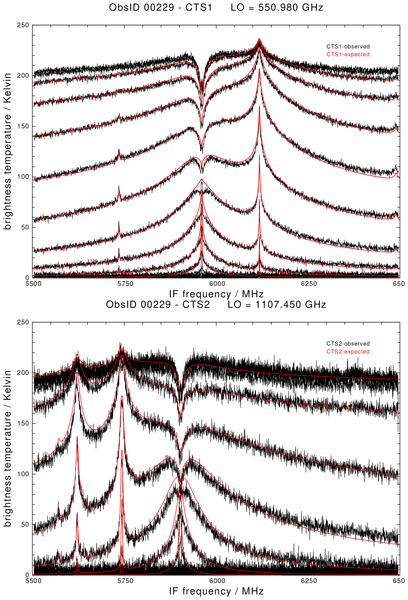
Christopher Jarchow, Ladislav Rezac, Paul Hartogh, Ali Schulz-Ravanbakhsh, Thibault Cavalié, Fabrice Herpin, Raphael Moreno, and Axel Murk
Ann. Geophys., 44, 795–809, https://doi.org/10.5194/angeo-44-795-2026, https://doi.org/10.5194/angeo-44-795-2026, 2026
Short summary
Short summary
The Jupiter Icy Moons Explorer is a spacecraft sent towards Jupiter to perform detailed observations of the giant gas planet & its Galilean satellites. The Submillimetre Wave Instrument onboard this spacecraft is a newly built instrument, which first of all has to demonstrate proper performance before the observed data can be trusted. Using the Earth as a well-known observation target, proper functionality of this instrument has been verified during the Lunar Earth Gravity Assist in August 2024.
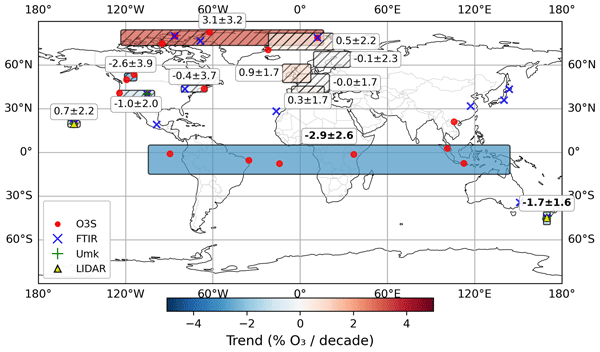
Louis Mirallie, Eliane Maillard Barras, Caroline Jonas, Corinne Vigouroux, Roeland Van Malderen, Irina Petropavlovskikh, Sophie Godin-Beekmann, Thierry Leblanc, Wolfgang Steinbrecht, Antoine Vadès, Rolf Ruefenacht, Alexander Haefele, Gunter Stober, Peter Effertz, Julian Gröbner, Gerard Ancellet, María Cazorla, Petra Duff, Matthias M. Frey, Michael Gill, James W. Hannigan, Nicholas Jones, Rigel Kivi, Raphael Köhler, Bogumil Kois, Debra E. Kollonige, Emmanuel Mahieu, Glen McConville, Johan Mellqvist, Gary Morris, Isao Murata, Tomoo Nagahama, Gerald E. Nedoluha, Shin-Ya Ogino, Richard Querel, Ryan M. Stauffer, Wolfgang Stremme, Kimberly Strong, Ralf Sussmann, Anne M. Thompson, and Yana Virolainen
Atmos. Chem. Phys., 26, 10303–10330, https://doi.org/10.5194/acp-26-10303-2026, https://doi.org/10.5194/acp-26-10303-2026, 2026
Short summary
Short summary
We present regional Bayesian composites of ground-based ozone partial column records. Defining coherent regions using a CAMS (Copernicus Atmosphere Monitoring Service) representativeness study, we merge five instrument types using the BASIC (Ball et al., 2017) algorithm, reducing trend uncertainties by 9.4 % compared to a weighted mean. Results confirm upper stratospheric recovery, predominantly negative middle stratospheric trends, while lower stratospheric trends remain mostly non-significant.
Loretta Pearl Poku, Gunter Stober, Diego Janches, Brian Fuller, Daniel O’Connor, Leandro Maslov, Eric Marderwald, Jose Luis Hormaechea, and Marcelo Colazo
EGUsphere, https://doi.org/10.5194/egusphere-2026-2287, https://doi.org/10.5194/egusphere-2026-2287, 2026
This preprint is open for discussion and under review for Atmospheric Measurement Techniques (AMT).
Short summary
Short summary
SAAMER-NOVA is the first imaging meteor radar network at high southern latitudes, located in the southern tip of the Andes. We present 3D tomographic wind retrievals at the MLT, altitude-time wind plots, and keogram plots revealing large-scale dynamics and multiple atmospheric waves. Its strategic location, rectangular-triangle arrangement, and angular diversity provide robust, continuous measurements. Performance is demonstrated by capturing Q2DW spatial characteristics and GW residuals.
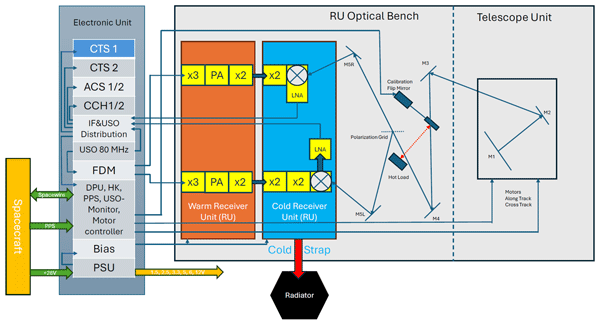
Paul Hartogh, Ladislav Rezac, Thibault Cavalié, Christopher Jarchow, Raphael Moreno, Ali Schulz-Ravanbakhsh, Alberto Carrasco Gallardo, Borys Dabrowski, Samuel Goodyear, Miriam Rengel, Fabrice Herpin, Yasuko Kasai, Mikko Kotiranta, Emmanuel Lellouch, Axel Murk, Michael Olberg, Slawomira Szutowicz, and Eva Wirström
Ann. Geophys., 44, 645–654, https://doi.org/10.5194/angeo-44-645-2026, https://doi.org/10.5194/angeo-44-645-2026, 2026
Short summary
Short summary
We provide an introduction and overview about the initial Submillimetre Wave Instrument (SWI) characterization, operation, and in-flight calibration during the Lunar Earth Gravity Assist (LEGA) campaign of the Juice (Jupiter icy moons) spacecraft. A preliminary analysis on the frequency calibration is provided. For detailed analyses on total power and beam calibration and the observation and operations planning we refer to three other SWI papers prepared for this special issue of Annales Geophysicae (ANGEO).
Gunter Stober, Hanli Liu, Zishun Qiao, Kaoru Sato, Loretta Pearl Poku, Witali Krochin, Alan Liu, Alexander Kozlovsky, Diego Janches, Jie Zeng, Wen Yi, Masaki Tsutsumi, Njål Gulbrandsen, Satonori Nozawa, Mark Lester, Johan Kero, and Nicholas Mitchell
EGUsphere, https://doi.org/10.5194/egusphere-2026-3156, https://doi.org/10.5194/egusphere-2026-3156, 2026
This preprint is open for discussion and under review for Atmospheric Measurement Techniques (AMT).
Short summary
Short summary
Vertical winds are a crucial atmospheric parameter in the mesosphere/lower thermosphere and are connected to adiabatic heating and cooling of the atmosphere. Mesospheric temperatures are affected by the vertical transport driven by a pole-to-pole circulation with upwelling in the summer hemisphere and downwelling in the winter hemisphere. We present results based on a new retrieval technique for the seasonal climatological vertical winds and an intercomparison to current state-of-the-art models.
Witali Krochin, Axel Murk, and Gunter Stober
EGUsphere, https://doi.org/10.5194/egusphere-2026-2364, https://doi.org/10.5194/egusphere-2026-2364, 2026
This preprint is open for discussion and under review for Annales Geophysicae (ANGEO).
Short summary
Short summary
This manuscript presents measurements of the microwave emission spectra of oxygen. These spectra depend strongly on the geomagnetic field, since oxygen's magnetic dipole couples to it what produces measurable spectral shifts. The interaction is analyzed in detail, including observation geometry and polarization. Using the relation between magnetic field and spectral characteristics, a method is proposed for remote monitoring of geomagnetic variations.
Raphael Moreno, Ladislav Rezac, Tomáš Formánek, Thibault Cavalié, Christopher Jarchow, Emmanuel Lellouch, Paul Hartogh, Axel Murk, Mikko Kotiranta, Alberto Carrasco Gallardo, Samuel Goodyear, Ali Schulz-Ravanbakhsh, Borys Dabrowski, Fabrice Herpin, Yasuko Kasai, Donal Murtagh, Michael Olberg, Miriam Rengel, Hideo Sagawa, Slawomira Szutowicz, and Eva Wirström
EGUsphere, https://doi.org/10.5194/egusphere-2026-2064, https://doi.org/10.5194/egusphere-2026-2064, 2026
Short summary
Short summary
The Submillimetre Wave Instrument (SWI) onboard the Jupiter Icy Moons Explorer (Juice) spacecraft consists of a 29 cm antenna and two radio receivers operating at submillimeter wavelength. This instrument is designed to study Jupiter's atmosphere and the thin atmospheres of its moons.
We used Earth observations obtained during the Lunar-Earth-Gravity-Assist (LEGA) . This data analysis allows us to characterise the antenna beam and pointing corrections.
Loretta Pearl Poku, Gunter Stober, Witali Krochin, Alan Liu, Alexander Kozlovsky, Diego Janches, Jie Zeng, Wen Yi, Masaki Tsutsumi, Njål Gulbrandsen, Satonori Nozawa, Mark Lester, Johan Kero, and Nicholas Mitchell
EGUsphere, https://doi.org/10.5194/egusphere-2025-6377, https://doi.org/10.5194/egusphere-2025-6377, 2026
Short summary
Short summary
This study presents 3D spatially resolved wind fields in the MLT using advanced retrieval techniques. Specifically, a novel SVVP method in spherical coordinates to enhance the physical consistency of wind retrievals compared to the conventional VVP method in plane geometry and the 3DVAR+DIV method. The SVVP provides a robust framework for future MLT dynamics studies, and the 3DVAR+DIV retrieval is beneficial for high-resolution case studies due to its ability to capture small-scale variability.
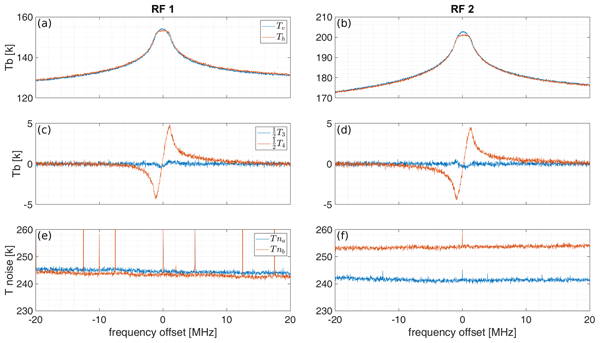
Witali Krochin, Axel Murk, Andres Luder, and Gunter Stober
Atmos. Meas. Tech., 19, 2103–2123, https://doi.org/10.5194/amt-19-2103-2026, https://doi.org/10.5194/amt-19-2103-2026, 2026
Short summary
Short summary
In this manuscript a new fully polarimetric radiometer for ground-based temperature sounding, TEMPERA-C (Campaign Temperature Radiometer), is presented. The advantages of the fully polarimetric approach are discussed, and a fully polarimetric calibration method is described in detail. The final measurements and the continuous series of temperature retrievals from the high altitude research station on the Jungfraujoch are also shown in this manuscript.
Klemens Hocke, Wenyue Wang, Leonie Bernet, Alistair Bell, and Christian Mätzler
EGUsphere, https://doi.org/10.5194/egusphere-2026-989, https://doi.org/10.5194/egusphere-2026-989, 2026
Preprint archived
Short summary
Short summary
We analyse observations of the tropospheric water radiometer (TROWARA) which monitored integrated water vapour (IWV) above Bern from 1995 to 2025. The relative IWV increase is 5.1 %/decade. Evaluation of coincident IWV data from ERA5 (reanalysis of European Centre for Medium-Range Weather Forecasts) gives a trend of 3.7 %/decade. The positive IWV trends are possibly due to the warming climate in Switzerland over the past decades.
Chao Ban, Xin Fang, Wen Yi, Jie Zeng, Gunter Stober, Weilin Pan, Tao Li, and Xianghui Xue
Atmos. Meas. Tech., 19, 1697–1709, https://doi.org/10.5194/amt-19-1697-2026, https://doi.org/10.5194/amt-19-1697-2026, 2026
Short summary
Short summary
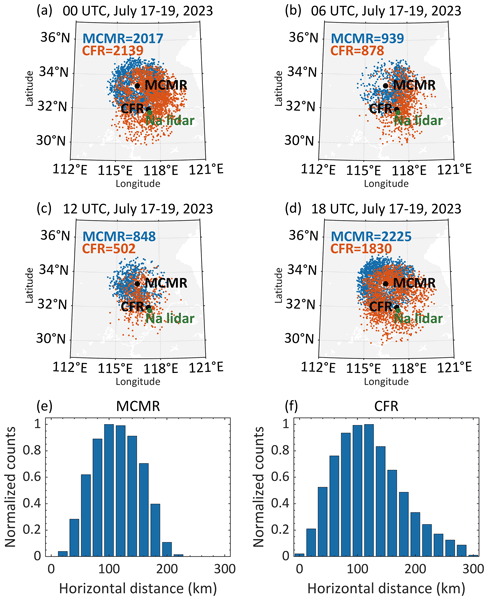
This paper presents an intercomparison of zonal winds observed by a sodium fluorescence lidar and three types of meteor radars – a multistatic meteor radar, a conventional monostatic radar, and a forward remote receiver – located near Hefei, China. The multistatic meteor radar shows the best agreement with the lidar measurements, confirming the reliability of its wind retrievals in the mesosphere and lower thermosphere and highlighting its potential for future atmospheric dynamics studies.
Florian Günzkofer, Anders Tjulin, Gang Lu, Hanli Liu, and Gunter Stober
EGUsphere, https://doi.org/10.5194/egusphere-2026-823, https://doi.org/10.5194/egusphere-2026-823, 2026
Short summary
Short summary
Incoherent scatter radars (ISRs) are an important measurement tool for space weather research. However, ISR measurements require previous knowledge of the state of the ionosphere, especially the ratio of atomic oxygen ions (O+) to electrons. We present ISR measurements during the May 2024 "Mothers' Day Storm" and apply data assimilation-based O+ ratios, which should result in more accurate ISR measurements. The advantages and disadvantages of our method are compared to those of other approaches.
Ales Kuchar, Matthias Stocker, Alistair Bell, Bruno Lehner, Jessica Kult-Herdin, Gabriel Chiodo, Timofei Sukhodolov, Eugene Rozanov, Gunter Stober, and Harald E. Rieder
EGUsphere, https://doi.org/10.5194/egusphere-2026-406, https://doi.org/10.5194/egusphere-2026-406, 2026
Short summary
Short summary
We investigated why the Northern Hemisphere winter polar vortex became unusually strong in the winter of 2024/2025. Using satellite and reanalysis datasets, and model simulations, we found that extra water erupted high in the atmosphere by the 2022 Hunga Tonga eruption led to cooling of polar latitudes of the upper atmosphere, helping the winds aloft intensify. This link suggests such volcanic eruptions can shape winters in the upper atmosphere for several years.
Patrick Eriksson, Anders Emrich, Kalle Kempe, Johan Riesbeck, Alhassan Aljarosha, Olivier Auriacombe, Joakim Kugelberg, Enne Hekma, Roland Albers, Axel Murk, Søren Møller Pedersen, Laurenz John, Jan Stake, Peter McEvoy, Bengt Rydberg, Adam Dybbroe, Anke Thoss, Alessio Canestri, Christophe Accadia, Paolo Colucci, Daniele Gherardi, and Ville Kangas
Atmos. Meas. Tech., 18, 4709–4729, https://doi.org/10.5194/amt-18-4709-2025, https://doi.org/10.5194/amt-18-4709-2025, 2025
Short summary
Short summary
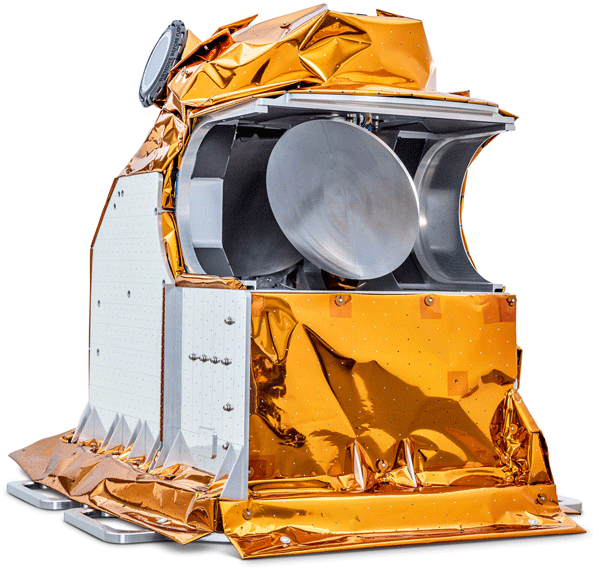
The Arctic Weather Satellite (AWS), developed by the European Space Agency, highlights a new approach in satellite design, aiming to expand the network of operational microwave sensors cost-effectively. Launched in August 2024, AWS features a 19-channel microwave cross-track radiometer. Notably, it introduces groundbreaking channels at 325.15 GHz. In addition, AWS acts as the stepping stone to a suggested constellation of satellites, denoted as EUMETSAT Polar System Sterna.
Guochun Shi, Hanli Liu, Masaki Tsutsumi, Njål Gulbrandsen, Alexander Kozlovsky, Dimitry Pokhotelov, Mark Lester, Christoph Jacobi, Kun Wu, and Gunter Stober
Atmos. Chem. Phys., 25, 9403–9430, https://doi.org/10.5194/acp-25-9403-2025, https://doi.org/10.5194/acp-25-9403-2025, 2025
Short summary
Short summary
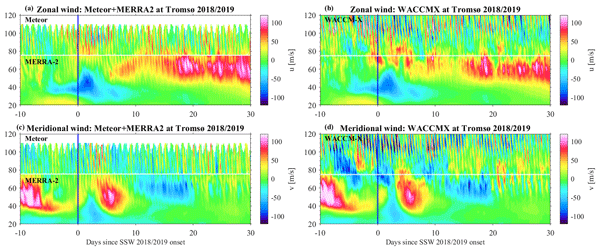
Concerns about climate change are growing due to its widespread impacts, including rising temperatures, extreme weather events, and disruptions to ecosystems. To address these challenges, urgent global action is needed to monitor the distribution of trace gases and understand their effects on the atmosphere.
Ales Kuchar, Gunter Stober, Dimitry Pokhotelov, Huixin Liu, Han-Li Liu, Manfred Ern, Damian Murphy, Diego Janches, Tracy Moffat-Griffin, Nicholas Mitchell, and Christoph Jacobi
EGUsphere, https://doi.org/10.5194/egusphere-2025-2827, https://doi.org/10.5194/egusphere-2025-2827, 2025
Short summary
Short summary
We studied how the healing of the Antarctic ozone layer is affecting winds high above the South Pole. Using ground-based radar, satellite data, and computer models, we found that winds in the upper atmosphere have become stronger over the past two decades. These changes appear to be linked to shifts in the lower atmosphere caused by ozone recovery. Our results show that human efforts to repair the ozone layer are also influencing climate patterns far above Earth’s surface.
Arthur Gauthier, Claudia Borries, Alexander Kozlovsky, Diego Janches, Peter Brown, Denis Vida, Christoph Jacobi, Damian Murphy, Masaki Tsutsumi, Njål Gulbrandsen, Satonori Nozawa, Mark Lester, Johan Kero, Nicholas Mitchell, Tracy Moffat-Griffin, and Gunter Stober
Ann. Geophys., 43, 427–440, https://doi.org/10.5194/angeo-43-427-2025, https://doi.org/10.5194/angeo-43-427-2025, 2025
Short summary
Short summary
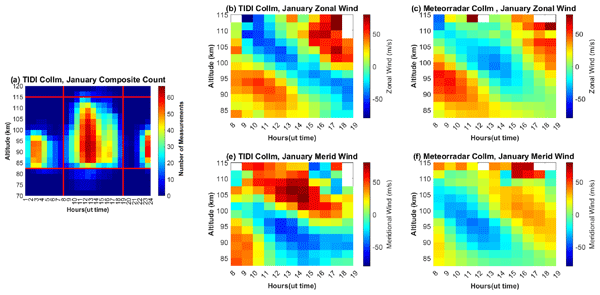
This study focuses on a TIMED Doppler Interferometer (TIDI)–meteor radar (MR) comparison of zonal and meridional winds and their dependence on local time and latitude. The correlation calculation between TIDI wind measurements and MR winds shows good agreement. A TIDI–MR seasonal comparison and analysis of the altitude–latitude dependence for winds are performed. TIDI reproduces the mean circulation well when compared with MRs and may be a useful lower boundary for general circulation models.
Florian Günzkofer, Gunter Stober, Johan Kero, David R. Themens, Anders Tjulin, Njål Gulbrandsen, Masaki Tsutsumi, and Claudia Borries
Ann. Geophys., 43, 331–348, https://doi.org/10.5194/angeo-43-331-2025, https://doi.org/10.5194/angeo-43-331-2025, 2025
Short summary
Short summary
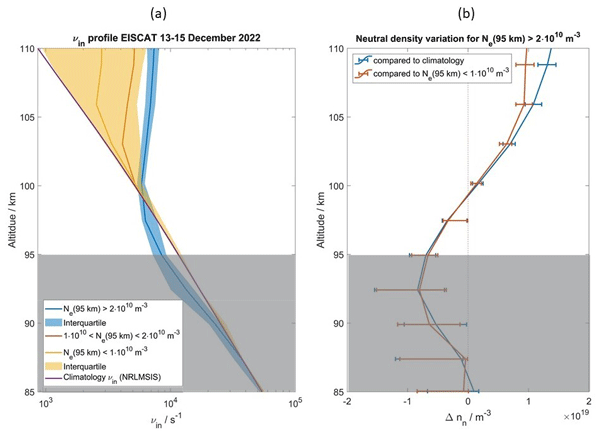
The Earth’s magnetic field is not closed at high latitudes. Electrically charged particles can penetrate the Earth’s atmosphere, deposit their energy, and heat the local atmosphere–ionosphere. This presumably causes an upwelling of the neutral atmosphere, which affects the atmosphere–ionosphere coupling. We apply a new analysis technique to infer the atmospheric density from incoherent scatter radar measurements. We identify signs of particle precipitation impact on the neutral atmosphere.
Alistair Bell, Axel Murk, and Gunter Stober
EGUsphere, https://doi.org/10.5194/egusphere-2025-1396, https://doi.org/10.5194/egusphere-2025-1396, 2025
Short summary
Short summary
Increases in middle atmospheric water vapour from the 2022 Hunga eruption have been measured worldwide. This study uses remote sensing measurements at two latitudes and accurate radiative transfer modeling to show significant long-wave heating effects. Though minimal at the surface, the water vapour enhancement can alter middle-atmospheric dynamics, potentially affecting ozone chemistry and weather patterns.
Zishun Qiao, Alan Z. Liu, Gunter Stober, Javier Fuentes, Fabio Vargas, Christian L. Adami, and Iain M. Reid
Atmos. Meas. Tech., 18, 1091–1104, https://doi.org/10.5194/amt-18-1091-2025, https://doi.org/10.5194/amt-18-1091-2025, 2025
Short summary
Short summary
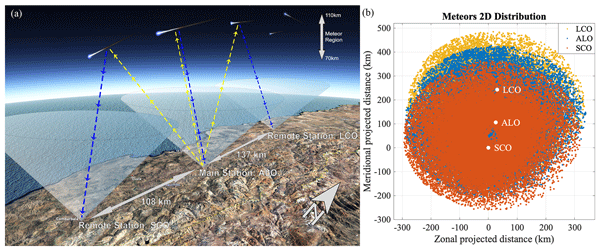
This paper describes the installation of the Chilean Observation Network De Meteor Radars (CONDOR) and its initial results. The routine winds are point-to-point comparable to the co-located lidar winds. The retrievals of spatially resolved horizontal wind fields and vertical winds are also facilitated, benefiting from the extensive meteor detections. The successful deployment and maintenance of CONDOR provide 24/7 and state-of-the-art wind measurements to the research community.
Alistair Bell, Eric Sauvageat, Gunter Stober, Klemens Hocke, and Axel Murk
Atmos. Meas. Tech., 18, 555–567, https://doi.org/10.5194/amt-18-555-2025, https://doi.org/10.5194/amt-18-555-2025, 2025
Short summary
Short summary
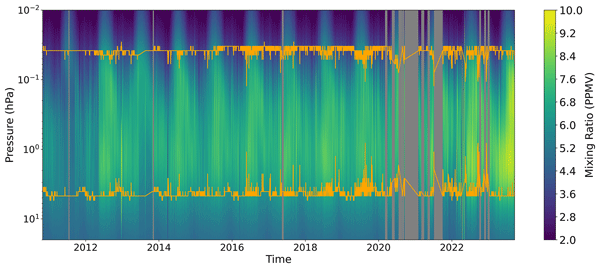
Hardware and software developments have been made on a 22 GHz microwave radiometer for the measurement of middle-atmospheric water vapour near Bern, Switzerland. Previous measurements dating back to 2010 have been re-calibrated and an improved optimal estimation retrieval performed on these measurements, giving a 13-year dataset. Measurements made with new and improved instrumental hardware are used to correct previous measurements, which show better agreement than the non-corrected dataset.
Guochun Shi, Witali Krochin, Eric Sauvageat, and Gunter Stober
Atmos. Chem. Phys., 24, 10187–10207, https://doi.org/10.5194/acp-24-10187-2024, https://doi.org/10.5194/acp-24-10187-2024, 2024
Short summary
Short summary
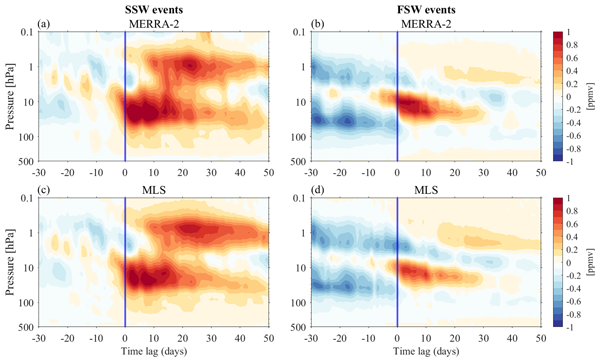
Here we investigated ozone anomalies over polar regions during sudden stratospheric and final stratospheric warming with ground-based microwave radiometers at polar latitudes compared with reanalysis and satellite data. The underlying dynamical and chemical mechanisms are responsible for the observed ozone anomalies in both events. Our research sheds light on these processes, emphasizing the need for a deeper understanding of these processes for more accurate climate modeling and forecasting.
Witali Krochin, Axel Murk, and Gunter Stober
Atmos. Meas. Tech., 17, 5015–5028, https://doi.org/10.5194/amt-17-5015-2024, https://doi.org/10.5194/amt-17-5015-2024, 2024
Short summary
Short summary
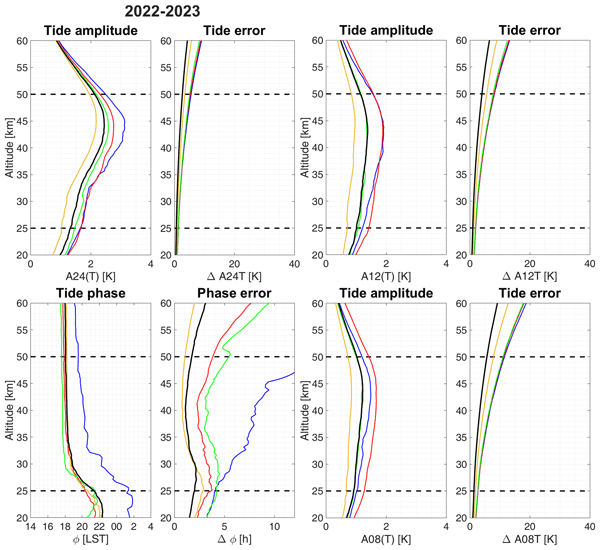
Atmospheric tides are global-scale oscillations with periods of a fraction of a day. Their observation in the middle atmosphere is challenging and rare, as it requires continuous measurements with a high temporal resolution. In this paper, temperature time series of a ground-based microwave radiometer were analyzed with a spectral filter to derive thermal tide amplitudes and phases in an altitude range of 25–50 km at the geographical locations of Payerne and Bern (Switzerland).
Gunter Stober, Sharon L. Vadas, Erich Becker, Alan Liu, Alexander Kozlovsky, Diego Janches, Zishun Qiao, Witali Krochin, Guochun Shi, Wen Yi, Jie Zeng, Peter Brown, Denis Vida, Neil Hindley, Christoph Jacobi, Damian Murphy, Ricardo Buriti, Vania Andrioli, Paulo Batista, John Marino, Scott Palo, Denise Thorsen, Masaki Tsutsumi, Njål Gulbrandsen, Satonori Nozawa, Mark Lester, Kathrin Baumgarten, Johan Kero, Evgenia Belova, Nicholas Mitchell, Tracy Moffat-Griffin, and Na Li
Atmos. Chem. Phys., 24, 4851–4873, https://doi.org/10.5194/acp-24-4851-2024, https://doi.org/10.5194/acp-24-4851-2024, 2024
Short summary
Short summary
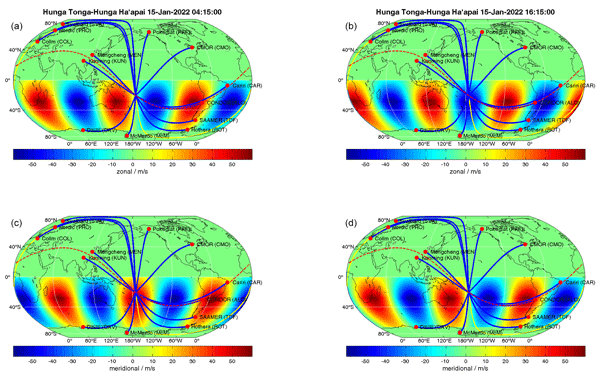
On 15 January 2022, the Hunga Tonga-Hunga Ha‘apai volcano exploded in a vigorous eruption, causing many atmospheric phenomena reaching from the surface up to space. In this study, we investigate how the mesospheric winds were affected by the volcanogenic gravity waves and estimated their propagation direction and speed. The interplay between model and observations permits us to gain new insights into the vertical coupling through atmospheric gravity waves.
Florian Günzkofer, Gunter Stober, Dimitry Pokhotelov, Yasunobu Miyoshi, and Claudia Borries
Atmos. Meas. Tech., 16, 5897–5907, https://doi.org/10.5194/amt-16-5897-2023, https://doi.org/10.5194/amt-16-5897-2023, 2023
Short summary
Short summary
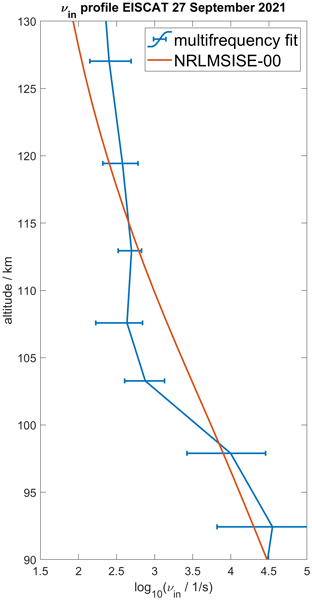
Electric currents in the ionosphere can impact both satellite and ground-based infrastructure. These currents depend strongly on the collisions of ions and neutral particles. Measuring ion–neutral collisions is often only possible via certain assumptions. The direct measurement of ion–neutral collision frequencies is possible with multifrequency incoherent scatter radar measurements. This paper presents one analysis method of such measurements and discusses its advantages and disadvantages.
Florian Günzkofer, Dimitry Pokhotelov, Gunter Stober, Ingrid Mann, Sharon L. Vadas, Erich Becker, Anders Tjulin, Alexander Kozlovsky, Masaki Tsutsumi, Njål Gulbrandsen, Satonori Nozawa, Mark Lester, Evgenia Belova, Johan Kero, Nicholas J. Mitchell, and Claudia Borries
Ann. Geophys., 41, 409–428, https://doi.org/10.5194/angeo-41-409-2023, https://doi.org/10.5194/angeo-41-409-2023, 2023
Short summary
Short summary
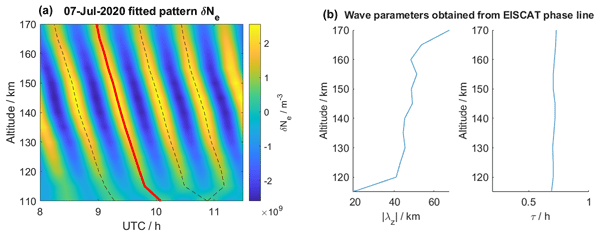
Gravity waves (GWs) are waves in Earth's atmosphere and can be observed as cloud ripples. Under certain conditions, these waves can propagate up into the ionosphere. Here, they can cause ripples in the ionosphere plasma, observable as oscillations of the plasma density. Therefore, GWs contribute to the ionospheric variability, making them relevant for space weather prediction. Additionally, the behavior of these waves allows us to draw conclusions about the atmosphere at these altitudes.
Guochun Shi, Witali Krochin, Eric Sauvageat, and Gunter Stober
Atmos. Chem. Phys., 23, 9137–9159, https://doi.org/10.5194/acp-23-9137-2023, https://doi.org/10.5194/acp-23-9137-2023, 2023
Short summary
Short summary
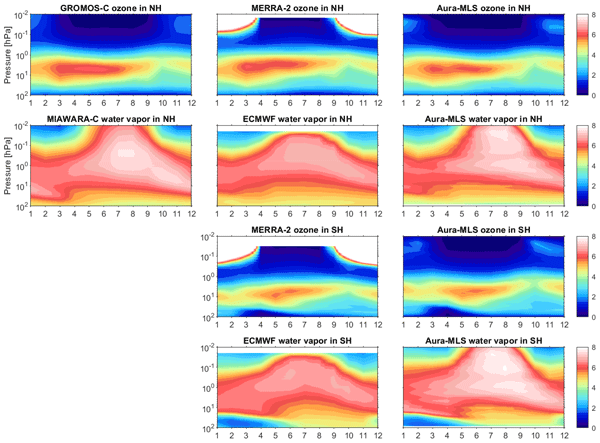
We present the interannual and climatological behavior of ozone and water vapor from microwave radiometers in the Arctic.
By defining a virtual conjugate latitude station in the Southern Hemisphere, we investigate altitude-dependent interhemispheric differences and estimate the ascent and descent rates of water vapor in both hemispheres. Ozone and water vapor measurements will create a deeper understanding of the evolution of middle atmospheric ozone and water vapor.
Eric Sauvageat, Klemens Hocke, Eliane Maillard Barras, Shengyi Hou, Quentin Errera, Alexander Haefele, and Axel Murk
Atmos. Chem. Phys., 23, 7321–7345, https://doi.org/10.5194/acp-23-7321-2023, https://doi.org/10.5194/acp-23-7321-2023, 2023
Short summary
Short summary
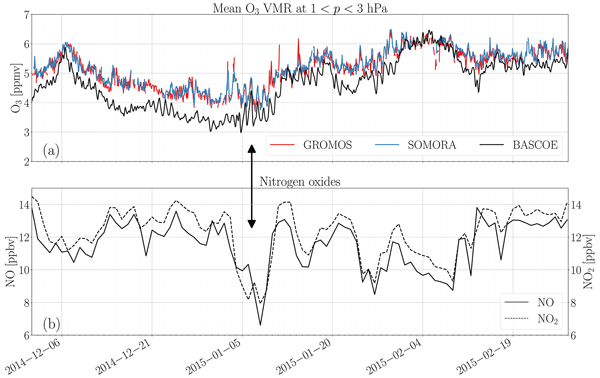
In Switzerland, two microwave radiometers can measure continuous ozone profiles in the middle atmosphere. From these instruments, we can study the diurnal variation of ozone, which is difficult to observe otherwise. It is valuable to validate the model simulations of diurnal variations in this region. We present results obtained during the last decade and compare them against various models. For the first time, we also show that the winter diurnal variations have some short-term fluctuations.
Gunter Stober, Alan Liu, Alexander Kozlovsky, Zishun Qiao, Witali Krochin, Guochun Shi, Johan Kero, Masaki Tsutsumi, Njål Gulbrandsen, Satonori Nozawa, Mark Lester, Kathrin Baumgarten, Evgenia Belova, and Nicholas Mitchell
Ann. Geophys., 41, 197–208, https://doi.org/10.5194/angeo-41-197-2023, https://doi.org/10.5194/angeo-41-197-2023, 2023
Short summary
Short summary
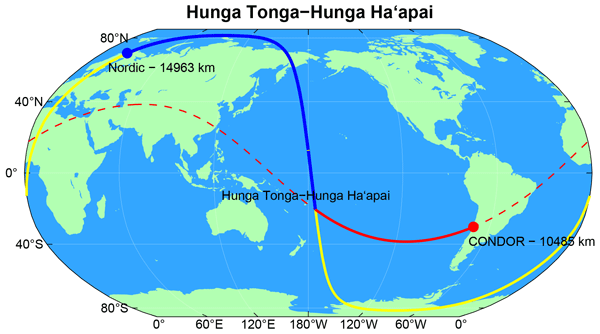
The Hunga Tonga–Hunga Ha‘apai volcanic eruption was one of the most vigorous volcanic explosions in the last centuries. The eruption launched many atmospheric waves traveling around the Earth. In this study, we identify these volcanic waves at the edge of space in the mesosphere/lower-thermosphere, leveraging wind observations conducted with multi-static meteor radars in northern Europe and with the Chilean Observation Network De Meteor Radars (CONDOR).
Pragya Vishwakarma, Julien Delanoë, Susana Jorquera, Pauline Martinet, Frederic Burnet, Alistair Bell, and Jean-Charles Dupont
Atmos. Meas. Tech., 16, 1211–1237, https://doi.org/10.5194/amt-16-1211-2023, https://doi.org/10.5194/amt-16-1211-2023, 2023
Short summary
Short summary
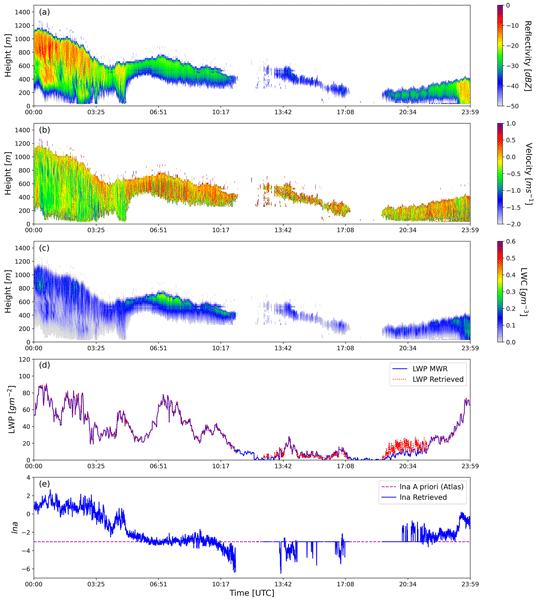
Cloud observations are necessary to characterize the cloud properties at local and global scales. The observations must be translated to cloud geophysical parameters. This paper presents the estimation of liquid water content (LWC) using radar and microwave radiometer (MWR) measurements. Liquid water path from MWR scales LWC and retrieves the scaling factor (ln a). The retrievals are compared with in situ observations. A climatology of ln a is built to estimate LWC using only radar information.

Eric Sauvageat, Eliane Maillard Barras, Klemens Hocke, Alexander Haefele, and Axel Murk
Atmos. Meas. Tech., 15, 6395–6417, https://doi.org/10.5194/amt-15-6395-2022, https://doi.org/10.5194/amt-15-6395-2022, 2022
Short summary
Short summary
We present new harmonized ozone time series from two ground-based microwave radiometers in Switzerland. The new series consist of hourly ozone profiles in the middle atmosphere (~ 20–70 km) from 2009 until 2021. Cross-validation of the new data series shows the benefit of the harmonization process compared to the previous versions. Comparisons with collocated satellite observations is used to further validate these time series for long-term ozone monitoring over central Europe.
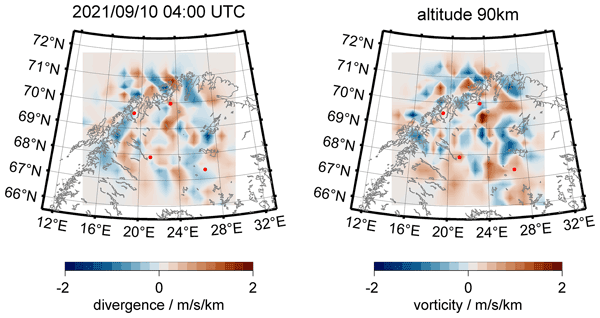
Gunter Stober, Alan Liu, Alexander Kozlovsky, Zishun Qiao, Ales Kuchar, Christoph Jacobi, Chris Meek, Diego Janches, Guiping Liu, Masaki Tsutsumi, Njål Gulbrandsen, Satonori Nozawa, Mark Lester, Evgenia Belova, Johan Kero, and Nicholas Mitchell
Atmos. Meas. Tech., 15, 5769–5792, https://doi.org/10.5194/amt-15-5769-2022, https://doi.org/10.5194/amt-15-5769-2022, 2022
Short summary
Short summary
Precise and accurate measurements of vertical winds at the mesosphere and lower thermosphere are rare. Although meteor radars have been used for decades to observe horizontal winds, their ability to derive reliable vertical wind measurements was always questioned. In this article, we provide mathematical concepts to retrieve mathematically and physically consistent solutions, which are compared to the state-of-the-art non-hydrostatic model UA-ICON.
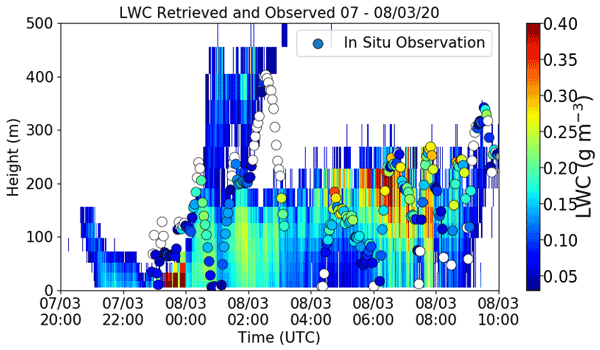
Alistair Bell, Pauline Martinet, Olivier Caumont, Frédéric Burnet, Julien Delanoë, Susana Jorquera, Yann Seity, and Vinciane Unger
Atmos. Meas. Tech., 15, 5415–5438, https://doi.org/10.5194/amt-15-5415-2022, https://doi.org/10.5194/amt-15-5415-2022, 2022
Short summary
Short summary
Cloud radars and microwave radiometers offer the potential to improve fog forecasts when assimilated into a high-resolution model. As this process can be complex, a retrieval of model variables is sometimes made as a first step. In this work, results from a 1D-Var algorithm for the retrieval of temperature, humidity and cloud liquid water content are presented. The algorithm is applied first to a synthetic dataset and then to a dataset of real measurements from a recent field campaign.
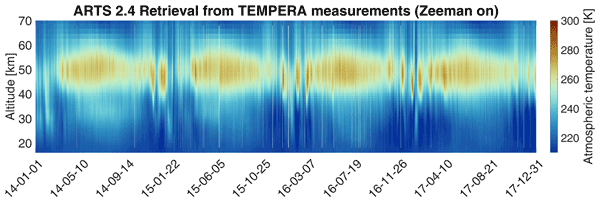
Witali Krochin, Francisco Navas-Guzmán, David Kuhl, Axel Murk, and Gunter Stober
Atmos. Meas. Tech., 15, 2231–2249, https://doi.org/10.5194/amt-15-2231-2022, https://doi.org/10.5194/amt-15-2231-2022, 2022
Short summary
Short summary
This study leverages atmospheric temperature measurements performed with a ground-based radiometer making use of data that was collected during a 4-year observational campaign applying a new retrieval algorithm that improves the maximal altitude range from 45 to 55 km. The measurements are validated against two independent data sets, MERRA2 reanalysis data and the meteorological analysis of NAVGEM-HA.
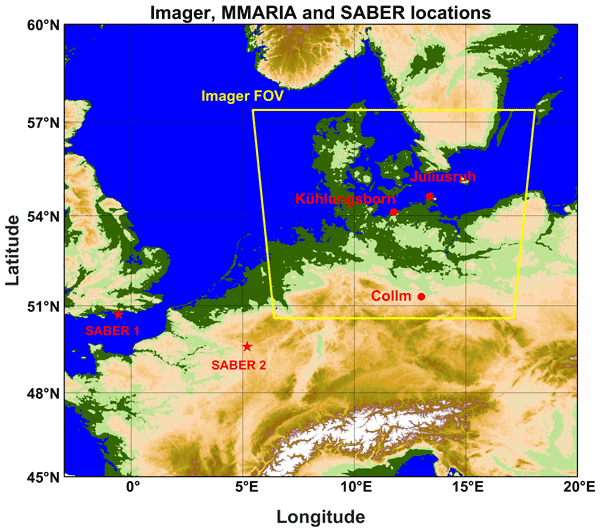
Sumanta Sarkhel, Gunter Stober, Jorge L. Chau, Steven M. Smith, Christoph Jacobi, Subarna Mondal, Martin G. Mlynczak, and James M. Russell III
Ann. Geophys., 40, 179–190, https://doi.org/10.5194/angeo-40-179-2022, https://doi.org/10.5194/angeo-40-179-2022, 2022
Short summary
Short summary
A rare gravity wave event was observed on the night of 25 April 2017 over northern Germany. An all-sky airglow imager recorded an upward-propagating wave at different altitudes in mesosphere with a prominent wave front above 91 km and faintly observed below. Based on wind and satellite-borne temperature profiles close to the event location, we have found the presence of a leaky thermal duct layer in 85–91 km. The appearance of this duct layer caused the wave amplitudes to diminish below 91 km.

Christoph Jacobi, Friederike Lilienthal, Dmitry Korotyshkin, Evgeny Merzlyakov, and Gunter Stober
Adv. Radio Sci., 19, 185–193, https://doi.org/10.5194/ars-19-185-2021, https://doi.org/10.5194/ars-19-185-2021, 2021
Short summary
Short summary
We compare winds and tidal amplitudes in the upper mesosphere/lower thermosphere region for cases with disturbed and undisturbed geomagnetic conditions. The zonal winds in both the mesosphere and lower thermosphere tend to be weaker during disturbed conditions. The summer equatorward meridional wind jet is weaker for disturbed geomagnetic conditions. The effect of geomagnetic variability on tidal amplitudes, except for the semidiurnal tide, is relatively small.
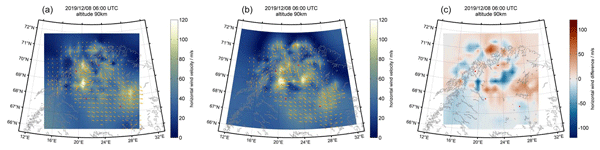
Gunter Stober, Alexander Kozlovsky, Alan Liu, Zishun Qiao, Masaki Tsutsumi, Chris Hall, Satonori Nozawa, Mark Lester, Evgenia Belova, Johan Kero, Patrick J. Espy, Robert E. Hibbins, and Nicholas Mitchell
Atmos. Meas. Tech., 14, 6509–6532, https://doi.org/10.5194/amt-14-6509-2021, https://doi.org/10.5194/amt-14-6509-2021, 2021
Short summary
Short summary
Wind observations at the edge to space, 70–110 km altitude, are challenging. Meteor radars have become a widely used instrument to obtain mean wind profiles above an instrument for these heights. We describe an advanced mathematical concept and present a tomographic analysis using several meteor radars located in Finland, Sweden and Norway, as well as Chile, to derive the three-dimensional flow field. We show an example of a gravity wave decelerating the mean flow.
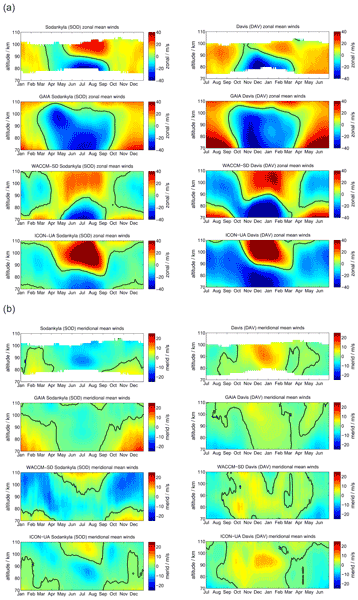
Gunter Stober, Ales Kuchar, Dimitry Pokhotelov, Huixin Liu, Han-Li Liu, Hauke Schmidt, Christoph Jacobi, Kathrin Baumgarten, Peter Brown, Diego Janches, Damian Murphy, Alexander Kozlovsky, Mark Lester, Evgenia Belova, Johan Kero, and Nicholas Mitchell
Atmos. Chem. Phys., 21, 13855–13902, https://doi.org/10.5194/acp-21-13855-2021, https://doi.org/10.5194/acp-21-13855-2021, 2021
Short summary
Short summary
Little is known about the climate change of wind systems in the mesosphere and lower thermosphere at the edge of space at altitudes from 70–110 km. Meteor radars represent a well-accepted remote sensing technique to measure winds at these altitudes. Here we present a state-of-the-art climatological interhemispheric comparison using continuous and long-lasting observations from worldwide distributed meteor radars from the Arctic to the Antarctic and sophisticated general circulation models.
Cited articles
Bell, A. and Murk, A.: Monitoring of Middle Atmospheric Water Vapour, https://www.meteoswiss.admin.ch/dam/jcr:94899c15-57ba-4969-a56a-11781d0de260/Final-report-MIAWARA-GCOS.pdf (last access: 20 February 2026), 2023. a
Bell, A., Sauvageat, E., Stober, G., Hocke, K., and Murk, A.: Developments on a 22 GHz microwave radiometer and reprocessing of 13-year time series for water vapour studies, Atmos. Meas. Tech., 18, 555–567, https://doi.org/10.5194/amt-18-555-2025, 2025. a, b
Brasseur, G. P. and Solomon, S.: Aeronomy of the Middle Atmosphere: Chemistry and Physics of the Stratosphere and Mesosphere, Vol. 32, Springer, Dordrecht, 3rd Edn., https://doi.org/10.1007/1-4020-3824-0, 2005. a
Buehler, S. A., Larsson, R., Lemke, O., Pfreundschuh, S., Brath, M., Adams, I., Fox, S., Roemer, F. E., Czarnecki, P., and Eriksson, P.: The atmospheric radiative transfer simulator ARTS, version 2.6 – Deep python integration, Journal of Quantitative Spectroscopy and Radiative Transfer, 341, 109443, https://doi.org/10.1016/j.jqsrt.2025.109443, 2025. a
Carr, J. L., Horváth, A., Wu, D. L., and Friberg, M. D.: Stereo Plume Height and Motion Retrievals for the Record-Setting Hunga Tonga-Hunga Ha'apai Eruption of 15 January 2022, Geophys. Res. Lett., 49, e2022GL098131, https://doi.org/10.1029/2022GL098131, 2022. a
De Wachter, E., Hocke, K., Flury, T., Scheiben, D., Kämpfer, N., Ka, S., and Oh, J. J.: Signatures of the Sudden Stratospheric Warming events of January–February 2008 in Seoul, S. Korea, Adv. Space Res., 48, 1631–1637, https://doi.org/10.1016/j.asr.2011.08.002, 2011. a, b
Deuber, B., Haefele, A., Feist, D. G., Martin, L., Kämpfer, N., Nedoluha, G. E., Yushkov, V., Khaykin, S., Kivi, R., and Vömel, H.: Middle Atmospheric Water Vapour Radiometer (MIAWARA): Validation and first results of the LAPBIAT Upper Tropospheric Lower Stratospheric Water Vapour Validation Project (LAUTLOS-WAVVAP) campaign, J. Geophys. Res.-Atmos., 110, https://doi.org/10.1029/2004JD005543, 2005. a
D'Alessandro, G., Paiella, A., Coppolecchia, A., Castellano, M., Colantoni, I., de Bernardis, P., Lamagna, L., and Masi, S.: Ultra high molecular weight polyethylene: optical features at millimeter wavelengths, Infrared Phys. Techn., 90, 59–65, 2018. a
Farias, N., Beckman, S., Lee, A., and Suzuki, A.: Simulated Performance of Laser-Machined Metamaterial Anti-reflection Coatings, J. low Temp. Phys., 209, 1232–1241, 2022. a
Federal Office of Meteorology and Climatology MeteoSwiss: GAW-CH and GCOS-CH Supported Activities, https://www.meteoswiss.admin.ch/about-us/research-and-cooperation/programmes-gaw-ch-and-gcos-ch/gaw-ch-and-gcos-ch-supported-activities.html, last access: 28 October 2025. a
Forkman, P., Eriksson, P., and Winnberg, A.: The 22 ghz radio-aeronomy receiver at onsala space observatory, J. Quant. Spectrosc. Ra., 77, 23–42, 2003. a
Goldsmith, P. F.: Quasi-optical techniques, P. IEEE, 80, 1729–1747, 1992. a
Hallgren, K., Hartogh, P., and Jarchow, C.: A new microwave spectrometer for ground-based observations of water vapour, Atmos. Meas. Tech. Discuss., 6, 4677–4703, https://doi.org/10.5194/amtd-6-4677-2013, 2013. a, b, c
Joint, F., Lapkin, I., Vigneron, P.-B., Hérault, E., Meledin, D., Pavolotsky, A., Strandberg, M., Ferm, S. E., Fredrixon, M., Helldner, L., Sundin, E., Belitsky, V., and Desmaris, V.: 3D-Structured Polyethylene Windows for Low-Loss Transmission in Wideband Cryogenic Terahertz Systems, IEEE Transactions on Terahertz Science and Technology, 1–9, https://doi.org/10.1109/TTHZ.2026.3655493, 2026. a
Khaykin, S., Podglajen, A., Ploeger, F., Grooß, J.-U., Tencé, F., Bekki, S., Khlopenkov, K., Bedka, K., Rieger, L., Baron, A., Godin- Beekmann, S., Legras, B., Sellitto, P., Sakai, T., Barnes, J., Uchino, O., Morino, I., Nagai, T., Wing, R., Baumgarten, G., Gerding, M., Duflot, V., Payen, G., Jumelet, J., Querel, R., Liley, B., Bourassa, A., Clouser, B., Feofilov, A., Hauchecorne, A., and Ravetta, F.: Global perturbation of stratospheric water and aerosol burden by Hunga eruption, Commun. Earth Environ., 3, 316, https://doi.org/10.1038/s43247-022-00652-x, 2022. a
Krochin, W., Stober, G., and Murk, A.: Development of a Polarimetric 50-GHz Spectrometer for Temperature Sounding in the Middle Atmosphere, IEEE Journal of Selected Topics in Applied Earth Observations and Remote Sensing, 15, 5644–5651, 2022. a
Krochin, W., Murk, A., Luder, A., and Stober, G.: Operational calibration of a fully polarimetric radiometer for stratospheric temperature retrievals, EGUsphere [preprint], https://doi.org/10.5194/egusphere-2025-2561, 2025. a
Matoza, R. S., Fee, D., Assink, J. D., Iezzi, A. M., Green, D. N., Kim, K., Toney, L., Lecocq, T., Krishnamoorthy, S., Lalande, J.-M., Nishida, K., Gee, K. L., Haney, M. M., Ortiz, H. D., Brissaud, Q., Martire, L., Rolland, L., Vergados, P., Nippress, A., Park, J., Shani-Kadmiel, S., Witsil, A., Arrowsmith, S., Caudron, C., Watada, S., Perttu, A. B., Taisne, B., Mialle, P., Pichon, A. L., Vergoz, J., Hupe, P., Blom, P. S., Waxler, R., Angelis, S. D., Snively, J. B., Ringler, A. T., Anthony, R. E., Jolly, A. D., Kilgour, G., Averbuch, G., Ripepe, M., Ichihara, M., Arciniega-Ceballos, A., Astafyeva, E., Ceranna, L., Cevuard, S., Che, I.-Y., Negri, R. D., Ebeling, C. W., Evers, L. G., Franco-Marin, L. E., Gabrielson, T. B., Hafner, K., Harrison, R. G., Komjathy, A., Lacanna, G., Lyons, J., Macpherson, K. A., Marchetti, E., McKee, K. F., Mellors, R. J., Mendo-Pérez, G., Mikesell, T. D., Munaibari, E., Oyola-Merced, M., Park, I., Pilger, C., Ramos, C., Ruiz, M. C., Sabatini, R., Schwaiger, H. F., Tailpied, D., Talmadge, C., Vidot, J., Webster, J., and Wilson, D. C.: Atmospheric waves and global seismoacoustic observations of the January 2022 Hunga eruption, Tonga, Science, 377, 95–100, https://doi.org/10.1126/science.abo7063, 2022. a
McKay, J. E., Robertson, D. A., Speirs, P. J., Hunter, R. I., Wylde, R. J., and Smith, G. M.: Compact Corrugated Feedhorns With High Gaussian Coupling Efficiency and −60 dB Sidelobes, IEEE T. Antenn. Propag., 64, 2518–2522, https://doi.org/10.1109/TAP.2016.2543799, 2016. a
Millan, R., Mouginot, J., Rabatel, A., and Morlighem, M.: Ice velocity and thickness of the world’s glaciers, Nat. Geosci., 15, 124–129, 2022. a
Milz, M., von Clarmann, T., Fischer, H., Glatthor, N., Grabowski, U., Höpfner, M., Kellmann, S., Kiefer, M., Linden, A., Mengistu Tsidu, G., Steck, T., Stiller, G. P., Funke, B., López-Puertas, M., and Koukouli, M. E.: Water vapor distributions measured with the Michelson Interferometer for Passive Atmospheric Sounding on board Envisat (MIPAS/Envisat), J. Geophys. Res.-Atmos., 110, https://doi.org/10.1029/2005JD005973, 2005. a
Motte, E., Ricaud, P., Gabard, B., Niclas, M., and Gangneron, F.: A 22-GHz Mobile Microwave Radiometer (MobRa) for the Study of Middle Atmospheric Water Vapor, IEEE T. Geosci. Remote, 46, 3104–3114, https://doi.org/10.1109/TGRS.2008.2000626, 2008. a
Murtagh, D., Frisk, U., Merino, F., Ridal, M., Jonsson, A., Stegman, J., Witt, G., Eriksson, P., Jiménez, C., Megie, G., Noë, J. d. l., Ricaud, P., Baron, P., Pardo, J. R., Hauchcorne, A., Llewellyn, E. J., Degenstein, D. A., Gattinger, R. L., Lloyd, N. D., Evans, W. F., McDade, I. C., Haley, C. S., Sioris, C., Savigny, C. v., Solheim, B. H., McConnell, J. C., Strong, K., Richardson, E. H., Leppelmeier, G. W., Kyrölä, E., Auvinen, H., and Oikarinen, L.: An overview of the Odin atmospheric mission, Can. J. Phys., 80, 309–319, https://doi.org/10.1139/p01-157, 2002. a
Nedoluha, G. E., Bevilacqua, R. M., Gomez, R. M., Waltman, W. B., Hicks, B. C., Thacker, D. L., Russell III, J. M., Abrams, M., Pumphrey, H. C., and Connor, B. J.: A comparative study of mesospheric water vapor measurements from the ground-based water vapor millimeter-wave spectrometer and space-based instruments, J. Geophys. Res.-Atmos., 102, 16647–16661, https://doi.org/10.1029/97JD01095, 1997. a
Nedoluha, G. E., Gomez, R. M., Hicks, B. C., Bevilacqua, R. M., Russell III, J. M., Connor, B. J., and Lambert, A.: A comparison of middle atmospheric water vapor as measured by WVMS, EOS-MLS, and HALOE, J. Geophys. Res.-Atmos., 112, https://doi.org/10.1029/2007JD008757, 2007. a
Parrish, A., Dezafra, R., Solomon, P., and Barrett, J.: A ground-based technique for millimeter wave spectroscopic observations of stratospheric trace constituents, Radio Sci., 23, 106–118, 1988. a
Schranz, F., Hagen, J., Stober, G., Hocke, K., Murk, A., and Kämpfer, N.: Small-scale variability of stratospheric ozone during the sudden stratospheric warming 2018/2019 observed at Ny-Ålesund, Svalbard, Atmos. Chem. Phys., 20, 10791–10806, https://doi.org/10.5194/acp-20-10791-2020, 2020. a
Schröder, A., Murk, A., Yagoubov, P., and Patt, F.: Design and characterization of the ALMA band 5 vacuum window, IEEE T. Thz. Sci. Techn., 6, 156–162, 2015. a
Seele, C. and Hartogh, P.: Water vapor of the polar middle atmosphere: Annual variation and summer mesosphere Conditions as observed by ground-based microwave spectroscopy, Geophys. Res. Lett., 26, 1517–1520, https://doi.org/10.1029/1999GL900315, 1999. a
Seele, C. and Hartogh, P.: A case study on middle atmospheric water vapor transport during the February 1998 stratospheric warming, Geophys. Res. Lett., 27, 3309–3312, 2000. a
Shi, G., Krochin, W., Sauvageat, E., and Stober, G.: Ozone and water vapor variability in the polar middle atmosphere observed with ground-based microwave radiometers, Atmos. Chem. Phys., 23, 9137–9159, https://doi.org/10.5194/acp-23-9137-2023, 2023. a
Shi, G., Krochin, W., Sauvageat, E., and Stober, G.: Ozone anomalies over the polar regions during stratospheric warming events, Atmos. Chem. Phys., 24, 10187–10207, https://doi.org/10.5194/acp-24-10187-2024, 2024. a
Shi, G., Liu, H., Tsutsumi, M., Gulbrandsen, N., Kozlovsky, A., Pokhotelov, D., Lester, M., Jacobi, C., Wu, K., and Stober, G.: New insights into the polar ozone and water vapor, radiative effects, and their connection to the tides in the mesosphere–lower thermosphere during major sudden stratospheric warming events, Atmos. Chem. Phys., 25, 9403–9430, https://doi.org/10.5194/acp-25-9403-2025, 2025. a
Speirs, P., Molina, R., Saenz, E., Yagoubov, P. M. P., and Murk, A.: Design and Measurement of Possible Wide-band 67-116 GHz ALMA Vacuum Window Anti-reflection Layers, in: 2020 14th European Conference on Antennas and Propagation (EuCAP), 1–5, IEEE, https://doi.org/10.23919/EuCAP48036.2020.9135970, 2020. a
Steiner, M., Luo, B., Peter, T., Pitts, M. C., and Stenke, A.: Evaluation of polar stratospheric clouds in the global chemistry–climate model SOCOLv3.1 by comparison with CALIPSO spaceborne lidar measurements, Geosci. Model Dev., 14, 935–959, https://doi.org/10.5194/gmd-14-935-2021, 2021. a
Straub, C., Murk, A., and Kämpfer, N.: MIAWARA-C, a new ground based water vapor radiometer for measurement campaigns, Atmos. Meas. Tech., 3, 1271–1285, https://doi.org/10.5194/amt-3-1271-2010, 2010. a
Straub, C., Tschanz, B., Hocke, K., Kämpfer, N., and Smith, A. K.: Transport of mesospheric H2O during and after the stratospheric sudden warming of January 2010: observation and simulation, Atmos. Chem. Phys., 12, 5413–5427, https://doi.org/10.5194/acp-12-5413-2012, 2012. a
Thacker, D., Bevilacqua, R., Waltman, W., Pauls, T., Gomez, G., Nedoluha, G., and Schwartz, P.: Ground-based sensing of water vapor in the stratosphere and mesosphere, IEEE T. Instrum. Meas., 44, 355–359, https://doi.org/10.1109/19.377851, 1995. a
TICRA: TICRA Tools – GRASP and CHAMP 3D, computer software, https://www.ticra.com/software/all-software/ (last access: 10 January 2025), 2024. a
Ulaby, F. T., Moore, R. K., and Fung, A. K.: Microwave Remote Sensing: Active and Passive. Volume 1, Microwave Remote Sensing Fundamentals and Radiometry, Vol. 1, Addison-Wesley Publishing Company, Advanced Book Program/World Science Division, Reading, MA, 1981. a
Wang, L., Sun, X., Shulga, D., Forkman, P., Milinevsky, G., Han, W., Wang, X., Pylypenko, O., Shi, Y., Wang, Y., Reshetnyk, V., and Tuz, V.: Microwave 110/115 GHz radiometer for simultaneous atmospheric ozone and carbon monoxide measurements, Measurement, 253, 117546, https://doi.org/10.1016/j.measurement.2025.117546, 2025. a
Waters, J. W., Froidevaux, L., Harwood, R. S., Jarnot, R. F., Pickett, H. M., Read, W. G., Siegel, P. H., Cofield, R. E., Filipiak, M. J., Flower, D. A., Holden, J. R., Lau, G. K., Livesey, N. J., Manney, G. L., Pumphrey, H. C., Santee, M. L., Wu, D. L., Cuddy, D. T., Lay, R. R., Loo, M. S., Perun, V. S., Schwartz, M. J., Stek, P. C., Thurstans, R. P., Boyles, M. A., Chandra, K. M., Chavez, M. C., Chen, G.-S., Chudasama, B. V., Dodge, R., Fuller, R. A., Girard, M. A., Jiang, J. H., Jiang, Y., Knosp, B. W., Labelle, R. C., Lam, J. C., Lee, K. A., Miller, D., Oswald, J. E., Patel, N. C., Pukala, D. M., Quintero, O., Scaff, D. M., Van Snyder, W., Tope, M. C., Wagner, P. A., and Walch, M. J.: The Earth Observing System Microwave Limb Sounder (EOS MLS) on the aura satellite, IEEE T. Geosci. Remote, 44, 1075–1092, https://doi.org/10.1109/TGRS.2006.873771, cited by: 1063, 2006. a
Wright, C. J., Hindley, N. P., Alexander, M. J., Barlow, M., Hoffmann, L., Mitchell, C. N., Prata, F., Bouillon, M.and Carstens, J., Clerbaux, C., Osprey, S. M., Powell, N., Randall, C. E., and Yue, J.: Surface-to-space atmospheric waves from Hunga Tonga-Hunga Ha’apai eruption, Nature, 609, 741–746, https://doi.org/10.1038/s41586-022-05012-5, 2022. a
Yagoubov, P., Mroczkowski, T., Belitsky, V., Cuadrado-Calle, D., Cuttaia, F., Fuller, G. A., Gallego, J.-D., Gonzalez, A., Kaneko, K., Mena, P., Molina, R., Nesti, R., Tapia, V., Villa, F., Beltrán, M., Cavaliere, F., Ceru, J., Chesmore, G. E., Coughlin, K., De Breuck, C., Fredrixon, M., George, D., Gibson, H., Golec, J., Josaitis, A., Kemper, F., Kotiranta, M., Lapkin, I., López-Fernández, I., Marconi, G., Mariotti, S., McGenn, W., McMahon, J., Murk, A., Pezzotta, F., Phillips, N., Reyes, N., Ricciardi, S., Sandri, M., Strandberg, M., Terenzi, L., Testi, L., Thomas, B., Uzawa, Y., Viganò, D., and Wadefalk, N.: Wideband 67–116 GHz receiver development for ALMA Band 2, Astron. Astrophys., 634, A46, https://doi.org/10.1051/0004-6361/201936777, 2020. a, b
Short summary
Water vapor is an essential climate variable in the Earth's atmosphere and plays an important role in the radiative balance, serving as the most significant greenhouse gas in the upper troposphere. Hence, high-quality and continuous measurements are required. In this paper, we present the breadboard design of a newly developed radiometer, which will retrieve vertical profiles of middle atmospheric water vapor.
Water vapor is an essential climate variable in the Earth's atmosphere and plays an important...


