
Articles | Volume 19, issue 5
https://doi.org/10.5194/amt-19-1853-2026
© Author(s) 2026. This work is distributed under
the Creative Commons Attribution 4.0 License.
the Creative Commons Attribution 4.0 License.
https://doi.org/10.5194/amt-19-1853-2026
© Author(s) 2026. This work is distributed under
the Creative Commons Attribution 4.0 License.
the Creative Commons Attribution 4.0 License.
Research article
| 
16 Mar 2026
Research article |
| 16 Mar 2026
| 16 Mar 2026
Analysis of convective cell evolution with split and merge events using a graph-based methodology

Finnish Meteorological Institute, Helsinki, Finland
Institute for Atmospheric and Earth System Research, Faculty of Science, University of Helsinki, Helsinki, Finland
Martin Aregger
Institute of Geography, University of Bern, Bern, Switzerland
Dmitri Moisseev
Finnish Meteorological Institute, Helsinki, Finland
Institute for Atmospheric and Earth System Research, Faculty of Science, University of Helsinki, Helsinki, Finland
Urs Germann
MeteoSwiss, Locarno-Monti, Switzerland
Alessandro Hering
MeteoSwiss, Locarno-Monti, Switzerland
Seppo Pulkkinen
Finnish Meteorological Institute, Helsinki, Finland
Related authors
Jenna Ritvanen, Seppo Pulkkinen, Dmitri Moisseev, and Daniele Nerini
Geosci. Model Dev., 18, 1851–1878, https://doi.org/10.5194/gmd-18-1851-2025, https://doi.org/10.5194/gmd-18-1851-2025, 2025
Short summary
Short summary
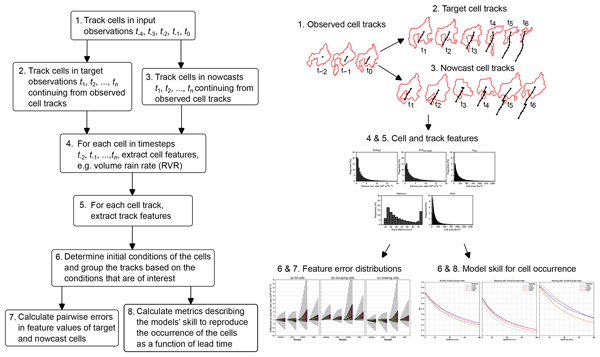
Nowcasting models struggle with the rapid evolution of heavy rain, and common verification methods are unable to describe how accurately the models predict the growth and decay of heavy rain. We propose a framework to assess model performance. In the framework, convective cells are identified and tracked in the forecasts and observations, and the model skill is then evaluated by comparing differences between forecast and observed cells. We demonstrate the framework with four open-source models.
Jenna Ritvanen, Ewan O'Connor, Dmitri Moisseev, Raisa Lehtinen, Jani Tyynelä, and Ludovic Thobois
Atmos. Meas. Tech., 15, 6507–6519, https://doi.org/10.5194/amt-15-6507-2022, https://doi.org/10.5194/amt-15-6507-2022, 2022
Short summary
Short summary
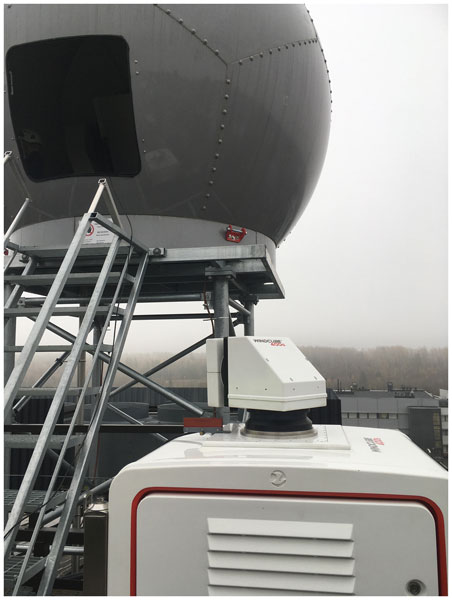
Doppler lidars and weather radars provide accurate wind measurements, with Doppler lidar usually performing better in dry weather conditions and weather radar performing better when there is precipitation. Operating both instruments together should therefore improve the overall performance. We investigate how well a co-located Doppler lidar and X-band radar perform with respect to various weather conditions, including changes in horizontal visibility, cloud altitude, and precipitation.
Victoria Anne Sinclair, Jenna Ritvanen, Gabin Urbancic, Irene Erner, Yurii Batrak, Dmitri Moisseev, and Mona Kurppa
Atmos. Meas. Tech., 15, 3075–3103, https://doi.org/10.5194/amt-15-3075-2022, https://doi.org/10.5194/amt-15-3075-2022, 2022
Short summary
Short summary
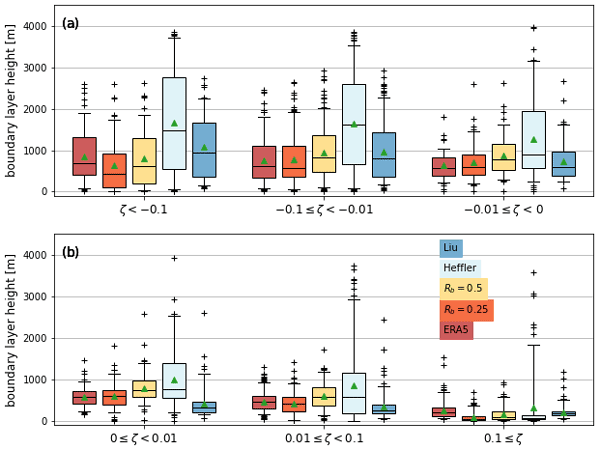
We investigate the boundary-layer (BL) height and surface stability in southern Finland using radiosondes, a microwave radiometer and ERA5 reanalysis. Accurately quantifying the BL height is challenging, and the diagnosed BL height can depend strongly on the method used. Microwave radiometers provide reliable estimates of the BL height but only in unstable conditions. ERA5 captures the BL height well except under very stable conditions, which occur most commonly at night during the warm season.
Florian Ackermann, Martin Aregger, Daniele Nerini, Simone Balmelli, Alessandro Hering, Josué Gehring, and Monika Feldmann
EGUsphere, https://doi.org/10.5194/egusphere-2026-4243, https://doi.org/10.5194/egusphere-2026-4243, 2026
This preprint is open for discussion and under review for Atmospheric Measurement Techniques (AMT).
Short summary
Short summary
Severe storms in Switzerland cause dangerous winds that are hard to track. We created an algorithm using weather radar and lightning data to detect them. By training it on official weather records and public reports, our algorithm identifies damaging gusts more accurately than current tools. This provides a better way to monitor severe weather, helping protect people and property as these storms may intensify due to a warming climate.
Matteo Guidicelli, Alfonso Ferrone, Gionata Ghiggi, Marco Gabella, Urs Germann, and Alexis Berne
EGUsphere, https://doi.org/10.5194/egusphere-2026-594, https://doi.org/10.5194/egusphere-2026-594, 2026
Short summary
Short summary
We developed a radar-based method to estimate the number and size of hailstones across Switzerland using multiple weather radars. The approach shows reasonable agreement with independent observations (automatic hailsensors, drone-based, and crowd-sourced) and provides high-resolution information on hail events. This method can support monitoring, forecasting, and assessing hail-related damages.
Ari Leskinen, Antonia Radlwimmer, Uula Isopahkala, Silvia Calderón, David Brus, Konstantinos Doulgeris, Ville Kaikkonen, Eero Molkoselkä, Dmitri Moiseev, Marie Lou Hirschy, Anssi Mäkynen, Sami Romakkaniemi, and Mika Komppula
EGUsphere, https://doi.org/10.5194/egusphere-2026-2088, https://doi.org/10.5194/egusphere-2026-2088, 2026
Short summary
Short summary
We present a lightweight holographic imaging instrument, designed for high-resolution in-cloud particle measurements at a rate of 10 holograms per second, which leads to sub-meter spatial resolution on-board UAV. The approach offers a cost-effective and versatile alternative, capable of accessing confined or remote areas, enabling improved validation of remote sensing products and numerical cloud models. We present the potential of such instrumentation for high-resolution cloud observations.
Talia Rosin, Francesco Marra, Marco Gabella, Urs Germann, Daniel Wolfensberger, and Efrat Morin
EGUsphere, https://doi.org/10.5194/egusphere-2026-1800, https://doi.org/10.5194/egusphere-2026-1800, 2026
Short summary
Short summary
Extreme rainfall in mountainous regions is difficult to assess as it varies strongly across space and time, and rain gauges are often too sparse to capture it. Using 9 years of radar data, we analyse summer rainfall extremes across Switzerland for different durations and areas. We show that rainfall intensity depends strongly on scale and topography, and that radar better captures local extremes, improving flood hazard assessment, as demonstrated for three recent major flood-producing storms.
Bernd Mom and Dmitri Moisseev
EGUsphere, https://doi.org/10.5194/egusphere-2026-507, https://doi.org/10.5194/egusphere-2026-507, 2026
Short summary
Short summary
A method for estimating wet radome and rain attenuation in cloud radar observations using a disdrometer is developed. Because of the uncertainty in disdrometer measurements, we created a statistical model that provides an estimate for the drop size distribution parameters and radar variables. Analysis of selected case studies indicates that wet radome attenuation can be successfully estimated. The mitigation of rain attenuation, however, is affected by cloud layers embedded in rain.
Shuai Zhang, Haoran Li, Dmitri Moisseev, and Matti Leskinen
Atmos. Meas. Tech., 18, 4839–4855, https://doi.org/10.5194/amt-18-4839-2025, https://doi.org/10.5194/amt-18-4839-2025, 2025
Short summary
Short summary
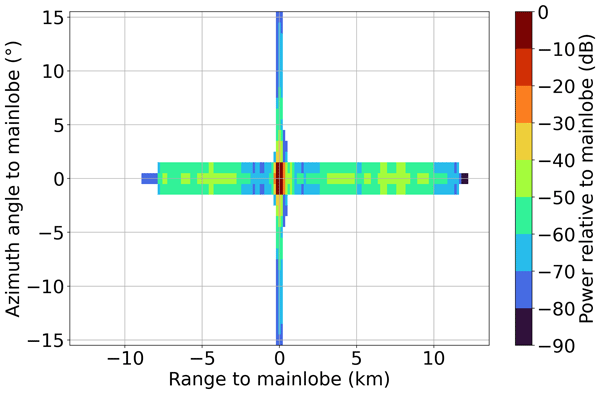
The data quality of weather radar near coastlines can be affected by echoes from ships, and this interference is exacerbated when pulse compression technology is used. This study developed a hybrid ship clutter identification algorithm based on artificial intelligence and heuristic criteria, effectively mitigating the issue. The successful reproduction of ship tracks in the Gulf of Finland supports this conclusion.
Jenna Ritvanen, Seppo Pulkkinen, Dmitri Moisseev, and Daniele Nerini
Geosci. Model Dev., 18, 1851–1878, https://doi.org/10.5194/gmd-18-1851-2025, https://doi.org/10.5194/gmd-18-1851-2025, 2025
Short summary
Short summary
Nowcasting models struggle with the rapid evolution of heavy rain, and common verification methods are unable to describe how accurately the models predict the growth and decay of heavy rain. We propose a framework to assess model performance. In the framework, convective cells are identified and tracked in the forecasts and observations, and the model skill is then evaluated by comparing differences between forecast and observed cells. We demonstrate the framework with four open-source models.
Frédéric G. Jordan, Clément Cosson, Marco Gabella, Ioannis V. Sideris, Adrien Liernur, Alexis Berne, and Urs Germann
Abstr. Int. Cartogr. Assoc., 9, 19, https://doi.org/10.5194/ica-abs-9-19-2025, https://doi.org/10.5194/ica-abs-9-19-2025, 2025
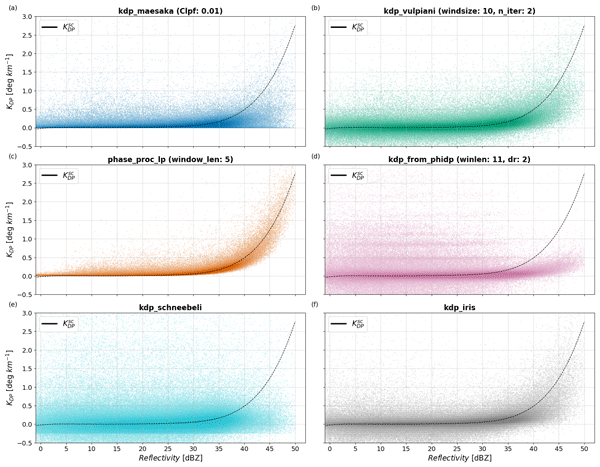
Miguel Aldana, Seppo Pulkkinen, Annakaisa von Lerber, Matthew R. Kumjian, and Dmitri Moisseev
Atmos. Meas. Tech., 18, 793–816, https://doi.org/10.5194/amt-18-793-2025, https://doi.org/10.5194/amt-18-793-2025, 2025
Short summary
Short summary
Accurate KDP estimates are crucial in radar-based applications. We quantify the uncertainties of several publicly available KDP estimation methods for multiple rainfall intensities. We use C-band weather radar observations and employed a self-consistency KDP, estimated from reflectivity and differential reflectivity, as a framework for the examination. Our study provides guidance for the performance, uncertainties, and optimisation of the methods, focusing mainly on accuracy and robustness.
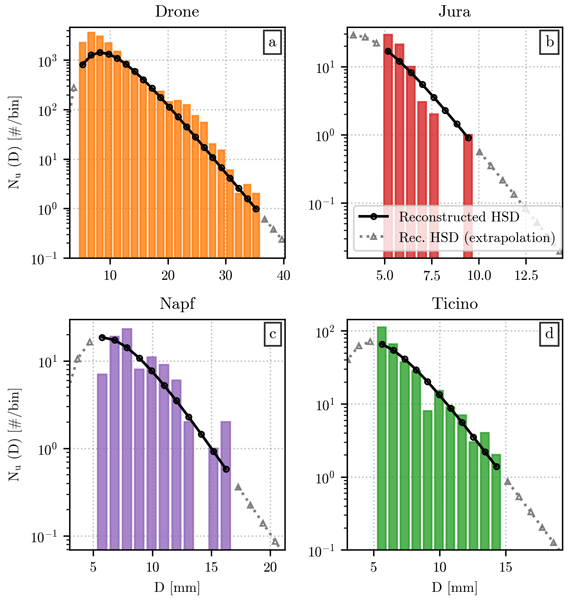
Alfonso Ferrone, Jérôme Kopp, Martin Lainer, Marco Gabella, Urs Germann, and Alexis Berne
Atmos. Meas. Tech., 17, 7143–7168, https://doi.org/10.5194/amt-17-7143-2024, https://doi.org/10.5194/amt-17-7143-2024, 2024
Short summary
Short summary
Estimates of hail size have been collected by a network of hail sensors, installed in three regions of Switzerland, since September 2018. In this study, we use a technique called “double-moment normalization” to model the distribution of diameter sizes. The parameters of the method have been defined over 70 % of the dataset and tested over the remaining 30 %. An independent distribution of hail sizes, collected by a drone, has also been used to evaluate the method.
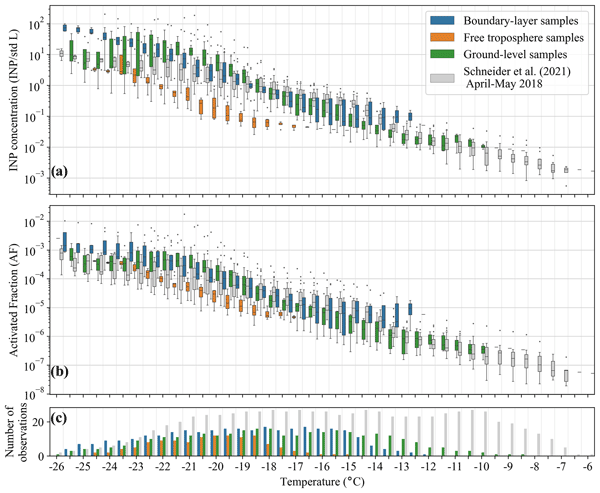
Zoé Brasseur, Julia Schneider, Janne Lampilahti, Ville Vakkari, Victoria A. Sinclair, Christina J. Williamson, Carlton Xavier, Dmitri Moisseev, Markus Hartmann, Pyry Poutanen, Markus Lampimäki, Markku Kulmala, Tuukka Petäjä, Katrianne Lehtipalo, Erik S. Thomson, Kristina Höhler, Ottmar Möhler, and Jonathan Duplissy
Atmos. Chem. Phys., 24, 11305–11332, https://doi.org/10.5194/acp-24-11305-2024, https://doi.org/10.5194/acp-24-11305-2024, 2024
Short summary
Short summary
Ice-nucleating particles (INPs) strongly influence the formation of clouds by initiating the formation of ice crystals. However, very little is known about the vertical distribution of INPs in the atmosphere. Here, we present aircraft measurements of INP concentrations above the Finnish boreal forest. Results show that near-surface INPs are efficiently transported and mixed within the boundary layer and occasionally reach the free troposphere.
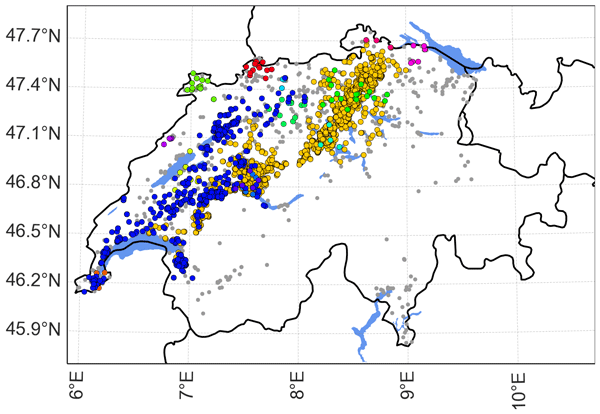
Jérôme Kopp, Alessandro Hering, Urs Germann, and Olivia Martius
Atmos. Meas. Tech., 17, 4529–4552, https://doi.org/10.5194/amt-17-4529-2024, https://doi.org/10.5194/amt-17-4529-2024, 2024
Short summary
Short summary
We present a verification of two products based on weather radars to detect the presence of hail and estimate its size. Radar products are remote detection of hail, so they must be verified against ground-based observations. We use reports from users of the Swiss Weather Services phone app to do the verification. We found that the product estimating the presence of hail provides fair results but that it should be recalibrated and that estimating the hail size with radar is more challenging.
Loris Foresti, Bernat Puigdomènech Treserras, Daniele Nerini, Aitor Atencia, Marco Gabella, Ioannis V. Sideris, Urs Germann, and Isztar Zawadzki
Nonlin. Processes Geophys., 31, 259–286, https://doi.org/10.5194/npg-31-259-2024, https://doi.org/10.5194/npg-31-259-2024, 2024
Short summary
Short summary
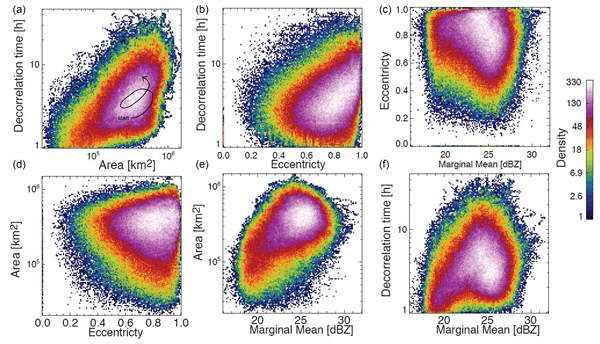
We compared two ways of defining the phase space of low-dimensional attractors describing the evolution of radar precipitation fields. The first defines the phase space by the domain-scale statistics of precipitation fields, such as their mean, spatial and temporal correlations. The second uses principal component analysis to account for the spatial distribution of precipitation. To represent different climates, radar archives over the United States and the Swiss Alpine region were used.
Bent Harnist, Seppo Pulkkinen, and Terhi Mäkinen
Geosci. Model Dev., 17, 3839–3866, https://doi.org/10.5194/gmd-17-3839-2024, https://doi.org/10.5194/gmd-17-3839-2024, 2024
Short summary
Short summary
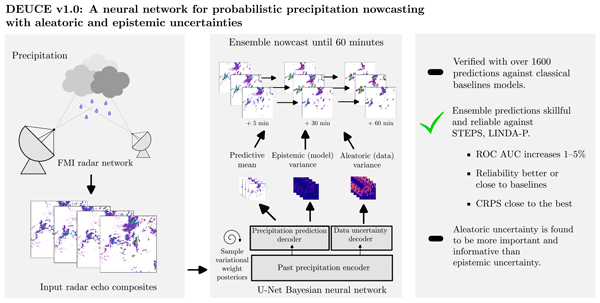
Probabilistic precipitation nowcasting (local forecasting for 0–6 h) is crucial for reducing damage from events like flash floods. For this goal, we propose the DEUCE neural-network-based model which uses data and model uncertainties to generate an ensemble of potential precipitation development scenarios for the next hour. Trained and evaluated with Finnish precipitation composites, DEUCE was found to produce more skillful and reliable nowcasts than established models.

Martin Lainer, Killian P. Brennan, Alessandro Hering, Jérôme Kopp, Samuel Monhart, Daniel Wolfensberger, and Urs Germann
Atmos. Meas. Tech., 17, 2539–2557, https://doi.org/10.5194/amt-17-2539-2024, https://doi.org/10.5194/amt-17-2539-2024, 2024
Short summary
Short summary
This study uses deep learning (the Mask R-CNN model) on drone-based photogrammetric data of hail on the ground to estimate hail size distributions (HSDs). Traditional hail sensors' limited areas complicate the full HSD retrieval. The HSD of a supercell event on 20 June 2021 is retrieved and contains > 18 000 hailstones. The HSD is compared to automatic hail sensor measurements and those of weather-radar-based MESHS. Investigations into ground hail melting are performed by five drone flights.
Maximilian Maahn, Dmitri Moisseev, Isabelle Steinke, Nina Maherndl, and Matthew D. Shupe
Atmos. Meas. Tech., 17, 899–919, https://doi.org/10.5194/amt-17-899-2024, https://doi.org/10.5194/amt-17-899-2024, 2024
Short summary
Short summary
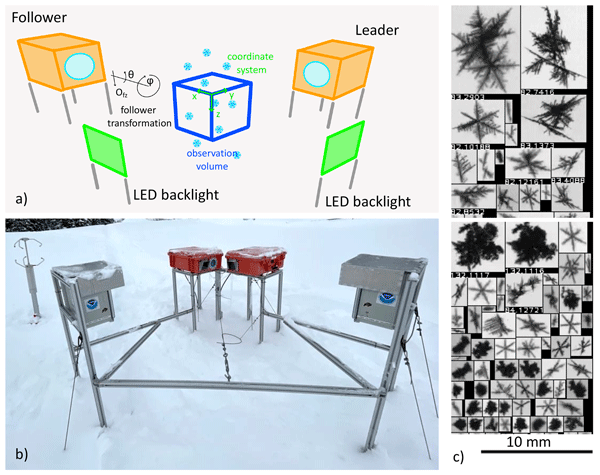
The open-source Video In Situ Snowfall Sensor (VISSS) is a novel instrument for characterizing particle shape, size, and sedimentation velocity in snowfall. It combines a large observation volume with relatively high resolution and a design that limits wind perturbations. The open-source nature of the VISSS hardware and software invites the community to contribute to the development of the instrument, which has many potential applications in atmospheric science and beyond.
Jérôme Kopp, Agostino Manzato, Alessandro Hering, Urs Germann, and Olivia Martius
Atmos. Meas. Tech., 16, 3487–3503, https://doi.org/10.5194/amt-16-3487-2023, https://doi.org/10.5194/amt-16-3487-2023, 2023
Short summary
Short summary
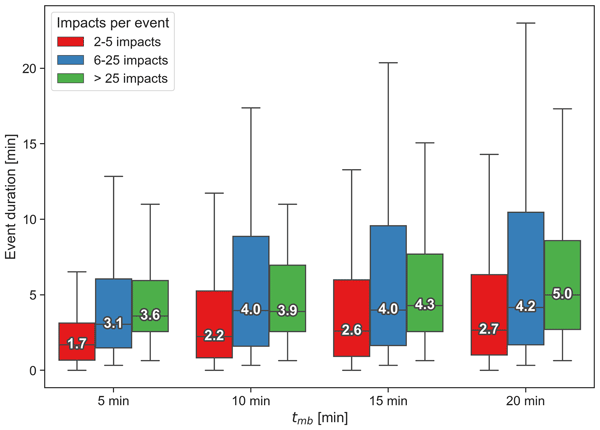
We present the first study of extended field observations made by a network of 80 automatic hail sensors from Switzerland. The sensors record the exact timing of hailstone impacts, providing valuable information about the local duration of hailfall. We found that the majority of hailfalls lasts just a few minutes and that most hailstones, including the largest, fall during a first phase of high hailstone density, while a few remaining and smaller hailstones fall in a second low-density phase.
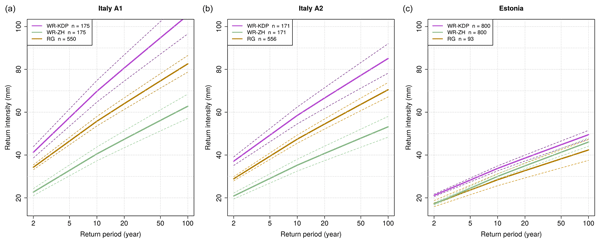
Roberto Cremonini, Tanel Voormansik, Piia Post, and Dmitri Moisseev
Atmos. Meas. Tech., 16, 2943–2956, https://doi.org/10.5194/amt-16-2943-2023, https://doi.org/10.5194/amt-16-2943-2023, 2023
Short summary
Short summary
Extreme rainfall for a specific location is commonly evaluated when designing stormwater management systems. This study investigates the use of quantitative precipitation estimations (QPEs) based on polarimetric weather radar data, without rain gauge corrections, to estimate 1 h rainfall total maxima in Italy and Estonia. We show that dual-polarization weather radar provides reliable QPEs and effective estimations of return periods for extreme rainfall in climatologically homogeneous regions.
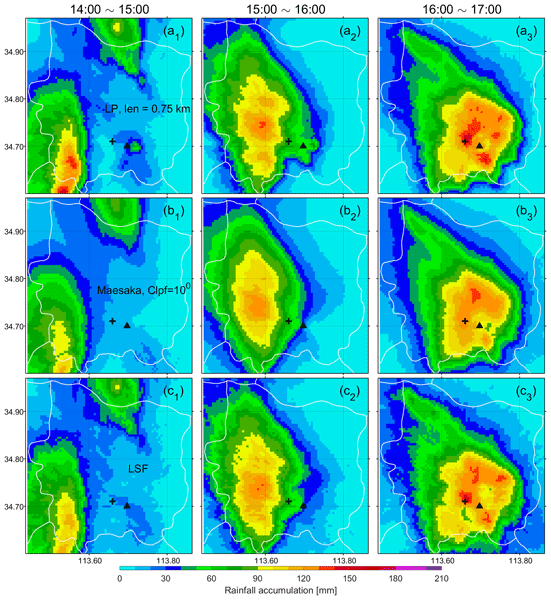
Haoran Li, Dmitri Moisseev, Yali Luo, Liping Liu, Zheng Ruan, Liman Cui, and Xinghua Bao
Hydrol. Earth Syst. Sci., 27, 1033–1046, https://doi.org/10.5194/hess-27-1033-2023, https://doi.org/10.5194/hess-27-1033-2023, 2023
Short summary
Short summary
A rainfall event that occurred at Zhengzhou on 20 July 2021 caused tremendous loss of life and property. This study compares different KDP estimation methods as well as the resulting QPE outcomes. The results show that the selection of the KDP estimation method has minimal impact on QPE, whereas the inadequate assumption of rain microphysics and unquantified vertical air motion may explain the underestimated 201.9 mm h−1 record.
Jenna Ritvanen, Ewan O'Connor, Dmitri Moisseev, Raisa Lehtinen, Jani Tyynelä, and Ludovic Thobois
Atmos. Meas. Tech., 15, 6507–6519, https://doi.org/10.5194/amt-15-6507-2022, https://doi.org/10.5194/amt-15-6507-2022, 2022
Short summary
Short summary
Doppler lidars and weather radars provide accurate wind measurements, with Doppler lidar usually performing better in dry weather conditions and weather radar performing better when there is precipitation. Operating both instruments together should therefore improve the overall performance. We investigate how well a co-located Doppler lidar and X-band radar perform with respect to various weather conditions, including changes in horizontal visibility, cloud altitude, and precipitation.
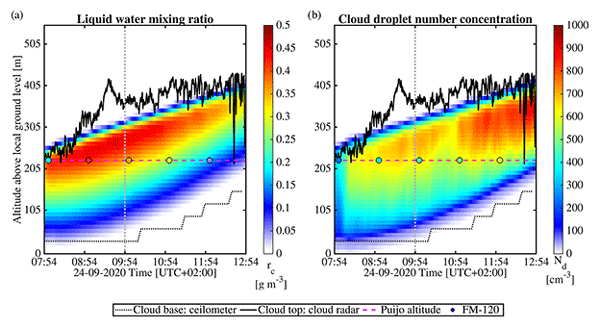
Silvia M. Calderón, Juha Tonttila, Angela Buchholz, Jorma Joutsensaari, Mika Komppula, Ari Leskinen, Liqing Hao, Dmitri Moisseev, Iida Pullinen, Petri Tiitta, Jian Xu, Annele Virtanen, Harri Kokkola, and Sami Romakkaniemi
Atmos. Chem. Phys., 22, 12417–12441, https://doi.org/10.5194/acp-22-12417-2022, https://doi.org/10.5194/acp-22-12417-2022, 2022
Short summary
Short summary
The spatial and temporal restrictions of observations and oversimplified aerosol representation in large eddy simulations (LES) limit our understanding of aerosol–stratocumulus interactions. In this closure study of in situ and remote sensing observations and outputs from UCLALES–SALSA, we have assessed the role of convective overturning and aerosol effects in two cloud events observed at the Puijo SMEAR IV station, Finland, a diurnal-high aerosol case and a nocturnal-low aerosol case.
Victoria Anne Sinclair, Jenna Ritvanen, Gabin Urbancic, Irene Erner, Yurii Batrak, Dmitri Moisseev, and Mona Kurppa
Atmos. Meas. Tech., 15, 3075–3103, https://doi.org/10.5194/amt-15-3075-2022, https://doi.org/10.5194/amt-15-3075-2022, 2022
Short summary
Short summary
We investigate the boundary-layer (BL) height and surface stability in southern Finland using radiosondes, a microwave radiometer and ERA5 reanalysis. Accurately quantifying the BL height is challenging, and the diagnosed BL height can depend strongly on the method used. Microwave radiometers provide reliable estimates of the BL height but only in unstable conditions. ERA5 captures the BL height well except under very stable conditions, which occur most commonly at night during the warm season.
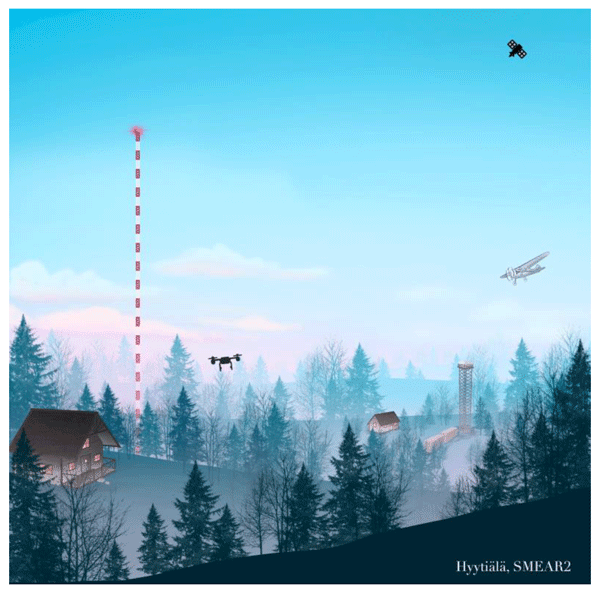
Zoé Brasseur, Dimitri Castarède, Erik S. Thomson, Michael P. Adams, Saskia Drossaart van Dusseldorp, Paavo Heikkilä, Kimmo Korhonen, Janne Lampilahti, Mikhail Paramonov, Julia Schneider, Franziska Vogel, Yusheng Wu, Jonathan P. D. Abbatt, Nina S. Atanasova, Dennis H. Bamford, Barbara Bertozzi, Matthew Boyer, David Brus, Martin I. Daily, Romy Fösig, Ellen Gute, Alexander D. Harrison, Paula Hietala, Kristina Höhler, Zamin A. Kanji, Jorma Keskinen, Larissa Lacher, Markus Lampimäki, Janne Levula, Antti Manninen, Jens Nadolny, Maija Peltola, Grace C. E. Porter, Pyry Poutanen, Ulrike Proske, Tobias Schorr, Nsikanabasi Silas Umo, János Stenszky, Annele Virtanen, Dmitri Moisseev, Markku Kulmala, Benjamin J. Murray, Tuukka Petäjä, Ottmar Möhler, and Jonathan Duplissy
Atmos. Chem. Phys., 22, 5117–5145, https://doi.org/10.5194/acp-22-5117-2022, https://doi.org/10.5194/acp-22-5117-2022, 2022
Short summary
Short summary
The present measurement report introduces the ice nucleation campaign organized in Hyytiälä, Finland, in 2018 (HyICE-2018). We provide an overview of the campaign settings, and we describe the measurement infrastructure and operating procedures used. In addition, we use results from ice nucleation instrument inter-comparison to show that the suite of these instruments deployed during the campaign reports consistent results.
Jussi Leinonen, Ulrich Hamann, Urs Germann, and John R. Mecikalski
Nat. Hazards Earth Syst. Sci., 22, 577–597, https://doi.org/10.5194/nhess-22-577-2022, https://doi.org/10.5194/nhess-22-577-2022, 2022
Short summary
Short summary
We evaluate the usefulness of different data sources and variables to the short-term prediction (
nowcasting) of severe thunderstorms using machine learning. Machine-learning models are trained with data from weather radars, satellite images, lightning detection and weather forecasts and with terrain elevation data. We analyze the benefits provided by each of the data sources to predicting hazards (heavy precipitation, lightning and hail) caused by the thunderstorms.

Teresa Vogl, Maximilian Maahn, Stefan Kneifel, Willi Schimmel, Dmitri Moisseev, and Heike Kalesse-Los
Atmos. Meas. Tech., 15, 365–381, https://doi.org/10.5194/amt-15-365-2022, https://doi.org/10.5194/amt-15-365-2022, 2022
Short summary
Short summary
We are using machine learning techniques, a type of artificial intelligence, to detect graupel formation in clouds. The measurements used as input to the machine learning framework were performed by cloud radars. Cloud radars are instruments located at the ground, emitting radiation with wavelenghts of a few millimeters vertically into the cloud and measuring the back-scattered signal. Our novel technique can be applied to different radar systems and different weather conditions.
Monika Feldmann, Urs Germann, Marco Gabella, and Alexis Berne
Weather Clim. Dynam., 2, 1225–1244, https://doi.org/10.5194/wcd-2-1225-2021, https://doi.org/10.5194/wcd-2-1225-2021, 2021
Short summary
Short summary
Mesocyclones are the rotating updraught of supercell thunderstorms that present a particularly hazardous subset of thunderstorms. A first-time characterisation of the spatiotemporal occurrence of mesocyclones in the Alpine region is presented, using 5 years of Swiss operational radar data. We investigate parallels to hailstorms, particularly the influence of large-scale flow, daily cycles and terrain. Improving understanding of mesocyclones is valuable for risk assessment and warning purposes.
Hélène Barras, Olivia Martius, Luca Nisi, Katharina Schroeer, Alessandro Hering, and Urs Germann
Weather Clim. Dynam., 2, 1167–1185, https://doi.org/10.5194/wcd-2-1167-2021, https://doi.org/10.5194/wcd-2-1167-2021, 2021
Short summary
Short summary
In Switzerland hail may occur several days in a row. Such multi-day hail events may cause significant damage, and understanding and forecasting these events is important. Using reanalysis data we show that weather systems over Europe move slower before and during multi-day hail events compared to single hail days. Surface temperatures are typically warmer and the air more humid over Switzerland and winds are slower on multi-day hail clusters. These results may be used for hail forecasting.
Anna Franck, Dmitri Moisseev, Ville Vakkari, Matti Leskinen, Janne Lampilahti, Veli-Matti Kerminen, and Ewan O'Connor
Atmos. Meas. Tech., 14, 7341–7353, https://doi.org/10.5194/amt-14-7341-2021, https://doi.org/10.5194/amt-14-7341-2021, 2021
Short summary
Short summary
We proposed a method to derive a convective boundary layer height, using insects in radar observations, and we investigated the consistency of these retrievals among different radar frequencies (5, 35 and 94 GHz). This method can be applied to radars at other measurement stations and serve as additional way to estimate the boundary layer height during summer. The entrainment zone was also observed by the 5 GHz radar above the boundary layer in the form of a Bragg scatter layer.
Timothy H. Raupach, Andrey Martynov, Luca Nisi, Alessandro Hering, Yannick Barton, and Olivia Martius
Geosci. Model Dev., 14, 6495–6514, https://doi.org/10.5194/gmd-14-6495-2021, https://doi.org/10.5194/gmd-14-6495-2021, 2021
Short summary
Short summary
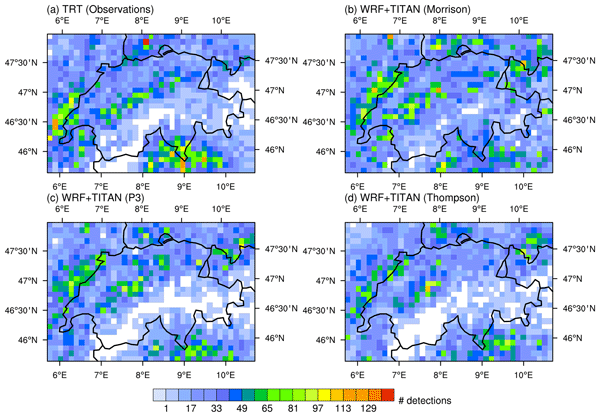
When simulated thunderstorms are compared to observations or other simulations, a match between overall storm properties is often more important than exact matches to individual storms. We tested a comparison method that uses a thunderstorm tracking algorithm to characterise simulated storms. For May 2018 in Switzerland, the method produced reasonable matches to independent observations for most storm properties, showing its feasibility for summarising simulated storms over mountainous terrain.
Haoran Li, Ottmar Möhler, Tuukka Petäjä, and Dmitri Moisseev
Atmos. Chem. Phys., 21, 14671–14686, https://doi.org/10.5194/acp-21-14671-2021, https://doi.org/10.5194/acp-21-14671-2021, 2021
Short summary
Short summary
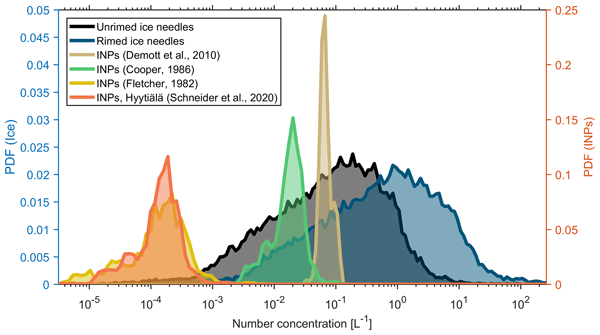
In natural clouds, ice-nucleating particles are expected to be rare above –10 °C. In the current paper, we found that the formation of ice columns is frequent in stratiform clouds and is associated with increased precipitation intensity and liquid water path. In single-layer shallow clouds, the production of ice columns was attributed to secondary ice production, despite the rime-splintering process not being expected to take place in such clouds.
Cited articles
Aregger, M., Martius, O., Germann, U., and Hering, A.: Differential Reflectivity Columns and Hail: Linking C-band Radar-Based Estimated Column Characteristics to Crowdsourced Hail Observations in Switzerland, Q. J. Roy. Meteor. Soc., 151, e5003, https://doi.org/10.1002/qj.5003, 2025. a, b, c, d
Bluestein, H. B., McCaul, E. W., Byrd, G. P., Walko, R. L., and Davies-Jones, R.: An Observational Study of Splitting Convective Clouds, Mon. Weather Rev., 118, 1359–1370, https://doi.org/10.1175/1520-0493(1990)118<1359:AOSOSC>2.0.CO;2, 1990. a
Bournas, A. and Baltas, E.: Development of a Storm-Tracking Algorithm for the Analysis of Radar Rainfall Patterns in Athens, Greece, Water, 16, 2905, https://doi.org/10.3390/w16202905, 2024. a
Brooks, H. E., Doswell III, C. A., Zhang, X., Chernokulsky, A. M. A., Tochimoto, E., Hanstrum, B., de Lima Nascimento, E., Sills, D. M. L., Antonescu, B., and Barrett, B.: A Century of Progress in Severe Convective Storm Research and Forecasting, Meteor. Mon., 59, 18.1–18.41, https://doi.org/10/ggwphp, 2018. a
Bunke, H.: Recent Developments in Graph Matching, in: Proceedings 15th International Conference on Pattern Recognition, ICPR-2000, 2, 117–124, ISSN 1051-4651, https://doi.org/10.1109/ICPR.2000.906030, 2000. a
Bunke, H., Foggia, P., Guidobaldi, C., and Vento, M.: Graph Clustering Using the Weighted Minimum Common Supergraph, in: Graph Based Representations in Pattern Recognition, edited by: Hancock, E. and Vento, M., Springer, Berlin, Heidelberg, 235–246, ISBN 978-3-540-45028-3, https://doi.org/10.1007/3-540-45028-9_21, 2003. a
Cheng, Y.-S., Wang, L.-P., Scovell, R. W., and Wright, D.: Exploring the Use of 3D Radar Measurements in Predicting the Evolution of Single-Core Convective Cells, Atmos. Res., 304, 107380, https://doi.org/10.1016/j.atmosres.2024.107380, 2024. a
Cormen, T. H. (Ed.): Introduction to Algorithms, MIT Press, Cambridge, Mass., 3. ed edn., ISBN 978-0-262-03384-8 978-0-262-53305-8, 2009. a
Crameri, F.: Scientific Colour Maps (8.0.1), Zenodo, https://doi.org/10.5281/zenodo.5501399, 2023. a, b
Crameri, F., Shephard, G. E., and Heron, P. J.: The Misuse of Colour in Science Communication, Nat. Commun., 11, 1–10, https://doi.org/10/ghg5rd, 2020. a
De Luca, D. L., Napolitano, Francesco, Kim, Dongkyun, Onof, Christian, Biondi, Daniela, Wang, Li-Pen, Russo, Fabio, Ridolfi, Elena, Moccia, Benedetta, and Marconi, F.: Rainfall Nowcasting Models: State of the Art and Possible Future Perspectives, Hydrolog. Sci. J., 1–20, https://doi.org/10.1080/02626667.2025.2490780, 2025. a
Dixon, M. and Wiener, G.: TITAN: Thunderstorm Identification, Tracking, Analysis, and Nowcasting – A Radar-based Methodology, J. Atmos. Ocean. Tech., 10, 785–797, https://doi.org/10/dc5g2t, 1993. a, b
Esbrí, L., Rigo, T., Llasat, M. C., Biondi, R., Federico, S., Gluchshenko, O., Kerschbaum, M., Lagasio, M., Mazzarella, V., Milelli, M.,540 Parodi, A., Realini, E., and Temme, M.-M.: Application of Severe Weather Nowcasting to Case Studies in Air Traffic Management, Atmosphere, 14, https://doi.org/10.3390/atmos14081238, 2023. a, b
Feldmann, M., Germann, U., Gabella, M., and Berne, A.: A characterisation of Alpine mesocyclone occurrence, Weather Clim. Dynam., 2, 1225–1244, https://doi.org/10.5194/wcd-2-1225-2021, 2021. a
Feng, Z., Leung, L. R., Houze Jr., R. A., Hagos, S., Hardin, J., Yang, Q., Han, B., and Fan, J.: Structure and Evolution of Mesoscale Convective Systems: Sensitivity to Cloud Microphysics in Convection-Permitting Simulations Over the United States, J. Adv. Model. Earth Sy., 10, 1470–1494, https://doi.org/10.1029/2018MS001305, 2018. a
Feng, Z., Varble, A., Hardin, J., Marquis, J., Hunzinger, A., Zhang, Z., and Thieman, M.: Deep Convection Initiation, Growth, and Environments in the Complex Terrain of Central Argentina during CACTI, Mon. Weather Rev., 150, 1135–1155, https://doi.org/10.1175/MWR-D-21-0237.1, 2022. a
Fluck, E., Kunz, M., Geissbuehler, P., and Ritz, S. P.: Radar-based assessment of hail frequency in Europe, Nat. Hazards Earth Syst. Sci., 21, 683–701, https://doi.org/10.5194/nhess-21-683-2021, 2021. a, b
Foresti, L., Panziera, L., Mandapaka, P. V., Germann, U., and Seed, A.: Retrieval of Analogue Radar Images for Ensemble Nowcasting of Orographic Rainfall, Meteorol. Appl., 22, 141–155, https://doi.org/10.1002/met.1416, 2015. a
Germann, U., Galli, G., Boscacci, M., and Bolliger, M.: Radar Precipitation Measurement in a Mountainous Region, Q. J. Roy. Meteor. Soc., 132, 1669–1692, https://doi.org/10.1256/qj.05.190, 2006. a, b, c
Germann, U., Boscacci, M., Clementi, L., Gabella, M., Hering, A., Sartori, M., Sideris, I. V., and Calpini, B.: Weather Radar in Complex Orography, Remote Sens., 14, 503, https://doi.org/10.3390/rs14030503, 2022. a
Greene, D. R. and Clark, R. A.: Vertically Integrated Liquid Water—A New Analysis Tool, Mon. Weather Rev., 100, 548–552, https://doi.org/10.1175/1520-0493(1972)100<0548:VILWNA>2.3.CO;2, 1972. a, b
Günter, S. and Bunke, H.: Self-Organizing Map for Clustering in the Graph Domain, Pattern Recogn. Lett., 23, 405–417, https://doi.org/10.1016/S0167-8655(01)00173-8, 2002. a
Gupta, S., Wang, D., Giangrande, S. E., Biscaro, T. S., and Jensen, M. P.: Lifecycle of updrafts and mass flux in isolated deep convection over the Amazon rainforest: insights from cell tracking, Atmos. Chem. Phys., 24, 4487–4510, https://doi.org/10.5194/acp-24-4487-2024, 2024. a
Guyot, A., Brook, J. P., Protat, A., Turner, K., Soderholm, J., McCarthy, N. F., and McGowan, H.: Segmentation of polarimetric radar imagery using statistical texture, Atmos. Meas. Tech., 16, 4571–4588, https://doi.org/10.5194/amt-16-4571-2023, 2023. a
Handwerker, J.: Cell Tracking with TRACE3D – a New Algorithm, Atmos. Res., 61, 15–34, https://doi.org/10/cvzsp7, 2002. a
Heinselman, P. L., Burke, P. C., Wicker, L. J., Clark, A. J., Kain, J. S., Gao, J., Yussouf, N., Jones, T. A., Skinner, P. S., Potvin, C. K., Wilson, K. A., Gallo, B. T., Flora, M. L., Martin, J., Creager, G., Knopfmeier, K. H., Wang, Y., Matilla, B. C., Dowell, D. C., Mansell, E. R., Roberts, B., Hoogewind, K. A., Stratman, D. R., Guerra, J., Reinhart, A. E., Kerr, C. A., and Miller, W.: Warn-on-Forecast System: From Vision to Reality, Weather Forecast., 39, 75–95, https://doi.org/10.1175/WAF-D-23-0147.1, 2024. a
Hou, J. and Wang, P.: Storm Tracking via Tree Structure Representation of Radar Data, J. Atmos. Ocean. Tech., 34, 729–747, https://doi.org/10/f93gwb, 2017. a, b, c, d
Hu, J., Rosenfeld, D., Zrnic, D., Williams, E., Zhang, P., Snyder, J. C., Ryzhkov, A., Hashimshoni, E., Zhang, R., and Weitz, R.: Tracking and Characterization of Convective Cells through Their Maturation into Stratiform Storm Elements Using Polarimetric Radar and Lightning Detection, Atmos. Res., 226, 192–207, https://doi.org/10/ggk6g7, 2019. a, b, c, d, e
Illingworth, A. J., Goddard, J. W. F., and Cherry, S. M.: Polarization Radar Studies of Precipitation Development in Convective Storms, Q. J. Roy. Meteor. Soc., 113, 469–489, https://doi.org/10.1002/qj.49711347604, 1987. a
Johnson, J. T., MacKeen, P. L., Witt, A., Mitchell, E. D. W., Stumpf, G. J., Eilts, M. D., and Thomas, K. W.: The Storm Cell Identification and Tracking Algorithm: An Enhanced WSR-88D Algorithm, Weather Forecast., 13, 263–276, https://doi.org/10/fb54r3, 1998. a
Joss, J., Schädler, B., Galli, G., Cavalli, R., Boscacci, M., Held, E., Bruna, G. D., Kappenberger, G., Nespor, V., and Spiess, R.: Operational Use of Radar for Precipitation Measurements in Switzerland, vdf Hochschulverlag AG, ETH Zurich, Switzerland, https://www.meteosuisse.admin.ch/dam/jcr:600197d5-fe54-495c-a6f6-5418147f301b/meteoswiss_operational_use_of_radar.pdf (last access: 11 March 2026), 1998. a
Kingfield, D. M. and Picca, J. C.: Development of an Operational Convective Nowcasting Algorithm Using Raindrop Size Sorting Information from Polarimetric Radar Data, Weather Forecast., 33, 1477–1495, https://doi.org/10.1175/WAF-D-18-0025.1, 2018. a
Kumjian, M. R., Khain, A. P., Benmoshe, N., Ilotoviz, E., Ryzhkov, A. V., and Phillips, V. T. J.: The Anatomy and Physics of ZDR Columns: Investigating a Polarimetric Radar Signature with a Spectral Bin Microphysical Model, J. Appl. Meteorol. Clim., 53, 1820–1843, https://doi.org/10.1175/JAMC-D-13-0354.1, 2014. a, b, c
Kyznarová, H. and Novák, P.: CELLTRACK – Convective Cell Tracking Algorithm and Its Use for Deriving Life Cycle Characteristics, Atmos. Res., 93, 317–327, https://doi.org/10/chxgvk, 2009. a, b
Lakshmanan, V. and Smith, T.: An Objective Method of Evaluating and Devising Storm-Tracking Algorithms, Weather Forecast., 25, 701–709, https://doi.org/10.1175/2009WAF2222330.1, 2010. a
Lakshmanan, V., Rabin, R., and DeBrunner, V.: Multiscale Storm Identification and Forecast, Atmos. Res., 67–68, 367–380, https://doi.org/10/cpf7f7, 2003. a, b
Lamer, K., Kollias, P., Luke, E. P., Treserras, B. P., Oue, M., and Dolan, B.: Multisensor Agile Adaptive Sampling (MAAS): A Methodology to Collect Radar Observations of Convective Cell Life Cycle, J. Atmos. Ocean. Tech., 40, 1509–1522, https://doi.org/10.1175/JTECH-D-23-0043.1, 2023. a, b, c
Lang, P.: KONRAD, Umweltwissenschaften und Schadstoff-Forschung, 14, 212–212, https://doi.org/10/b38x5t, 2002. a
Li, J., Zheng, J., Li, B., Min, M., Liu, Y., Liu, C.-Y., Li, Z., Menzel, W. P., Schmit, T. J., Cintineo, J. L., Lindstrom, S., Bachmeier, S., Xue, Y., Ma, Y., Di, D., and Lin, H.: Quantitative Applications of Weather Satellite Data for Nowcasting: Progress and Challenges, J. Meteorol. Res., 38, 399–413, https://doi.org/10.1007/s13351-024-3138-6, 2024. a
Liu, J., Xue, C., Dong, Q., Wu, C., and Xu, Y.: A Process-Oriented Spatiotemporal Clustering Method for Complex Trajectories of Dynamic Geographic Phenomena, IEEE Access, 7, 155951–155964, https://doi.org/10.1109/ACCESS.2019.2949049, 2019. a
Liu, W. and Li, X.: Life Cycle Characteristics of Warm-Season Severe Thunderstorms in Central United States from 2010 to 2014, Climate, 4, 45, https://doi.org/10.3390/cli4030045, 2016. a, b, c
Liu, W., Li, X., and Rahn, D. A.: Storm Event Representation and Analysis Based on a Directed Spatiotemporal Graph Model, Int. J. Geogr. Inf. Sci., 30, 948–969, https://doi.org/10.1080/13658816.2015.1081910, 2016. a, b, c
Merk, D. and Zinner, T.: Detection of convective initiation using Meteosat SEVIRI: implementation in and verification with the tracking and nowcasting algorithm Cb-TRAM, Atmos. Meas. Tech., 6, 1903–1918, https://doi.org/10.5194/amt-6-1903-2013, 2013. a
Muñoz, C., Wang, L.-P., and Willems, P.: Enhanced Object-Based Tracking Algorithm for Convective Rain Storms and Cells, Atmos. Res., 201, 144–158, https://doi.org/10/gcvgxr, 2018. a, b, c
Oue, M., Saleeby, S. M., Marinescu, P. J., Kollias, P., and van den Heever, S. C.: Optimizing radar scan strategies for tracking isolated deep convection using observing system simulation experiments, Atmos. Meas. Tech., 15, 4931–4950, https://doi.org/10.5194/amt-15-4931-2022, 2022. a
Picca, J. C., Kumjian, M., and Ryzhkov, A. V.: ZDR Columns as a Predictive Tool for Hail Growth and Storm Evolution, in: 25th Conf. on Severe Local Storms, 11.3, American Meteorological Society, Denver, CO, USA, https://ams.confex.com/ams/pdfpapers/175750.pdf (last access: 11 March 2026), 2010. a, b
Rädler, A. T., Groenemeijer, P. H., Faust, E., Sausen, R., and Púčik, T.: Frequency of Severe Thunderstorms across Europe Expected to Increase in the 21st Century Due to Rising Instability, npj Climate and Atmospheric Science, 2, 1–5, https://doi.org/10/ggvkxt, 2019. a
Raut, B. A., Jackson, R., Picel, M., Collis, S. M., Bergemann, M., and Jakob, C.: An Adaptive Tracking Algorithm for Convection in Simulated and Remote Sensing Data, J. Appl. Meteorol. Clim., 60, 513–526, https://doi.org/10/gh7m8x, 2021. a
Ritvanen, J.: fmidev/convective-cell-graph-analysis: Graph-based Analysis of Convective Cell Development, Zenodo [code], https://doi.org/10.5281/zenodo.17540363, 2025. a
Ritvanen, J., Aregger, M., Moisseev, D., Germann, U., Hering, A., and Pulkkinen, S.: Data for Manuscript “Analysis of Convective Cell Development with Split and Merge Events Using a Graph-Based Methodology” by Ritvanen et al., b2share [data set], https://doi.org/10.57707/fmi-b2share.c857ccb10eb547d2a21384cc37ddaf7b, 2025a. a
Ritvanen, J., Pulkkinen, S., Moisseev, D., and Nerini, D.: Cell-tracking-based framework for assessing nowcasting model skill in reproducing growth and decay of convective rainfall, Geosci. Model Dev., 18, 1851–1878, https://doi.org/10.5194/gmd-18-1851-2025, 2025b. a, b, c, d
Rosenfeld, D.: Objective Method for Analysis and Tracking of Convective Cells as Seen by Radar, J. Atmos. Ocean. Tech., 4, 422–434, https://doi.org/10.1175/1520-0426(1987)004<0422:OMFAAT>2.0.CO;2, 1987. a
Rossi, P. J.: Object-Oriented Analysis and Nowcasting of Convective Storms in Finland, Doctoral thesis, Aalto University, Helsinki, Finland, ISBN 978-952-60-6441-3, 2015. a
Rossi, P. J., Hasu, V., Halmevaara, K., Mäkelä, A., Koistinen, J., and Pohjola, H.: Real-Time Hazard Approximation of Long-Lasting Convective Storms Using Emergency Data, J. Atmos. Ocean. Tech., 30, 538–555, https://doi.org/10/f4rxhk, 2012. a, b, c, d
Rossi, P. J., Chandrasekar, V., Hasu, V., and Moisseev, D.: Kalman Filtering–Based Probabilistic Nowcasting of Object-Oriented Tracked Convective Storms, J. Atmos. Ocean. Tech., 32, 461–477, https://doi.org/10/f652r2, 2015. a, b, c
Shehu, B. and Haberlandt, U.: Improving radar-based rainfall nowcasting by a nearest-neighbour approach – Part 1: Storm characteristics, Hydrol. Earth Syst. Sci., 26, 1631–1658, https://doi.org/10.5194/hess-26-1631-2022, 2022. a
Shi, Z., Wen, Y., and He, J.: A clustering-based method for identifying and tracking squall lines, Atmos. Meas. Tech., 17, 4121–4135, https://doi.org/10.5194/amt-17-4121-2024, 2024. a
Skinner, P. S., Wheatley, D. M., Knopfmeier, K. H., Reinhart, A. E., Choate, J. J., Jones, T. A., Creager, G. J., Dowell, D. C., Alexander, C. R., Ladwig, T. T., Wicker, L. J., Heinselman, P. L., Minnis, P., and Palikonda, R.: Object-Based Verification of a Prototype Warn-on-Forecast System, Weather Forecast., 33, 1225–1250, https://doi.org/10.1175/WAF-D-18-0020.1, 2018. a
Snyder, J. C., Ryzhkov, A. V., Kumjian, M. R., Khain, A. P., and Picca, J.: A ZDR Column Detection Algorithm to Examine Convective Storm Updrafts, Weather Forecast., 30, 1819–1844, https://doi.org/10.1175/WAF-D-15-0068.1, 2015. a, b, c
Steiner, M., Houze, R. A., and Yuter, S. E.: Climatological Characterization of Three-Dimensional Storm Structure from Operational Radar and Rain Gauge Data, J. Appl. Meteorol., 34, 1978–2007, https://doi.org/10/d96zc8, 1995. a
Taszarek, M., Allen, J. T., Brooks, H. E., Pilguj, N., and Czernecki, B.: Differing Trends in United States and European Severe Thunderstorm Environments in a Warming Climate, B. Am. Meteor. Soc., 102, E296–E322, https://doi.org/10.1175/BAMS-D-20-0004.1, 2021. a
Tervo, R., Karjalainen, J., and Jung, A.: Short-Term Prediction of Electricity Outages Caused by Convective Storms, IEEE T. Geosci. Remote, 1–9, https://doi.org/10/gf6hz6, 2019. a, b, c, d
Tseng, C.-Y., Wang, L.-P., and Onof, C.: Modelling convective cell life cycles with a copula-based approach, Hydrol. Earth Syst. Sci., 29, 1–25, https://doi.org/10.5194/hess-29-1-2025, 2025. a
Tuftedal, K. S., Treserras, B. P., Oue, M., and Kollias, P.: Shallow- and deep-convection characteristics in the greater Houston, Texas, area using cell tracking methodology, Atmos. Chem. Phys., 24, 5637–5657, https://doi.org/10.5194/acp-24-5637-2024, 2024. a, b, c, d
Utriainen, L., Virman, M., Laakso, A., Ritvanen, J., Jylhä, K., and Merikanto, J.: Less Frequent but More Intense Summertime Precipitation in Finland: Results from a Convection-Permitting Climate Model, Boreal Environ. Res., 30, 93–109, https://doi.org/10.60910/BER2025.XV04-3N48, 2025. a
Van Den Broeke, M. S.: Polarimetric Radar Metrics Related to Tornado Life Cycles and Intensity in Supercell Storms, Mon. Weather Rev., 145, 3671–3686, https://doi.org/10.1175/MWR-D-16-0453.1, 2017. a
Wang, H., Du, Y., Yi, J., Wang, N., and Liang, F.: Mining Evolution Patterns from Complex Trajectory Structures – A Case Study of Mesoscale Eddies in the South China Sea, ISPRS Int. Geo-Inf., 9, 441, https://doi.org/10.3390/ijgi9070441, 2020. a
Wang, Y. V., Kim, S. H., Lyu, G., Lee, C.-L., Lee, G., Min, K.-H., and Kafatos, M. C.: Relative Importance of Radar Variables for Nowcasting Heavy Rainfall: A Machine Learning Approach, IEEE T. Geosci. Remote, 61, 1–14, https://doi.org/10.1109/TGRS.2022.3231125, 2023. a
Westcott, N.: A Historical Perspective on Cloud Mergers, B. Am. Meteor. Soc., 65, 219–226, https://doi.org/10.1175/1520-0477(1984)065<0219:AHPOCM>2.0.CO;2, 1984. a
Wilhelm, J., Wapler, K., Blahak, U., Potthast, R., and Kunz, M.: Statistical Relevance of Meteorological Ambient Conditions and Cell Attributes for Nowcasting the Life Cycle of Convective Storms, Q. J. Roy. Meteor. Soc., 149, 2252–2280, https://doi.org/10.1002/qj.4505, 2023. a, b
Wilson, M. B. and Broeke, M. S. V. D.: Using the Supercell Polarimetric Observation Research Kit (SPORK) to Examine a Large Sample of Pretornadic and Nontornadic Supercells, E-Journal of Severe Storms Meteorology, 17, 1–38, https://doi.org/10.55599/ejssm.v17i2.85, 2022. a
World Meteorological Organization: Guidelines for Nowcasting Techniques, Tech. Rep. WMO-No.1198, World Meteorological Organization, Geneva, Switzerland, ISBN 978-92-63-11198-2, 2017. a
Xia, Y., Chen, J., Li, X., and Gao, J.: DeepNM: Incremental Graph Matching Based on Sinkhorn Similarity, IEEE T. Knowl. Data En., 37, 5141–5157, https://doi.org/10.1109/TKDE.2025.3583059, 2025. a
Xue, C., Liu, J., Yang, G., and Wu, C.: A Process-Oriented Method for Tracking Rainstorms with a Time-Series of Raster Datasets, Appl. Sci., 9, 2468, https://doi.org/10.3390/app9122468, 2019a. a
Xue, C., Wu, C., Liu, J., and Su, F.: A Novel Process-Oriented Graph Storage for Dynamic Geographic Phenomena, ISPRS Int. Geo-Inf., 8, 100, https://doi.org/10.3390/ijgi8020100, 2019b. a
Yan, J., Yin, X.-C., Lin, W., Deng, C., Zha, H., and Yang, X.: A Short Survey of Recent Advances in Graph Matching, in: Proceedings of the 2016 ACM on International Conference on Multimedia Retrieval, ICMR '16, Association for Computing Machinery, New York, NY, USA, 167–174, ISBN 978-1-4503-4359-6, https://doi.org/10.1145/2911996.2912035, 2016. a
Yin, J., Pan, Z., Rosenfeld, D., Mao, F., Zang, L., Zhu, Y., Hu, J., Chen, J., and Gong, J.: Full-Tracking Algorithm for Convective Thunderstorm System From Initiation to Complete Dissipation, J. Geophys. Res.-Atmos., 127, e2022JD037601, https://doi.org/10.1029/2022JD037601, 2022. a
Yunwen Xu, Salapaka, S. M., and Beck, C. L.: A Distance Metric between Directed Weighted Graphs, in: 52nd IEEE Conference on Decision and Control, IEEE, Firenze, 6359–6364, ISBN 978-1-4673-5717-3 978-1-4673-5714-2 978-1-4799-1381-7, https://doi.org/10.1109/CDC.2013.6760895, 2013. a
Zan, B., Yu, Y., Li, J., Zhao, G., Zhang, T., and Ge, J.: Solving the Storm Split-Merge Problem – A Combined Storm Identification, Tracking Algorithm, Atmos. Res., 218, 335–346, https://doi.org/10/gf52zh, 2019. a
Short summary
Convective storms pose several hazards, like heavy rainfall, but operational short-term forecasting (nowcasting) suffers from limited models of storm development. Cell tracking, commonly used for nowcasting of convective storms and analyzing storm evolution, is complicated by splits and merges. We show how splits and merges can be integrated into cell track analysis, using case studies and analysis of split and merge events with operational data from the Swiss weather radar network.
Convective storms pose several hazards, like heavy rainfall, but operational short-term...


