Articles | Volume 19, issue 10
https://doi.org/10.5194/amt-19-3427-2026
© Author(s) 2026. This work is distributed under
the Creative Commons Attribution 4.0 License.
https://doi.org/10.5194/amt-19-3427-2026
© Author(s) 2026. This work is distributed under
the Creative Commons Attribution 4.0 License.
A methodological framework for evaluating real-time bioaerosol classification algorithms

Marie-Pierre Meurville
CORRESPONDING AUTHOR
MeteoSwiss, Chemin de l'aérologie 1, 1530 Payerne, Switzerland
Bernard Clot
MeteoSwiss, Chemin de l'aérologie 1, 1530 Payerne, Switzerland
Sophie Erb
MeteoSwiss, Chemin de l'aérologie 1, 1530 Payerne, Switzerland
Environmental Remote Sensing Laboratory (LTE), École Polytechnique Fédérale de Lausanne (EPFL), 1015 Lausanne, Switzerland
Maria Lbadaoui-Darvas
MeteoSwiss, Chemin de l'aérologie 1, 1530 Payerne, Switzerland
Laboratory of Atmospheric Processes and their Impacts, School of Architecture, Civil & Environmental Engineering, École Polytechnique Fédérale de Lausanne (EPFL), 1015 Lausanne, Switzerland
Fiona Tummon
MeteoSwiss, Chemin de l'aérologie 1, 1530 Payerne, Switzerland
Gian-Duri Lieberherr
CORRESPONDING AUTHOR
MeteoSwiss, Chemin de l'aérologie 1, 1530 Payerne, Switzerland
Benoît Crouzy
CORRESPONDING AUTHOR
MeteoSwiss, Chemin de l'aérologie 1, 1530 Payerne, Switzerland
Related authors
No articles found.
Marilena Gidarakou, Alexandros Papayannis, Kunfeng Gao, Panagiotis Gidarakos, Benoît Crouzy, Romanos Foskinis, Sophie Erb, Benjamin T. Brem, Cuiqi Zhang, Gian Lieberherr, Martine Collaud Coen, Branko Sikoparija, Zamin A. Kanji, Bernard Clot, Bertrand Calpini, Eugenia Giagka, and Athanasios Nenes
Atmos. Chem. Phys., 26, 923–945, https://doi.org/10.5194/acp-26-923-2026, https://doi.org/10.5194/acp-26-923-2026, 2026
Short summary
Short summary
Vertical profiles of pollen and biomass burning particles were obtained at a semi-rural site at the MeteoSwiss station near Payerne (Switzerland) using a novel multi-channel elastic-fluorescence lidar system combined with in situ measurements during the spring 2023 wildfires and pollination season during the PERICLES (PayernE lidaR and Insitu detection of fluorescent bioaerosol and dust partiCLES and their cloud impacts) campaign.
Sophie Erb, Elias Graf, Yanick Zeder, Simone Lionetti, Alexis Berne, Bernard Clot, Gian Lieberherr, Fiona Tummon, Pascal Wullschleger, and Benoît Crouzy
Atmos. Meas. Tech., 17, 441–451, https://doi.org/10.5194/amt-17-441-2024, https://doi.org/10.5194/amt-17-441-2024, 2024
Short summary
Short summary
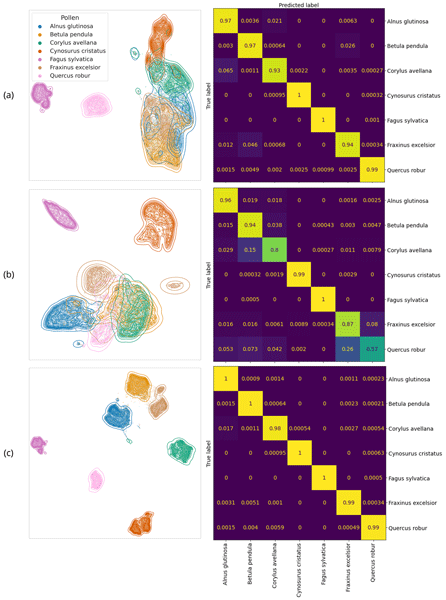
In this study, we focus on an automatic bioaerosol measurement instrument and investigate the impact of using its fluorescence measurement for pollen identification. The fluorescence signal is used together with a pair of images from the same instrument to identify single pollen grains via neural networks. We test whether considering fluorescence as a supplementary input improves the pollen identification performance by comparing three different neural networks.
Mária Lbadaoui-Darvas, Ari Laaksonen, and Athanasios Nenes
Atmos. Chem. Phys., 23, 10057–10074, https://doi.org/10.5194/acp-23-10057-2023, https://doi.org/10.5194/acp-23-10057-2023, 2023
Short summary
Short summary
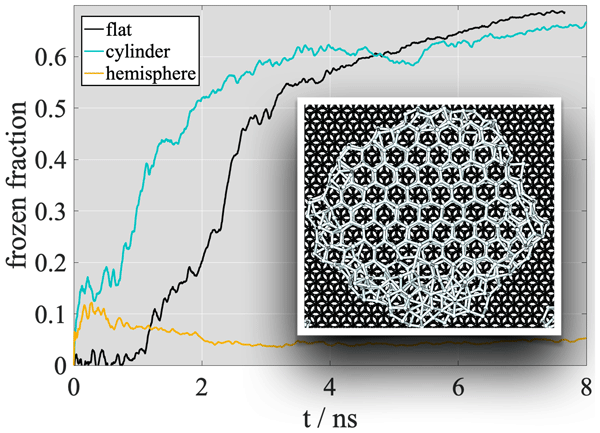
Heterogeneous ice nucleation is the main ice formation mechanism in clouds. The mechanism of different freezing modes is to date unknown, which results in large model biases. Experiments do not allow for direct observation of ice nucleation at its native resolution. This work uses first principles molecular simulations to determine the mechanism of the least-understood ice nucleation mode and link it to adsorption through a novel modeling framework that unites ice and droplet formation.
Gian Lieberherr, Kevin Auderset, Bertrand Calpini, Bernard Clot, Benoît Crouzy, Martin Gysel-Beer, Thomas Konzelmann, José Manzano, Andrea Mihajlovic, Alireza Moallemi, David O'Connor, Branko Sikoparija, Eric Sauvageat, Fiona Tummon, and Konstantina Vasilatou
Atmos. Meas. Tech., 14, 7693–7706, https://doi.org/10.5194/amt-14-7693-2021, https://doi.org/10.5194/amt-14-7693-2021, 2021
Short summary
Short summary
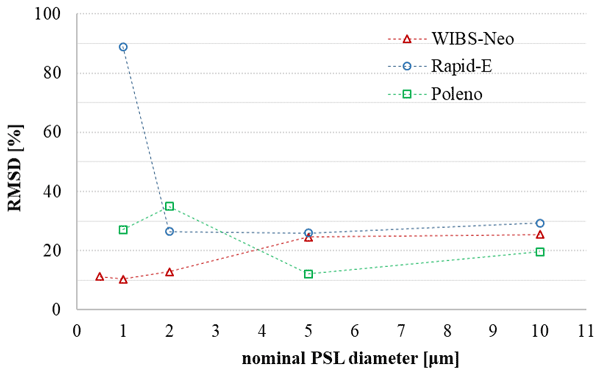
Today there is no standard procedure to validate bioaerosol and pollen monitors. Three instruments were tested, focusing on detecting particles of different sizes. Only one instrument was able to detect the smallest particles (0.5 µm Ø), whereas the others performed best at the largest tested particles (10 µm Ø). These results are the first step towards a standardised validation procedure. The need for a reference counting method for larger particles (pollen grains: 10–200 µm Ø) was emphasised.
Mária Lbadaoui-Darvas, Satoshi Takahama, and Athanasios Nenes
Atmos. Chem. Phys., 21, 17687–17714, https://doi.org/10.5194/acp-21-17687-2021, https://doi.org/10.5194/acp-21-17687-2021, 2021
Short summary
Short summary
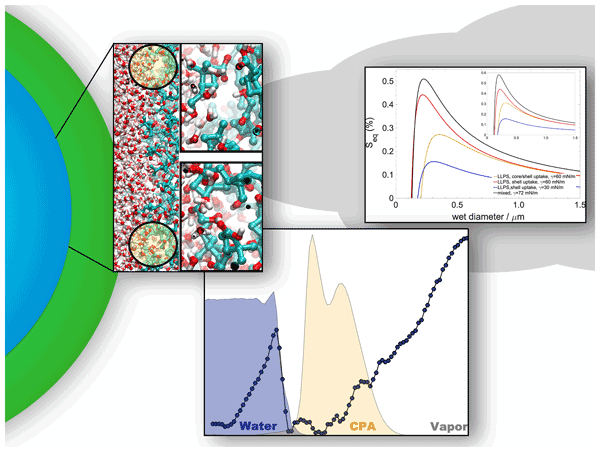
Aerosol–cloud interactions constitute the most uncertain contribution to climate change. The uptake kinetics of water by aerosol is a central process of cloud droplet formation, yet its molecular-scale mechanism is unknown. We use molecular simulations to study this process for phase-separated organic particles. Our results explain the increased cloud condensation activity of such particles and can be generalized over various compositions, thus possibly serving as a basis for future models.
Cited articles
Adamov, S., Lemonis, N., Clot, B., Crouzy, B., Gehrig, R., Graber, M.-J., Sallin, C., and Tummon, F.: On the measurement uncertainty of Hirst-type volumetric pollen and spore samplers, Aerobiologia, 40, 77–91, https://doi.org/10.1007/s10453-021-09724-5, 2021. a, b, c, d
Bai, J., Lu, F., Zhang, K., et al.: ONNX: Open Neural Network Exchange, GitHub [code], https://github.com/onnx/onnx (last access: 5 August 2025), 2019. a
Bastl, K., Kmenta, M., and Berger, U. E.: Defining pollen seasons: Background and recommendations, Curr. Allergy Asthma Rep., 18, 73, https://doi.org/10.1007/s11882-018-0829-z, 2018. a
Berg, M. J. and Videen, G.: Digital holographic imaging of aerosol particles in flight, Journal of Quantitative Spectroscopy and Radiative Transfer, 112, 1776–1783, https://doi.org/10.1016/j.jqsrt.2011.01.013, 2011. a
Brdar, S., Panić, M., Matavulj, P., Stanković, M., Bartolić, D., and Šikoparija, B.: Explainable AI for unveiling deep learning pollen classification model based on fusion of scattered light patterns and fluorescence spectroscopy, Sci. Rep., 13, https://doi.org/10.1038/s41598-023-30064-6, 2023. a
Brito, F. F.: Grass pollen, aeroallergens, and clinical symptoms in Ciudad Real, Spain, J. Invest. Allerg. Clin., 20, 603, PMID: 20815307, 2010. a
Burden, R. L. and Faires, J. D.: Numerical Analysis, 9th edn., Chapter 4: Numerical Differentiation and Integration, Section: The Trapezoidal Rule, Brooks/Cole, Cengage Learning, Boston, MA, ISBN-13 978-0-538-73351-9, ISBN-10 0-538-73351-9, 2011. a
Buters, J. T. M., Antunes, C., Galveias, A., Bergmann, K. C., Thibaudon, M., Galán, C., Schmidt-Weber, C., and Oteros, J.: Pollen and spore monitoring in the world, Clinical and Translational Allergy, 8, https://doi.org/10.1186/s13601-018-0197-8, 2018. a
Croux, C. and Dehon, C.: Influence functions of the Spearman and Kendall correlation measures, Stat. Method. Appl., 19, 497–515, https://doi.org/10.1007/s10260-010-0142-z, 2010. a
Crouzy, B., Lieberherr, G., Tummon, F., and Clot, B.: False positives: handling them operationally for automatic pollen monitoring, Aerobiologia, 38, 429–432, https://doi.org/10.1007/s10453-022-09757-4, 2022. a, b
Crouzy, B., Meurville, M.-P., Clot, B., Erb, S., Lbadaoui-Darvas, M., Tummon, F., and Lieberherr, G.: Operational pollen classification using digital holography and fluorescence, Aerobiologia, https://doi.org/10.1007/s10453-025-09882-w, 2025. a, b
Emberlin, J., Savage, M., and Jones, S.: Annual variations in grass pollen seasons in London 1961–1990: trends and forecast models, Clin. Exp. Allergy, 23, 911–918, https://doi.org/10.1111/j.1365-2222.1993.tb00275.x, 1993. a
Emberlin, J., Detandt, M., Gehrig, R., Jaeger, S., Nolard, N., and Rantio-Lehtimäki, A.: Responses in the start of Betula (birch) pollen seasons to recent changes in spring temperatures across Europe, Int. J. Biometeorol., 46, 159–170, 2002. a
Erb, S., Graf, E., Zeder, Y., Lionetti, S., Berne, A., Clot, B., Lieberherr, G., Tummon, F., Wullschleger, P., and Crouzy, B.: Real-time pollen identification using holographic imaging and fluorescence measurements, Atmos. Meas. Tech., 17, 441–451, https://doi.org/10.5194/amt-17-441-2024, 2024. a, b, c, d
Erb, S., Berne, A., Clot, B., Lbadaoui-Darvas, M., Lieberherr, G.-D., Meurville, M.-P., Tummon, F., and Crouzy, B.: Pollen holographic images and light-induced fluorescence measurements at the species level, Sci. Data, 12, https://doi.org/10.1038/s41597-025-05139-w, 2025. a
European Committee for Standardization (CEN): Ambient air – Sampling and analysis of airborne pollen grains and fungal spores for networks related to allergy – Volumetric Hirst method, CEN, Brussels, standard no. EN 16868:2019, https://www.en-standard.eu/csn-en-16868-ambient-air-sampling-and-analysis-of-airborne-pollen-grains-for-allergy-networks-volumetric-hirst-method/ (last access: 4 May 2026), 2019. a, b
Federal Statistical Office (Switzerland): Densité de la population (surface totale), BFS-Nummer mx-f-01-01.02.01-003, Asset 3262709, Office fédéral de la statistique (Switzerland), https://www.bfs.admin.ch/bfs/fr/home/statistiken/bevoelkerung/stand-entwicklung.assetdetail.3262709.html (last access: 4 May 2026), 2017. a
Galán, C., Smith, M., Thibaudon, M., Frenguelli, G., Oteros, J., Gehrig, R., Berger, U., Clot, B., and Brandao, R.: Pollen monitoring: minimum requirements and reproducibility of analysis, Aerobiologia, 30, 385–395, https://doi.org/10.1007/s10453-014-9335-5, 2014. a
Gehrig, R. and Clot, B.: 50 Years of Pollen Monitoring in Basel (Switzerland) Demonstrate the Influence of Climate Change on Airborne Pollen, Frontiers in Allergy, 2, https://doi.org/10.3389/falgy.2021.677159, 2021. a, b
Hasegawa, T. M., Itagaki, T., and Sakai, S.: Intraspecific variation in morphology of spiny pollen grains along an altitudinal gradient in an insect‐pollinated shrub, Plant Biol., 25, 287–295, https://doi.org/10.1111/plb.13493, 2022. a
Hirst, J. M.: An automatic volumetric spore trap, Ann. Appl. Biol., 39, 257–265, https://doi.org/10.1111/j.1744-7348.1952.tb00904.x, 1952. a
Huffman, J. A., Perring, A. E., Savage, N. J., Clot, B., Crouzy, B., Tummon, F., Shoshanim, O., Damit, B., Schneider, J., Sivaprakasam, V., Zawadowicz, M. A., Crawford, I., Gallagher, M., Topping, D., Doughty, D. C., Hill, S. C., and Pan, Y.: Real-time sensing of bioaerosols: Review and current perspectives, Aerosol Sci. Tech., 54, 465–495, https://doi.org/10.1080/02786826.2019.1664724, 2019. a
Hyde, H.: Volumetric counts of pollen grains at Cardiff, 1954–1957, J. Allergy, 30, 219–234, https://doi.org/10.1016/0021-8707(59)90069-3, 1959. a
Kendall, M. G.: A new measure of rank correlation, Biometrika, 30, 81–93, https://doi.org/10.1093/biomet/30.1-2.81, 1938. a
Maya-Manzano, J. M., Tummon, F., Abt, R., Allan, N., Bunderson, L., Clot, B., Crouzy, B., Daunys, G., Erb, S., Gonzalez-Alonso, M., Graf, E., Grewling, L., Haus, J., Kadantsev, E., Kawashima, S., Martinez-Bracero, M., Matavulj, P., Mills, S., Niederberger, E., Lieberherr, G., Lucas, R. W., O'Connor, D. J., Oteros, J., Palamarchuk, J., Pope, F. D., Rojo, J., Šaulienė, I., Schäfer, S., Schmidt-Weber, C. B., Schnitzler, M., Šikoparija, B., Skjøth, C. A., Sofiev, M., Stemmler, T., Triviño, M., Zeder, Y., and Buters, J.: Towards European automatic bioaerosol monitoring: Comparison of 9 automatic pollen observational instruments with classic Hirst-type traps, Sci. Total Environ., 866, 161220, https://doi.org/10.1016/j.scitotenv.2022.161220, 2023. a, b
Oteros, J., Buters, J., Laven, G., Röseler, S., Wachter, R., Schmidt-Weber, C., and Hofmann, F.: Errors in determining the flow rate of Hirst-type pollen traps, Aerobiologia, 33, 201–210, https://doi.org/10.1007/s10453-016-9467-x, 2016. a, b, c
Peel, M. C., Finlayson, B. L., and McMahon, T. A.: Updated world map of the Köppen-Geiger climate classification, Hydrol. Earth Syst. Sci., 11, 1633–1644, https://doi.org/10.5194/hess-11-1633-2007, 2007. a
Sikoparija, B., Galán, C., and Smith, M.: Pollen-monitoring: between analyst proficiency testing, Aerobiologia, 33, 191–199, https://doi.org/10.1007/s10453-016-9461-3, 2016. a, b, c
Simonyan, K. and Zisserman, A.: Very Deep Convolutional Networks for Large-Scale Image Recognition, arXiv [preprint], https://doi.org/10.48550/arXiv.1409.1556, 2014. a
Tan, M. and Le, Q. V.: EfficientNet: Rethinking Model Scaling for Convolutional Neural Networks, arXiv [preprint], https://doi.org/10.48550/arXiv.1905.11946, 2020. a
Triviño, M. M., Maya-Manzano, J. M., Tummon, F., Clot, B., Grewling, L., Schmidt-Weber, C., and Buters, J.: Variability between Hirst-type pollen traps is reduced by resistance-free flow adjustment, Aerobiologia, 39, 257–273, https://doi.org/10.1007/s10453-023-09790-x, 2023. a, b, c
Tummon, F., Adamov, S., Clot, B., Crouzy, B., Gysel-Beer, M., Kawashima, S., Lieberherr, G., Manzano, J., Markey, E., Moallemi, A., and O'Connor, D.: A first evaluation of multiple automatic pollen monitors run in parallel, Aerobiologia, 40, 93–108, https://doi.org/10.1007/s10453-021-09729-0, 2021. a
Virtanen, P., Gommers, R., Oliphant, T. E., Haberland, M., Reddy, T., Cournapeau, D., Burovski, E., Peterson, P., Weckesser, W., Bright, J., van der Walt, S. J., Brett, M., Wilson, J., Millman, K. J., Mayorov, N., Nelson, A. R. J., Jones, E., Kern, R., Larson, E., Carey, C. J., Polat, I., Feng, Y., Moore, E. W., VanderPlas, J., Laxalde, D., Perktold, J., Cimrman, R., Henriksen, I., Quintero, E. A., Harris, C. R., Archibald, A. M., Ribeiro, A. H., Pedregosa, F., van Mulbregt, P., Vijaykumar, A., Bardelli, A. P., Rothberg, A., Hilboll, A., Kloeckner, A., Scopatz, A., Lee, A., Rokem, A., Woods, C. N., Fulton, C., Masson, C., Häggström, C., Fitzgerald, C., Nicholson, D. A., Hagen, D. R., Pasechnik, D. V., Olivetti, E., Martin, E., Wieser, E., Silva, F., Lenders, F., Wilhelm, F., Young, G., Price, G. A., Ingold, G.-L., Allen, G. E., Lee, G. R., Audren, H., Probst, I., Dietrich, J. P., Silterra, J., Webber, J. T., Slavič, J., Nothman, J., Buchner, J., Kulick, J., Schönberger, J. L., de Miranda Cardoso, J. V., Reimer, J., Harrington, J., Rodríguez, J. L. C., Nunez-Iglesias, J., Kuczynski, J., Tritz, K., Thoma, M., Newville, M., Kümmerer, M., Bolingbroke, M., Tartre, M., Pak, M., Smith, N. J., Nowaczyk, N., Shebanov, N., Pavlyk, O., Brodtkorb, P. A., Lee, P., McGibbon, R. T., Feldbauer, R., Lewis, S., Tygier, S., Sievert, S., Vigna, S., Peterson, S., More, S., Pudlik, T., Oshima, T., Pingel, T. J., Robitaille, T. P., Spura, T., Jones, T. R., Cera, T., Leslie, T., Zito, T., Krauss, T., Upadhyay, U., Halchenko, Y. O., and Vázquez-Baeza, Y.: SciPy 1.0: fundamental algorithms for scientific computing in Python, Nat. Methods, 17, 261–272, https://doi.org/10.1038/s41592-019-0686-2, 2020. a
Wüthrich, B., Schindler, C., Leuenberger, P., and Ackermann-Liebrich, U.: Prevalence of Atopy and Pollinosis in the Adult Population of Switzerland (SAPALDIA Study), Int. Arch. Allergy Imm., 106, 149–156, https://doi.org/10.1159/000236836, 2009. a
Short summary
Our method evaluates how well automatic devices can classify pollen and other airborne particles in real time. Our goal is to compare different classification systems and understand their strengths and weaknesses. By developing this evaluation process, we aim to enhance the accuracy of bioaerosol forecasts. This research is essential for improving public health and helping people manage allergies more effectively.
Our method evaluates how well automatic devices can classify pollen and other airborne particles...