
Articles | Volume 19, issue 10
https://doi.org/10.5194/amt-19-3445-2026
© Author(s) 2026. This work is distributed under
the Creative Commons Attribution 4.0 License.
the Creative Commons Attribution 4.0 License.
https://doi.org/10.5194/amt-19-3445-2026
© Author(s) 2026. This work is distributed under
the Creative Commons Attribution 4.0 License.
the Creative Commons Attribution 4.0 License.
Research article
| 
26 May 2026
Research article |
| 26 May 2026
| 26 May 2026
Particle nitrate measurement using a thermal-dissociation, cavity-ringdown-spectrometer with gas-phase denuder (D-TD-CRDS)
Patrick Dewald
Max-Planck-Institute for Chemistry, Atmospheric Chemistry Department, Mainz, Germany
Tobias Seubert
Max-Planck-Institute for Chemistry, Atmospheric Chemistry Department, Mainz, Germany
Laura Wüst
Max-Planck-Institute for Chemistry, Atmospheric Chemistry Department, Mainz, Germany
Jan Schuladen
Max-Planck-Institute for Chemistry, Atmospheric Chemistry Department, Mainz, Germany
Frank Drewnick
Max-Planck-Institute for Chemistry, Multiphase Chemistry Department, Mainz, Germany
Friederike Fachinger
Max-Planck-Institute for Chemistry, Multiphase Chemistry Department, Mainz, Germany
Thorsten Hoffmann
Johannes Gutenberg University Mainz, Department of Chemistry, Mainz, Germany

Max-Planck-Institute for Chemistry, Atmospheric Chemistry Department, Mainz, Germany
Related authors
Patrick Dewald, Sergio Harb, Bénédicte Picquet-Varrault, Mathieu Cazaunau, Maxime Feingesicht, Lucas Beltran, Vincent Michoud, Xavier Landsheere, Edouard Pangui, Antonin Bergé, Christopher Cantrell, and Manuela Cirtog
EGUsphere, https://doi.org/10.5194/egusphere-2026-5307, https://doi.org/10.5194/egusphere-2026-5307, 2026
Short summary
Short summary
We built an instrument to measure reactive nitrogen compounds in the atmosphere with a focus on the detection of nitrate radicals. They are formed by pollutants such as ozone and nitrogen oxides and are an important nocturnal oxidant of trace gases, thereby indirectly impacting the interconversion of reactive nitrogen and air quality. The instrument’s characterization, performance assessment and the first field deployment are presented.
Gunther N. T. E. Türk, Simone T. Andersen, Patrick Dewald, Jan Schuladen, Jos Lelieveld, and John N. Crowley
Atmos. Meas. Tech., 19, 4815–4832, https://doi.org/10.5194/amt-19-4815-2026, https://doi.org/10.5194/amt-19-4815-2026, 2026
Short summary
Short summary
We built a small instrument to measure the air-borne molecules NO₃ and N₂O₅. These originate mostly from human-made nitrogen oxide emissions and are important for nighttime chemistry and air quality. Our instrument is lightweight and sensitive, detecting these molecules at levels below one part per trillion. Tests in the laboratory and during a field study show its ability to accurately measure these trace gases. Here, we present the design of the instrument and discuss its performance.
Chenjie Yu, Paola Formenti, Joel F. de Brito, Astrid Bauville, Antonin Bergé, Hichem Bouzidi, Mathieu Cazaunau, Manuela Cirtog, Claudia Di Biagio, Ludovico Di Antonio, Cécile Gaimoz, Franck Maisonneuve, Pascal Zapf, Tobias Seubert, Simone T. Andersen, Patrick Dewald, Gunther N. T. E. Türk, John N. Crowley, Alexandre Kukui, Chaoyang Xue, Cyrielle Denjean, Olivier Garrouste, Jean-Claude Etienne, Huihui Wu, James D. Allan, Dantong Liu, Yangzhou Wu, Christopher Cantrell, and Vincent Michoud
Atmos. Chem. Phys., 26, 5313–5332, https://doi.org/10.5194/acp-26-5313-2026, https://doi.org/10.5194/acp-26-5313-2026, 2026
Short summary
Short summary
We presented a field measurement in a Paris suburban forest region to characterise the impacts of photochemical aging process on aerosol physical chemical properties. Photochemical production of organic aerosols increased forest fine particle mass and significantly enhanced absorption of short-wavelength sunlight. This study highlights the critical need to incorporate light absorbing carbonaceous particles formation mechanisms into models to accurately simulate their direct radiative impacts.
Simone T. Andersen, Rolf Sander, Patrick Dewald, Laura Wüst, Tobias Seubert, Gunther N. T. E. Türk, Jan Schuladen, Max R. McGillen, Chaoyang Xue, Abdelwahid Mellouki, Alexandre Kukui, Vincent Michoud, Manuela Cirtog, Mathieu Cazaunau, Astrid Bauville, Hichem Bouzidi, Paola Formenti, Cyrielle Denjean, Jean-Claude Etienne, Olivier Garrouste, Christopher Cantrell, Jos Lelieveld, and John N. Crowley
Atmos. Chem. Phys., 25, 5893–5909, https://doi.org/10.5194/acp-25-5893-2025, https://doi.org/10.5194/acp-25-5893-2025, 2025
Short summary
Short summary
Measurements and modelling of reactive nitrogen gases observed in a suburban temperate forest in Rambouillet, France, circa 50 km southwest of Paris in 2022 indicate that the biosphere rapidly scavenges organic nitrates of mixed biogenic and anthropogenic origin, resulting in short lifetimes for, for example, alkyl nitrates and peroxy nitrates.
Laura Wüst, Patrick Dewald, Gunther N. T. E. Türk, Jos Lelieveld, and John N. Crowley
Atmos. Meas. Tech., 18, 1943–1959, https://doi.org/10.5194/amt-18-1943-2025, https://doi.org/10.5194/amt-18-1943-2025, 2025
Short summary
Short summary
Detection of NO2 via cavity ring-down spectroscopy (CRDS) after thermal dissociation (TD) of alkyl and peroxy nitrates can be used to detect total atmospheric organic nitrates originating from the interaction between biogenic emissions of volatile organic compounds and nitrogen oxides of anthropogenic origin. Here we present an improved TD-CRDS technique that avoids systematic bias resulting from secondary chemistry in the heated inlets and that can be deployed in regions with strong biogenic emissions.
Simone T. Andersen, Max R. McGillen, Chaoyang Xue, Tobias Seubert, Patrick Dewald, Gunther N. T. E. Türk, Jan Schuladen, Cyrielle Denjean, Jean-Claude Etienne, Olivier Garrouste, Marina Jamar, Sergio Harb, Manuela Cirtog, Vincent Michoud, Mathieu Cazaunau, Antonin Bergé, Christopher Cantrell, Sebastien Dusanter, Bénédicte Picquet-Varrault, Alexandre Kukui, Abdelwahid Mellouki, Lucy J. Carpenter, Jos Lelieveld, and John N. Crowley
Atmos. Chem. Phys., 24, 11603–11618, https://doi.org/10.5194/acp-24-11603-2024, https://doi.org/10.5194/acp-24-11603-2024, 2024
Short summary
Short summary
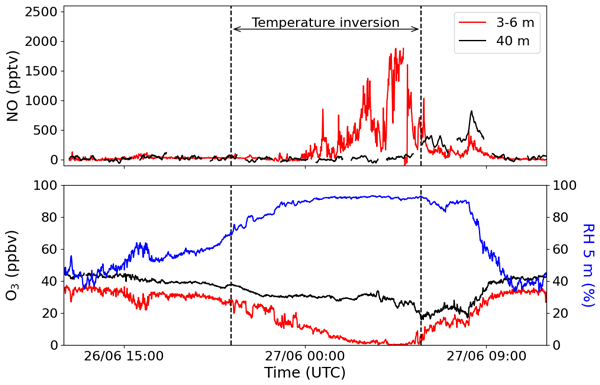
Using measurements of various trace gases in a suburban forest near Paris in the summer of 2022, we were able to gain insight into the sources and sinks of NOx (NO+NO2) with a special focus on their nighttime chemical and physical loss processes. NO was observed as a result of nighttime soil emissions when O3 levels were strongly depleted by deposition. NO oxidation products were not observed at night, indicating that soil and/or foliar surfaces are an efficient sink of reactive N.
Patrick Dewald, Tobias Seubert, Simone T. Andersen, Gunther N. T. E. Türk, Jan Schuladen, Max R. McGillen, Cyrielle Denjean, Jean-Claude Etienne, Olivier Garrouste, Marina Jamar, Sergio Harb, Manuela Cirtog, Vincent Michoud, Mathieu Cazaunau, Antonin Bergé, Christopher Cantrell, Sebastien Dusanter, Bénédicte Picquet-Varrault, Alexandre Kukui, Chaoyang Xue, Abdelwahid Mellouki, Jos Lelieveld, and John N. Crowley
Atmos. Chem. Phys., 24, 8983–8997, https://doi.org/10.5194/acp-24-8983-2024, https://doi.org/10.5194/acp-24-8983-2024, 2024
Short summary
Short summary
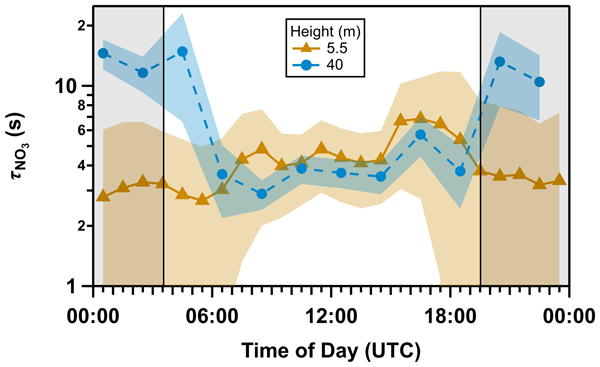
In the scope of a field campaign in a suburban forest near Paris in the summer of 2022, we measured the reactivity of the nitrate radical NO3 towards biogenic volatile organic compounds (BVOCs; e.g. monoterpenes) mainly below but also above the canopy. NO3 reactivity was the highest during nights with strong temperature inversions and decreased strongly with height. Reactions with BVOCs were the main removal process of NO3 throughout the diel cycle below the canopy.
Philip T. M. Carlsson, Luc Vereecken, Anna Novelli, François Bernard, Steven S. Brown, Bellamy Brownwood, Changmin Cho, John N. Crowley, Patrick Dewald, Peter M. Edwards, Nils Friedrich, Juliane L. Fry, Mattias Hallquist, Luisa Hantschke, Thorsten Hohaus, Sungah Kang, Jonathan Liebmann, Alfred W. Mayhew, Thomas Mentel, David Reimer, Franz Rohrer, Justin Shenolikar, Ralf Tillmann, Epameinondas Tsiligiannis, Rongrong Wu, Andreas Wahner, Astrid Kiendler-Scharr, and Hendrik Fuchs
Atmos. Chem. Phys., 23, 3147–3180, https://doi.org/10.5194/acp-23-3147-2023, https://doi.org/10.5194/acp-23-3147-2023, 2023
Short summary
Short summary
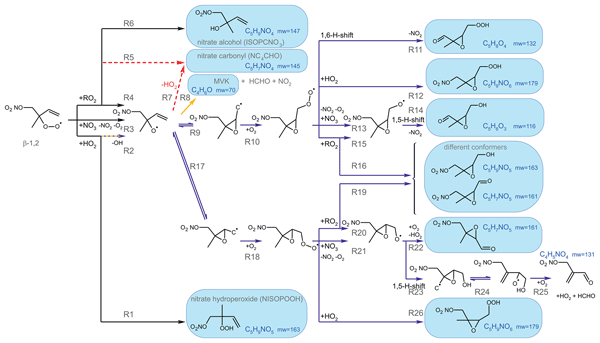
The investigation of the night-time oxidation of the most abundant hydrocarbon, isoprene, in chamber experiments shows the importance of reaction pathways leading to epoxy products, which could enhance particle formation, that have so far not been accounted for. The chemical lifetime of organic nitrates from isoprene is long enough for the majority to be further oxidized the next day by daytime oxidants.
Lenard L. Röder, Patrick Dewald, Clara M. Nussbaumer, Jan Schuladen, John N. Crowley, Jos Lelieveld, and Horst Fischer
Atmos. Meas. Tech., 16, 1167–1178, https://doi.org/10.5194/amt-16-1167-2023, https://doi.org/10.5194/amt-16-1167-2023, 2023
Short summary
Short summary
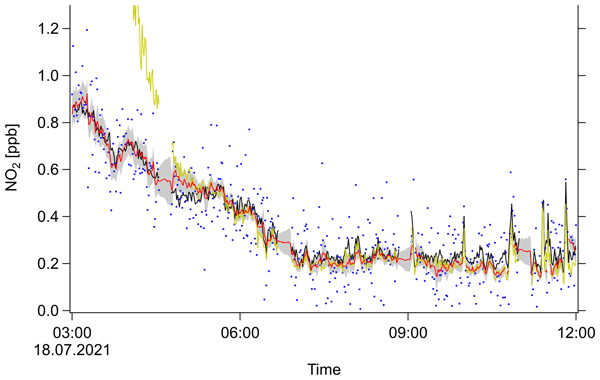
Field experiments in atmospheric chemistry provide insights into chemical interactions of our atmosphere. However, high data coverage and accuracy are needed to enable further analysis. In this study, we explore a statistical method that combines knowledge about the chemical reactions with information from measurements to increase the quality of field experiment datasets. We test the algorithm for several applications and discuss limitations that depend on the specific variable and the dynamics.
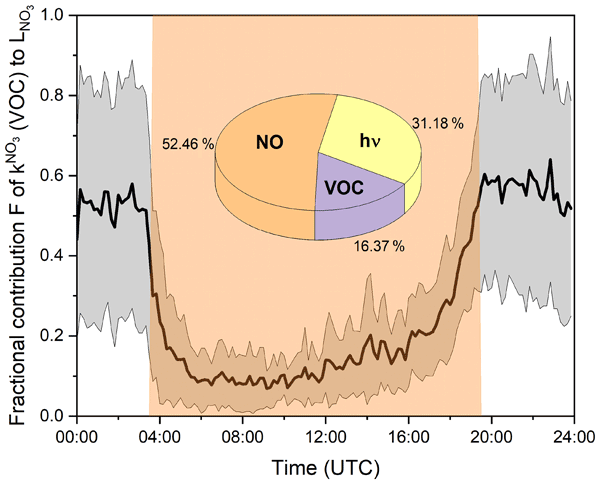
Patrick Dewald, Clara M. Nussbaumer, Jan Schuladen, Akima Ringsdorf, Achim Edtbauer, Horst Fischer, Jonathan Williams, Jos Lelieveld, and John N. Crowley
Atmos. Chem. Phys., 22, 7051–7069, https://doi.org/10.5194/acp-22-7051-2022, https://doi.org/10.5194/acp-22-7051-2022, 2022
Short summary
Short summary
We measured the gas-phase reactivity of the NO3 radical on the summit (825 m a.s.l.) of a semi-rural mountain in southwestern Germany in July 2021. The impact of VOC-induced NO3 losses (mostly monoterpenes) competing with a loss by reaction with NO and photolysis throughout the diel cycle was estimated. Besides chemistry, boundary layer dynamics and plant-physiological processes presumably have a great impact on our observations, which were compared to previous NO3 measurements at the same site.
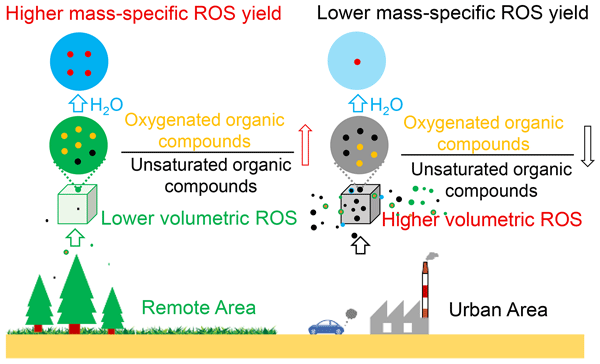
Fobang Liu, Yun Zhang, Siyao Yue, Helmi-Marja K. Keskinen, Tuukka Petäjä, Markku Kulmala, Pingqing Fu, Thorsten Hoffmann, Kai Wang, and Haijie Tong
Atmos. Chem. Phys., 26, 14655–14669, https://doi.org/10.5194/acp-26-14655-2026, https://doi.org/10.5194/acp-26-14655-2026, 2026
Short summary
Short summary
Reactive oxygen species (ROS) produced by airborne particles are linked to adverse health effects, but the organic compounds responsible remain unclear. We developed a new molecular framework to classify complex organic compounds using advanced mass spectrometry. The framework shows that particles rich in oxidized organic compounds produce more ROS per unit mass, while polluted urban air produces more total ROS mainly because of higher particle concentrations.
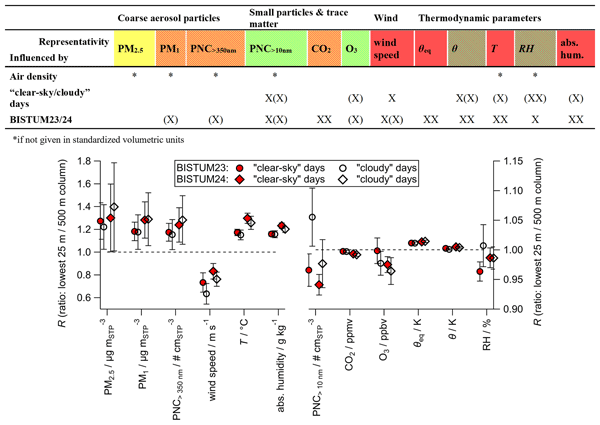
Lasse Moormann, Friederike Fachinger, Holger Tost, and Frank Drewnick
Atmos. Chem. Phys., 26, 14417–14437, https://doi.org/10.5194/acp-26-14417-2026, https://doi.org/10.5194/acp-26-14417-2026, 2026
Short summary
Short summary
Using drone-based vertical profiling, we a) compare the sensitivity of various meteorological and trace substances to detect mixing layer heights at night, b) investigate the dependency of the vertical trace matter distribution on irradiance and mixing layer heights and c) evaluate the representativity of ground-based measured variables for the lowermost troposphere and finally provide suggestions to enhance the representativity of ground-based measurement stations.
Patrick Dewald, Sergio Harb, Bénédicte Picquet-Varrault, Mathieu Cazaunau, Maxime Feingesicht, Lucas Beltran, Vincent Michoud, Xavier Landsheere, Edouard Pangui, Antonin Bergé, Christopher Cantrell, and Manuela Cirtog
EGUsphere, https://doi.org/10.5194/egusphere-2026-5307, https://doi.org/10.5194/egusphere-2026-5307, 2026
Short summary
Short summary
We built an instrument to measure reactive nitrogen compounds in the atmosphere with a focus on the detection of nitrate radicals. They are formed by pollutants such as ozone and nitrogen oxides and are an important nocturnal oxidant of trace gases, thereby indirectly impacting the interconversion of reactive nitrogen and air quality. The instrument’s characterization, performance assessment and the first field deployment are presented.
Gunther N. T. E. Türk, Simone T. Andersen, Patrick Dewald, Jan Schuladen, Jos Lelieveld, and John N. Crowley
Atmos. Meas. Tech., 19, 4815–4832, https://doi.org/10.5194/amt-19-4815-2026, https://doi.org/10.5194/amt-19-4815-2026, 2026
Short summary
Short summary
We built a small instrument to measure the air-borne molecules NO₃ and N₂O₅. These originate mostly from human-made nitrogen oxide emissions and are important for nighttime chemistry and air quality. Our instrument is lightweight and sensitive, detecting these molecules at levels below one part per trillion. Tests in the laboratory and during a field study show its ability to accurately measure these trace gases. Here, we present the design of the instrument and discuss its performance.
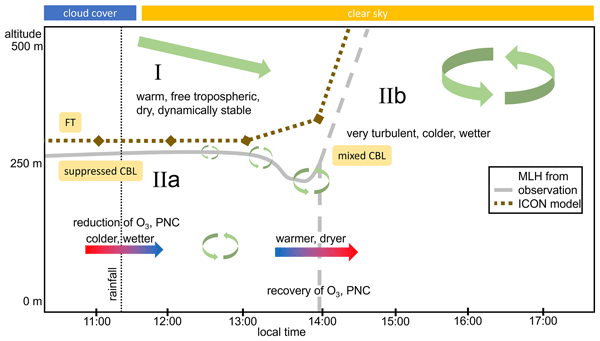
Lasse Moormann, Friederike Fachinger, Frank Drewnick, and Holger Tost
Atmos. Chem. Phys., 26, 8455–8474, https://doi.org/10.5194/acp-26-8455-2026, https://doi.org/10.5194/acp-26-8455-2026, 2026
Short summary
Short summary
We examine boundary layer (BL) processes during summer rain in Germany, focusing on air mass exchange and precipitation effects. Using drone and ground observations, and ICON (ICOsahedral Nonhydrostatic) model data, we link delayed BL breakup and weak vertical mixing to aerosol formation and chemical processes. ICON predicts mixing layer height under stable conditions but underestimates it during cold pool events, enhancing understanding of frontal weather scenarios and atmospheric changes.
Johannes Degen, Nicole Bobrowski, Mélisende M. Bossard, Lucie Boucher, Huilin Chen, Andreas Engel, Bastien H. Geil, Giovanni B. Giuffrida, Steven van Heuven, Thorsten Hoffmann, Niklas Karbach, Gianluigi Ortenzi, and Tanja J. Schuck
EGUsphere, https://doi.org/10.5194/egusphere-2026-1865, https://doi.org/10.5194/egusphere-2026-1865, 2026
This preprint is open for discussion and under review for Atmospheric Measurement Techniques (AMT).
Short summary
Short summary
Observations in volcanic plumes often rely on Uncrewed Aerial Systems (UAS). In July 2024, we used the active AirCore technique with UAS to probe the plumes of Mount Etna (Italy). This was the first time to use this technique inside volcanic plumes. AirCore samples are stored in long coils for laboratory analyses delivering high-quality trace gas measurements. We observed enhanced mole fractions of CO2 and often also of CO. allowing conclusions on oxidation processes inside the crater.
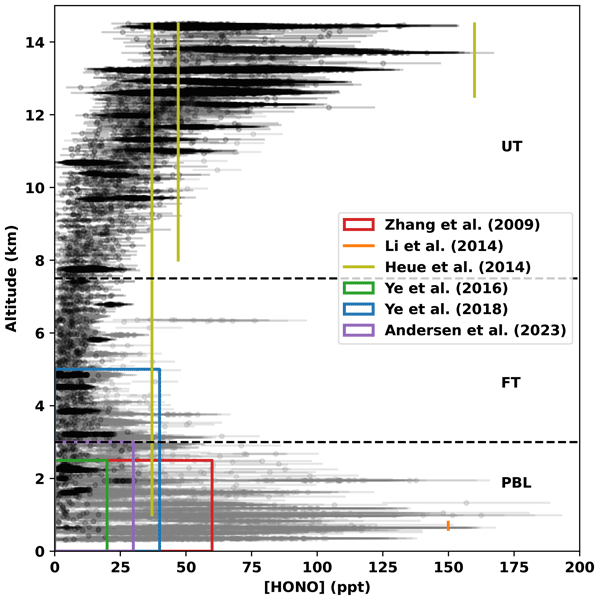
Benjamin Weyland, Simon Rosanka, Domenico Taraborrelli, Birger Bohn, Andreas Zahn, Florian Obersteiner, Eric Förster, Mariano Mertens, Patrick Jöckel, Helmut Ziereis, Katharina Kaiser, Horst Fischer, John N. Crowley, Nijing Wang, Achim Edtbauer, Jonathan Williams, Maria Dolores Andrés Hernández, John P. Burrows, Flora Kluge, Meike K. Rotermund, Andre Butz, and Klaus Pfeilsticker
Atmos. Chem. Phys., 26, 6825–6856, https://doi.org/10.5194/acp-26-6825-2026, https://doi.org/10.5194/acp-26-6825-2026, 2026
Short summary
Short summary
The destruction by sunlight of nitrous acid (HONO) produces the so-called detergent of the atmosphere. HONO has been measured in concentrations which exceed predictions based on known chemistry for decades. Several reactions have been proposed which may explain this excess HONO. This study reports on airborne measurements of HONO; the observations exceed predictions and form a C-shaped profile in the troposphere. Together with a host of other measurements, various reactions are investigated.
Timothy J. Wallington, Markus Ammann, John N. Crowley, Hartmut Herrmann, Michael E. Jenkin, V. Faye McNeill, Abdelwahid Mellouki, and Jürgen Troe
Atmos. Chem. Phys., 26, 6579–6592, https://doi.org/10.5194/acp-26-6579-2026, https://doi.org/10.5194/acp-26-6579-2026, 2026
Short summary
Short summary
Halogenated alkanes, alkenes, and oxygenated compounds play an important role in atmospheric chemistry. This article, the ninth in the series, presents kinetic and photochemical data sheets evaluated by the International Union of Pure and Applied Chemistry (IUPAC) Task Group on Atmospheric Chemical Kinetic Data Evaluation. It covers the gas-phase reactions (with HO radicals, NO3 radicals, and ozone) and photolysis of halogenated organic compounds. These data are important for atmospheric models.
Niklas Karbach, Pauline Pouyes, Emilie Perraudin, Eric Villenave, and Thorsten Hoffmann
EGUsphere, https://doi.org/10.5194/egusphere-2026-2473, https://doi.org/10.5194/egusphere-2026-2473, 2026
Short summary
Short summary
We investigated the chemical composition of organic aerosol near Paris to distinguish contributions from urban emissions and surrounding biogenic sources. By combining high resolution mass spectrometry with statistical clustering and wind information, we identified clear source specific patterns. Urban influence was associated with sulfur and nitrogen containing compounds, whereas biogenic influence was dominated by oxidized organic compounds.
Chenjie Yu, Paola Formenti, Joel F. de Brito, Astrid Bauville, Antonin Bergé, Hichem Bouzidi, Mathieu Cazaunau, Manuela Cirtog, Claudia Di Biagio, Ludovico Di Antonio, Cécile Gaimoz, Franck Maisonneuve, Pascal Zapf, Tobias Seubert, Simone T. Andersen, Patrick Dewald, Gunther N. T. E. Türk, John N. Crowley, Alexandre Kukui, Chaoyang Xue, Cyrielle Denjean, Olivier Garrouste, Jean-Claude Etienne, Huihui Wu, James D. Allan, Dantong Liu, Yangzhou Wu, Christopher Cantrell, and Vincent Michoud
Atmos. Chem. Phys., 26, 5313–5332, https://doi.org/10.5194/acp-26-5313-2026, https://doi.org/10.5194/acp-26-5313-2026, 2026
Short summary
Short summary
We presented a field measurement in a Paris suburban forest region to characterise the impacts of photochemical aging process on aerosol physical chemical properties. Photochemical production of organic aerosols increased forest fine particle mass and significantly enhanced absorption of short-wavelength sunlight. This study highlights the critical need to incorporate light absorbing carbonaceous particles formation mechanisms into models to accurately simulate their direct radiative impacts.
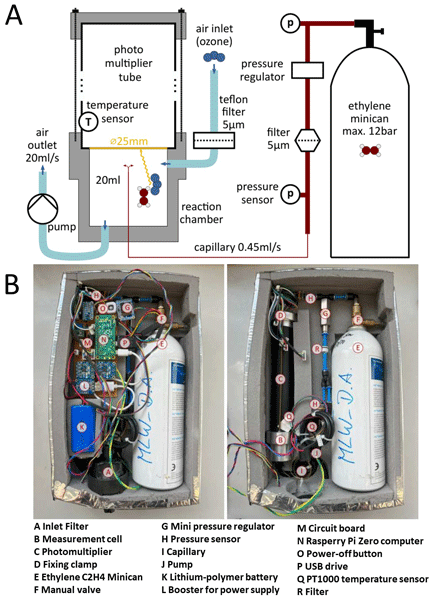
Maja Rüth, Nicole Bobrowski, Ellen Bräutigam, Alexander Nies, Jonas Kuhn, Thorsten Hoffmann, Niklas Karbach, Bastien Geil, Ralph Kleinschek, Stefan Schmitt, and Ulrich Platt
Atmos. Meas. Tech., 19, 2047–2059, https://doi.org/10.5194/amt-19-2047-2026, https://doi.org/10.5194/amt-19-2047-2026, 2026
Short summary
Short summary
UV absorption and electrochemical O3 sensor measurement techniques suffer from interferences, especially from SO2, which is a main constituent of volcanic plumes. Only chemiluminescence (CL) O3 monitors have no known interference with SO2. However, modern CL O3 monitors are impractical because they are heavy and bulky. We developed and applied a lightweight version of a CL O3 instrument (l.5 kg, shoebox size) and present the result of those drone based CL O3 measurements.
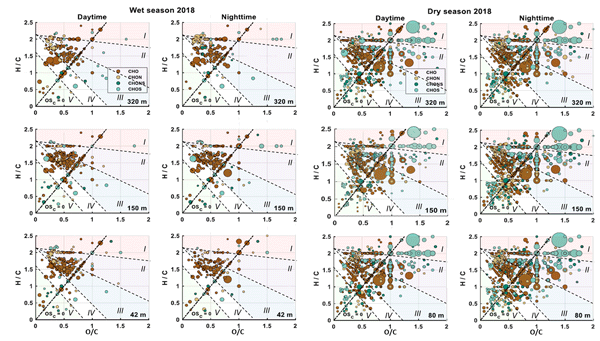
Denis Leppla, Stefanie Hildmann, Nora Zannoni, Leslie A. Kremper, Bruna A. Holanda, Jonathan Williams, Christopher Pöhlker, Stefan Wolff, Marta Sà, Maria Christina Solci, Ulrich Pöschl, and Thorsten Hoffmann
Atmos. Chem. Phys., 26, 365–390, https://doi.org/10.5194/acp-26-365-2026, https://doi.org/10.5194/acp-26-365-2026, 2026
Short summary
Short summary
The chemical composition of organic particles in the Amazon rainforest was investigated to understand how biogenic and human emissions influence the atmosphere in this unique ecosystem. Seasonal patterns were found where wet seasons were dominated by biogenic compounds from natural sources while dry seasons showed increased fire-related pollutants. These findings reveal how emissions, fires and long-range transport affect atmospheric chemistry, with implications for climate models.
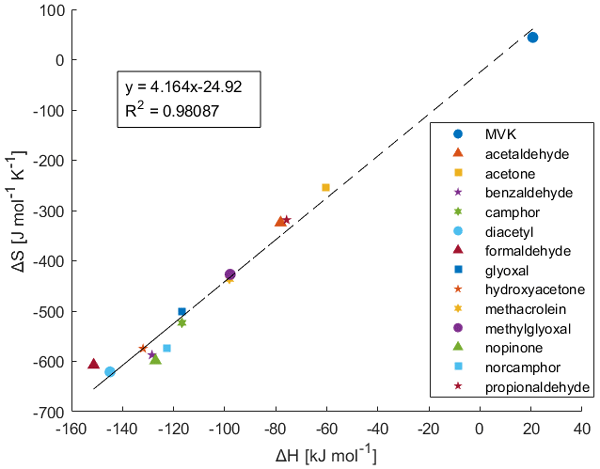
Jackson Seymore, Miklós Szakáll, Alexander Theis, Subir K. Mitra, Christine Borchers, and Thorsten Hoffmann
Atmos. Chem. Phys., 25, 18249–18265, https://doi.org/10.5194/acp-25-18249-2025, https://doi.org/10.5194/acp-25-18249-2025, 2025
Short summary
Short summary
Laboratory studies examined carbonyl deposition into ice crystals using a flowtube setup. Ice crystals were grown under conditions that mimic cirrus clouds in the presence of carbonyl vapors. Ice and gas samples were collected and analyzed to calculate ice uptake coefficients for 14 carbonyls at different temperatures. This revealed an inverse relationship between uptake and temperature. Vapor pressure and molar mass were found to be the most significant factors in uptake.
Christine Borchers, Lasse Moormann, Bastien Geil, Niklas Karbach, David Wasserzier, and Thorsten Hoffmann
Atmos. Meas. Tech., 18, 7231–7242, https://doi.org/10.5194/amt-18-7231-2025, https://doi.org/10.5194/amt-18-7231-2025, 2025
Short summary
Short summary
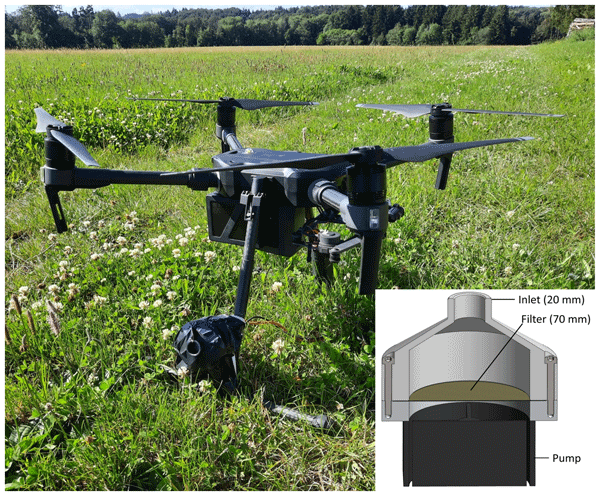
A three-dimensionally printed filter holder is connected to a lightweight, high-performance pump. This sampling system allows for easy and cost-effective measurements of organic aerosols at different heights and locations. By elucidating the chemical composition of organic aerosol, sources and processing of the compounds can be identified. Measurements at different altitudes and times of the day provide insight into the chemical aging and daytime trends of the aerosol particles.
Anna Breuninger, Philipp Joppe, Jonas Wilsch, Cornelis Schwenk, Heiko Bozem, Nicolas Emig, Laurin Merkel, Rainer Rossberg, Timo Keber, Arthur Kutschka, Philipp Waleska, Stefan Hofmann, Sarah Richter, Florian Ungeheuer, Konstantin Dörholt, Thorsten Hoffmann, Annette Miltenberger, Johannes Schneider, Peter Hoor, and Alexander L. Vogel
Atmos. Chem. Phys., 25, 16533–16551, https://doi.org/10.5194/acp-25-16533-2025, https://doi.org/10.5194/acp-25-16533-2025, 2025
Short summary
Short summary
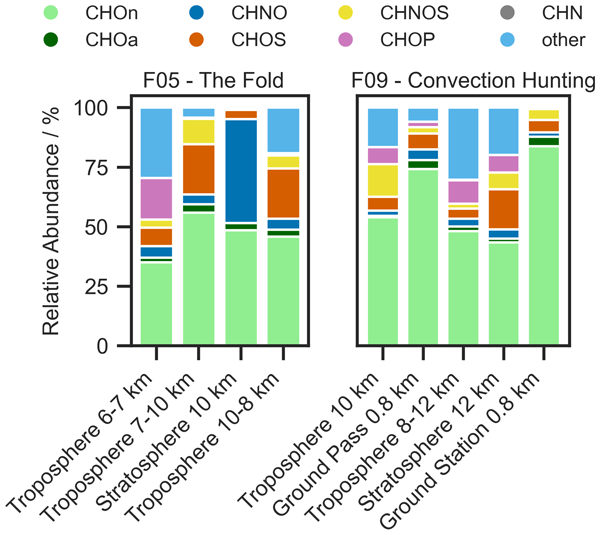
This study investigates molecular organic aerosol composition in the upper troposphere and lower stratosphere from an airborne campaign over Central Europe in summer 2024. Via ultra-high-performance liquid chromatography and high-resolution mass spectrometry of tropospheric and stratospheric filter samples, we identified various organic compounds. Our findings underscore the significant cross-tropopause transport of biogenic secondary organic aerosol and anthropogenic pollutants.
Jackson Seymore, Martanda Gautam, Miklós Szakáll, Alexander Theis, Thorsten Hoffmann, Jialiang Ma, Lingli Zhou, and Alexander L. Vogel
Atmos. Chem. Phys., 25, 11829–11845, https://doi.org/10.5194/acp-25-11829-2025, https://doi.org/10.5194/acp-25-11829-2025, 2025
Short summary
Short summary
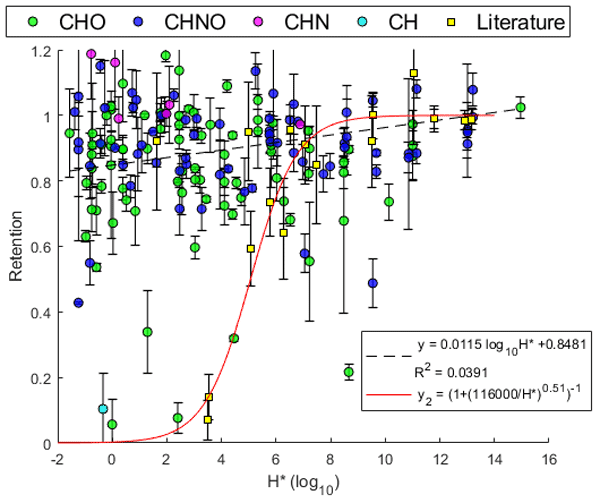
We investigated the chemical retention of water-soluble organic compounds in Beijing aerosols using an acoustic levitator and drop-freezing experiments. Samples from PM2.5 filter extracts were frozen at -15 °C in an acoustic levitator without artificial nucleators and analyzed using ultra-high resolution mass spectrometry. Our findings reveal a non-normal distribution of retention coefficients that differs from current literature on cloud droplets.
Simone T. Andersen, Rolf Sander, Patrick Dewald, Laura Wüst, Tobias Seubert, Gunther N. T. E. Türk, Jan Schuladen, Max R. McGillen, Chaoyang Xue, Abdelwahid Mellouki, Alexandre Kukui, Vincent Michoud, Manuela Cirtog, Mathieu Cazaunau, Astrid Bauville, Hichem Bouzidi, Paola Formenti, Cyrielle Denjean, Jean-Claude Etienne, Olivier Garrouste, Christopher Cantrell, Jos Lelieveld, and John N. Crowley
Atmos. Chem. Phys., 25, 5893–5909, https://doi.org/10.5194/acp-25-5893-2025, https://doi.org/10.5194/acp-25-5893-2025, 2025
Short summary
Short summary
Measurements and modelling of reactive nitrogen gases observed in a suburban temperate forest in Rambouillet, France, circa 50 km southwest of Paris in 2022 indicate that the biosphere rapidly scavenges organic nitrates of mixed biogenic and anthropogenic origin, resulting in short lifetimes for, for example, alkyl nitrates and peroxy nitrates.
Laura Wüst, Patrick Dewald, Gunther N. T. E. Türk, Jos Lelieveld, and John N. Crowley
Atmos. Meas. Tech., 18, 1943–1959, https://doi.org/10.5194/amt-18-1943-2025, https://doi.org/10.5194/amt-18-1943-2025, 2025
Short summary
Short summary
Detection of NO2 via cavity ring-down spectroscopy (CRDS) after thermal dissociation (TD) of alkyl and peroxy nitrates can be used to detect total atmospheric organic nitrates originating from the interaction between biogenic emissions of volatile organic compounds and nitrogen oxides of anthropogenic origin. Here we present an improved TD-CRDS technique that avoids systematic bias resulting from secondary chemistry in the heated inlets and that can be deployed in regions with strong biogenic emissions.
Lasse Moormann, Thomas Böttger, Philipp Schuhmann, Luis Valero, Friederike Fachinger, and Frank Drewnick
Atmos. Meas. Tech., 18, 1441–1459, https://doi.org/10.5194/amt-18-1441-2025, https://doi.org/10.5194/amt-18-1441-2025, 2025
Short summary
Short summary
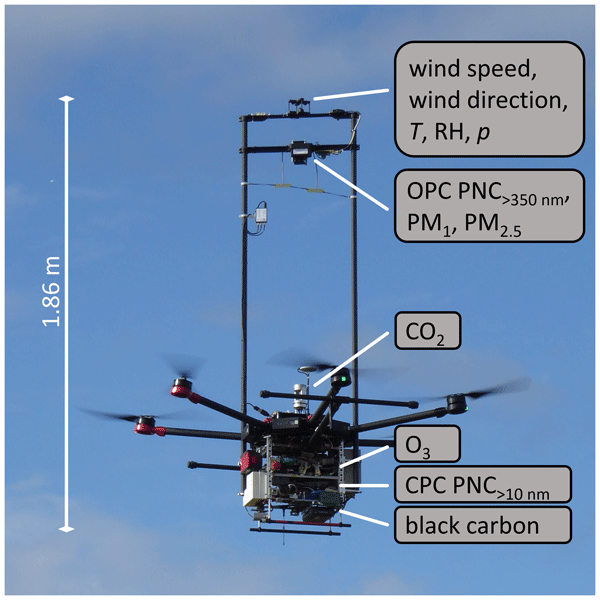
The drone-based Flying Laboratory FLab was developed to simultaneously measure aerosol (number concentration, size distribution, and black carbon), trace gas (O3, CO2), and meteorological variables. FLab was characterized in the field regarding limitations and biases due to different flight maneuvers. Two application cases are presented: analysis of the development of the lowermost troposphere (up to 300 m) and successfully bridging ground-based and aircraft- and radiosonde-based measurements.
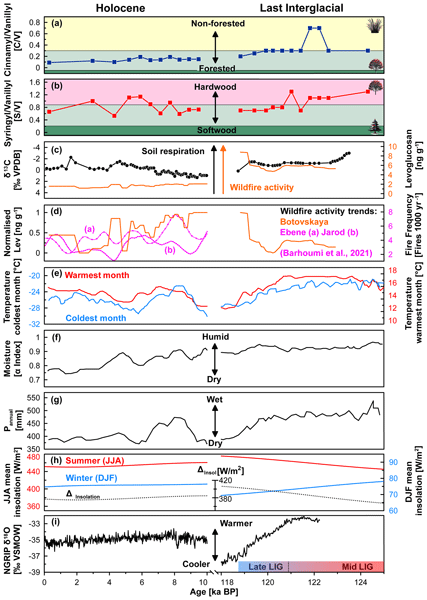
Jade Margerum, Julia Homann, Stuart Umbo, Gernot Nehrke, Thorsten Hoffmann, Anton Vaks, Aleksandr Kononov, Alexander Osintsev, Alena Giesche, Andrew Mason, Franziska A. Lechleitner, Gideon M. Henderson, Ola Kwiecien, and Sebastian F. M. Breitenbach
Clim. Past, 21, 661–677, https://doi.org/10.5194/cp-21-661-2025, https://doi.org/10.5194/cp-21-661-2025, 2025
Short summary
Short summary
We analyse a southern Siberian stalagmite to reconstruct soil respiration, wildfire, and vegetation trends during the Last Interglacial (LIG) (124.1–118.8 ka) and the Holocene (10–0 ka). Wildfires were more prevalent during the LIG than the Holocene and were supported by fire-prone species, low soil respiration, and a greater difference between summer and winter temperature. We show that vegetation type and summer/winter temperature contrast are strong drivers of Siberian wildfires.
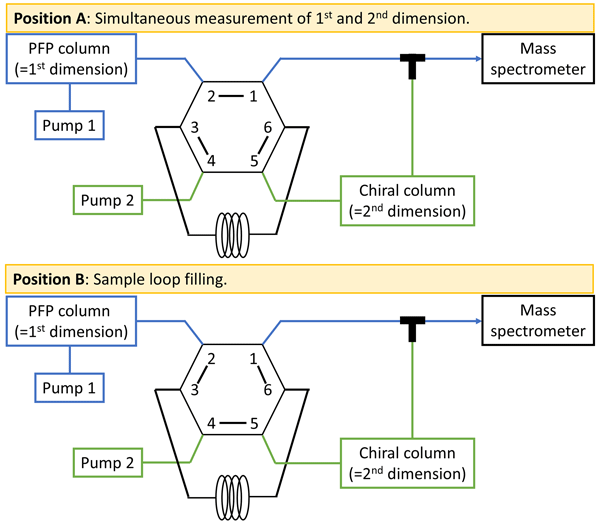
Johanna Schäfer, Anja Beschnitt, François Burgay, Thomas Singer, Margit Schwikowski, and Thorsten Hoffmann
Atmos. Meas. Tech., 18, 421–430, https://doi.org/10.5194/amt-18-421-2025, https://doi.org/10.5194/amt-18-421-2025, 2025
Short summary
Short summary
Glaciers preserve organic compounds from atmospheric aerosols, which can serve as markers for emission sources. Most studies overlook the enantiomers of chiral compounds. We developed a two-dimensional liquid chromatography method to determine the chiral ratios of the monoterpene oxidation products cis-pinic acid and cis-pinonic acid in ice-core samples. Applied to samples from the Belukha Glacier (1870–1970 CE), the method revealed fluctuating chiral ratios for the analytes.
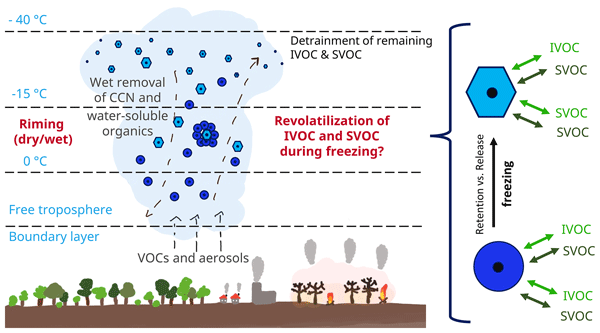
Christine Borchers, Jackson Seymore, Martanda Gautam, Konstantin Dörholt, Yannik Müller, Andreas Arndt, Laura Gömmer, Florian Ungeheuer, Miklós Szakáll, Stephan Borrmann, Alexander Theis, Alexander L. Vogel, and Thorsten Hoffmann
Atmos. Chem. Phys., 24, 13961–13974, https://doi.org/10.5194/acp-24-13961-2024, https://doi.org/10.5194/acp-24-13961-2024, 2024
Short summary
Short summary
Riming, a crucial process in cloud dynamics, influences the vertical distribution of compounds in the atmosphere. Experiments in Mainz's wind tunnel investigated retention coefficients of organic compounds under varying conditions. Findings suggest a correlation between the Henry's law constant and retention, applicable even to complex organic molecules.
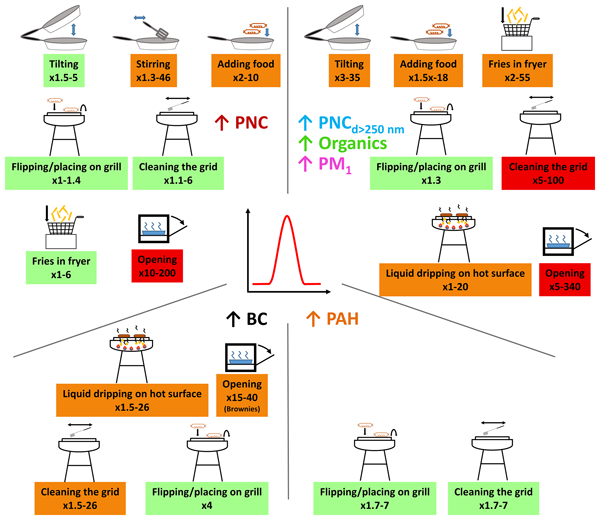
Julia Pikmann, Frank Drewnick, Friederike Fachinger, and Stephan Borrmann
Atmos. Chem. Phys., 24, 12295–12321, https://doi.org/10.5194/acp-24-12295-2024, https://doi.org/10.5194/acp-24-12295-2024, 2024
Short summary
Short summary
Cooking activities can contribute substantially to indoor and ambient aerosol. We performed a comprehensive study with laboratory measurements cooking 19 different dishes and ambient measurements at two Christmas markets measuring various particle properties and trace gases of emissions in real time. Similar emission characteristics were observed for dishes with the same preparation method, mainly due to similar cooking temperature and use of oil, with barbecuing as an especially strong source.
Simone T. Andersen, Max R. McGillen, Chaoyang Xue, Tobias Seubert, Patrick Dewald, Gunther N. T. E. Türk, Jan Schuladen, Cyrielle Denjean, Jean-Claude Etienne, Olivier Garrouste, Marina Jamar, Sergio Harb, Manuela Cirtog, Vincent Michoud, Mathieu Cazaunau, Antonin Bergé, Christopher Cantrell, Sebastien Dusanter, Bénédicte Picquet-Varrault, Alexandre Kukui, Abdelwahid Mellouki, Lucy J. Carpenter, Jos Lelieveld, and John N. Crowley
Atmos. Chem. Phys., 24, 11603–11618, https://doi.org/10.5194/acp-24-11603-2024, https://doi.org/10.5194/acp-24-11603-2024, 2024
Short summary
Short summary
Using measurements of various trace gases in a suburban forest near Paris in the summer of 2022, we were able to gain insight into the sources and sinks of NOx (NO+NO2) with a special focus on their nighttime chemical and physical loss processes. NO was observed as a result of nighttime soil emissions when O3 levels were strongly depleted by deposition. NO oxidation products were not observed at night, indicating that soil and/or foliar surfaces are an efficient sink of reactive N.
Patrick Dewald, Tobias Seubert, Simone T. Andersen, Gunther N. T. E. Türk, Jan Schuladen, Max R. McGillen, Cyrielle Denjean, Jean-Claude Etienne, Olivier Garrouste, Marina Jamar, Sergio Harb, Manuela Cirtog, Vincent Michoud, Mathieu Cazaunau, Antonin Bergé, Christopher Cantrell, Sebastien Dusanter, Bénédicte Picquet-Varrault, Alexandre Kukui, Chaoyang Xue, Abdelwahid Mellouki, Jos Lelieveld, and John N. Crowley
Atmos. Chem. Phys., 24, 8983–8997, https://doi.org/10.5194/acp-24-8983-2024, https://doi.org/10.5194/acp-24-8983-2024, 2024
Short summary
Short summary
In the scope of a field campaign in a suburban forest near Paris in the summer of 2022, we measured the reactivity of the nitrate radical NO3 towards biogenic volatile organic compounds (BVOCs; e.g. monoterpenes) mainly below but also above the canopy. NO3 reactivity was the highest during nights with strong temperature inversions and decreased strongly with height. Reactions with BVOCs were the main removal process of NO3 throughout the diel cycle below the canopy.
Niklas Karbach, Lisa Höhler, Peter Hoor, Heiko Bozem, Nicole Bobrowski, and Thorsten Hoffmann
Atmos. Meas. Tech., 17, 4081–4086, https://doi.org/10.5194/amt-17-4081-2024, https://doi.org/10.5194/amt-17-4081-2024, 2024
Short summary
Short summary
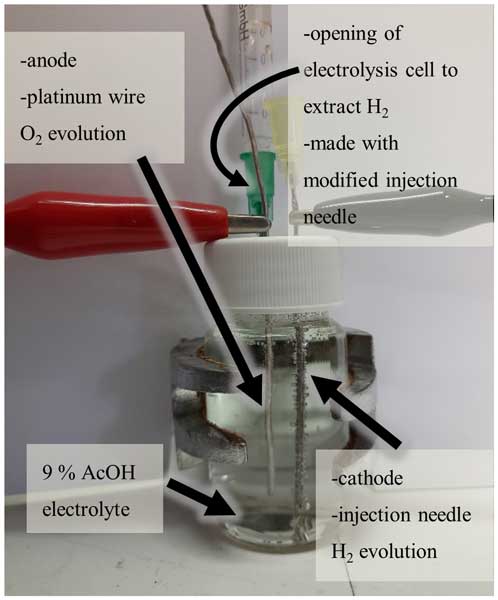
The system presented here can accurately generate and reproduce a stable flow of gas mixtures of known concentrations over several days using ambient air as a dilution medium. In combination with the small size and low weight of the system, this enables the calibration of hydrogen sensors in the field, reducing the influence of matrix effects on the accuracy of the sensor. The system is inexpensive to assemble and easy to maintain, which is the key to reliable measurement results.
Julia Homann, Niklas Karbach, Stacy A. Carolin, Daniel H. James, David Hodell, Sebastian F. M. Breitenbach, Ola Kwiecien, Mark Brenner, Carlos Peraza Lope, and Thorsten Hoffmann
Biogeosciences, 20, 3249–3260, https://doi.org/10.5194/bg-20-3249-2023, https://doi.org/10.5194/bg-20-3249-2023, 2023
Short summary
Short summary
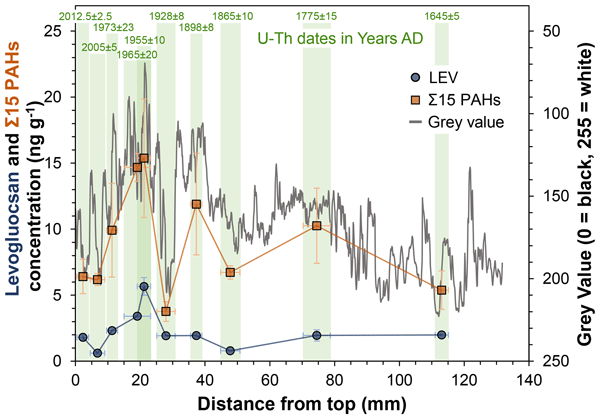
Cave stalagmites contain substances that can be used to reconstruct past changes in local and regional environmental conditions. We used two classes of biomarkers (polycyclic aromatic hydrocarbons and monosaccharide anhydrides) to detect the presence of fire and to also explore changes in fire regime (e.g. fire frequency, intensity, and fuel source). We tested our new method on a stalagmite from Mayapan, a large Maya city on the Yucatán Peninsula.
Julia Pikmann, Lasse Moormann, Frank Drewnick, and Stephan Borrmann
Atmos. Meas. Tech., 16, 1323–1341, https://doi.org/10.5194/amt-16-1323-2023, https://doi.org/10.5194/amt-16-1323-2023, 2023
Short summary
Short summary
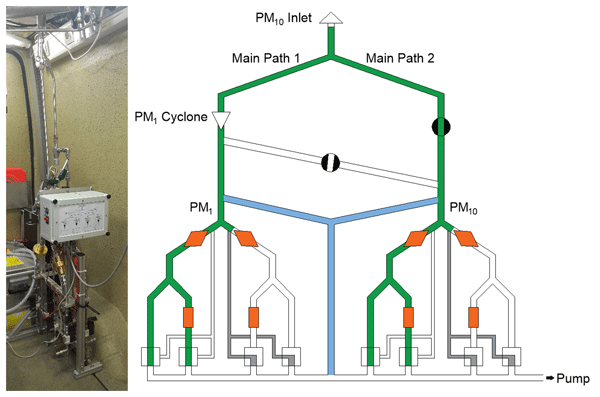
Aerosols measured in complex environments are usually a mixture of emissions from different sources. To characterize sources individually, we developed a sampling system for particles and organic trace gases which is coupled to real-time data of physical and chemical aerosol properties, gas concentrations, and meteorological variables. Using suitable sampling conditions for individual aerosols which are compared with the real-time data the desired aerosols are sampled separately from each other.
Philip T. M. Carlsson, Luc Vereecken, Anna Novelli, François Bernard, Steven S. Brown, Bellamy Brownwood, Changmin Cho, John N. Crowley, Patrick Dewald, Peter M. Edwards, Nils Friedrich, Juliane L. Fry, Mattias Hallquist, Luisa Hantschke, Thorsten Hohaus, Sungah Kang, Jonathan Liebmann, Alfred W. Mayhew, Thomas Mentel, David Reimer, Franz Rohrer, Justin Shenolikar, Ralf Tillmann, Epameinondas Tsiligiannis, Rongrong Wu, Andreas Wahner, Astrid Kiendler-Scharr, and Hendrik Fuchs
Atmos. Chem. Phys., 23, 3147–3180, https://doi.org/10.5194/acp-23-3147-2023, https://doi.org/10.5194/acp-23-3147-2023, 2023
Short summary
Short summary
The investigation of the night-time oxidation of the most abundant hydrocarbon, isoprene, in chamber experiments shows the importance of reaction pathways leading to epoxy products, which could enhance particle formation, that have so far not been accounted for. The chemical lifetime of organic nitrates from isoprene is long enough for the majority to be further oxidized the next day by daytime oxidants.
Lenard L. Röder, Patrick Dewald, Clara M. Nussbaumer, Jan Schuladen, John N. Crowley, Jos Lelieveld, and Horst Fischer
Atmos. Meas. Tech., 16, 1167–1178, https://doi.org/10.5194/amt-16-1167-2023, https://doi.org/10.5194/amt-16-1167-2023, 2023
Short summary
Short summary
Field experiments in atmospheric chemistry provide insights into chemical interactions of our atmosphere. However, high data coverage and accuracy are needed to enable further analysis. In this study, we explore a statistical method that combines knowledge about the chemical reactions with information from measurements to increase the quality of field experiment datasets. We test the algorithm for several applications and discuss limitations that depend on the specific variable and the dynamics.
Denis Leppla, Nora Zannoni, Leslie Kremper, Jonathan Williams, Christopher Pöhlker, Marta Sá, Maria Christina Solci, and Thorsten Hoffmann
Atmos. Chem. Phys., 23, 809–820, https://doi.org/10.5194/acp-23-809-2023, https://doi.org/10.5194/acp-23-809-2023, 2023
Short summary
Short summary
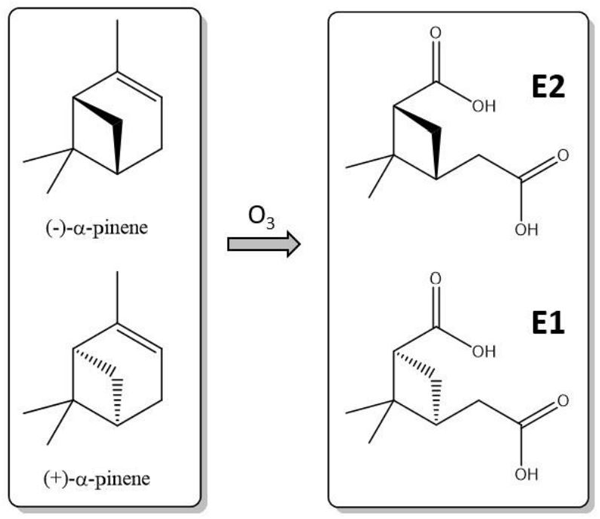
Chiral chemodiversity plays a critical role in biochemical processes such as insect and plant communication. Here we report on the measurement of chiral-specified secondary organic aerosol in the Amazon rainforest. The results show that the chiral ratio is mainly determined by large-scale emission processes. Characteristic emissions of chiral aerosol precursors from different forest ecosystems can thus provide large-scale information on different biogenic sources via chiral particle analysis.
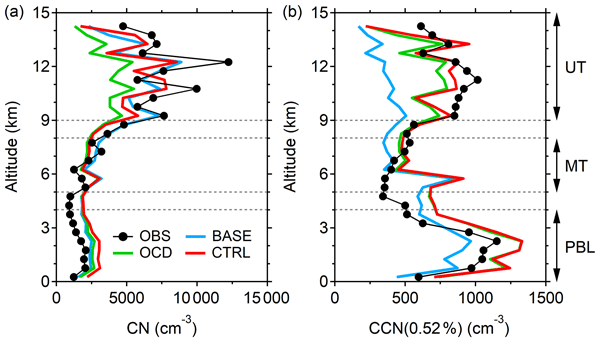
Yunfan Liu, Hang Su, Siwen Wang, Chao Wei, Wei Tao, Mira L. Pöhlker, Christopher Pöhlker, Bruna A. Holanda, Ovid O. Krüger, Thorsten Hoffmann, Manfred Wendisch, Paulo Artaxo, Ulrich Pöschl, Meinrat O. Andreae, and Yafang Cheng
Atmos. Chem. Phys., 23, 251–272, https://doi.org/10.5194/acp-23-251-2023, https://doi.org/10.5194/acp-23-251-2023, 2023
Short summary
Short summary
The origins of the abundant cloud condensation nuclei (CCN) in the upper troposphere (UT) of the Amazon remain unclear. With model developments of new secondary organic aerosol schemes and constrained by observation, we show that strong aerosol nucleation and condensation in the UT is triggered by biogenic organics, and organic condensation is key for UT CCN production. This UT CCN-producing mechanism may prevail over broader vegetation canopies and deserves emphasis in aerosol–climate feedback.
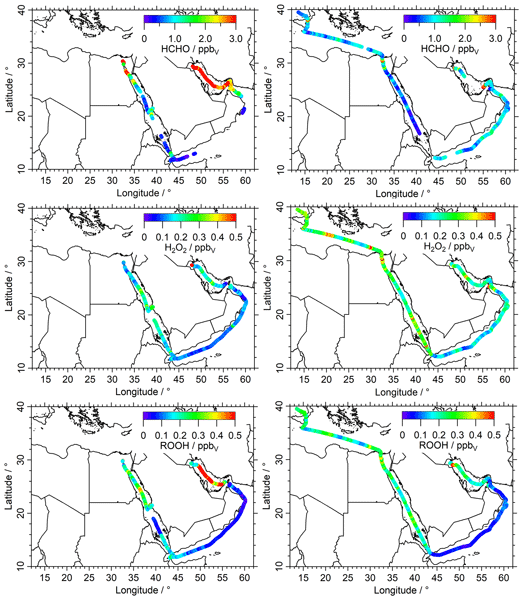
Dirk Dienhart, Bettina Brendel, John N. Crowley, Philipp G. Eger, Hartwig Harder, Monica Martinez, Andrea Pozzer, Roland Rohloff, Jan Schuladen, Sebastian Tauer, David Walter, Jos Lelieveld, and Horst Fischer
Atmos. Chem. Phys., 23, 119–142, https://doi.org/10.5194/acp-23-119-2023, https://doi.org/10.5194/acp-23-119-2023, 2023
Short summary
Short summary
Formaldehyde and hydroperoxide measurements were performed in the marine boundary layer around the Arabian Peninsula and highlight the Suez Canal and Arabian (Persian) Gulf as a hotspot of photochemical air pollution. A comparison with the EMAC model shows that the formaldehyde results match within a factor of 2, while hydrogen peroxide was overestimated by more than a factor of 5, which revealed enhanced HOx (OH+HO2) radicals in the simulation and an underestimation of dry deposition velocites.
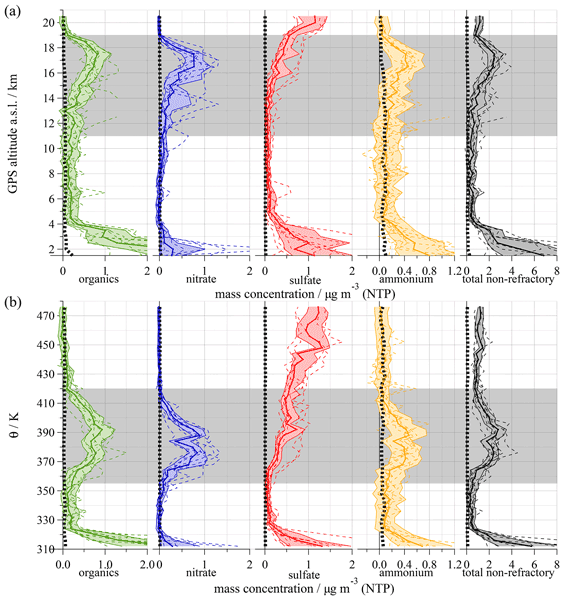
Oliver Appel, Franziska Köllner, Antonis Dragoneas, Andreas Hünig, Sergej Molleker, Hans Schlager, Christoph Mahnke, Ralf Weigel, Max Port, Christiane Schulz, Frank Drewnick, Bärbel Vogel, Fred Stroh, and Stephan Borrmann
Atmos. Chem. Phys., 22, 13607–13630, https://doi.org/10.5194/acp-22-13607-2022, https://doi.org/10.5194/acp-22-13607-2022, 2022
Short summary
Short summary
This paper clarifies the chemical composition of the Asian tropopause aerosol layer (ATAL) by means of airborne in situ aerosol mass spectrometry (AMS). Ammonium nitrate and organics are found to significantly contribute to the particle layer, while sulfate does not show a layered structure. An analysis of the single-particle mass spectra suggests that secondary particle formation and subsequent growth dominate the particle composition, rather than condensation on pre-existing primary particles.
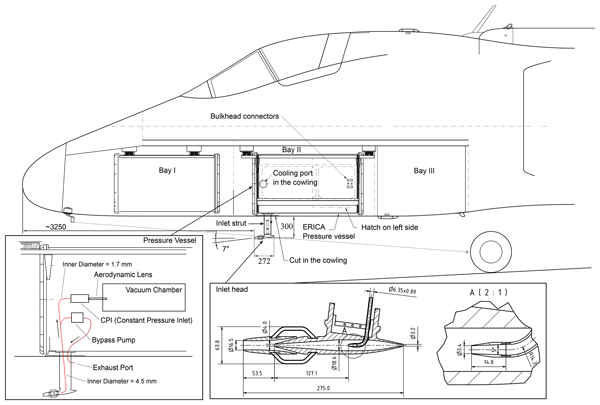
Antonis Dragoneas, Sergej Molleker, Oliver Appel, Andreas Hünig, Thomas Böttger, Markus Hermann, Frank Drewnick, Johannes Schneider, Ralf Weigel, and Stephan Borrmann
Atmos. Meas. Tech., 15, 5719–5742, https://doi.org/10.5194/amt-15-5719-2022, https://doi.org/10.5194/amt-15-5719-2022, 2022
Short summary
Short summary
The ERICA is a specially designed aerosol particle mass spectrometer for in situ, real-time chemical composition analysis of aerosols. It can operate completely autonomously, in the absence of an instrument operator. Its design has enabled its operation under harsh conditions, like those experienced in the upper troposphere and lower stratosphere, aboard unpressurized high-altitude research aircraft. The instrument has successfully participated in several aircraft operations around the world.
Charlotte M. Beall, Thomas C. J. Hill, Paul J. DeMott, Tobias Köneman, Michael Pikridas, Frank Drewnick, Hartwig Harder, Christopher Pöhlker, Jos Lelieveld, Bettina Weber, Minas Iakovides, Roman Prokeš, Jean Sciare, Meinrat O. Andreae, M. Dale Stokes, and Kimberly A. Prather
Atmos. Chem. Phys., 22, 12607–12627, https://doi.org/10.5194/acp-22-12607-2022, https://doi.org/10.5194/acp-22-12607-2022, 2022
Short summary
Short summary
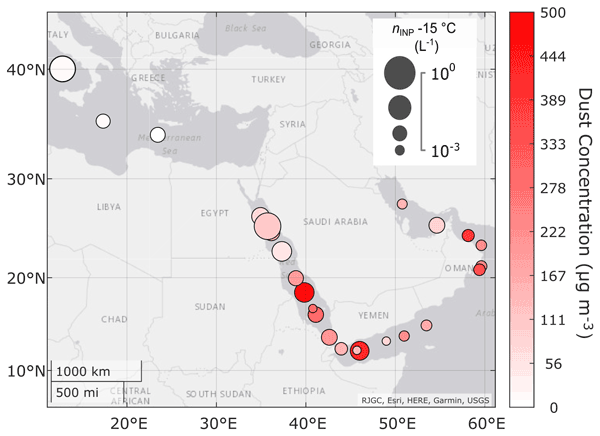
Ice-nucleating particles (INPs) are rare aerosols that can trigger ice formation in clouds and affect climate-relevant cloud properties such as phase, reflectivity and lifetime. Dust is the dominant INP source, yet few measurements have been reported near major dust sources. We report INP observations within hundreds of kilometers of the biggest dust source regions globally: the Sahara and the Arabian Peninsula. Results show that at temperatures > −15 °C, INPs are dominated by organics.
Simon F. Reifenberg, Anna Martin, Matthias Kohl, Sara Bacer, Zaneta Hamryszczak, Ivan Tadic, Lenard Röder, Daniel J. Crowley, Horst Fischer, Katharina Kaiser, Johannes Schneider, Raphael Dörich, John N. Crowley, Laura Tomsche, Andreas Marsing, Christiane Voigt, Andreas Zahn, Christopher Pöhlker, Bruna A. Holanda, Ovid Krüger, Ulrich Pöschl, Mira Pöhlker, Patrick Jöckel, Marcel Dorf, Ulrich Schumann, Jonathan Williams, Birger Bohn, Joachim Curtius, Hardwig Harder, Hans Schlager, Jos Lelieveld, and Andrea Pozzer
Atmos. Chem. Phys., 22, 10901–10917, https://doi.org/10.5194/acp-22-10901-2022, https://doi.org/10.5194/acp-22-10901-2022, 2022
Short summary
Short summary
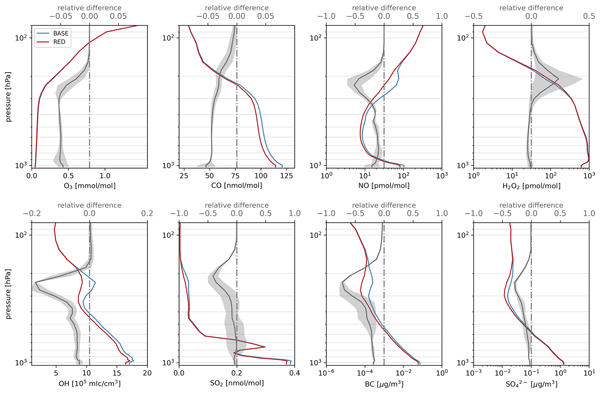
In this work we use a combination of observational data from an aircraft campaign and model results to investigate the effect of the European lockdown due to COVID-19 in spring 2020. Using model results, we show that the largest relative changes to the atmospheric composition caused by the reduced emissions are located in the upper troposphere around aircraft cruise altitude, while the largest absolute changes are present at the surface.
Jing Duan, Ru-Jin Huang, Yifang Gu, Chunshui Lin, Haobin Zhong, Wei Xu, Quan Liu, Yan You, Jurgita Ovadnevaite, Darius Ceburnis, Thorsten Hoffmann, and Colin O'Dowd
Atmos. Chem. Phys., 22, 10139–10153, https://doi.org/10.5194/acp-22-10139-2022, https://doi.org/10.5194/acp-22-10139-2022, 2022
Short summary
Short summary
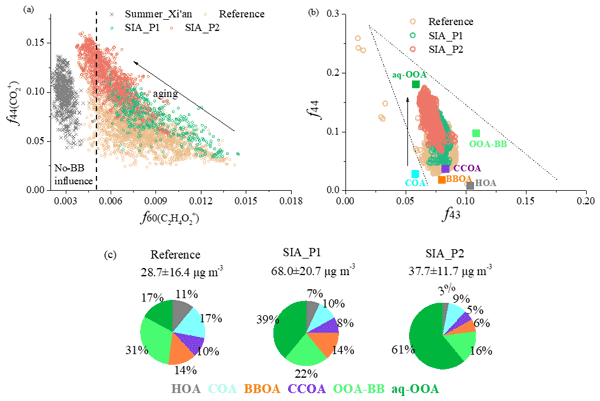
Biomass-burning-influenced oxygenated organic aerosol (OOA-BB), formed from the photochemical oxidation and aging of biomass burning OA (BBOA), was resolved in urban Xi’an. The aqueous-phase processed oxygenated OA (aq-OOA) concentration was more dependent on secondary inorganic aerosol (SIA) content and aerosol liquid water content (ALWC). The increased aq-OOA contribution during SIA-enhanced periods likely reflects OA evolution due to the addition of alcohol or peroxide groups
Marco Wietzoreck, Marios Kyprianou, Benjamin A. Musa Bandowe, Siddika Celik, John N. Crowley, Frank Drewnick, Philipp Eger, Nils Friedrich, Minas Iakovides, Petr Kukučka, Jan Kuta, Barbora Nežiková, Petra Pokorná, Petra Přibylová, Roman Prokeš, Roland Rohloff, Ivan Tadic, Sebastian Tauer, Jake Wilson, Hartwig Harder, Jos Lelieveld, Ulrich Pöschl, Euripides G. Stephanou, and Gerhard Lammel
Atmos. Chem. Phys., 22, 8739–8766, https://doi.org/10.5194/acp-22-8739-2022, https://doi.org/10.5194/acp-22-8739-2022, 2022
Short summary
Short summary
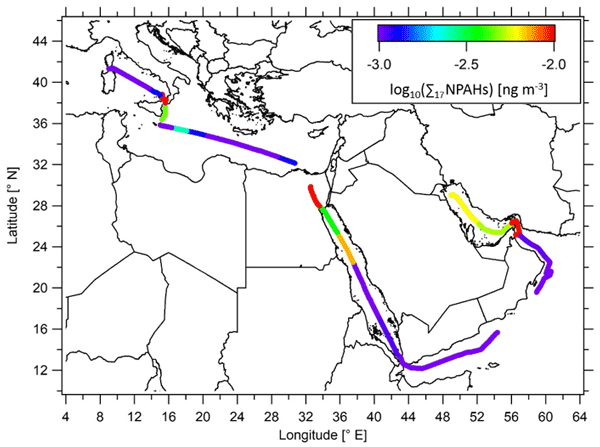
A unique dataset of concentrations and sources of polycyclic aromatic hydrocarbons (PAHs) and their alkylated, oxygenated and nitrated derivatives, in total 74 individual species, in the marine atmosphere is presented. Exposure to these substances poses a major health risk. We found very low concentrations over the Arabian Sea, while both local and long-range-transported pollution caused elevated levels over the Mediterranean Sea and the Arabian Gulf.
Patrick Dewald, Clara M. Nussbaumer, Jan Schuladen, Akima Ringsdorf, Achim Edtbauer, Horst Fischer, Jonathan Williams, Jos Lelieveld, and John N. Crowley
Atmos. Chem. Phys., 22, 7051–7069, https://doi.org/10.5194/acp-22-7051-2022, https://doi.org/10.5194/acp-22-7051-2022, 2022
Short summary
Short summary
We measured the gas-phase reactivity of the NO3 radical on the summit (825 m a.s.l.) of a semi-rural mountain in southwestern Germany in July 2021. The impact of VOC-induced NO3 losses (mostly monoterpenes) competing with a loss by reaction with NO and photolysis throughout the diel cycle was estimated. Besides chemistry, boundary layer dynamics and plant-physiological processes presumably have a great impact on our observations, which were compared to previous NO3 measurements at the same site.
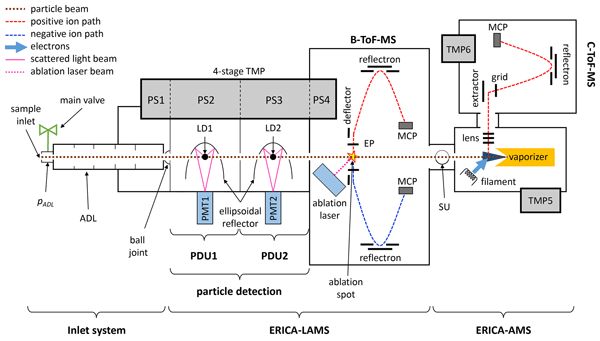
Andreas Hünig, Oliver Appel, Antonis Dragoneas, Sergej Molleker, Hans-Christian Clemen, Frank Helleis, Thomas Klimach, Franziska Köllner, Thomas Böttger, Frank Drewnick, Johannes Schneider, and Stephan Borrmann
Atmos. Meas. Tech., 15, 2889–2921, https://doi.org/10.5194/amt-15-2889-2022, https://doi.org/10.5194/amt-15-2889-2022, 2022
Short summary
Short summary
We have serially combined the two well-established methods for in situ real-time measurement of fine particle chemical composition, the single-particle laser ablation method and the flash evaporation with electron impact ionization method, into a novel instrument. Here we present the design; instrument characteristics, as derived from laboratory and field measurements; and results from the first field deployment during the 2017 StratoClim aircraft campaign.

Wenyu Sun, Matias Berasategui, Andrea Pozzer, Jos Lelieveld, and John N. Crowley
Atmos. Chem. Phys., 22, 4969–4984, https://doi.org/10.5194/acp-22-4969-2022, https://doi.org/10.5194/acp-22-4969-2022, 2022
Short summary
Short summary
The reaction between OH and SO2 is a termolecular process that in the atmosphere results in the formation of H2SO4 and thus aerosols. We present the first temperature- and pressure-dependent measurements of the rate coefficients in N2. This is also the first study to examine the effects of water vapour on the kinetics of this reaction. Our results indicate the rate coefficient is larger than that recommended by evaluation panels, with deviations of up to 30 % in some parts of the atmosphere.

Clara M. Nussbaumer, John N. Crowley, Jan Schuladen, Jonathan Williams, Sascha Hafermann, Andreas Reiffs, Raoul Axinte, Hartwig Harder, Cheryl Ernest, Anna Novelli, Katrin Sala, Monica Martinez, Chinmay Mallik, Laura Tomsche, Christian Plass-Dülmer, Birger Bohn, Jos Lelieveld, and Horst Fischer
Atmos. Chem. Phys., 21, 18413–18432, https://doi.org/10.5194/acp-21-18413-2021, https://doi.org/10.5194/acp-21-18413-2021, 2021
Short summary
Short summary
HCHO is an important atmospheric trace gas influencing the photochemical processes in the Earth’s atmosphere, including the budget of HOx and the abundance of tropospheric O3. This research presents the photochemical calculations of HCHO and O3 based on three field campaigns across Europe. We show that HCHO production via the oxidation of only four volatile organic compound precursors, i.e., CH4, CH3CHO, C5H8 and CH3OH, can balance the observed loss at all sites well.
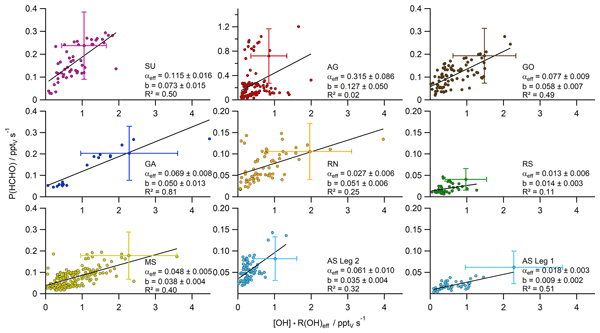
Dirk Dienhart, John N. Crowley, Efstratios Bourtsoukidis, Achim Edtbauer, Philipp G. Eger, Lisa Ernle, Hartwig Harder, Bettina Hottmann, Monica Martinez, Uwe Parchatka, Jean-Daniel Paris, Eva Y. Pfannerstill, Roland Rohloff, Jan Schuladen, Christof Stönner, Ivan Tadic, Sebastian Tauer, Nijing Wang, Jonathan Williams, Jos Lelieveld, and Horst Fischer
Atmos. Chem. Phys., 21, 17373–17388, https://doi.org/10.5194/acp-21-17373-2021, https://doi.org/10.5194/acp-21-17373-2021, 2021
Short summary
Short summary
We present the first ship-based in situ measurements of formaldehyde (HCHO), hydroxyl radicals (OH) and the OH reactivity around the Arabian Peninsula. Regression analysis of the HCHO production rate and the related OH chemistry revealed the regional HCHO yield αeff, which represents the different chemical regimes encountered. Highest values were found for the Arabian Gulf (also known as the Persian Gulf), which highlights this region as a hotspot of photochemical air pollution.
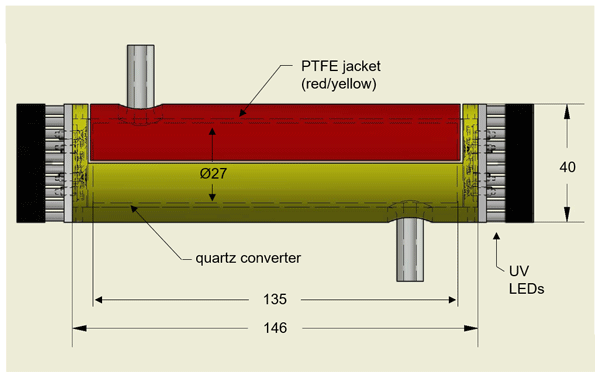
Clara M. Nussbaumer, Uwe Parchatka, Ivan Tadic, Birger Bohn, Daniel Marno, Monica Martinez, Roland Rohloff, Hartwig Harder, Flora Kluge, Klaus Pfeilsticker, Florian Obersteiner, Martin Zöger, Raphael Doerich, John N. Crowley, Jos Lelieveld, and Horst Fischer
Atmos. Meas. Tech., 14, 6759–6776, https://doi.org/10.5194/amt-14-6759-2021, https://doi.org/10.5194/amt-14-6759-2021, 2021
Short summary
Short summary
NO2 plays a central role in atmospheric photochemical processes and requires accurate measurements. This research presents NO2 data obtained via chemiluminescence using a photolytic converter from airborne studies around Cabo Verde and laboratory investigations. We show the limits and error-proneness of a conventional blue light converter in aircraft measurements affected by humidity and NO levels and suggest the use of an alternative quartz converter for more reliable results.
Cited articles
Andersen, S. T., Carpenter, L. J., Reed, C., Lee, J. D., Chance, R., Sherwen, T., Vaughan, A. R., Stewart, J., Edwards, P. M., Bloss, W. J., Sommariva, R., Crilley, L. R., Nott, G. J., Neves, L., Read, K., Heard, D. E., Seakins, P. W., Whalley, L. K., Boustead, G. A., Fleming, L. T., Stone, D., and Fomba, K. W.: Extensive field evidence for the release of HONO from the photolysis of nitrate aerosols, Science Advances, 9, eadd6266, https://doi.org/10.1126/sciadv.add6266, 2023.
Brownwood, B., Turdziladze, A., Hohaus, T., Wu, R., Mentel, T. F., Carlsson, P. T. M., Tsiligiannis, E., Hallquist, M., Andres, S., Hantschke, L., Reimer, D., Rohrer, F., Tillmann, R., Winter, B., Liebmann, J., Brown, S. S., Kiendler-Scharr, A., Novelli, A., Fuchs, H., and Fry, J. L.: Gas-particle partitioning and SOA yields of organonitrate products from NO3-initiated oxidation of isoprene under varied chemical regimes, ACS Earth Space Chem., 5, 785–800, https://doi.org/10.1021/acsearthspacechem.0c00311, 2021.
Canagaratna, M. R., Jayne, J. T., Jimenez, J. L., Allan, J. D., Alfarra, M. R., Zhang, Q., Onasch, T. B., Drewnick, F., Coe, H., Middlebrook, A., Delia, A., Williams, L. R., Trimborn, A. M., Northway, M. J., DeCarlo, P. F., Kolb, C. E., Davidovits, P., and Worsnop, D. R.: Chemical and microphysical characterization of ambient aerosols with the aerodyne aerosol mass spectrometer, Mass Spectrom. Rev., 26, 185–222, https://doi.org/10.1002/mas.20115, 2007.
Crowley, J.: Data from Figures in Dewald et al. (Particle nitrate measurement using a thermal-dissociation, cavity-ringdown-spectrometer with gas-phase denuder (D-TD-CRDS)), Version V1, Edmond [data set], https://doi.org/10.17617/3.TP76K3, 2026.
Crowley, J. N., Burrows, J. P., Moortgat, G. K., Poulet, G., and LeBras, G.: Optical detection of NO3 and NO2 in “pure” HNO3 vapor, the liquid-phase decomposition of HNO3, Int. J. Chem. Kinet., 25, 795–803, 1993.
Day, D. A., Campuzano-Jost, P., Nault, B. A., Palm, B. B., Hu, W., Guo, H., Wooldridge, P. J., Cohen, R. C., Docherty, K. S., Huffman, J. A., de Sá, S. S., Martin, S. T., and Jimenez, J. L.: A systematic re-evaluation of methods for quantification of bulk particle-phase organic nitrates using real-time aerosol mass spectrometry, Atmos. Meas. Tech., 15, 459–483, https://doi.org/10.5194/amt-15-459-2022, 2022.
DeCarlo, P. F., Kimmel, J. R., Trimborn, A., Northway, M. J., Jayne, J. T., Aiken, A. C., Gonin, M., Fuhrer, K., Horvath, T., Docherty, K. S., Worsnop, D. R., and Jimenez, J. L.: Field-deployable, high-resolution, time-of-flight aerosol mass spectrometer, Anal. Chem., 78, 8281–8289, https://doi.org/10.1021/ac061249n, 2006.
Dewald, P., Dörich, R., Schuladen, J., Lelieveld, J., and Crowley, J. N.: Impact of ozone and inlet design on the quantification of isoprene-derived organic nitrates by thermal dissociation cavity ring-down spectroscopy (TD-CRDS), Atmos. Meas. Tech., 14, 5501–5519, https://doi.org/10.5194/amt-14-5501-2021, 2021.
Drewnick, F., Hings, S. S., DeCarlo, P., Jayne, J. T., Gonin, M., Fuhrer, K., Weimer, S., Jimenez, J. L., Demerjian, K. L., Borrmann, S., and Worsnop, D. R.: A new Time-Of-Flight Aerosol Mass Spectrometer (TOF-AMS) – Instrument description and first field Deployment, Aerosol Sci. Technol., 39, 637–658, https://doi.org/10.1080/02786820500182040, 2005.
Farmer, D. K., Matsunaga, A., Docherty, K. S., Surratt, J. D., Seinfeld, J. H., Ziemann, P. J., and Jimenez, J. L.: Response of an aerosol mass spectrometer to organonitrates and organosulfates and implications for atmospheric chemistry, P. Natl. Acad. Sci. USA, 107, 6670–6675, https://doi.org/10.1073/pnas.0912340107, 2010.
Friedrich, N., Tadic, I., Schuladen, J., Brooks, J., Darbyshire, E., Drewnick, F., Fischer, H., Lelieveld, J., and Crowley, J. N.: Measurement of NOx and NOy with a thermal dissociation cavity ring-down spectrometer (TD-CRDS): instrument characterisation and first deployment, Atmos. Meas. Tech., 13, 5739–5761, https://doi.org/10.5194/amt-13-5739-2020, 2020.
Fry, J. L., Draper, D. C., Zarzana, K. J., Campuzano-Jost, P., Day, D. A., Jimenez, J. L., Brown, S. S., Cohen, R. C., Kaser, L., Hansel, A., Cappellin, L., Karl, T., Hodzic Roux, A., Turnipseed, A., Cantrell, C., Lefer, B. L., and Grossberg, N.: Observations of gas- and aerosol-phase organic nitrates at BEACHON-RoMBAS 2011, Atmos. Chem. Phys., 13, 8585–8605, https://doi.org/10.5194/acp-13-8585-2013, 2013.
Garner, N. M., Matchett, L. C., and Osthoff, H. D.: Quantification of Non-refractory Aerosol Nitrate in Ambient Air by Thermal Dissociation Cavity Ring-Down Spectroscopy, Environ. Sci. Technol., 54, 9854–9861, https://doi.org/10.1021/acs.est.0c01156, 2020.
Glänzer, K. and Troe, J.: Thermal decomposition of nitrocompounds in shock waves. IV: decomposition of nitric acid, Berichte der Bunsengesellschaft für physikalische Chemie, 78, 71–76, https://doi.org/10.1002/bbpc.19740780112, 1974.
Hang, Y., Meng, X., Li, T., Wang, T., Cao, J., Fu, Q., Dey, S., Li, S., Huang, K., Liang, F., Kan, H., Shi, X., and Liu, Y.: Assessment of long-term particulate nitrate air pollution and its health risk in China, iScience, 25, 104899, https://doi.org/10.1016/j.isci.2022.104899, 2022.
Hogrefe, O., Schwab, J. J., Drewnick, F., Lala, G. G., Peters, S., Demerjian, K. L., Rhoads, K., Felton, H. D., Rattigan, O. V., Husain, L., and Dutkiewicz, V. A.: Semicontinuous PM2.5 Sulfate and Nitrate Measurements at an Urban and a Rural Location in New York: PMTACS-NY Summer 2001 and 2002 Campaigns, J. Air Waste Manage. Assoc., 54, 1040–1060, https://doi.org/10.1080/10473289.2004.10470972, 2004.
Huang, W., Saathoff, H., Shen, X., Ramisetty, R., Leisner, T., and Mohr, C.: Chemical characterization of highly functionalized organonitrates contributing to night-time organic aerosol mass loadings and particle growth, Environ. Sci. Technol., 53, 1165–1174, https://doi.org/10.1021/acs.est.8b05826, 2019.
Jimenez, J. L., Jayne, J. T., Shi, Q., Kolb, C. E., Worsnop, D. R., Yourshaw, I., Seinfeld, J. H., Flagan, R. C., Zhang, X., Smith, K. A., Morris, J. W., and Davidovits, P.: Ambient aerosol sampling using the Aerodyne Aerosol Mass Spectrometer, J. Geophy. Res.-Atmos., 108, https://doi.org/10.1029/2001JD001213, 2003.
Keehan, N. I., Brownwood, B., Marsavin, A., Day, D. A., and Fry, J. L.: A thermal-dissociation–cavity ring-down spectrometer (TD-CRDS) for the detection of organic nitrates in gas and particle phases, Atmos. Meas. Tech., 13, 6255–6269, https://doi.org/10.5194/amt-13-6255-2020, 2020.
Khlystov, A., Wyers, G., and Slanina, J.: The steam-jet aerosol collector, Atmos. Environ., 29, 2229–2234, 1995.
Kiendler-Scharr, A., Mensah, A. A., Friese, E., Topping, D., Nemitz, E., Prevot, A. S. H., Aijala, M., Allan, J., Canonaco, F., Canagaratna, M., Carbone, S., Crippa, M., Dall Osto, M., Day, D. A., De Carlo, P., Di Marco, C. F., Elbern, H., Eriksson, A., Freney, E., Hao, L., Herrmann, H., Hildebrandt, L., Hillamo, R., Jimenez, J. L., Laaksonen, A., McFiggans, G., Mohr, C., O'Dowd, C., Otjes, R., Ovadnevaite, J., Pandis, S. N., Poulain, L., Schlag, P., Sellegri, K., Swietlicki, E., Tiitta, P., Vermeulen, A., Wahner, A., Worsnop, D., and Wu, H. C.: Ubiquity of organic nitrates from nighttime chemistry in the European submicron aerosol, Geophys. Res. Lett., 43, 7735–7744, https://doi.org/10.1002/2016GL069239, 2016.
Lee, B. H., Mohr, C., Lopez-Hilfiker, F. D., Lutz, A., Hallquist, M., Lee, L., Romer, P., Cohen, R. C., Iyer, S., Kurten, T., Hu, W. W., Day, D. A., Campuzano-Jost, P., Jimenez, J. L., Xu, L., Ng, N. L., Guo, H. Y., Weber, R. J., Wild, R. J., Brown, S. S., Koss, A., de Gouw, J., Olson, K., Goldstein, A. H., Seco, R., Kim, S., McAvey, K., Shepson, P. B., Starn, T., Baumann, K., Edgerton, E. S., Liu, J. M., Shilling, J. E., Miller, D. O., Brune, W., Schobesberger, S., D'Ambro, E. L., and Thornton, J. A.: Highly functionalized organic nitrates in the southeast United States: Contribution to secondary organic aerosol and reactive nitrogen budgets, P. Natl. Acad. Sci. USA, 113, 1516–1521, https://doi.org/10.1073/pnas.1508108113, 2016.
Lee, L., Wooldridge, P. J., deGouw, J., Brown, S. S., Bates, T. S., Quinn, P. K., and Cohen, R. C.: Particulate organic nitrates observed in an oil and natural gas production region during wintertime, Atmos. Chem. Phys., 15, 9313–9325, https://doi.org/10.5194/acp-15-9313-2015, 2015.
Lelieveld, J., Evans, J. S., Fnais, M., Giannadaki, D., and Pozzer, A.: The contribution of outdoor air pollution sources to premature mortality on a global scale, Nature, 525, 367–371, https://doi.org/10.1038/nature15371, 2015.
Liu, P. S. K., Deng, R., Smith, K. A., Williams, L. R., Jayne, J. T., Canagaratna, M. R., Moore, K., Onasch, T. B., Worsnop, D. R., and Deshler, T.: Transmission Efficiency of an Aerodynamic Focusing Lens System: Comparison of Model Calculations and Laboratory Measurements for the Aerodyne Aerosol Mass Spectrometer, Aerosol Sci. Tech., 41, 721–733, https://doi.org/10.1080/02786820701422278, 2007.
Palm, B. B., Campuzano-Jost, P., Day, D. A., Ortega, A. M., Fry, J. L., Brown, S. S., Zarzana, K. J., Dube, W., Wagner, N. L., Draper, D. C., Kaser, L., Jud, W., Karl, T., Hansel, A., Gutiérrez-Montes, C., and Jimenez, J. L.: Secondary organic aerosol formation from in situ OH, O3, and NO3 oxidation of ambient forest air in an oxidation flow reactor, Atmos. Chem. Phys., 17, 5331–5354, https://doi.org/10.5194/acp-17-5331-2017, 2017.
Phillips, G. J., Makkonen, U., Schuster, G., Sobanski, N., Hakola, H., and Crowley, J. N.: The detection of nocturnal N2O5 as HNO3 by alkali- and aqueous-denuder techniques, Atmos. Meas. Tech., 6, 231–237, https://doi.org/10.5194/amt-6-231-2013, 2013.
Pozzer, A., Anenberg, S. C., Dey, S., Haines, A., Lelieveld, J., and Chowdhury, S.: Mortality attributable to ambient air pollution: A review of global estimates, GeoHealth, 7, e2022GH000711, https://doi.org/10.1029/2022GH000711, 2023.
Rollins, A. W., Smith, J. D., Wilson, K. R., and Cohen, R. C.: Real Time In Situ Detection of Organic Nitrates in Atmospheric Aerosols, Environ. Sci. Technol., 44, 5540–5545, https://doi.org/10.1021/es100926x, 2010.
Rollins, A. W., Browne, E. C., Min, K.-E., Pusede, S. E., Wooldridge, P. J., Gentner, D. R., Goldstein, A. H., Liu, S., Day, D. A., Russell, L. M., and Cohen, R. C.: Evidence for NOx control over nighttime SOA formation, Science, 337, 1210–1212, 2012.
Seinfeld, J. H.: Atmospheric chemistry and physics of air pollution, John Wiley and Sons, ISBN 978-0471828570, 1986.
Stolzenburg, M. R. and Hering, S. V.: Method for the automated measurement of fine particle nitrate in the atmosphere, Environ. Sci. Technol., 34, 907–914, https://doi.org/10.1021/es990956d, 2000.
Thieser, J., Schuster, G., Schuladen, J., Phillips, G. J., Reiffs, A., Parchatka, U., Pöhler, D., Lelieveld, J., and Crowley, J. N.: A two-channel thermal dissociation cavity ring-down spectrometer for the detection of ambient NO2, RO2NO2 and RONO2, Atmos. Meas. Tech., 9, 553–576, https://doi.org/10.5194/amt-9-553-2016, 2016.
Twigg, M. M., Di Marco, C. F., McGhee, E. A., Braban, C. F., Nemitz, E., Brown, R. J. C., Blakley, K. C., Leeson, S. R., Sanocka, A., Green, D. C., Priestman, M., Riffault, V., Bourin, A., Minguillón, M. C., Via, M., Ovadnevaite, J., Ceburnis, D., O'Dowd, C., Poulain, L., Stieger, B., Makkonen, U., Rumsey, I. C., Beachley, G., Walker, J. T., and Butterfield, D. M.: The potential of high temporal resolution automatic measurements of PM2.5 composition as an alternative to the filter-based manual method used in routine monitoring, Atmos. Environ., 315, 120148, https://doi.org/10.1016/j.atmosenv.2023.120148, 2023.
von der Weiden, S.-L., Drewnick, F., and Borrmann, S.: Particle Loss Calculator – a new software tool for the assessment of the performance of aerosol inlet systems, Atmos. Meas. Tech., 2, 479–494, https://doi.org/10.5194/amt-2-479-2009, 2009.
Weber, R., Orsini, D., Daun, Y., Lee, Y.-N., Klotz, P., and Brechtel, F.: A particle-into-liquid collector for rapid measurement of aerosol bulk chemical composition, Aerosol Sci. Tech., 35, 718–727, 2001.
Wild, R. J., Edwards, P. M., Bates, T. S., Cohen, R. C., de Gouw, J. A., Dubé, W. P., Gilman, J. B., Holloway, J., Kercher, J., Koss, A. R., Lee, L., Lerner, B. M., McLaren, R., Quinn, P. K., Roberts, J. M., Stutz, J., Thornton, J. A., Veres, P. R., Warneke, C., Williams, E., Young, C. J., Yuan, B., Zarzana, K. J., and Brown, S. S.: Reactive nitrogen partitioning and its relationship to winter ozone events in Utah, Atmos. Chem. Phys., 16, 573–583, https://doi.org/10.5194/acp-16-573-2016, 2016.
Womack, C. C., Neuman, J. A., Veres, P. R., Eilerman, S. J., Brock, C. A., Decker, Z. C. J., Zarzana, K. J., Dube, W. P., Wild, R. J., Wooldridge, P. J., Cohen, R. C., and Brown, S. S.: Evaluation of the accuracy of thermal dissociation CRDS and LIF techniques for atmospheric measurement of reactive nitrogen species, Atmos. Meas. Tech., 10, 1911–1926, https://doi.org/10.5194/amt-10-1911-2017, 2017.
Wüst, L., Dewald, P., Türk, G. N. T. E., Lelieveld, J., and Crowley, J. N.: Influence of ambient NO and NO2 on the quantification of total peroxy nitrates (ΣPNs) and total alkyl nitrates (ΣANs) by thermal dissociation cavity ring-down spectroscopy (TD-CRDS), Atmos. Meas. Tech., 18, 1943–1959, https://doi.org/10.5194/amt-18-1943-2025, 2025.
Xu, L., Suresh, S., Guo, H., Weber, R. J., and Ng, N. L.: Aerosol characterization over the southeastern United States using high-resolution aerosol mass spectrometry: spatial and seasonal variation of aerosol composition and sources with a focus on organic nitrates, Atmos. Chem. Phys., 15, 7307–7336, https://doi.org/10.5194/acp-15-7307-2015, 2015.
Short summary
We have developed and tested an instrument that quantitatively detects particulate nitrate. Gas-phase reactive nitrogen species are denuded using an active-carbon surface and particle nitrate is converted to NO2, which is detected using cavity-ringdown-spectroscopy. Key to accurate measurement of particulate nitrate is drying of the sampled air. Excellent agreement with an aerosol-mass-spectrometer indicates that the instrument detects both organic and inorganic nitrate particle mass accurately.
We have developed and tested an instrument that quantitatively detects particulate nitrate....


