Articles | Volume 19, issue 11
https://doi.org/10.5194/amt-19-3713-2026
© Author(s) 2026. This work is distributed under
the Creative Commons Attribution 4.0 License.
https://doi.org/10.5194/amt-19-3713-2026
© Author(s) 2026. This work is distributed under
the Creative Commons Attribution 4.0 License.
Direct-sun versus sky-scan Pandora formaldehyde retrievals: implications for satellite validation and sampling representativeness in Tropical Southeast Asia

Santanasawry A. L. David Arul
Preparatory Center for Science and Technology, University Malaysia Sabah (UMS), Jalan UMS, 88400, Kota Kinabalu, Sabah, Malaysia
Faculty of Science and Technology, University Malaysia Sabah (UMS), Jalan UMS, 88400, Kota Kinabalu, Sabah, Malaysia
Jackson Hian-Wui Chang
CORRESPONDING AUTHOR
Preparatory Center for Science and Technology, University Malaysia Sabah (UMS), Jalan UMS, 88400, Kota Kinabalu, Sabah, Malaysia
Department of Atmospheric Sciences, National Central University (NCU), Taoyuan, 32001, Taiwan
Yong Jie Wong
Department of Bioenvironmental Design, Faculty of Bioenvironmental Sciences, Kyoto University of Advanced Science, Kyoto, 606-8501, Japan
Maggie Chel-Gee Ooi
Centre of Tropical Climate Change System, Institute of Climate Change, National University of Malaysia (UKM), Bangi, 43600, Malaysia
Juneng Liew
Department of Earth Sciences and Environment, Faculty of Sciences and Technology, National University of Malaysia (UKM), Bangi, 43600, Malaysia
Fuei Pien Chee
Faculty of Science and Technology, University Malaysia Sabah (UMS), Jalan UMS, 88400, Kota Kinabalu, Sabah, Malaysia
Jedol Dayou
Energy, Vibration and Sound Research Laboratory (e-VIBS), Faculty of Science and Technology, University Malaysia Sabah (UMS), Jalan UMS, 88400, Kota Kinabalu, Sabah, Malaysia
Centre for Instrumentation and Science Services (CISS), University Malaysia Sabah (UMS), Jalan UMS, 88400, Kota Kinabalu, Sabah, Malaysia
Justin Sentian
Faculty of Science and Technology, University Malaysia Sabah (UMS), Jalan UMS, 88400, Kota Kinabalu, Sabah, Malaysia
Putu Aryastana
Department of Infrastructure and Environmental Engineering, Faculty of Postgraduates, Universitas Warmadewa, Denpasar, 80239, Indonesia
Department of Civil Engineering, Faculty of Engineering and Planning, Universitas Warmadewa, Denpasar, 80239, Indonesia
Neng-Huei Lin
Department of Atmospheric Sciences, National Central University (NCU), Taoyuan, 32001, Taiwan
Related authors
No articles found.
Phuong Loan Nguyen, Lisa V. Alexander, Thanh Ngo-Duc, Faye Cruz, Jerasorn Santisirisomboon, Liew Juneng, Donaldi S. Permana, Jing Xiang Chung, Julie Mae Dado, John L. McGregor, Grace Redmond, Tse Wai Po, Fredolin Tangang, Tan Phan-Van, Son C. H. Truong, Marcus Thatcher, Long Trinh-Tuan, Ummu Ma’rufah, Jennifer Tibay, Giovanni Di Virgilio, and Stephen White
EGUsphere, https://doi.org/10.5194/egusphere-2026-1325, https://doi.org/10.5194/egusphere-2026-1325, 2026
This preprint is open for discussion and under review for Geoscientific Model Development (GMD).
Short summary
Short summary
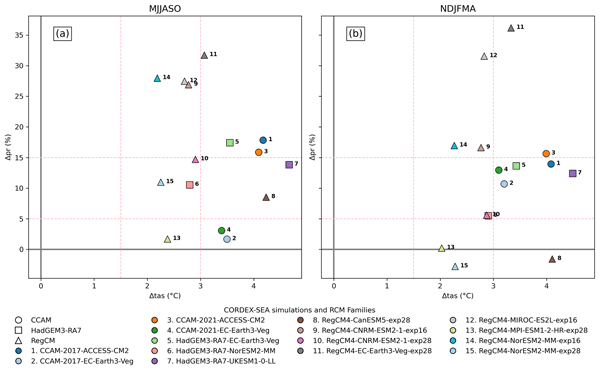
We introduce an ensemble of climate models that simulate Southeast Asia's future climate for 1960–2100. We (1) showed how well these models simulate observed climate by comparison with multiple observations, (2) applied a standardized benchmarking framework to model outputs to select a subset of models for further dynamical downscaling at kilometre-scale over megacities of SEA. These international efforts can help guide climate model design and the use and interpretation of climate projections.
Duy-Hieu Nguyen, Hsin-Cheng Hsieh, Mao-Chang Liang, Neng-Huei Lin, Chieh-Heng Wang, and Jia-Lin Wang
Atmos. Chem. Phys., 26, 2831–2852, https://doi.org/10.5194/acp-26-2831-2026, https://doi.org/10.5194/acp-26-2831-2026, 2026
Short summary
Short summary
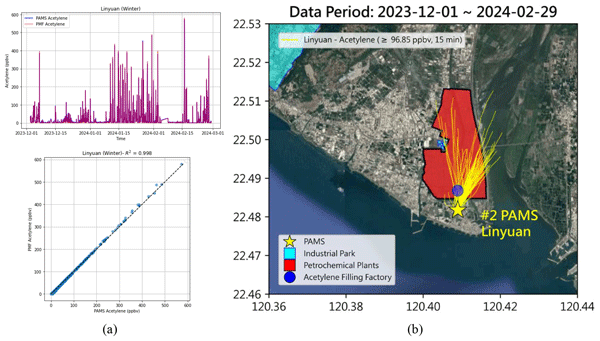
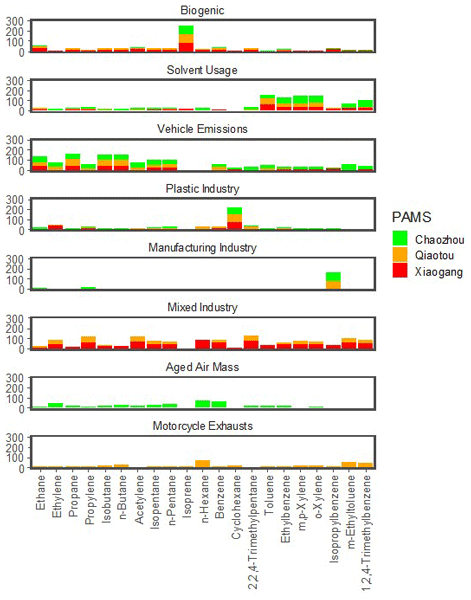
Using year-round, high-frequency non-methane hydrocarbons measurements from three monitoring sites, each with distinct source–receptor characteristics, this study applied the source apportionment model to resolve eight sources and assess ozone-forming potential. Distinct acetylene plumes at Linyuan (R² > 0.99) provided an internal consistency check. Results reveal spatial–seasonal source variability and highlight the roles of petroleum, mixed, and aged air sources in ozone formation management.
Po-Hsun Lin, Sheng-Hsiang Wang, Otto Klemm, and Neng-Huei Lin
Atmos. Chem. Phys., 26, 2083–2102, https://doi.org/10.5194/acp-26-2083-2026, https://doi.org/10.5194/acp-26-2083-2026, 2026
Short summary
Short summary
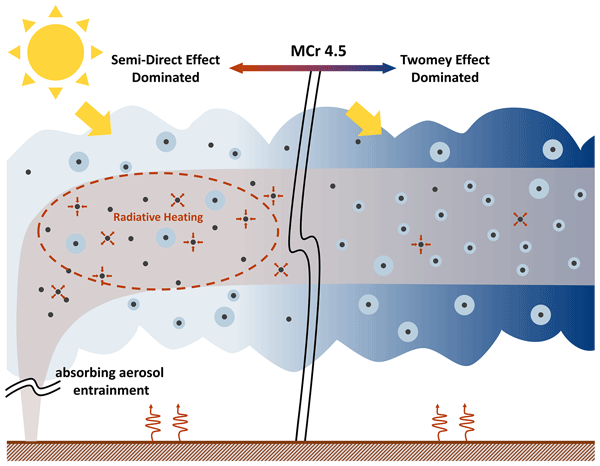
This study used in-situ observations to explore how long-range transported biomass-burning aerosols affect the development of warm clouds in Southeast Asia. Our findings provide evidence of the nonlinear responses of cloud systems to absorbing aerosols. When liquid water is relatively abundant compared to aerosol concentration, increased aerosols tend to enhance droplet formation; otherwise, aerosols may suppress cloud development by altering the surrounding environment.
Saginela Ravindra Babu and Neng-Huei Lin
EGUsphere, https://doi.org/10.5194/egusphere-2025-4223, https://doi.org/10.5194/egusphere-2025-4223, 2025
Short summary
Short summary
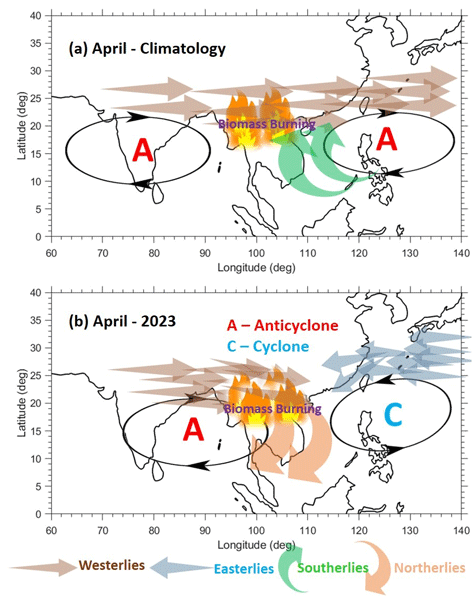
This study investigates record-breaking aerosol loading over the South China Sea in April 2023, driven by intense biomass burning in Laos and Myanmar. Using satellite and reanalysis data, we show that compound climate extremes and circulation anomalies enhanced fire activity and altered smoke transport, leading to severe transboundary pollution. The findings highlight links between climate variability, aerosols, and regional air quality in Southeast Asia.
Steven Soon-Kai Kong, Joshua S. Fu, Neng-Huei Lin, Guey-Rong Sheu, and Wei-Syun Huang
Atmos. Chem. Phys., 25, 7245–7268, https://doi.org/10.5194/acp-25-7245-2025, https://doi.org/10.5194/acp-25-7245-2025, 2025
Short summary
Short summary
The accuracy of the chemical transport model, a key focus of our research, is strongly dependent on the dry deposition parameterization. Our findings show that the refined CMAQ dust model correlated well with ground-based and high-altitude in situ measurements by implementing the suggested dry deposition schemes. Furthermore, we reveal the mixing state of two types of aerosols at the upper level, a finding supported by both the optimized model and measurements.
Steven Soon-Kai Kong, Saginela Ravindra Babu, Sheng-Hsiang Wang, Stephen M. Griffith, Jackson Hian-Wui Chang, Ming-Tung Chuang, Guey-Rong Sheu, and Neng-Huei Lin
Atmos. Chem. Phys., 24, 1041–1058, https://doi.org/10.5194/acp-24-1041-2024, https://doi.org/10.5194/acp-24-1041-2024, 2024
Short summary
Short summary
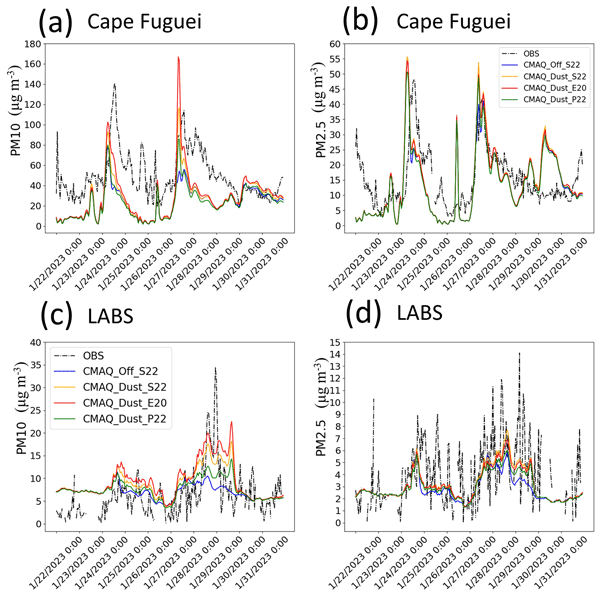
In this study, we combined ground observations from 7-SEAS Dongsha Experiment, MERRA-2 reanalysis, and MODIS satellite images for evaluation and improvement of the CMAQ dust model for cases of East Asian Dust reaching the Taiwan region, including Dongsha in the western Pacific. We proposed a better CMAQ dust treatment over East Asia and for the first time revealed the impact of typhoons on dust transport.
Jackson Hian-Wui Chang, Stephen M. Griffith, Steven Soon-Kai Kong, Ming-Tung Chuang, and Neng-Huei Lin
Atmos. Chem. Phys., 23, 6357–6382, https://doi.org/10.5194/acp-23-6357-2023, https://doi.org/10.5194/acp-23-6357-2023, 2023
Short summary
Short summary
A novel CMAQ–PMF-based composite index is developed to identify the key VOC source species for an effective ozone abatement strategy. The index provides information as to which VOC species are key to ozone formation and where to reduce sources of these VOC species. Using the composite index, we recommended the VOC control measures in southern Taiwan should prioritize solvent usage, vehicle emissions, and the petrochemical industry.
Saginela Ravindra Babu, Chang-Feng Ou-Yang, Stephen M. Griffith, Shantanu Kumar Pani, Steven Soon-Kai Kong, and Neng-Huei Lin
Atmos. Chem. Phys., 23, 4727–4740, https://doi.org/10.5194/acp-23-4727-2023, https://doi.org/10.5194/acp-23-4727-2023, 2023
Short summary
Short summary
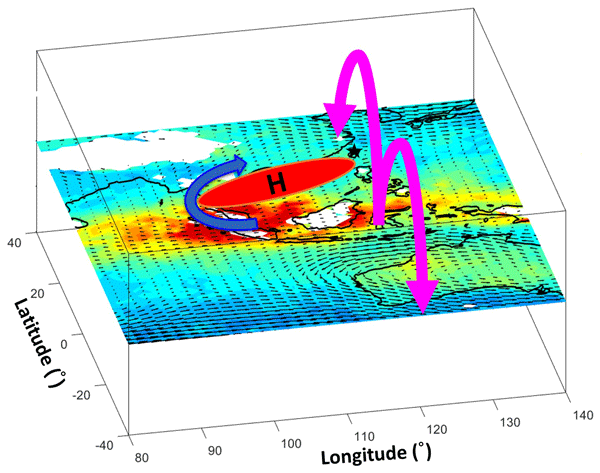
In October 2006 and 2015, extensive fire episodes occurred in Indonesia, releasing an enormous amount of CO emissions. By combining in situ and satellite CO measurements and reanalysis products, we reported plausible transport pathways of CO from Indonesia to the Lulin Atmospheric Background Station (LABS; 23.47° N, 120.87° E; 2862 m a.s.l.) in Taiwan. We identified (i) horizontal transport in the free troposphere and (ii) vertical transport through the Hadley circulation.
Clémence Rose, Martine Collaud Coen, Elisabeth Andrews, Yong Lin, Isaline Bossert, Cathrine Lund Myhre, Thomas Tuch, Alfred Wiedensohler, Markus Fiebig, Pasi Aalto, Andrés Alastuey, Elisabeth Alonso-Blanco, Marcos Andrade, Begoña Artíñano, Todor Arsov, Urs Baltensperger, Susanne Bastian, Olaf Bath, Johan Paul Beukes, Benjamin T. Brem, Nicolas Bukowiecki, Juan Andrés Casquero-Vera, Sébastien Conil, Konstantinos Eleftheriadis, Olivier Favez, Harald Flentje, Maria I. Gini, Francisco Javier Gómez-Moreno, Martin Gysel-Beer, Anna Gannet Hallar, Ivo Kalapov, Nikos Kalivitis, Anne Kasper-Giebl, Melita Keywood, Jeong Eun Kim, Sang-Woo Kim, Adam Kristensson, Markku Kulmala, Heikki Lihavainen, Neng-Huei Lin, Hassan Lyamani, Angela Marinoni, Sebastiao Martins Dos Santos, Olga L. Mayol-Bracero, Frank Meinhardt, Maik Merkel, Jean-Marc Metzger, Nikolaos Mihalopoulos, Jakub Ondracek, Marco Pandolfi, Noemi Pérez, Tuukka Petäjä, Jean-Eudes Petit, David Picard, Jean-Marc Pichon, Veronique Pont, Jean-Philippe Putaud, Fabienne Reisen, Karine Sellegri, Sangeeta Sharma, Gerhard Schauer, Patrick Sheridan, James Patrick Sherman, Andreas Schwerin, Ralf Sohmer, Mar Sorribas, Junying Sun, Pierre Tulet, Ville Vakkari, Pieter Gideon van Zyl, Fernando Velarde, Paolo Villani, Stergios Vratolis, Zdenek Wagner, Sheng-Hsiang Wang, Kay Weinhold, Rolf Weller, Margarita Yela, Vladimir Zdimal, and Paolo Laj
Atmos. Chem. Phys., 21, 17185–17223, https://doi.org/10.5194/acp-21-17185-2021, https://doi.org/10.5194/acp-21-17185-2021, 2021
Short summary
Short summary
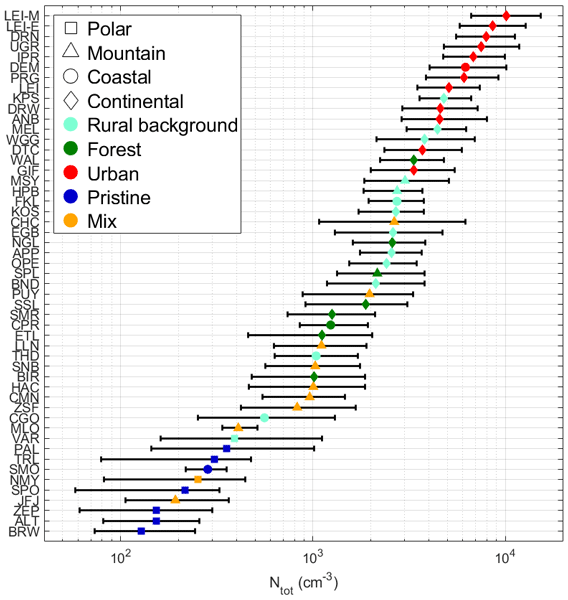
Aerosol particles are a complex component of the atmospheric system the effects of which are among the most uncertain in climate change projections. Using data collected at 62 stations, this study provides the most up-to-date picture of the spatial distribution of particle number concentration and size distribution worldwide, with the aim of contributing to better representation of aerosols and their interactions with clouds in models and, therefore, better evaluation of their impact on climate.
Maggie Chel-Gee Ooi, Ming-Tung Chuang, Joshua S. Fu, Steven S. Kong, Wei-Syun Huang, Sheng-Hsiang Wang, Sittichai Pimonsree, Andy Chan, Shantanu Kumar Pani, and Neng-Huei Lin
Atmos. Chem. Phys., 21, 12521–12541, https://doi.org/10.5194/acp-21-12521-2021, https://doi.org/10.5194/acp-21-12521-2021, 2021
Short summary
Short summary
There is very limited local modeling effort in Southeast Asia, where haze is an annually recurring threat. In this work, the accuracy of haze prediction is improved not only at the burning source but also at the downwind site in northern Southeast Asia to highlight the influence of trans-boundary haze, which is often regional. The burning haze is carried to the populated west of Taiwan via several mechanisms, with the most severe conditions related to the boreal winter pressure system.
Cited articles
Ahn, C., Torres, O., and Bhartia, P. K.: Comparison of Ozone Monitoring Instrument UV Aerosol Products with Aqua/Moderate Resolution Imaging Spectroradiometer and Multiangle Imaging Spectroradiometer observations in 2006, J. Geophys. Res., 113, https://doi.org/10.1029/2007jd008832, 2008.
Bak, J., Baek, K.-H., Kim, J.-H., Liu, X., Kim, J., and Chance, K.: Cross-evaluation of GEMS tropospheric ozone retrieval performance using OMI data and the use of an ozonesonde dataset over East Asia for validation, Atmos. Meas. Tech., 12, 5201–5215, https://doi.org/10.5194/amt-12-5201-2019, 2019.
Boersma, K. F., Vinken, G. C. M., and Eskes, H. J.: Representativeness errors in comparing chemistry transport and chemistry climate models with satellite UV–Vis tropospheric column retrievals, Geosci. Model Dev., 9, 875–898, https://doi.org/10.5194/gmd-9-875-2016, 2016.
Cheong, K. H., Ngiam, N. J., Morgan, G. G., Pek, P. P., Tan, B. Y.-Q., Lai, J. W., Koh, J. M., Ong, M. E. H., and Ho, A. F. W.: Acute Health Impacts of the Southeast Asian Transboundary Haze Problem – A Review, Int. J. Env. Res. Pub. He., 16, 3286, https://doi.org/10.3390/ijerph16183286, 2019.
De Smedt, I., Theys, N., Yu, H., Danckaert, T., Lerot, C., Compernolle, S., Van Roozendael, M., Richter, A., Hilboll, A., Peters, E., Pedergnana, M., Loyola, D., Beirle, S., Wagner, T., Eskes, H., van Geffen, J., Boersma, K. F., and Veefkind, P.: Algorithm theoretical baseline for formaldehyde retrievals from S5P TROPOMI and from the QA4ECV project, Atmos. Meas. Tech., 11, 2395–2426, https://doi.org/10.5194/amt-11-2395-2018, 2018.
De Smedt, I., Pinardi, G., Vigouroux, C., Compernolle, S., Bais, A., Benavent, N., Boersma, F., Chan, K.-L., Donner, S., Eichmann, K.-U., Hedelt, P., Hendrick, F., Irie, H., Kumar, V., Lambert, J.-C., Langerock, B., Lerot, C., Liu, C., Loyola, D., Piters, A., Richter, A., Rivera Cárdenas, C., Romahn, F., Ryan, R. G., Sinha, V., Theys, N., Vlietinck, J., Wagner, T., Wang, T., Yu, H., and Van Roozendael, M.: Comparative assessment of TROPOMI and OMI formaldehyde observations and validation against MAX-DOAS network column measurements, Atmos. Chem. Phys., 21, 12561–12593, https://doi.org/10.5194/acp-21-12561-2021, 2021.
Dimitropoulou, E., Hendrick, F., Friedrich, M. M., Tack, F., Pinardi, G., Merlaud, A., Fayt, C., Hermans, C., and Van Roozendael, M.: Improved TROPOMI HCHO Column Validation Using Dual-Scan MAX-DOAS Retrievals, in: 2021 IEEE International Geoscience and Remote Sensing Symposium IGARSS, Brussels, Belgium, 11–16 July 2021, IEEE, 8026–8029, https://doi.org/10.1109/igarss47720.2021.9553326, 2021.
Dimitropoulou, E., Hendrick, F., Friedrich, M. M., Tack, F., Pinardi, G., Merlaud, A., Fayt, C., Hermans, C., Fierens, F., and Van Roozendael, M.: Horizontal distribution of tropospheric NO2 and aerosols derived by dual-scan multi-wavelength multi-axis differential optical absorption spectroscopy (MAX-DOAS) measurements in Uccle, Belgium, Atmos. Meas. Tech., 15, 4503–4529, https://doi.org/10.5194/amt-15-4503-2022, 2022.
Fang, Z., Deng, W., Zhang, Y., Ding, X., Tang, M., Liu, T., Hu, Q., Zhu, M., Wang, Z., Yang, W., Huang, Z., Song, W., Bi, X., Chen, J., Sun, Y., George, C., and Wang, X.: Open burning of rice, corn and wheat straws: primary emissions, photochemical aging, and secondary organic aerosol formation, Atmos. Chem. Phys., 17, 14821–14839, https://doi.org/10.5194/acp-17-14821-2017, 2017.
Fu, T., Jacob, D. J., Palmer, P. I., Chance, K., Wang, Y. X., Barletta, B., Blake, D. R., Stanton, J. C., and Pilling, M. J.: Space-based formaldehyde measurements as constraints on volatile organic compound emissions in east and south Asia and implications for ozone, J. Geophys. Res., 112, https://doi.org/10.1029/2006jd007853, 2007.
Glowania, M., Rohrer, F., Dorn, H.-P., Hofzumahaus, A., Holland, F., Kiendler-Scharr, A., Wahner, A., and Fuchs, H.: Comparison of formaldehyde measurements by Hantzsch, CRDS and DOAS in the SAPHIR chamber, Atmos. Meas. Tech., 14, 4239–4253, https://doi.org/10.5194/amt-14-4239-2021, 2021.
Hansen, A. B., Witham, C. S., Chong, W. M., Kendall, E., Chew, B. N., Gan, C., Hort, M. C., and Lee, S.-Y.: Haze in Singapore – source attribution of biomass burning PM10 from Southeast Asia, Atmos. Chem. Phys., 19, 5363–5385, https://doi.org/10.5194/acp-19-5363-2019, 2019.
Harkey, M., Holloway, T., Kim, E. J., Baker, K. R., and Henderson, B.: Satellite Formaldehyde to Support Model Evaluation, J. Geophys. Res.-Atmos., 126, https://doi.org/10.1029/2020jd032881, 2021.
Herman, J., Evans, R., Cede, A., Abuhassan, N., Petropavlovskikh, I., and McConville, G.: Comparison of ozone retrievals from the Pandora spectrometer system and Dobson spectrophotometer in Boulder, Colorado, Atmos. Meas. Tech., 8, 3407–3418, https://doi.org/10.5194/amt-8-3407-2015, 2015.
Herman, J., Spinei, E., Fried, A., Kim, J., Kim, J., Kim, W., Cede, A., Abuhassan, N., and Segal-Rozenhaimer, M.: NO2 and HCHO measurements in Korea from 2012 to 2016 from Pandora spectrometer instruments compared with OMI retrievals and with aircraft measurements during the KORUS-AQ campaign, Atmos. Meas. Tech., 11, 4583–4603, https://doi.org/10.5194/amt-11-4583-2018, 2018.
Johnson, M. S., Philip, S., Meech, S., Kumar, R., Sorek-Hamer, M., Shiga, Y. P., and Jung, J.: Insights into the long-term (2005–2021) spatiotemporal evolution of summer ozone production sensitivity in the Northern Hemisphere derived with the Ozone Monitoring Instrument (OMI), Atmos. Chem. Phys., 24, 10363–10384, https://doi.org/10.5194/acp-24-10363-2024, 2024.
Jones, N. B., Riedel, K., Allan, W., Wood, S., Palmer, P. I., Chance, K., and Notholt, J.: Long-term tropospheric formaldehyde concentrations deduced from ground-based fourier transform solar infrared measurements, Atmos. Chem. Phys., 9, 7131–7142, https://doi.org/10.5194/acp-9-7131-2009, 2009.
Lamsal, L. N., Krotkov, N. A., Celarier, E. A., Swartz, W. H., Pickering, K. E., Bucsela, E. J., Gleason, J. F., Martin, R. V., Philip, S., Irie, H., Cede, A., Herman, J., Weinheimer, A., Szykman, J. J., and Knepp, T. N.: Evaluation of OMI operational standard NO2 column retrievals using in situ and surface-based NO2 observations, Atmos. Chem. Phys., 14, 11587–11609, https://doi.org/10.5194/acp-14-11587-2014, 2014.
Lee, G. T., Park, R. J., Kwon, H.-A., Ha, E. S., Lee, S. D., Shin, S., Ahn, M.-H., Kang, M., Choi, Y.-S., Kim, G., Lee, D.-W., Kim, D.-R., Hong, H., Langerock, B., Vigouroux, C., Lerot, C., Hendrick, F., Pinardi, G., De Smedt, I., Van Roozendael, M., Wang, P., Chong, H., Cho, Y., and Kim, J.: First evaluation of the GEMS formaldehyde product against TROPOMI and ground-based column measurements during the in-orbit test period, Atmos. Chem. Phys., 24, 4733–4749, https://doi.org/10.5194/acp-24-4733-2024, 2024.
Liao, K., Chen, Q., Liu, Y., Li, Y. J., Lambe, A. T., Zhu, T., Huang, R.-J., Zheng, Y., Cheng, X., Miao, R., Huang, G., Khuzestani, R. B., and Jia, T.: Secondary Organic Aerosol Formation of Fleet Vehicle Emissions in China: Potential Seasonality of Spatial Distributions, Environ. Sci. Technol., 55, 7276–7286, https://doi.org/10.1021/acs.est.0c08591, 2021.
Lim, C. Y., Hagan, D. H., Coggon, M. M., Koss, A. R., Sekimoto, K., de Gouw, J., Warneke, C., Cappa, C. D., and Kroll, J. H.: Secondary organic aerosol formation from the laboratory oxidation of biomass burning emissions, Atmos. Chem. Phys., 19, 12797–12809, https://doi.org/10.5194/acp-19-12797-2019, 2019.
Liu, J., Li, X., Yang, Y., Wang, H., Kuang, C., Zhu, Y., Chen, M., Hu, J., Zeng, L., and Zhang, Y.: Sensitive Detection of Ambient Formaldehyde by Incoherent Broadband Cavity Enhanced Absorption Spectroscopy, Anal. Chem., 92, 2697–2705, https://doi.org/10.1021/acs.analchem.9b04821, 2020.
Palmer, P. I., Jacob, D. J., Fiore, A. M., Martin, R. V., Chance, K., and Kurosu, T. P.: Mapping isoprene emissions over North America using formaldehyde column observations from space, J. Geophys. Res., 108, https://doi.org/10.1029/2002jd002153, 2003.
Park, J.-U., Lim, S., Hanisco, T. F., Abuhassan, N., Place, B. K., Pandey, A., Cede, A., Tiefengraber, M., Gebetsberger, M., Park, J., Choi, J., Crawford, J. H., Song, C.-K., and Kim, S.-W.: Global analysis of nitrogen dioxide and formaldehyde column densities from the Pandora global network: Variability and implications for satellite validation, Remote Sens. Environ., 335, 115249, https://doi.org/10.1016/j.rse.2026.115249, 2026.
Pinardi, G., Van Roozendael, M., Abuhassan, N., Adams, C., Cede, A., Clémer, K., Fayt, C., Frieß, U., Gil, M., Herman, J., Hermans, C., Hendrick, F., Irie, H., Merlaud, A., Navarro Comas, M., Peters, E., Piters, A. J. M., Puentedura, O., Richter, A., Schönhardt, A., Shaiganfar, R., Spinei, E., Strong, K., Takashima, H., Vrekoussis, M., Wagner, T., Wittrock, F., and Yilmaz, S.: MAX-DOAS formaldehyde slant column measurements during CINDI: intercomparison and analysis improvement, Atmos. Meas. Tech., 6, 167–185, https://doi.org/10.5194/amt-6-167-2013, 2013.
Rawat, P., Crawford, J. H., Travis, K. R., Judd, L. M., Demetillo, M. A. G., Valin, L. C., Szykman, J. J., Whitehill, A., Baumann, E., and Hanisco, T. F.: Maximizing the scientific application of Pandora column observations of HCHO and NO2, Atmos. Meas. Tech., 18, 2899–2917, https://doi.org/10.5194/amt-18-2899-2025, 2025.
Spinei, E., Whitehill, A., Fried, A., Tiefengraber, M., Knepp, T. N., Herndon, S., Herman, J. R., Müller, M., Abuhassan, N., Cede, A., Richter, D., Walega, J., Crawford, J., Szykman, J., Valin, L., Williams, D. J., Long, R., Swap, R. J., Lee, Y., Nowak, N., and Poche, B.: The first evaluation of formaldehyde column observations by improved Pandora spectrometers during the KORUS-AQ field study, Atmos. Meas. Tech., 11, 4943–4961, https://doi.org/10.5194/amt-11-4943-2018, 2018.
Su, W., Liu, C., Chan, K. L., Hu, Q., Liu, H., Ji, X., Zhu, Y., Liu, T., Zhang, C., Chen, Y., and Liu, J.: An improved TROPOMI tropospheric HCHO retrieval over China, Atmos. Meas. Tech., 13, 6271–6292, https://doi.org/10.5194/amt-13-6271-2020, 2020.
Tanskanen, A., Krotkov, N. A., Herman, J. R., and Arola, A.: Surface ultraviolet irradiance from OMI, IEEE T. Geosci. Remote, 44, 1267–1271, https://doi.org/10.1109/tgrs.2005.862203, 2006.
Tian, X., Xie, P., Xu, J., Wang, Y., Li, A., Wu, F., Hu, Z., Liu, C., and Zhang, Q.: Ground-based MAX-DOAS observations of tropospheric formaldehyde VCDs and comparisons with the CAMS model at a rural site near Beijing during APEC 2014, Atmos. Chem. Phys., 19, 3375–3393, https://doi.org/10.5194/acp-19-3375-2019, 2019.
Tzortziou, M., Herman, J. R., Cede, A., and Abuhassan, N.: High precision, absolute total column ozone measurements from the Pandora spectrometer system: Comparisons with data from a Brewer double monochromator and Aura OMI, J. Geophys. Res., 117, D16303, https://doi.org/10.1029/2012jd017814, 2012.
Vigouroux, C., Bauer Aquino, C. A., Bauwens, M., Becker, C., Blumenstock, T., De Mazière, M., García, O., Grutter, M., Guarin, C., Hannigan, J., Hase, F., Jones, N., Kivi, R., Koshelev, D., Langerock, B., Lutsch, E., Makarova, M., Metzger, J.-M., Müller, J.-F., Notholt, J., Ortega, I., Palm, M., Paton-Walsh, C., Poberovskii, A., Rettinger, M., Robinson, J., Smale, D., Stavrakou, T., Stremme, W., Strong, K., Sussmann, R., Té, Y., and Toon, G.: NDACC harmonized formaldehyde time series from 21 FTIR stations covering a wide range of column abundances, Atmos. Meas. Tech., 11, 5049–5073, https://doi.org/10.5194/amt-11-5049-2018, 2018.
Zhu, L., Jacob, D. J., Kim, P. S., Fisher, J. A., Yu, K., Travis, K. R., Mickley, L. J., Yantosca, R. M., Sulprizio, M. P., De Smedt, I., González Abad, G., Chance, K., Li, C., Ferrare, R., Fried, A., Hair, J. W., Hanisco, T. F., Richter, D., Jo Scarino, A., Walega, J., Weibring, P., and Wolfe, G. M.: Observing atmospheric formaldehyde (HCHO) from space: validation and intercomparison of six retrievals from four satellites (OMI, GOME2A, GOME2B, OMPS) with SEAC4RS aircraft observations over the southeast US, Atmos. Chem. Phys., 16, 13477–13490, https://doi.org/10.5194/acp-16-13477-2016, 2016.
Zhu, L., Jacob, D. J., Keutsch, F. N., Mickley, L. J., Scheffe, R., Strum, M., González Abad, G., Chance, K., Yang, K., Rappenglück, B., Millet, D. B., Baasandorj, M., Jaeglé, L., and Shah, V.: Formaldehyde (HCHO) As a Hazardous Air Pollutant: Mapping Surface Air Concentrations from Satellite and Inferring Cancer Risks in the United States, Environ. Sci. Technol., 51, 5650–5657, https://doi.org/10.1021/acs.est.7b01356, 2017.
Short summary
This study examines how ground-based instruments measure air pollution and how well these measurements match satellite observations over Southeast Asia. We compared two observing methods and found that one captures more detailed short-term changes, while the other provides more stable and representative results. Satellite data improved with newer technology but still showed differences. These findings help improve how scientists interpret satellite data for air quality and climate studies.
This study examines how ground-based instruments measure air pollution and how well these...