
Articles | Volume 19, issue 11
https://doi.org/10.5194/amt-19-3741-2026
© Author(s) 2026. This work is distributed under
the Creative Commons Attribution 4.0 License.
the Creative Commons Attribution 4.0 License.
https://doi.org/10.5194/amt-19-3741-2026
© Author(s) 2026. This work is distributed under
the Creative Commons Attribution 4.0 License.
the Creative Commons Attribution 4.0 License.
Research article
| 
11 Jun 2026
Research article |
| 11 Jun 2026
| 11 Jun 2026
Rain gauges and X-band radar hourly comparison under complex orographic conditions in Reunion Island during the passage of the tropical cyclone Batsirai
Ambinintsoa Volatiana Ramanamahefa
CORRESPONDING AUTHOR
Laboratoire de l'Atmosphère et des Cyclones LACY, UMR 8105 CNRS, Faculty of Sciences and Technologies, Université de La Réunion, 97400 Saint-Denis, France
Thiruvengadam Padmanabhan
Laboratoire de l'Atmosphère et des Cyclones LACY, UMR 8105 CNRS, Faculty of Sciences and Technologies, Université de La Réunion, 97400 Saint-Denis, France
School of Meteorology, University of Oklahoma, Norman, Oklahoma, United States
Guillaume Lesage
Laboratoire de l'Atmosphère et des Cyclones LACY, UMR 8105 CNRS, Faculty of Sciences and Technologies, Université de La Réunion, 97400 Saint-Denis, France
Joël Van Baelen
CORRESPONDING AUTHOR
Laboratoire de l'Atmosphère et des Cyclones LACY, UMR 8105 CNRS, Faculty of Sciences and Technologies, Université de La Réunion, 97400 Saint-Denis, France
Related authors
Padmanabhan Thiruvengadam, Guillaume Lesage, Ambinintsoa Volatiana Ramanamahefa, and Joël Van Baelen
Atmos. Meas. Tech., 18, 1185–1191, https://doi.org/10.5194/amt-18-1185-2025, https://doi.org/10.5194/amt-18-1185-2025, 2025
Short summary
Short summary
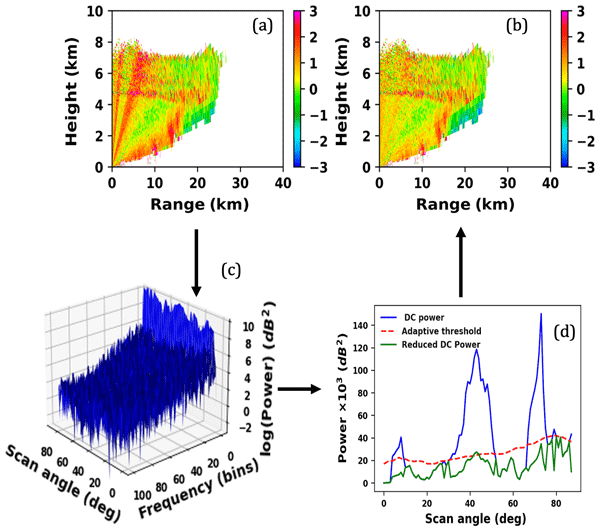
This study explores how the joints in a weather radar's protective cover affect its measurements. We developed a new method to correct these errors, improving the accuracy of the radar's data. Our method was tested during an intense cyclone on Réunion Island, demonstrating significant improvements in data accuracy. This research is crucial for enhancing weather predictions and understanding, particularly in challenging terrains.
Padmanabhan Thiruvengadam, Guillaume Lesage, Ambinintsoa Volatiana Ramanamahefa, and Joël Van Baelen
Atmos. Meas. Tech., 18, 1185–1191, https://doi.org/10.5194/amt-18-1185-2025, https://doi.org/10.5194/amt-18-1185-2025, 2025
Short summary
Short summary
This study explores how the joints in a weather radar's protective cover affect its measurements. We developed a new method to correct these errors, improving the accuracy of the radar's data. Our method was tested during an intense cyclone on Réunion Island, demonstrating significant improvements in data accuracy. This research is crucial for enhancing weather predictions and understanding, particularly in challenging terrains.
Pierre Tulet, Joel Van Baelen, Pierre Bosser, Jérome Brioude, Aurélie Colomb, Philippe Goloub, Andrea Pazmino, Thierry Portafaix, Michel Ramonet, Karine Sellegri, Melilotus Thyssen, Léa Gest, Nicolas Marquestaut, Dominique Mékiès, Jean-Marc Metzger, Gilles Athier, Luc Blarel, Marc Delmotte, Guillaume Desprairies, Mérédith Dournaux, Gaël Dubois, Valentin Duflot, Kevin Lamy, Lionel Gardes, Jean-François Guillemot, Valérie Gros, Joanna Kolasinski, Morgan Lopez, Olivier Magand, Erwan Noury, Manuel Nunes-Pinharanda, Guillaume Payen, Joris Pianezze, David Picard, Olivier Picard, Sandrine Prunier, François Rigaud-Louise, Michael Sicard, and Benjamin Torres
Earth Syst. Sci. Data, 16, 3821–3849, https://doi.org/10.5194/essd-16-3821-2024, https://doi.org/10.5194/essd-16-3821-2024, 2024
Short summary
Short summary
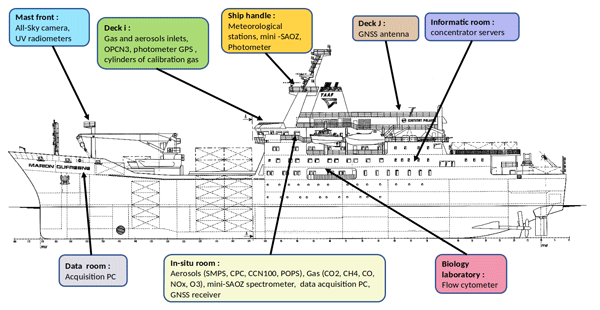
The MAP-IO program aims to compensate for the lack of atmospheric and oceanographic observations in the Southern Ocean by equipping the ship Marion Dufresne with a set of 17 scientific instruments. This program collected 700 d of measurements under different latitudes, seasons, sea states, and weather conditions. These new data will support the calibration and validation of numerical models and the understanding of the atmospheric composition of this region of Earth.
Fanny Noirmain, Jean-Luc Baray, Frédéric Tridon, Philippe Cacault, Hermine Billard, Guillaume Voyard, Joël Van Baelen, and Delphine Latour
Biogeosciences, 19, 5729–5749, https://doi.org/10.5194/bg-19-5729-2022, https://doi.org/10.5194/bg-19-5729-2022, 2022
Short summary
Short summary
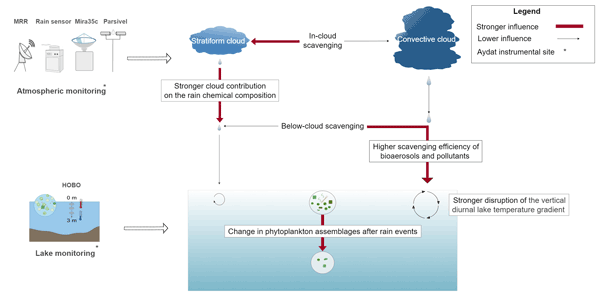
We present a study linking rain, meteorology, and mountain lake phytoplankton dynamics on the basis of a case study at Aydat (France) in September 2020. The air mass origin mainly influences the rain chemical composition, which depends on the type of rain, convective or stratiform. Our results also highlighted a non-negligible presence of photosynthetic cells in rainwater. The impact of the atmospheric forcing on the lake could play a key role in phytoplankton dynamics in the temperate zone.
Cited articles
Antonini, A., Melani, S., Corongiu, M., Romanelli, S., Mazza, A., Ortolani, A., and Gozzini, B.: On the Implementation of a Regional X-Band Weather Radar Network, Atmosphere, 8, 25, https://doi.org/10.3390/atmos8020025, 2017.
Barros, A. P. and Arulraj, M.: Remote Sensing of Orographic Precipitation, in: Satellite Precipitation Measurement: Volume 2, edited by: Levizzani, V., Kidd, C., Kirschbaum, D. B., Kummerow, C. D., Nakamura, K., and Turk, F. J., Springer International Publishing, Cham, 559–582, https://doi.org/10.1007/978-3-030-35798-6_6, 2020.
Berne, A. and Uijlenhoet, R.: Quantitative analysis of X-band weather radar attenuation correction accuracy, Nat. Hazards Earth Syst. Sci., 6, 419–425, https://doi.org/10.5194/nhess-6-419-2006, 2006.
Bringi, V. N. and Chandrasekar, V.: Polarimetric Doppler Weather Radar: Principles and Applications, Cambridge University Press, 666 pp., ISBN 0-521-62384-7, 2001.
Bringi, V. N., Chandrasekar, V., Balakrishnan, N., and Zrnić, D. S.: An Examination of Propagation Effects in Rainfall on Radar Measurements at Microwave Frequencies, J. Atmos. Ocean. Technol., 7, 829–840, https://doi.org/10.1175/1520-0426(1990)007<0829:AEOPEI>2.0.CO;2, 1990.
Carey, L. D., Rutledge, S. A., Ahijevych, D. A., and Keenan, T. D.: Correcting Propagation Effects in C-Band Polarimetric Radar Observations of Tropical Convection Using Differential Propagation Phase, J. Appl. Meteorol. Climatol., 39, 1405–1433, https://doi.org/10.1175/1520-0450(2000)039<1405:CPEICB>2.0.CO;2, 2000.
Delrieu, G., Hucke, L., and Creutin, J. D.: Attenuation in Rain for X- and C-Band Weather Radar Systems: Sensitivity with respect to the Drop Size Distribution, J. Appl. Meteorol., 38, 57–68, https://doi.org/10.1175/1520-0450(1999)038<0057:AIRFXA>2.0.CO;2, 1999.
Dhiram, K. and Wang, Z.: Evaluation on Radar Reflectivity-Rainfall Rate (Z-R) Relationships for Guyana, Atmos. Clim. Sci., 6, 489–499, https://doi.org/10.4236/acs.2016.64039, 2016.
Ding, B., Yang, K., Qin, J., Wang, L., Chen, Y., and He, X.: The dependence of precipitation types on surface elevation and meteorological conditions and its parameterization, J. Hydrol., 513, 154–163, https://doi.org/10.1016/j.jhydrol.2014.03.038, 2014.
Fabry, F.: Radar meteorology: principles and practice, Cambridge University Press, Cambridge, 256 pp., ISBN 978-1-108-46039-2, 2017.
Fabry, F. and Zawadzki, I.: Long-Term Radar Observations of the Melting Layer of Precipitation and Their Interpretation, J. Atmos. Sci., 52, 838–851, https://doi.org/10.1175/1520-0469(1995)052<0838:LTROOT>2.0.CO;2, 1995.
Figueras i Ventura, J., Boumahmoud, A.-A., Fradon, B., Dupuy, P., and Tabary, P.: Long-term monitoring of French polarimetric radar data quality and evaluation of several polarimetric quantitative precipitation estimators in ideal conditions for operational implementation at C-band, Q. J. R. Meteorol. Soc., 138, 2212–2228, https://doi.org/10.1002/qj.1934, 2012.
Frech, M.: Monitoring the data quality of the new polarimetric weather radar network of the German Meteorological Service, Ext. Abstr. 9B3 AMS Radar Conf., https://www.researchgate.net/doi/10.13140/RG.2.1.2639.4328 (last access: 23 May 2026), 2013.
Ghada, W., Casellas, E., Herbinger, J., Garcia-Benadí, A., Bothmann, L., Estrella, N., Bech, J., and Menzel, A.: Stratiform and Convective Rain Classification Using Machine Learning Models and Micro Rain Radar, Remote Sens., 14, 4563, https://doi.org/10.3390/rs14184563, 2022.
Giangrande, S. E., McGraw, R., and Lei, L.: An Application of Linear Programming to Polarimetric Radar Differential Phase Processing, J. Atmos. Ocean. Technol., 30, 1716–1729, https://doi.org/10.1175/JTECH-D-12-00147.1, 2013.
Gorgucci, E., Scarchilli, G., and Chandrasekar, V.: A procedure to calibrate multiparameter weather radar using properties of the rain medium, IEEE Trans. Geosci. Remote Sens., 37, 269–276, https://doi.org/10.1109/36.739161, 1999.
Harrison, D. L., Driscoll, S. J., and Kitchen, M.: Improving precipitation estimates from weather radar using quality control and correction techniques, Meteorl. Appl., 7, 135–144, https://doi.org/10.1017/S1350482700001468, 2000.
Helmus, J. J. and Collis, S. M.: The Python ARM Radar Toolkit (Py-ART), a Library for Working with Weather Radar Data in the Python Programming Language, J. Open Res. Softw., 4, 25, https://doi.org/10.5334/jors.119, 2016.
Hitschfeld, W. and Bordan, J.: Errors Inherent In The Radar Measurement Of Rainfall At Attenuating Wavelengths, J. Atmos. Sci., 11, 58–67, https://doi.org/10.1175/1520-0469(1954)011<0058:EIITRM>2.0.CO;2, 1954.
Houze, R. A.: Structure and Dynamics of a Tropical Squall–Line System, Mon. Weather Rev., 105, 1540–1567, https://doi.org/10.1175/1520-0493(1977)105<1540:SADOAT>2.0.CO;2, 1977.
Houze, R. A.: Stratiform Precipitation in Regions of Convection: A Meteorological Paradox?, Bull. Am. Meteorol. Soc., 78, 2179–2196, https://doi.org/10.1175/1520-0477(1997)078<2179:SPIROC>2.0.CO;2, 1997.
Illingworth, A. J.: The estimation of moderate rain rates with operational polarisation radar, 32nd Conference on Radar Meteorology, https://meetings.copernicus.org/www.cosis.net/abstracts/EGU06/02770/EGU06-J-02770.pdf (last access: 23 May 2026), 2005.
Jacobi, S. and Heistermann, M.: Benchmarking attenuation correction procedures for six years of single-polarized C-band weather radar observations in South-West Germany, Geomat. Nat. Hazards Risk, 7, 1785–1799, https://doi.org/10.1080/19475705.2016.1155080, 2016.
Jameson, A. R.: The Effect of Temperature on Attenuation-Correction Schemes in Rain Using Polarization Propagation Differential Phase Shift, J. Appl. Meteorol. Climatol., 31, 1106–1118, https://doi.org/10.1175/1520-0450(1992)031<1106:TEOTOA>2.0.CO;2, 1992.
Jorgensen, D. P. and Willis, P. T.: A Z-R Relationship for Hurricanes, J. Appl. Meteorol., 21, 356–366, https://doi.org/10.1175/1520-0450(1982)021<0356:AZRRFH>2.0.CO;2, 1982.
Koffi, A. K., Gosset, M., Zahiri, E.-P., Ochou, A. D., Kacou, M., Cazenave, F., and Assamoi, P.: Evaluation of X-band polarimetric radar estimation of rainfall and rain drop size distribution parameters in West Africa, Atmos. Res., 143, 438–461, https://doi.org/10.1016/j.atmosres.2014.03.009, 2014.
Krämer, S. and Verworn, H.-R.: Improved radar data processing algorithms for quantitative rainfall estimation in real time, Water Sci. Technol., 60, 175–184, https://doi.org/10.2166/wst.2009.282, 2009.
Lee, J.-T., Ko, K.-Y., Lee, D.-I., You, C.-H., and Liou, Y.-C.: Enhancement of orographic precipitation in Jeju Island during the passage of Typhoon Khanun (2012), Atmos. Res., 201, 58–71, https://doi.org/10.1016/j.atmosres.2017.10.013, 2018.
Li, H., Moisseev, D., Luo, Y., Liu, L., Ruan, Z., Cui, L., and Bao, X.: Assessing specific differential phase (KDP)-based quantitative precipitation estimation for the record- breaking rainfall over Zhengzhou city on 20 July 2021, Hydrol. Earth Syst. Sci., 27, 1033–1046, https://doi.org/10.5194/hess-27-1033-2023, 2023.
Maesaka, T., Iwanami, K., and Maki, M.: Non-negative KDP Estimation by Monotone Increasing ΦDP Assumption below Melting Layer, 7th European Conference on Radar in Meteorology and Hydrology, http://www.meteo.fr/cic/meetings/2012/ERAD/extended_abs/QPE_233_ext_abs.pdf (last access: 24 May 2026), 2012.
Matrosov, S. Y.: Distinguishing between Warm and Stratiform Rain Using Polarimetric Radar Measurements, Remote Sens., 13, 214, https://doi.org/10.3390/rs13020214, 2021.
Matrosov, S. Y., Clark, K. A., Martner, B. E., and Tokay, A.: X-band polarimetric radar measurements of rainfall, J. Appl. Meteorol., 41, 941–952, 2002.
Park, S.-G., Bringi, V. N., Chandrasekar, V., Maki, M., and Iwanami, K.: Correction of Radar Reflectivity and Differential Reflectivity for Rain Attenuation at X Band. Part I: Theoretical and Empirical Basis, J. Atmos. Ocean. Technol., 22, 1621–1632, https://doi.org/10.1175/JTECH1803.1, 2005.
Radhakrishna, B.: Raindrop size distribution (DSD) during the passage of tropical cyclone Nivar: effect of measuring principle and wind on DSDs and retrieved rain integral and polarimetric parameters from impact and laser disdrometers, Atmos. Meas. Tech., 15, 6705–6722, https://doi.org/10.5194/amt-15-6705-2022, 2022.
Rauber, R. M. and Nesbitt, S. W.: Radar meteorology: a first course, 1st edn., John Wiley & Sons, Hoboken, NJ, ISBN 978-1-118-43262-4, 2018.
Reimel, K. J. and Kumjian, M.: Evaluation of KDP Estimation Algorithm Performance in Rain Using a Known-Truth Framework, J. Atmos. Ocean. Technol., 38, 587–605, https://doi.org/10.1175/JTECH-D-20-0060.1, 2021.
Rosenfeld, D. and Ulbrich, C. W.: Cloud Microphysical Properties, Processes, and Rainfall Estimation Opportunities, Meteorol. Monogr., 30, 237–258, https://doi.org/10.1175/0065-9401(2003)030<0237:CMPPAR>2.0.CO;2, 2003.
Ryzhkov, A. V. and Zrnic, D. S.: Polarimetric Measurements of Precipitation, in: Radar Polarimetry for Weather Observations, Springer International Publishing, Cham, 373–433, https://doi.org/10.1007/978-3-030-05093-1_10, 2019.
Sánchez-Diezma, R., Zawadzki, I., and Sempere-Torres, D.: Identification of the bright band through the analysis of volumetric radar data, J. Geophys. Res.-Atmos., 105, 2225–2236, https://doi.org/10.1029/1999JD900310, 2000.
Schneebeli, M., Grazioli, J., and Berne, A.: Improved Estimation of the Specific Differential Phase Shift Using a Compilation of Kalman Filter Ensembles, IEEE Trans. Geosci. Remote Sens., 52, 5137–5149, https://doi.org/10.1109/TGRS.2013.2287017, 2014.
Singh, N., Das, S., Sahoo, U. K., Kundu, S. S., and Chakraborty, S.: On collisional drop breakup in orographic rain, Atmos. Res., 300, 107232, https://doi.org/10.1016/j.atmosres.2024.107232, 2024.
Sugier, J. and Tabary, P.: Evaluation of dual polarization technology at C-band for operational weather radars as part of the EUMETNET OPERA programme, Fourth European Conference on Radar in Meteorology and Hydrology-ERAD, 2006.
Testud, J., Le Bouar, E., Obligis, E., and Ali-Mehenni, M.: The Rain Profiling Algorithm Applied to Polarimetric Weather Radar, J. Atmos. Ocean. Technol., 17, 332–356, https://doi.org/10.1175/1520-0426(2000)017<0332:TRPAAT>2.0.CO;2, 2000.
Thiruvengadam, P., Lesage, G., Ramanamahefa, A. V., and Van Baelen, J.: Mitigating radome-induced bias in X-band weather radar polarimetric moments using an adaptive discrete Fourier transform algorithm, Atmos. Meas. Tech., 18, 1185–1191, https://doi.org/10.5194/amt-18-1185-2025, 2025.
Thurai, M., Bringi, V. N., Wolff, D. B., Marks, D. A., and Pabla, C. S.: Drop Size Distribution Measurements in Outer Rainbands of Hurricane Dorian at the NASA Wallops Precipitation-Research Facility, Atmosphere, 11, 578, https://doi.org/10.3390/atmos11060578, 2020.
Timothy, K. I., Iguchi, T., Ohsaki, Y., Horie, H., Hanado, H., and Kumagai, H.: Test of the Specific Differential Propagation Phase Shift (KDP) Technique for Rain-Rate Estimation with a Ku-Band Rain Radar, J. Atmos. Ocean. Technol., 16, 1077–1091, https://doi.org/10.1175/1520-0426(1999)016<1077:TOTSDP>2.0.CO;2, 1999.
Tokay, A., Bashor, P. G., Habib, E., and Kasparis, T.: Raindrop Size Distribution Measurements in Tropical Cyclones, Mon. Weather Rev., 136, 1669–1685, https://doi.org/10.1175/2007MWR2122.1, 2008.
Tridon, F.: Mesure des précipitations à l'aide d'un radar en bande X non-cohérent à haute résolution et d'un radar en bande K à visée verticale. Application à l'étude de la variabilité des précipitations lors de la campagne COPS, 199, https://theses.hal.science/tel-00777843 (last access: 24 May 2026), 2011.
Trömel, S., Kumjian, M. R., Ryzhkov, A. V., Simmer, C., and Diederich, M.: Backscatter Differential Phase – Estimation and Variability, J. Appl. Meteorol. Climatol., 52, 2529–2548, https://doi.org/10.1175/JAMC-D-13-0124.1, 2013.
Unuma, T., Yamauchi, H., Kato, T., Umehara, A., Hashimoto, A., Adachi, A., and Nagumo, N.: Characteristics of Raindrop Size Distribution Using 10-year Disdrometer Data in Eastern Japan, J. Meteorol. Soc. Jpn. Ser II, 103, 219–232, https://doi.org/10.2151/jmsj.2025-011, 2025.
Vulpiani, G., Montopoli, M., Passeri, L. D., Gioia, A. G., Giordano, P., and Marzano, F. S.: On the Use of Dual-Polarized C-Band Radar for Operational Rainfall Retrieval in Mountainous Areas, J. Appl. Meteorol. Climatol., 51, 405–425, https://doi.org/10.1175/JAMC-D-10-05024.1, 2012.
Wu, D., Zhang, F., Chen, X., Ryzhkov, A., Zhao, K., Kumjian, M. R., Chen, X., and Chan, P.-W.: Evaluation of microphysics schemes in tropical cyclones using polarimetric radar observations: Convective precipitation in an outer rainband, Mon. Weather Rev., 149, 1055–1068, 2021.
Yang, Q., Feng, Y., Guan, L., Wu, W., Wang, S., and Li, Q.: X-Band Radar Attenuation Correction Method Based on LightGBM Algorithm, Remote Sens., 15, 864, https://doi.org/10.3390/rs15030864, 2023.
Yang, S., Du, Y., Han, B., Wu, C., and Kong, H.: Microphysical Characteristics of Tropical Cyclone Choiwan (2021) Outer Rainbands Derived From Polarimetric Radar Observations on a Research Vessel, Geophys. Res. Lett., 52, e2024GL112557, https://doi.org/10.1029/2024GL112557, 2025.
Yu, C.-K. and Cheng, L.-W.: Radar Observations of Intense Orographic Precipitation Associated with Typhoon Xangsane (2000), Mon. Weather Rev., 136, 497–521, https://doi.org/10.1175/2007MWR2129.1, 2008.
Yu, N., Gaussiat, N., and Tabary, P.: Polarimetric X-band weather radars for quantitative precipitation estimation in mountainous regions, Q. J. R. Meteorol. Soc., 144, 2603–2619, https://doi.org/10.1002/qj.3366, 2018.
Zeng, Z., Wang, D., and Chen, Y.: An investigation of convective features and Z–R relationships for a local extreme precipitation event, Atmos. Res., 250, 105372, https://doi.org/10.1016/j.atmosres.2020.105372, 2021.
Zeyong, G., Zhaoping, S., Jia, G., Feifei, L., and Zhichao, B.: A Method for Calibrating Zdr by Using Light Rain Echo in Volume Scan Data, in: 2019 International Conference on Meteorology Observations (ICMO), 1–3, https://doi.org/10.1109/ICMO49322.2019.9025914, 2019.
Zrnić, D. S. and Ryzhkov, A.: Advantages of Rain Measurements Using Specific Differential Phase, J. Atmos. Ocean. Technol., 13, 454–464, https://doi.org/10.1175/1520-0426(1996)013<0454:AORMUS>2.0.CO;2, 1996.
Short summary
This study examines quantitative precipitation estimation (QPE) using X-band radar in Reunion, a mountainous island. Rain rate (R) was derived from reflectivity (Z) and specific differential phase (kdp) using the Z(R) and R(kdp) estimators. Z was corrected using the single-polarization Hitschfeld-Bordan (HB) and the dual-polarization philinear methods. Their strengths, limitations, and pre-processing steps were detailed. R(kdp) coefficients were calculated from radar observations.
This study examines quantitative precipitation estimation (QPE) using X-band radar in Reunion, a...


