Articles | Volume 19, issue 13
https://doi.org/10.5194/amt-19-4539-2026
© Author(s) 2026. This work is distributed under
the Creative Commons Attribution 4.0 License.
https://doi.org/10.5194/amt-19-4539-2026
© Author(s) 2026. This work is distributed under
the Creative Commons Attribution 4.0 License.
Emissions from fuel combustion by stoves in residential kitchens in São Paulo – Brazil
Tailine Corrêa dos Santos
CORRESPONDING AUTHOR
Department of Atmospheric Science, Institute of Astronomy, Geophysics and Atmospheric Sciences, University of São Paulo, São Paulo, Brazil
Elaine Cristina Araujo
CORRESPONDING AUTHOR
Laser Environment Applications Laboratory, Lasers and Applications Center, Nuclear and Energy Institute, University of São Paulo, São Paulo, Brazil
Thaís Andrade da Silva
CORRESPONDING AUTHOR
Laser Environment Applications Laboratory, Lasers and Applications Center, Nuclear and Energy Institute, University of São Paulo, São Paulo, Brazil
Enrico Valente Freire
Environmental Assessment, EBP Brasil Consulting and Environmental Engineering, São Paulo, Brazil
Eduardo Landulfo
Laser Environment Applications Laboratory, Lasers and Applications Center, Nuclear and Energy Institute, University of São Paulo, São Paulo, Brazil
Maria de Fátima Andrade
Department of Atmospheric Science, Institute of Astronomy, Geophysics and Atmospheric Sciences, University of São Paulo, São Paulo, Brazil
Related authors
No articles found.
Jean-Paul Vernier, Nicolas Dumelie, Amit Kumar Pandit, Gwenael Berthet, Lilian Joly, Giovanni de Souza, Eduardo Landulfo, Demilson Quintao, Bruno Biazon, Ravi Kiran, Vankat Ratnam, James Flaten, Rubel Das, David Paraiseau, Frank Wienhold, and Yaowei Li
EGUsphere, https://doi.org/10.5194/egusphere-2026-3280, https://doi.org/10.5194/egusphere-2026-3280, 2026
This preprint is open for discussion and under review for Atmospheric Measurement Techniques (AMT).
Short summary
Short summary
Stratospheric aerosols, from volcanoes, wildfires, pollution, and space debris, impact climate and atmospheric chemistry. A new lightweight, 500g particle counter – measures aerosol sizes (0.3–10 µm) with high accuracy. Validated against leading instruments, it has tracked volcanic plumes and smoke globally since 2018. Now used in the BalNeO network, its data is publicly available for research.
Peng Yao, Rupert Holzinger, Beatriz Sayuri Oyama, Agne Masalaite, Dipayan Paul, Haiyan Ni, Hanne Noto, Dušan Materić, Maria de Fátima Andrade, Ru-Jin Huang, and Ulrike Dusek
Atmos. Chem. Phys., 26, 5005–5018, https://doi.org/10.5194/acp-26-5005-2026, https://doi.org/10.5194/acp-26-5005-2026, 2026
Short summary
Short summary
We identify a previously unrecognized class of synthetic organic compounds, large molecular methylsiloxanes, in ambient aerosols across diverse environments in three countries. These compounds are present at substantial levels, primarily originating from traffic emissions related to engine lubrication. Their high abundance and significant daily human exposure suggest potential, yet still poorly understood, implications for both health and climate.
Hazel Vernier, Demilson Quintao, Bruno Biazon, Eduardo Landulfo, Giovanni Souza, Amanda Santos, Fabio Lopes, Alex Mendes, José da Matta, Pinheiro Damaris, Benoit Grosslin, Maria Paulete, Maria de Fátima Andrade, Neeraj Rastogi, Akhil Raj, Hongyu Liu, Mahesh Kovilakam, Suvarna Fadnavis, Frank Wienhold, Mathieu Colombier, Chris Boone, Gwenael Berthet, Nicolas Dumelie, Lilian Joly, and Jean-Paul Vernier
EGUsphere, https://doi.org/10.5194/egusphere-2025-6226, https://doi.org/10.5194/egusphere-2025-6226, 2026
Short summary
Short summary
This paper shows unique balloon measurements from Brazil within the Hunga volcanic plume eight months after the eruption. The chemical analysis of samples collected reveal new insights on volcanic aerosol composition and suggest the presence of marine aerosols.
Rafaela Cruz Alves Alberti, Thomas Lauvaux, Angel Liduvino Vara-Vela, Ricard Segura Barrero, Christoffer Karoff, Maria de Fátima Andrade, Márcia Talita Amorim Marques, Noelia Rojas Benavente, Osvaldo Machado Rodrigues Cabral, Humberto Ribeiro da Rocha, and Rita Yuri Ynoue
Atmos. Chem. Phys., 25, 9803–9829, https://doi.org/10.5194/acp-25-9803-2025, https://doi.org/10.5194/acp-25-9803-2025, 2025
Short summary
Short summary
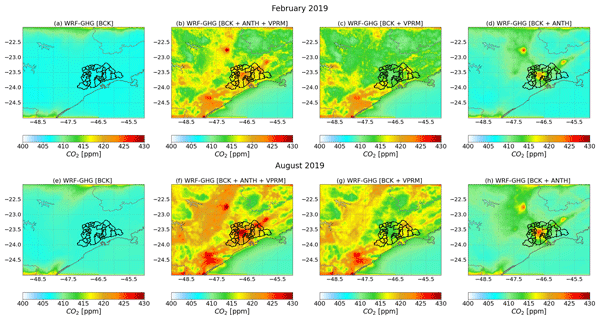
This study addresses uncertainties in atmospheric models by analyzing CO2 dynamics in a complex urban environment characterized by a dense population and tropical vegetation. High-accuracy sensors were deployed, and the Weather Research and Forecasting model coupled with Chemistry (WRF-Chem) was utilized to simulate CO2 transport, capturing variations and assessing contributions from both anthropogenic and biogenic sources.
Guilherme Martins Pereira, Leonardo Yoshiaki Kamigauti, Rubens Fabio Pereira, Djacinto Monteiro dos Santos, Thayná da Silva Santos, José Vinicius Martins, Célia Alves, Cátia Gonçalves, Ismael Casotti Rienda, Nora Kováts, Thiago Nogueira, Luciana Rizzo, Paulo Artaxo, Regina Maura de Miranda, Marcia Akemi Yamasoe, Edmilson Dias de Freitas, Pérola de Castro Vasconcellos, and Maria de Fatima Andrade
Atmos. Chem. Phys., 25, 4587–4616, https://doi.org/10.5194/acp-25-4587-2025, https://doi.org/10.5194/acp-25-4587-2025, 2025
Short summary
Short summary
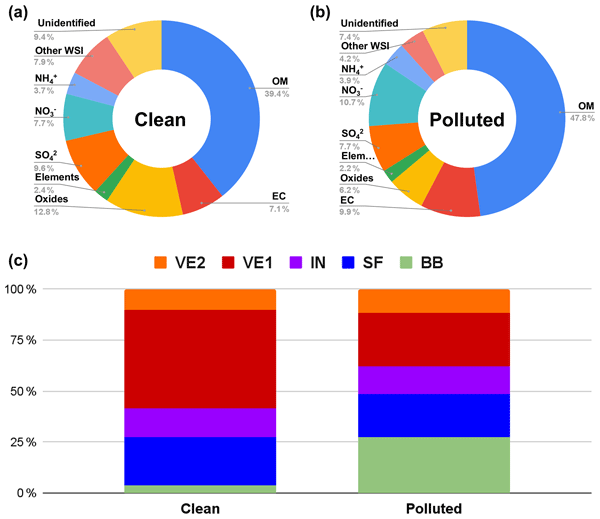
The chemical composition of fine particulate matter was studied in the megacity of São Paulo (Brazil) during a polluted period. Vehicular-related sources remain relevant; however, a high contribution of biomass burning was observed and correlated with sample ecotoxicity. Emerging biomass burning sources, such as forest fires and sugarcane-bagasse-based power plants, highlight the need for additional control measures alongside stricter rules concerning vehicular emissions.
Hazel Vernier, Demilson Quintão, Bruno Biazon, Eduardo Landulfo, Giovanni Souza, V. Amanda Santos, J. S. Fabio Lopes, C. P. Alex Mendes, A. S. José da Matta, K. Pinheiro Damaris, Benoit Grosslin, P. M. P. Maria Jorge, Maria de Fátima Andrade, Neeraj Rastogi, Akhil Raj, Hongyu Liu, Mahesh Kovilakam, Suvarna Fadnavis, Frank G. Wienhold, Mathieu Colombier, D. Chris Boone, Gwenael Berthet, Nicolas Dumelie, Lilian Joly, and Jean-Paul Vernier
EGUsphere, https://doi.org/10.5194/egusphere-2025-924, https://doi.org/10.5194/egusphere-2025-924, 2025
Preprint withdrawn
Short summary
Short summary
The eruption of Hunga Tonga-Hunga Ha'apai injected large amounts of water vapor and sea salt into the stratosphere, altering traditional views of volcanic aerosols. Using balloon-borne samplers, we collected aerosol samples and found high levels of sea salt and calcium, suggesting sulfate depletion due to gypsum formation. These findings highlight the need to consider sea salt in climate models to better predict volcanic impacts on the atmosphere and climate.
Jorge E. Pachón, Mariel A. Opazo, Pablo Lichtig, Nicolas Huneeus, Idir Bouarar, Guy Brasseur, Cathy W. Y. Li, Johannes Flemming, Laurent Menut, Camilo Menares, Laura Gallardo, Michael Gauss, Mikhail Sofiev, Rostislav Kouznetsov, Julia Palamarchuk, Andreas Uppstu, Laura Dawidowski, Nestor Y. Rojas, María de Fátima Andrade, Mario E. Gavidia-Calderón, Alejandro H. Delgado Peralta, and Daniel Schuch
Geosci. Model Dev., 17, 7467–7512, https://doi.org/10.5194/gmd-17-7467-2024, https://doi.org/10.5194/gmd-17-7467-2024, 2024
Short summary
Short summary
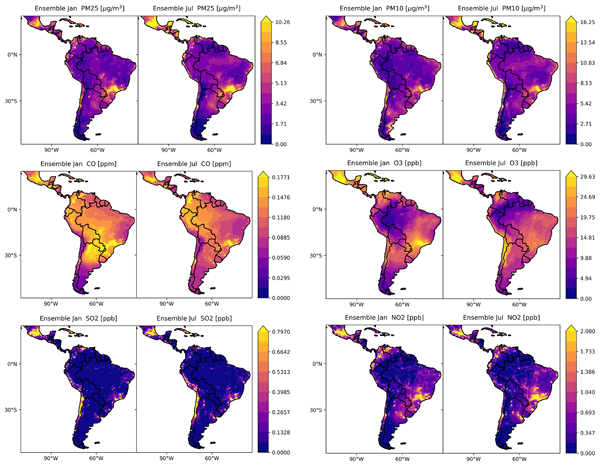
Latin America (LAC) has some of the most populated urban areas in the world, with high levels of air pollution. Air quality management in LAC has been traditionally focused on surveillance and building emission inventories. This study performed the first intercomparison and model evaluation in LAC, with interesting and insightful findings for the region. A multiscale modeling ensemble chain was assembled as a first step towards an air quality forecasting system.
Cássia Maria Leme Beu and Eduardo Landulfo
Wind Energ. Sci., 9, 1431–1450, https://doi.org/10.5194/wes-9-1431-2024, https://doi.org/10.5194/wes-9-1431-2024, 2024
Short summary
Short summary
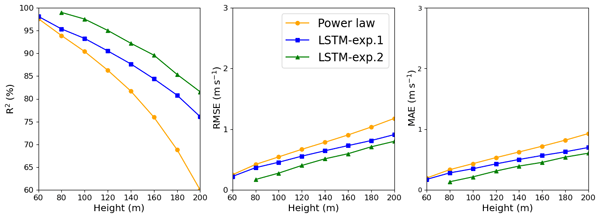
Extrapolating the wind profile for complex terrain through the long short-term memory model outperformed the traditional power law methodology, which due to its universal nature cannot capture local features as the machine-learning methodology does. Moreover, considering the importance of investigating the wind potential and the need for alternative energy sources, it is motivating to find that a short observational campaign can produce better results than the traditional techniques.
Juan Vicente Pallotta, Silvânia Alves de Carvalho, Fabio Juliano da Silva Lopes, Alexandre Cacheffo, Eduardo Landulfo, and Henrique Melo Jorge Barbosa
Geosci. Instrum. Method. Data Syst., 12, 171–185, https://doi.org/10.5194/gi-12-171-2023, https://doi.org/10.5194/gi-12-171-2023, 2023
Short summary
Short summary
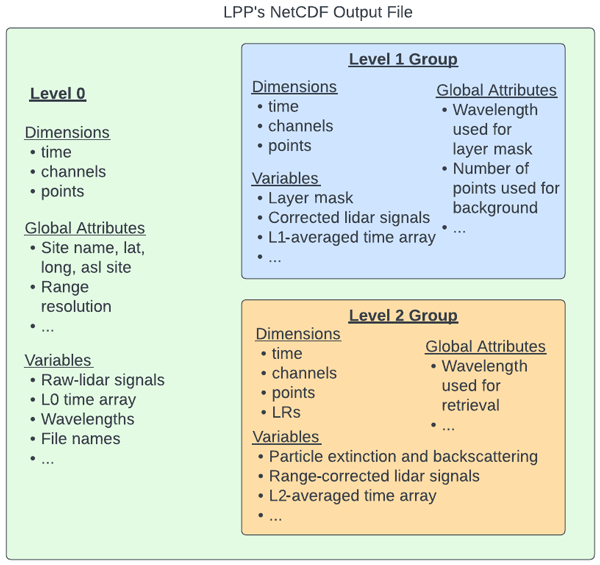
Lidar networks coordinate efforts of different groups, providing guidelines to homogenize retrievals from different instruments. We describe an ongoing effort to develop the Lidar Processing Pipeline (LPP) collaboratively, a collection of tools developed in C/C++ to handle all the steps of a typical lidar analysis. Analysis of simulations and real lidar data showcases the LPP’s features. From this exercise, we draw a roadmap to guide future development, accommodating the needs of our community.
Cited articles
ABEGÁS: Consumo de gás natural cresce 39,6 % em outubro, Associação Brasileira das Empresas Distribuidoras de Gás Canalizado, https://www.abegas.org.br/arquivos/78359 (last access: 23 July 2025), 2020. a
ANP: Resolução ANP no. 7, de 16 de abril de 2010, Diário Oficial da União, DOU in 19 Apr 2010, https://atosoficiais.com.br/anp/resolucao-n-7-2010?origin=instituicao (last access: 28 February 2025), 2010 (revoked by Resolução no. 982/2025, https://atosoficiais.com.br/anp/resolucao-n-982-2025-estabelece-as-especificacoes-do-gas-natural-nacional-ou-importado-e-as-obrigacoes-quanto-ao-controle-da-qualidade-a-serem-atendidas-pelos-agentes-economicos-que-comercializam-ou-transportam-o-produto-em-territorio-nacional?origin=instituicao, last access: 11 June 2026). a, b
ANP: Resolução ANP no. 825, de 28 de agosto de 2020, Diário Oficial da União, DOU in 31 Aug 2020, https://atosoficiais.com.br/anp/resolucao-n-825-2020 (last access: 28 February 2025), 2020 (revoked by Resolução no. 980/2025, https://atosoficiais.com.br/anp/resolucao-n-980-2025-dispoe-sobre-as-obrigacoes-quanto-ao-controle-da-qualidade-dos-produtos-importados-a-que-se-refere-e-da-outras-providencias?origin=instituicao, last access: 11 June 2026). a, b
Cameron, C., Pachauri, S., Rao, N. D., McCollum, D., Rogelj, J., and Riahi, K.: Policy trade-offs between climate mitigation and clean cook-stove access in South Asia, Environ. Res. Lett., 1, 15010, https://doi.org/10.1038/nenergy.2015.10, 2016. a, b
CETESB: QUALAR – Sistema de Monitoramento da Qualidade do Ar: Dados de Temperatura, Governo Estadual de São Paulo, https://cetesb.sp.gov.br/ar/qualar/ (last access: 23 July 2025), 2025. a
Ecotech Inc.: Serinus 40: NOx Oxides of Nitrogen Gas Analyser – Spec Sheet, Ecotech Inc., 3.2 version, https://cleanaireurope.com/wp-content/uploads/2023/03/ACOEM-Ecotech-Serinus-40-NOx-Oxides-of-Nitrogen-Gas-Analyser-spec-sheet-20201014.pdf (last access: 27 February 2025), 2020. a, b
EPE: Brazilian Energy Balance 2020: Summary Report/Year 2019, Empresa de Pesquisa Energética, https://www.epe.gov.br/sites-en/publicacoes-dados-abertos/publicacoes/PublicacoesArquivos/publicacao-217/SUMMARY%20REPORT%202020.pdf (last access: 11 June 2026), 2020. a
EPE: Estudos prospectivos sobre oferta, demanda, investimentos e o abastecimento de GLP no Brasil, Nota Técnica EPE/DPG-DEA/2022/01, Empresa de Pesquisa Energética, https://www.sindigas.org.br/Download/PUBLICACOES_SETOR/NT-EPE-DPG-DEA-2022-01_Investimentos%20GLP%20e%20Outros%20Usos.pdf (last acess: 11 June 2026), 2022. a
Fischer, M. L., Chan, W. R., Delp, W. W., Jeong, S., Rapp, V. H., and Zhu, Z.: An Estimate of Natural Gas Methane Emissions from California Homes, Environ. Sci. Technol., 52, 10205–10213, https://doi.org/10.1021/acs.est.8b03217, 2018. a, b
Gioda, A.: Residential fuelwood consumption in Brazil: Environmental and social implications, Biomass Bioenerg., 120, 367–375, https://doi.org/10.1016/j.biombioe.2018.11.014, 2019. a
IBGE: São Paulo – Panorama, Instituto Brasileiro de Geografia e Estatística, https://cidades.ibge.gov.br/brasil/sp/sao-paulo/panorama (last access: 23 January 2025), 2025. a
INMET: Normais Climatológicas do Brasil. Período: 1991–2020, Ministério da Cultura e Agropecuária. Governo Federal do Brasil, https://portal.inmet.gov.br/normais (last access: 23 July 2025), 2023. a
IPCC: Chapter 3: Mitigation Pathways Compatible with Long-term Goals, in: Climate Change 2022: Mitigation of Climate Change, Contribution of Working Group III to the Sixth Assessment Report of the Intergovernmental Panel on Climate Change, Intergovernmental Panel on Climate Change, Cambridge University Press, Cambridge, https://www.ipcc.ch/report/ar6/wg3/chapter/chapter-3/ (last access: 26 February 2025), 2022a. a, b, c
IPCC: Chapter 9: Sectoral Approaches to Mitigation, in: Climate Change 2022: Mitigation of Climate Change, 1st edn., Intergovernmental Panel on Climate Change, 1–42, https://www.ipcc.ch/report/ar6/wg3/chapter/chapter-9/ (last access: 26 February 2025), 2022b. a
Merrin, Z. and Francisco, P. W.: Unburned Methane Emissions from Residential Natural Gas Appliances, Environ. Sci. Technol., 53, 5473–5482, https://doi.org/10.1021/acs.est.8b05323, 2019. a, b
NIOSH: Workplace Safety & Health Topics, U.S. Centers for Disease Control and Prevention (CDC), National Institute for Occupational Safety and Health, https://www.cdc.gov/niosh/topics/default.html (last access: 11 June 2026), 2025. a
OSHA: Carbon Dioxide – Health Effects and Occupational Exposure Limits, U.S. Occupational Safety and Health Administration, https://www.osha.gov/chemicaldata/183 (last access: 11 June 2026), 2021. a
SEEG: Lacunas de Dados Primários para Estimativas de Emissões de Gases de Efeito Estufa: Avanços Necessários e Recomendações, Sistema de Estimativas de Emissões de Gases de Efeito Estufa, Observatório do Clima, https://seeg.eco.br/wp-content/uploads/2024/03/SEEG-LACUNAS-DADOS.pdf (last access: 23 July 2025), 2021. a
SVMA: Inventário de Emissões e Remoções Antrópicas de Gases de Efeito Estufa do Município de São Paulo 2010 – 2018, Secretaria Municipal do Verde e do Meio Ambiente. São Paulo (Município), São Paulo, Coordenação: Laura Lucia Vieira Ceneviva. Compilação geral: Fábio Pedó. Núcleo de Assessoria Técnica em Mudanças Climáticas da SVMA, ISBN 978-65-87274-08-9, https://drive.prefeitura.sp.gov.br/cidade/secretarias/upload/meio_ambiente/Invent%C3%A1rio%20GEE%202010-2018%20-%20vers%C3%A3o%20final(1).pdf (last access: 11 June 2026), 2022. a, b, c
U.S. EPA: List of Designated Reference and Equivalent Methods, Tech. rep., United States Environmental Protection Agency, Office of Air Quality Planning and Standards, https://www3.epa.gov/ttnamti1/files/ambient/criteria/AMTIC_List_June_2017_update_6-19-2017.pdf (last access: 1 July 2025), 2017. a
WRI: 4 Charts Explain Greenhouse Gas Emissions by Sector, World Resources Institute, https://www.wri.org/insights/4-charts-explain-greenhouse-gas-emissions-countries-and-sectors (last access: 25 February 2025), 2024. a

Short summary
Emission factors are used in inventories, yet household cooking data remain scarce. This study analyzes CO2, CH4, and NOx emissions from natural gas and liquefied petroleum gas stoves in São Paulo, Brazil. Field measurements combined chemiluminescence, spectroscopy, and mass balance methods. CH4 emissions were higher for natural gas, with factors exceeding Brazil and IPCC (Intergovernmental Panel on Climate Change) values, revealing uncertainty and the need for research to support mitigation actions and public policies.
Emission factors are used in inventories, yet household cooking data remain scarce. This study...