
Articles | Volume 19, issue 2
https://doi.org/10.5194/amt-19-485-2026
© Author(s) 2026. This work is distributed under
the Creative Commons Attribution 4.0 License.
the Creative Commons Attribution 4.0 License.
https://doi.org/10.5194/amt-19-485-2026
© Author(s) 2026. This work is distributed under
the Creative Commons Attribution 4.0 License.
the Creative Commons Attribution 4.0 License.
Research article
| 
21 Jan 2026
Research article |
| 21 Jan 2026
| 21 Jan 2026
Synthesis of ARM User Facility Surface Rainfall Datasets to Construct a Best Estimate Value Added Product (PrecipBE)

Atmospheric, Climate, and Earth Sciences Division, Pacific Northwest National Laboratory, Richland, WA, 99352, USA
Jennifer M. Comstock
Advanced Computing, Mathematics, and Data Division, Pacific Northwest National Laboratory, Richland, WA, 99352, USA
Adam K. Theisen
Environmental Science Division, Argonne National Laboratory, Lemont, IL 60439, USA
Michael R. Kieburtz
Advanced Computing, Mathematics, and Data Division, Pacific Northwest National Laboratory, Richland, WA, 99352, USA
Environmental Science and Technologies Department, Brookhaven National Laboratory, Upton, NY 11973, USA
Jenni Kyrouac
Environmental Science Division, Argonne National Laboratory, Lemont, IL 60439, USA
Related authors
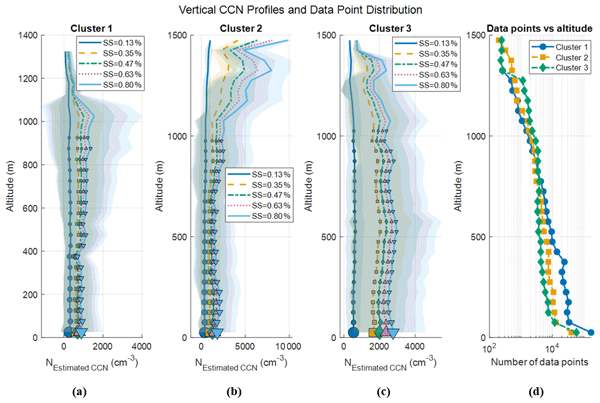
Fan Mei, Jian Wang, Israel Silber, Nurun Nahar Lata, Gregory W. Vandergrift, Jing Li, Bo Chen, Sarah D. Brooks, Michael P. Jensen, Min Deng, Damao Zhang, Darielle Dexheimer, Beat Schmid, Zezhen Cheng, and Swarup China
Atmos. Chem. Phys., 26, 13885–13908, https://doi.org/10.5194/acp-26-13885-2026, https://doi.org/10.5194/acp-26-13885-2026, 2026
Short summary
Short summary
Tethered balloon measurements from 149 flights during DOE ARM TRACER over Houston characterize vertical aerosol and CCN structure. Back-trajectory clustering identifies three air mass types – marine, mixed, and urban – with distinct profiles shaped by boundary-layer depth and coastal circulations. A case study shows mesoscale advection simultaneously transforms thermodynamic and aerosol conditions, underscoring the need to constrain meteorology before attributing cloud changes to aerosol forcing.
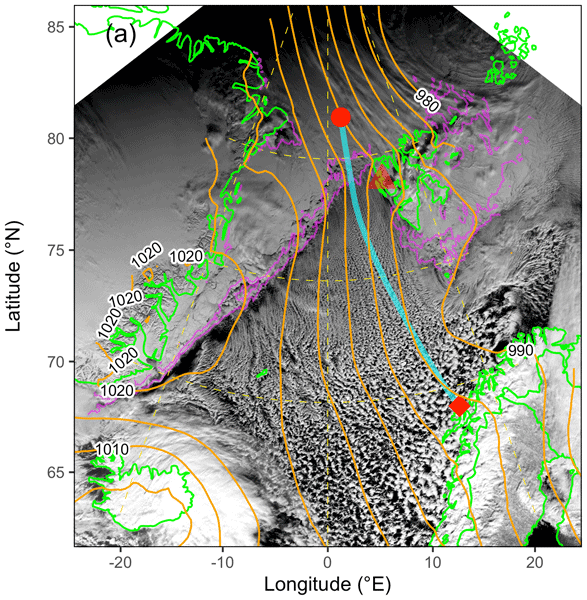
Timothy W. Juliano, Florian Tornow, Ann M. Fridlind, Andrew S. Ackerman, Gregory S. Elsaesser, Bart Geerts, Christian P. Lackner, David Painemal, Israel Silber, Mikhail Ovchinnikov, Gunilla Svensson, Michael Tjernström, Peng Wu, Alejandro Baró Pérez, Peter Bogenschutz, Dmitry Chechin, Kamal Kant Chandrakar, Jan Chylik, Andrey Debolskiy, Rostislav Fadeev, Anu Gupta, Luisa Ickes, Michail Karalis, Martin Köhler, Branko Kosović, Peter Kuma, Weiwei Li, Evgeny Mortikov, Hugh Morrison, Roel A. J. Neggers, Anna Possner, Tomi Raatikainen, Lea Raillard, Sami Romakkaniemi, Niklas Schnierstein, Shin-ichiro Shima, Nikita Silin, Mikhail Tolstykh, Étienne Vignon, Lulin Xue, Meng Zhang, and Xue Zheng
Atmos. Chem. Phys., 26, 13267–13302, https://doi.org/10.5194/acp-26-13267-2026, https://doi.org/10.5194/acp-26-13267-2026, 2026
Short summary
Short summary
Models struggle to capture cloud and precipitation processes and their radiative effects in marine cold-air outbreaks. We use a quasi-Lagrangian framework to compare large-eddy simulation (LES) and single-column model (SCM) output with field and satellite observations. With fixed droplet and ice numbers, LES and SCM agree in liquid-only tests. In mixed-phase conditions, LES plausibly capture cloud thinning and breakup, while SCMs largely remain overcast and thereby miss cloud radiative effects.
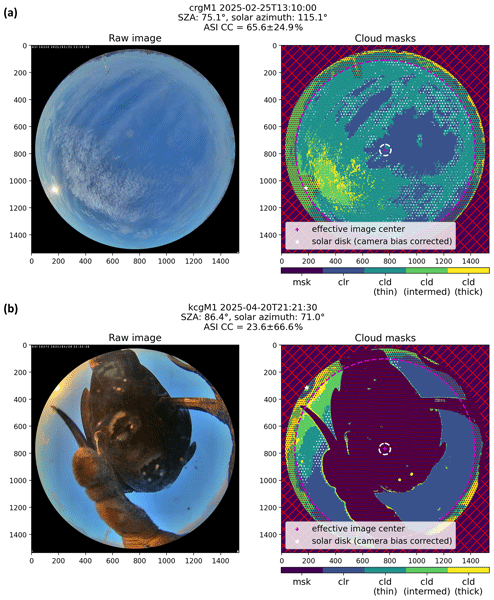
Israel Silber, Donna M. Flynn, Jennifer M. Comstock, Erol L. Cromwell, and Brian D. Ermold
Atmos. Meas. Tech., 19, 5457–5474, https://doi.org/10.5194/amt-19-5457-2026, https://doi.org/10.5194/amt-19-5457-2026, 2026
Short summary
Short summary
We describe ASISKYCOVER, a new machine learning algorithm for pixel segmentation of all-sky imager (ASI-16) data used by the Atmospheric Radiation Measurement (ARM) User Facility. ASISKYCOVER provides cloud cover and thickness estimates, detects artifacts, and reports uncertainties. Using one year of data from the ARM Southern Great Plains site and comparisons with other ARM datasets, we demonstrate its use and robustness, which will improve cloud cover analyses and data evaluation efforts.
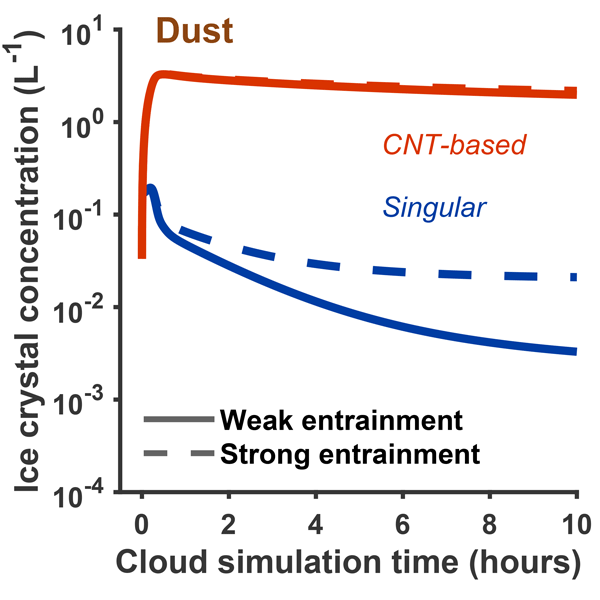
Yijia Sun, Ann M. Fridlind, Israel Silber, Nicole Riemer, and Daniel A. Knopf
Geosci. Model Dev., 19, 1581–1617, https://doi.org/10.5194/gmd-19-1581-2026, https://doi.org/10.5194/gmd-19-1581-2026, 2026
Short summary
Short summary
The role of Arctic clouds in the regional climate remains uncertain due to insufficient understanding of the amount of liquid droplets and ice crystals present in these clouds. An aerosol-cloud model is employed to examine the role of different aerosol types and freezing parameterizations on the number of ice crystals. The choice of freezing parameterization significantly changes the number of ice crystals impacting the interpretation of the evolution and warming effect of Arctic clouds.
Timothy W. Juliano, Florian Tornow, Ann M. Fridlind, Andrew S. Ackerman, Gregory S. Elsaesser, Bart Geerts, Christian P. Lackner, David Painemal, Israel Silber, Mikhail Ovchinnikov, Gunilla Svensson, Michael Tjernström, Peng Wu, Alejandro Baró Pérez, Peter Bogenschutz, Dmitry Chechin, Kamal Kant Chandrakar, Jan Chylik, Andrey Debolskiy, Rostislav Fadeev, Anu Gupta, Luisa Ickes, Michail Karalis, Martin Köhler, Branko Kosović, Peter Kuma, Weiwei Li, Evgeny Mortikov, Hugh Morrison, Roel A. J. Neggers, Anna Possner, Tomi Raatikainen, Sami Romakkaniemi, Niklas Schnierstein, Shin-ichiro Shima, Nikita Silin, Mikhail Tolstykh, Lulin Xue, Meng Zhang, and Xue Zheng
EGUsphere, https://doi.org/10.5194/egusphere-2025-6217, https://doi.org/10.5194/egusphere-2025-6217, 2026
Preprint archived
Short summary
Short summary
Models struggle to capture cloud and precipitation processes and their radiative effects in marine cold-air outbreaks. We use a quasi-Lagrangian framework to compare large-eddy simulation (LES) and single-column model (SCM) output with field and satellite observations. With fixed droplet and ice numbers, LES and SCM agree in liquid-only tests. In mixed-phase conditions, LES plausibly capture cloud thinning and breakup, while SCMs largely remain overcast and thereby miss cloud radiative effects.
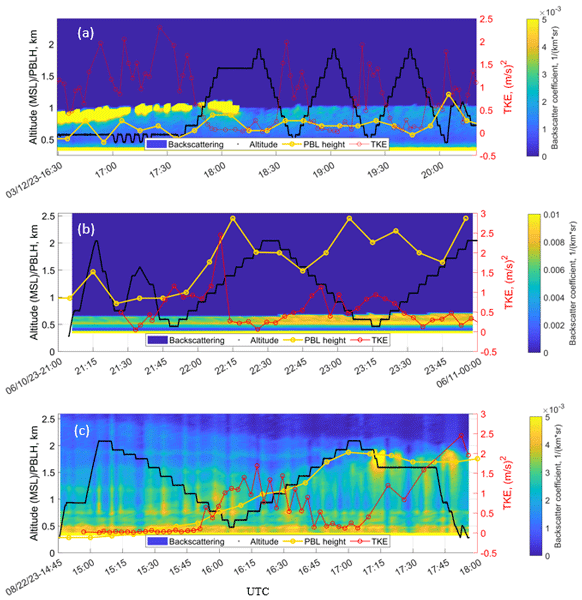
Fan Mei, Qi Zhang, Damao Zhang, Jerome D. Fast, Gourihar Kulkarni, Mikhail S. Pekour, Christopher R. Niedek, Susanne Glienke, Israel Silber, Beat Schmid, Jason M. Tomlinson, Hardeep S. Mehta, Xena Mansoura, Zezhen Cheng, Gregory W. Vandergrift, Nurun Nahar Lata, Swarup China, and Zihua Zhu
Atmos. Chem. Phys., 25, 3425–3444, https://doi.org/10.5194/acp-25-3425-2025, https://doi.org/10.5194/acp-25-3425-2025, 2025
Short summary
Short summary
This study highlights the unique capability of the ArcticShark, an uncrewed aerial system, in measuring vertically resolved atmospheric properties. Data from 32 research flights in 2023 reveal seasonal patterns and correlations with conventional measurements. The consistency and complementarity of in situ and remote sensing methods are highlighted. The study demonstrates the ArcticShark’s versatility in bridging data gaps and improving the understanding of vertical atmospheric structures.
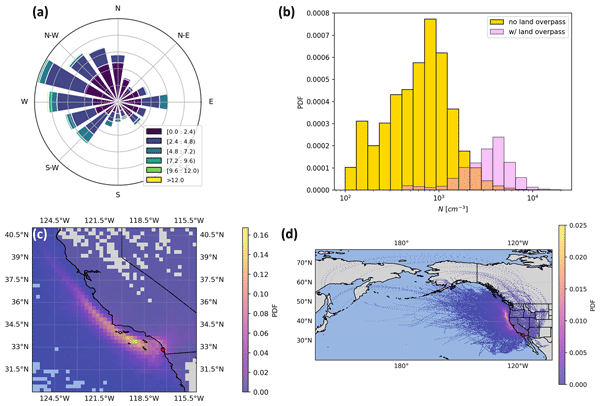
Israel Silber, Jennifer M. Comstock, Michael R. Kieburtz, and Lynn M. Russell
Earth Syst. Sci. Data, 17, 29–42, https://doi.org/10.5194/essd-17-29-2025, https://doi.org/10.5194/essd-17-29-2025, 2025
Short summary
Short summary
We present ARMTRAJ, a set of multipurpose trajectory datasets, which augments cloud, aerosol, and boundary layer studies utilizing the U.S. Department of Energy Atmospheric Radiation Measurement (ARM) user facility data. ARMTRAJ data include ensemble run statistics that enhance consistency and serve as uncertainty metrics for air mass coordinates and state variables. ARMTRAJ will soon become a near real-time product that will accompany past, ongoing, and future ARM deployments.
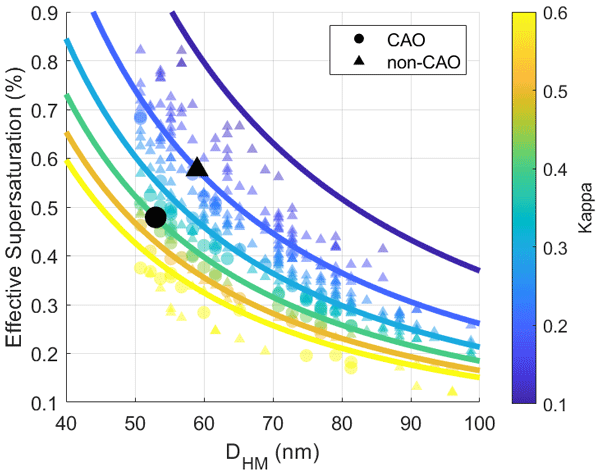
Abigail S. Williams, Jeramy L. Dedrick, Lynn M. Russell, Florian Tornow, Israel Silber, Ann M. Fridlind, Benjamin Swanson, Paul J. DeMott, Paul Zieger, and Radovan Krejci
Atmos. Chem. Phys., 24, 11791–11805, https://doi.org/10.5194/acp-24-11791-2024, https://doi.org/10.5194/acp-24-11791-2024, 2024
Short summary
Short summary
The measured aerosol size distribution modes reveal distinct properties characteristic of cold-air outbreaks in the Norwegian Arctic. We find higher sea spray number concentrations, smaller Hoppel minima, lower effective supersaturations, and accumulation-mode particle scavenging during cold-air outbreaks. These results advance our understanding of cold-air outbreak aerosol–cloud interactions in order to improve their accurate representation in models.
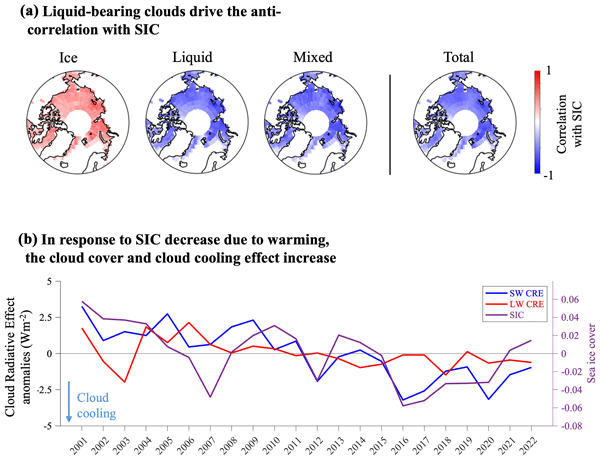
Grégory V. Cesana, Olivia Pierpaoli, Matteo Ottaviani, Linh Vu, Zhonghai Jin, and Israel Silber
Atmos. Chem. Phys., 24, 7899–7909, https://doi.org/10.5194/acp-24-7899-2024, https://doi.org/10.5194/acp-24-7899-2024, 2024
Short summary
Short summary
Better characterizing the relationship between sea ice and clouds is key to understanding Arctic climate because clouds and sea ice affect surface radiation and modulate Arctic surface warming. Our results indicate that Arctic liquid clouds robustly increase in response to sea ice decrease. This increase has a cooling effect on the surface because more solar radiation is reflected back to space, and it should contribute to dampening future Arctic surface warming.
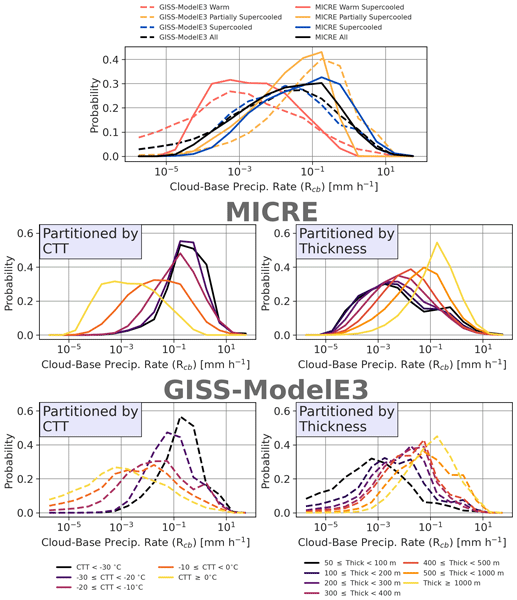
McKenna W. Stanford, Ann M. Fridlind, Israel Silber, Andrew S. Ackerman, Greg Cesana, Johannes Mülmenstädt, Alain Protat, Simon Alexander, and Adrian McDonald
Atmos. Chem. Phys., 23, 9037–9069, https://doi.org/10.5194/acp-23-9037-2023, https://doi.org/10.5194/acp-23-9037-2023, 2023
Short summary
Short summary
Clouds play an important role in the Earth’s climate system as they modulate the amount of radiation that either reaches the surface or is reflected back to space. This study demonstrates an approach to robustly evaluate surface-based observations against a large-scale model. We find that the large-scale model precipitates too infrequently relative to observations, contrary to literature documentation suggesting otherwise based on satellite measurements.
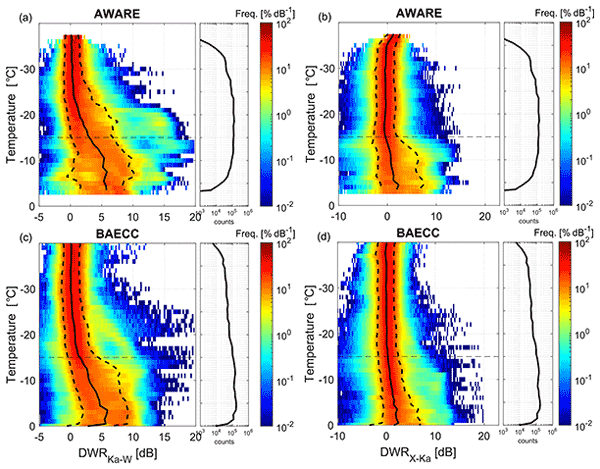
Frederic Tridon, Israel Silber, Alessandro Battaglia, Stefan Kneifel, Ann Fridlind, Petros Kalogeras, and Ranvir Dhillon
Atmos. Chem. Phys., 22, 12467–12491, https://doi.org/10.5194/acp-22-12467-2022, https://doi.org/10.5194/acp-22-12467-2022, 2022
Short summary
Short summary
The role of ice precipitation in the Earth water budget is not well known because ice particles are complex, and their formation involves intricate processes. Riming of ice crystals by supercooled water droplets is an efficient process, but little is known about its importance at high latitudes. In this work, by exploiting the deployment of an unprecedented number of remote sensing systems in Antarctica, we find that riming occurs at much lower temperatures compared with the mid-latitudes.

Israel Silber, Robert C. Jackson, Ann M. Fridlind, Andrew S. Ackerman, Scott Collis, Johannes Verlinde, and Jiachen Ding
Geosci. Model Dev., 15, 901–927, https://doi.org/10.5194/gmd-15-901-2022, https://doi.org/10.5194/gmd-15-901-2022, 2022
Short summary
Short summary
The Earth Model Column Collaboratory (EMC2) is an open-source ground-based (and air- or space-borne) lidar and radar simulator and subcolumn generator designed for large-scale models, in particular climate models, applicable also for high-resolution models. EMC2 emulates measurements while remaining faithful to large-scale models' physical assumptions implemented in their cloud or radiation schemes. We demonstrate the use of EMC2 to compare AWARE measurements with the NASA GISS ModelE3 and LES.
Liwen Wang, Jiaoshi Zhang, Jie Chen, Xiaoyu Xu, Yuhan Cheng, Shuling Chen, Yuzhong Zhang, Zeen Zhu, Yang Wang, and Xianda Gong
EGUsphere, https://doi.org/10.5194/egusphere-2026-6243, https://doi.org/10.5194/egusphere-2026-6243, 2026
This preprint is open for discussion and under review for Atmospheric Chemistry and Physics (ACP).
Short summary
Short summary
Low clouds over the ocean help cool Earth, but their formation remains uncertain. Using aircraft and ground measurements, we found that weak mixing can prevent particles near the surface from reaching clouds. Larger particles mainly control cloud droplet numbers in summer, while smaller particles become more important in cleaner winter air. These findings can improve how clouds are represented in climate models and help assess proposals to brighten marine clouds to cool the planet.
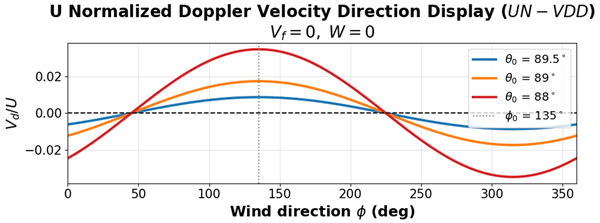
Min Deng, Scott E. Giangrande, Adam K. Theisen, Karen L. Johnson, Iosif A. Lindenmaier, Timothy G. Wendler, Jennifer Comstock, Marquette Rocque, Zeen Zhu, and Alyssa Matthews
Atmos. Meas. Tech., 19, 6327–6339, https://doi.org/10.5194/amt-19-6327-2026, https://doi.org/10.5194/amt-19-6327-2026, 2026
Short summary
Short summary
Cloud radars are used to measure air motion, clouds, and precipitation, but small pointing errors can reduce their accuracy. We developed a method to detect these errors using routine weather balloon observations. Tests with several radar systems in different environments showed that the method can identify small but important pointing biases, helping improve the accuracy and long-term consistency of weather and climate observations.
Fan Mei, Jian Wang, Israel Silber, Nurun Nahar Lata, Gregory W. Vandergrift, Jing Li, Bo Chen, Sarah D. Brooks, Michael P. Jensen, Min Deng, Damao Zhang, Darielle Dexheimer, Beat Schmid, Zezhen Cheng, and Swarup China
Atmos. Chem. Phys., 26, 13885–13908, https://doi.org/10.5194/acp-26-13885-2026, https://doi.org/10.5194/acp-26-13885-2026, 2026
Short summary
Short summary
Tethered balloon measurements from 149 flights during DOE ARM TRACER over Houston characterize vertical aerosol and CCN structure. Back-trajectory clustering identifies three air mass types – marine, mixed, and urban – with distinct profiles shaped by boundary-layer depth and coastal circulations. A case study shows mesoscale advection simultaneously transforms thermodynamic and aerosol conditions, underscoring the need to constrain meteorology before attributing cloud changes to aerosol forcing.
Timothy W. Juliano, Florian Tornow, Ann M. Fridlind, Andrew S. Ackerman, Gregory S. Elsaesser, Bart Geerts, Christian P. Lackner, David Painemal, Israel Silber, Mikhail Ovchinnikov, Gunilla Svensson, Michael Tjernström, Peng Wu, Alejandro Baró Pérez, Peter Bogenschutz, Dmitry Chechin, Kamal Kant Chandrakar, Jan Chylik, Andrey Debolskiy, Rostislav Fadeev, Anu Gupta, Luisa Ickes, Michail Karalis, Martin Köhler, Branko Kosović, Peter Kuma, Weiwei Li, Evgeny Mortikov, Hugh Morrison, Roel A. J. Neggers, Anna Possner, Tomi Raatikainen, Lea Raillard, Sami Romakkaniemi, Niklas Schnierstein, Shin-ichiro Shima, Nikita Silin, Mikhail Tolstykh, Étienne Vignon, Lulin Xue, Meng Zhang, and Xue Zheng
Atmos. Chem. Phys., 26, 13267–13302, https://doi.org/10.5194/acp-26-13267-2026, https://doi.org/10.5194/acp-26-13267-2026, 2026
Short summary
Short summary
Models struggle to capture cloud and precipitation processes and their radiative effects in marine cold-air outbreaks. We use a quasi-Lagrangian framework to compare large-eddy simulation (LES) and single-column model (SCM) output with field and satellite observations. With fixed droplet and ice numbers, LES and SCM agree in liquid-only tests. In mixed-phase conditions, LES plausibly capture cloud thinning and breakup, while SCMs largely remain overcast and thereby miss cloud radiative effects.
Israel Silber, Donna M. Flynn, Jennifer M. Comstock, Erol L. Cromwell, and Brian D. Ermold
Atmos. Meas. Tech., 19, 5457–5474, https://doi.org/10.5194/amt-19-5457-2026, https://doi.org/10.5194/amt-19-5457-2026, 2026
Short summary
Short summary
We describe ASISKYCOVER, a new machine learning algorithm for pixel segmentation of all-sky imager (ASI-16) data used by the Atmospheric Radiation Measurement (ARM) User Facility. ASISKYCOVER provides cloud cover and thickness estimates, detects artifacts, and reports uncertainties. Using one year of data from the ARM Southern Great Plains site and comparisons with other ARM datasets, we demonstrate its use and robustness, which will improve cloud cover analyses and data evaluation efforts.
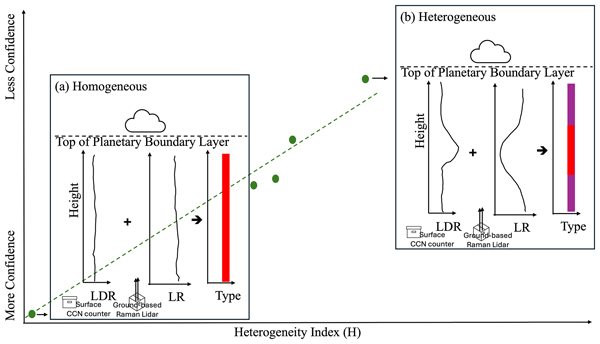
Jingjing Tian, Gourihar Kulkarni, Jennifer M. Comstock, John E. Shilling, Damao Zhang, Peng Wu, and Fan Mei
Atmos. Meas. Tech., 19, 5051–5069, https://doi.org/10.5194/amt-19-5051-2026, https://doi.org/10.5194/amt-19-5051-2026, 2026
Short summary
Short summary
Cloud condensation nuclei are tiny particles that attract water vapor and help form clouds. A ground-based lidar method can estimate their number at different heights, but assumes the aerosol type does not change with height. Comparisons with aircraft data show good agreement of this method when aerosols are well mixed, but larger errors when stacked layers occur. We also developed an index to flag these complex conditions and indicate when this estimation method is more reliable.
Jessie M. Creamean, Darielle Dexheimer, Carson C. Hume, Maria Vazquez, Benjamin T. M. Hess, Casey M. Longbottom, Carlos A. Ruiz, and Adam K. Theisen
Atmos. Meas. Tech., 19, 4601–4615, https://doi.org/10.5194/amt-19-4601-2026, https://doi.org/10.5194/amt-19-4601-2026, 2026
Short summary
Short summary
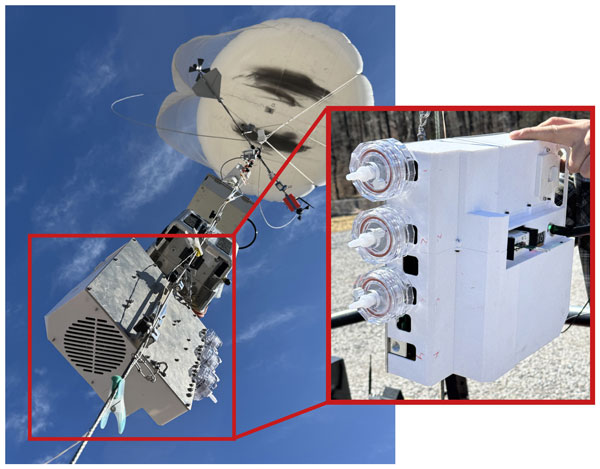
PUFIN (Profiling Upper altitudes For Ice Nucleation) is a lightweight sampler flown on the U.S. Department of Energy’s Atmospheric Radiation Measurement user facility’s tethered balloons to measure ice nucleating particles at multiple altitudes. Deployments in Maryland and Alabama show it can detect low concentrations in under an hour and capture changes with height. All data are publicly available, and future flights will help track seasonal and vertical patterns of these unique particles.
Florian Poydenot, Nina Robbins-Blanch, Zeen Zhu, and Raphaela Vogel
EGUsphere, https://doi.org/10.5194/egusphere-2026-1974, https://doi.org/10.5194/egusphere-2026-1974, 2026
Short summary
Short summary
Trade wind cumuli often rain, which produces downward motion of the surrounding air as the raindrops evaporate. However, we do not understand well what controls this due to a lack of observations inside raining clouds. We use a combination of radar and lidar to obtain the vertical wind for six years at the Barbados Cloud Observatory. We show that trade wind cumuli are organized in similar ways to storms. These observations can help us design better models of clouds used to study the climate.
Yijia Sun, Ann M. Fridlind, Israel Silber, Nicole Riemer, and Daniel A. Knopf
Geosci. Model Dev., 19, 1581–1617, https://doi.org/10.5194/gmd-19-1581-2026, https://doi.org/10.5194/gmd-19-1581-2026, 2026
Short summary
Short summary
The role of Arctic clouds in the regional climate remains uncertain due to insufficient understanding of the amount of liquid droplets and ice crystals present in these clouds. An aerosol-cloud model is employed to examine the role of different aerosol types and freezing parameterizations on the number of ice crystals. The choice of freezing parameterization significantly changes the number of ice crystals impacting the interpretation of the evolution and warming effect of Arctic clouds.
Timothy W. Juliano, Florian Tornow, Ann M. Fridlind, Andrew S. Ackerman, Gregory S. Elsaesser, Bart Geerts, Christian P. Lackner, David Painemal, Israel Silber, Mikhail Ovchinnikov, Gunilla Svensson, Michael Tjernström, Peng Wu, Alejandro Baró Pérez, Peter Bogenschutz, Dmitry Chechin, Kamal Kant Chandrakar, Jan Chylik, Andrey Debolskiy, Rostislav Fadeev, Anu Gupta, Luisa Ickes, Michail Karalis, Martin Köhler, Branko Kosović, Peter Kuma, Weiwei Li, Evgeny Mortikov, Hugh Morrison, Roel A. J. Neggers, Anna Possner, Tomi Raatikainen, Sami Romakkaniemi, Niklas Schnierstein, Shin-ichiro Shima, Nikita Silin, Mikhail Tolstykh, Lulin Xue, Meng Zhang, and Xue Zheng
EGUsphere, https://doi.org/10.5194/egusphere-2025-6217, https://doi.org/10.5194/egusphere-2025-6217, 2026
Preprint archived
Short summary
Short summary
Models struggle to capture cloud and precipitation processes and their radiative effects in marine cold-air outbreaks. We use a quasi-Lagrangian framework to compare large-eddy simulation (LES) and single-column model (SCM) output with field and satellite observations. With fixed droplet and ice numbers, LES and SCM agree in liquid-only tests. In mixed-phase conditions, LES plausibly capture cloud thinning and breakup, while SCMs largely remain overcast and thereby miss cloud radiative effects.
Zeen Zhu, Fan Yang, Steven Krueger, and Yangang Liu
Atmos. Chem. Phys., 25, 18461–18474, https://doi.org/10.5194/acp-25-18461-2025, https://doi.org/10.5194/acp-25-18461-2025, 2025
Short summary
Short summary
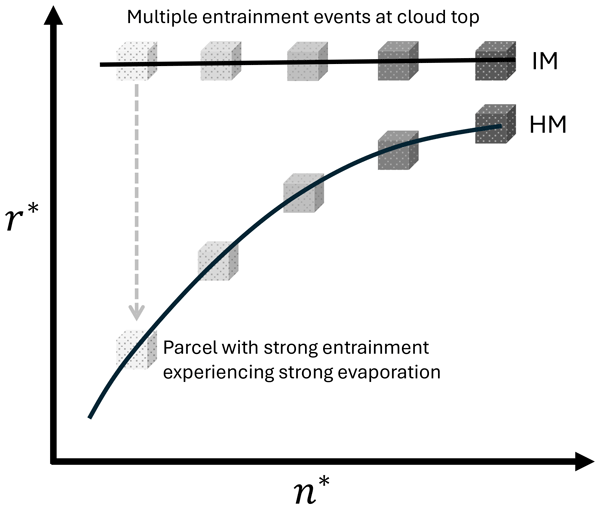
To better understand cloud behavior, we used model simulation to study how the air mix in clouds. Our results show that the pattern of mixing seen from aircraft measurements may not reflect the true mixing process happening inside clouds. This result suggests that care is needed when using aircraft data to study the cloud mixing process and that new ways of observing clouds could offer clearer insights.
Jessie M. Creamean, Carson C. Hume, Maria Vazquez, and Adam Theisen
Earth Syst. Sci. Data, 17, 6943–6963, https://doi.org/10.5194/essd-17-6943-2025, https://doi.org/10.5194/essd-17-6943-2025, 2025
Short summary
Short summary
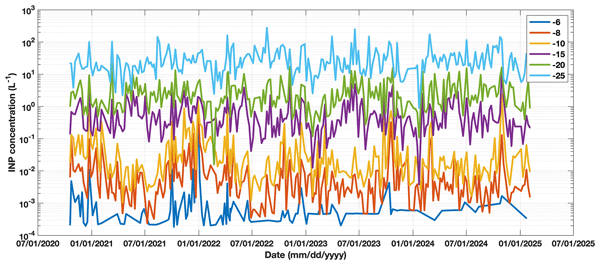
This study presents a comprehensive, publicly available ice nucleating particles (INP) dataset from the U.S. Department of Energy Atmospheric Radiation Measurement (ARM) user facility across diverse environments, including Arctic, agricultural, urban, marine, and mountainous sites. Samples are collected via fixed and mobile platforms and processed using a standardized pipeline. The dataset supports observational and modelling analyses of seasonal, spatial, and compositional variability in INPs.
Ryan C. Sullivan, David P. Billesbach, Sebastien Biraud, Stephen Chan, Richard Hart, Evan Keeler, Jenni Kyrouac, Sujan Pal, Mikhail Pekour, Sara L. Sullivan, Adam Theisen, Matt Tuftedal, and David R. Cook
Earth Syst. Sci. Data, 17, 5007–5038, https://doi.org/10.5194/essd-17-5007-2025, https://doi.org/10.5194/essd-17-5007-2025, 2025
Short summary
Short summary
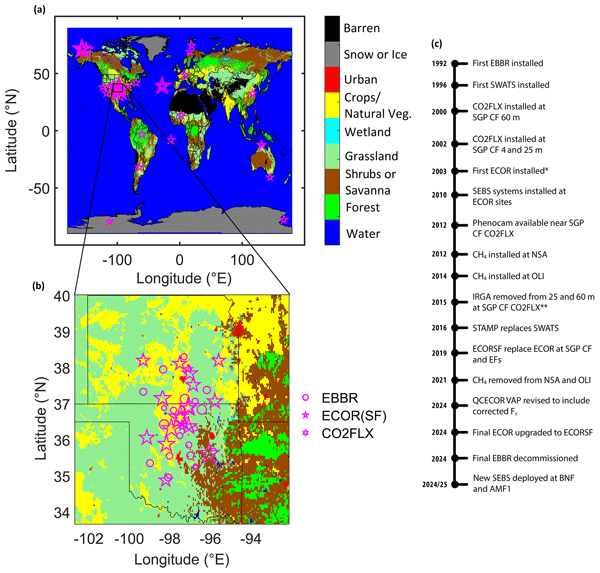
Turbulent fluxes quantify the exchange of energy, water, or trace gases into and out of the atmosphere. The U.S. Department of Energy Atmospheric Radiation Measurement user facility has been making atmospheric measurements since the early 1990s, including measurements of turbulent fluxes using two well-established methods: the energy balance Bowen ratio and eddy covariance. This paper documents key aspects of these datasets, including their history, changes through time, and best use practices.

Damao Zhang, Jennifer Comstock, Chitra Sivaraman, Kefei Mo, Raghavendra Krishnamurthy, Jingjing Tian, Tianning Su, Zhanqing Li, and Natalia Roldán-Henao
Atmos. Meas. Tech., 18, 3453–3475, https://doi.org/10.5194/amt-18-3453-2025, https://doi.org/10.5194/amt-18-3453-2025, 2025
Short summary
Short summary
Planetary boundary layer height (PBLHT) is an important parameter in atmospheric process studies and numerical model simulations. We use machine learning methods to produce a best-estimate planetary boundary layer height (PBLHT-BE-ML) by integrating four PBLHT estimates derived from remote sensing measurements. We demonstrated that PBLHT-BE-ML greatly improved the comparisons against sounding-derived PBLHT.
Min Deng, Scott E. Giangrande, Michael P. Jensen, Karen Johnson, Christopher R. Williams, Jennifer M. Comstock, Ya-Chien Feng, Alyssa Matthews, Iosif A. Lindenmaier, Timothy G. Wendler, Marquette Rocque, Aifang Zhou, Zeen Zhu, Edward Luke, and Die Wang
Atmos. Meas. Tech., 18, 1641–1657, https://doi.org/10.5194/amt-18-1641-2025, https://doi.org/10.5194/amt-18-1641-2025, 2025
Short summary
Short summary
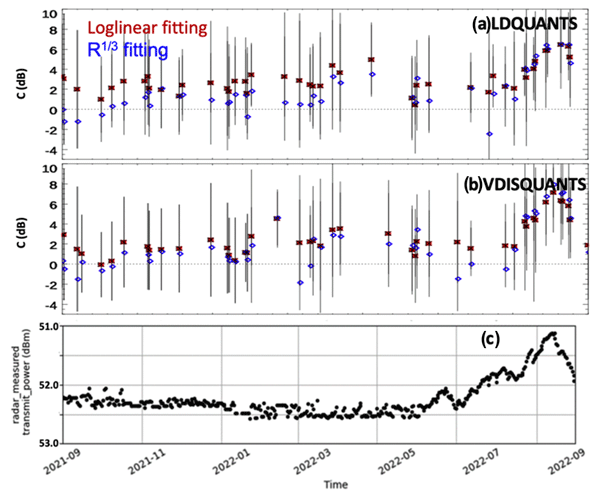
A relative calibration technique is developed for the cloud radar by monitoring the intercept of the wet-radome attenuation log-linear behavior as a function of rainfall rates in light and moderate rain conditions. This resulting reflectivity offset during the recent field campaign is compared favorably with the traditional disdrometer comparison near the rain onset, while it also demonstrates similar trends with respect to collocated and independently calibrated reference radars.
Fan Mei, Qi Zhang, Damao Zhang, Jerome D. Fast, Gourihar Kulkarni, Mikhail S. Pekour, Christopher R. Niedek, Susanne Glienke, Israel Silber, Beat Schmid, Jason M. Tomlinson, Hardeep S. Mehta, Xena Mansoura, Zezhen Cheng, Gregory W. Vandergrift, Nurun Nahar Lata, Swarup China, and Zihua Zhu
Atmos. Chem. Phys., 25, 3425–3444, https://doi.org/10.5194/acp-25-3425-2025, https://doi.org/10.5194/acp-25-3425-2025, 2025
Short summary
Short summary
This study highlights the unique capability of the ArcticShark, an uncrewed aerial system, in measuring vertically resolved atmospheric properties. Data from 32 research flights in 2023 reveal seasonal patterns and correlations with conventional measurements. The consistency and complementarity of in situ and remote sensing methods are highlighted. The study demonstrates the ArcticShark’s versatility in bridging data gaps and improving the understanding of vertical atmospheric structures.
Israel Silber, Jennifer M. Comstock, Michael R. Kieburtz, and Lynn M. Russell
Earth Syst. Sci. Data, 17, 29–42, https://doi.org/10.5194/essd-17-29-2025, https://doi.org/10.5194/essd-17-29-2025, 2025
Short summary
Short summary
We present ARMTRAJ, a set of multipurpose trajectory datasets, which augments cloud, aerosol, and boundary layer studies utilizing the U.S. Department of Energy Atmospheric Radiation Measurement (ARM) user facility data. ARMTRAJ data include ensemble run statistics that enhance consistency and serve as uncertainty metrics for air mass coordinates and state variables. ARMTRAJ will soon become a near real-time product that will accompany past, ongoing, and future ARM deployments.
Fan Mei, Jennifer M. Comstock, Mikhail S. Pekour, Jerome D. Fast, Krista L. Gaustad, Beat Schmid, Shuaiqi Tang, Damao Zhang, John E. Shilling, Jason M. Tomlinson, Adam C. Varble, Jian Wang, L. Ruby Leung, Lawrence Kleinman, Scot Martin, Sebastien C. Biraud, Brian D. Ermold, and Kenneth W. Burk
Earth Syst. Sci. Data, 16, 5429–5448, https://doi.org/10.5194/essd-16-5429-2024, https://doi.org/10.5194/essd-16-5429-2024, 2024
Short summary
Short summary
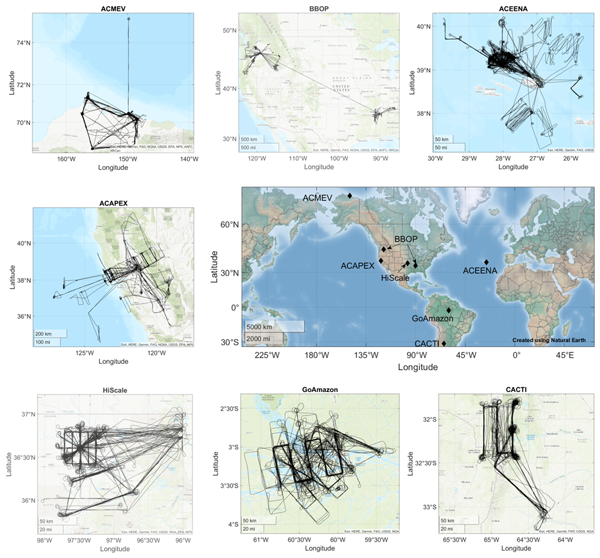
Our study explores a comprehensive dataset from airborne field studies (2013–2018) conducted using the US Department of Energy's Gulfstream 1 (G-1). The 236 flights span diverse regions, including the Arctic, US Southern Great Plains, US West Coast, eastern North Atlantic, Amazon Basin in Brazil, and Sierras de Córdoba range in Argentina. This dataset provides unique insights into atmospheric dynamics, aerosols, and clouds and makes data available in a more accessible format.
Abigail S. Williams, Jeramy L. Dedrick, Lynn M. Russell, Florian Tornow, Israel Silber, Ann M. Fridlind, Benjamin Swanson, Paul J. DeMott, Paul Zieger, and Radovan Krejci
Atmos. Chem. Phys., 24, 11791–11805, https://doi.org/10.5194/acp-24-11791-2024, https://doi.org/10.5194/acp-24-11791-2024, 2024
Short summary
Short summary
The measured aerosol size distribution modes reveal distinct properties characteristic of cold-air outbreaks in the Norwegian Arctic. We find higher sea spray number concentrations, smaller Hoppel minima, lower effective supersaturations, and accumulation-mode particle scavenging during cold-air outbreaks. These results advance our understanding of cold-air outbreak aerosol–cloud interactions in order to improve their accurate representation in models.
Evgueni Kassianov, Connor J. Flynn, James C. Barnard, Brian D. Ermold, and Jennifer M. Comstock
Atmos. Meas. Tech., 17, 4997–5013, https://doi.org/10.5194/amt-17-4997-2024, https://doi.org/10.5194/amt-17-4997-2024, 2024
Short summary
Short summary
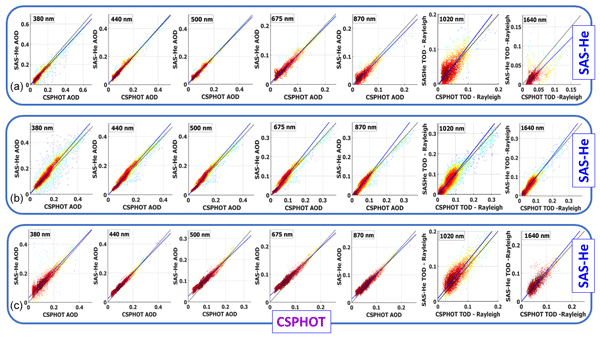
Conventional ground-based radiometers commonly measure solar radiation at a few wavelengths within a narrow spectral range. These limitations prevent improved retrievals of aerosol, cloud, and surface characteristics. To address these limitations, an advanced ground-based radiometer with expanded spectral coverage and hyperspectral capability is introduced. Its good performance is demonstrated using reference data collected over three coastal regions with diverse types of aerosols and clouds.
Grégory V. Cesana, Olivia Pierpaoli, Matteo Ottaviani, Linh Vu, Zhonghai Jin, and Israel Silber
Atmos. Chem. Phys., 24, 7899–7909, https://doi.org/10.5194/acp-24-7899-2024, https://doi.org/10.5194/acp-24-7899-2024, 2024
Short summary
Short summary
Better characterizing the relationship between sea ice and clouds is key to understanding Arctic climate because clouds and sea ice affect surface radiation and modulate Arctic surface warming. Our results indicate that Arctic liquid clouds robustly increase in response to sea ice decrease. This increase has a cooling effect on the surface because more solar radiation is reflected back to space, and it should contribute to dampening future Arctic surface warming.
Kelly A. Balmes, Laura D. Riihimaki, John Wood, Connor Flynn, Adam Theisen, Michael Ritsche, Lynn Ma, Gary B. Hodges, and Christian Herrera
Atmos. Meas. Tech., 17, 3783–3807, https://doi.org/10.5194/amt-17-3783-2024, https://doi.org/10.5194/amt-17-3783-2024, 2024
Short summary
Short summary
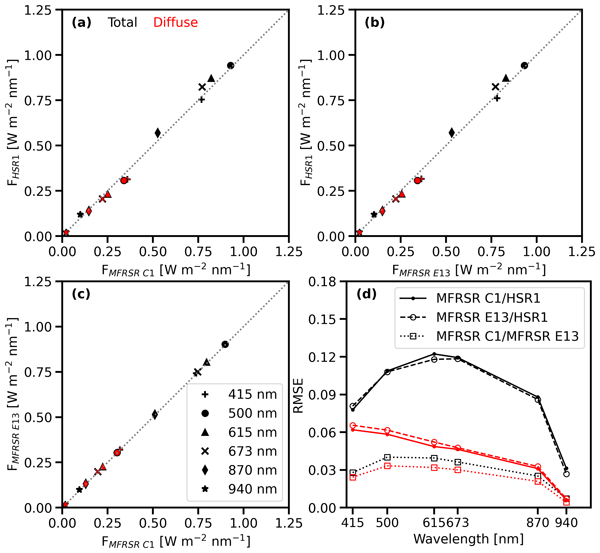
A new hyperspectral radiometer (HSR1) was deployed and evaluated in the central United States (northern Oklahoma). The HSR1 total spectral irradiance agreed well with nearby existing instruments, but the diffuse spectral irradiance was slightly smaller. The HSR1-retrieved aerosol optical depth (AOD) also agreed well with other retrieved AODs. The HSR1 performance is encouraging: new hyperspectral knowledge is possible that could inform atmospheric process understanding and weather forecasting.
Zeen Zhu, Fan Yang, Pavlos Kollias, Raymond A. Shaw, Alex B. Kostinski, Steve Krueger, Katia Lamer, Nithin Allwayin, and Mariko Oue
Atmos. Meas. Tech., 17, 1133–1143, https://doi.org/10.5194/amt-17-1133-2024, https://doi.org/10.5194/amt-17-1133-2024, 2024
Short summary
Short summary
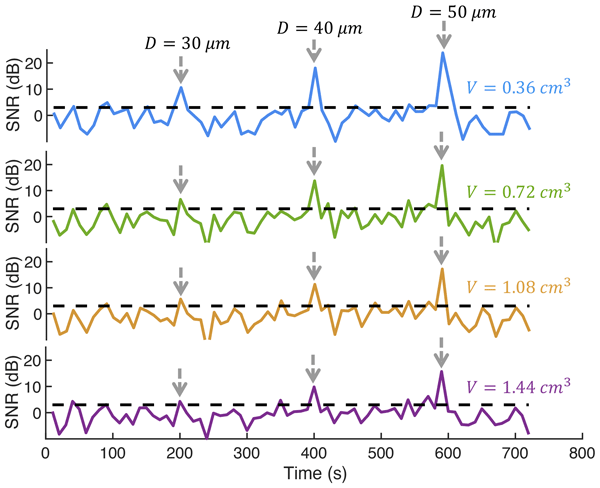
In this article, we demonstrate the feasibility of applying advanced radar technology to detect liquid droplets generated in the cloud chamber. Specifically, we show that using radar with centimeter-scale resolution, single drizzle drops with a diameter larger than 40 µm can be detected. This study demonstrates the applicability of remote sensing instruments in laboratory experiments and suggests new applications of ultrahigh-resolution radar for atmospheric sensing.
McKenna W. Stanford, Ann M. Fridlind, Israel Silber, Andrew S. Ackerman, Greg Cesana, Johannes Mülmenstädt, Alain Protat, Simon Alexander, and Adrian McDonald
Atmos. Chem. Phys., 23, 9037–9069, https://doi.org/10.5194/acp-23-9037-2023, https://doi.org/10.5194/acp-23-9037-2023, 2023
Short summary
Short summary
Clouds play an important role in the Earth’s climate system as they modulate the amount of radiation that either reaches the surface or is reflected back to space. This study demonstrates an approach to robustly evaluate surface-based observations against a large-scale model. We find that the large-scale model precipitates too infrequently relative to observations, contrary to literature documentation suggesting otherwise based on satellite measurements.
Zeen Zhu, Pavlos Kollias, and Fan Yang
Atmos. Meas. Tech., 16, 3727–3737, https://doi.org/10.5194/amt-16-3727-2023, https://doi.org/10.5194/amt-16-3727-2023, 2023
Short summary
Short summary
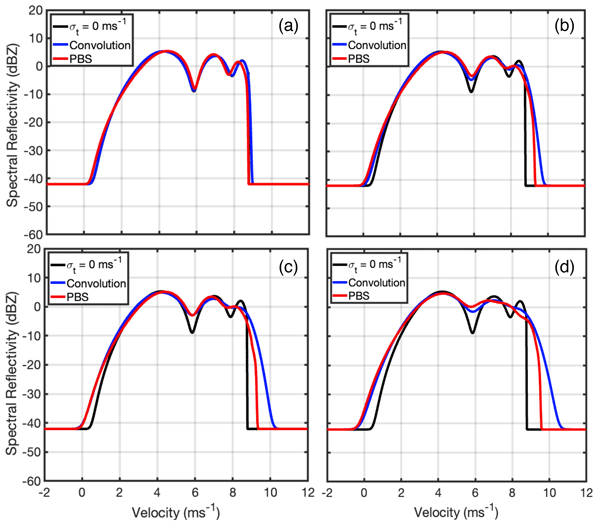
We show that large rain droplets, with large inertia, are unable to follow the rapid change of velocity field in a turbulent environment. A lack of consideration for this inertial effect leads to an artificial broadening of the Doppler spectrum from the conventional simulator. Based on the physics-based simulation, we propose a new approach to generate the radar Doppler spectra. This simulator provides a valuable tool to decode cloud microphysical and dynamical properties from radar observation.

Zackary Mages, Pavlos Kollias, Zeen Zhu, and Edward P. Luke
Atmos. Chem. Phys., 23, 3561–3574, https://doi.org/10.5194/acp-23-3561-2023, https://doi.org/10.5194/acp-23-3561-2023, 2023
Short summary
Short summary
Cold-air outbreaks (when cold air is advected over warm water and creates low-level convection) are a dominant cloud regime in the Arctic, and we capitalized on ground-based observations, which did not previously exist, from the COMBLE field campaign to study them. We characterized the extent and strength of the convection and turbulence and found evidence of secondary ice production. This information is useful for model intercomparison studies that will represent cold-air outbreak processes.
Frederic Tridon, Israel Silber, Alessandro Battaglia, Stefan Kneifel, Ann Fridlind, Petros Kalogeras, and Ranvir Dhillon
Atmos. Chem. Phys., 22, 12467–12491, https://doi.org/10.5194/acp-22-12467-2022, https://doi.org/10.5194/acp-22-12467-2022, 2022
Short summary
Short summary
The role of ice precipitation in the Earth water budget is not well known because ice particles are complex, and their formation involves intricate processes. Riming of ice crystals by supercooled water droplets is an efficient process, but little is known about its importance at high latitudes. In this work, by exploiting the deployment of an unprecedented number of remote sensing systems in Antarctica, we find that riming occurs at much lower temperatures compared with the mid-latitudes.
Damao Zhang, Jennifer Comstock, and Victor Morris
Atmos. Meas. Tech., 15, 4735–4749, https://doi.org/10.5194/amt-15-4735-2022, https://doi.org/10.5194/amt-15-4735-2022, 2022
Short summary
Short summary
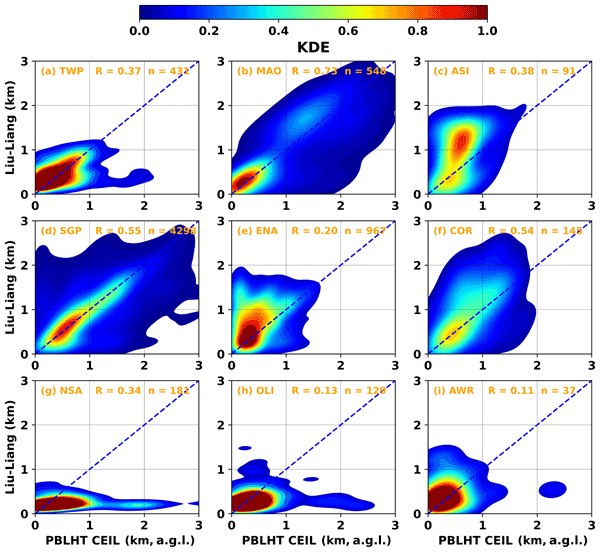
The planetary boundary layer is the lowest part of the atmosphere. Its structure and depth (PBLHT) significantly impact air quality, global climate, land–atmosphere interactions, and a wide range of atmospheric processes. To test the robustness of the ceilometer-estimated PBLHT under different atmospheric conditions, we compared ceilometer- and radiosonde-estimated PBLHTs using multiple years of U.S. DOE ARM measurements at various ARM observatories located around the world.

Zeen Zhu, Pavlos Kollias, Edward Luke, and Fan Yang
Atmos. Chem. Phys., 22, 7405–7416, https://doi.org/10.5194/acp-22-7405-2022, https://doi.org/10.5194/acp-22-7405-2022, 2022
Short summary
Short summary
Drizzle (small rain droplets) is an important component of warm clouds; however, its existence is poorly understood. In this study, we capitalized on a machine-learning algorithm to develop a drizzle detection method. We applied this algorithm to investigate drizzle occurrence and found out that drizzle is far more ubiquitous than previously thought. This study demonstrates the ubiquitous nature of drizzle in clouds and will improve understanding of the associated microphysical process.

Yun Lin, Jiwen Fan, Pengfei Li, Lai-yung Ruby Leung, Paul J. DeMott, Lexie Goldberger, Jennifer Comstock, Ying Liu, Jong-Hoon Jeong, and Jason Tomlinson
Atmos. Chem. Phys., 22, 6749–6771, https://doi.org/10.5194/acp-22-6749-2022, https://doi.org/10.5194/acp-22-6749-2022, 2022
Short summary
Short summary
How sea spray aerosols may affect cloud and precipitation over the region by acting as ice-nucleating particles (INPs) is unknown. We explored the effects of INPs from marine aerosols on orographic cloud and precipitation for an atmospheric river event observed during the 2015 ACAPEX field campaign. The marine INPs enhance the formation of ice and snow, leading to less shallow warm clouds but more mixed-phase and deep clouds. This work suggests models need to consider the impacts of marine INPs.
Israel Silber, Robert C. Jackson, Ann M. Fridlind, Andrew S. Ackerman, Scott Collis, Johannes Verlinde, and Jiachen Ding
Geosci. Model Dev., 15, 901–927, https://doi.org/10.5194/gmd-15-901-2022, https://doi.org/10.5194/gmd-15-901-2022, 2022
Short summary
Short summary
The Earth Model Column Collaboratory (EMC2) is an open-source ground-based (and air- or space-borne) lidar and radar simulator and subcolumn generator designed for large-scale models, in particular climate models, applicable also for high-resolution models. EMC2 emulates measurements while remaining faithful to large-scale models' physical assumptions implemented in their cloud or radiation schemes. We demonstrate the use of EMC2 to compare AWARE measurements with the NASA GISS ModelE3 and LES.
Wouter Dorigo, Irene Himmelbauer, Daniel Aberer, Lukas Schremmer, Ivana Petrakovic, Luca Zappa, Wolfgang Preimesberger, Angelika Xaver, Frank Annor, Jonas Ardö, Dennis Baldocchi, Marco Bitelli, Günter Blöschl, Heye Bogena, Luca Brocca, Jean-Christophe Calvet, J. Julio Camarero, Giorgio Capello, Minha Choi, Michael C. Cosh, Nick van de Giesen, Istvan Hajdu, Jaakko Ikonen, Karsten H. Jensen, Kasturi Devi Kanniah, Ileen de Kat, Gottfried Kirchengast, Pankaj Kumar Rai, Jenni Kyrouac, Kristine Larson, Suxia Liu, Alexander Loew, Mahta Moghaddam, José Martínez Fernández, Cristian Mattar Bader, Renato Morbidelli, Jan P. Musial, Elise Osenga, Michael A. Palecki, Thierry Pellarin, George P. Petropoulos, Isabella Pfeil, Jarrett Powers, Alan Robock, Christoph Rüdiger, Udo Rummel, Michael Strobel, Zhongbo Su, Ryan Sullivan, Torbern Tagesson, Andrej Varlagin, Mariette Vreugdenhil, Jeffrey Walker, Jun Wen, Fred Wenger, Jean Pierre Wigneron, Mel Woods, Kun Yang, Yijian Zeng, Xiang Zhang, Marek Zreda, Stephan Dietrich, Alexander Gruber, Peter van Oevelen, Wolfgang Wagner, Klaus Scipal, Matthias Drusch, and Roberto Sabia
Hydrol. Earth Syst. Sci., 25, 5749–5804, https://doi.org/10.5194/hess-25-5749-2021, https://doi.org/10.5194/hess-25-5749-2021, 2021
Short summary
Short summary
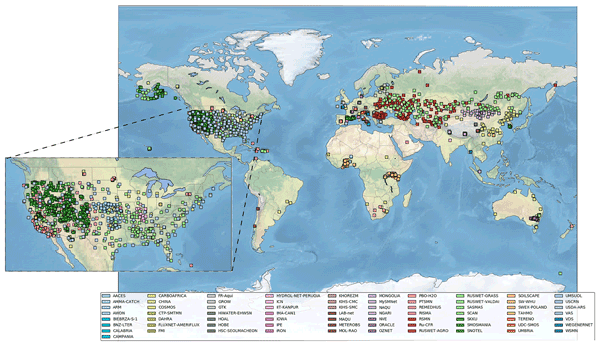
The International Soil Moisture Network (ISMN) is a community-based open-access data portal for soil water measurements taken at the ground and is accessible at https://ismn.earth. Over 1000 scientific publications and thousands of users have made use of the ISMN. The scope of this paper is to inform readers about the data and functionality of the ISMN and to provide a review of the scientific progress facilitated through the ISMN with the scope to shape future research and operations.
Cited articles
Bartholomew, M. J.: Impact Disdrometers Instrument Handbook, ARM Climate Research Facility, Pacific Northwest National Laboratory, Richland, WA, US, https://doi.org/10.2172/1251384, 2016a.
Bartholomew, M. J.: Optical Rain Gauge Instrument Handbook, ARM Climate Research Facility, Pacific Northwest National Laboratory, Richland, WA, US, https://doi.org/10.2172/1251388, 2016b.
Bartholomew, M. J.: Rain Gauges Handbook, https://doi.org/10.2172/1245982, 2016c.
Bartholomew, M. J.: Weighing Bucket Rain Gauge Instrument Handbook, US, https://doi.org/10.2172/1572341, 2019.
Bartholomew, M. J.: Laser Disdrometer Instrument Handbook, DOE ARM Climate Research Facility, Pacific Northwest National Laboratory, Richland, WA, US, https://doi.org/10.2172/1226796, 2020a.
Bartholomew, M. J.: Two-Dimensional Video Disdrometer (VDIS) Instrument Handbook, ARM Climate Research Facility, Pacific Northwest National Laboratory, Richland, WA, US, https://doi.org/10.2172/1251384, 2020b.
Battaglia, A., Rustemeier, E., Tokay, A., Blahak, U., and Simmer, C.: PARSIVEL snow observations: a critical assessment, J. Atmos. Ocean. Tech., 27, 333–344, https://doi.org/10.1175/2009JTECHA1332.1, 2010.
Bretherton, C. S., Uchida, J., and Blossey, P. N.: Slow manifolds and multiple equilibria in stratocumulus-capped boundary layers, J. Adv. Model. Earth Sy., 2, https://doi.org/10.3894/JAMES.2010.2.14, 2010.
Christensen, M. W., Wu, P., Varble, A. C., Xiao, H., and Fast, J. D.: Aerosol-induced closure of marine cloud cells: enhanced effects in the presence of precipitation, Atmos. Chem. Phys., 24, 6455–6476, https://doi.org/10.5194/acp-24-6455-2024, 2024.
Ciach, G. J.: Local random errors in tipping-bucket rain gauge measurements, J. Atmos. Ocean. Tech., 20, 752–759, https://doi.org/10.1175/1520-0426(2003)20<752:LREITB>2.0.CO;2, 2003.
Colli, M., Lanza, L. G., and La Barbera, P.: Performance of a weighing rain gauge under laboratory simulated time-varying reference rainfall rates, Perspect. Precip. Sci. – Part I, 131, 3–12, https://doi.org/10.1016/j.atmosres.2013.04.006, 2013.
Emmenegger, T., Kuo, Y.-H., Xie, S., Zhang, C., Tao, C., and Neelin, J. D.: Evaluating tropical precipitation relations in CMIP6 models with ARM data, J. Climate, 35, 6343–6360, https://doi.org/10.1175/JCLI-D-21-0386.1, 2022.
Fehlmann, M., Rohrer, M., von Lerber, A., and Stoffel, M.: Automated precipitation monitoring with the Thies disdrometer: biases and ways for improvement, Atmos. Meas. Tech., 13, 4683–4698, https://doi.org/10.5194/amt-13-4683-2020, 2020.
Goessling, H. F., Rackow, T., and Jung, T.: Recent global temperature surge intensified by record-low planetary albedo, Science, 387, 68–73, https://doi.org/10.1126/science.adq7280, 2025.
Hardin, J., Giangrande, S., and Zhou, A.: ldquants, Atmospheric Radiat. Meas. ARM User Facil. [data set], https://doi.org/10.5439/1432694, 2019.
Hardin, J., Giangrande, S., and Zhou, A.: Laser Disdrometer Quantities (LDQUANTS) and Video Disdrometer Quantities (VDISQUANTS) Value-Added Products Report, DOE Office of Science Atmospheric Radiation Measurement (ARM) Program (US), https://doi.org/10.2172/1808573, 2020.
Hardin, J., Giangrande, S., Fairless, T., and Zhou, A.: vdisquants: Video Distrometer derived radar equivalent quantities. Retrievals from the VDIS instrument providing radar equivalent quantities, including dual polarization radar quantities (e.g. Z, Differential Reflectivity ZDR), Atmospheric Radiat. Meas. ARM User Facil. [data set], https://doi.org/10.5439/1592683, 2021.
Harp, R. D. and Horton, D. E.: Observed changes in daily precipitation intensity in the United States, Geophys. Res. Lett., 49, e2022GL099955, https://doi.org/10.1029/2022GL099955, 2022.
Higgins, R. W., Silva, V. B. S., Shi, W., and Larson, J.: Relationships between climate variability and fluctuations in daily precipitation over the United States, J. Climate, 20, 3561–3579, https://doi.org/10.1175/JCLI4196.1, 2007.
Holdridge, D. and Kyrouac, J.: ARM: ARM-standard Meteorological Instrumentation, Marine, Atmospheric Radiat. Meas. ARM User Facil. [data set], https://doi.org/10.5439/1095605, 2012.
Holdridge, D. J. and Kyrouac, J. A.: Meteorological Automatic Weather Station (MAWS) Instrument Handbook, https://doi.org/10.2172/1373930, 2017.
Howie, J., Protat, A., Kyrouac, J., and Tuftedal, M.: Australian Bureau of Meteorology surface meteorology data, Atmospheric Radiat. Meas. ARM User Facil. [data set], https://doi.org/10.5439/1597382, 2016.
Jensen, M. P., Flynn, J. H., Kollias, P., Kuang, C., McFarquhar, G., Powers, H., Brooks, S., Bruning, E., Collins, D., Collis, S. M., Fan, J., Fridlind, A., Giangrande, S. E., Griffin, R., Hu, J., Jackson, R. C., Kumjian, M., Logan, T., Matsui, T., Nowotarski, C. J., Oue, M., Rapp, A. D., Rosenfeld, D., Ryzhkov, A., Sheesley, R., Snyder, J., Stier, P., Usenko, S., van den Heever, S. C., van Lier-Walqui, M., Varble, A., Wang, Y., Aiken, A., Deng, M., Dexheimer, D., Dubey, M., Feng, Y., Ghate, V. P., Johnson, K. L., Lamer, K., Saleeby, S. M., Wang, D., Zawadowicz, M. A., and Zhou, A.: Tracking Aerosol Convection Interactions Experiment (TRACER) Field Campaign Report, US, https://doi.org/10.2172/2202672, 2023.
Keefer, T. O., Unkrich, C. L., Smith, J. R., Goodrich, D. C., Moran, M. S., and Simanton, J. R.: An event-based comparison of two types of automated-recording, weighing bucket rain gauges, Water Resour. Res., 44, 2006WR005841, https://doi.org/10.1029/2006WR005841, 2008.
Koralegedara, S. B., Lin, C.-Y., and Sheng, Y.-F.: Numerical analysis of the mesoscale dynamics of an extreme rainfall and flood event in Sri Lanka in May 2016, J. Meteorol. Soc. Jpn. Ser. II, 97, 821–839, https://doi.org/10.2151/jmsj.2019-046, 2019.
Krishnamurthy, R., Newsom, R. K., Kaul, C. M., Letizia, S., Pekour, M., Hamilton, N., Chand, D., Flynn, D., Bodini, N., and Moriarty, P.: Observations of wind farm wake recovery at an operating wind farm, Wind Energ. Sci., 10, 361–380, https://doi.org/10.5194/wes-10-361-2025, 2025.
Kyrouac, J.: Aerosol Observing System Surface Meteorology (AOSMET) Instrument Handbook, US, https://doi.org/10.2172/1573797, 2019a.
Kyrouac, J.: Precipitation Meteorological Instruments (PRECIPMET) Handbook, https://doi.org/10.2172/2575103, 2019b.
Kyrouac, J. and Shi, Y.: metwxt, Atmospheric Radiat. Meas. ARM User Facil. [data set], https://doi.org/10.5439/1455447, 2018.
Kyrouac, J. and Tuftedal, M.: pws (b1), Atmospheric Radiat. Meas. ARM User Facil. [data set], https://doi.org/10.5439/1992050, 2001.
Kyrouac, J. and Tuftedal, M.: aosmet (a1), Atmospheric Radiat. Meas. ARM User Facil. [data set], https://doi.org/10.5439/1984920, 2010.
Kyrouac, J. and Tuftedal, M.: Surface Meteorological System (MET) Instrument Handbook, Atmospheric Radiation Measurement User Facility, Richland, WA, US, https://doi.org/10.2172/1007926, 2024.
Kyrouac, J., Shi, Y., Jane, M., and Wang, D.: raintb.b1, Atmospheric Radiat. Meas. ARM User Facil. [data set], https://doi.org/10.5439/1224827, 2006.
Kyrouac, J., Shi, Y., and Tuftedal, M.: precipmet, Atmospheric Radiat. Meas. ARM User Facil. [data set], https://doi.org/10.5439/1353192, 2017.
Kyrouac, J., Shi, Y., and Tuftedal, M.: met.b1, Atmospheric Radiat. Meas. ARM User Facil. [data set], https://doi.org/10.5439/1786358, 2021.
Lagouvardos, K., Kotroni, V., Defer, E., and Bousquet, O.: Study of a heavy precipitation event over southern France, in the frame of HYMEX project: observational analysis and model results using assimilation of lightning, Atmospheric Res., 134, 45–55, https://doi.org/10.1016/j.atmosres.2013.07.003, 2013.
Lanza, L. G. and Vuerich, E.: The WMO field intercomparison of rain intensity gauges, Atmospheric Res., 94, 534–543, https://doi.org/10.1016/j.atmosres.2009.06.012, 2009.
Lanza, L. G., Vuerich, E., and Gnecco, I.: Analysis of highly accurate rain intensity measurements from a field test site, Adv. Geosci., 25, 37–44, https://doi.org/10.5194/adgeo-25-37-2010, 2010.
Loeb, N. G., Ham, S.-H., Allan, R. P., Thorsen, T. J., Meyssignac, B., Kato, S., Johnson, G. C., and Lyman, J. M.: Observational assessment of changes in Earth's energy imbalance since 2000, Surv. Geophys., 45, 1757–1783, https://doi.org/10.1007/s10712-024-09838-8, 2024.
Martin, S. T., Artaxo, P., Machado, L., Manzi, A. O., Souza, R. A. F., Schumacher, C., Wang, J., Biscaro, T., Brito, J., Calheiros, A., Jardine, K., Medeiros, A., Portela, B., Sá, S. S. de, Adachi, K., Aiken, A. C., Albrecht, R., Alexander, L., Andreae, M. O., Barbosa, H. M. J., Buseck, P., Chand, D., Comstock, J. M., Day, D. A., Dubey, M., Fan, J., Fast, J., Fisch, G., Fortner, E., Giangrande, S., Gilles, M., Goldstein, A. H., Guenther, A., Hubbe, J., Jensen, M., Jimenez, J. L., Keutsch, F. N., Kim, S., Kuang, C., Laskin, A., McKinney, K., Mei, F., Miller, M., Nascimento, R., Pauliquevis, T., Pekour, M., Peres, J., Petäjä, T., Pöhlker, C., Pöschl, U., Rizzo, L., Schmid, B., Shilling, J. E., Dias, M. A. S., Smith, J. N., Tomlinson, J. M., Tóta, J., and Wendisch, M.: The Green Ocean Amazon Experiment (GoAmazon2014/5) observes pollution affecting gases, aerosols, clouds, and rainfall over the rain forest, B. Am. Meteorol. Soc., 98, 981–997, https://doi.org/10.1175/BAMS-D-15-00221.1, 2017.
Mather, J.: Atmospheric Radiation Measurement (ARM) Management Plan, DOE ARM User Facility, Pacific Northwest National Laboratory, Richland, WA, US, https://doi.org/10.2172/1253897, 2024.
Mather, J. H., Turner, D. D., and Ackerman, T. P.: Scientific maturation of the ARM program, Meteor. Mon., 57, 4.1–4.19, https://doi.org/10.1175/AMSMONOGRAPHS-D-15-0053.1, 2016.
McKinnon, K. A. and Deser, C.: The inherent uncertainty of precipitation variability, trends, and extremes due to internal variability, with implications for Western US water resources, J. Climate, 1–46, https://doi.org/10.1175/JCLI-D-21-0251.1, 2021.
Mikkelsen, A., McCoy, D. T., Eidhammer, T., Gettelman, A., Song, C., Gordon, H., and McCoy, I. L.: Constraining aerosol–cloud adjustments by uniting surface observations with a perturbed parameter ensemble, Atmos. Chem. Phys., 25, 4547–4570, https://doi.org/10.5194/acp-25-4547-2025, 2025.
Milewska, E. J., Vincent, L. A., Hartwell, M. M., Charlesworth, K., and Mekis, É.: Adjusting precipitation amounts from Geonor and Pluvio automated weighing gauges to preserve continuity of observations in Canada, Can. Water Resour. J. Rev. Can. Ressour. Hydr., 44, 127–145, https://doi.org/10.1080/07011784.2018.1530611, 2019.
Montero-Martínez, G. and García-García, F.: On the behaviour of raindrop fall speed due to wind, Q. J. Roy. Meteor. Soc., 142, 2013–2020, https://doi.org/10.1002/qj.2794, 2016.
Montero-Martínez, G., Torres-Pérez, E. F., and García-García, F.: A comparison of two optical precipitation sensors with different operating principles: the PWS100 and the OAP-2DP, Atmospheric Res., 178–179, 550–558, https://doi.org/10.1016/j.atmosres.2016.05.007, 2016.
Pedregosa, F., Varoquaux, G., Gramfort, A., Michel, V., Thirion, B., Grisel, O., Blondel, M., Prettenhofer, P., Weiss, R., Dubourg, V., Vanderplas, J., Passos, A., Cournapeau, D., Brucher, M., Perrot, M., and Duchesnay, É.: Scikit-learn: machine learning in Python, J. Mach. Learn. Res., 12, 2825–2830, 2011.
Raupach, T. H. and Berne, A.: Correction of raindrop size distributions measured by Parsivel disdrometers, using a two-dimensional video disdrometer as a reference, Atmos. Meas. Tech., 8, 343–365, https://doi.org/10.5194/amt-8-343-2015, 2015.
Reynolds, M., Ermold, B., and Shi, Y.: Marine Precipitation Measurements, Atmospheric Radiat. Meas. ARM User Facil. [data set], https://doi.org/10.5439/1372168, 2017.
Ritsche, M. T.: Surface and Tower Meteorological Instrumentation at Barrow (METTWR4H) Handbook, https://doi.org/10.2172/1020564, 2008.
Ro, Y., Chang, K.-H., Hwang, H., Kim, M., Cha, J.-W., and Lee, C.: Comparative study of rainfall measurement by optical disdrometer, tipping-bucket rain gauge, and weighing precipitation gauge, Nat. Hazards, 120, 2829–2845, https://doi.org/10.1007/s11069-023-06308-z, 2024.
Saha, R., Testik, F. Y., and Testik, M. C.: Assessment of OTT Pluvio2 rain intensity measurements, J. Atmos. Ocean. Tech., 38, 897–908, https://doi.org/10.1175/JTECH-D-19-0219.1, 2021.
Sherwood, S. C., Webb, M. J., Annan, J. D., Armour, K. C., Forster, P. M., Hargreaves, J. C., Hegerl, G., Klein, S. A., Marvel, K. D., Rohling, E. J., Watanabe, M., Andrews, T., Braconnot, P., Bretherton, C. S., Foster, G. L., Hausfather, Z., Von Der Heydt, A. S., Knutti, R., Mauritsen, T., Norris, J. R., Proistosescu, C., Rugenstein, M., Schmidt, G. A., Tokarska, K. B., and Zelinka, M. D.: An assessment of Earth's climate sensitivity using multiple lines of evidence, Rev. Geophys., 58, e2019RG000678, https://doi.org/10.1029/2019RG000678, 2020.
Shi, Y., Jane, M., and Wang, D.: rainwb.b1, Atmospheric Radiat. Meas. ARM User Facil. [data set], https://doi.org/10.5439/1224830, 2010.
Silber, I.: precipbestats (c0), Atmospheric Radiat. Meas. ARM User Facil. [data set], https://doi.org/10.5439/2523641, 2025a.
Silber, I.: precipbestats (c1), Atmospheric Radiat. Meas. ARM User Facil. [data set], https://doi.org/10.5439/2523640, 2025b.
Silber, I.: precipbetseries (c0), Atmospheric Radiat. Meas. ARM User Facil. [data set], https://doi.org/10.5439/2523643, 2025c.
Silber, I.: precipbetseries (c1), Atmospheric Radiat. Meas. ARM User Facil. [data set], https://doi.org/10.5439/2523642, 2025d.
Sisterson, D. L., Peppler, R. A., Cress, T. S., Lamb, P. J., and Turner, D. D.: The ARM Southern Great Plains (SGP) site, Meteor. Mon., 57, 6.1–6.14, https://doi.org/10.1175/AMSMONOGRAPHS-D-16-0004.1, 2016.
Song, H., Choi, Y.-S., and Kang, H.: Global change in cloud radiative effect revealed in CERES observations, [preprint], https://doi.org/10.21203/rs.3.rs-3781529/v1, 28 December 2023.
Sun, Q., Zhang, X., Zwiers, F., Westra, S., and Alexander, L. V.: A global, continental, and regional analysis of changes in extreme precipitation, J. Climate, 34, 243–258, https://doi.org/10.1175/JCLI-D-19-0892.1, 2021.
Tokay, A., Petersen, W. A., Gatlin, P., and Wingo, M.: Comparison of raindrop size distribution measurements by collocated disdrometers, J. Atmos. Ocean. Tech., 30, 1672–1690, https://doi.org/10.1175/JTECH-D-12-00163.1, 2013.
Tokay, A., Wolff, D. B., and Petersen, W. A.: Evaluation of the new version of the laser-optical disdrometer, OTT Parsivel2, J. Atmos. Ocean. Tech., 31, 1276–1288, https://doi.org/10.1175/JTECH-D-13-00174.1, 2014.
Tokay, A., D'Adderio, L. P., Marks, D. A., Pippitt, J. L., Wolff, D. B., and Petersen, W. A.: Comparison of raindrop size distribution between NASA's S-Band polarimetric radar and two-dimensional video disdrometers, J. Appl. Meteorol., 59, 517–533, https://doi.org/10.1175/JAMC-D-18-0339.1, 2020.
Vuerich, E., Monesi, C., Lanza, L. G., Stagi, L., and Lanzinger, E.: WMO field intercomparison of rainfall intensity gauges, World Meteorological Organization, 99, WMO/TD-No. 1504, 2009.
Wang, D.: disdrometer (b1), Atmospheric Radiat. Meas. ARM User Facil. [data set], https://doi.org/10.5439/1987821, 2006.
Wang, D., Bartholomew, M. J., Giangrande, S. E., and Hardin, J. C.: Analysis of Three Types of Collocated Disdrometer Measurements at the ARM Southern Great Plains Observatory, US, https://doi.org/10.2172/1828172, 2021.
Wood, R., Wyant, M., Bretherton, C. S., Rémillard, J., Kollias, P., Fletcher, J., Stemmler, J., Szoeke, S. de, Yuter, S., Miller, M., Mechem, D., Tselioudis, G., Chiu, J. C., Mann, J. A. L., O'Connor, E. J., Hogan, R. J., Dong, X., Miller, M., Ghate, V., Jefferson, A., Min, Q., Minnis, P., Palikonda, R., Albrecht, B., Luke, E., Hannay, C., and Lin, Y.: Clouds, aerosols, and precipitation in the marine boundary layer: an arm mobile facility deployment, B. Am. Meteorol. Soc., 96, 419–440, https://doi.org/10.1175/BAMS-D-13-00180.1, 2015.
Yuter, S. E., Kingsmill, D. E., Nance, L. B., and Löffler-Mang, M.: Observations of precipitation size and fall speed characteristics within coexisting rain and wet snow, J. Appl. Meteorol., 45, 1450–1464, https://doi.org/10.1175/JAM2406.1, 2006.
Zhang, L., Dong, X., Kennedy, A., Xi, B., and Li, Z.: Evaluation of NASA GISS post-CMIP5 single column model simulated clouds and precipitation using ARM Southern Great Plains observations, Adv. Atmospheric Sci., 34, 306–320, https://doi.org/10.1007/s00376-016-5254-4, 2017.
Zhu, Z., Wang, D., Jane, M., Cromwell, E., Sturm, M., Irving, K., and Delamere, J.: wbpluvio2.a1, Atmospheric Radiat. Meas. ARM User Facil. [data set], https://doi.org/10.5439/1338194, 2016.
Short summary
We present PrecipBE, a multi-instrument precipitation event best-estimate data product developed at the Atmospheric Radiation Measurement (ARM) User Facility, providing time series and tabular statistics of events, which could help advance model evaluation and cloud-process studies. We demonstrate PrecipBE's utilization with a brief 30-year trend analysis of ARM Southern Great Plains (SGP) site data, suggesting shorter, less intense events, but rising annual rainfall, driven by rare extremes.
We present PrecipBE, a multi-instrument precipitation event best-estimate data product developed...


